Open any financial news site during an oil rally and you'll notice something odd: there isn't one oil price. There are two — and they're never quite the same number.
WTI vs Brent Crude: The Two Oil Prices Explained (And Why They Differ)
News reports quote two different oil prices — WTI and Brent crude. Here's what each benchmark measures, why they rarely match, and how the 2026 Strait of Hormuz crisis showed the difference in action.
9 min read
Practice trading with Finelo
Practice in a simulator, learn with bite-sized lessons, and build confidence before risking real money.
Want to learn more?
Practice in a simulator, learn with bite-sized lessons, and build confidence before risking real money.
Explore FineloExplore Finelo's 28-day challenges
Turn learning into a daily habit with guided challenge paths.
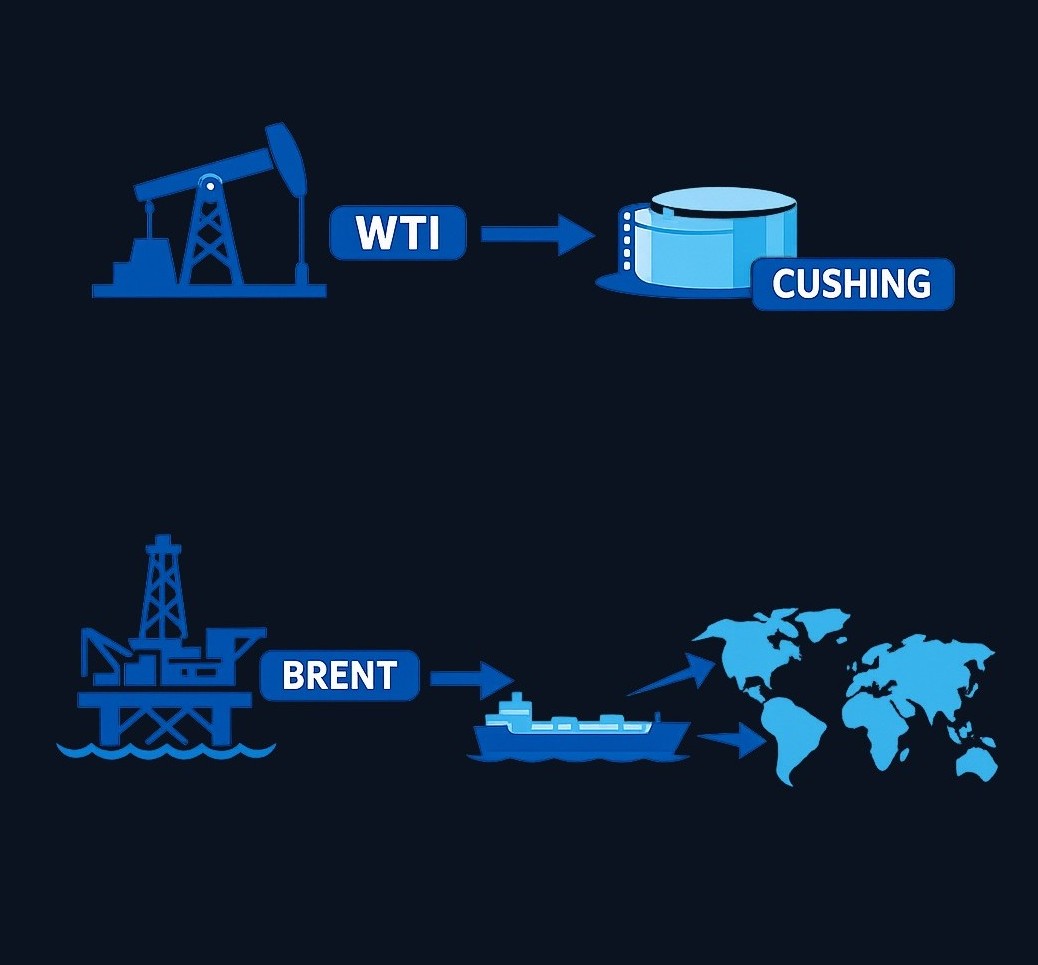
In short: WTI (West Texas Intermediate) and Brent crude are the world's two main oil benchmarks — standardized reference grades of crude that futures contracts are built on. WTI tracks US oil, priced at Cushing, Oklahoma; Brent crude tracks seaborne oil from the North Sea and serves as the global benchmark. They usually move together, but supply logistics and regional risks can pull them apart.
Understanding WTI vs Brent crude makes market news far easier to read — and 2026 offered a live demonstration of why the distinction matters.
Educational note: This page is for learning purposes only and is not financial advice. Markets involve risk, and past price behavior does not predict future outcomes.
Who this is for
This explainer is for beginner investors and traders who see "WTI jumped 8%" or "Brent crude settled at $84" in the news and want to know what those labels mean, why two prices exist, and what oil moves have historically meant for the stock market. No energy-industry background needed.
Key benefits
The main benefit of learning the WTI vs Brent crude distinction is news literacy. Once you know which benchmark a story quotes and why, a confusing wall of numbers turns into information: a US inventory report speaks through WTI, a Middle East shipping disruption speaks through Brent crude, and a gap opening between them tells you where in the world the pressure sits.
A second benefit is macro awareness. Oil connects to inflation, and inflation connects to central bank policy and stock valuations. Understanding the benchmarks is the first link in a chain that helps you read the whole market, not just one commodity.
| If your goal is… | Focus on… | Practical next step |
|---|---|---|
| Understand why there are two oil prices | Origin, pricing point, and scope of each benchmark | Study the at-a-glance table below |
| Decode a specific news story | Which benchmark is quoted and why | Use the reading checklist in this article |
| Connect oil to your stock watchlist | The oil → inflation → policy → stocks chain | Read the "why stock traders watch oil" section |
| Practice without risking money | Observing reactions across markets | Follow one oil story in a trading simulator |
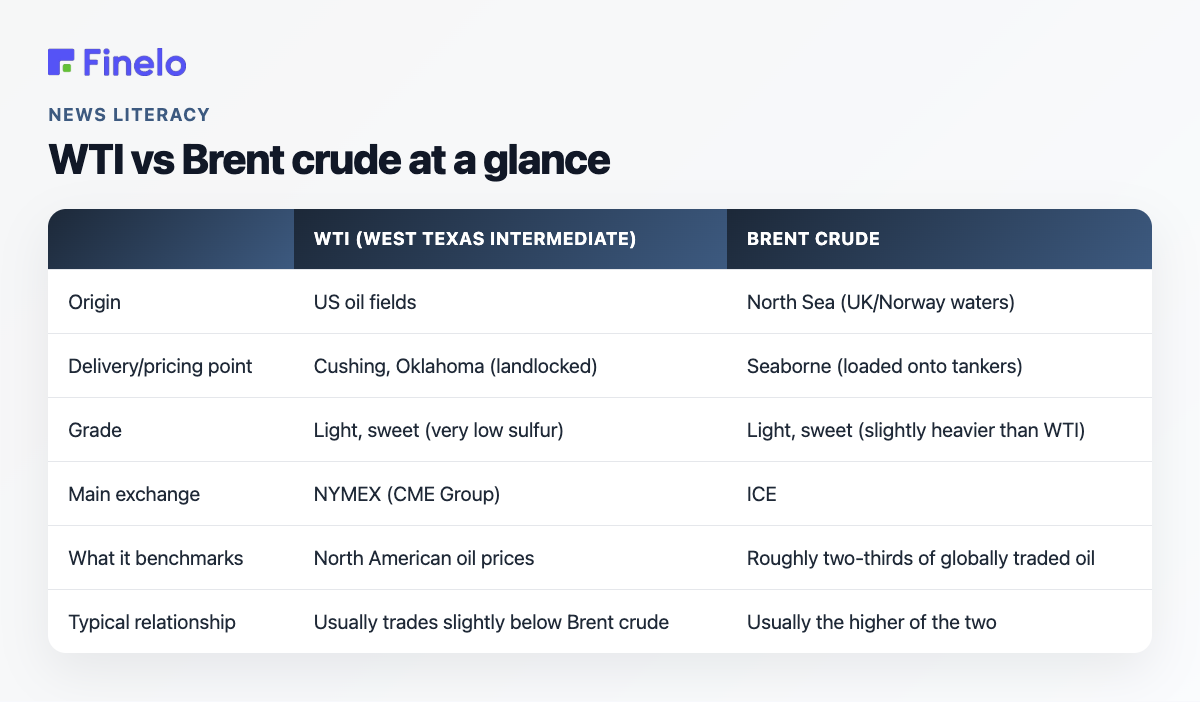
WTI vs Brent crude at a glance
| WTI (West Texas Intermediate) | Brent crude | |
|---|---|---|
| Origin | US oil fields | North Sea (UK/Norway waters) |
| Delivery/pricing point | Cushing, Oklahoma (landlocked) | Seaborne (loaded onto tankers) |
| Grade | Light, sweet (very low sulfur) | Light, sweet (slightly heavier than WTI) |
| Main exchange | NYMEX (CME Group) | ICE |
| What it benchmarks | North American oil prices | Roughly two-thirds of globally traded oil |
| Typical relationship | Usually trades slightly below Brent crude | Usually the higher of the two |
What is WTI?
West Texas Intermediate is the benchmark grade for US crude oil. It's "light" (low density) and "sweet" (low sulfur content), which makes it relatively easy and cheap to refine into gasoline — refiners prize it.
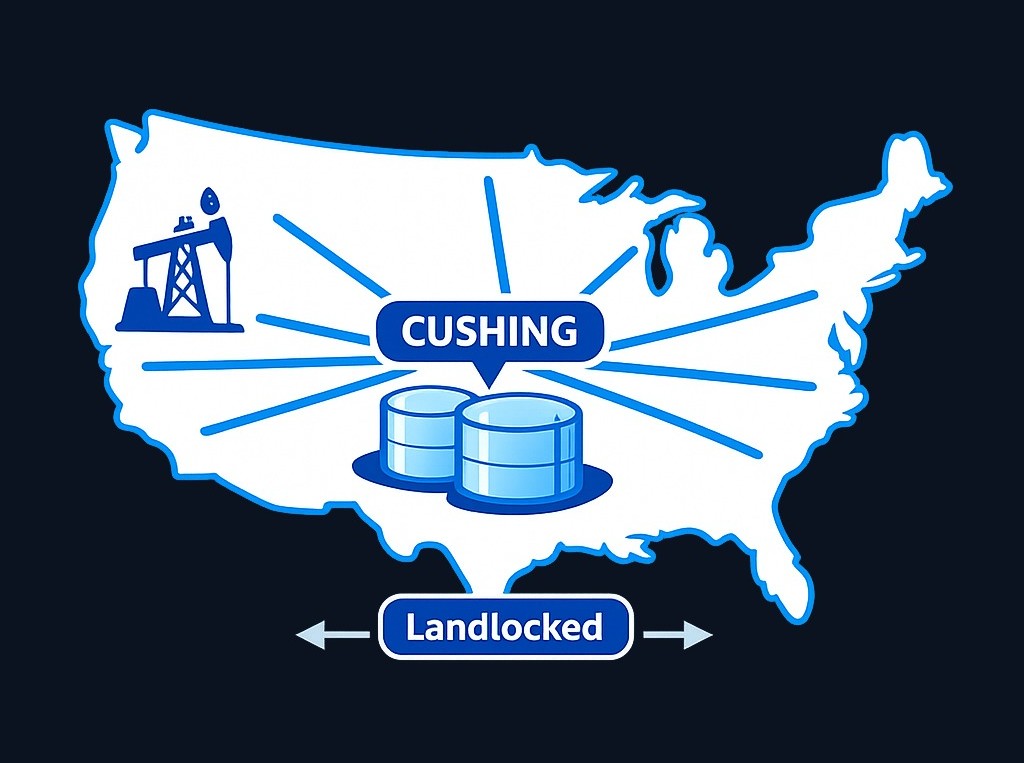
The quirk that shapes WTI's behavior is geography: the contract prices oil delivered to Cushing, Oklahoma — a landlocked storage hub. That means WTI reflects North American supply-and-demand conditions first: US production levels, pipeline capacity, and inventory levels at Cushing itself, which the US Energy Information Administration reports weekly.
What is Brent crude?
Brent crude comes from oil fields in the North Sea. Because it's produced offshore and loaded directly onto tankers, Brent crude plugs straight into global shipping routes — which is why it became the pricing reference for most of the world's internationally traded oil.
When you read about oil deals in Europe, Africa, or Asia, the price being negotiated is usually expressed relative to Brent crude. That global role is also Brent crude's vulnerability: anything that threatens seaborne oil flows — shipping disruptions, tanker insurance costs, chokepoint risks — shows up in Brent crude quickly.
Why the two prices differ
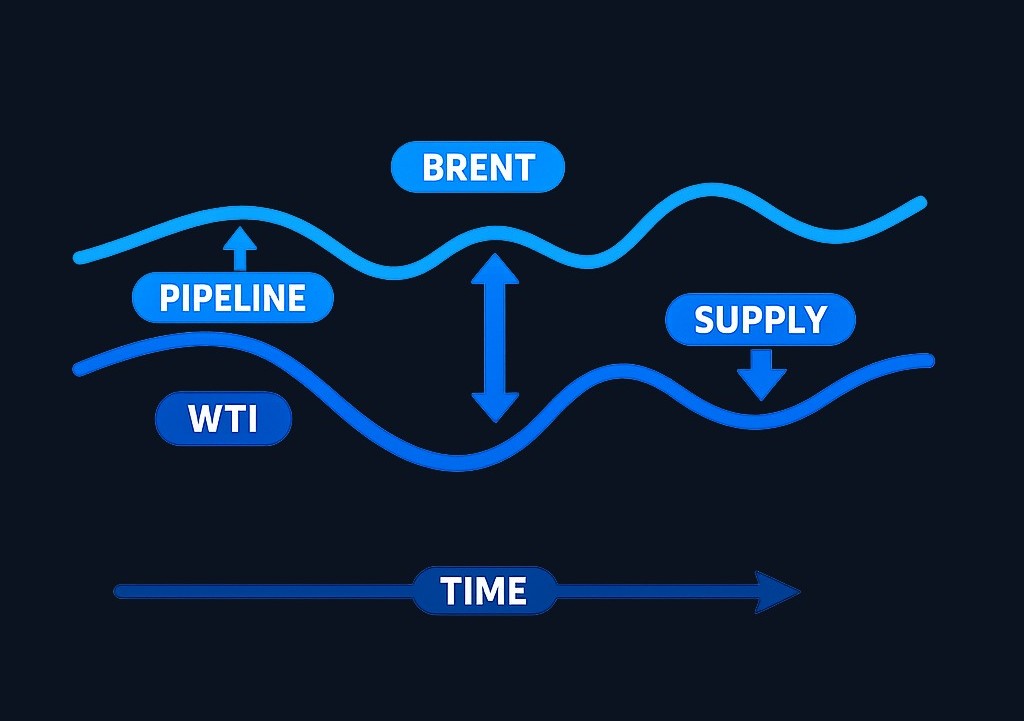
The gap between the two benchmarks — traders call it the spread — comes from a few structural differences:
- Logistics. Brent crude is already on the water; WTI has to travel from Cushing to the coast before it can be exported. Transport costs and pipeline bottlenecks affect the two differently.
- Exposure to global shipping risk. Seaborne Brent crude absorbs geopolitical shipping risks directly. Landlocked WTI feels them second-hand.
- Regional supply pictures. A US production boom can weigh on WTI while Brent crude holds firm; a North Sea outage does the reverse.
The spread isn't fixed — it widens and narrows as these forces shift, and watching it is one way analysts gauge where in the world a supply problem sits.
Practice trading with Finelo
Practice in a simulator, learn with bite-sized lessons, and build confidence before risking real money.
A real example: the 2026 Strait of Hormuz crisis
The first half of 2026 turned this textbook distinction into front-page news.
Renewed hostilities between the US and Iran disrupted shipping through the Strait of Hormuz — the chokepoint that roughly one-fifth of the world's oil and gas trade passed through, according to US Energy Information Administration (EIA) chokepoint data.
The full arc was dramatic. Per the EIA's Short-Term Energy Outlook (July 7, 2026), the strait was effectively closed from late February until an interim agreement reopened it in mid-June. Prices spiked above $110 per barrel in April as markets priced the loss of a large share of the world's seaborne oil, then fell below $70 by early July as tanker traffic resumed and stranded supply returned. The EIA reported that Brent crude averaged about $85 per barrel in June — roughly $22 below May — and that production shut-ins peaked near 11.2 million barrels per day in May.
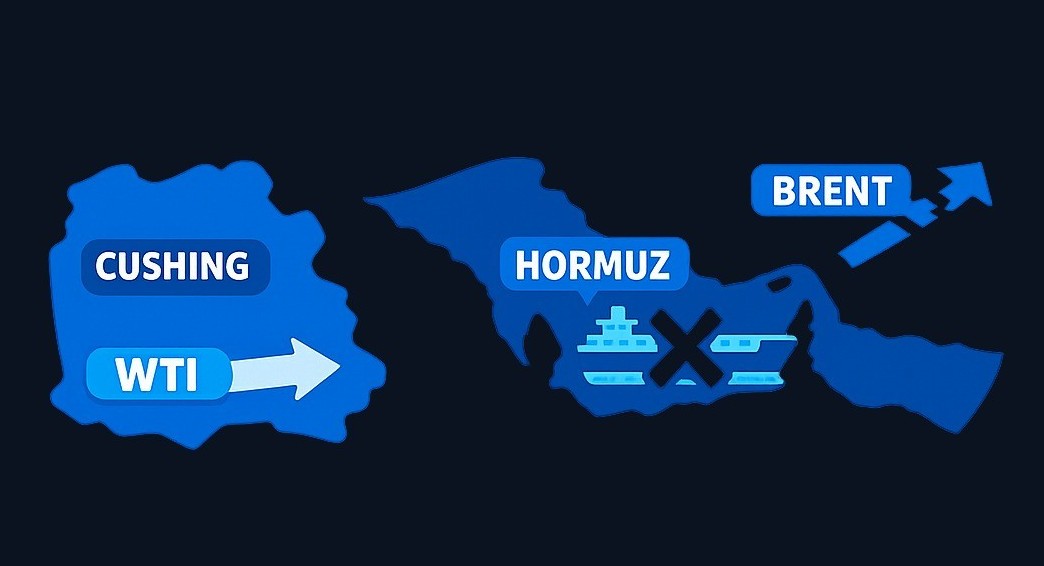
Then the situation re-escalated. Oil prices swung violently on the news. In mid-July sessions, WTI rose sharply after the US announced a blockade on Iranian vessels transiting the strait, pushing prices back toward the $80 level — while attacks on tankers and drilling infrastructure in the Gulf kept a risk premium in prices. On July 15, 2026, for example, WTI August futures traded near $79.70 and Brent crude September futures near $85.31, according to financial press coverage of the session.
Notice the benchmark mechanics at work: the threatened barrels were Gulf exports moving by sea — Brent crude's territory — while WTI, priced at landlocked Cushing, was insulated from the direct shipping risk even as it rallied on the broader supply scare. Regional shipping risk tends to show up faster in Brent crude; landlocked US crude can still rise on the supply scare without absorbing the same tanker-route premium firsthand.
At the same time, the demand side pulled the other way: OPEC cut its 2026 demand growth forecast even as the supply scare raged. Two opposing forces, one price — a compact lesson in how markets weigh supply shocks against demand outlooks in real time.
Why stock traders watch oil at all
Finelo is a stock-education platform, so here's the bridge: oil is one of the most powerful macro inputs into equity markets.
- Sector effects run in opposite directions. Historically, rising oil has tended to lift energy producers' revenues while squeezing fuel-heavy sectors like airlines and shipping. The same news story can be good for one part of an index and bad for another.
- Oil feeds inflation. Energy costs flow into transportation, manufacturing, and consumer prices. In 2026, energy-driven inflation was a key reason the Federal Reserve turned more cautious about rate cuts — a reminder that an oil shock can reach your portfolio through how the Fed's stance affects markets even if you own no energy stocks.
- Volatility clusters. Oil shocks have often coincided with wider equity-market swings, as traders reprice growth and inflation expectations together.
None of this is a trading rule — the historical relationships are tendencies, not guarantees. The point is literacy: when oil moves, an informed trader knows which second-order questions to ask.
How to read oil market news: a quick checklist
Use this checklist as a learning aid when the next oil story hits the news:
- Which benchmark is quoted — WTI or Brent crude? A move in one that's much bigger than in the other hints at where the story is regional vs global.
- Supply story or demand story? A pipeline outage, conflict, or OPEC production decision is supply; recession fears or demand forecasts are demand. They can point in opposite directions at once — as in mid-2026.
- Level vs change. "$80 oil" means little without context: is that up from $67 or down from $117? Check the recent range.
- One-day spike or trend? Single-session jumps on breaking news often partially retrace; sustained moves reshape inflation expectations.
Related intent coverage
If you searched for "wti meaning," the short answer: WTI stands for West Texas Intermediate — the light, sweet grade of US crude oil that serves as the North American pricing benchmark, with futures traded on NYMEX and delivery priced at Cushing, Oklahoma.
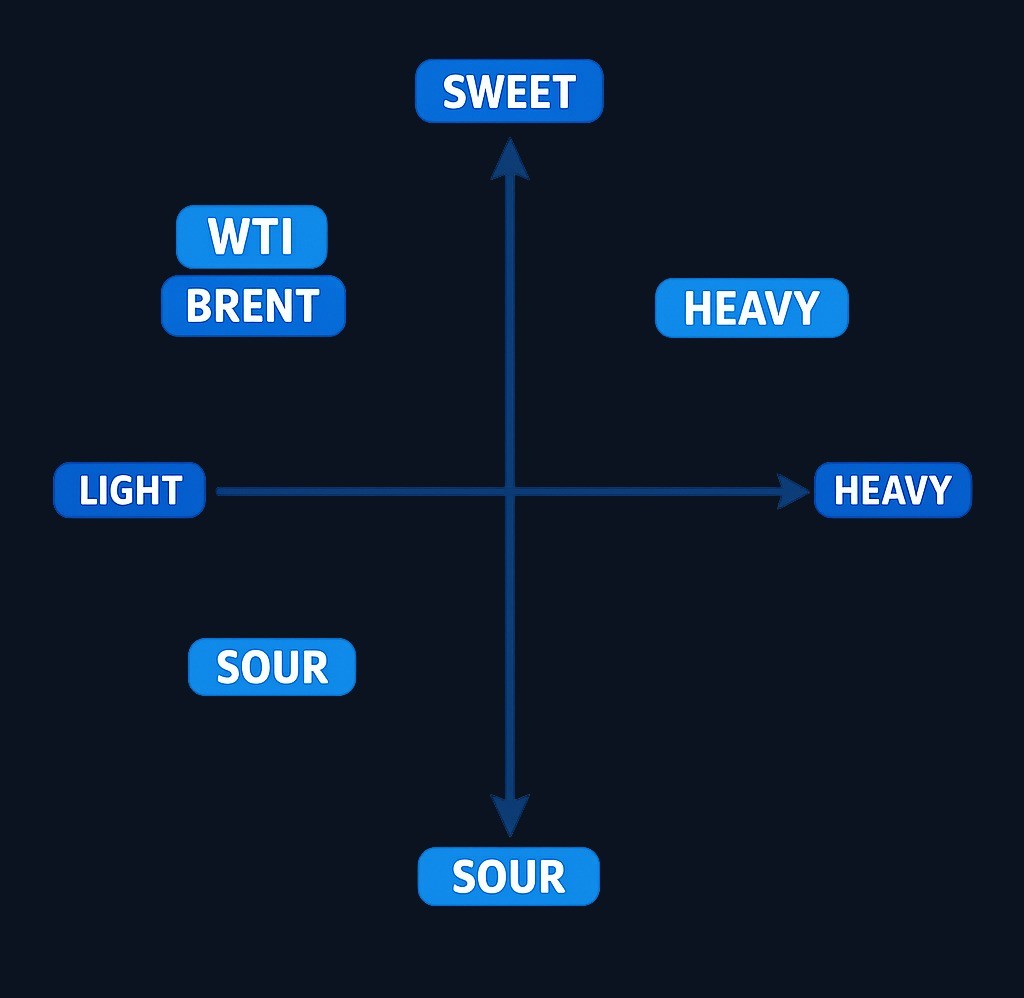
If you searched for "types of crude oil," the core framework is density and sulfur. Crude grades range from light to heavy (density) and sweet to sour (sulfur content). Light, sweet grades like WTI and Brent crude refine most easily into gasoline and command benchmark status; heavier, sour grades — such as Dubai/Oman or Western Canadian Select — trade at discounts and serve as regional references.
If you searched for "oil benchmarks," the idea is standardization: because crude quality varies enormously by field, markets need reference grades that contracts can settle against. WTI, Brent crude, and Dubai/Oman are the three most cited; most of the world's physical oil deals are priced as a premium or discount to one of them.
Common mistakes beginners make
Thinking there's one "oil price." Quoting WTI when a story is about European energy costs (or vice versa) leads to confused conclusions — always check the benchmark.
Treating oil up = energy stocks up, automatically. Producers' costs, hedging programs, and refining margins mean individual stocks can lag or defy the commodity.
Extrapolating a spike. A geopolitical news event can add several dollars of "risk premium" in hours — and remove it just as fast when tensions ease, as happened repeatedly during the 2026 ceasefire-and-escalation cycle.
Ignoring the demand side. The most dramatic supply scare can coexist with softening demand forecasts — prices settle where the two collide.
Practice reading oil-driven markets — without risking money
Commodity-driven volatility is one of the best classrooms in the market. Pick a week with a major oil story in the news, note how WTI, Brent crude, energy stocks, and the broader index each reacted — then test your read of the next big story in a trading simulator with virtual funds. The goal isn't to predict oil; it's to practice tracing how one market's move ripples into another.
If you're new to practice accounts, start with What Is Paper Trading? A Beginner's Guide.
Next steps
If you are learning how oil prices work, do not start by trying to call the next move. Start by observing: pick one week, track both benchmarks, and write down which stories moved which one. Then trace one step further — how energy stocks and the broader index reacted the same day.
For guided learning, visit Finelo or open the Finelo app. To evaluate user experiences and trust signals before signing up, read Finelo reviews. For product or account questions, use the official support resources at support.finelo.com.
This article is for educational purposes only and does not constitute financial advice, an investment recommendation, or a prediction of future oil prices or market movements. Markets involve risk. Always do your own research.
Frequently asked questions
What is the difference between WTI and Brent crude?
WTI is the US oil benchmark — light, sweet crude priced at Cushing, Oklahoma. Brent crude is the global benchmark — North Sea crude loaded onto tankers, used to price most internationally traded oil. They track the same commodity but reflect different regions and logistics, so their prices usually differ by a few dollars.
Why is Brent crude usually more expensive than WTI?
Mainly logistics and exposure: Brent crude is seaborne and plugged into global demand, while WTI must be transported from a landlocked hub before export. Transport costs, US supply gluts, and global shipping risks have historically kept Brent crude trading at a premium most of the time — though the spread varies and has occasionally inverted.
Which oil price should I follow — WTI vs Brent crude?
Both, for different questions. For US-centric stories (US inflation, American energy stocks, EIA inventory data), WTI is the reference. For global supply stories — OPEC decisions, Middle East shipping, European energy costs — Brent crude is the better lens.
What does WTI stand for?
WTI stands for West Texas Intermediate. The name reflects its historical origin in Texas oil fields and its intermediate density classification; today it refers to the standardized light, sweet US crude grade that NYMEX futures settle against.
What are the main types of crude oil?
Crude is classified by density (light to heavy) and sulfur content (sweet = low sulfur, sour = high). Light, sweet grades like WTI and Brent crude are easiest to refine into gasoline and command benchmark status. Heavier, sour grades (like Dubai/Oman or Western Canadian Select) trade at discounts and serve as regional references.
What is an oil benchmark?
A standardized reference grade of crude that contracts and news reports price against. Because oil quality varies by field, the market uses a few well-defined grades — WTI, Brent crude, Dubai/Oman — as common yardsticks; most physical deals are quoted as a premium or discount to one of them.
Does the oil price affect the stock market?
Historically, yes — through opposite-direction sector effects (energy vs transport), through inflation and central-bank policy, and through general volatility. But the relationship is a tendency, not a rule: the impact depends on why oil is moving and what markets had already priced in.
CommoditiesOilMarket BasicsBeginner
Practice trading with Finelo
Practice in a simulator, learn with bite-sized lessons, and build confidence before risking real money.
About the author
Finelo Team
The Finelo Team creates practical investing and trading education designed to help beginners learn faster with structured challenges, simulator practice, and bite-sized lessons.
Keep reading — Related articles

News
The September Effect Explained: What the Stock Market Data Really Says
September has delivered the S&P 500's weakest average monthly return since 1928, but the result is not a reliable trading signal. Here is how to read the seasonality data.
Finelo Team
News
Nvidia–Hugging Face Deal: What the $12.9 Billion Agreement Changes
Nvidia agreed to acquire Hugging Face for $12.93 billion while promising to keep the platform open. Here is what the price, developer reach, and neutrality pledge mean.
Finelo Team
News
Lululemon Stock Falls to 2018 Levels After Its Q2 Earnings Report
Lululemon shares fell below $100 after revenue declined, comparable sales dropped, and management cut its outlook. The report offers a practical lesson about brand moats and falling knives.
Finelo Team