Before you put real money into a trade, you need a place to be wrong.
What Is Paper Trading? A Beginner's Guide to Practicing Without Real Money
Paper trading lets you practice buying, selling, and holding decisions with virtual funds instead of real cash, so the only cost of a wrong call is the lesson.
8 min read
Practice trading with Finelo
Practice in a simulator, learn with bite-sized lessons, and build confidence before risking real money.
Want to learn more?
Practice in a simulator, learn with bite-sized lessons, and build confidence before risking real money.
Explore FineloExplore Finelo's 28-day challenges
Turn learning into a daily habit with guided challenge paths.
Paper trading is that place. It lets you practice buying, selling, and holding decisions with virtual funds instead of your own cash, so the only cost of a wrong call is the lesson.
If you've heard the term "paper trading" on Reddit, YouTube, or from a friend and weren't sure whether it meant real trading, fake money, or something in between, this guide answers the question plainly: what is paper trading, how does it work, and where does it actually help?
The short version: paper trading is practice. Done well, it makes your decisions visible so you can study them. Done carelessly, it becomes a points game that teaches you very little. The difference is in how you use it.
What paper trading means
Paper trading means placing trades using simulated money in an environment that mirrors a real market, but no real funds change hands.
That's paper trading in plain terms: real mechanics, fake money. The name comes from the old habit of writing hypothetical trades on paper before brokers offered digital tools.
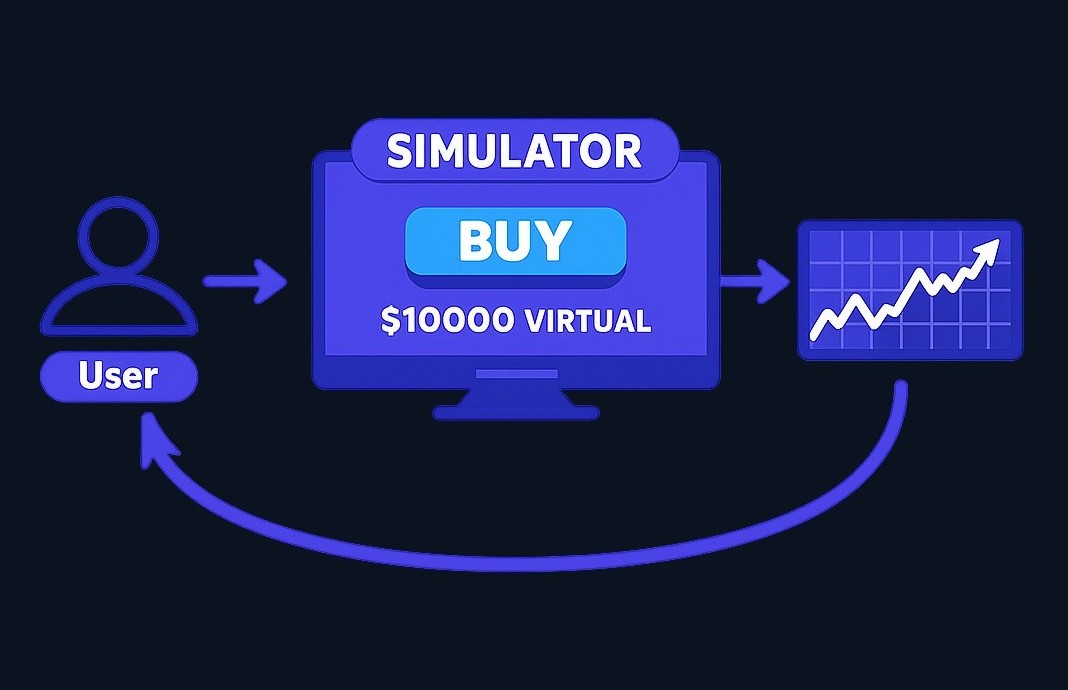
A single simulated trade is often called a paper trade. The broader activity goes by several names that mostly point to the same idea:
- Simulated trading and virtual trading: trading with fake money against real or near-real market conditions.
- Demo trading in a demo account: common broker language for the same practice setup.
- A paper trading account or practice account: the workspace where your virtual funds and virtual money live.
So if someone asks whether a stock market simulator and paper trading are different things, the honest answer is: usually not. A simulator is one common way to practice trading without real money. The label changes; the core idea doesn't.
How paper trading works with virtual funds
When you open a paper trading account, the platform hands you a balance of virtual buying power, a starting figure used purely as an educational example. You use that balance to place hypothetical trades exactly as you would with real cash.
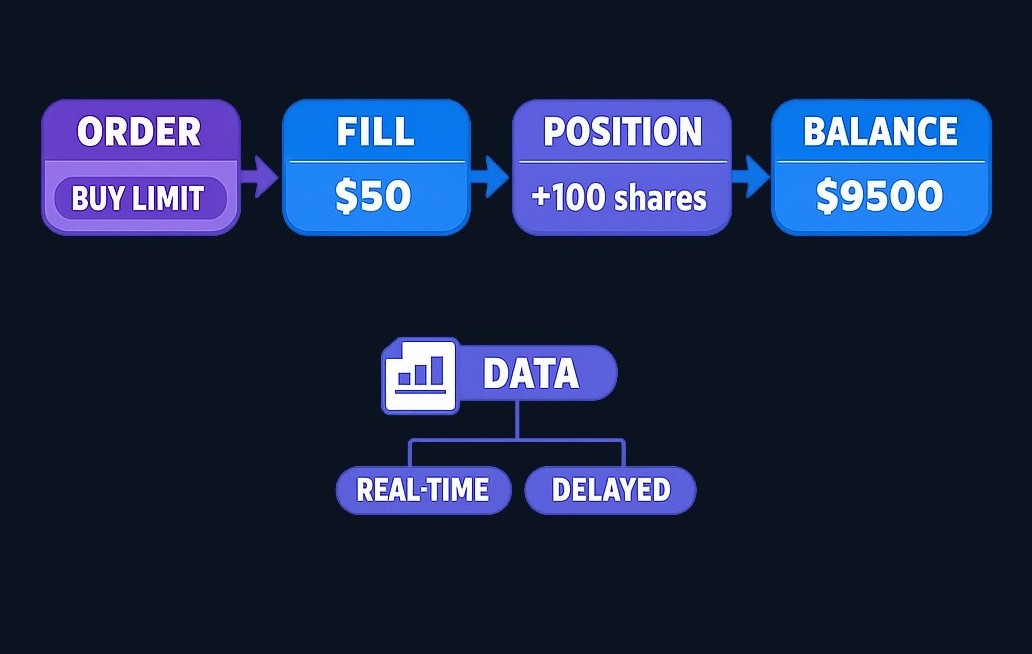
Here's the basic loop. You fill out an order ticket to buy or sell, choosing an order type such as a market order (fill now at the current price) or a limit order (fill only at a price you set). The platform records the trade, and it becomes one of your open positions. From there, portfolio tracking shows your simulated balance rising and falling as prices move.
Two details matter more than beginners expect:
- Real-time vs delayed market data. Some simulators run on real-time market data, so your fills reflect current prices. Others use delayed market data, which can make a fast-moving setup feel calmer than it really is. Always check which one you're practicing on.
- Idealized fills. In a simulator, your order often fills at the price you see. In a live market, that isn't guaranteed, and that gap is one of the things paper trading can't fully reproduce.
Demo practice does not touch a real brokerage account. In Demo mode, there are no deposits, no withdrawals, and no brokerage connection — it's a closed practice loop. The Finelo simulator, for example, runs on real market data with virtual funds, completely separate from any real-money account.
What beginners can practice in a paper trading account
This is where paper trading earns its place. A practice account is a low-pressure way to build the mechanical habits that get expensive to learn live.
Useful things to rehearse:
- Order types. Practice placing a market order, a limit order, and a stop-loss order until the mechanics feel automatic. Fumbling an order ticket should happen here, not later.
- Chart observation. Use chart analysis to watch how price reacts around levels you've identified, and notice when your read was wrong.
- Position size concepts. Experiment with how position size changes the size of a gain or loss. This is where risk management stops being a slogan and starts being a number.
- A trading journal. Write down why you entered, what you expected, and your planned exit before the trade. Then revisit it.
- Decision review. After a position closes, do a short trade review: was the reasoning sound, even if the result was bad? Was a lucky win actually a poor decision?
That last pair is the part most guides skip. A paper trade you didn't journal is just a click. A paper trade you planned, recorded, and reviewed is a rep that builds skill.
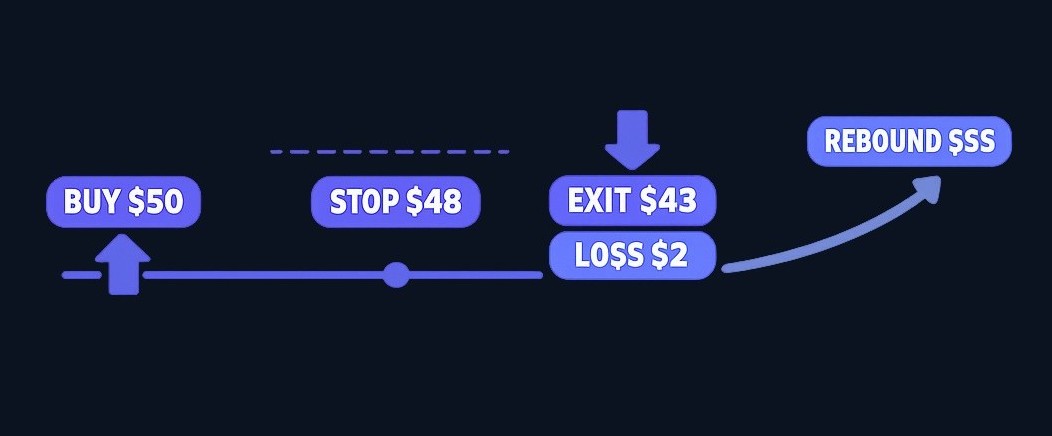
Here's how that looks in practice. Say you simulate buying a stock at $50 because it just cleared a level you'd been watching, and you set a stop-loss at $48 as your exit if you're wrong. You write down that reasoning before anything happens. The price slips to $48, your stop closes the position, and you're down a hypothetical $2 per share. The next morning it rebounds to $55. In a real account, that sting would tempt you to scrap stops altogether. In a journal, it reads as plain data: the stop did its job, the plan was sound, and one outcome doesn't make the process wrong. (Figures here are illustrative examples for learning, not recommendations.)
What paper trading does not teach you
Paper trading is a tool, not a graduation certificate. It has real blind spots, and pretending otherwise creates a false sense of security.
- Emotional pressure. When the money is virtual, fear and greed barely register. Real trading psychology, the urge to bail early, to revenge-trade, to hold a loser hoping it turns, mostly shows up when something real is on the line. Simulators are weak at building emotional discipline.
- Execution differences. Live markets involve spreads, slippage, and commissions and fees that a simplified simulator may ignore or smooth over. Liquidity also matters: a size that fills instantly in practice might move the price in reality.
- False confidence. A clean run in a simulator can convince you that you've "figured it out." Virtual gains and losses are hypothetical; they don't predict real-world results.
- Gamification. When a practice account feels like a high score to beat, you start optimizing for the score instead of for decision quality. That's a habit worth catching early.
Hold onto the honest framing: paper trading is not a scoreboard. It's a practice environment for decision quality.
Practice trading with Finelo
Practice in a simulator, learn with bite-sized lessons, and build confidence before risking real money.
Paper trading vs real trading
The clearest way to see the gap is side by side.
| Dimension | Paper trading | Real trading |
|---|---|---|
| Money involved | Virtual funds only | Your own real money |
| Emotion | Low — nothing real is at stake | High — fear and greed shape decisions |
| Execution | Simplified; fills are often idealized | Real spreads, slippage, and fees apply |
| Learning value | Strong for mechanics and process | Strong for psychology and consequences |
| Risk | No real financial risk | Real financial risk |
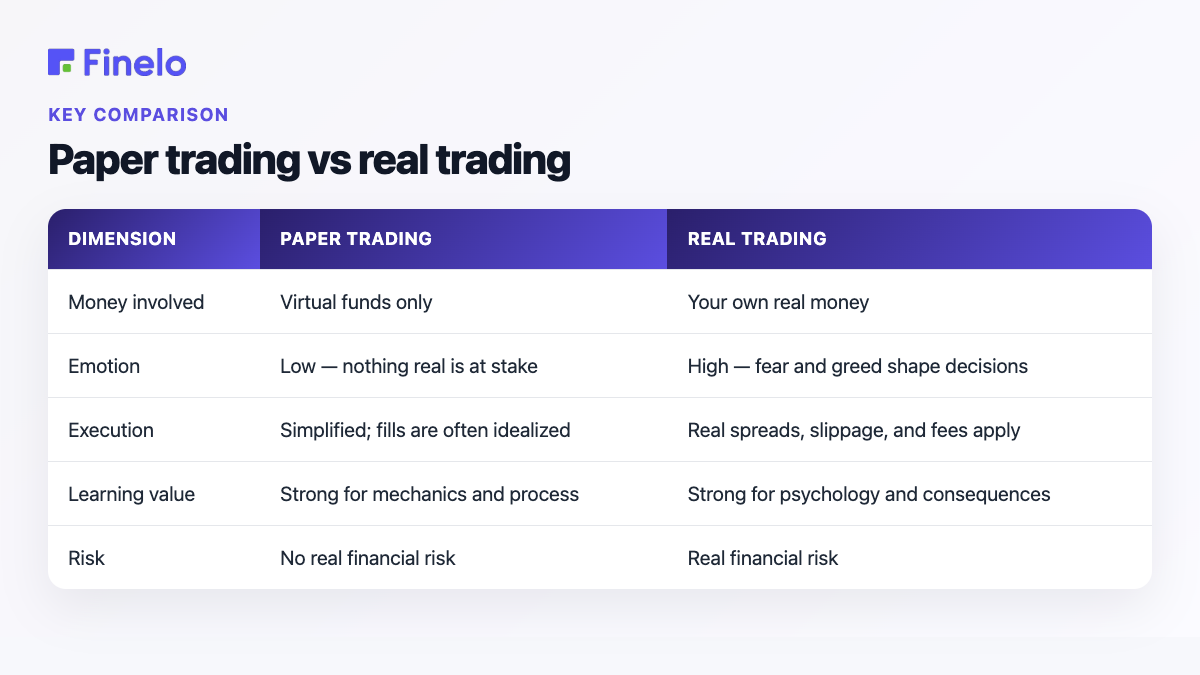
Paper trading teaches the process. Live trading in a real-money account teaches the parts that only show up when consequences are real.
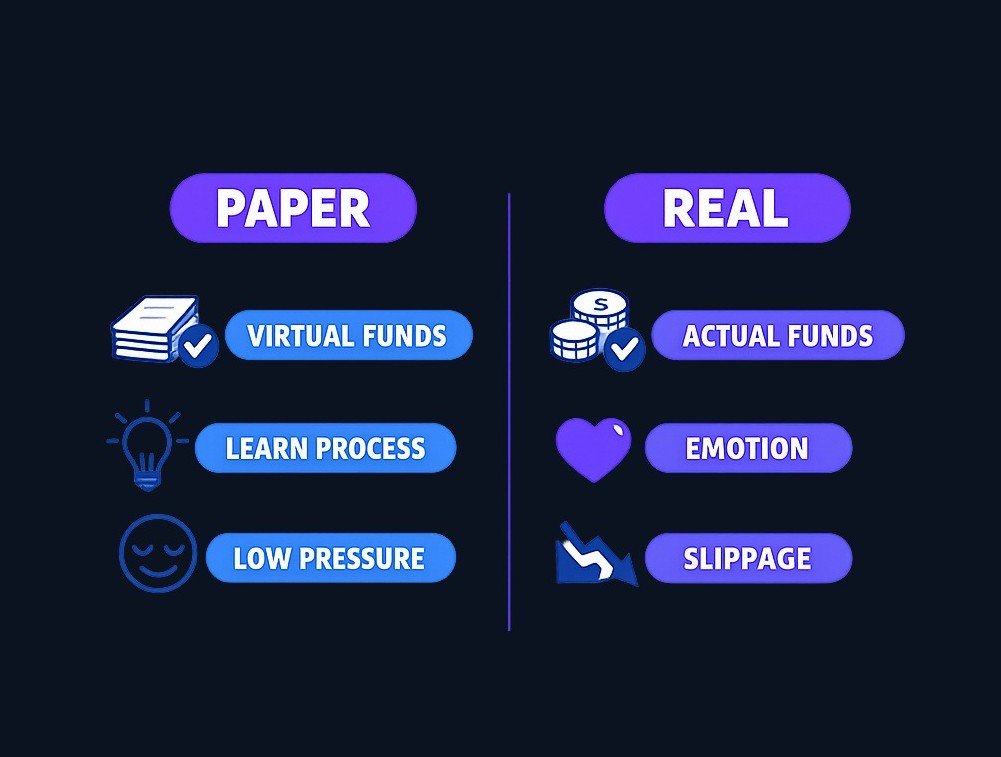
Paper trading vs backtesting
Paper trading is forward-looking and decision-style: you make a call now, watch it play out, and review how you thought.
Backtesting is backward-looking and rule-style: you take a defined set of rules and run them against historical data to see how they would have performed.
One trains your decision-making in something close to live conditions; the other stress-tests a strategy's logic against the past. Most learners benefit from understanding both, but they aren't substitutes.
How to use a simulator as part of a learning plan
A simulator is most useful when it's part of a loop, not a sandbox you poke at randomly. Try this:
- Learn one concept. For example, how a stop-loss order limits a single trade's downside.
- Simulate it. Place a paper trade that puts that one concept into practice.
- Journal it. Record your reasoning, your expectation, and your planned exit before the outcome is known.
- Review it. When the trade closes, judge the decision, not just the result.
- Repeat. Add the next concept and run the loop again.
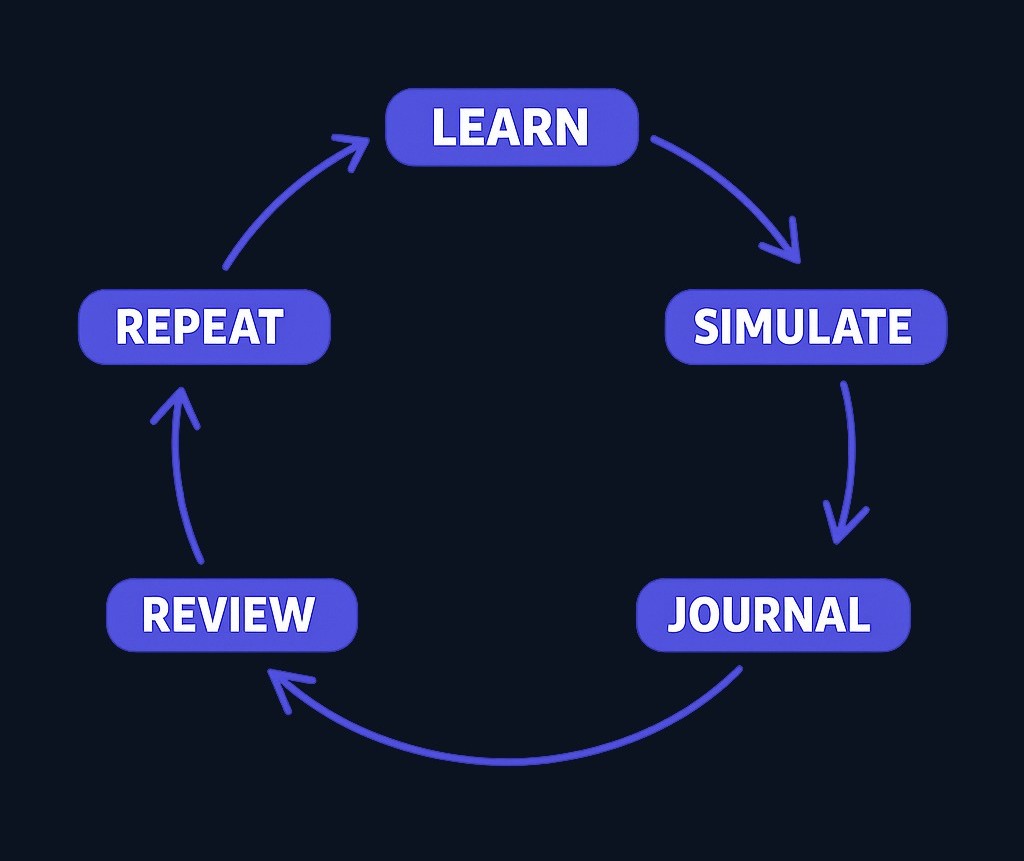
Learn, simulate, journal, review, repeat. That sequence turns a trading simulator from a toy into a teacher. If you'd rather run that loop in a guided environment instead of building it yourself, explore Finelo's trading simulator, which pairs short lessons with virtual-funds practice and a built-in review habit.
When to move from practice to deeper education
There's no magic number of paper trades that makes you "ready," and anyone who gives you a fixed timeline is guessing. Readiness for more structured learning tends to look like a few quiet signs:
- You can explain why you entered and exited a trade without hand-waving.
- You follow your own rules even when a position is going against you in the simulator.
- You can sit with a losing paper trade and review it honestly instead of rationalizing it.
- Risk concepts like position size and risk management feel like habits, not vocabulary.
When those start showing up consistently, it's a sign you're ready to go deeper into the material, not a green light to assume real-money trading will feel the same. It won't, and that's worth respecting.
When you do want more structure around the practice, a day-by-day path helps. The Finelo Challenges wrap the same simulator in a 28-day learning path, and the Finelo app keeps the lessons and simulator together in one place, so the practice loop has a curriculum around it rather than sitting on its own.
Finelo is an educational product, not a brokerage. Brokerage connection availability depends on your region. The simulator uses virtual funds and real market data, and final trading and investing decisions are yours, made through your own brokerage account when you choose to act. This article is for education and is not financial advice.
Frequently asked questions
Is paper trading real money?
No. Paper trading uses virtual funds or simulated money, not real cash. Nothing leaves or enters a bank account. Any gains or losses are hypothetical, which means a strong simulated result does not guarantee, or even reliably predict, how the same decisions would perform with real money on the line.
Can you lose money paper trading?
You can lose simulated money, not real money, in a standard paper trading account. The balance is virtual, so a losing paper trade costs you nothing financially. What it should cost you is attention: a loss in practice is a free chance to review the decision and learn something before any real money is involved.
Is paper trading good for beginners?
Yes, when it's used with structure. Random clicking teaches little. But if you set rules, keep a trading journal, review each decision, and hold realistic expectations about what a simulator can't replicate, paper trading is one of the calmest ways for a beginner to build mechanics and process before trading live.
How long should you paper trade before real trading?
There's no fixed timeline. Instead of counting days, watch for consistency: do you follow your own rules, understand risk concepts like position size, and review decisions honestly? Those signals matter far more than any week count someone tries to sell you.
Are paper trading and stock simulators the same thing?
In everyday usage, usually yes. A stock market simulator is one common form of paper trading — a place to practice with virtual funds against real or near-real market conditions. The terms get used interchangeably, so don't worry if you've seen both.
TradingBeginner Guide
Practice trading with Finelo
Practice in a simulator, learn with bite-sized lessons, and build confidence before risking real money.
About the author
Mark
The Finelo Team creates practical investing and trading education designed to help beginners learn faster with structured challenges, simulator practice, and bite-sized lessons.
Keep reading — Related articles
Trading
Understanding Walk Forward Analysis in Trading
Brief educational note: this article is educational — not investment advice — and trading involves the risk of loss.
Finelo Team
Trading
VWAP vs Moving Average: Formulas, Uses, and Limits
VWAP weights price by recorded volume over a defined period, while a moving average summarizes a sequence of prices over a rolling lookback.
Finelo Team
Trading
Volume Profile vs Market Profile: What Each Chart Measures
Volume Profile groups traded volume by price level.
Finelo Team


