For U.S. readers: This article discusses U.S. rules and financial products. State rules and individual eligibility may differ.
The 52-Week Savings Challenge: A Guide With a Printable Tracker

After you pick a structure, set rules: how to handle missed weeks, where funds go, and a simple weekly routine to follow.
9 min read
Practice trading with Finelo
Practice in a simulator, learn with bite-sized lessons, and build confidence before risking real money.
Want to learn more?
Practice in a simulator, learn with bite-sized lessons, and build confidence before risking real money.
Explore FineloExplore Finelo's 28-day challenges
Turn learning into a daily habit with guided challenge paths.
Quick answer
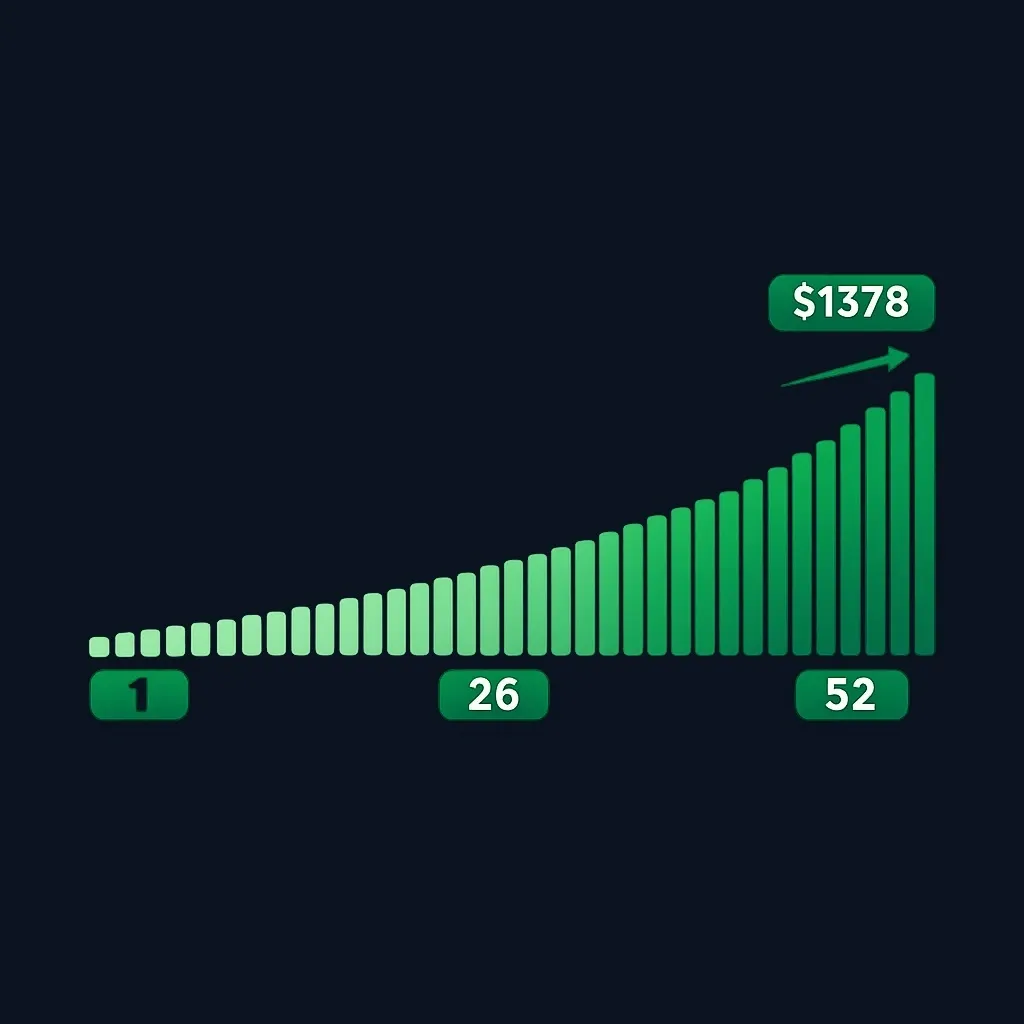
The 52-week savings challenge is a simple yearly plan that helps you save regularly by increasing the amount you set aside over time. In the standard version, you save $1 in week 1, $2 in week 2, and continue increasing the deposit by $1 each week. The 52 deposits total $1,378. The tracker in this article can be printed or saved as a PDF from your browser. Finelo provides financial education, not financial or investment advice.
What to know before deciding
This challenge suits beginners who want structure and momentum for saving. It emphasizes habit formation (a small action every week) over complicated budgeting. Before you start, consider these practical points so the plan fits your circumstances.
Key considerations
- Time commitment: The plan runs 52 weeks (one year) and recommends a weekly action, so pick a start date you can commit to for at least several months.
- Flexibility: The challenge is a template, not a rule—most people adjust amounts, skip or make up weeks, or use a reverse progression to match cash flow.
- Where to keep funds: Use an account you won’t touch impulsively (a separate savings account, envelope, or high-yield savings). Keeping funds separate reduces temptation.
- Educational note: This content is educational, not financial advice; saving involves tradeoffs (liquidity versus short-term spending) and personal suitability matters.
Decision framework
Use this short framework to decide whether the 52 week plan fits your goals and how to adapt it.
Step 1 — Define your objective (weeks 1–2)
Decide what you want the saved money to do: build an emergency buffer, save for a holiday, or form a weekly saving habit. Your objective determines how strict or flexible to be.
Step 2 — Choose a structure
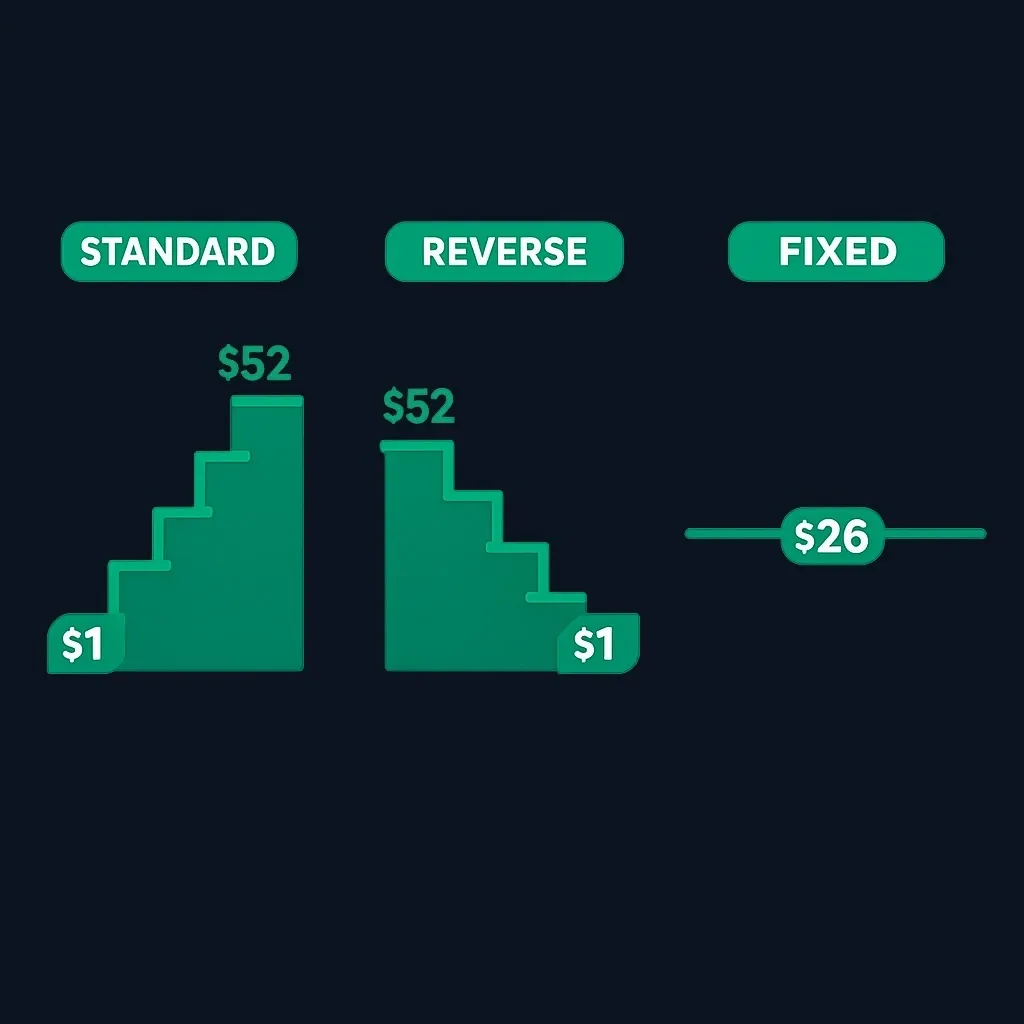
Pick one of three common structures (see table below). Consider cash flow, discipline, and psychological wins when selecting.
| Structure | How it works | Best when… |
|---|---|---|
| Standard incremental | Start small and increase steadily each week | You want a rising target to build momentum |
| Reverse (descending) | Start larger and decrease weekly | Income is front-loaded (bonuses, tax refund) |
| Custom fixed or stepped | Same amount each week or grouped increases | You need predictability for budgeting |
After you pick a structure, set rules: how to handle missed weeks, where funds go, and a simple weekly routine to follow.
Step 3 — Stress-test against real life
Run a 4‑week simulation on paper: mark your planned weekly deposits against expected paydays and bills. If several weeks conflict, either switch structure or use a smaller weekly increment.
Step 4 — Measurement and reward
Choose two progress signals: a tracked balance (weekly total) and a non-monetary reward every 4–8 weeks (small treat, social post, or checklist badge) to reinforce the habit.
How the 52 Week Savings Challenge Works
This section explains the mechanics and gives a compact worked example to make the routine concrete.
Typical mechanics
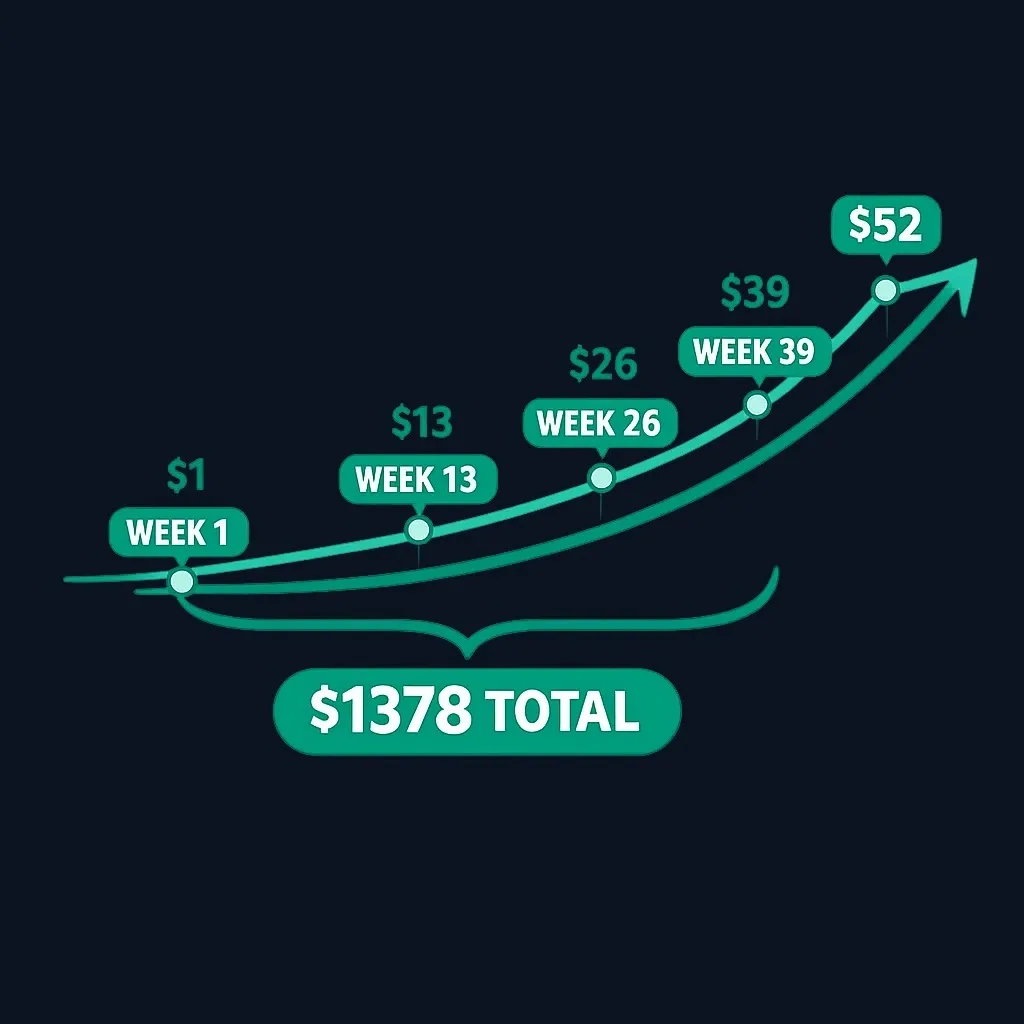
The classic version starts with a $1 deposit and increases the deposit by $1 each week until the week-52 deposit of $52. Adding the full sequence—$1 + $2 + … + $52—produces a year-end total of $1,378. This is a template rather than a requirement: use smaller, fixed, or reversed deposits if the standard progression does not fit your cash flow. People commonly track progress on a printed chart, in a habit app, or with cash envelopes.
Practice trading with Finelo
Practice in a simulator, learn with bite-sized lessons, and build confidence before risking real money.
Printable 52-Week Savings Tracker
The table below is the printable tracker included with this article. It is not a separate PDF download. Print this page using your browser’s print command, or choose Save as PDF in the print dialog. The amounts shown follow the standard $1-increase version and total $1,378.
| Week | Deposit | Running total | Done? | Week | Deposit | Running total | Done? |
|---|---|---|---|---|---|---|---|
| 1 | $1 | $1 | ☐ | 27 | $27 | $378 | ☐ |
| 2 | $2 | $3 | ☐ | 28 | $28 | $406 | ☐ |
| 3 | $3 | $6 | ☐ | 29 | $29 | $435 | ☐ |
| 4 | $4 | $10 | ☐ | 30 | $30 | $465 | ☐ |
| 5 | $5 | $15 | ☐ | 31 | $31 | $496 | ☐ |
| 6 | $6 | $21 | ☐ | 32 | $32 | $528 | ☐ |
| 7 | $7 | $28 | ☐ | 33 | $33 | $561 | ☐ |
| 8 | $8 | $36 | ☐ | 34 | $34 | $595 | ☐ |
| 9 | $9 | $45 | ☐ | 35 | $35 | $630 | ☐ |
| 10 | $10 | $55 | ☐ | 36 | $36 | $666 | ☐ |
| 11 | $11 | $66 | ☐ | 37 | $37 | $703 | ☐ |
| 12 | $12 | $78 | ☐ | 38 | $38 | $741 | ☐ |
| 13 | $13 | $91 | ☐ | 39 | $39 | $780 | ☐ |
| 14 | $14 | $105 | ☐ | 40 | $40 | $820 | ☐ |
| 15 | $15 | $120 | ☐ | 41 | $41 | $861 | ☐ |
| 16 | $16 | $136 | ☐ | 42 | $42 | $903 | ☐ |
| 17 | $17 | $153 | ☐ | 43 | $43 | $946 | ☐ |
| 18 | $18 | $171 | ☐ | 44 | $44 | $990 | ☐ |
| 19 | $19 | $190 | ☐ | 45 | $45 | $1,035 | ☐ |
| 20 | $20 | $210 | ☐ | 46 | $46 | $1,081 | ☐ |
| 21 | $21 | $231 | ☐ | 47 | $47 | $1,128 | ☐ |
| 22 | $22 | $253 | ☐ | 48 | $48 | $1,176 | ☐ |
| 23 | $23 | $276 | ☐ | 49 | $49 | $1,225 | ☐ |
| 24 | $24 | $300 | ☐ | 50 | $50 | $1,275 | ☐ |
| 25 | $25 | $325 | ☐ | 51 | $51 | $1,326 | ☐ |
| 26 | $26 | $351 | ☐ | 52 | $52 | $1,378 | ☐ |
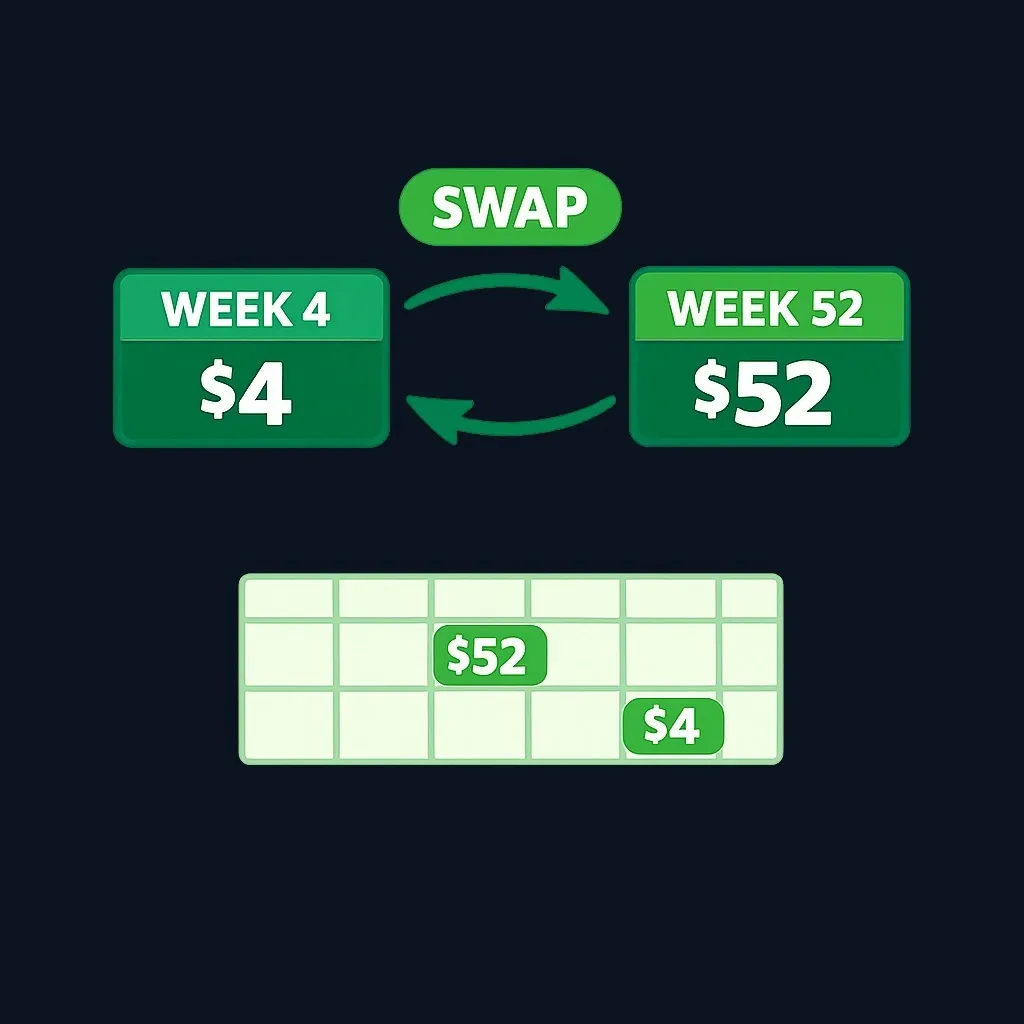
If you miss a week, note it and choose whether to make up the deposit, swap it with a lower week, or continue from the next week. The challenge should fit your budget rather than create financial strain. For a broader savings-planning worksheet, see the Consumer Financial Protection Bureau’s savings-plan tool.
How to use the printable
- Print one sheet and keep it visible (fridge, planner, wallet).
- Each week, write the date and check the box when you save the planned amount.
- Record the running total every month to see momentum.
- If you prefer digital, save the PDF to your phone and update it weekly.
There is currently no separate Finelo PDF download for this tracker. Use the table above and your browser’s Print or Save as PDF option.
Tips for Success and Common Pitfalls
Combine motivational techniques with realistic rules to make the year sustainable.
Practical tips that work
- Automate transfers when possible so the money moves before you can spend it.
- Anchor the weekly action to an existing routine (payday, weekly grocery trip, bill day).
- Use visual cues: a printed chart, sticky notes, or a progress jar. Visual momentum reduces quitting.
- Build forgiveness into the plan: allow one “make-up” week per month, or swap a high week with several smaller deposits.
- Pair the challenge with a simple budget review every month to adapt amounts to changing circumstances.
Common pitfalls and fixes
- Pitfall: starting too aggressive. Fix: scale initial increments to fit disposable cash.
- Pitfall: storing funds in an account that’s easy to withdraw. Fix: use a separate savings account or a physical envelope zone.
- Pitfall: loss of motivation midyear. Fix: schedule small rewards and share progress with a friend or group to gain accountability.
Example: adapting the challenge to a practical goal
Suppose someone wants to build a fund for occasional car repairs but cannot follow the standard rising deposits during higher-expense months. They could use the tracker, swap expensive weeks with lower-deposit weeks, and record each change. This is a hypothetical illustration—not a customer testimonial or evidence that the same approach will work for everyone.
How groups and families adapt it
Families often customize the plan: parents assign smaller weekly amounts to kids to teach saving, or partners split deposits to meet a shared goal. If living on a variable income, consider the reverse or custom fixed structure to match pay cycles.
FAQ
What is the 52 week savings challenge?
It’s a year-long plan that turns saving into a weekly habit by using a simple, repeatable deposit schedule and a tracker to mark progress. The standard version starts at $1 and increases the planned deposit by $1 each week, but the amounts can be adjusted to fit your budget.
How do I print or save the tracker?
Use your browser’s print command while viewing the tracker table above. Select a printer for a paper copy or choose Save as PDF for a digital copy. Finelo does not currently provide a separate downloadable tracker file for this article.
Can I customize the savings amounts?
Yes. You can invert the progression, use steady weekly amounts, or create grouped increases. The important part is choosing a structure that you can maintain consistently.
What if I miss a week?
Acceptable options include making up the deposit later the same month, reducing future weeks slightly to compensate, or treating the missed week as a learning moment and continuing the plan. Build a simple makeup rule before you start so you don’t derail motivation.
Conclusion and next steps
The 52-week savings challenge is a flexible way to practice a consistent saving habit. Start by choosing a structure, checking that the deposits fit your budget, and printing or saving the tracker above.
Ready to start? Print this page or save it as a PDF, then keep the tracker somewhere visible. Adjust the amounts whenever the standard progression does not suit your circumstances.
BudgetingFinancial Education
Practice trading with Finelo
Practice in a simulator, learn with bite-sized lessons, and build confidence before risking real money.
About the author
Finelo Team
The Finelo Team creates practical investing and trading education designed to help beginners learn faster with structured challenges, simulator practice, and bite-sized lessons.