For U.S. readers: This article discusses U.S. rules and financial products. State rules and individual eligibility may differ.
Does Debt Consolidation Affect Buying a Home?

Debt consolidation can affect a mortgage application in both directions.
7 min read
Practice trading with Finelo
Practice in a simulator, learn with bite-sized lessons, and build confidence before risking real money.
Want to learn more?
Practice in a simulator, learn with bite-sized lessons, and build confidence before risking real money.
Explore FineloExplore Finelo's 28-day challenges
Turn learning into a daily habit with guided challenge paths.
Quick answer
Debt consolidation can affect a mortgage application in both directions. A new consolidation loan may lower required monthly debt payments, which can improve the debt-to-income calculation. But it can also create a hard inquiry, a new account, fees, a longer repayment period, or new secured debt. It does not guarantee a higher credit score or mortgage approval.
The effect depends on how the consolidation is structured, how recently it occurred, whether old revolving accounts are used again, and how the mortgage lender documents the new obligations.
Finelo provides general financial education, not mortgage, credit, legal, tax, investment, or individualized financial advice. Underwriting standards and credit models vary by lender and loan program.
What debt consolidation changes
Debt consolidation combines multiple obligations into one new loan, promotional balance-transfer account, or repayment arrangement. It can change:
- the number of open accounts;
- required monthly payments;
- revolving-credit utilization;
- account age;
- recent inquiry and new-account activity;
- total interest and fees;
- collateral exposure; and
- the documentation a mortgage underwriter requests.
The CFPB cautions that borrowers with damaged credit may not qualify for the low rates advertised for some consolidation products. See What to know about consolidating credit-card debt.
Debt-to-income ratio
Mortgage underwriting compares certain required monthly debt payments with qualifying gross monthly income. If a consolidation loan replaces several obligations with a lower documented monthly payment, the ratio may improve.
Example: three accounts have required payments totaling $650 per month. A new installment loan pays them off and requires $425 per month. If the mortgage program uses the documented $425 obligation and the paid accounts report correctly, recurring monthly debt falls by $225 for the ratio calculation.
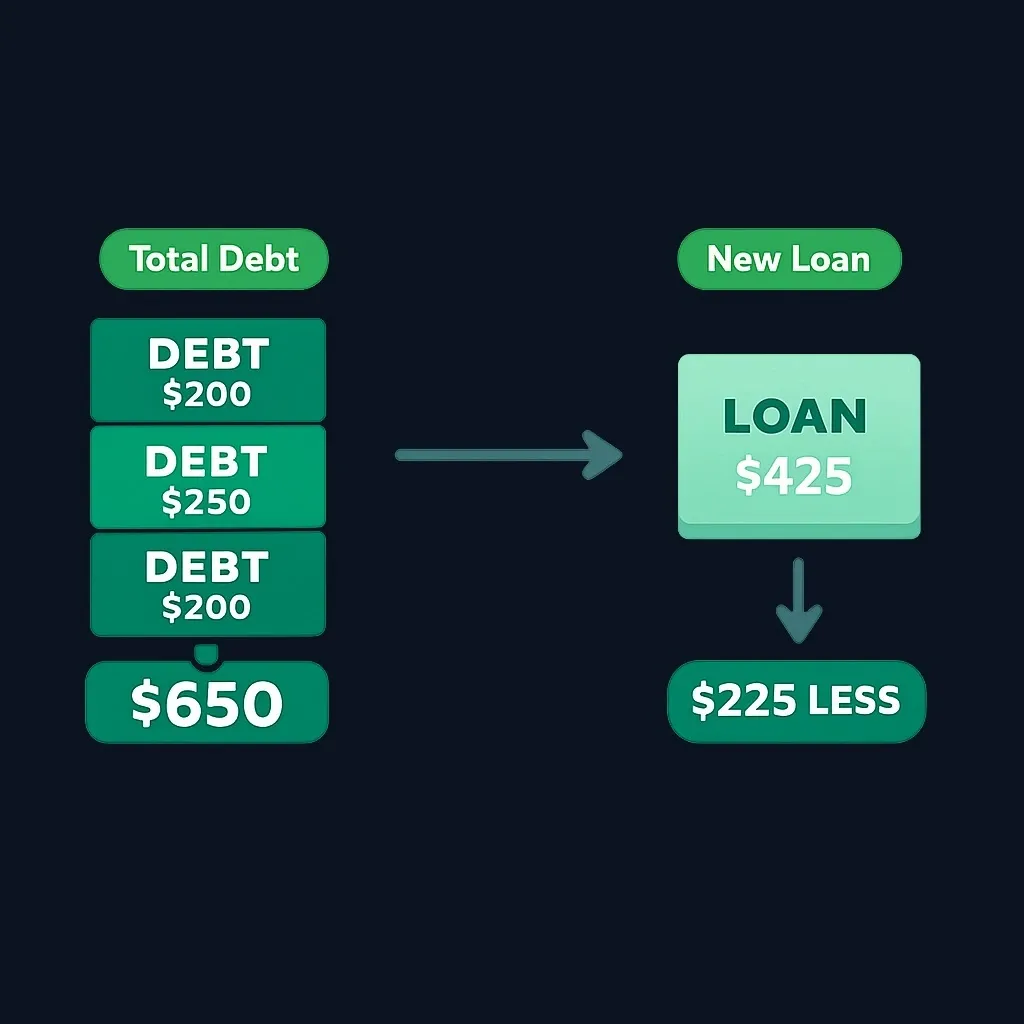
This hypothetical example does not prove mortgage eligibility. Underwriters may verify that the original accounts were paid, review recent statements, and apply program-specific treatment.
Credit-report effects are not predictable from one action
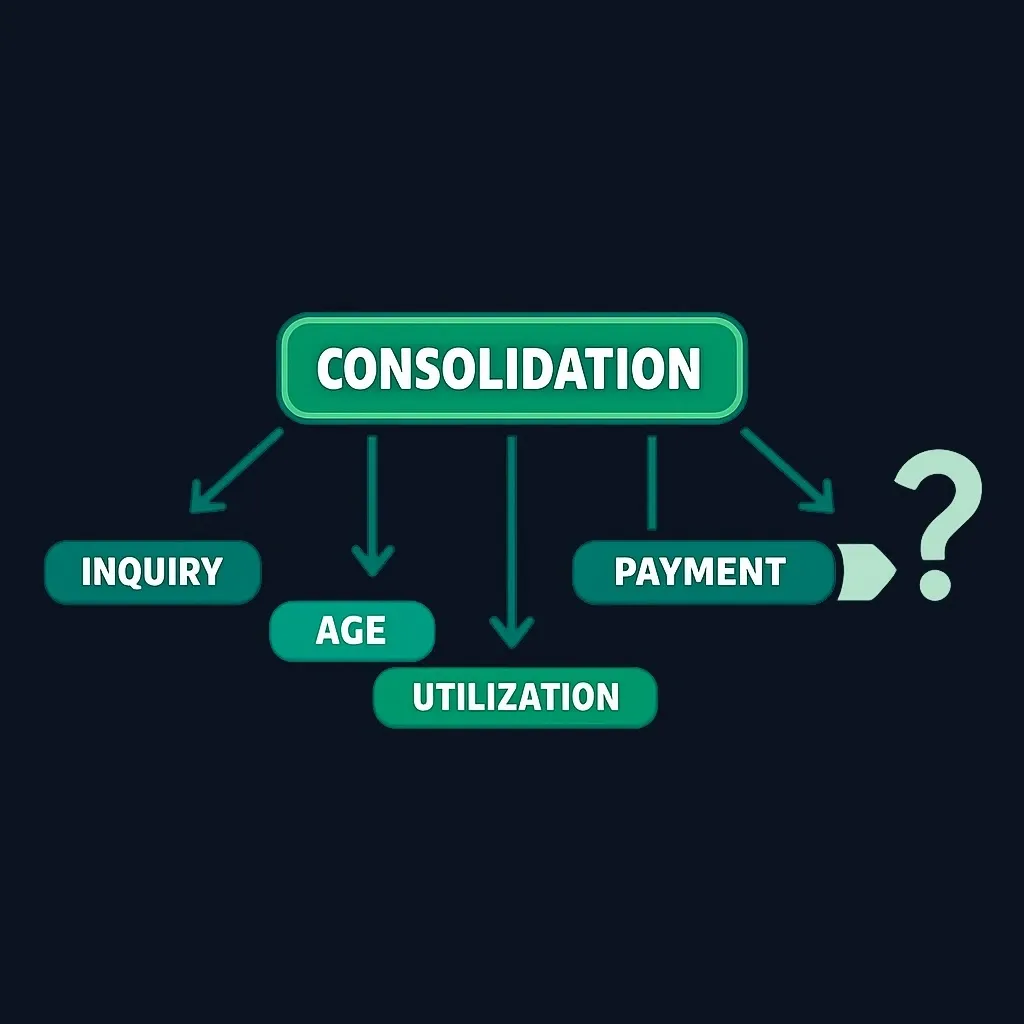
Opening a consolidation account may add a hard inquiry and lower the average age of accounts. Paying down revolving balances may reduce utilization. Closing cards may change available credit. Payment history on the new account matters over time.
The combined score effect can be positive, negative, or neutral and can vary among score models. Avoid claims that a score will “recover in three months” or increase by a specific number of points.
Review reports at AnnualCreditReport.com and dispute factual errors. Accurate new-account and payment information generally cannot be removed simply because it affects a mortgage application.
The consolidation method matters
| Method | Potential mortgage-relevant benefit | Important risk |
|---|---|---|
| Unsecured installment loan | May replace variable revolving payments with one fixed obligation | Origination fee, new inquiry, longer term, or higher total cost |
| Promotional balance-transfer card | May lower interest temporarily | Transfer fee, expiration of promotional rate, variable minimum payment, continued revolving use |
| Nonprofit debt-management plan | May simplify payments without a new consolidation loan | Creditor participation and mortgage-program treatment vary |
| Home-equity loan or HELOC | May lower the rate on unsecured debt | Converts debt into a lien on the home; variable-rate HELOC payments may rise |
| Cash-out refinance | Combines mortgage and other debt | Closing costs, larger mortgage balance, new rate, longer repayment, and home-collateral risk |
For a prospective first-time homebuyer who does not yet own a home, home-equity options are not available. Marketing language should not imply otherwise.
Why a lower monthly payment may cost more overall
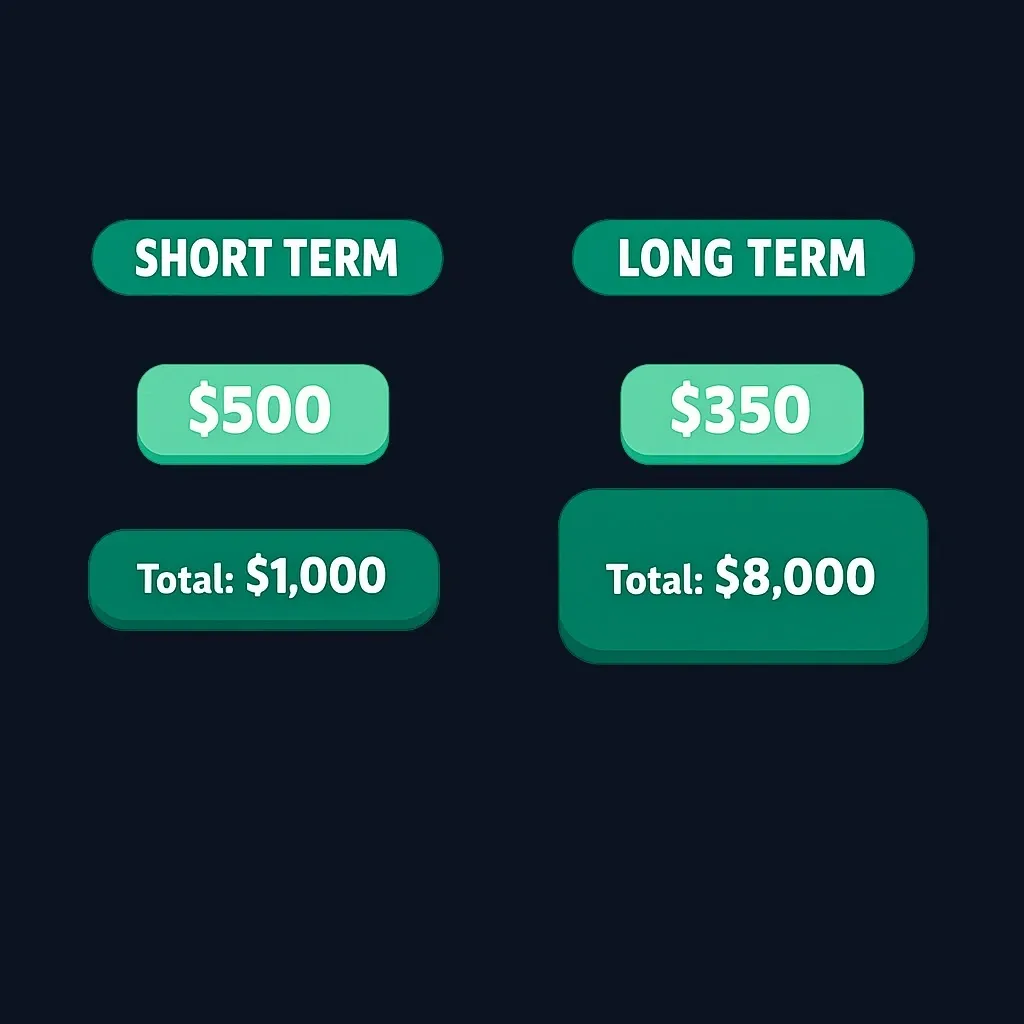
A consolidation product can lower the required payment primarily by extending the term. That can increase total interest even when the rate is lower.
Compare:
- amount financed;
- annual percentage rate;
- origination or transfer fees;
- repayment term;
- total scheduled payments;
- variable-rate provisions;
- prepayment terms; and
- any collateral securing the loan.
The relevant mortgage question is not only whether the monthly obligation fell, but whether the household can afford both the consolidated debt and the proposed housing costs over time.
Practice trading with Finelo
Practice in a simulator, learn with bite-sized lessons, and build confidence before risking real money.
Timing before a mortgage application
There is no universal rule requiring a borrower to wait a fixed number of months after consolidation. The mortgage lender may ask for:
- the consolidation note;
- statements showing the debts paid off;
- proof of the new required payment;
- an explanation of recent inquiries or accounts;
- source-of-funds records; and
- updated credit information before closing.
Before consolidating during an active home search, ask the mortgage professional how the proposed transaction would be treated under the intended loan program. Avoid opening or changing credit after mortgage preapproval without discussing the effect, because lenders may refresh credit and verify liabilities before closing.
Avoid re-borrowing on paid cards
Consolidation does not eliminate debt if paid-off cards are used again. The borrower can end up with:
- the new consolidation payment;
- renewed card balances;
- a higher debt-to-income ratio; and
- greater total interest.
A realistic plan should account for future card use, irregular expenses, and emergency savings. Closing cards is not automatically the answer; it can affect utilization and account history, while leaving cards open can create re-borrowing risk. The choice is account-specific.
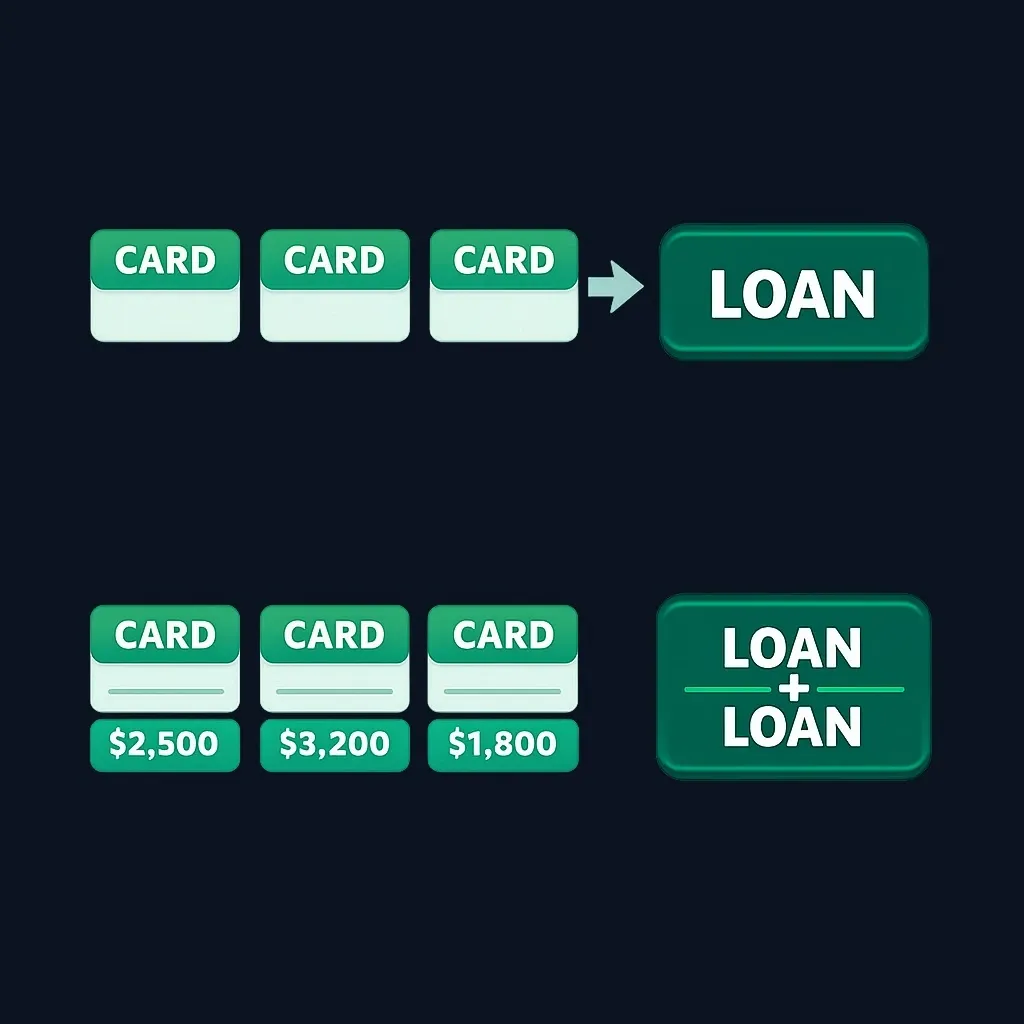
A neutral pre-mortgage comparison
1. List current obligations
Record balance, APR, minimum payment, remaining term, fees, and whether the debt is secured.
2. Obtain the proposed consolidation terms
Use a written offer, not an advertised “as low as” rate. Include every fee and the payment after any introductory period.
3. Compare total cost and monthly debt
Calculate the monthly-payment change separately from the lifetime-cost change. A lower payment can help a ratio while increasing long-term cost.
4. Ask the mortgage lender how it will be documented
Provide the proposed terms and ask which obligations will remain in the debt-to-income calculation. Do not assume that a paid-off account disappears immediately from reports.
5. Protect the down-payment record
Large transfers, new loans, and paid accounts can create documentation needs. Preserve statements showing the source and destination of funds.
6. Recalculate the home budget
Include the proposed mortgage, property taxes, homeowners insurance, mortgage insurance if applicable, association dues, maintenance, utilities, and consolidated debt.
Warning signs in consolidation offers
Be cautious when a company:
- guarantees a credit-score increase or mortgage approval;
- tells a borrower to stop communicating with creditors without explaining consequences;
- charges large fees before providing promised debt-relief services;
- describes a high-cost loan only by its monthly payment;
- pressures the borrower to secure unsecured debt with a home;
- cannot identify the lender or loan terms; or
- advises the borrower to omit debt or recent credit activity from a mortgage application.
The CFPB provides information about debt collection and debt relief and accepts complaints about financial products.
Frequently asked questions
Will consolidation improve mortgage approval odds?
It may help if it creates a lower, sustainable documented payment and the rest of the application qualifies. It may hurt if it adds cost, new debt, late payments, or an unstable repayment structure. There is no guarantee.
Should someone consolidate immediately before applying?
Not without checking how the intended mortgage lender and loan program will treat the new account. There is no universal waiting period, but recent credit changes can require documentation and may affect scores or ratios.
Does paying off credit cards through a loan close the cards?
Not automatically. The card issuer’s account remains subject to its terms unless the consumer or issuer closes it. Continued use can recreate balances.
Is a balance transfer better than a personal loan?
Neither is universally better. Compare transfer fees, promotional expiration, APR, required payment, term, credit limit, and the ability to repay before rates change.
Can a consolidation loan be used for the down payment?
Borrowed funds can affect mortgage eligibility, debt-to-income calculations, and source-of-funds rules. Disclose every loan and ask the mortgage lender which sources are permitted.
Bottom line
Debt consolidation can improve a mortgage debt-to-income calculation when it genuinely lowers required monthly obligations, but it can also add a new account, fees, inquiries, and long-term cost. Its credit-score effect is not predictable or guaranteed.
Compare written terms, ask the intended mortgage lender how the transaction will be documented, and evaluate the full housing budget before changing debt during a home purchase.
For more plain-language borrowing education, visit the Finelo Blog.
BudgetingFinancial Education
Practice trading with Finelo
Practice in a simulator, learn with bite-sized lessons, and build confidence before risking real money.
About the author
Finelo Team
The Finelo Team creates practical investing and trading education designed to help beginners learn faster with structured challenges, simulator practice, and bite-sized lessons.
Keep reading — Related articles
Budgeting
Subsidized or Unsubsidized Loans: Which Should Get Extra Payments First?
Loan type alone does not determine the best payoff order.
Finelo Team
Budgeting
The 52-Week Savings Challenge: A Guide With a Printable Tracker
After you pick a structure, set rules: how to handle missed weeks, where funds go, and a simple weekly routine to follow.
Finelo Team