The difference between qualified vs ordinary dividends is tax treatment. Qualified dividends meet IRS requirements, mainly that a US or qualifying foreign company paid them and you held the shares long enough, and are taxed at the lower long-term capital gains rates. Ordinary (non-qualified) dividends miss those requirements and are taxed at your regular income tax rates, which are typically higher.
Qualified vs Ordinary Dividends: What You Need to Know

The difference between qualified vs ordinary dividends is tax treatment. Qualified dividends meet IRS requirements, mainly that a US or qualifying foreign company paid them and you held the shares long enough, and are…
7 min read
Practice investing with Finelo
Build practical investing skills with guided lessons, simulator practice, and structured challenges.
Want to learn more?
Build practical investing skills with guided lessons, simulator practice, and structured challenges.
Explore FineloExplore Finelo's 28-day challenges
Turn learning into a daily habit with guided challenge paths.
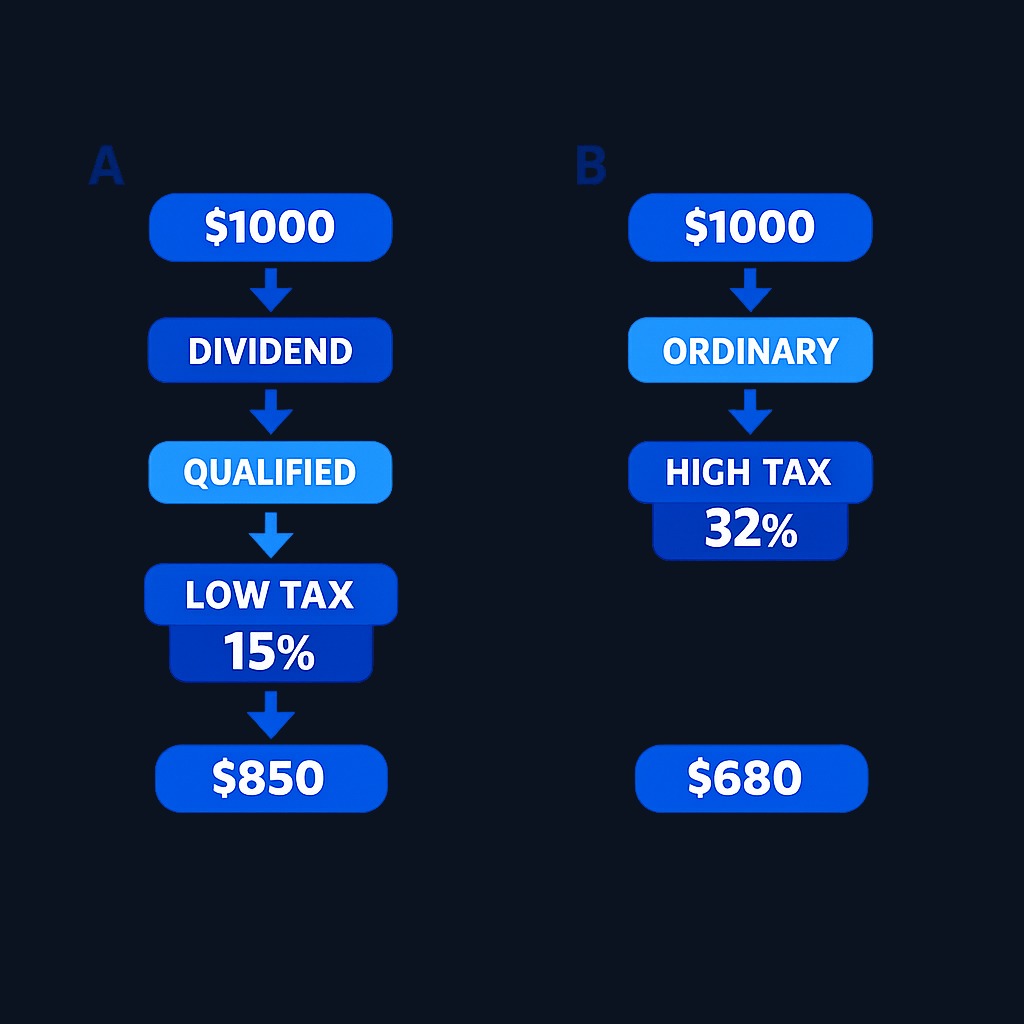
This page is for beginner investors who receive dividends in taxable accounts and want to keep more of them. You will learn what each type is, how the tax gap works, how to check your own dividends, and a framework for decisions. This content is educational, not tax or financial advice; confirm specifics with the IRS or a tax professional.
What are ordinary dividends?
Ordinary dividends are the default category. Technically, every dividend a company pays from its earnings and profits is an ordinary dividend; a subset then qualifies for better tax treatment. When investors say "ordinary" in this comparison, they mean the non-qualified remainder, payouts that do not meet the IRS criteria and are therefore taxed at ordinary income rates, as Fidelity's guide to qualified dividends explains.
Common sources of non-qualified dividends include:
- Real estate investment trusts (REITs), whose distributions mostly do not qualify.
- Money market funds and bond funds, whose payouts are interest-like and taxed as ordinary income.
- Shares held only briefly around the dividend date, failing the holding-period test.
- Certain foreign companies that do not meet the qualifying criteria.
- Dividends tied to hedged positions, where offsetting trades cancel the real ownership risk.
Nothing is wrong with these payouts as income; they simply arrive with a larger tax bill attached in a taxable account.
What are qualified dividends?
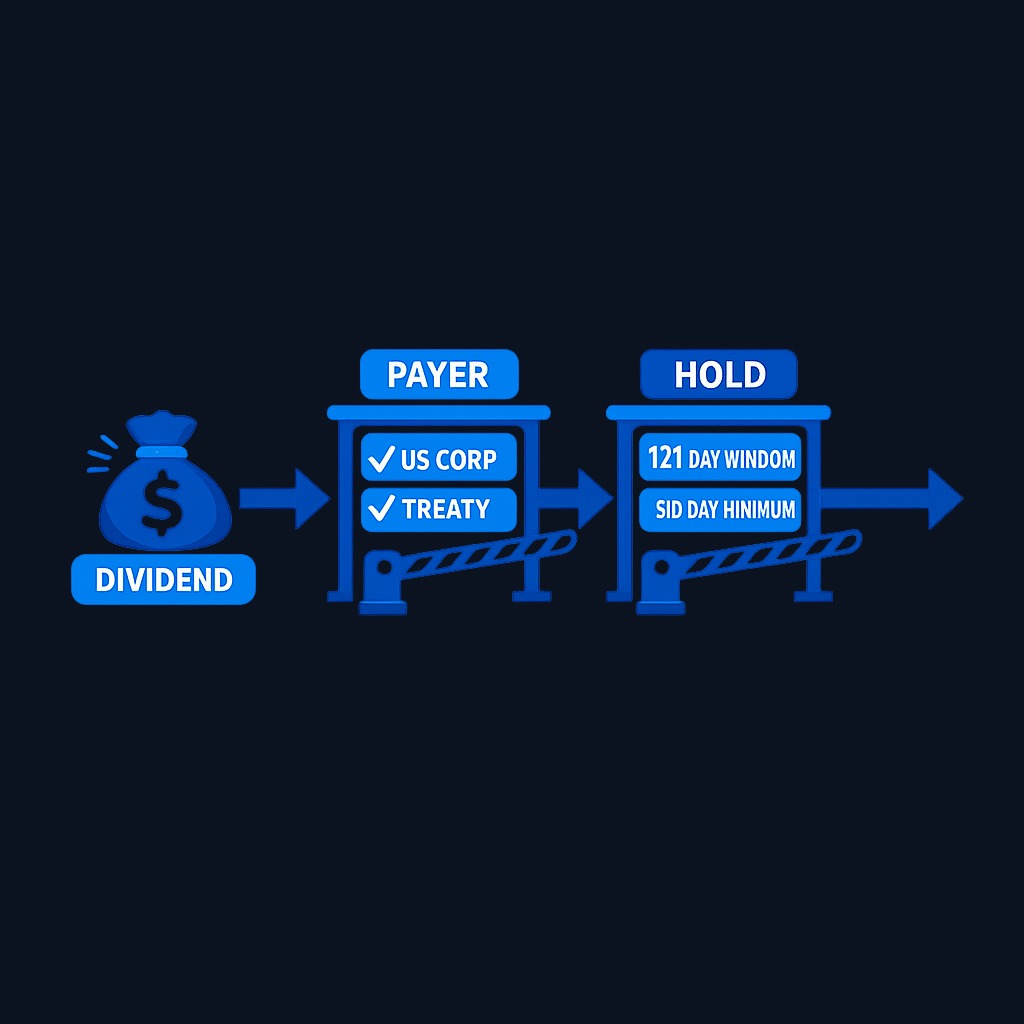
Qualified dividends are the subset that clears two main hurdles:
- Qualifying payer. The dividend must come from a US corporation or a qualifying foreign corporation, for example one whose shares trade on a major US exchange or that benefits from an eligible tax treaty.
- Holding period. You must hold the shares for more than 60 days within the 121-day window surrounding the ex-dividend date (the cutoff date that determines who receives the payment). Preferred stock has a longer test in some cases.
Meet both, and the dividend is taxed at long-term capital gains rates rather than ordinary income rates. The policy logic is simple: the lower rate rewards genuine, patient ownership of businesses rather than quick trades timed around payout dates. Most dividends from mainstream US blue-chip stocks held long term in a brokerage account end up qualified.
Tax implications: how big is the difference?
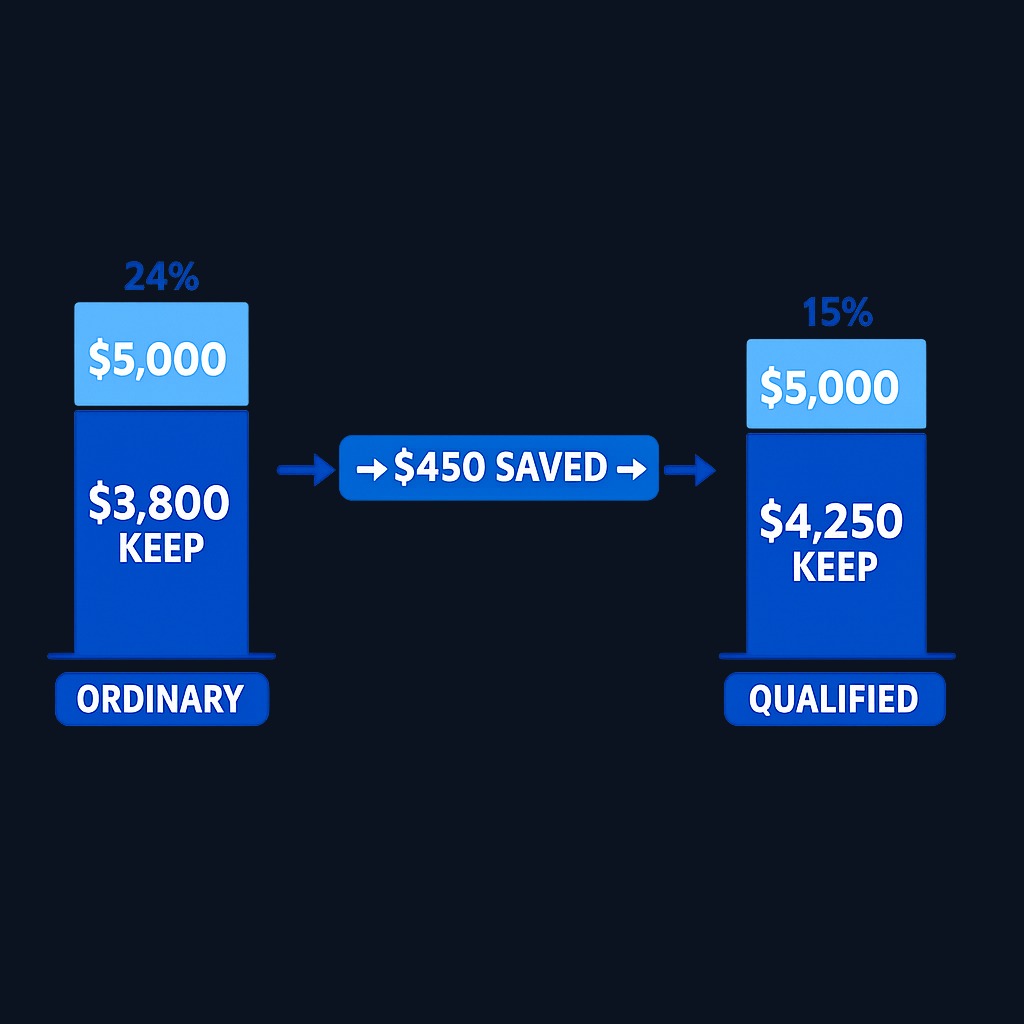
The gap matters because the two rate schedules differ substantially:
| Feature | Ordinary dividends | Qualified dividends |
|---|---|---|
| Tax schedule | Regular income tax brackets | Long-term capital gains rates |
| Typical burden | Higher, same as wages | Lower, sometimes zero at modest incomes |
| Reported on | Form 1099-DIV, box 1a | Form 1099-DIV, box 1b |
| Typical sources | REITs, bond funds, short holds | US blue chips held long term |
Exact rates depend on your taxable income and current law, so verify the brackets for the year on official IRS materials. The structural point holds regardless: for the same dollar of dividend income, qualified status usually means a meaningfully smaller tax bill, and the advantage compounds every year the portfolio pays you.
Note that in tax-advantaged retirement accounts the distinction mostly disappears, since taxes there follow the account's rules rather than the dividend's category.
How to determine if your dividends are qualified
You rarely have to compute this from scratch:
- Read your 1099-DIV. Your broker reports total ordinary dividends in box 1a and the qualified portion in box 1b. The split is done for you.
- Check your holding period. If you bought shares shortly before the ex-dividend date or sold shortly after, the payment likely failed the more-than-60-days test even if the company qualifies.
- Know your asset types. Common stock of established US companies usually produces qualified dividends; REITs, bond funds, and money market funds usually do not.
- Check fund documentation. For ETFs and mutual funds, the fund's own tax reporting shows what portion of its distributions passed through as qualified.
- When in doubt, ask. Brokerage tax centers and a tax professional resolve edge cases like hedged positions, foreign payers, and preferred shares.
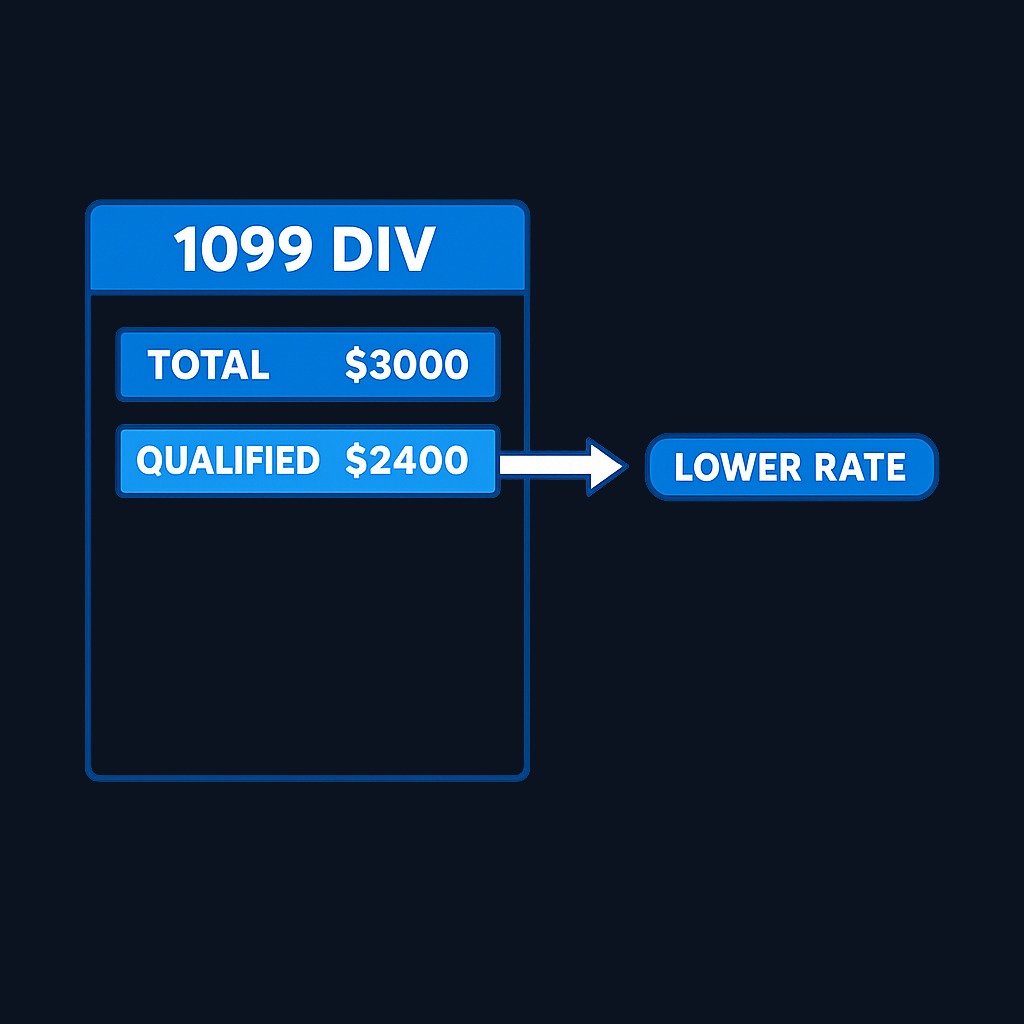
A practical habit: before buying a dividend payer in a taxable account, check what kind of income it typically distributes. That single check predicts most of the after-tax outcome.
Practice investing with Finelo
Build practical investing skills with guided lessons, simulator practice, and structured challenges.
Tradeoffs, caveats, and common misconceptions
- "Qualified is always better." For after-tax income in a taxable account, usually yes. But chasing qualified status should not override asset choice: a REIT with strong economics can still beat a weaker common stock after taxes.
- "All big-company dividends are qualified." Only if you satisfy the holding period. Trading around ex-dividend dates converts would-be qualified payouts into ordinary income.
- "Dividends are free money." Share prices typically adjust around the ex-dividend date (the market prices the payout), so a dividend is a distribution of value you already own, and it is taxable when received in a taxable account.
- "The category changes the company." Qualified status is about your taxes, not business quality. Payout sustainability, growth, and valuation still decide the investment outcome.
- "Account type doesn't matter." It matters enormously. Holding tax-inefficient payers inside tax-advantaged accounts, and qualified payers in taxable accounts, is a standard placement strategy many investors use.
What to know before deciding
Before acting on the qualified vs ordinary distinction, confirm three things. First, your account context: inside retirement accounts, the distinction has little effect, so optimize there for investment merit alone. Second, your actual 1099-DIV history: your broker's boxes 1a and 1b show how much of your income already qualifies, which tells you whether there is anything to optimize. Third, your bracket: the size of the benefit depends on the gap between your income tax rate and your capital gains rate, which varies by year and income. Tax rules also change, so check current IRS guidance before locking in a strategy.
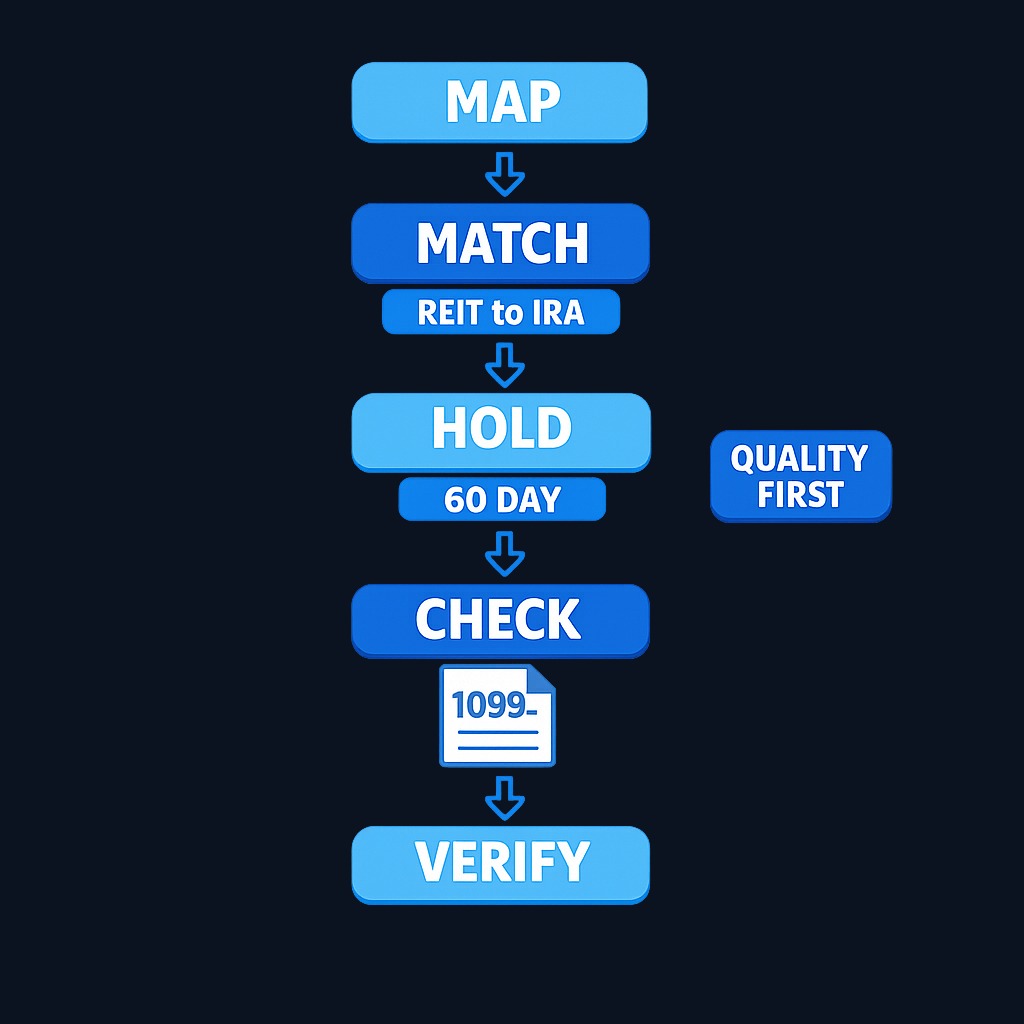
Decision framework: managing dividends tax-efficiently
- Map your holdings by income type. Label each position: qualified payer, non-qualified payer, or non-dividend.
- Match holdings to accounts. Where possible, place REITs and bond funds in tax-advantaged accounts and long-term stock holdings in taxable ones.
- Respect the holding period. Avoid trading around ex-dividend dates in taxable accounts when you want qualified treatment.
- Verify with last year's 1099-DIV. Measure the qualified share of your dividend income and see whether placement changes could raise it.
- Weigh taxes last, not first. Pick durable businesses and sound funds first; tax placement is the optimization layer, not the strategy.
And keep first things first: regulators encourage maintaining a liquid emergency fund before investing, so a surprise expense never forces you to sell dividend payers at a bad moment.
Conclusion and next steps
Qualified and ordinary dividends can be identical dollars with different tax bills. Qualified status, earned through a qualifying payer plus a real holding period, routes the income through lower capital gains rates; ordinary status routes it through your regular brackets. Check your 1099-DIV, place tax-inefficient payers thoughtfully, and let holding discipline preserve the advantage.
Next steps: pull last year's 1099-DIV, compute what share of your dividends was qualified, and identify one placement improvement for this year. For structured, beginner-friendly education on dividends and investing fundamentals, Finelo offers guided lessons you can take at your own pace.
Frequently asked questions
Are qualified dividends taxed twice?
Corporate profits are taxed at the company level, and shareholders then pay tax on distributed dividends, which is the "double taxation" idea. The lower qualified rate partly offsets this. Within your own return, though, each dividend dollar is taxed once, at either the qualified or ordinary rate.
How long do I need to hold a stock for its dividend to be qualified?
More than 60 days within the 121-day window centered on the ex-dividend date for common stock, with a longer requirement for certain preferred shares. Your broker's year-end tax forms reflect whether you met the test.
Are REIT dividends ever qualified?
Mostly no; the bulk of REIT distributions are taxed as ordinary income because of how REITs themselves are taxed. Portions can occasionally receive different treatment, which the REIT's or fund's tax reporting breaks out each year.
Where do I see my qualified vs ordinary dividends for tax filing?
On Form 1099-DIV from your broker: box 1a reports total ordinary dividends, and box 1b reports the portion that is qualified. Tax software transfers both boxes and applies the correct rates automatically.
qualifiedordinarydividendsyou
Practice investing with Finelo
Build practical investing skills with guided lessons, simulator practice, and structured challenges.
About the author
Finelo Team
The Finelo Team creates practical investing and trading education designed to help beginners learn faster with structured challenges, simulator practice, and bite-sized lessons.
Keep reading — Related articles

Investing
Yield to Maturity: Formula, Example & Key Risks
Yield to maturity, or YTM, is the annualized return implied by a bond’s current price, coupon payments, face value, and time remaining until maturity—assuming the bond makes all scheduled payments…
Finelo Team
Investing
WACC Formula: How to Calculate Weighted Average Cost of Capital
The WACC formula is WACC = (E ÷ V × Re) + (D ÷ V × Rd × (1 − Tc)). It estimates a company’s blended cost of financing from equity and debt, weighted by how much each source contributes to the…
Finelo Team
Investing
Tracking Error: Formula, Example & Interpretation
Tracking error measures how much an investment’s returns fluctuate away from a benchmark’s returns.
Finelo Team