Quality factor investing is a strategy that targets companies with strong, stable fundamentals: high profitability, low debt, and consistent earnings. It belongs to factor investing, where portfolios tilt toward characteristics believed to drive long-run returns. In practice, most people access the quality factor through rules-based index funds and ETFs that screen and weight stocks by these fundamental metrics.
Quality Factor Investing: What It Is and How to Use It
Learn what quality factor investing means, which metrics define a quality stock, how quality ETFs work, and when the factor fits a portfolio.
7 min read
Practice investing with Finelo
Build practical investing skills with guided lessons, simulator practice, and structured challenges.
Want to learn more?
Build practical investing skills with guided lessons, simulator practice, and structured challenges.
Explore FineloExplore Finelo's 28-day challenges
Turn learning into a daily habit with guided challenge paths.
This page is for investors who keep hearing "quality" in fund names and want to know what the label actually screens for. You will get the defining metrics, a comparison with other factors, ways to build exposure, and a framework for deciding whether a quality tilt fits your portfolio. This is educational content, not financial advice. Start with the metrics below, then look inside one quality ETF's index methodology.
What quality factor investing means
A factor is a measurable characteristic that groups of stocks share and that researchers link to distinct return and risk patterns. The SEC's investor education office describes factors as features believed to cause certain securities to outperform or underperform the market, and it lists value, dividends, and quality among the common examples in its smart beta investor bulletin.
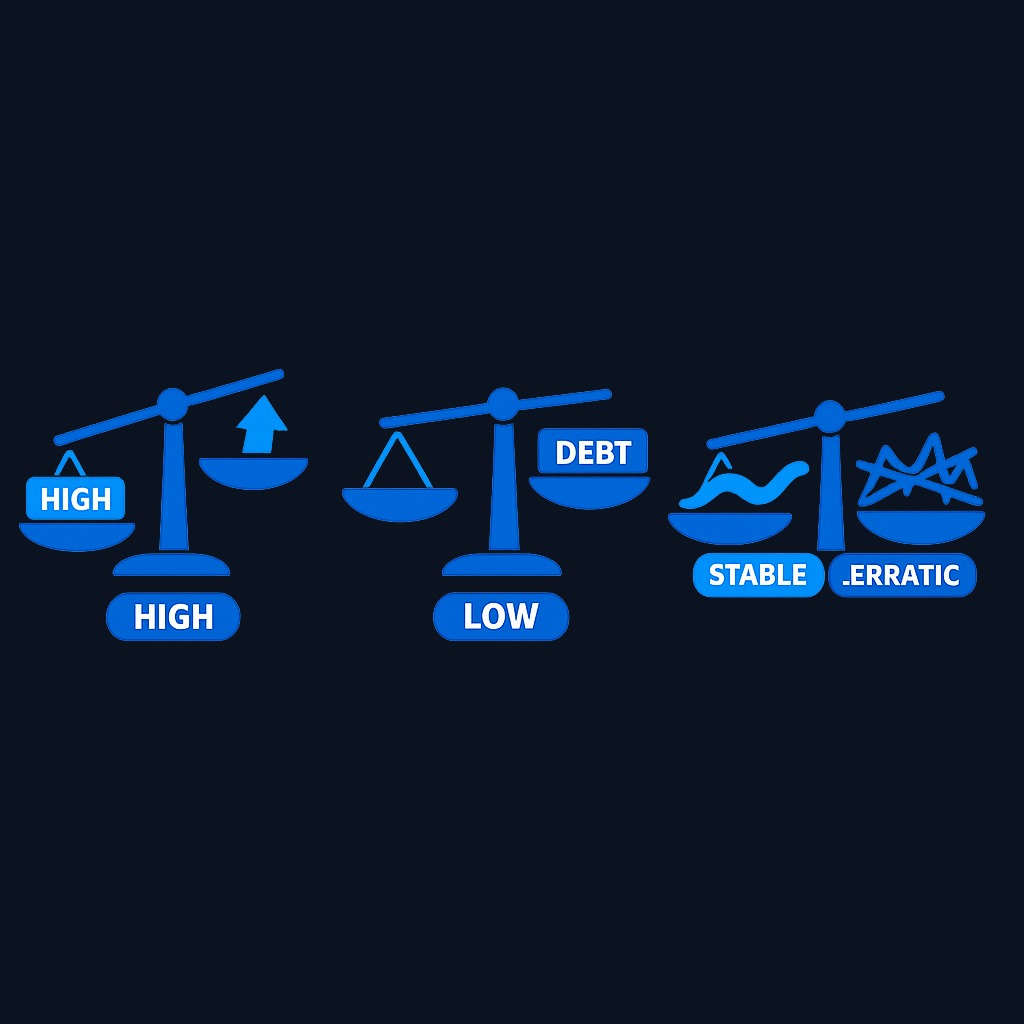
The quality factor specifically favors businesses that earn a lot relative to the capital they use, carry manageable debt, and produce steady rather than erratic profits. The intuition is simple: durable, well-run companies should hold up better through stress and compound more reliably over long periods. Quality is often described as a defensive tilt, in contrast to more aggressive factors like small size or momentum.
The metrics that define quality
Index providers define quality with slightly different recipes, but three ingredients appear almost everywhere:
- Profitability. Return on equity (ROE) is the classic measure: net income divided by shareholder equity. High-ROE firms squeeze more profit from each dollar of capital. Gross profitability and return on invested capital serve the same purpose.
- Balance-sheet strength. Debt-to-equity or debt-to-earnings ratios flag leverage. Lower debt means less fragility when revenue dips or interest costs rise.
- Earnings stability. The variability of earnings growth over several years. Smooth earners score higher than boom-and-bust businesses.
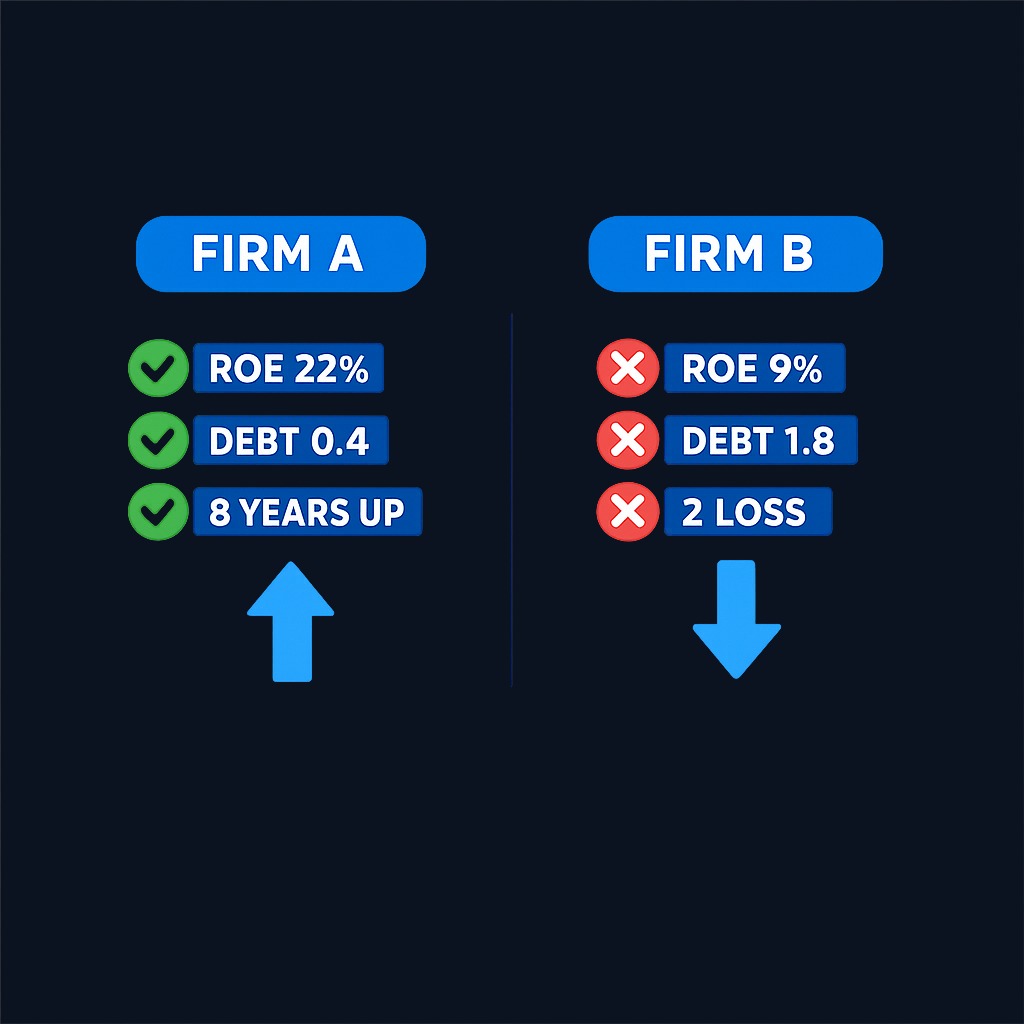
A quick illustrative screen shows how the pieces combine. Imagine two companies. Firm A: 22% ROE, debt-to-equity of 0.4, earnings that grew every year for eight years. Firm B: 9% ROE, debt-to-equity of 1.8, and two loss years in the same stretch. A quality index would overweight Firm A and underweight or exclude Firm B, regardless of which stock is cheaper. That last part is important: quality screens ignore price. A wonderful business at any valuation can still pass.
Some methodologies add accruals checks (how much of earnings converts to cash) or payout discipline. When you evaluate a quality fund, read the index methodology document to see which recipe it actually uses.
Quality vs other factors
| Factor | What it targets | Typical behavior | Main risk |
|---|---|---|---|
| Quality | Profitable, low-debt, stable firms | Defensive; steadier in downturns | Can lag strong bull markets; often pricier valuations |
| Value | Cheap stocks vs fundamentals | Cyclical; strong in recoveries | Long stretches of underperformance |
| Momentum | Recent winners | Trend-following | Sharp reversals |
| Size | Smaller companies | Higher risk and potential reward | Volatility, weaker balance sheets |
| Low volatility | Price-stable stocks | Defensive | Rate sensitivity, crowding |
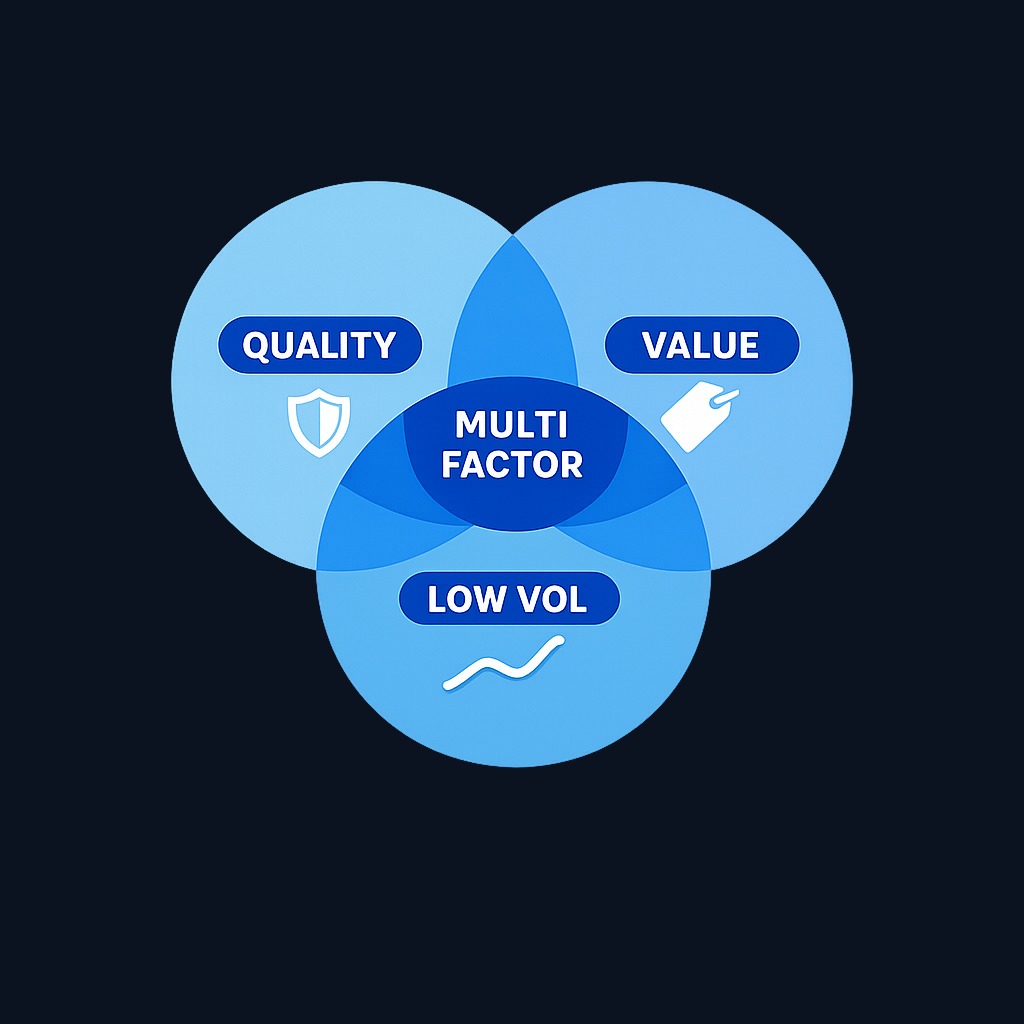
Quality overlaps most naturally with low volatility, and it often pairs well with value: combining "good business" with "reasonable price" addresses each factor's weakness. Multi-factor funds exist precisely to blend these exposures.
How to get exposure
There are three practical routes:
- Quality-factor ETFs and index funds. These track custom-built indexes that screen the parent universe on quality metrics, then weight the survivors. They are passively managed against those rules. Costs vary, and the SEC's bulletin notes that non-traditional index funds typically carry higher expenses than plain market-cap index funds, so compare expense ratios before buying.
- Multi-factor funds. These blend quality with value, momentum, or size in one wrapper, which reduces the risk of betting on a single factor's cycle.
- DIY screening. Screen for ROE, debt ratios, and earnings consistency yourself, then research the survivors one by one. More work, more control, and it forces you to learn the fundamentals behind the label.
Whichever route you choose, look through to the actual holdings. Two funds with "quality" in the name can hold noticeably different portfolios because their indexes define the factor differently.
Practice investing with Finelo
Build practical investing skills with guided lessons, simulator practice, and structured challenges.
When quality helps and when it lags
No factor works in every market, and quality's pattern is fairly intuitive. It has tended to matter most when conditions tighten: recessions, credit stress, and profit slowdowns punish weak balance sheets, and high-quality firms' steadier earnings become scarce and prized. In exuberant, risk-seeking rallies, the opposite often holds: speculative and highly leveraged names can sprint past sturdy compounders, and a quality tilt feels slow.
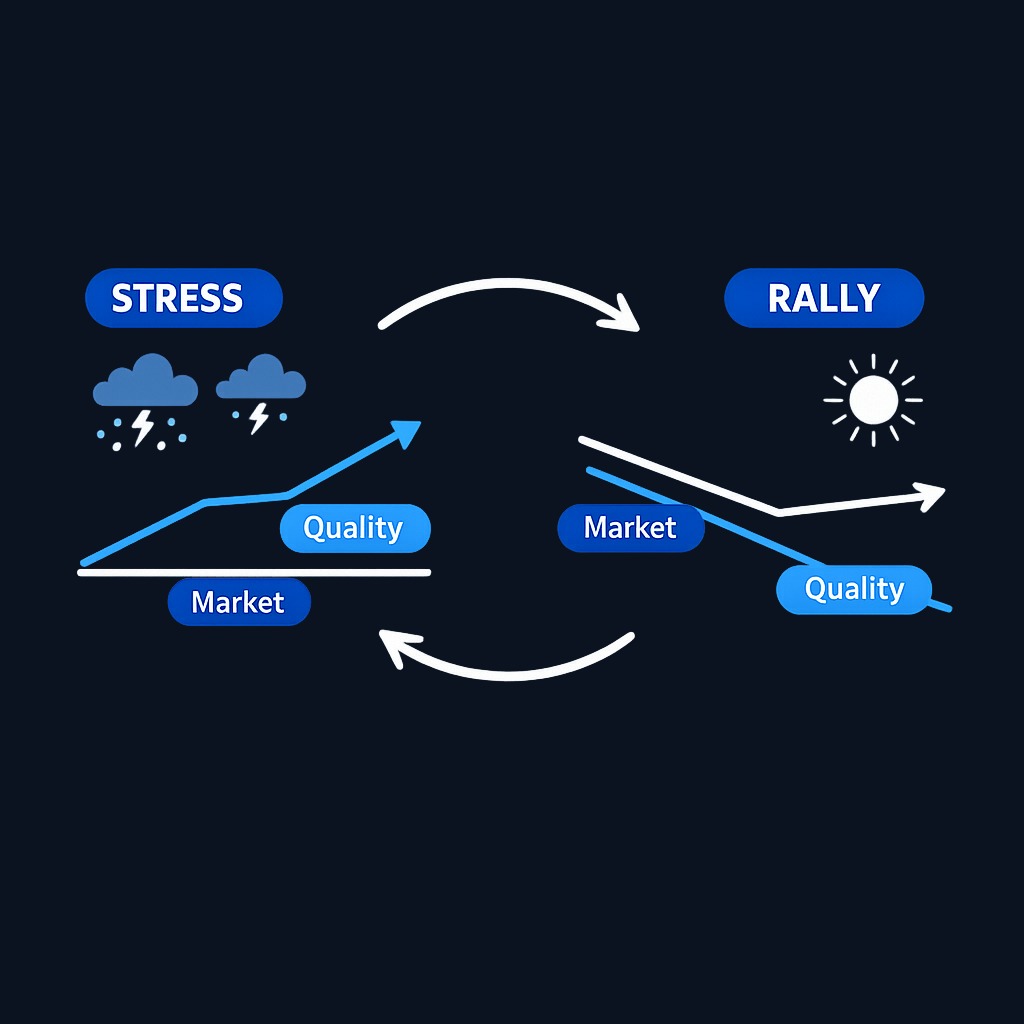
That cyclicality is the point, not a flaw. Factor investing asks you to hold a deliberate tilt through its out-of-favor stretches. Historical patterns describe tendencies, not promises; the SEC's bulletin is explicit that factor-based funds will not necessarily outperform the market, and past behavior does not guarantee future results.
Limitations and risks
- No outperformance guarantee. Quality is a research-supported tilt, not a certainty. Long lag periods happen.
- Definition drift. "Quality" varies by index provider. One fund's screen may emphasize ROE, another's earnings stability, producing different results under the same label.
- Valuation risk. Quality stocks are rarely cheap. Paying too much for excellent businesses has historically been its own way to earn mediocre returns.
- Higher costs than plain indexing. Factor funds usually charge more than broad market-cap funds, and fees compound against you.
- Crowding. Popular defensive tilts can get expensive simultaneously, reducing their future advantage.
- Concentration surprises. Screens can cluster in a few sectors, so a quality fund may be less diversified than its holdings count suggests.
What to know before deciding
Before adding quality factor investing to your portfolio, settle four questions. First, purpose: are you seeking smoother drawdowns, long-run compounding, or both? Second, implementation: single-factor ETF, multi-factor fund, or DIY screen. Third, cost: compare the fund's expense ratio against a plain index fund and decide whether the tilt justifies the difference. Fourth, commitment: factor tilts only make sense if you can hold them through multi-year stretches of lagging a benchmark. Read the fund's prospectus and index methodology before committing money, and check how the strategy behaved in past drawdowns.
Decision framework: adding a quality tilt
- Confirm your core first. A broad, diversified base portfolio comes before any tilt.
- Pick the implementation. Want simplicity? A single quality ETF. Want balance? A multi-factor fund. Want education and control? Screen and pick yourself.
- Read the methodology. Identify which metrics the index screens (ROE, leverage, earnings variability) and check sector weights.
- Size the tilt modestly. A tilt is a seasoning, not the meal; keep it a fraction of the equity allocation so one factor's bad decade cannot sink the plan.
- Set review rules in advance. Judge the tilt on multi-year windows against its own index, not on quarters. Predecide what would make you exit: methodology changes or your own goals, not a single lagging year.
The most common mistake is buying a quality fund after it has led the market and abandoning it the first year it trails. Factor benefits, where they exist, accrue to holders who stay through the full cycle.
Conclusion and next steps
Quality factor investing tilts a portfolio toward profitable, low-debt, steady-earning companies, usually through rules-based ETFs. The metrics are measurable, the logic is defensive, and the tradeoffs are real: higher fees than plain indexing, cyclical stretches of lagging, and definitions that vary by provider. Used deliberately and held patiently, it is one of the clearer ways to express "own better businesses" in a systematic form.
Next steps: open one quality ETF's methodology page, list the exact metrics it screens, and compare its top holdings and expense ratio against a broad index fund. To build the underlying skills of reading ROE, leverage, and earnings quality, Finelo offers structured, beginner-friendly investing education.
Frequently asked questions
What counts as a quality stock?
Typically a company with high return on equity, low debt relative to peers, and stable earnings across several years. Exact thresholds vary by index provider, so check the methodology behind any fund you consider.
Is quality factor investing the same as buying blue chips?
Not exactly. Blue chip usually means large and well known. Quality is defined by measured fundamentals, and some large famous companies fail quality screens on leverage or earnings volatility, while smaller, less famous firms pass.
Do quality ETFs beat the market?
Not reliably, and no fund can promise to. The factor has shown favorable long-run risk-adjusted patterns in research, but regulators explicitly note factor funds may underperform, and results depend on period, definition, and cost.
How much of a portfolio should a factor tilt be?
There is no universal number. Many investors keep tilts small relative to a diversified core so the portfolio's fate does not hinge on one factor's cycle. Your allocation should reflect your horizon and tolerance for tracking a benchmark loosely.
qualityfactorinvesting
Practice investing with Finelo
Build practical investing skills with guided lessons, simulator practice, and structured challenges.
About the author
Finelo Team
The Finelo Team creates practical investing and trading education designed to help beginners learn faster with structured challenges, simulator practice, and bite-sized lessons.
Keep reading — Related articles
Investing
Tax-gain harvesting vs. tax-loss harvesting
Compare realizing investment gains with realizing losses, including holding periods, wash sales, offsets, and portfolio tradeoffs.
Finelo Team
Investing
Stable value fund vs. money market fund
Compare investment structure, contract protections, transfer restrictions, net yields, and access inside a retirement account.
Finelo Team

Investing
Single-life vs. joint-life annuity
Compare income for one lifetime with continued payments to a survivor, using equal premiums and matching guarantee terms.
Finelo Team