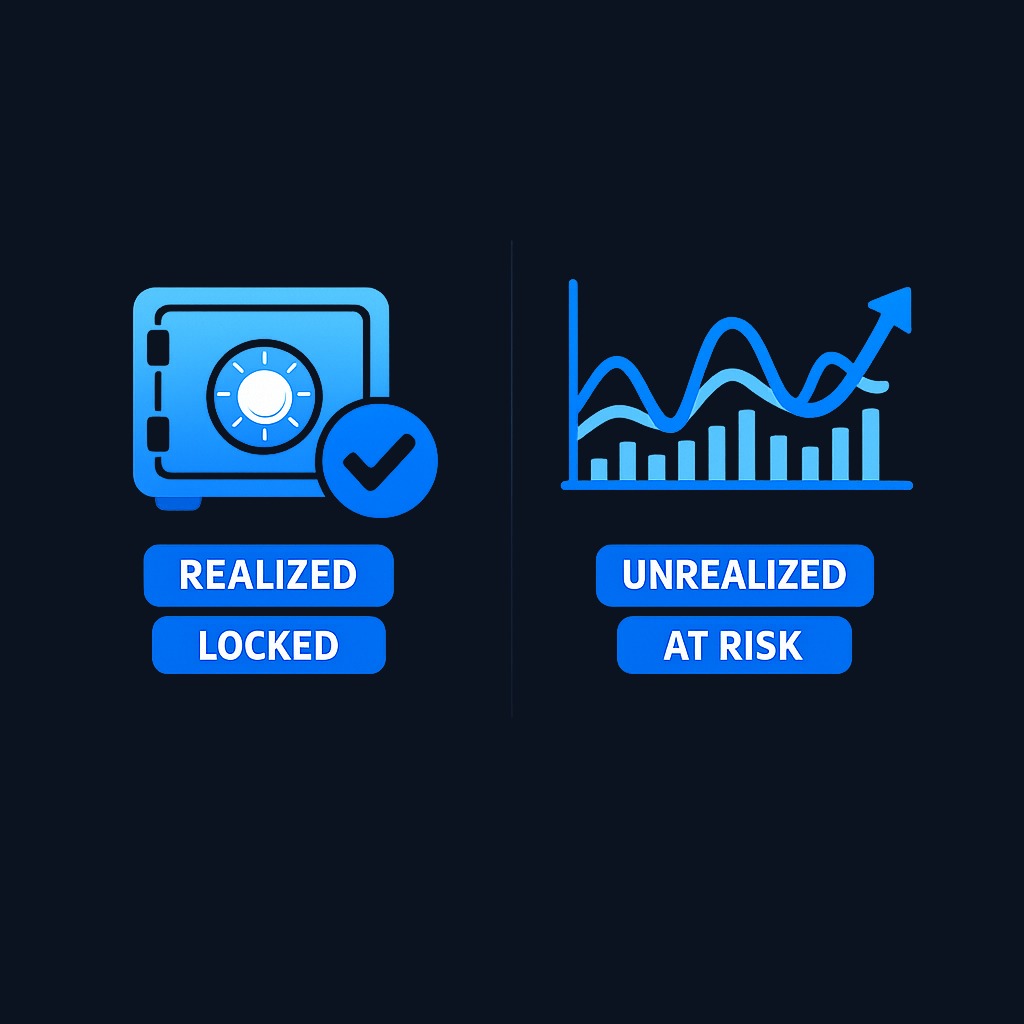
The realized vs unrealized gains distinction is simple at its core. A realized gain is profit locked in by selling an asset for more than you paid. An unrealized gain is profit that exists only on paper while you still hold the asset. The difference decides when taxes are due and how secure your profit really is.
Realized vs. Unrealized Gains: Understanding the Key Differences

The realized vs unrealized gains distinction is simple at its core. A realized gain is profit locked in by selling an asset for more than you paid. An unrealized gain is profit that exists only on paper while you still…
5 min read
Practice investing with Finelo
Build practical investing skills with guided lessons, simulator practice, and structured challenges.
Want to learn more?
Build practical investing skills with guided lessons, simulator practice, and structured challenges.
Explore FineloExplore Finelo's 28-day challenges
Turn learning into a daily habit with guided challenge paths.
This page is for investors reading account statements and wondering what their "gains" actually mean for taxes and decisions. You will find definitions, examples, a comparison table, a decision framework, and the tax basics. It is educational content, not tax or financial advice.
What are realized gains?
A gain becomes realized the moment you sell. Buy shares for $5,000, sell them later for $7,000, and you have a realized gain of $2,000. The profit is now cash-denominated and final. Market moves after the sale no longer affect it.

Realization is triggered by the transaction, not by the price move. The same applies in reverse: selling below cost produces a realized loss. Realized amounts are what flow into tax calculations, performance records, and your actual spendable wealth. Once realized, a gain cannot evaporate in the next downturn, and a loss cannot heal in the next rally.
What are unrealized gains?
An unrealized gain is the increase in value of something you still own. If your $5,000 position is now worth $7,000 and you have not sold, you hold a $2,000 unrealized gain, sometimes called a paper profit. Your statement shows it, your net worth includes it, but no cash has changed hands.

Paper profits move with the market every day. They can grow, shrink, or flip into unrealized losses without you doing anything. In most cases they are not taxed while they remain unrealized, which is exactly what makes holding appreciated assets a form of tax deferral. The flip side is exposure: an unrealized gain is a position still at risk.
Key differences between realized and unrealized gains
| Dimension | Realized gains | Unrealized gains |
|---|---|---|
| Trigger | A completed sale | A price change while holding |
| Certainty | Locked in, final | Fluctuates with the market |
| Tax status | Generally taxable in the year of sale | Generally not taxed while held |
| Shows up as | Cash proceeds and tax forms | Paper value on statements |
| Reversible? | No | Yes, can shrink or vanish |
The practical meaning: your portfolio's headline growth mixes both kinds. A statement showing strong gains may rest mostly on paper profits that a bad quarter could erase. Separating the two tells you how much of your progress is banked and how much is still riding on the market.
Practice investing with Finelo
Build practical investing skills with guided lessons, simulator practice, and structured challenges.
What to know before deciding
Before selling to lock in a profit, weigh three things. First, the tax cost: realizing converts a deferred, invisible liability into a real bill this year. Second, the investment case: selling purely to make a gain feel "safe" abandons an asset you may still believe in. Third, your timeline: paper gains you will not need for years can keep compounding untaxed, while money needed soon argues for locking in results. There is no universally right answer; the decision balances certainty, taxes, and conviction.
When to realize gains: decision framework
- Need the money soon? If the goal is near, converting paper profit into cash reduces the risk of a badly timed downturn.
- Position too large? When a winner dominates your portfolio, realizing part of the gain funds rebalancing and trims concentration risk.
- Thesis broken? If the reason you bought no longer holds, the tax bill is rarely a good reason to keep the position.
- Losses available? Realized losses can offset realized gains, so pairing sales can shrink the net tax impact.
- Holding period short? If you are close to crossing into long-term status, waiting may cut the tax rate on the same profit.
- None of the above? Letting an unrealized gain keep compounding, untaxed, is often the strongest default for long-horizon investors.
Run the framework on each position rather than the whole account. The answer commonly differs stock by stock.
Tax implications of realized vs. unrealized gains
In the standard case, tax follows realization. Selling at a profit in a taxable account creates a capital gain for that tax year, and the holding period matters: gains on assets held beyond one year are generally taxed at lower long-term rates, while shorter holds are taxed like ordinary income, as outlined in the IRS's capital gains and losses guidance. Realized losses can offset realized gains and, within limits, other income.
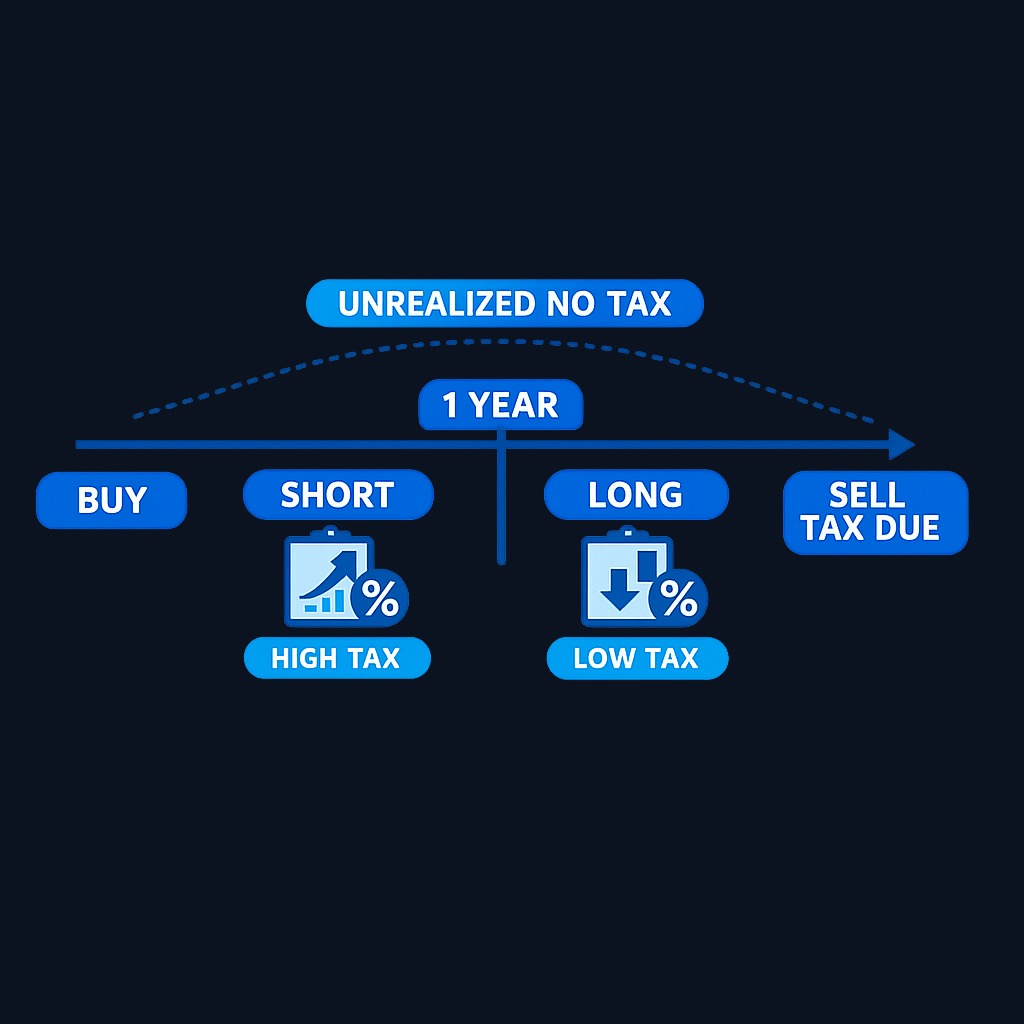
Unrealized gains generally stay untaxed until sale, which is why long-term investors treat deferral as a quiet advantage: the money that would have paid tax keeps working. Retirement accounts change the picture, since taxation there follows the account's rules instead of each sale. Rules differ by situation and change over time, so confirm specifics with a tax professional before acting on a large gain.
Conclusion and next steps
Realized gains are banked and taxable; unrealized gains are provisional and deferred. Neither is better in the abstract: realization buys certainty at a tax cost, while holding preserves compounding at market risk. Knowing which kind of gain you are looking at is the first step of every sell decision.
Next steps: split your portfolio's total gain into realized and unrealized parts, then run the decision framework on your three largest paper profits. Confirm tax specifics for your situation with a professional. If you want structured practice with concepts like these, Finelo teaches investing fundamentals step by step.
Frequently asked questions
Do I pay taxes on unrealized gains?
Generally no. In a standard taxable account, tax applies when a sale realizes the gain. The paper profit can sit untaxed for years, which is a core reason buy-and-hold investing is tax-efficient.
Can an unrealized gain turn into a loss?
Yes. Until you sell, the value moves with the market, and a paper profit can shrink or become an unrealized loss. Only realization fixes the outcome permanently.
How do realized losses interact with realized gains?
Realized losses offset realized gains in the same tax year, reducing the taxable amount, and limited excess loss can typically offset other income. This pairing is the basis of tax-loss harvesting strategies.
Why does the holding period matter when realizing a gain?
Because the tax rate changes. Profits on assets held longer than a year generally qualify for lower long-term capital gains rates, while short-term profits are taxed like ordinary income. Timing a sale around that boundary can change the after-tax result meaningfully.
realizedunrealizedgains
Practice investing with Finelo
Build practical investing skills with guided lessons, simulator practice, and structured challenges.
About the author
Finelo Team
The Finelo Team creates practical investing and trading education designed to help beginners learn faster with structured challenges, simulator practice, and bite-sized lessons.
Keep reading — Related articles

Investing
Tax-gain harvesting vs. tax-loss harvesting
Compare realizing investment gains with realizing losses, including holding periods, wash sales, offsets, and portfolio tradeoffs.
Finelo Team

Investing
Stable value fund vs. money market fund
Compare investment structure, contract protections, transfer restrictions, net yields, and access inside a retirement account.
Finelo Team

Investing
Single-life vs. joint-life annuity
Compare income for one lifetime with continued payments to a survivor, using equal premiums and matching guarantee terms.
Finelo Team