Last editorial review: September 28, 2026
Stable value fund vs. money market fund

Compare investment structure, contract protections, transfer restrictions, net yields, and access inside a retirement account.
10 min read
Practice investing with Finelo
Build practical investing skills with guided lessons, simulator practice, and structured challenges.
Want to learn more?
Build practical investing skills with guided lessons, simulator practice, and structured challenges.
Explore FineloExplore Finelo's 28-day challenges
Turn learning into a daily habit with guided challenge paths.
Both options aim to limit volatility, but they work differently. A stable value option is commonly offered in a workplace retirement plan and uses investment contracts to support its stated value. A money market fund invests in short-term debt and is designed for liquidity and limited price movement.
Neither label means the investment is risk-free or automatically insured like a bank deposit.
Compare the structure
| Feature | Stable value | Money market fund |
|---|---|---|
| Common setting | Employer retirement plans | Retirement and brokerage accounts |
| Main structure | Fixed-income assets and contract protections, varying by product | A mutual fund holding short-term instruments |
| Access | Plan and contract restrictions can apply | Fund redemption rules apply |
| Key risks | Investment, insurer or wrap-provider, and contract risk | Credit, interest-rate, liquidity, and possible loss of value |
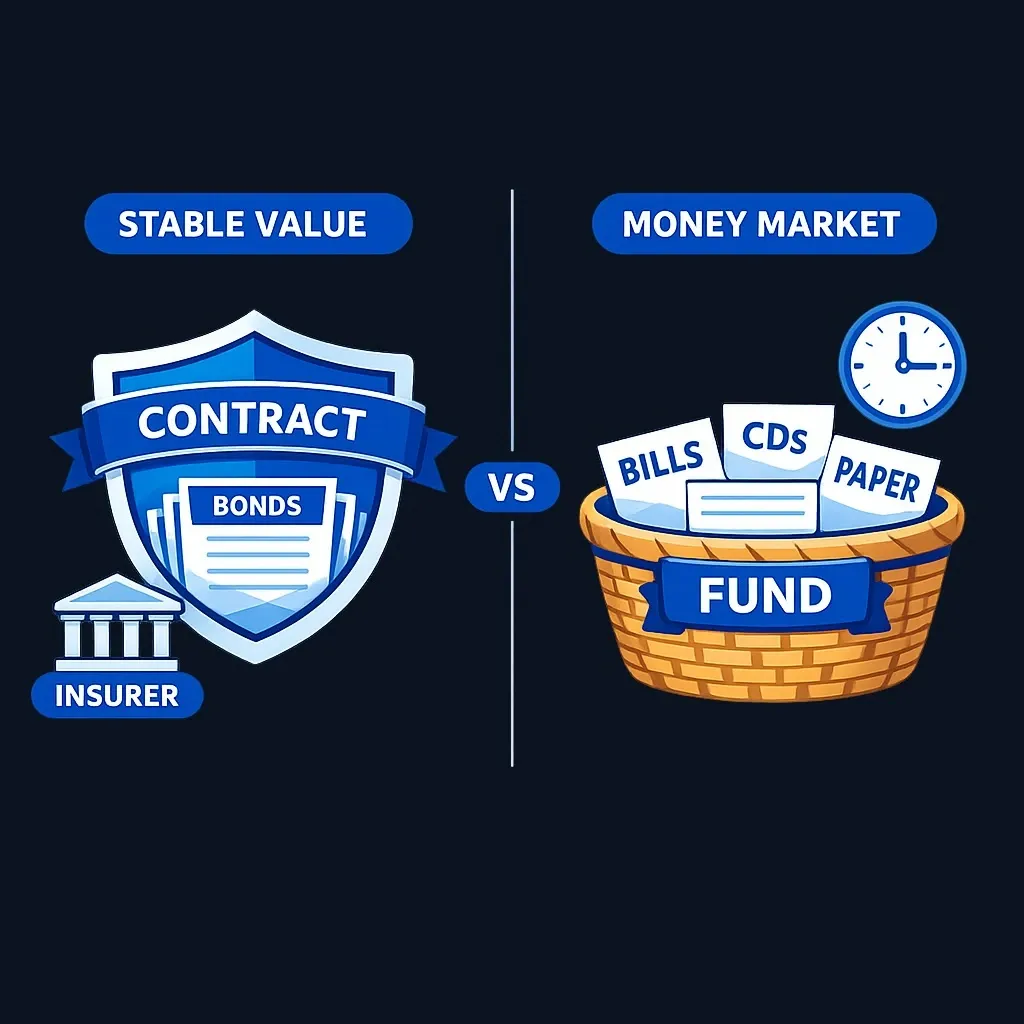
The Investor.gov money-market guide distinguishes money market funds from insured deposit accounts. A money market deposit account at a bank is a different product.
Read withdrawal restrictions
Stable value is not one uniform product. Fidelity’s workplace-investment glossary describes fixed-income investments paired with contracts intended to support principal stability. The assets, contract providers, fees, and conditions still matter.
Restrictions are real but plan-specific. For example, a 2026 General Dynamics filing describes a 90-day stay in a noncompeting fund before moving stable-value money into specified competing options. That is evidence about the plans described in that filing, not a universal 90-day rule for every stable value fund.

Ask for the current fact sheet and contract restrictions. Check what happens when you rebalance, leave employment, or the employer changes plan providers.
Compare net yield and intended use
Use the same date when comparing yields and account for fees. A higher historical return does not establish a better current offer. For money needed soon, the ability to access it under the actual rules may matter more than a small yield difference.
Suppose two options show net annualized yields of 4.0% and 3.7% on the same date. On $20,000, the 0.3 percentage-point difference would be about $60 over a year if both rates and the balance stayed unchanged. Actual yields can change, so that is a scale comparison, not a return forecast. A transfer restriction that conflicts with your planned use may matter more than that hypothetical difference.
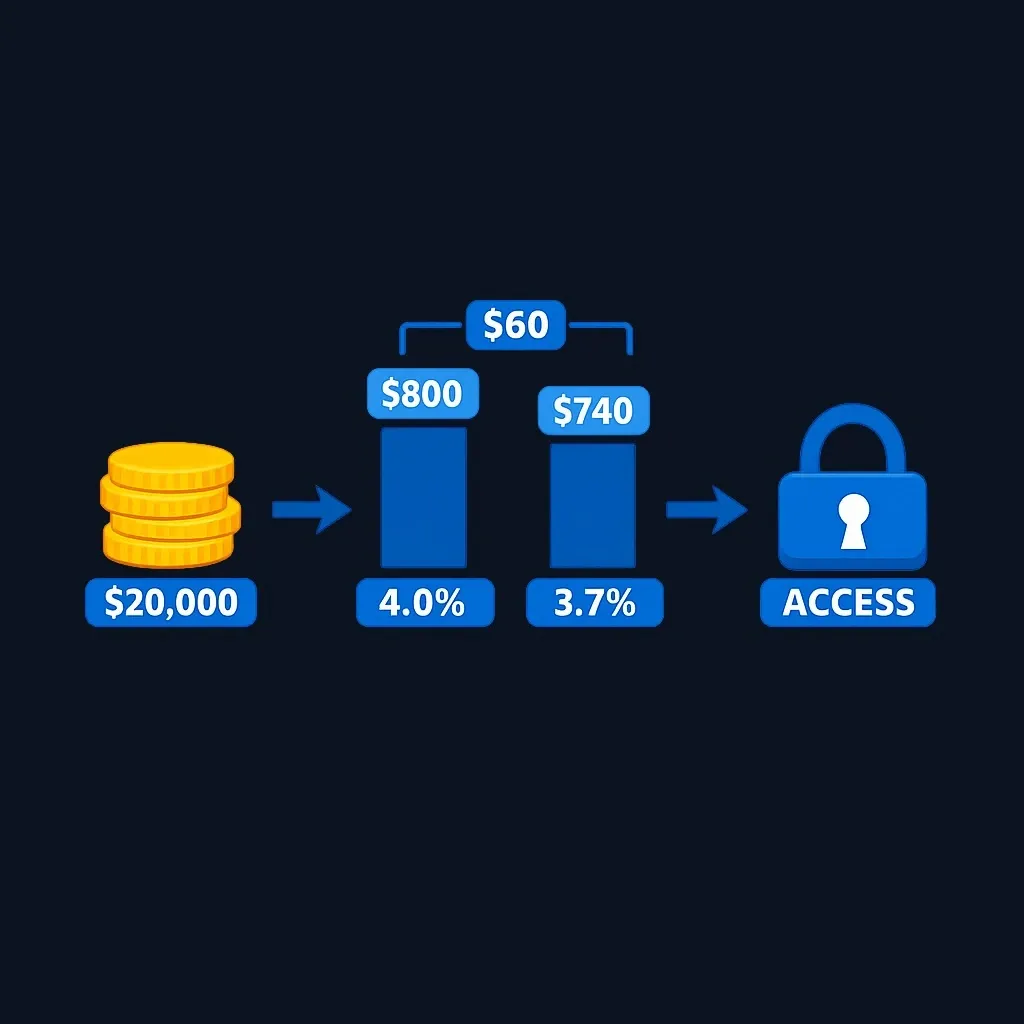
Also distinguish investment liquidity from retirement-account withdrawal rules: being able to sell a fund inside a 401(k) does not automatically let you withdraw from the plan without consequences.
Choose based on the role of the money, the product's protections, and its restrictions—not simply the word “stable” or “cash.”
Compare the roles inside the portfolio
First decide whether this allocation is for near-term spending, a conservative part of retirement savings, or a temporary place for money awaiting investment. That purpose affects how much weight to place on yield, stability, access, and the ability to move into another fund.
A stable value option may only be available through a particular retirement plan. Leaving the employer or rolling money to an IRA can therefore change the available choices. Review plan access and distribution rules alongside the investment's own terms. Money described as liquid inside the plan may still be subject to retirement-account withdrawal rules.
For a money market fund, identify the fund type and its investments. Do not confuse a money market mutual fund with an insured money market deposit account at a bank. Similar names do not establish the same protections.
Practice investing with Finelo
Build practical investing skills with guided lessons, simulator practice, and structured challenges.
Read the yield together with fees and restrictions
Compare current disclosures using the same date and understand what each quoted yield measures. A stable-value crediting rate and a money market fund's quoted short-term yield are not necessarily calculated in the same way. Check whether expenses have already been reflected so costs are not subtracted twice.
Ask what events could affect the stable value contract's book-value treatment and what restrictions apply to transfers into competing options. For the money market fund, check redemption terms and the risks described in the prospectus. Capital preservation is an objective with defined limits, not an unconditional promise that every transaction can occur at any time without loss.
Review the choice when the purpose of the money changes. An allocation suitable for retirement spending several years away may need a different access plan when distributions are approaching. The investment and the account holding it both shape that plan.
What is a Stable Value Fund?
A stable value fund is a collective investment option commonly offered inside retirement plans that seeks capital preservation and steady crediting rates over time. Managers invest primarily in short- and intermediate-term fixed-income securities and pair that portfolio with contracts (often called guaranteed investment contracts or wrap contracts) that smooth interest-rate gains and losses, which aim to reduce fluctuations in credited participant values under the contract terms. Concrete point: stable value designs amortize gains and losses so credited returns change slowly, not day-to-day. Decision point: because returns are smoothed by contract terms, short-holding-period performance can differ from the underlying bond portfolio. Caveat: stable value funds are typically plan-specific; employer plan rules and contract terms affect access and behavior. Example: In a 401(k), a stable value fund can act like a conservative "core" fixed-income option for employees who want capital stability and a crediting rate they can compare with available short-term cash options—subject to plan rules and the contract’s liquidity provisions.

What is a Money Market Fund?
A money market fund is a mutual fund that invests in very short-term debt instruments (commercial paper, Treasury bills, certificates of deposit and similar instruments). Its stated objective is liquidity and preservation of capital while providing a modest yield; share price stability is a design goal but not an absolute guarantee. Concrete point: money market funds trade daily and are commonly used for short-term cash management both inside and outside retirement plans. Decision point: because holdings mature quickly, money market yields react faster to changes in short-term interest rates than funds with longer-dated bonds. Caveat: structure and investor protections vary by fund type and jurisdiction. Example: An investor considering a money market fund for part of an emergency reserve should check redemption cutoffs, settlement, and cash access, and compare those with an insured deposit account.
How to compare your options
Use this short checklist to decide which option fits your situation:
- Time horizon: When must the cash arrive? Check redemption cutoffs, settlement, and bank-transfer timing for either option rather than assuming same-day access.
- Location: Is the money inside an employer plan? Stable value funds are generally plan offerings.
- Liquidity needs: Will you need to move funds frequently or on short notice?
- Transparency and simplicity: Do you prefer simple daily NAV behavior or are you comfortable with contract structures?
- Costs and fees: Compare plan disclosures and fund prospectuses for explicit fees and wrap costs (plan documents will show participant fees).
- Plan restrictions: Check for employer plan rules such as an equity-wash requirement when moving between competing cash options—plan sponsors sometimes select money market alternatives and set transfer rules for participants.
Read the plan and fund documents for withdrawal and competing-fund transfer restrictions. Requirements belong to the particular plan and contract; do not assume one provider’s waiting period applies universally.
When to choose each option
- Consider a stable value fund when:
- You’re saving inside a 401(k) or similar plan and want a conservative, steady crediting rate over quarters or years.
- You can accept plan-level liquidity rules and occasional transfer limits in exchange for smoother returns.
- Your goal is capital preservation, and the actual crediting rate, fees, and restrictions fit that goal. A higher return than cash alternatives is not assured.
- Consider a money market fund when:
- You need high liquidity and easy redemptions for near-term spending or an emergency cushion.
- You hold cash outside employer plans and want simple daily access or sweep mechanics.
- You prefer transparent daily NAV behavior and holdings that mirror short-term rates.
Hypothetical example: Alice has a 401(k) and plans to retire in 8 years. She wants conservative exposure for a portion of her balance but may reallocate only infrequently. A stable value option inside her plan could provide smoother crediting over that period. Bob keeps his emergency fund in a taxable brokerage account and needs quick access—he chooses a money market fund for daily liquidity. Key tradeoffs:

- Liquidity vs smoothing: Stable value funds trade some liquidity under the fund’s redemption rules and simplicity for smoother returns over time. Money market funds trade smoothing for liquidity under the fund’s redemption rules and simpler mechanics.
- Plan constraints: Stable value availability and transfer rules depend on the employer plan and contract language. The General Dynamics filing linked above illustrates one plan’s competing-fund restriction; the rule in your plan may differ.
- Complexity and transparency: Stable value funds use wrap contracts and amortization accounting. This makes performance drivers less transparent to individual participants compared with money market holdings.
- Potential costs: Fees and wrap contract costs vary by fund and plan. Review your plan’s disclosures and fund notices rather than assuming one option is always cheaper.
Common mistakes and how to avoid them:
- Mistake: Treating a stable value fund as fully liquid like a bank account. Fix: Check your plan’s transfer and withdrawal rules before assuming immediate access.
- Mistake: Assuming higher short-term yields will persist. Fix: Evaluate how each vehicle reacts to interest-rate changes and match your horizon to the product.
- Due diligence tip: Review the fund’s participant disclosures. The plan’s summary plan description, and the fund fact sheet for fees and restrictions.
How should you choose between stable value and a money market fund?
There’s no single best choice—stable value funds generally suit long-dated cash inside employer plans when you prioritize steady credited returns and can accept plan rules; money market funds can suit short-term cash needs when their redemption and transfer timing meets the need.
What supports principal stability in a stable value fund?
Stable value funds use contract structures (wraps or guarantees) around a fixed-income portfolio to smooth short-term volatility and provide steadier credited rates. The exact protections and terms depend on the fund’s contracts and plan provisions, so read the fund and plan documents.
Can I lose money in a money market fund?
Money market funds aim to preserve capital but are not absolute guarantees. Redemption mechanics and risk characteristics vary by fund type; check the fund’s prospectus and disclosures for details.
How can I check whether my employer plan offers a stable value fund and what rules apply?
Look at your plan’s enrollment materials, the summary plan description, and the fund fact sheets. These documents explain whether a stable value option exists, transfer restrictions, and any equity-wash or competing-fund rules; ask the administrator which options count as competing funds and how any waiting period works. Final practical next step: review your plan’s fund fact sheets and the summary plan description, then match the option to your horizon, liquidity needs, and tolerance for contract complexity.
For insured deposit products rather than funds, compare IRA CD vs. regular CD: same investment, different account rules.
This guide covers U.S. rules. Finelo provides financial education, not personalized financial, investment, tax, or legal advice.
InvestingU.S. GuideFinancial Education
Practice investing with Finelo
Build practical investing skills with guided lessons, simulator practice, and structured challenges.
About the author
Finelo Team
The Finelo Team creates practical investing and trading education designed to help beginners learn faster with structured challenges, simulator practice, and bite-sized lessons.
Keep reading — Related articles

Investing
Tax-gain harvesting vs. tax-loss harvesting
Compare realizing investment gains with realizing losses, including holding periods, wash sales, offsets, and portfolio tradeoffs.
Finelo Team

Investing
Single-life vs. joint-life annuity
Compare income for one lifetime with continued payments to a survivor, using equal premiums and matching guarantee terms.
Finelo Team

Investing
Should you stop contributing to a 401(k) to pay off debt?
Balance required bills, debt interest, employer matching, vesting, and take-home pay before reducing retirement contributions.
Finelo Team