Last editorial review: September 28, 2026
IRA CD vs. regular CD: same investment, different account rules
A CD is a deposit product; an IRA is a tax account. Compare the separate tax, access, penalty, and deposit-insurance rules.
11 min read
Practice investing with Finelo
Build practical investing skills with guided lessons, simulator practice, and structured challenges.
Want to learn more?
Build practical investing skills with guided lessons, simulator practice, and structured challenges.
Explore FineloExplore Finelo's 28-day challenges
Turn learning into a daily habit with guided challenge paths.
An IRA CD is a certificate of deposit held inside an individual retirement account. A regular CD is held outside a retirement account. The CD sets the deposit's rate and maturity terms; the account determines the tax and retirement rules.
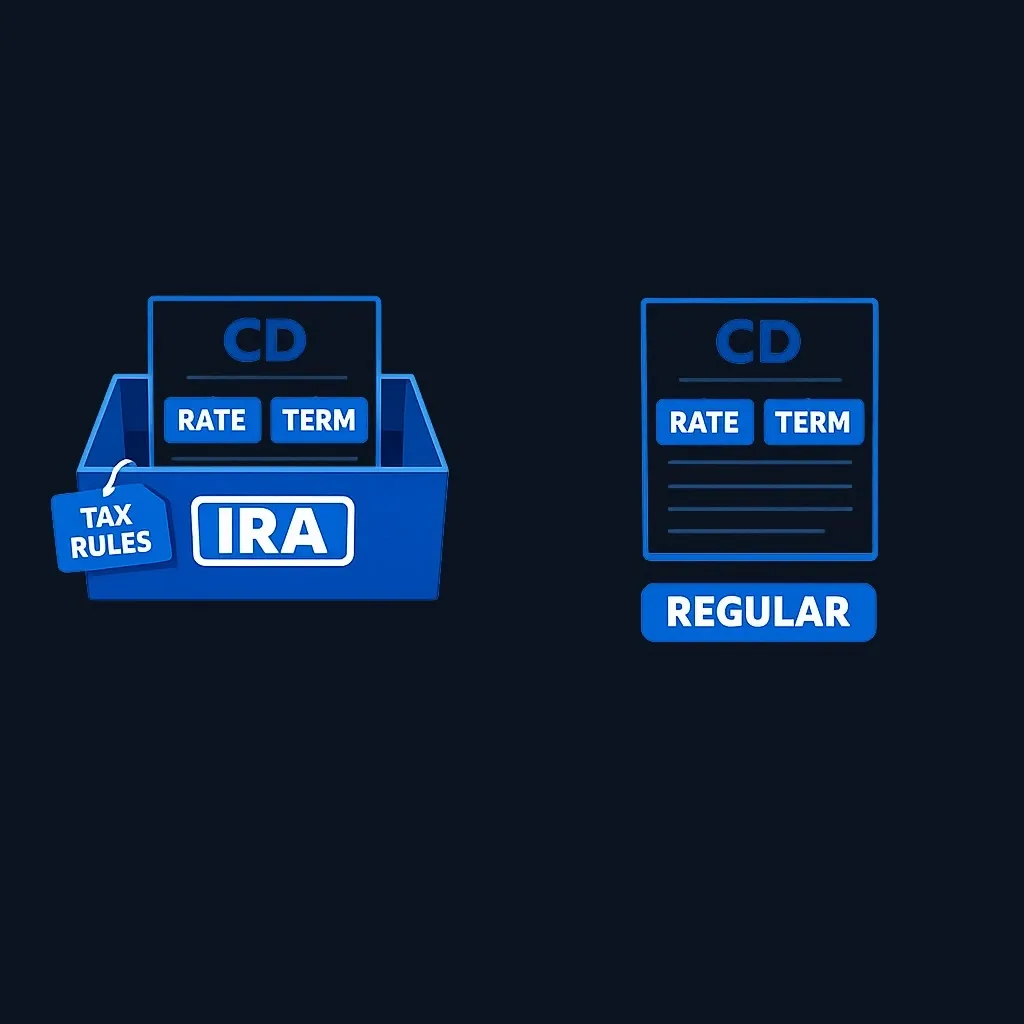
That distinction explains why an IRA CD reaching maturity does not automatically let you withdraw the money without tax consequences.
Compare the layers
| Feature | IRA CD | Regular CD |
|---|---|---|
| Tax rules | Traditional or Roth IRA rules | Interest is generally taxable under ordinary interest-reporting rules |
| Contributions | New IRA contributions follow eligibility and annual limits; investing existing IRA funds is different | No IRA contribution limit |
| Access | CD terms plus IRA distribution rules | CD withdrawal terms |
| Suitable purpose | A conservative holding within retirement savings | Savings for a goal outside retirement accounts |
The IRS IRA overview explains the account types. Traditional IRA tax deferral and qualified Roth IRA withdrawals should not be described as the same tax treatment.
Two different early-withdrawal costs
A bank may charge a CD early-withdrawal penalty. An IRA distribution can separately trigger income tax and, depending on age and exceptions, an additional tax. One does not replace the other.
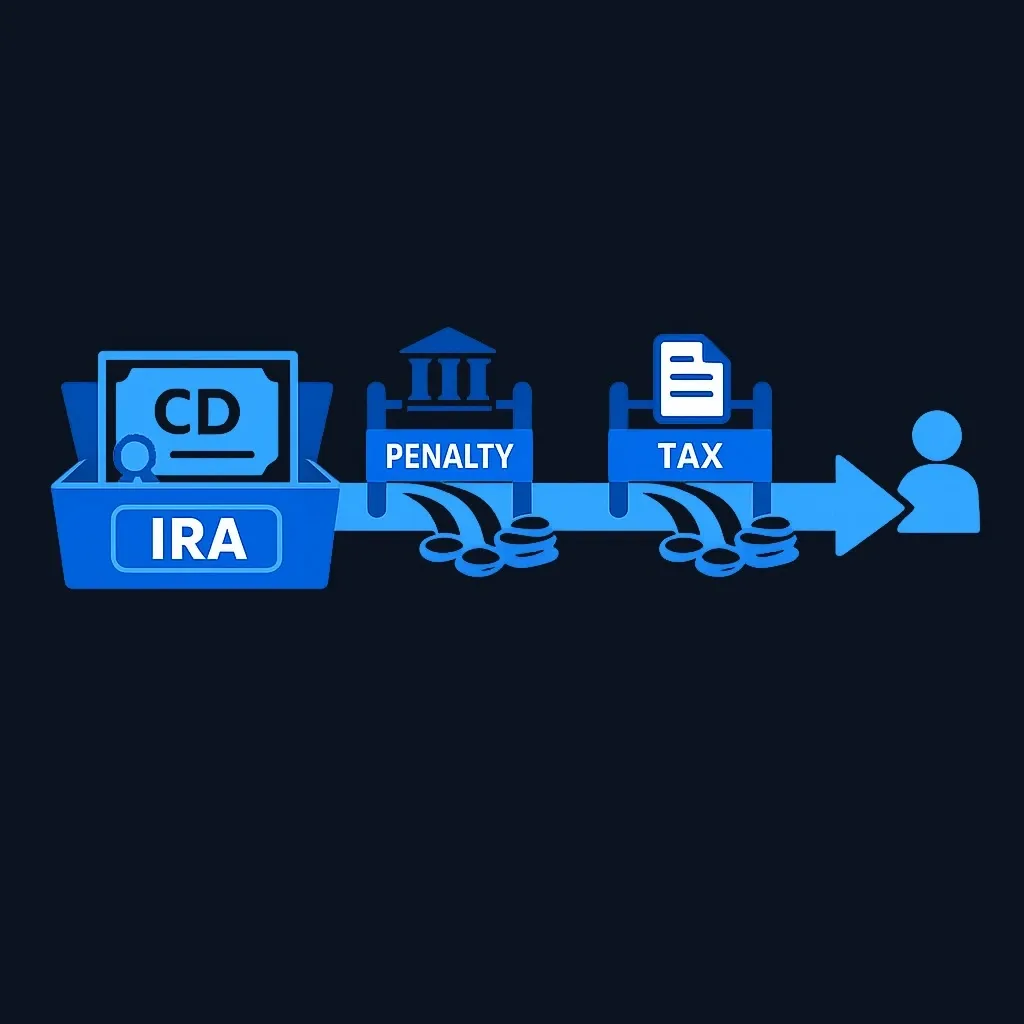
When a CD matures, you may be able to leave or reinvest the proceeds inside the IRA. Taking the money out of the IRA is a separate step. Read the renewal and grace-period terms; the CFPB explains CD renewals.
Match the maturity to your needs
For money needed outside retirement, an ordinary CD may be easier to use. Within an IRA, consider required withdrawals, inflation, and the rest of your investments before locking up funds.
Confirm deposit-insurance eligibility and applicable ownership-category limits with the institution. An IRA label does not itself insure an investment, and a brokered CD can have different sale and access mechanics from a CD purchased directly from a bank.
Treat maturity and withdrawal as separate decisions
When a CD matures, the deposit's term ends. If the CD is inside an IRA, the money can remain inside the IRA rather than becoming a personal withdrawal. You might renew, buy another permitted investment, or hold cash within the account. The tax result depends on the account transaction, not merely on the arrival of the maturity date.
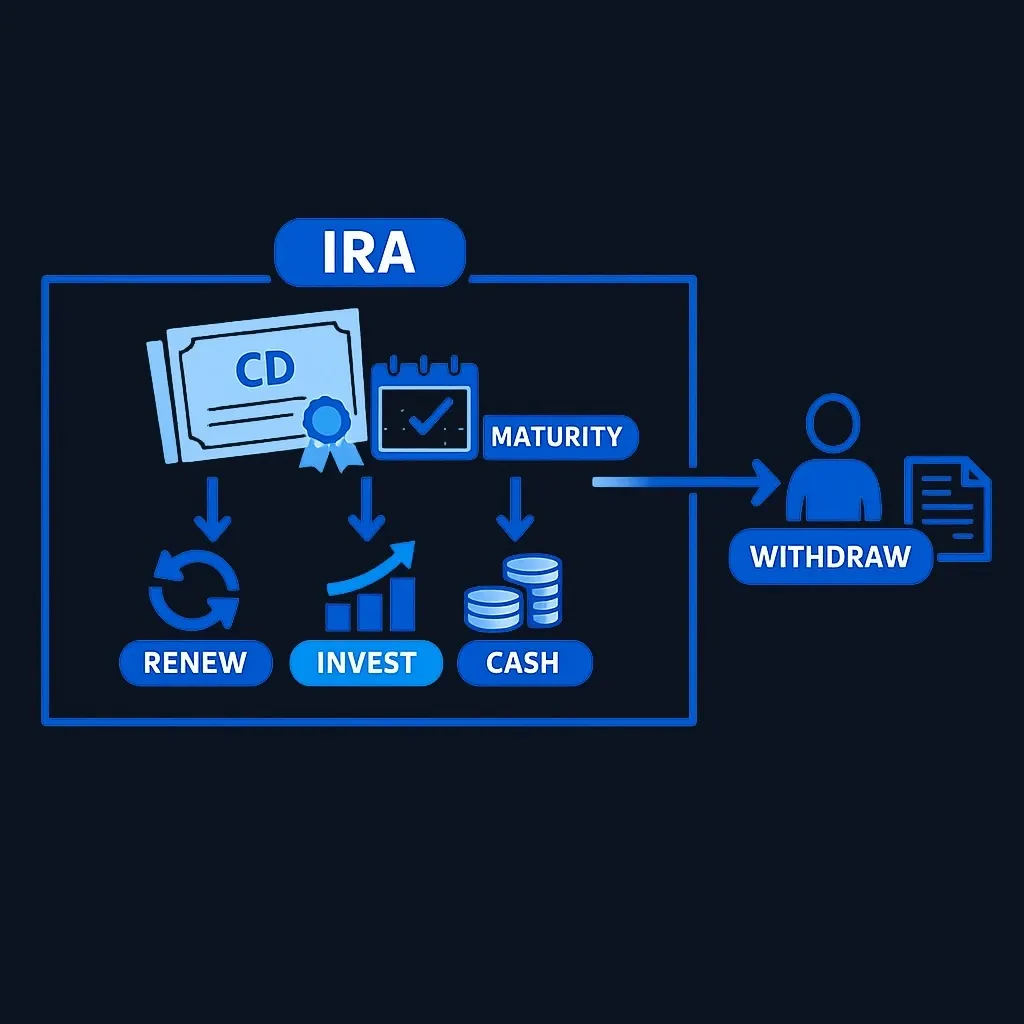
Before maturity, there can be two separate questions: what the bank charges for ending the CD early, and how a distribution from the IRA is taxed. Avoid assuming one fee replaces the other. Ask the institution to distinguish a CD redemption kept inside the IRA from money paid out to you.
Match the term to the purpose of the money
A fixed term can be useful for a known future expense, but money needed unexpectedly may be less convenient to access. An emergency reserve and a planned purchase fund are not identical. Check how much accessible cash remains outside the CD and whether the early-access terms fit the intended use.
Staggered maturities can spread access dates. For example, instead of committing all savings to one term, a saver could use separate deposits that mature at different times. That changes the access schedule; it does not remove tax rules, early-withdrawal charges, or deposit-insurance limits.
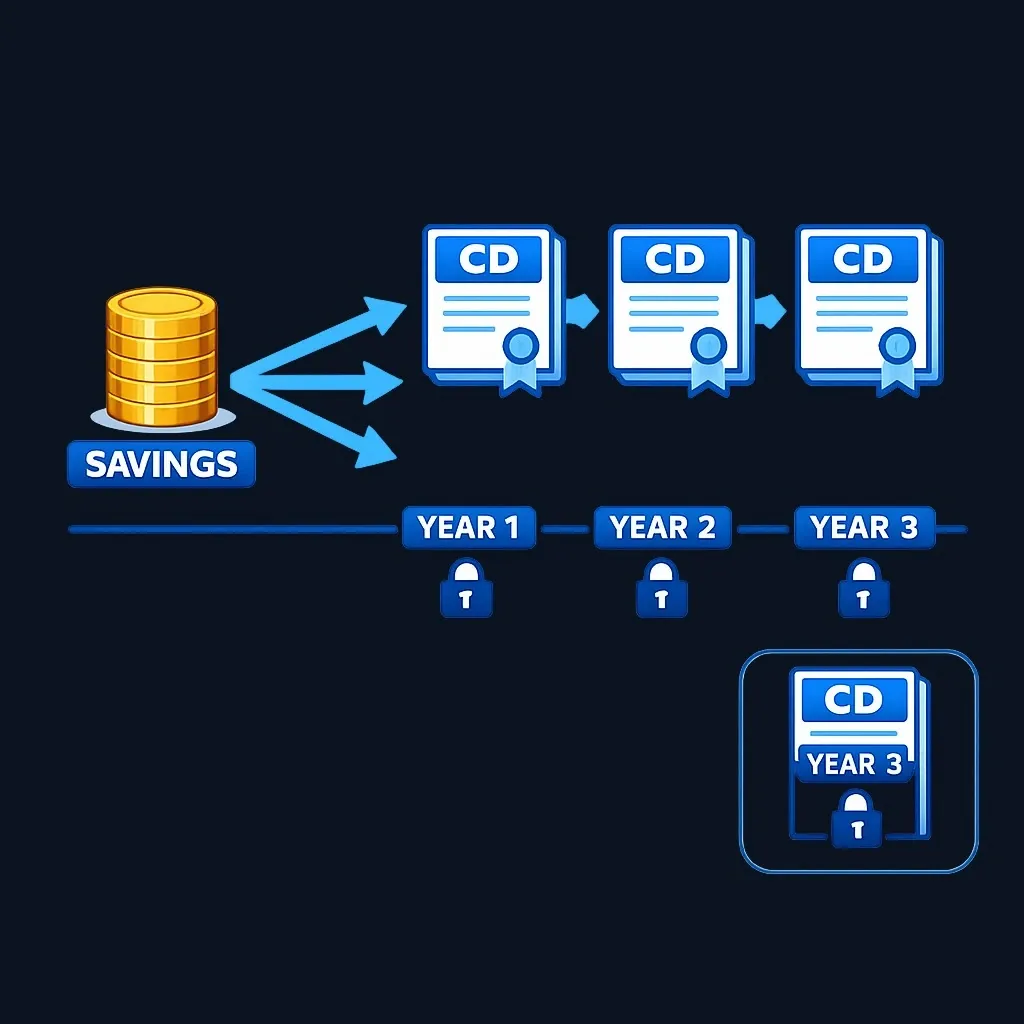
At renewal, compare the new rate and term instead of assuming they match the old contract. Set a reminder for the maturity notice and any grace period. For IRA money, also coordinate maturities with required distributions or other planned withdrawals when applicable, so a payment obligation does not force an avoidable early redemption.
Practice investing with Finelo
Build practical investing skills with guided lessons, simulator practice, and structured challenges.
What is an IRA CD?
An IRA CD is simply a certificate of deposit purchased inside an Individual Retirement Account. The key difference from a standalone CD is the account wrapper: the CD’s interest and principal sit within the IRA and follow that IRA’s tax rules. The IRS states that IRAs let you make tax-advantaged (for example, tax-deferred) investments to help provide retirement security.
What that means in practice
- The CD functions like a normal CD while it’s inside the IRA: it has a fixed term and a stated rate.
- The growth on the CD is subject to the IRA’s distribution and tax rules rather than immediate taxation at the moment the bank credits interest.
Example: If you’re saving specifically for retirement and want to keep part of your retirement balance in a predictable low-volatility instrument, an IRA CD lets you lock a term rate while the account follows IRA tax treatment. This example is a decision illustration, not tax advice.
What is a Regular CD?
A regular CD is a time deposit you buy at a bank or credit union and hold in a standard (taxable) deposit account. This comparison focuses on ordinary fixed-rate CDs, which pay the agreed rate for a set term. Other CD designs can have different rate and access terms. At the end of the term you can usually let the CD renew or roll it over into a new CD — a rollover or renewal typically happens at term maturity.
What that means in plain terms
- You buy a CD, lock the funds for the chosen term, and receive the agreed interest.
- The CD sits outside retirement accounts, so its financial treatment follows ordinary (non-IRA) account rules. That makes regular CDs a common choice for medium-term, non-retirement savings.
Example: A regular CD can hold money for a known future expense outside retirement accounts. Keep enough emergency cash readily accessible so an unexpected bill does not force early redemption.
Key Differences Between IRA CDs and Regular CDs
Tax treatment and account rules
- IRA CD: Growth is subject to the IRA’s tax and distribution framework. IRAs allow tax-advantaged investing intended for retirement.
- Regular CD: Held outside an IRA. Interest and consequences follow standard taxable account rules (tax treatment depends on your jurisdiction and situation).
Account purpose and contribution rules
- IRA CD: The CD is inside an IRA, so contributions to the IRA are subject to the IRA’s contribution rules and limits (see the IRS for details).
- Regular CD: No IRA contribution limits apply because a regular CD is funded from non-IRA deposits.
Access and withdrawal considerations
- CD mechanics: Most CDs have a fixed term. At maturity you may renew or roll over the CD.
- IRA-specific withdrawal rules: Because an IRA CD sits inside an IRA, withdrawals are governed by the IRA’s distribution rules and any applicable age-based penalties or tax rules set by tax authorities — consult the official IRS guidance for how distributions work.
Interest rates and product choices
- Compare the issuer’s current APY, term, compounding, renewal terms, and early-withdrawal provisions. A published rate roundup is not an offer for your account.
Decision point: If you want retirement-tax treatment, the IRA wrapper changes how interest is taxed and how withdrawals are handled. For savings outside retirement, a regular CD avoids IRA distribution rules, but its own access restrictions and early-withdrawal charges still apply.
When to Choose an IRA CD
Use an IRA CD when the following assumptions fit your plan:
- Your primary goal is retirement savings and you want to use an IRA’s tax rules to shelter interest growth from immediate taxation.
- You are comfortable leaving money under IRA distribution rules until retirement or until you can access funds without penalties per IRA rules.
- You value predictable, low-volatility holdings inside your retirement portfolio and want part of that savings in fixed-term instruments.
Decision framework (three quick checks)
- Goal alignment: Is the money earmarked for retirement? If yes, an IRA CD may align better because the account’s whole purpose is retirement saving.
- Funding source: New IRA contributions must meet eligibility and annual limits. Buying a CD with money already inside the IRA is not a new contribution, and eligible rollovers do not use the annual contribution limit. See the IRS contribution rules.
- Liquidity tolerance: Are you willing to follow IRA distribution rules if you need to withdraw before retirement? If not, a regular CD avoids IRA distribution restrictions.
Example scenario
- Claire wants a safe, predictable holding inside retirement accounts. She places some retirement funds into an IRA CD with staggered maturities to avoid locking all funds at once. The IRA wrapper keeps CD interest within retirement tax rules. This scenario illustrates using CDs strategically inside a retirement account; it is illustrative, not advice.
When to Consider a Regular CD
Consider a regular CD when any of these are true:
- The money is for non-retirement goals or near-term needs and you prefer funds outside retirement-account rules.
- You want to avoid IRA distribution rules and can accept the CD’s own access terms. A standard CD is not a substitute for cash you may need immediately.
- You’ve already maxed out IRA contributions for the year but still want a secure, term-based saving vehicle.
Decision framework (three quick checks)
- Purpose: Is the savings goal outside retirement? Regular CDs are built for taxable savings goals.
- Contribution limits: Do you have more to save beyond IRA contribution caps? A regular CD is not subject to IRA annual contribution limits, though institution limits and deposit-insurance limits still matter.
- Withdrawal needs: Do you need a simpler path to access funds without IRA distribution rules? Regular CDs typically have CD-specific early withdrawal penalties handled by the bank, not IRA distribution law.
Example scenario
- Marco is saving for a down payment in three years. He chooses a regular CD ladder with staggered terms to match his timeline. This keeps funds accessible under bank CD rules rather than retirement distribution rules.
Tradeoffs and caveats
Key tradeoffs
- Tax rules vs. flexibility: An IRA CD brings retirement tax rules that can be favorable for long-term growth but reduce flexibility for early withdrawals. A regular CD offers easier non-retirement access but doesn’t give the IRA tax wrapper. See IRS guidance on IRAs.
- Contribution and funding limits: IRAs have contribution constraints and eligibility rules; regular CDs do not. Check IRS materials for contribution rules.
- Product selection: A CD’s interest rate depends on term and issuer. Compare institutions and verify current APYs directly with the bank or credit union.
Common mistakes and how to avoid them
- Mistake: Treating an IRA CD like a regular CD and ignoring IRA distribution implications. Fix: Confirm how withdrawals from the IRA would be taxed or penalized before you lock funds in a long CD term.
- Mistake: Assuming a CD will automatically renew into the same terms. Fix: Monitor maturity notices and understand rollover/renewal timing; CD rollovers/renewals commonly occur at maturity.
- Mistake: Comparing advertised rates without checking the issuing institution’s current published rate. Fix: Verify the bank’s official rate page before opening a CD.
Practical tip: If you want both tax-advantaged retirement savings and post-retirement liquidity staging, consider using an IRA CD ladder inside the IRA for retirement goals while keeping a separate regular CD ladder for shorter-term non-retirement needs.
What are the tax implications of IRA CDs versus regular CDs?
An IRA CD sits inside an IRA and is subject to the IRA’s tax and distribution framework; IRAs allow tax-advantaged investing intended for retirement. For a regular CD, interest is generally taxable; returning your original deposit does not itself create interest income. Reporting can be required before maturity, depending on how interest accrues. See IRS guidance on interest income.
How do I choose between an IRA CD and a regular CD?
Compare your goal (retirement vs. non-retirement), contribution capacity (IRA contribution rules), and liquidity needs. If the money is for retirement and you’re comfortable with IRA distribution rules, an IRA CD can be appropriate; for a non-retirement goal, compare a regular CD’s maturity and early-access terms with when you will need the money.
What happens if I need to withdraw money early from an IRA CD?
Two different costs can apply: the institution’s CD early-redemption charge and any income tax or additional tax on a distribution from the IRA. Redeeming a CD while keeping the proceeds inside the IRA is different from withdrawing them from the IRA. Traditional and Roth distribution rules also differ; check IRS guidance on the two account types.
Can I have both an IRA CD and a regular CD at the same time?
Yes — nothing prevents holding CDs inside an IRA and holding separate regular CDs in taxable accounts. Use each for the purpose that best matches its rules: retirement saving vs. taxable short-to-medium-term goals.
For options held inside an employer plan, compare Stable value fund vs. money market fund.
This guide covers U.S. rules. Finelo provides financial education, not personalized financial, investment, tax, or legal advice.
InvestingU.S. GuideFinancial Education
Practice investing with Finelo
Build practical investing skills with guided lessons, simulator practice, and structured challenges.
About the author
Finelo Team
The Finelo Team creates practical investing and trading education designed to help beginners learn faster with structured challenges, simulator practice, and bite-sized lessons.
Keep reading — Related articles

Investing
Tax-gain harvesting vs. tax-loss harvesting
Compare realizing investment gains with realizing losses, including holding periods, wash sales, offsets, and portfolio tradeoffs.
Finelo Team

Investing
Stable value fund vs. money market fund
Compare investment structure, contract protections, transfer restrictions, net yields, and access inside a retirement account.
Finelo Team

Investing
Single-life vs. joint-life annuity
Compare income for one lifetime with continued payments to a survivor, using equal premiums and matching guarantee terms.
Finelo Team


