This guide focuses on the shareholder math after a rights issue is announced. It complements rather than repeats a general rights-offering overview. The actual prospectus controls the subscription ratio, price, transferability, oversubscription privilege, deadlines, proration, withdrawal rights, foreign-holder treatment, and use of proceeds.
Rights Offering Math: TERP, Dilution, and the Exercise Decision
This guide focuses on the shareholder math after a rights issue is announced. It complements rather than repeats a general rights-offering overview. The actual prospectus controls the subscription ratio, price,…
9 min read
Practice investing with Finelo
Build practical investing skills with guided lessons, simulator practice, and structured challenges.
Want to learn more?
Build practical investing skills with guided lessons, simulator practice, and structured challenges.
Explore FineloExplore Finelo's 28-day challenges
Turn learning into a daily habit with guided challenge paths.
Calculate theoretical ex-rights price and value
If a holder can buy m new shares for every n old shares at subscription price S, and the pre-rights market price is P, a simplified theoretical ex-rights price is:
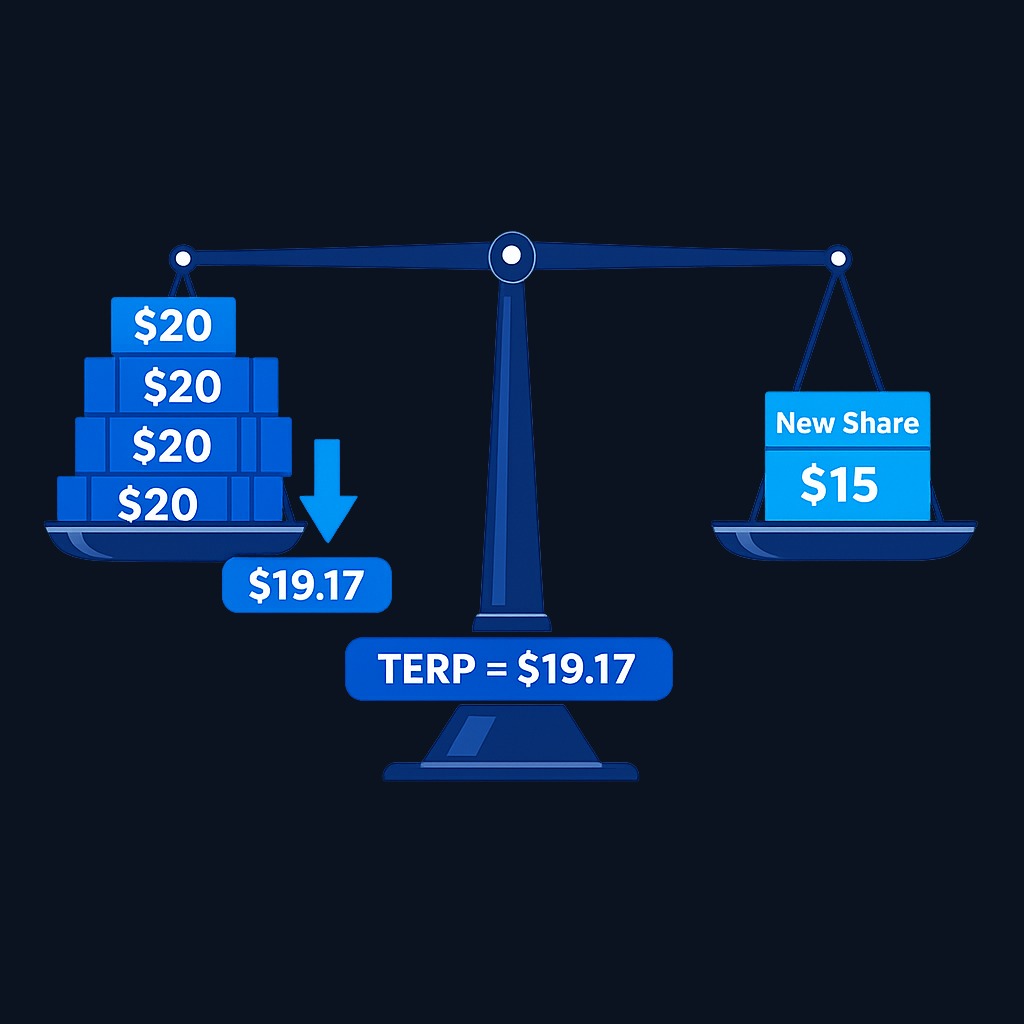
TERP = (n × P + m × S) ÷ (n + m)
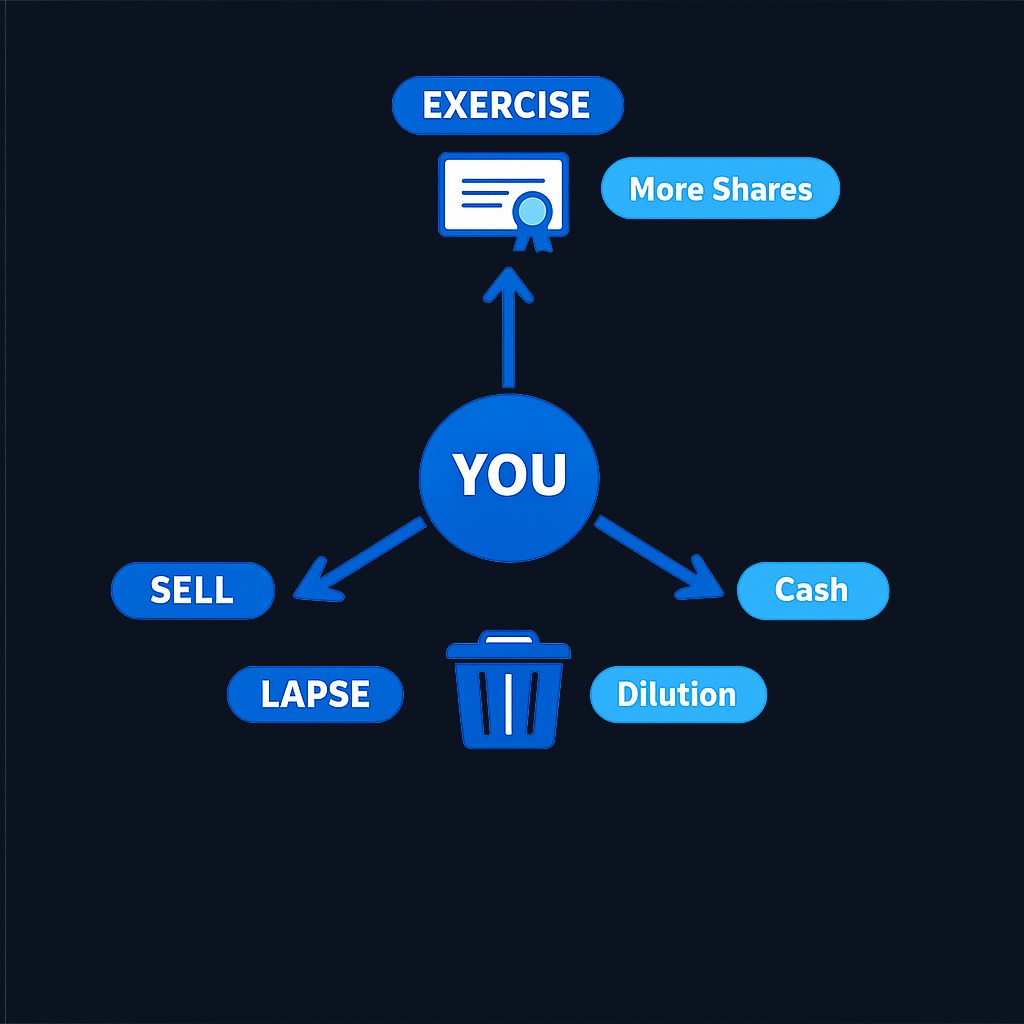
The theoretical value transferred from each old share is P − TERP. This is not a forecast: the stock can move, fees and taxes matter, and the issuer's prospects change when it raises and spends the cash. Compare three paths—exercise, sell transferable rights, or let them lapse—using the same ownership and cash assumptions. Also model nonparticipation dilution in voting percentage, earnings per share, and book value per share.
For U.S. federal tax questions, stock-rights basis and disposition rules can be complex; use IRS Publication 550 and professional advice for the specific offering.
A rights offering is a capital raise in which a company gives its existing shareholders the right, but not the obligation, to buy additional shares, usually at a discount to the market price and in proportion to what they already own. For shareholders, it is a decision point with three options: exercise the rights, sell them if they are transferable, or let them expire. This page is for investors who received a rights notice or want to understand the mechanics before it happens. Read how the process works, weigh the benefits against the dilution math, and check the decision framework below before your rights' expiration date.
How a rights offering works
When a company needs new equity capital, it can offer new shares to its current owners first. Each shareholder receives subscription rights based on a set ratio, for example one right for every five shares held on the record date. Each right allows the purchase of new stock at a fixed subscription price during a limited window, typically a few weeks.
The subscription price is normally set below the current market price. The discount compensates shareholders for the dilution the new shares create and gives them a reason to act before the window closes. After the offer period ends, unexercised rights usually expire worthless.
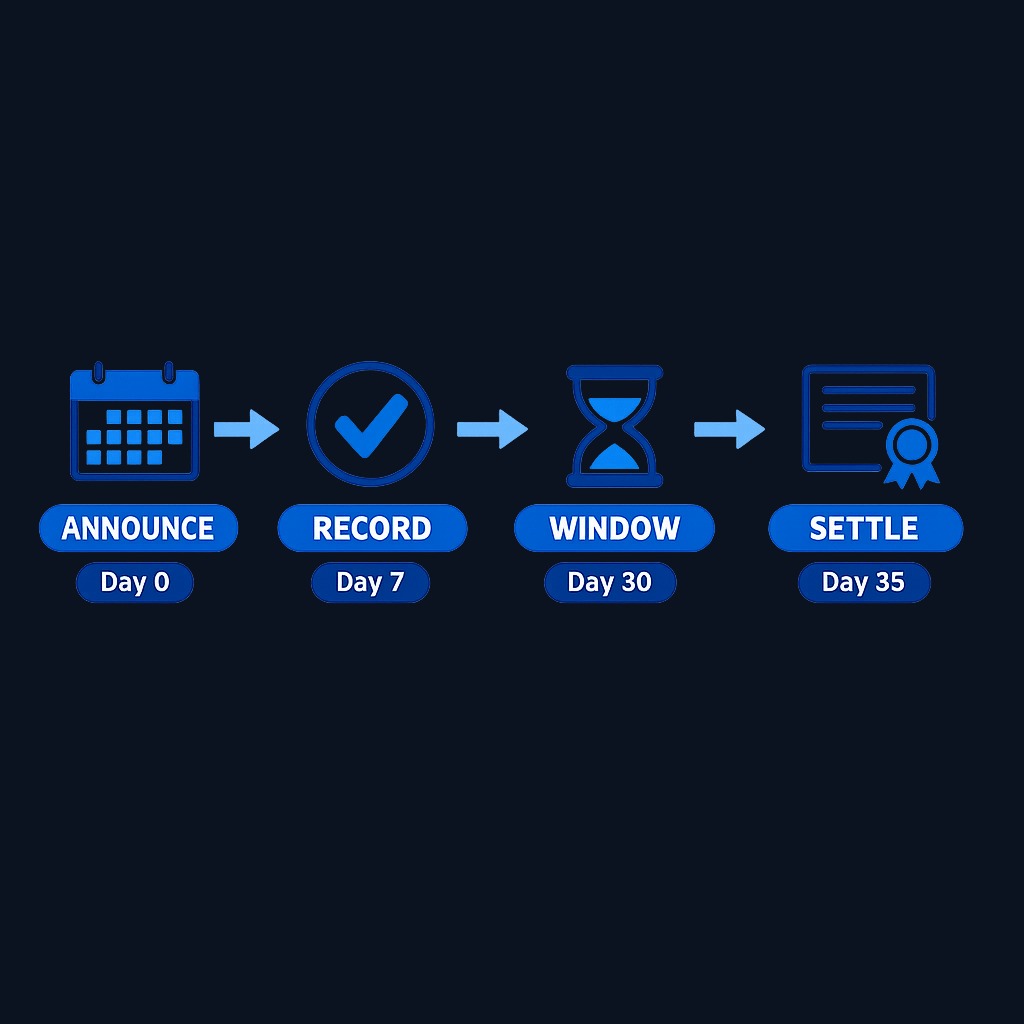
A typical timeline looks like this:
- Announcement. The company discloses the ratio, subscription price, record date, and expiration date.
- Record date. Only shareholders of record receive rights.
- Subscription window. Holders exercise, sell (if allowed), or ignore their rights.
- Settlement. New shares are issued, and the company receives the proceeds.
Companies use rights offerings to pay down debt, fund projects, or shore up the balance sheet while giving loyal shareholders first claim on the new stock.
Types of rights offerings
Transferable (renounceable) rights
The rights themselves trade on an exchange during the subscription window. A shareholder who does not want more shares can sell the rights and capture part of the discount's value as cash.
Non-transferable (non-renounceable) rights
The rights cannot be sold. The holder either exercises them or lets them lapse, which makes the decision more binary and makes ignoring the offer more costly.
Oversubscription privilege
Some offerings let participating shareholders apply for shares that other holders declined. This can matter in smaller offerings where insiders want to increase their stake at the subscription price.
Standby and backstopped offerings
In a backstopped offering, an underwriter or standby purchaser agrees to buy some or all unsubscribed shares subject to the agreement's conditions, caps, termination rights, and fees. It can increase funding certainty but is not an unconditional guarantee; read the standby purchase or underwriting agreement.
Benefits of participating
- Discounted purchase price. The subscription price usually sits below the market price at announcement, so exercising can mean buying at a discount, though the market price can move during the window.
- Protection against dilution. Exercising in proportion to your holding keeps your ownership percentage roughly intact as the share count grows.
- No commission in many cases. Shares bought through the subscription agent often carry no brokerage commission.
- Priority access. Existing owners get the first opportunity before any leftover shares are placed elsewhere.
Risks and drawbacks
- Dilution if you do nothing. The new shares reduce every non-participant's ownership percentage and can pressure earnings per share.
- A discount is not free money. The stock often trades lower after the announcement, because the market reprices for the larger share count. The theoretical ex-rights price sits between the old market price and the subscription price.
- A signal worth reading. Companies raising emergency equity may be under financial stress. The reason for the raise matters more than the discount.
- Concentration risk. Exercising means putting new money into a single company you already own, which increases portfolio concentration.
- Expiration risk. Rights are time-limited. Missing the deadline in a non-transferable offer forfeits the entire value of the rights.
Practice investing with Finelo
Build practical investing skills with guided lessons, simulator practice, and structured challenges.
A worked example
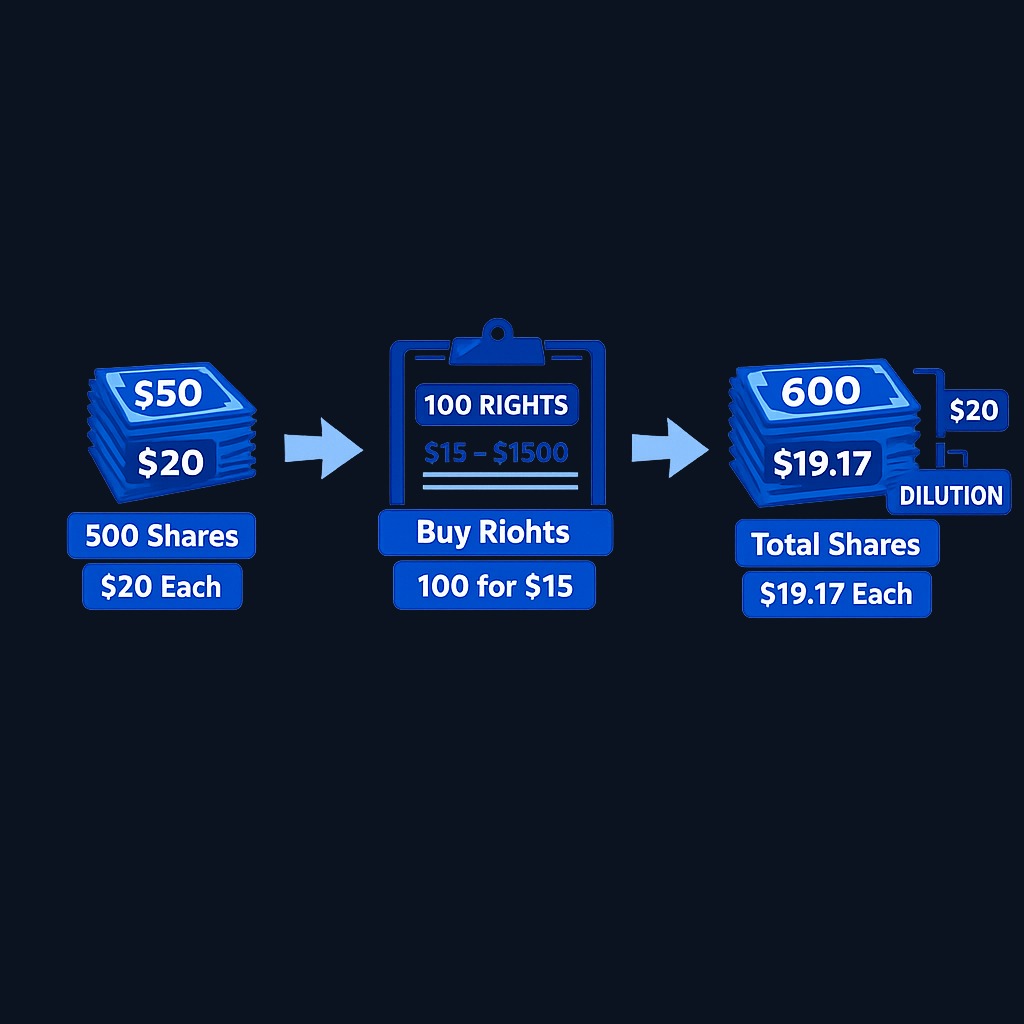
Suppose you own 500 shares of a company trading at $20. The company announces a 1-for-5 rights offering at a $15 subscription price. You receive 100 rights, letting you buy 100 new shares for $1,500.
| Choice | What happens | Outcome |
|---|---|---|
| Exercise all rights | You invest $1,500 for 100 discounted shares | Ownership percentage maintained; more capital at risk |
| Sell the rights (if transferable) | You collect roughly the rights' market value in cash | Ownership diluted, but you monetize the discount |
| Let rights expire | No action, no new money | Ownership diluted; the rights' value is lost |
After the raise, the share price typically adjusts toward the ex-rights level, in this ratio roughly $19.17, reflecting the new shares issued at $15. The right's rough theoretical value is the gap between that adjusted price and the subscription price.
Legal considerations and compliance
In the United States, rights offerings by public companies involve registered securities or an applicable exemption, and the terms are laid out in a prospectus or prospectus supplement. Before deciding, read the offering documents: they disclose the ratio, pricing, dilution math, intended use of proceeds, and any standby arrangements. You can retrieve these filings for free through the SEC's EDGAR database, which hosts every registered company's disclosure documents. Cross-border holders should also confirm eligibility, since some offers exclude residents of certain jurisdictions.
What to know before deciding
- Why is the company raising money? Growth funding and opportunistic debt paydown read very differently from a distressed capital call.
- What is the real discount? Compare the subscription price to the theoretical ex-rights price, not to yesterday's close.
- Can you sell the rights? Transferability changes the decision from "buy or lose" to "buy or monetize".
- Does the position still fit your plan? Adding shares should reflect conviction in the business, not just reluctance to be diluted.
- What is the deadline? Note the expiration date and your broker's earlier internal cutoff, which is often a day or two before the official close.
Decision framework: exercise, sell, or let lapse
- Confirm the terms. Ratio, subscription price, expiration, transferability, and oversubscription rights.
- Judge the business case. Would you buy this stock today at the subscription price with fresh money? If yes, exercising is coherent.
- Check your allocation. If the position is already large, selling transferable rights keeps your risk in balance while capturing value.
- Act before the cutoff. Instruct your broker early; missed deadlines are the most common and most avoidable error.
- Reassess afterward. Once the new shares settle, revisit position size and your original thesis at the post-offering price.
FAQ
What is a rights offering in simple terms?
It is an invitation for existing shareholders to buy newly issued shares at a set price, usually below market, in proportion to what they already own, within a limited time window.
Is a rights offering good or bad for shareholders?
It depends on the purpose and the terms. It can be a fair way to raise capital that lets owners avoid dilution at a discount, or it can signal financial stress. The offering documents and the use of proceeds tell you which case you are in.
What happens if I ignore a rights offering?
Your rights expire, your ownership percentage falls as new shares are issued, and any value the rights carried is lost. In transferable offers, selling the rights is usually better than doing nothing.
Are subscription rights taxable?
Tax treatment depends on the offer's structure and your jurisdiction, and receiving rights is often not a taxable event by itself while selling or exercising can have consequences. Confirm the specifics with the offering documents and a qualified tax professional.
Conclusion and next steps
A rights offering hands every shareholder a deadline-bound choice: put in more capital at a discount, monetize the opportunity if the rights trade, or accept dilution. The right answer depends on why the company is raising money, how the discount compares with the ex-rights price, and whether a larger position fits your plan. Treat the rights notice as a prompt to re-underwrite the investment, not as an automatic buy. If you are still building the vocabulary to read offering terms with confidence, the Finelo app turns concepts like dilution, record dates, and subscription pricing into short, practical lessons.
InvestingFundamental AnalysisBeginner
Practice investing with Finelo
Build practical investing skills with guided lessons, simulator practice, and structured challenges.
About the author
Finelo Team
The Finelo Team creates practical investing and trading education designed to help beginners learn faster with structured challenges, simulator practice, and bite-sized lessons.
Keep reading — Related articles

Investing
Yield to Maturity: Formula, Example & Key Risks
Yield to maturity, or YTM, is the annualized return implied by a bond’s current price, coupon payments, face value, and time remaining until maturity—assuming the bond makes all scheduled payments…
Finelo Team
Investing
WACC Formula: How to Calculate Weighted Average Cost of Capital
The WACC formula is WACC = (E ÷ V × Re) + (D ÷ V × Rd × (1 − Tc)). It estimates a company’s blended cost of financing from equity and debt, weighted by how much each source contributes to the…
Finelo Team
Investing
Tracking Error: Formula, Example & Interpretation
Tracking error measures how much an investment’s returns fluctuate away from a benchmark’s returns.
Finelo Team