A beginner-friendly guide to choosing broad, low-cost ETFs by goal, risk tolerance, fees, diversification, and time horizon — without chasing a single perfect ticker.
•16 min read
Practice investing with Finelo
Build practical investing skills with guided lessons, simulator practice, and structured challenges.
For most beginners, the “best ETFs to invest in” are usually broad, low-cost, diversified index ETFs rather than narrow funds focused on one industry, theme, or short-term trend. A beginner-friendly starting point often includes one or more of these categories: a total U.S. stock market ETF, an S&P 500 ETF, a total international stock ETF, a bond ETF, or an all-in-one balanced ETF.
Explore Finelo's 28-day challenges
Turn learning into a daily habit with guided challenge paths.
This page is for new investors who want to understand exchange-traded funds before buying anything. It is educational, not financial advice. Before investing, verify each ETF’s current expense ratio, holdings, risks, tax treatment, and suitability for your own situation with official fund documents or a qualified professional.
A practical next step: learn the ETF basics first, compare a few broad funds, then practice building a sample portfolio before using real money. If you want a structured way to keep learning, you can explore Finelo’s investing education resources at Finelo or review the learning app page at https://finelo.com/app.
Intent summary: what beginners usually mean by “best ETFs”
When people search for the best ETFs to invest in for beginners, they are rarely asking for a single ticker that works for everyone. More often, they want to know which ETFs are simple enough to understand, diversified enough to reduce single-company risk, and inexpensive enough that fees do not quietly eat into long-term results.
That means the better question is: Which type of ETF fits your goal, time horizon, and risk tolerance? A 25-year-old investing for retirement may look at broad stock market ETFs differently than someone saving for a near-term goal. A beginner who wants hands-off simplicity may prefer an all-in-one fund, while another may want to learn by combining U.S. stocks, international stocks, and bonds.
This article covers the related beginner questions in one place: what ETFs are, how they compare with stocks and mutual funds, which ETF categories are commonly used by new investors, what costs and risks to check, and how to take a careful first step.
What are ETFs?
An ETF, or exchange-traded fund, is an investment fund that holds a basket of assets, such as stocks, bonds, or other securities, and trades on an exchange like a stock. When you buy shares of an ETF, you are buying a piece of that fund rather than buying each individual company or bond directly.
Many ETFs track an index. For example, an S&P 500 ETF aims to follow an index of large U.S. companies, while a total market ETF may hold a much broader slice of the stock market. Other ETFs focus on bonds, dividends, sectors, commodities, international markets, or specific strategies.
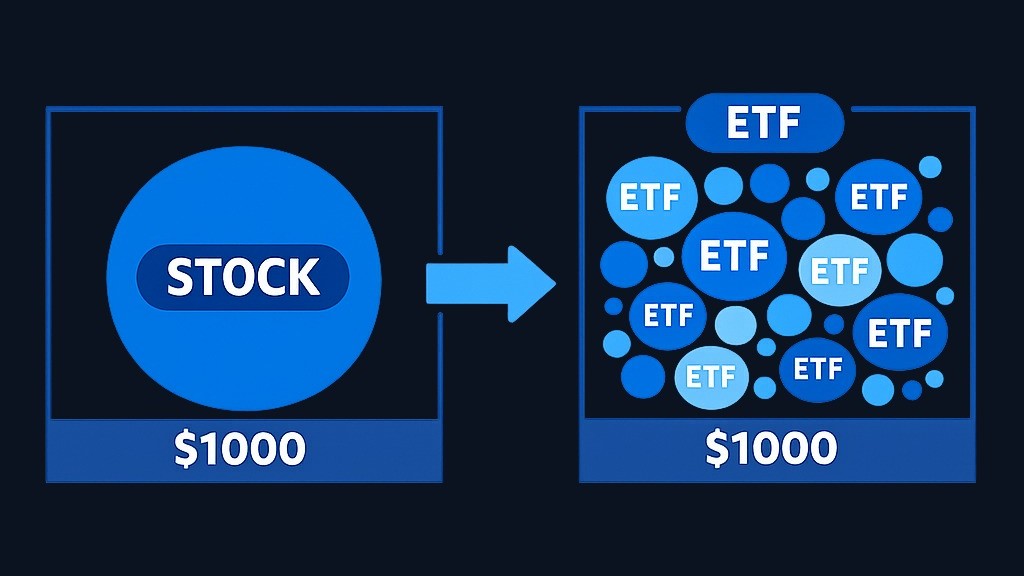
For beginners, the structure matters because it can make diversification easier. Instead of choosing one or two individual stocks, an investor may use a single ETF to get exposure to hundreds or even thousands of securities. That does not remove risk, but it can reduce dependence on the performance of any one company.
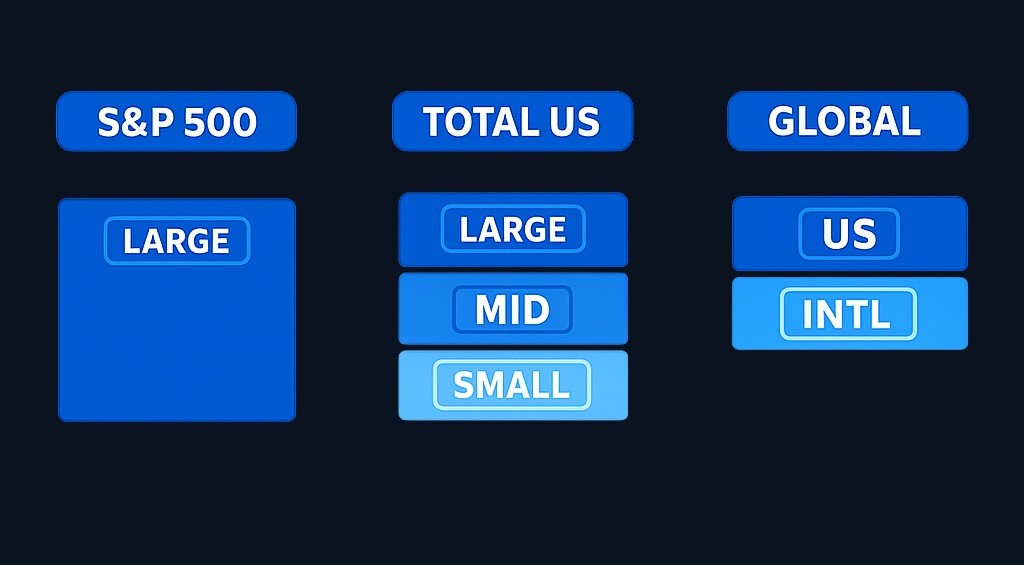
How a broad ETF spreads your investment across many companies instead of relying on one or two stocks A simple example: if you buy shares of a broad U.S. stock market ETF, your investment may be spread across large,
A simple example: if you buy shares of a broad U.S. stock market ETF, your investment may be spread across large, mid-sized, and smaller companies. If one company performs poorly, it may have less impact than it would in a portfolio built around only a few stocks. The ETF can still lose value if the overall market declines.
What to know before deciding
Before choosing an ETF, beginners should understand that “simple” does not mean “risk-free.” ETFs trade throughout the day, their prices move with the market, and their holdings can decline in value. Even broad index funds can experience sharp drops during market downturns.
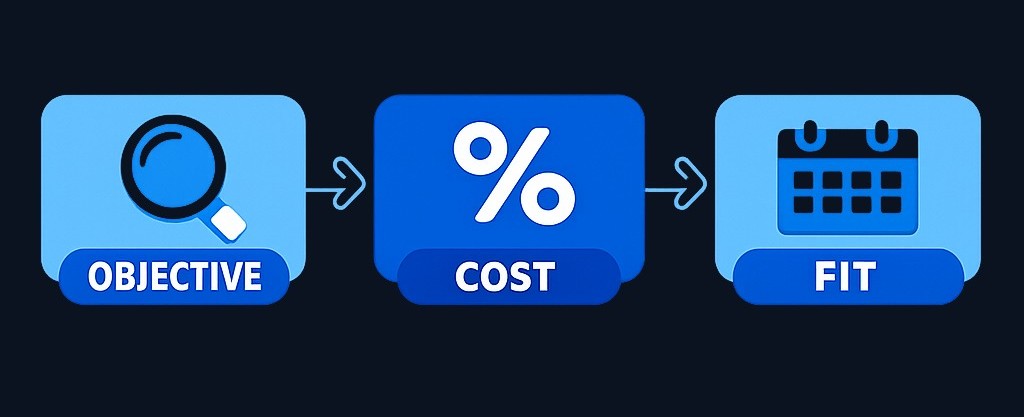
The first thing to check is the ETF’s investment objective. Does it track a broad index, a sector, a country, bonds, dividends, or a theme? A fund that looks diversified by ticker count may still be concentrated in one market segment, such as technology stocks or high-dividend companies.
The second thing to check is cost. The expense ratio is the annual fund operating cost expressed as a percentage of assets. Lower costs are often attractive for long-term investors, but fees should be evaluated alongside the fund’s strategy, diversification, tracking, bid-ask spread, and tax considerations. Current expense ratios and performance data can change, so check each issuer’s official fund page before making comparisons.
Three essential questions to answer before selecting any ETF: What does it hold? What does it cost? Does it fit your timeline?
The third thing to check is fit. A beginner saving for a goal decades away may be able to tolerate more stock market volatility than someone who expects to need the money soon. Your investment horizon, emergency savings, debt situation, and comfort with price swings all matter.
Key ETF terms beginners should know
Term
Plain-English meaning
Why it matters
Expense ratio
The annual cost of owning the fund
Lower costs may help reduce drag over time, but cost is not the only factor
Index
A benchmark the ETF may try to track
Helps you understand what the ETF owns and how it behaves
Holdings
The stocks, bonds, or securities inside the ETF
Shows whether the fund is broad or concentrated
Dividend yield
Income paid by the fund relative to price
Useful for income context, but not a guarantee of future payments
NAV
Net asset value of the fund’s holdings
Helps compare the trading price with underlying value
Tracking error
Difference between ETF performance and its index
Large gaps may signal costs, structure, or trading issues
Bid-ask spread
Difference between buying and selling price
Wider spreads can increase trading cost
Market capitalization
Company size based on market value
Large-cap, mid-cap, and small-cap ETFs may behave differently
Beginner-friendly ETF categories to compare
There is no universal list of the best ETFs for every beginner. However, several ETF categories are commonly used as starting points because they are easier to understand than highly specialized funds.
A total U.S. stock market ETF is often used by investors who want broad exposure to U.S. companies across different sizes and sectors. An S&P 500 ETF focuses on large U.S. companies and is widely followed, but it is not the entire stock market. A total international stock ETF can add exposure outside the United States, while a bond ETF may help reduce volatility depending on its duration and credit quality.
Some beginners also consider all-in-one allocation ETFs, which combine stocks and bonds in a single fund. These can be convenient, but they still require understanding the mix of assets, rebalancing approach, fees, and risk level.
Common ETF examples beginners research
The table below is not a recommendation to buy. It is a research starting point showing ETF types that beginners often compare. Verify current fees, holdings, performance, and risks from official issuer sources before relying on any data.
ETF category
Common examples beginners may encounter
What it generally represents
Beginner fit to consider
Total U.S. stock market
VTI, ITOT, SCHB
Broad U.S. stock exposure
For investors seeking broad U.S. equity exposure
S&P 500
VOO, IVV, SPY
Large U.S. companies in the S&P 500 index
For simple large-cap U.S. exposure
Total international stock
VXUS, IXUS
Stocks outside the U.S.
For geographic diversification
Total bond market
BND, AGG
Broad investment-grade bond exposure
For investors considering lower-volatility assets
All-in-one balanced allocation
AOR or similar allocation ETFs
Mixed stock/bond portfolio in one ETF
For beginners who want fewer moving parts
Dividend-focused equity
VIG, SCHD, DGRO
Stocks selected by dividend criteria
For income-oriented research, but not a substitute for diversification review
Large ETF issuers include Vanguard, BlackRock’s iShares, State Street’s SPDR, Charles Schwab, Invesco, and others. These companies sponsor many of the funds beginners see when researching broad index ETFs, sector ETFs, bond ETFs, and allocation ETFs. Issuer size or brand recognition does not automatically make a fund suitable; the fund’s objective, holdings, cost, liquidity, and risk profile still need to be reviewed.
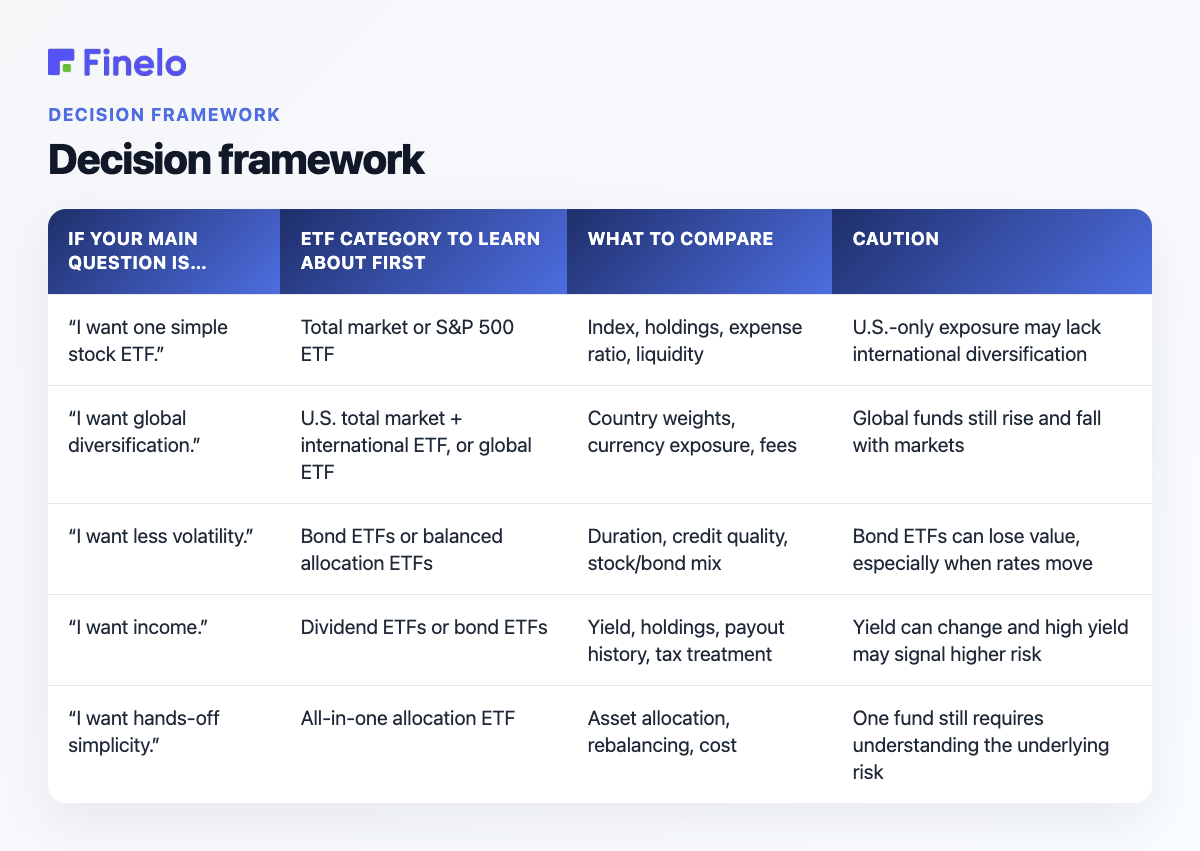
Decision framework
Choosing an ETF becomes easier when you work backward from your goal rather than starting with a ticker. A beginner who wants long-term growth may evaluate broad stock ETFs, while someone who wants stability may need to understand bonds, cash alternatives, or a more conservative allocation. The right decision is personal, and the purpose of a framework is to slow the process down.
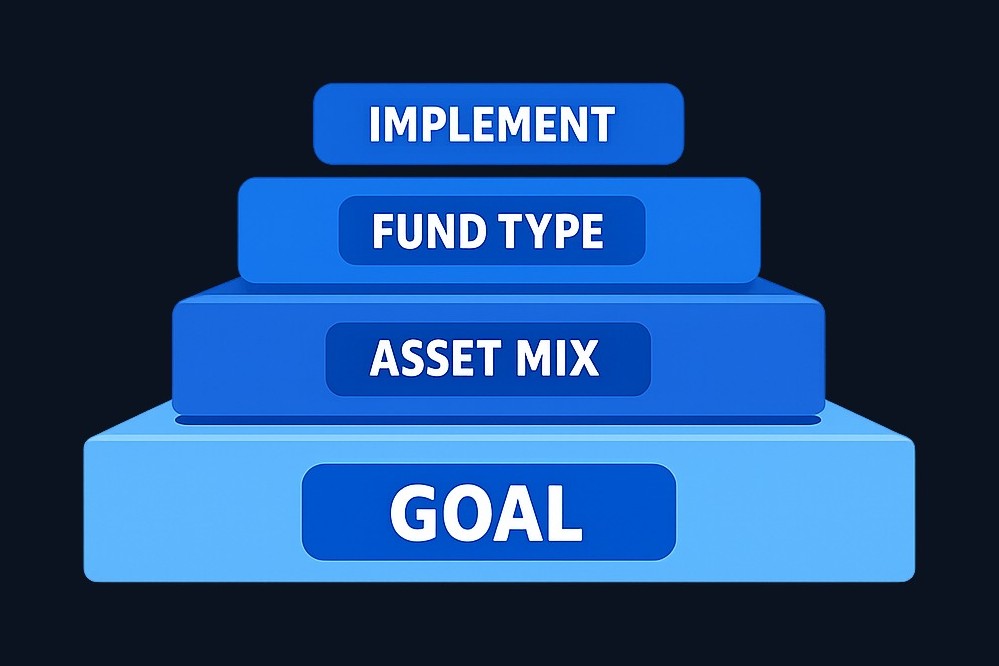
Think of ETF selection as four layers: goal, asset mix, fund type, and implementation. The goal tells you why you are investing. The asset mix determines how much stock, bond, and international exposure you may want to study. The fund type narrows the search to broad market, S&P 500, bond, international, dividend, or allocation ETFs. Implementation covers the brokerage account, trading costs, tax considerations, and ongoing review.
The four-layer approach to choosing an ETF: start with your goal, determine asset mix, select fund type, then implement Beginner scenario: choosing between two simple paths
If your main question is…
ETF category to learn about first
What to compare
Caution
“I want one simple stock ETF.”
Total market or S&P 500 ETF
Index, holdings, expense ratio, liquidity
U.S.-only exposure may lack international diversification
“I want global diversification.”
U.S. total market + international ETF, or global ETF
Country weights, currency exposure, fees
Global funds still rise and fall with markets
“I want less volatility.”
Bond ETFs or balanced allocation ETFs
Duration, credit quality, stock/bond mix
Bond ETFs can lose value, especially when rates move
“I want income.”
Dividend ETFs or bond ETFs
Yield, holdings, payout history, tax treatment
Yield can change and high yield may signal higher risk
“I want hands-off simplicity.”
All-in-one allocation ETF
Asset allocation, rebalancing, cost
One fund still requires understanding the underlying risk
Reference table from this guide — Decision framework.
Beginner scenario: choosing between two simple paths
Imagine Maya is new to investing and wants to learn about ETFs for a retirement goal that is more than 20 years away. She sees people online comparing an S&P 500 ETF and a total U.S. stock market ETF. Both may be reasonable to research, but they are not identical.
The S&P 500 ETF gives Maya exposure to large U.S. companies. The total U.S. stock market ETF includes large companies too, but may also include mid-sized and smaller companies. If Maya wants the broadest U.S. equity exposure in one fund, she may study the total market option. If she wants to track a widely known large-cap index, she may study the S&P 500 option.
Now imagine Maya also wants exposure outside the United States. She might research a total international stock ETF, or she might look for a global ETF that includes both U.S. and non-U.S. stocks. If she is uncomfortable seeing her portfolio drop sharply, she may also need to learn how bond ETFs or balanced funds behave. None of these choices guarantees results; they simply represent different trade-offs.
Example: Maya comparing S&P 500 (large companies only) versus total market (large + mid + small companies) versus adding international exposure How to start building wealth by investing in ETFs Building wealth through ETFs is less about finding a magic fund and more about developing repeatable habits: learning the basics, saving consistently, managing risk, keeping fees reasonable, and avoiding emotional decisions during market
Practice investing with Finelo
Build practical investing skills with guided lessons, simulator practice, and structured challenges.
Building wealth through ETFs is less about finding a magic fund and more about developing repeatable habits: learning the basics, saving consistently, managing risk, keeping fees reasonable, and avoiding emotional decisions during market swings. ETFs can be useful tools for long-term investing, but the tool only helps if it fits the plan.
A careful beginner might start by separating short-term money from long-term money. Funds needed for emergencies or near-term expenses are usually different from money intended for a multi-year or multi-decade investment horizon. Once that boundary is clear, the investor can study which ETF categories match the long-term goal.
The next step is to decide whether you want a one-fund approach or a small portfolio of broad ETFs. A one-fund balanced ETF may be easier to maintain, while a three-part portfolio might include U.S. stocks, international stocks, and bonds. The trade-off is control versus simplicity: more funds can offer more customization, but also require more decisions.
ETF starter checklist
Before buying an ETF, walk through this checklist:
Define the goal. Are you investing for retirement, education, a house, or general long-term growth?
Set the time horizon. Money needed soon may not belong in volatile stock ETFs.
Check the fund objective. Know whether the ETF tracks stocks, bonds, sectors, countries, or a mixed allocation.
Review holdings. Confirm what companies, markets, or bonds the ETF actually owns.
Compare fees. Verify the current expense ratio and any brokerage trading costs.
Understand risk. Look at market risk, concentration risk, currency exposure, interest-rate risk, and liquidity.
Read official documents. Use issuer pages, prospectuses, and brokerage research tools before making decisions.
Plan your review schedule. Decide how often you will revisit your allocation without reacting to every market move.
If you are still learning, you can use educational tools before committing real money. Finelo is an investment learning and financial education product; review official pages for current features, lessons, simulator availability, and plan details. You can start from https://finelo.com/, learn about the app at https://finelo.com/app, explore AI-related learning pages at https://finelo.com/ai, or read trust and user-review information at https://finelo.com/reviews.
Related investing questions
Beginners researching ETFs often compare several adjacent ideas: ETFs versus index funds, ETFs versus mutual funds, ETFs versus individual stocks, and whether a low-cost ETF is “safe.” These questions belong together because they all point to the same underlying decision: how to get diversified market exposure in a way you understand.
An ETF can be an index fund if it tracks an index, but not all ETFs are index funds. Some ETFs are actively managed, thematic, leveraged, inverse, or focused on a narrow sector. Likewise, mutual funds can also track indexes, but they usually trade once per day at net asset value, while ETFs trade on an exchange throughout the trading day.
Compared with individual stocks, ETFs may offer broader diversification. Instead of depending heavily on one company’s earnings, management, and competitive position, a broad ETF spreads exposure across many companies. That said, an ETF still carries market risk, and a narrow sector ETF may be much less diversified than its name suggests.
A helpful beginner rule is to look beneath the label. “Technology ETF,” “dividend ETF,” “growth ETF,” “AI ETF,” or “high-yield ETF” may sound appealing, but the holdings, fees, valuation exposure, and volatility matter more than the marketing category. When in doubt, start by understanding broad index funds before moving into specialized ETFs.
ETF companies and issuers beginners will see
When you search for ETFs, you will quickly encounter fund companies and issuer brands. Vanguard, iShares by BlackRock, SPDR by State Street, Schwab, Invesco, Fidelity, and other asset managers offer ETFs across stock, bond, sector, international, commodity, and allocation categories.
The issuer is responsible for creating and managing the ETF according to its stated objective. The issuer publishes the prospectus, expense ratio, holdings, distribution information, and performance data. For beginners, official issuer pages are important because third-party summaries can be outdated or incomplete.
Company reputation can matter, but it should not replace fund-level research. A strong issuer may offer both broad, low-cost index ETFs and more complex products that are unsuitable for a beginner. Focus on the ETF’s index, holdings, fees, liquidity, and risk disclosures rather than assuming every fund from a well-known company is equally appropriate.
Costs and risks beginners should not ignore
The most visible ETF cost is the expense ratio, but it is not the only one. Investors may also face bid-ask spreads, brokerage fees, tax consequences, and costs linked to frequent trading. Some of these costs are small, but they can matter more when an investor trades often or buys less liquid ETFs.
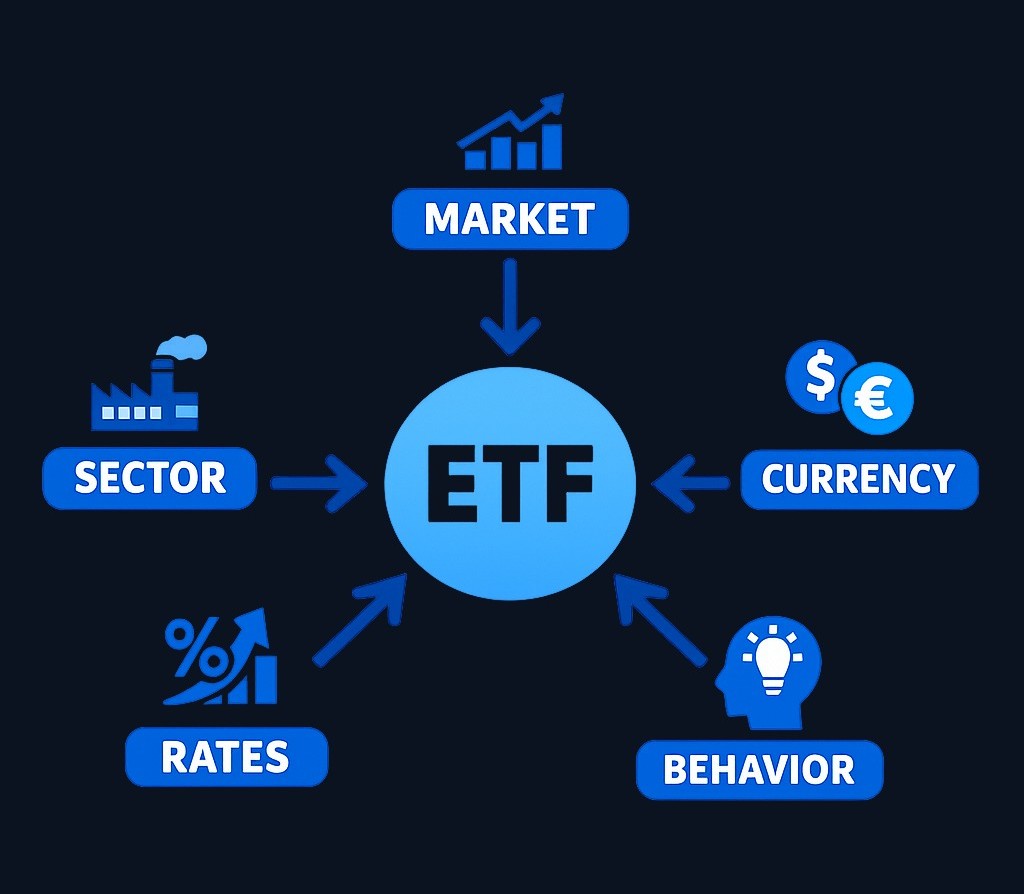
Risk also comes in several forms. Stock ETFs can decline when equity markets fall. International ETFs may be affected by currency changes, political risks, and regional market conditions. Bond ETFs can lose value when interest rates rise or when credit conditions deteriorate. Sector ETFs may be concentrated in a small group of companies.
There is also behavior risk. A beginner may buy an ETF after strong performance, panic during a downturn, then sell at a poor time. Having a written plan can help, but it does not remove uncertainty. The goal is not to predict exact market outcomes; it is to understand what you own and why you own it.
ETF risks come from multiple sources: market drops, sector concentration, currency changes, interest rate shifts, and emotional decisions during volatility
A useful real-world lesson from long-term index investing is that broad diversification and low costs have historically been important principles for many investors. However, past performance does not guarantee future results, and historical examples should be checked against current data before making decisions.
Beginner next steps
If you are new to ETFs, do not rush from a search result to a buy order. Start by choosing three ETF categories to understand: a broad U.S. stock ETF, an international stock ETF, and a bond or balanced ETF. Compare how they differ before deciding whether any of them belongs in your plan.
Then, practice describing each ETF in one sentence. For example: “This fund tracks large U.S. companies,” or “This fund holds investment-grade bonds with a certain duration profile.” If you cannot explain the fund simply, keep researching.
Finally, decide how you will continue learning. You can read official ETF prospectuses, use brokerage education materials, compare fund issuer pages, and explore investing education tools. For Finelo readers, a natural next step is to continue with structured investing education at https://finelo.com/app or learn more about Finelo at https://finelo.com/about-us. For account or billing questions related to Finelo, use the official support page at https://finelo.com/support.
Frequently asked questions
What are the best ETFs for beginners?
The best ETFs for beginners are typically broad, low-cost funds that are easy to understand, such as total market ETFs, S&P 500 ETFs, international stock ETFs, bond ETFs, or all-in-one allocation ETFs. The best choice depends on your goal, timeline, risk tolerance, and whether you want simplicity or more control.
Is an S&P 500 ETF enough for a beginner?
An S&P 500 ETF can provide exposure to many large U.S. companies, but it does not cover the entire global market. Some investors pair it with international or bond exposure, while others prefer a total market or all-in-one fund. Whether it is “enough” depends on the investor’s plan and diversification needs.
Are ETFs safer than individual stocks?
Broad ETFs can reduce single-company risk because they hold many securities, but they are not risk-free. If the market or the ETF’s underlying assets decline, the ETF can lose value. Narrow ETFs, such as sector or thematic funds, may be much more volatile than broad index ETFs.
How do ETFs compare with mutual funds?
ETFs trade on an exchange during the trading day, while mutual funds usually trade once per day after the market closes. Both can be passive or active, and both can hold diversified portfolios. Beginners should compare costs, minimum investments, tax considerations, trading behavior, and the fund’s objective.
What is a good expense ratio for an ETF?
A lower expense ratio is generally attractive, especially for long-term investing, but there is no single cutoff that fits every ETF. Broad index ETFs often have lower fees than specialized or actively managed ETFs. Always verify current expense ratios from the issuer before making comparisons.
Can I lose money in ETFs?
Yes. ETFs can decline in value, and some can be very volatile. Stock ETFs, bond ETFs, international ETFs, leveraged ETFs, and sector ETFs all carry different risks. Read the fund’s risk disclosures and consider whether the ETF matches your time horizon and risk tolerance.
Should beginners buy dividend ETFs?
Dividend ETFs can be useful to study, especially for investors interested in income, but they are not automatically better than broad market ETFs. Dividend-focused funds may be concentrated in certain sectors or company types. Review holdings, total return, yield stability, fees, and tax implications before deciding.
How much money do I need to start investing in ETFs?
The amount needed depends on your brokerage, whether fractional shares are available, and the ETF’s share price. Some platforms allow small purchases, while others may require buying whole shares. Verify current brokerage rules and fees before opening or funding an account.
The Finelo Team creates practical investing and trading education designed to help beginners learn faster with structured challenges, simulator practice, and bite-sized lessons.