The biggest investing mistakes beginners make — from chasing hype to ignoring fees and skipping risk basics — plus a practical checklist for building better habits.
•13 min read
Practice investing with Finelo
Build practical investing skills with guided lessons, simulator practice, and structured challenges.
The most common mistakes beginners make in investing are starting without a plan, chasing hype, investing money they may need soon, ignoring fees, overtrading, concentrating too much in one stock, and skipping basic risk management. New investors often focus on “what should I buy?” before answering more important questions: What is the money for? When might I need it? How much loss could I tolerate? What costs will I pay along the way?
Explore Finelo's 28-day challenges
Turn learning into a daily habit with guided challenge paths.
This guide is for people who are new to investing, including beginners learning about stocks, funds, investment apps, and long-term portfolio basics. It is educational only and not financial advice. Before making any investment decision, check risk, costs, tax implications, and suitability for your own situation; consider speaking with a qualified financial professional if you need personalized guidance.
A good next step is to build a simple investing checklist before putting real money at risk. If you want structured learning and practice, you can explore Finelo’s investing education resources at finelo.com or learn more about the Finelo app.
What to know before deciding
Investing is not just picking a stock or opening an account. It is a decision-making process that connects your money, time horizon, risk tolerance, and behavior. Beginners often make mistakes because they jump into the market with partial information: a friend recommends a company, a social media post highlights a fast-moving stock, or an app makes trading feel simple enough to do casually.
The challenge is that investing mistakes do not always feel like mistakes at first. Buying a popular stock can feel exciting. Trading frequently can feel productive. Avoiding investing altogether can feel safe. But each choice has trade-offs, and the real cost may only show up after months or years.
A beginner does not need to know everything before getting started, but they do need a basic framework. The goal is not to predict exactly what the market will do. The goal is to avoid preventable errors, understand what you own, and make decisions that match your financial situation.
Before you invest, clarify three things:
Purpose: Is this money for retirement, a home, education, or a short-term goal?
Timeline: Will you need the money soon, or can it stay invested for years?
Risk capacity: If the investment dropped in value, would you be forced to sell?
Those questions matter whether you are investing in individual stocks, exchange-traded funds, mutual funds, bonds, or other assets. The right learning path for a beginner usually starts with risk basics, diversification, costs, and behavior—not with trying to find the “perfect” investment.
Investing mistakes beginners make
Many beginner investment errors come from treating investing like a quick decision instead of a system. A system does not need to be complicated. It simply means you know why you are investing, what role each investment plays, and what would cause you to change course.
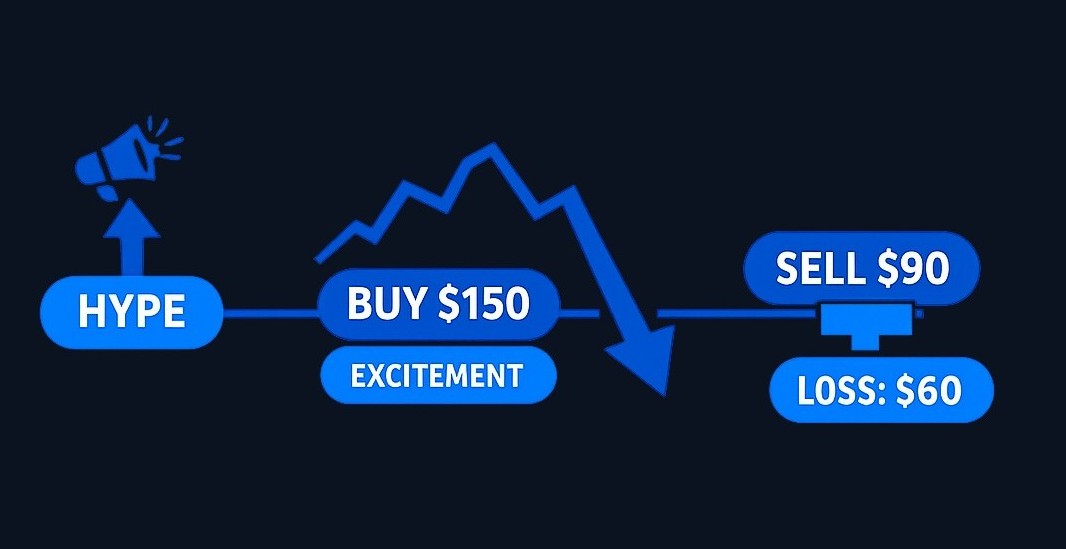
For example, imagine a beginner named Maya who sees several people online discussing a fast-rising stock. She buys it without reading about the company, understanding the sector, or deciding how much of her money she can afford to risk. When the price falls, she sells in frustration. Her mistake was not only choosing a volatile stock; it was investing without a plan for position size, research, or emotional pressure.
Maya buys a hyped stock without research or position sizing. When the price drops, emotional pressure forces her to sell at a loss—a
Another beginner, Daniel, avoids anything that moves up and down because he is afraid of losses. He keeps all long-term savings in cash. That may feel safer in the short term, but if prices rise over time, cash can lose purchasing power. The lesson is not that everyone must invest the same way. It is that doing nothing also carries risks, especially for long-term goals.
Here are the mistakes beginners most often need to avoid.
1. Chasing hype without understanding the investment
Hype can come from social media, news headlines, friends, influencers, or sudden price movements. The danger is that attention and quality are not the same thing. A stock can be popular and still be overpriced, risky, poorly understood, or unsuitable for your goals.
Beginners are especially vulnerable because hype creates urgency. If everyone seems to be making money, waiting to research can feel like missing out. That pressure can lead to buying near a peak, taking on too much concentration, or ignoring warning signs.
A safer approach is to pause before acting. Ask what the investment is, how it makes money, what could go wrong, and how it fits into your broader plan. If you cannot explain the investment in plain language, that is a sign to keep learning before committing money.
2. Investing without an emergency fund
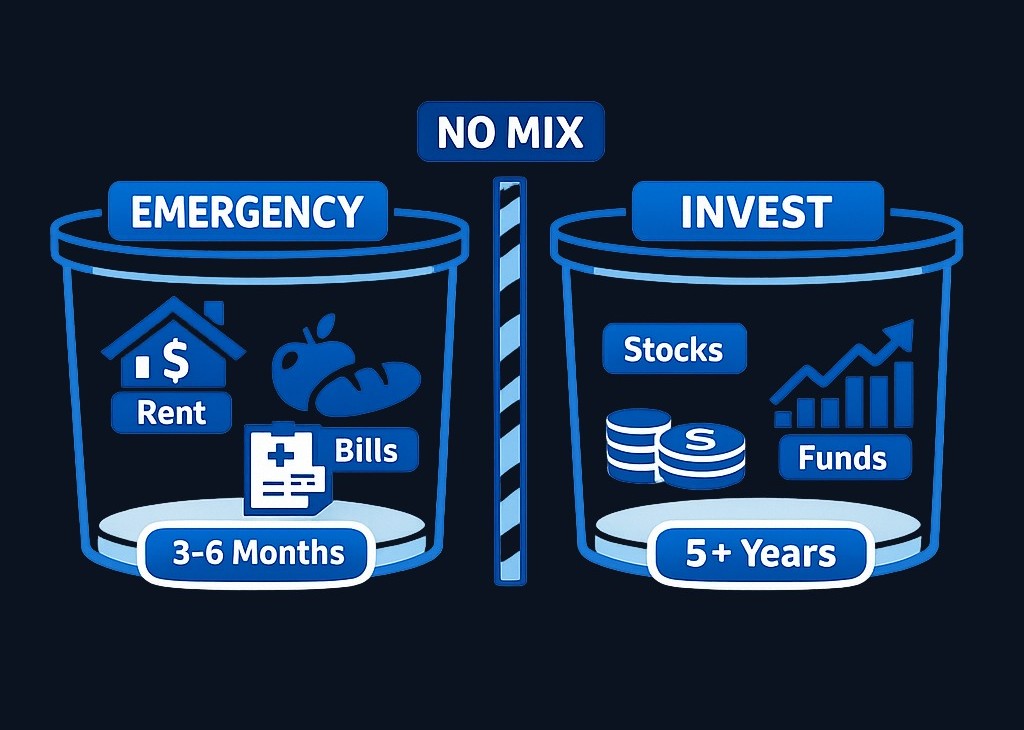
One topic worth taking seriously is the emergency fund. Investing money you may need for rent, food, medical costs, or urgent repairs can force you to sell at the wrong time. Markets can fall when your personal life also becomes stressful, and selling under pressure can turn temporary volatility into a permanent loss.
An emergency fund is not an investment strategy; it is a financial buffer. The appropriate amount varies by income stability, expenses, dependents, and personal circumstances.
For beginners, the practical point is simple: separate short-term safety money from long-term investing money. Money needed soon generally should not be exposed to stock-market volatility without understanding the risk.
Short-term safety money should stay separated from long-term investing money. Emergency funds protect you from being forced to sell
3. Ignoring fees and costs
Fees can be easy to overlook because they may seem small. But even small differences can matter over long periods, especially when fees apply every year or every transaction. Common costs may include fund expense ratios, trading commissions where applicable, account fees, advisory fees, spreads, and tax-related costs.
The important part is not to assume the cheapest option is always best. Sometimes service, education, support, or professional guidance may justify a cost. But beginners should know what they are paying and how those costs affect expected outcomes.
Here is a simple way to think about fee impact:
Net return before taxes = investment return before fees − annual investment fees and costs
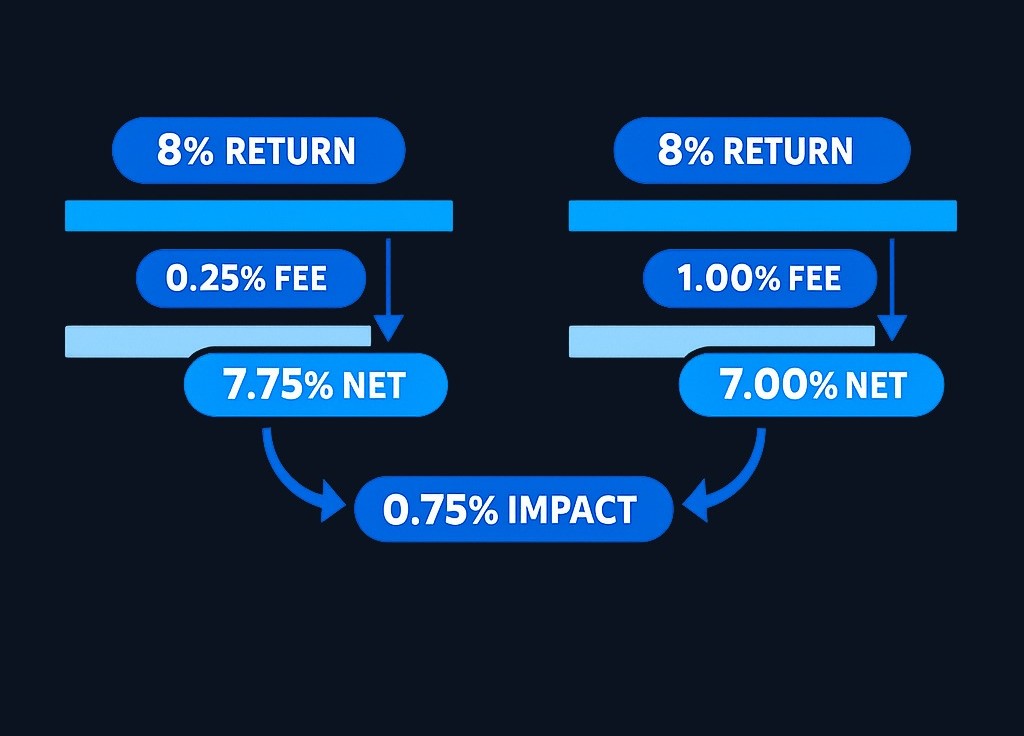
For a hypothetical example, suppose two investments have the same pre-fee performance in a given year. One has annual costs of 0.25%, and the other has annual costs of 1.00%. The higher-cost option would need to provide enough additional value to justify the difference. This is an illustration only, not a prediction of returns.
Over time, a 0.75% annual fee difference can significantly impact your net returns. This example shows two hypothetical investments with
A beginner-friendly fee check looks like this:
What fee am I paying to own this investment?
Is there a transaction cost when I buy or sell?
Does the platform or account charge recurring fees?
Are there tax consequences if I sell?
What value am I receiving in exchange for the cost?
If you use an education or investing platform, verify current pricing and subscription details from the official page before deciding. For Finelo pricing information, use the official pricing page.
4. Overtrading and reacting to every market move
Overtrading is the habit of buying and selling too often, usually because of emotion, boredom, headlines, or short-term price changes. It can create extra costs, tax complexity, and stress. It can also make investing feel like a constant test of willpower.
Beginners often overtrade because they mistake activity for progress. Checking prices multiple times a day can make normal volatility feel like a signal. A red day may feel like a warning; a green day may feel like confirmation. In reality, short-term moves can be noisy and difficult to interpret.
A more disciplined approach is to decide in advance why you would buy, hold, rebalance, or sell. If your reason changes every time the market moves, you may not have an investment plan yet—you may have a reaction pattern.
5. Putting too much money into one stock
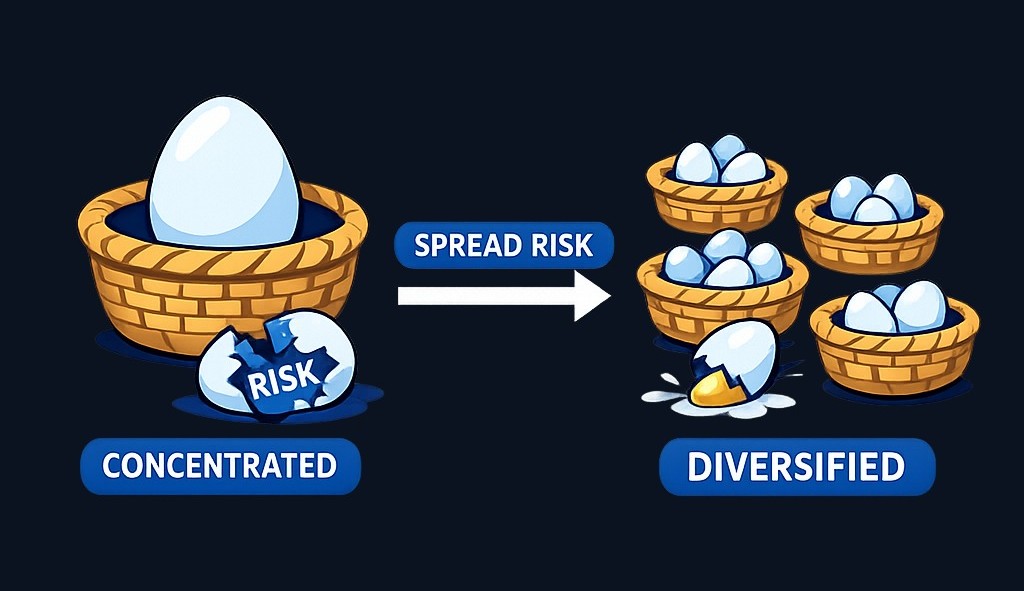
Individual stocks can play a role in some portfolios, but concentration increases risk. If one company performs poorly, faces legal issues, loses market share, or is affected by industry changes, a concentrated investor can be hit hard.
Beginners may concentrate because they recognize a brand, admire a company, or believe one stock is “obvious.” Familiarity is not the same as diversification. A company can make great products and still be a risky investment at a particular price.
Diversification does not eliminate risk, and it does not guarantee positive results. It can, however, reduce dependence on a single company, sector, or outcome.
Concentration means your portfolio's fate depends heavily on one company's performance. Diversification spreads risk across multiple
6. Skipping risk basics
Risk is not just “the investment might go down.” There are different kinds of risk: market risk, company risk, liquidity risk, inflation risk, interest-rate risk, currency risk, and behavioral risk. Beginners do not need to master every technical term immediately, but they should understand that different investments behave differently.
A stock may offer growth potential but can be volatile. A bond may behave differently depending on interest rates and credit quality. Cash may feel stable but can lose purchasing power if prices rise. Funds can diversify holdings but still fluctuate.
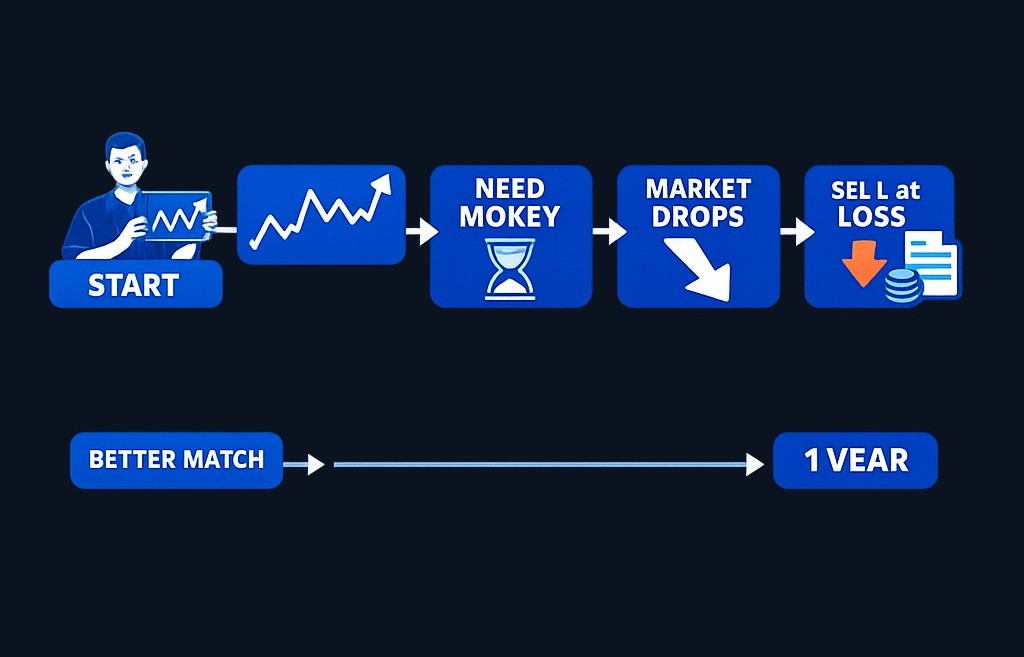
Here is a practical scenario. Suppose Jordan wants to invest for a goal that is only one year away. Jordan chooses a volatile stock fund because it has performed well recently. If the market drops right before the money is needed, Jordan may have to sell at a loss. If Jordan had matched the investment to the timeline first, the decision might have been different.
Jordan chose a volatile investment for a 1-year goal. When the market dropped before the deadline, Jordan had to sell at a loss.
Risk management starts by matching the investment to the goal, not by trying to guess the next market move.
7. Not investing at all because of fear or confusion
Not investing at all is often overlooked as a beginner mistake because it feels cautious. For short-term needs, caution may be appropriate. But for long-term goals, avoiding investment education and postponing every decision can create a different type of risk: never building a plan.
The risk of not investing depends on your goals, income, expenses, debt, time horizon, and local economic conditions. It is not always wrong to wait, especially if you are building savings, paying urgent bills, or learning the basics. The mistake is staying stuck indefinitely because investing feels intimidating.
A useful first step is education, not pressure. Learn how different assets work, compare risk levels, understand fees, and practice decision-making before committing meaningful sums. Finelo’s educational resources are designed for people learning investing and trading concepts. You can also review Finelo reviews for trust and product context.
Practice investing with Finelo
Build practical investing skills with guided lessons, simulator practice, and structured challenges.
A beginner’s best defense is a repeatable process. Instead of asking “Is this a good investment?” in isolation, ask whether the investment makes sense for your goal, timeline, risk tolerance, knowledge level, and costs.
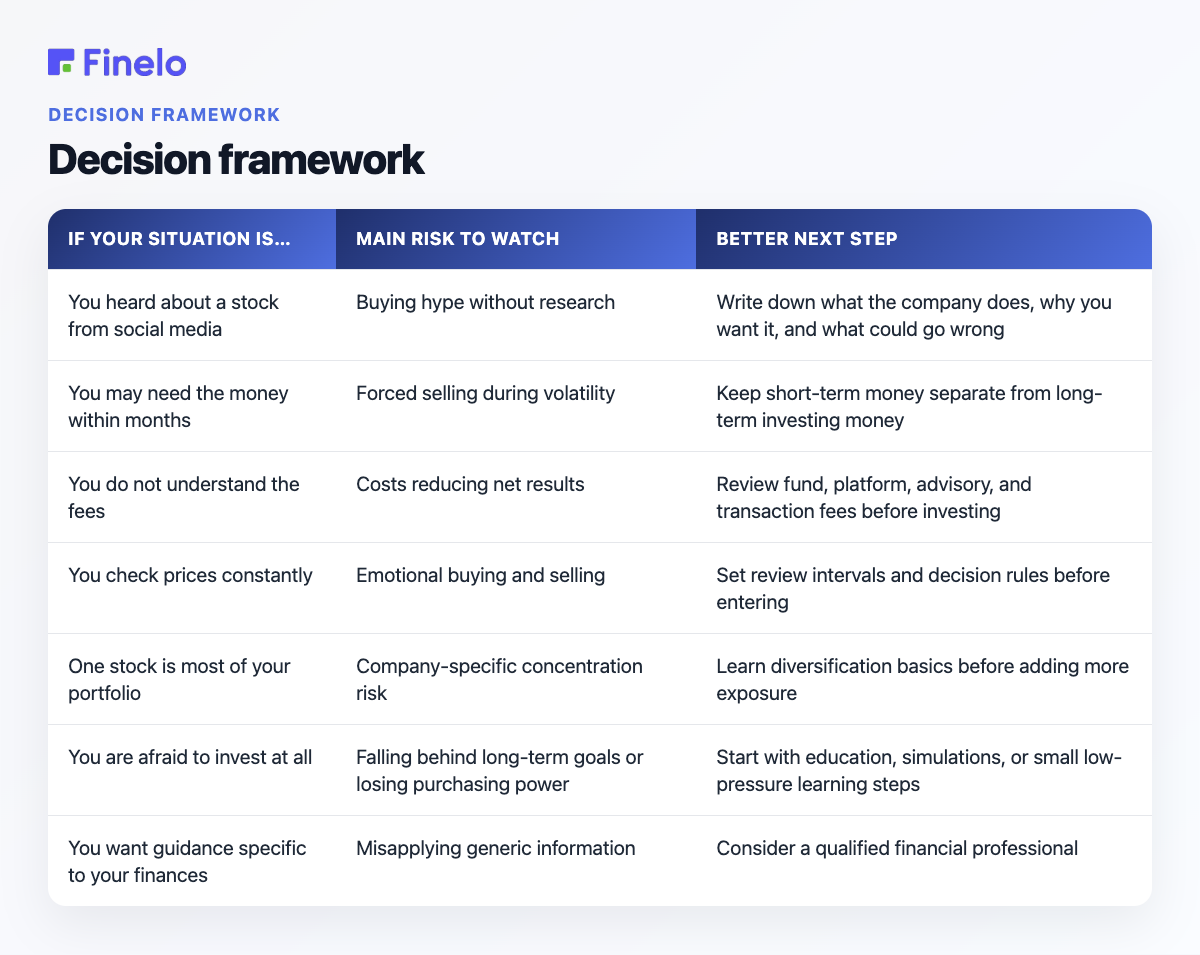
Use this table as a starting point before making an investing decision.
If your situation is…
Main risk to watch
Better next step
You heard about a stock from social media
Buying hype without research
Write down what the company does, why you want it, and what could go wrong
You may need the money within months
Forced selling during volatility
Keep short-term money separate from long-term investing money
You do not understand the fees
Costs reducing net results
Review fund, platform, advisory, and transaction fees before investing
You check prices constantly
Emotional buying and selling
Set review intervals and decision rules before entering
One stock is most of your portfolio
Company-specific concentration risk
Learn diversification basics before adding more exposure
You are afraid to invest at all
Falling behind long-term goals or losing purchasing power
Start with education, simulations, or small low-pressure learning steps
You want guidance specific to your finances
Misapplying generic information
Consider a qualified financial professional
Reference table from this guide — Decision framework.
This framework is not a substitute for personalized advice. It is a way to slow down the decision so you can see the trade-offs more clearly.
A beginner investing checklist
Before putting money into an investment, walk through this checklist:
I know the goal for this money. If the goal is short term, I have considered whether investing is appropriate.
I understand what I am buying. I can explain the investment without relying on buzzwords.
I know the main risks. I have thought about what could cause losses or volatility.
I know the costs. I have reviewed fees, commissions, spreads, subscriptions, and tax considerations where relevant.
I am not using emergency money. I have separated essential cash needs from investment money.
I have a reason to buy and a reason to sell. I am not acting only because of fear, excitement, or pressure.
I have considered learning or practice first. If I am unsure, I can use educational resources before committing more.
People searching for common mistakes beginners make in investing often mean one of three related things: general investing mistakes, stock investing mistakes, or mistakes made when choosing an investing platform. The core principles overlap, but the details are slightly different.
For general investing, the biggest issues are usually planning, time horizon, diversification, fees, and behavior. The question is not only “What should I invest in?” but “What role should investing play in my financial life?”
For stock investing, beginners need extra caution around single-company risk. Stocks can be easier to understand at a brand level—many people know popular companies—but harder to evaluate as investments. A familiar company may still have valuation risk, competitive risk, or earnings uncertainty.
For investing apps and education platforms, the common mistake is assuming the tool will make decisions easy. A platform can help with access, learning, tracking, or practice, but it does not remove the need to understand risk and suitability. If comparing Finelo with other investing education resources, review current product details at Finelo, check pricing, and visit support for account or billing questions. Check official pages for current plan, support, and feature details.
What should you do after reading?
Start by choosing one mistake from this article that feels most relevant to you. If you are chasing hype, slow down and write an investment thesis before buying. If you are avoiding investing completely, begin with education and basic risk concepts. If you are already investing, review your fees, diversification, and emergency fund.
The goal is not perfection. The goal is to build habits that reduce avoidable errors over time.
A practical next step is to create a one-page investing plan with your goal, timeline, risk tolerance, account type, investment choices, costs, and review schedule. If you are still learning, use educational resources before increasing risk. Finelo can be used as a learning and practice step for beginners.
Frequently asked questions
What are the most common mistakes beginners make in investing?
The most common beginner investing mistakes include chasing hype, investing without a plan, ignoring fees, overtrading, putting too much money into one stock, using money needed for emergencies, and avoiding risk education. These mistakes often come from rushing the decision before understanding the investment.
How can beginners avoid investing mistakes?
Beginners can avoid many mistakes by defining their goal, separating emergency savings from investment money, learning basic risk concepts, reviewing costs, and writing down a reason before buying or selling. Using educational resources and practicing decision-making can also help before committing larger amounts.
Is not investing a mistake?
Not always. It may make sense to wait if you need cash soon, have urgent financial obligations, or do not understand the risks yet. But for long-term goals, never learning about investing may create other risks, such as reduced purchasing power over time.
Why is an emergency fund important before investing?
An emergency fund can reduce the chance that you will need to sell investments during a downturn to cover urgent expenses. The right amount depends on your personal situation, income stability, expenses, and responsibilities.
Do fees really matter for beginners?
Yes, fees can affect net investment outcomes, especially over long periods. Beginners should understand expense ratios, platform costs, advisory fees, transaction costs, and tax considerations where relevant. A higher fee is not automatically bad, but it should be understood and justified.
Are individual stocks too risky for beginners?
Individual stocks can be more concentrated than diversified funds because one company’s performance can strongly affect your outcome. That does not mean every beginner must avoid stocks, but it does mean beginners should understand company-specific risk, position size, and diversification before investing.
Is Finelo an investment advisor?
No. Finelo is an investing and financial education product, not an investment advisor. The content is educational and does not provide personalized investment advice.
The Finelo Team creates practical investing and trading education designed to help beginners learn faster with structured challenges, simulator practice, and bite-sized lessons.