Compound interest is growth on prior growth. Learn how compounding works, why time and reinvestment matter, and what beginners should watch before investing.
•11 min read
Practice investing with Finelo
Build practical investing skills with guided lessons, simulator practice, and structured challenges.
Compound interest is interest earned on both your original money and the interest or returns that have already been added to it. For beginners, the main idea is simple: the earlier money is invested and allowed to stay invested, the more time it has to potentially compound. That does not mean returns are guaranteed, and investments can lose value, but compounding is one of the core concepts behind long-term investing.
Explore Finelo's 28-day challenges
Turn learning into a daily habit with guided challenge paths.
This guide is for new investors who want to understand how compound interest works, why time matters, and how to think about it without chasing unrealistic outcomes. The recommended next step is to learn the mechanics, run a few hypothetical examples, review risks and costs, and then practice building an investing plan before committing real money.
This article is educational only and is not financial advice. Before making investment decisions, verify the risks, fees, tax considerations, account rules, and suitability for your own situation.
What compound interest means for beginners
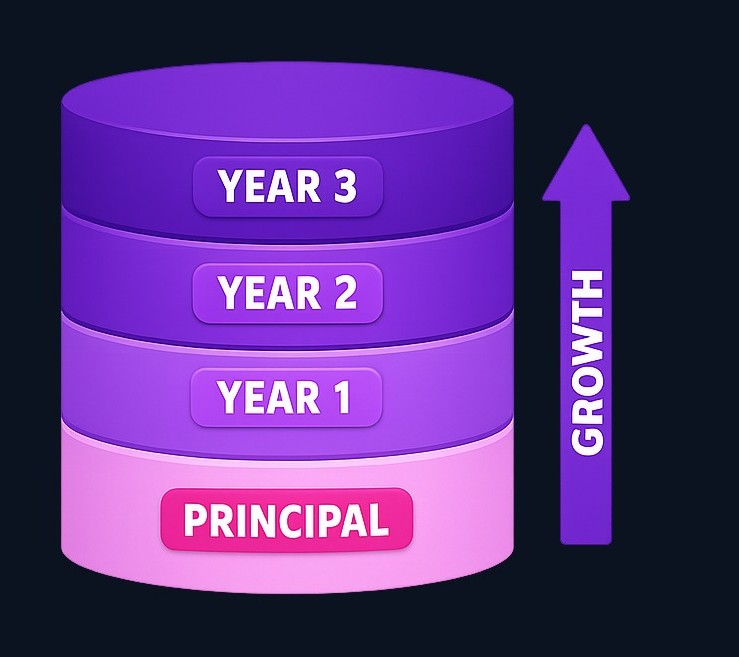
Compound interest is often described as “interest on interest,” but in investing it is better to think of it as growth building on prior growth. If money in an account earns a return and that return stays invested, future growth is calculated on a larger base. Over many years, that can create a snowball effect, especially when contributions continue and withdrawals are avoided.
Compound interest creates a snowball effect: returns earn additional returns over time. The original principal (light base) grows as
For example, imagine a beginner investor puts money into a long-term investment account and any dividends, interest, or gains remain invested. In the first year, growth is based mostly on the original principal. Later, growth may come from both the original principal and prior accumulated gains. The same concept can apply to savings accounts, bonds, dividend reinvestment, mutual funds, exchange-traded funds, and other investments, although each comes with different risks and costs.
The key word is may. Investment returns fluctuate, and markets do not move in a straight line. A hypothetical compound interest example can help you understand the math, but it should not be treated as a prediction of future performance.
The power of compound interest in investing
The power of compound interest comes from the relationship between money, time, and reinvestment. A small amount invested consistently over a long period can behave very differently from a larger amount invested for only a short period. This is why many beginner investing lessons focus less on “finding the perfect investment” and more on building habits that allow time to work.
Consider two people who each want to learn long-term investing. One starts with a small monthly contribution and keeps learning while staying consistent. The other waits until they feel completely ready, then invests a larger amount later. Depending on assumptions, time horizon, fees, taxes, and actual market performance, the early starter may benefit from having more years of compounding. That does not make early investing risk-free; it simply shows why time is such an important variable.
A useful beginner mindset is to separate the concept of compounding from the uncertainty of investing. Compound math is predictable when the rate is fixed, such as in a simplified example. Real-world investing is not fixed. Prices rise and fall, returns vary by year, and fees can reduce the amount that remains invested.
How compound interest works
The basic compound interest formula is:
A = P(1 + r/n)^(nt)
Where:
A is the future amount
P is the principal, or starting amount
r is the annual rate used in the example
n is the number of compounding periods per year
t is the number of years
For beginners, the formula matters less than the logic behind it. The amount grows because each compounding period adds growth to the account, and the next period starts from a new, larger amount. In a savings account, compounding may be tied to an interest schedule. In investing, compounding may happen through reinvested dividends, price appreciation, interest payments, or a combination of factors.
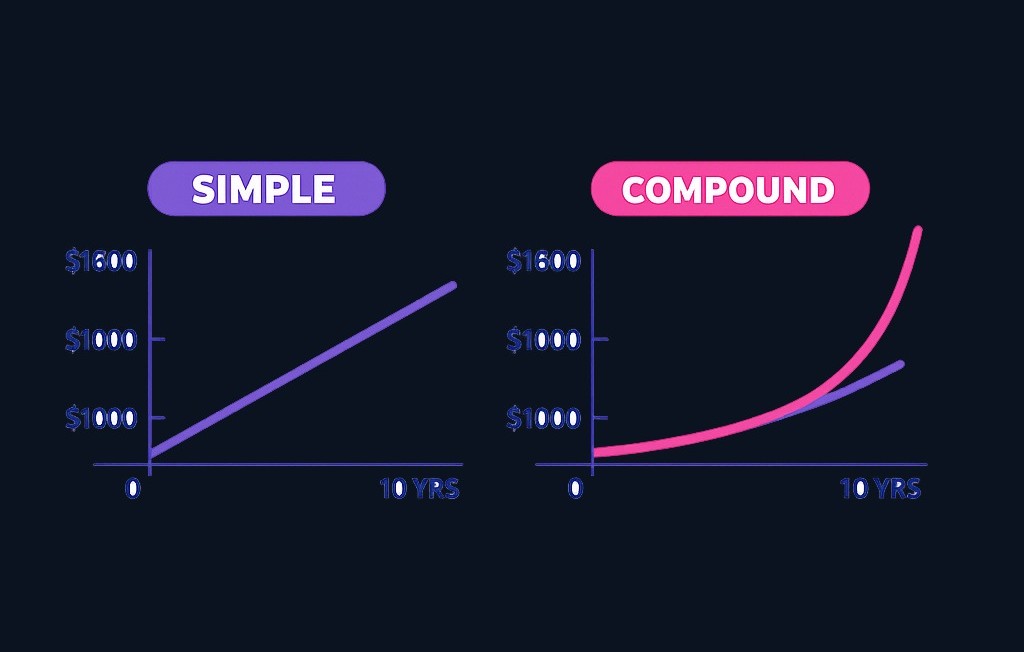
Here is a simple hypothetical comparison. Assume $1,000 is left alone for 10 years at an illustrative 5% annual rate. This rate is only for math demonstration and is not a promise or forecast.
Example
How growth is calculated
Hypothetical value after 10 years
Simple interest
$1,000 earns $50 each year
$1,500
Compound interest
Growth is added back each year
About $1,629
Difference
Compound growth builds on prior growth
About $129 more
This table shows why compounding becomes more noticeable over time. In the early years, the difference may seem modest. Over longer periods, the gap between simple and compound growth can widen, assuming the money remains invested and the rate assumption holds.
This comparison shows how compound interest pulls ahead of simple interest over time. With simple interest, only the original $1,000
What to know before deciding
Before deciding how to use compound interest in your investing plan, understand the tradeoffs. Compounding rewards patience, but patience does not remove risk. Investments can decline in value, and some may be unsuitable for a beginner depending on time horizon, financial goals, income stability, debt, emergency savings, and risk tolerance.
A beginner who needs money next month should think differently from someone investing for a goal decades away. Short-term money usually has less room to recover from market volatility. Long-term money may have more time, but it still needs a plan for diversification, costs, taxes, and behavior during downturns.
Fees also matter because they reduce the amount that can continue compounding. An investment with high costs may need stronger performance just to match a lower-cost alternative. Taxes can also affect compounding when gains, dividends, or interest are taxable.
A beginner scenario may help. Suppose Maya wants to learn investing but is unsure whether to start with individual stocks, funds, or a simulated portfolio. Instead of trying to predict winners, she first learns how compounding works, compares account types, reviews risk, and practices with hypothetical examples. Her goal is not to guarantee a return; it is to make better-informed decisions before using real money.
Related investing questions
People searching for compound interest investing for beginners are usually asking more than one question at once. Some want a definition of compound interest. Others want to know how investing differs from saving, whether compound interest is “good,” how much money is needed to start, or how long compounding takes to matter.
The most helpful answer combines all of those intents into one guide. Compound interest is the mechanism; investing is the context; time horizon is the lever; risk management is the guardrail. Beginners should avoid treating compounding as a shortcut to wealth and instead view it as a long-term principle that works best when paired with consistent habits, suitable investments, and realistic expectations.
Close related topics include dollar-cost averaging, long-term investing, reinvesting dividends, investment growth examples, and the time value of money. If you are still learning the basics, you may also want to explore Finelo’s investing education resources on the Finelo app page, the 28-Day Investing Challenge, and Finelo AI investing resources.
Practice investing with Finelo
Build practical investing skills with guided lessons, simulator practice, and structured challenges.
A compound interest strategy should start with your goal, not with a random investment idea. Beginners often skip this step because the math is exciting, but the right approach depends on when the money is needed and how much uncertainty you can accept.
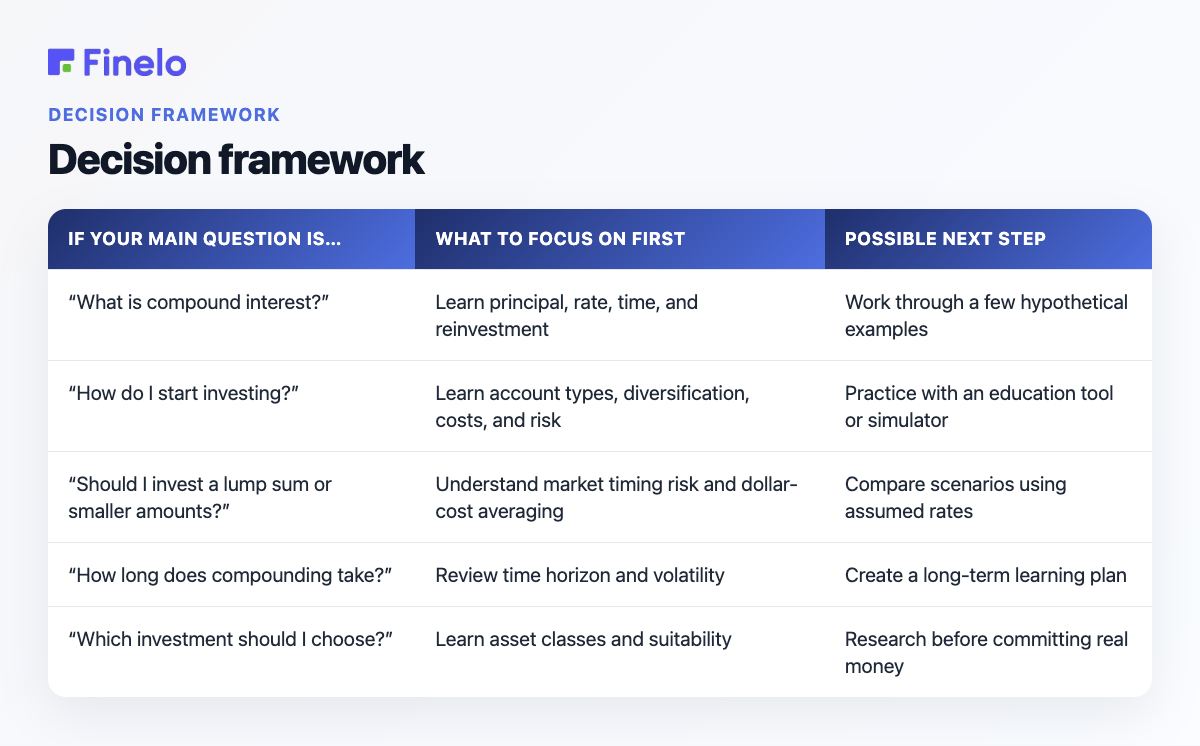
Use this table as an educational framework, not as personalized advice:
If your main question is…
What to focus on first
Possible next step
“What is compound interest?”
Learn principal, rate, time, and reinvestment
Work through a few hypothetical examples
“How do I start investing?”
Learn account types, diversification, costs, and risk
Practice with an education tool or simulator
“Should I invest a lump sum or smaller amounts?”
Understand market timing risk and dollar-cost averaging
Compare scenarios using assumed rates
“How long does compounding take?”
Review time horizon and volatility
Create a long-term learning plan
“Which investment should I choose?”
Learn asset classes and suitability
Research before committing real money
Reference table from this guide — Decision framework.
A practical beginner checklist can make the idea more concrete:
Define the goal for the money and when you may need it.
Build or review emergency savings before taking investment risk.
Learn the difference between savings interest and investment returns.
Compare costs, fees, account rules, and tax considerations.
Consider diversification instead of relying on one investment.
Use hypothetical examples to understand compounding, not to predict results.
Keep learning before increasing risk.
For readers who want a structured learning environment, Finelo is an investing and trading education product; review current product details, features, and plan information on official pages. Relevant pages include Finelo reviews, pricing information, and support.
How compounding fits into financial wellness
Compound interest does not exist in isolation. A beginner who understands compounding but ignores debt costs, emergency savings, or spending habits may still struggle to build a stable financial foundation.
If you are living paycheck to paycheck, the first priority may be budgeting and cash flow. If you have high-interest debt, debt reduction may matter before investing. If you have emergency savings and a long-term goal, investing education becomes more relevant.
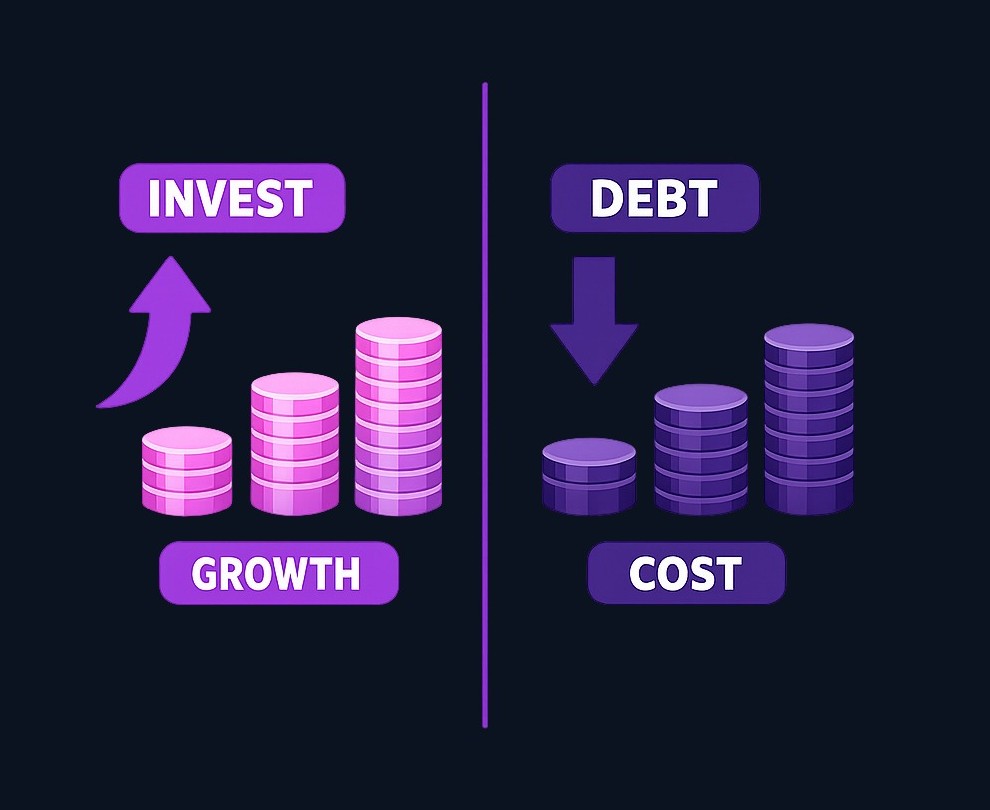
Compound interest connects to both savings and debt. Interest can work for you when money earns and reinvests. It can work against you when debt interest accumulates. Beginners should understand both sides before focusing only on investment growth.
Interest compounds in two directions. When you invest, returns reinvest and may accelerate growth. When you carry debt, interest
Worked example: a beginner investor learning compounding
Let’s use a hypothetical case study. Jordan is new to investing and wants to understand how consistent contributions and time may affect an account. Jordan decides to study a simplified example before investing real money.
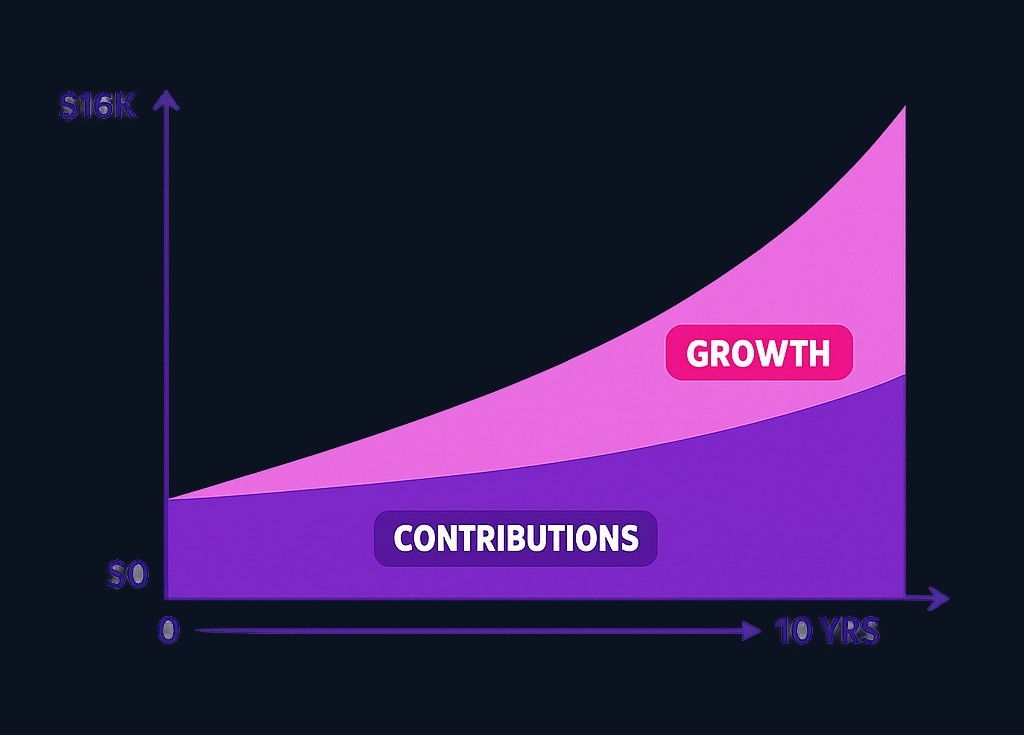
Assume Jordan starts with $500 and adds $100 per month for 10 years. For learning purposes only, assume a steady 5% annual return compounded monthly. In the real world, investment returns are not steady, and the account could lose value, especially over shorter periods.
Under those assumptions, Jordan’s contributions would total $12,500: the initial $500 plus $12,000 in monthly additions. Using monthly compounding and end-of-month contributions, the hypothetical ending value would be about $16,190 before taxes, fees, or inflation. That is higher than the $12,500 contributed because growth is added along the way.
A simple visual can show the idea:
Hypothetical account growth over time
Year 1: Contributions do most of the work
Year 3: Growth begins adding noticeable support
Year 5: Prior growth has more time to compound
Year 10: Contributions + reinvested growth drive the example
The lesson is not that Jordan will earn a specific return. The lesson is that regular contributions, reinvestment, and time horizon are the inputs a beginner can study and plan around.
In this hypothetical example, Jordan contributes $500 initially plus $100 per month for 10 years, assuming 5% annual return compounded monthly. The blue area represents total contributions ($12,500). The green area shows hypothetical growth from compounding (about
Common mistakes to avoid
The first common mistake is expecting compound interest to create guaranteed investment results. Compounding is a mathematical process, but investments are uncertain. A stock, fund, bond, or other asset can underperform, decline, or fail to match the assumptions used in an example.
The second mistake is ignoring the time horizon. If a beginner invests money needed for rent, tuition, or an emergency fund, market volatility can become a serious problem. Compound interest is most useful as a long-term concept, not as a short-term fix.
The third mistake is focusing only on returns and not on behavior. Selling during a downturn, chasing hype, or switching strategies too often can interrupt a long-term plan. A calmer approach is to learn the basics, understand risk, and make decisions based on goals rather than emotion.
Finally, beginners sometimes forget that costs compound too. Fees, taxes, and high-interest debt can all reduce financial progress. Before investing, review the full picture and use official sources for current account, pricing, and policy details.
What to do after reading
If compound interest is new to you, your next step should be learning and practice, not rushing. Start by calculating a few hypothetical scenarios with different time horizons, contribution amounts, and assumed rates. Then compare how the result changes when fees or lower returns are included.
The goal is to understand the principle well enough to ask better questions: What is my time horizon? What risks am I taking? What costs apply? What would make this investment unsuitable for me? Those questions are more valuable than any single hypothetical projection.
Frequently asked questions
What is compound interest in simple terms?
Compound interest means earning interest or growth on money that has already earned interest or growth. In investing, it often refers to reinvested gains, dividends, or interest that remain in the account and may contribute to future growth.
Is compound interest the same as investment return?
Not exactly. Compound interest describes how growth can build on prior growth. Investment return is the actual gain or loss from an investment over a period of time. Returns can be positive or negative, and they are not guaranteed.
How does compound interest benefit beginners?
It helps beginners understand why time, consistency, and reinvestment matter. Even small contributions may become more meaningful over long periods if returns are reinvested, although actual outcomes depend on market performance, costs, taxes, and risk.
Can compound interest make me rich?
No article or calculator can promise that. Compound interest can be a powerful long-term concept, but it does not eliminate investment risk or guarantee wealth. Treat examples as educational models, not predictions.
What are the risks of compound interest investing?
The main risks come from the investments themselves. Market prices can fall, returns can vary, fees can reduce growth, and the investment may not fit your time horizon or risk tolerance. Beginners should verify suitability and understand downside scenarios before investing.
How can beginners start learning compound interest investing?
Start with definitions, then run hypothetical examples using different contribution amounts and time periods. Learn about diversification, account types, fees, taxes, and risk management. Practicing through educational resources or simulators can help you build confidence before making real-money decisions.
The Finelo Team creates practical investing and trading education designed to help beginners learn faster with structured challenges, simulator practice, and bite-sized lessons.