Dollar Cost Averaging for Beginners: A Comprehensive Guide
Dollar-cost averaging means investing a fixed amount on a schedule. Learn how it works, where it can help beginners, and what risks it does not remove.
•14 min read
Practice investing with Finelo
Build practical investing skills with guided lessons, simulator practice, and structured challenges.
Dollar cost averaging is an investing approach where you invest a fixed dollar amount on a regular schedule, such as weekly or monthly, instead of trying to pick the “perfect” day to buy. For beginners, it can make investing feel more manageable because you buy more shares when prices are lower and fewer shares when prices are higher.
Explore Finelo's 28-day challenges
Turn learning into a daily habit with guided challenge paths.
This article is for new investors who want to understand how dollar cost averaging works, when it may help, when it may not fit, and how to think through the trade-offs without relying on market-timing guesses. It is educational, not financial advice; before investing, review your risk tolerance, goals, fees, taxes, and suitability.
A practical next step: learn the concept, test it with a small hypothetical example, then decide whether a recurring investing plan fits your budget and investment goals. If you want to keep learning, you can explore Finelo’s investing education resources at Finelo App or review broader learning options at Finelo AI.
What dollar cost averaging means
Dollar cost averaging, often shortened to DCA, means investing the same amount of money at regular intervals regardless of what the market is doing. Instead of investing $1,200 all at once, for example, someone might invest $100 per month for 12 months. The key idea is consistency: the amount and timing are planned in advance, rather than driven by headlines, fear, or excitement.
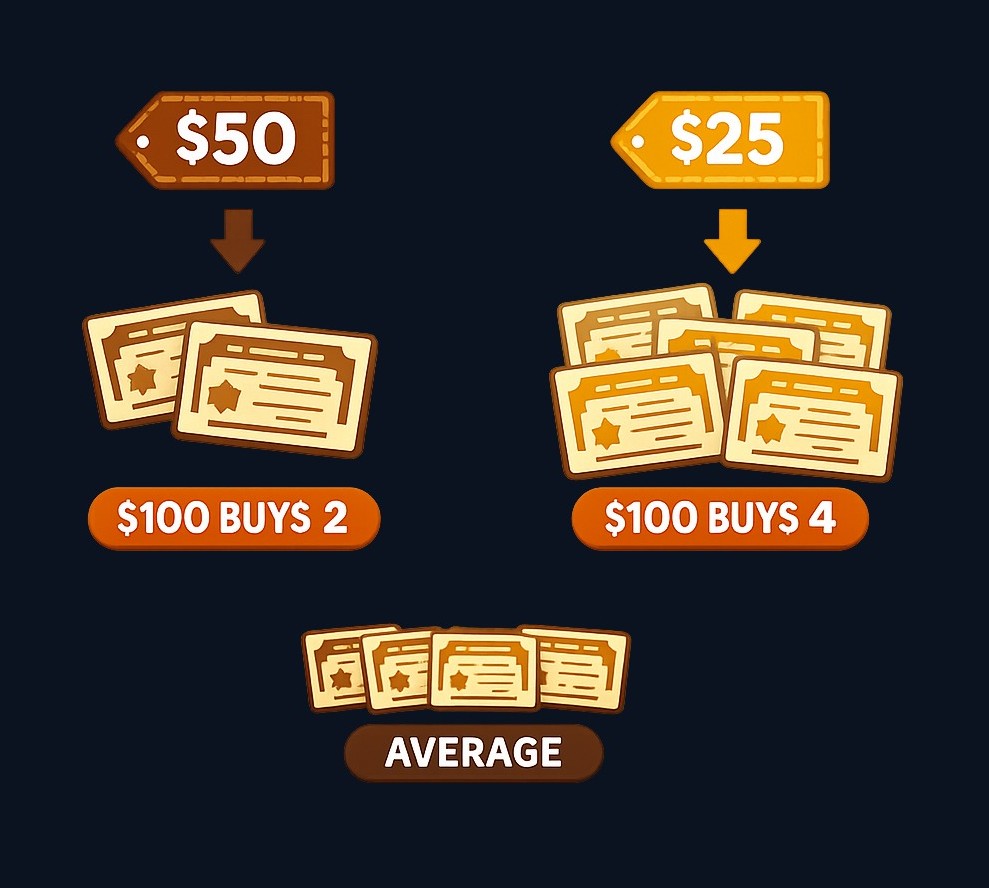
The phrase “cost averaging” comes from the way your purchase prices blend over time. If a share costs $50 one month, your $100 buys 2 shares. If the same investment costs $25 the next month, your $100 buys 4 shares. Over multiple purchases, your average cost per share depends on the prices at which you bought and the number of shares purchased at each price.
When you invest the same dollar amount regularly, you buy more shares when prices are low and fewer when prices are high. Your
For beginners, the appeal is not that dollar cost averaging removes risk. It does not. Investments can still decline, markets can stay volatile, and the value of your account can go down. The appeal is that it creates a repeatable process, which may help reduce the temptation to make every investment decision based on short-term market moves.
How dollar cost averaging works
Dollar cost averaging starts with three choices: the amount you plan to invest, the schedule you plan to follow, and the investment you plan to buy. The amount should fit your budget after essentials, emergency savings, debt obligations, and other financial priorities. The schedule might be monthly, every payday, or another interval that aligns with your cash flow.
Once the plan is set, you continue buying according to the schedule. When prices are high, the same dollar amount buys fewer shares. When prices are low, it buys more shares. This is why dollar cost averaging is often discussed alongside recurring investments, long-term investing, and market volatility.
The strategy is most often associated with diversified investments such as funds, although it can technically be used with many types of investments. Beginners should be especially careful with concentrated positions, individual stocks, complex products, and assets they do not understand. The investment choice matters at least as much as the schedule.
Here is a simplified example using made-up numbers. It is not a forecast, recommendation, or estimate of real market performance.
Month
Amount invested
Hypothetical price per share
Shares purchased
1
$300
$30
10.00
2
$300
$25
12.00
3
$300
$20
15.00
4
$300
$30
10.00
5
$300
$40
7.50
6
$300
$35
8.57
Total
$1,800
—
63.07 shares
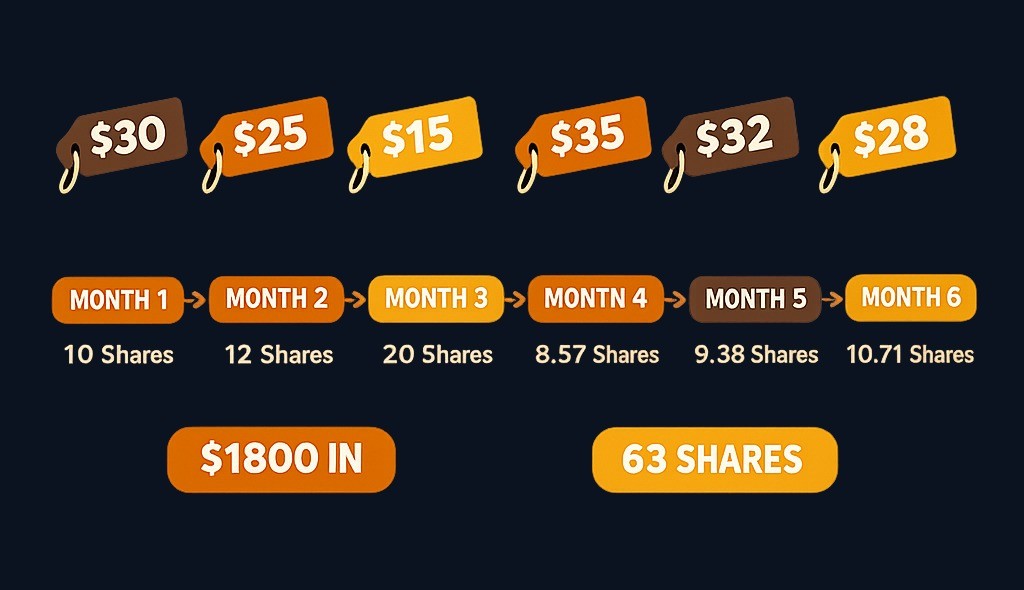
In this example, the investor put in $1,800 over six months and accumulated about 63.07 shares. The average cost per share is approximately $28.54, calculated by dividing the total amount invested by the number of shares purchased. If the investor had put the full $1,800 in during month one at $30 per share, they would have bought 60 shares instead; in this particular hypothetical path, dollar cost averaging bought more shares because prices fell after the first purchase.
A six-month example: investing $300 monthly at different prices. Total invested: $1,800. Total shares: ~63.07. Average cost per share:
That does not mean dollar cost averaging always produces more shares or a better result. If prices rise steadily after the first month, investing the full amount earlier could produce a better outcome in that scenario. The point of DCA is not to guarantee a result; it is to spread purchases over time and reduce dependence on one entry price.
What to know before deciding
Dollar cost averaging can be useful for beginners because it turns investing into a habit. Many people struggle not because they cannot understand markets, but because they hesitate, wait for the “right” time, or change plans after seeing volatility. A recurring investment plan can reduce the number of emotional decisions you need to make.
It can also fit naturally with how many people earn income. If money arrives through a paycheck, investing a set amount each payday may feel more realistic than waiting until a large lump sum is available. This can support long-term investing behavior, provided the plan is affordable and aligned with your broader financial situation.
However, DCA is not a solution to every problem. It does not protect you from choosing unsuitable investments, paying high fees, ignoring diversification, or investing money you may need soon. It also does not eliminate market risk. If the investment declines for a long period, a recurring plan can keep buying into a falling asset, which may or may not be appropriate depending on the investment and your goals.
Costs matter, too. Transaction fees, fund expense ratios, platform costs, tax consequences, bid-ask spreads, and currency conversion fees can affect outcomes. Before setting up a recurring investment plan, verify all relevant costs with your brokerage or platform and review current pricing directly from the provider. ## Benefits of dollar cost averaging for beginners
One of the main benefits of dollar cost averaging is that it can reduce the pressure to time the market. Market timing means trying to decide exactly when prices are about to rise or fall. Even experienced investors can struggle with that, and beginners may find the process especially stressful.
DCA also creates structure. Instead of asking, “Is today the best day to invest?” the question becomes, “Does my planned amount still fit my budget and goals?” That shift can be helpful because it moves the decision from prediction to process. A process is easier to review and adjust than a series of emotional reactions.
Another benefit is that dollar cost averaging gives beginners practical exposure to how prices and shares interact. When the market moves down, the same dollar amount buys more shares. When the market moves up, it buys fewer shares. Seeing that pattern over time can make market volatility less abstract, although it should not make risk feel harmless.
Finally, DCA may help with confidence. Investing can be intimidating when it feels like you must make one large decision all at once. Starting with a recurring, budget-conscious plan can make the learning curve feel more approachable, especially when paired with financial education and careful review of risks.
Potential drawbacks and risks
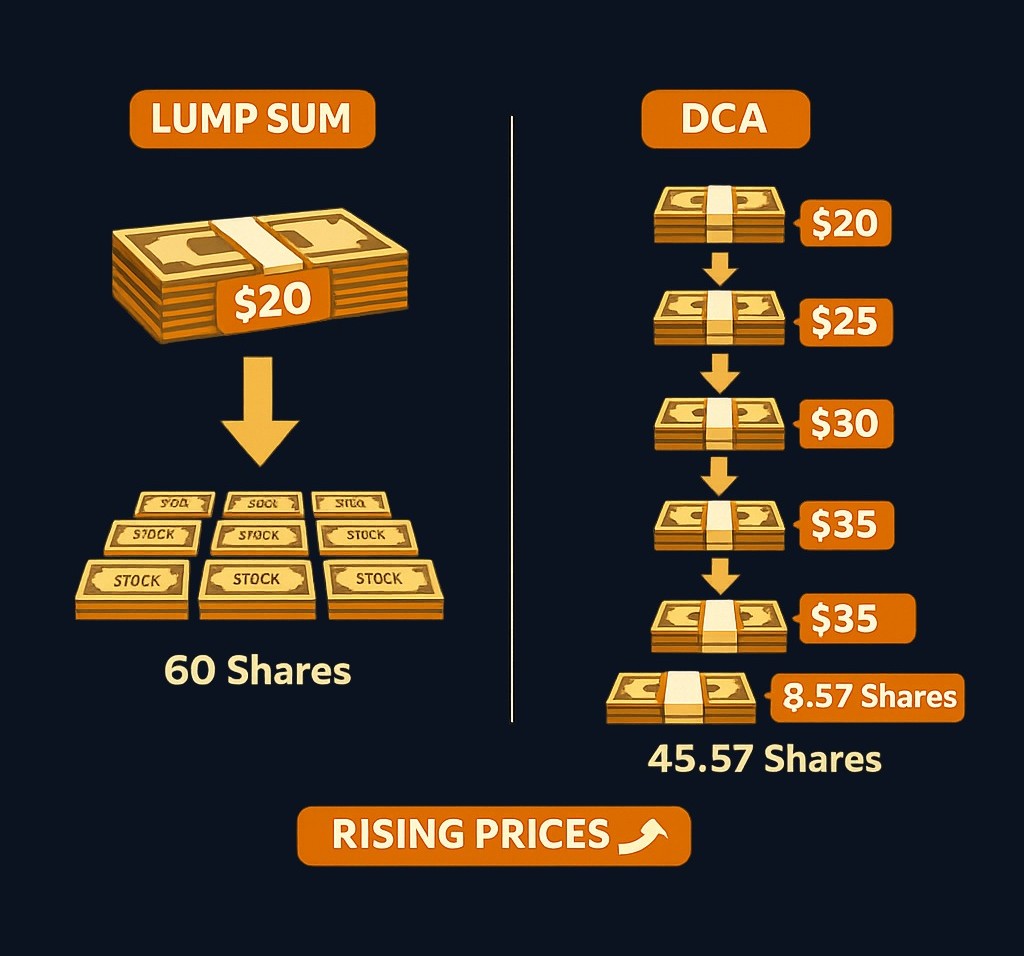
The biggest drawback of dollar cost averaging is opportunity cost. If you already have a lump sum available and markets rise after you begin spreading out purchases, you may end up with fewer shares than if you had invested the full amount earlier. This is not a guarantee of what will happen, but it is an important trade-off to understand.
Opportunity cost scenario: If you have $1,200 available and prices rise steadily, investing the full amount early (lump sum) may result in more shares than spreading it over several months (DCA). The outcome depends on the price path.
Another risk is false comfort. Dollar cost averaging can make the buying process feel disciplined, but it does not automatically make the investment itself suitable. A recurring plan into a highly speculative asset can still be risky. The schedule does not replace research, diversification, or an understanding of what you own.
DCA can also become too rigid if your life changes. A plan that made sense when your income was stable may need to be paused or adjusted if your expenses rise, your emergency fund changes, or your goals shift. Beginners should treat the plan as a framework, not a contract with themselves that can never be revisited.
There are also practical considerations. If each purchase triggers a fee, frequent small investments may become inefficient. If the investment is held in a taxable account, regular buying can create recordkeeping needs. Always review platform rules, investment costs, and tax considerations with qualified sources before implementing a plan.
Practice investing with Finelo
Build practical investing skills with guided lessons, simulator practice, and structured challenges.
Choosing between dollar cost averaging and lump-sum investing depends on your cash flow, emotional comfort, investment horizon, and the source of the money. If you invest from monthly income, DCA may simply match your real-life budget. If you receive a one-time bonus, inheritance, or sale proceeds, you may need to decide whether to invest it all at once or gradually.
The decision is not only mathematical. It is also behavioral. A strategy that looks efficient on paper may fail if it causes so much stress that you abandon it during volatility. On the other hand, spreading purchases over too long a period may leave money uninvested if your goal is long-term market exposure.
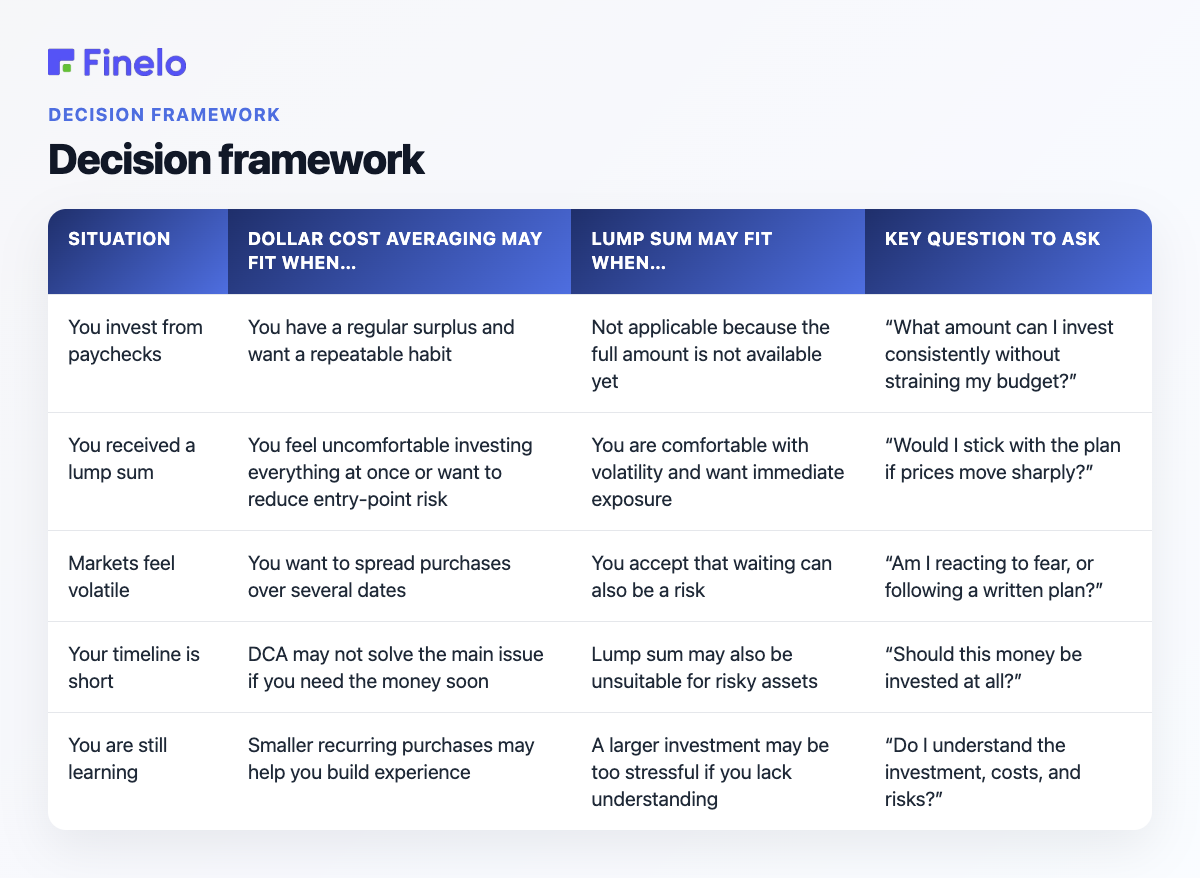
Use this table as an educational guide, not a personalized recommendation.
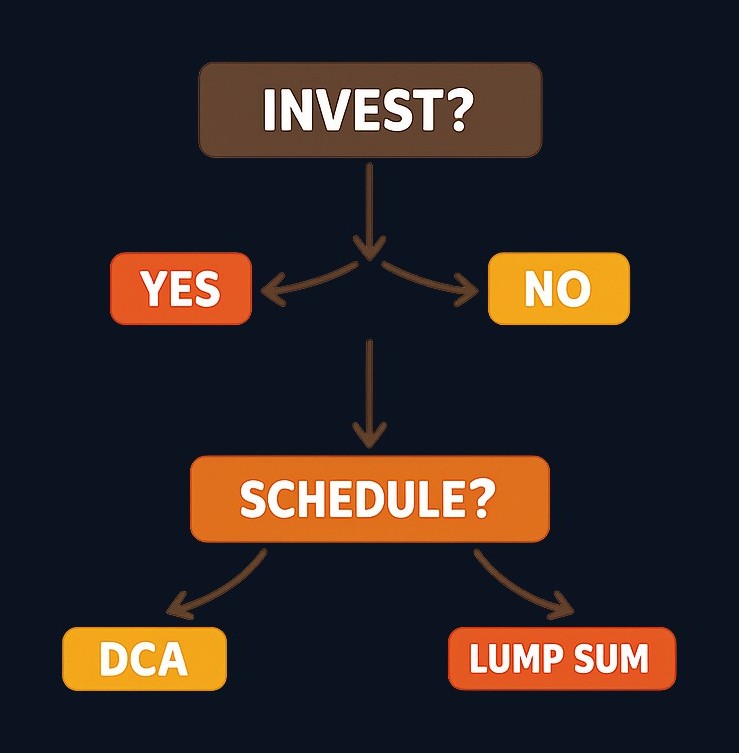
Decision framework: First ask whether the money should be invested at all (considering emergency funds, debt, and time horizon). Then
Situation
Dollar cost averaging may fit when…
Lump sum may fit when…
Key question to ask
You invest from paychecks
You have a regular surplus and want a repeatable habit
Not applicable because the full amount is not available yet
“What amount can I invest consistently without straining my budget?”
You received a lump sum
You feel uncomfortable investing everything at once or want to reduce entry-point risk
You are comfortable with volatility and want immediate exposure
“Would I stick with the plan if prices move sharply?”
Markets feel volatile
You want to spread purchases over several dates
You accept that waiting can also be a risk
“Am I reacting to fear, or following a written plan?”
Your timeline is short
DCA may not solve the main issue if you need the money soon
Lump sum may also be unsuitable for risky assets
“Should this money be invested at all?”
You are still learning
Smaller recurring purchases may help you build experience
A larger investment may be too stressful if you lack understanding
“Do I understand the investment, costs, and risks?”
Reference table from this guide — Decision framework.
A simple rule for beginners is to separate “how much to invest” from “how to schedule it.” First decide whether investing is appropriate for that money at all. Then decide whether you want to invest it gradually or all at once.
Beginner checklist for using dollar cost averaging
Before setting up a recurring investment, slow down and work through the basics. The most useful DCA plan is one that you understand, can afford, and can maintain without ignoring risk. This checklist can help you turn the idea into a practical plan.
Define the goal. Are you investing for retirement, long-term wealth building, education, or another objective? The goal affects your time horizon and risk tolerance.
Confirm the money is available to invest. Avoid using cash needed for rent, bills, emergency savings, or near-term obligations.
Choose a realistic amount. A smaller amount you can sustain may be more useful than an aggressive amount you stop after one month.
Pick a schedule. Monthly, biweekly, or payday-based schedules are common, but the best schedule is the one that matches your cash flow.
Understand the investment. Know what you are buying, how diversified it is, what risks it carries, and what costs apply.
Review fees and taxes. Verify transaction costs, fund expenses, platform pricing, and tax rules with current official sources.
Write down review dates. Revisit the plan periodically, such as quarterly or annually, and whenever your financial situation changes.
Avoid performance promises. Treat dollar cost averaging as a process for disciplined buying, not a guarantee of returns.
If you want to keep learning before making real-money decisions, consider practicing with educational tools or guided lessons first. Finelo is an investing and trading education product; you can review current learning resources at Finelo App and Finelo AI.
A volatility scenario: why the path matters
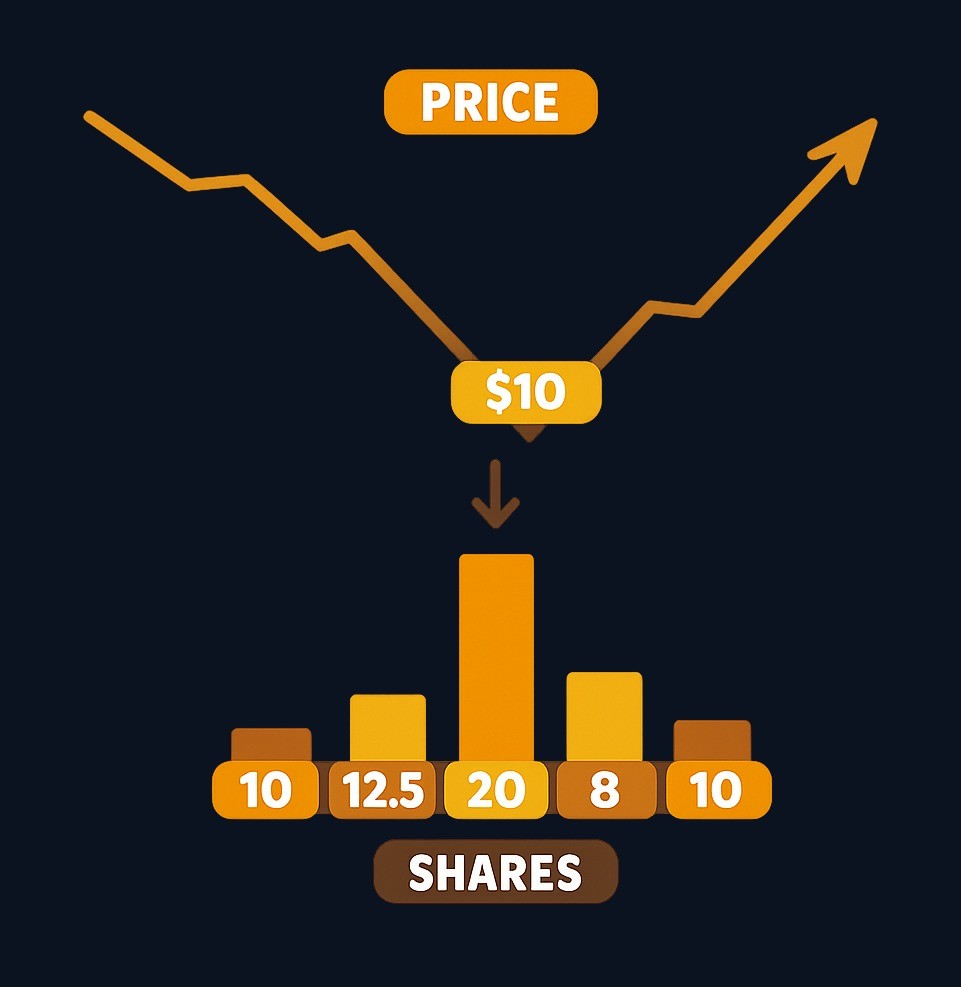
Dollar cost averaging is often discussed in volatile markets because price swings affect how many shares your fixed dollar amount buys. Suppose one beginner invests $200 per month for five months. If prices move from $20 to $16 to $10 to $25 to $20, the investor buys different numbers of shares each month, with the largest purchase happening when the hypothetical price is lowest.
That can feel encouraging, but it needs context. The ending result depends on the final price, the quality of the investment, fees, and how long the investor holds. A temporary decline followed by recovery produces one type of outcome; a long decline in a weak investment produces another. DCA changes the purchase pattern, but it does not change the underlying risk of the asset.
Volatility example: $200 monthly investment over five months as price moves from $20 → $16 → $10 → $25 → $20. The investor buys the most shares (20) during month three when the price hits $10. Final outcome depends on ending price and investment quality.
This is why beginners should avoid thinking of dollar cost averaging as a way to “beat” volatility. A better framing is that it helps you participate in a planned way when prices are uncertain. The plan should still be paired with diversification, risk awareness, and a clear reason for owning the investment.
Related investing concepts beginners often confuse with DCA
Dollar cost averaging overlaps with several beginner investing ideas, but it is not the same as all of them. Recurring investing is the act of setting up repeated purchases; DCA is the strategy of investing a fixed dollar amount over time. Many recurring investment plans use dollar cost averaging, but the concept can also be applied manually.
DCA is also different from diversification. Diversification means spreading money across different investments, sectors, asset classes, or regions to reduce concentration risk. You can dollar cost average into a diversified fund, or you can dollar cost average into a single investment; the schedule and the diversification decision are separate.
It is also different from risk management as a whole. DCA may reduce the risk of investing all your money at one unfavorable entry point, but it does not eliminate investment risk. Position size, asset allocation, time horizon, emergency savings, and investment selection all remain important.
Finally, DCA should not be confused with a guarantee of a lower average price. In some price paths it may lower the average cost per share compared with a first-day lump-sum purchase. In other paths it may not. The value of the strategy depends on your situation, behavior, and the way prices move after you begin.
What should you do after reading?
If you are new to investing, your next step should be educational rather than rushed. Start by writing down your goal, time horizon, available monthly amount, and comfort level with volatility. Then compare dollar cost averaging with lump-sum investing using a simple hypothetical example like the one above.
If you want to continue learning in a structured environment, you can explore Finelo App, Finelo AI, or read Finelo Reviews to review current Finelo information. Review current features, plan details, support policies, and pricing directly from official pages before making decisions.
For account access, billing, or subscription support, use official Finelo routes such as Finelo Support, Finelo Login, Cancel Subscription, and Finelo Pricing. Do not rely on unofficial links or outdated support instructions for account-specific questions.
Frequently asked questions
What is dollar cost averaging in simple terms?
Dollar cost averaging means investing the same amount of money on a regular schedule. For example, you might invest $100 every month instead of trying to choose one perfect day to invest. The amount stays consistent, while the number of shares you buy changes with the market price.
Is dollar cost averaging good for beginners?
It can be useful for beginners because it creates a repeatable process and may reduce the pressure to time the market. However, it is not automatically right for everyone. Beginners still need to consider risk tolerance, investment goals, costs, taxes, and whether the chosen investment is suitable.
Can dollar cost averaging lose money?
Yes. Dollar cost averaging does not prevent losses. If the investment declines in value, your account can lose money even if you followed the plan consistently. DCA affects when and how you buy; it does not guarantee positive returns.
Is dollar cost averaging better than lump-sum investing?
Neither approach is always better. Dollar cost averaging may feel easier emotionally and can reduce reliance on one entry price. Lump-sum investing may do better in scenarios where prices rise soon after the initial investment. The better choice depends on your cash flow, goals, time horizon, and comfort with volatility.
What types of investments can use dollar cost averaging?
DCA can be applied to many investments, but beginners often consider diversified funds because they may reduce single-company concentration risk. That said, every investment has risks and costs. Review official materials and consider qualified guidance before choosing an investment.
How much money do I need to start dollar cost averaging?
There is no universal amount. The right amount depends on your budget, platform minimums, fees, and financial priorities. A beginner should avoid investing money needed for near-term expenses or emergency savings.
How often should I invest with dollar cost averaging?
Common schedules include monthly, biweekly, or each payday. The best schedule is usually the one that matches your cash flow and keeps transaction costs reasonable. Consistency matters more than choosing a perfect interval.
Does dollar cost averaging reduce investment risk?
It may reduce the risk of investing all your money at one unfavorable moment, but it does not remove market risk. The value of your investment can still rise or fall. Think of DCA as one planning tool, not a complete risk-management system.
The Finelo Team creates practical investing and trading education designed to help beginners learn faster with structured challenges, simulator practice, and bite-sized lessons.