A bull call spread is a defined-risk options strategy built from two call options on the same stock and with the same expiration: you buy a call at a lower strike and sell a call at a higher strike. It is also called a call debit spread (or debit call spread), because you enter it for a net debit, paying more for the call you buy than you collect for the call you sell. Traders use it for a moderately bullish view, since someone expecting a large move would be giving up meaningful upside by capping it. Selling that higher-strike call lowers the cost of the position, but in exchange it caps the maximum profit.
What Is a Bull Call Spread? Structure, Example, and Risks
A bull call spread is a defined-risk options strategy: buy a call at a lower strike and sell a call at a higher strike, both with the same expiration. It's also called a call debit spread, and it suits a moderately bullish view.
10 min read
Practice trading with Finelo
Practice in a simulator, learn with bite-sized lessons, and build confidence before risking real money.
Want to learn more?
Practice in a simulator, learn with bite-sized lessons, and build confidence before risking real money.
Explore FineloExplore Finelo's 28-day challenges
Turn learning into a daily habit with guided challenge paths.
This page is for readers who already understand basic calls and puts and want to see how this specific strategy is built, what its payoff looks like, and where the risks are. If calls and puts are still fuzzy, read the options trading for beginners guide first, then come back. It explains the structure and mechanics; it does not tell you to trade it, or which strikes or expiration to pick. Options are higher-risk instruments and the full amount you pay can be lost, so treat this as education to build on, not a recommendation.
This page is for learning purposes only and is not financial advice. Options trading carries significant risk and is not suitable for everyone.
Who this guide is for
This guide fits if you have the basics of options down — calls, puts, strike, premium, and expiration — and want to see how traders combine two options into a single position with a defined shape.
It is a good fit if you want to answer: How is a bull call spread built? What are the most I can make, the most I can lose, and my breakeven? Why use it instead of just buying a call? And is a call debit spread the same thing? It answers the what and the how it works, not whether you should trade it, which depends on your knowledge, options approval level, and risk tolerance.
Use it as a learning path if you are:
- Comfortable with basic calls and puts and ready to look at a two-leg strategy.
- Trying to understand vertical spreads and defined-risk positions.
- Unsure whether "bull call spread" and "call debit spread" mean the same thing (they do).
- Curious how capped profit and capped loss actually work.
- Studying strategies before ever risking real money.
How it's built: two calls, one net debit
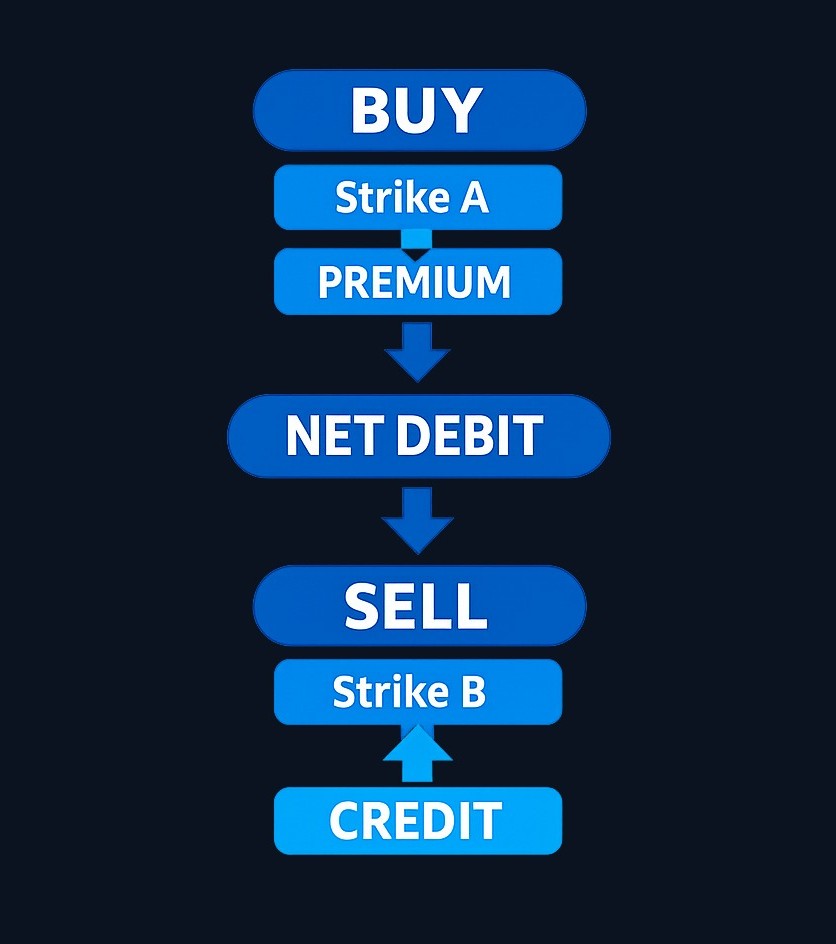
A bull call spread has exactly two legs, both calls, both on the same underlying and expiring on the same date:
- Buy a call at the lower strike (A). This is the long leg. It gives you upside exposure and costs a premium.
- Sell a call at the higher strike (B). This is the short leg. It brings in a premium and, in return, caps how much you can gain above strike B.
Because the call you buy at the lower strike costs more than the call you sell at the higher strike, you pay a net amount overall, the net debit. That net debit is the total cost of the position and, as the next sections show, also your maximum loss. The strategy is a type of vertical spread, meaning both legs share an expiration and differ only by strike. You will also see it called a long call spread, but bull call spread and call debit spread are its two most common names.
Why traders use it (moderately bullish, defined risk)
The appeal, described neutrally, is a trade-off between cost and upside. Buying a call outright gives large upside but costs the full premium. A bull call spread lowers that cost by selling the higher-strike call, and in doing so caps the profit at the higher strike. That is why it is described as a moderately bullish position: it suits someone expecting a moderate rise. A move far above strike B does not hurt the spread, it just earns the same capped maximum; the trade-off is the upside you give up by capping, not any downside from a big move.
It is a defined-risk, defined-reward position: both the most you can lose and the most you can make are known before you enter. That predictability is part of why it appears on "beginner-friendly" strategy lists, though it is worth being clear-eyed about what that phrase hides.
Defined risk still means you can lose the entire net debit.
Max profit, max loss, and breakeven
Three formulas define the whole position. Option prices are quoted per share, and one standard contract covers 100 shares, so the dollar figures below are the per-share numbers multiplied by 100.
- Maximum loss = the net debit paid. If the underlying is at or below the lower strike A at expiration, both calls expire worthless and you lose what you paid. That is the full downside.
- Maximum profit = (strike B minus strike A) minus net debit. This is reached when the underlying is at or above the higher strike B at expiration.
- Breakeven = lower strike A plus net debit. Above this price at expiration the position is in profit; below it, at a loss.
| Metric | Formula | Reached when |
|---|---|---|
| Maximum loss | Net debit paid | Underlying at or below strike A at expiration |
| Maximum profit | (Strike B − Strike A) − net debit | Underlying at or above strike B at expiration |
| Breakeven | Strike A + net debit | Underlying at this price at expiration |
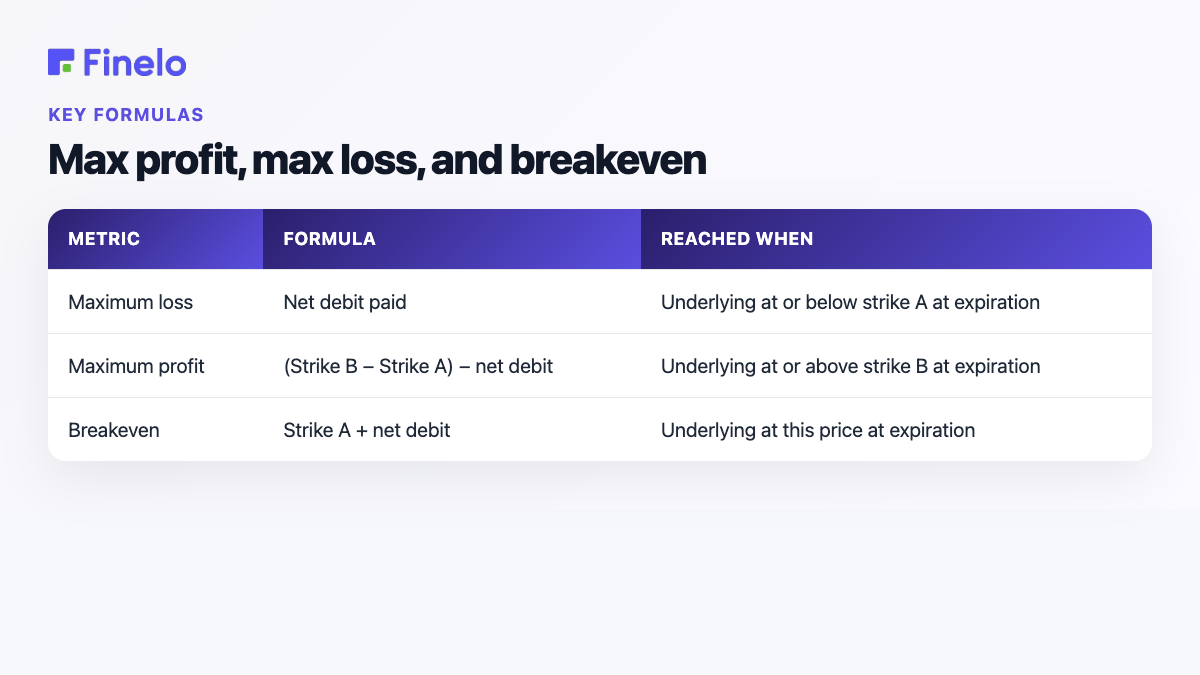
Selling the higher-strike call buys a lower cost and pays for it with a capped ceiling.
A worked example
Suppose a stock trades near $100 and someone is studying a bull call spread. They look at buying the $100 call for $4.00 and selling the $105 call for $1.50. The net debit is $4.00 minus $1.50, or $2.50 per share, which is $250 for one spread (multiplied by 100).
From the formulas, the maximum loss is that $250 net debit, realized if the stock is at or below $100 at expiration. The maximum profit is ($105 minus $100) minus $2.50, or $2.50 per share, which is $250, reached if the stock is at or above $105 at expiration. The breakeven is $100 plus $2.50, or $102.50. So this position risks $250 to make up to $250, with the best case being a move to $105 or higher by expiration. That one-to-one risk and reward is specific to these numbers, though; the ratio shifts with the strike width and the net debit paid. Between $100 and $102.50 the spread is worth something but less than the $250 paid, so it still shows a net loss. The example exists to show the structure — capped cost, capped gain, and a defined breakeven — not to suggest placing it.
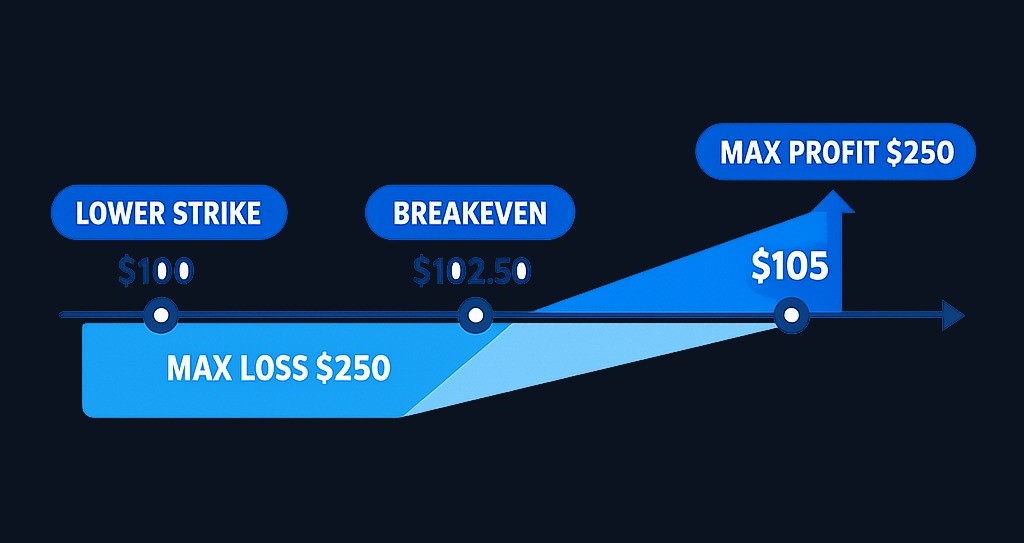
Illustrative example only. Round numbers, not a real quote or a recommendation.
Practice trading with Finelo
Practice in a simulator, learn with bite-sized lessons, and build confidence before risking real money.
The payoff diagram
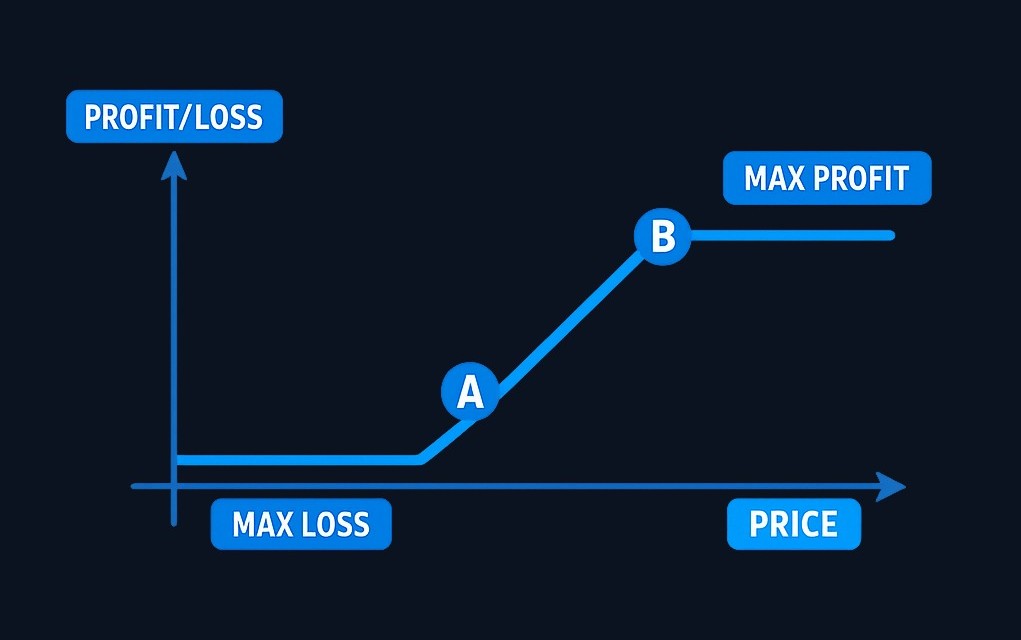
Plotted at expiration, a bull call spread has a distinctive shape: a flat line at the maximum loss below strike A, a rising diagonal between strikes A and B, and a flat line at the maximum profit above strike B. It looks like a long call whose top has been cut off at strike B, which is exactly what selling the higher-strike call does.
How volatility and time affect it
Because a bull call spread pairs one long call with one short call, it behaves differently from a single long call on both volatility and time.
On volatility, the spread is generally net long vega, so it tends to benefit modestly from rising implied volatility and to be hurt by falling implied volatility. The key word is modestly: higher volatility lifts the long call (helpful) and the short call (unhelpful) at once, so the legs partly offset and the spread's sensitivity is muted compared with a naked long call. That dampened exposure is one reason some traders prefer spreads. The implied volatility guide covers this input in depth.
On time, the effect depends on where the stock sits. While the underlying is between the strikes or near the lower strike, net time decay (theta) generally works against the position, because the long call's time value bleeds away faster than the short call helps. Only once the underlying is above the higher strike near expiration does time tend to help, letting the spread settle toward its capped maximum. Even then, this drag is milder than on a single long call, because the short call you sold decays in your favor. None of this is guaranteed, and the underlying's price remains the dominant driver.
Risks and things to watch
Defined risk does not mean low risk. A few points deserve emphasis:
- You can lose the entire net debit. If the underlying does not rise enough, both calls can expire worthless and the whole amount paid is gone.
- Upside is capped. If the stock surges far above strike B, you do not participate beyond the higher strike. That is a real trade-off for the lower cost.
- The short leg can be assigned. Because you sold the higher-strike call, you carry an obligation on that leg, and American-style short options can be assigned early, which complicates the position.
- Costs add up. Commissions and the bid-ask spread on two legs eat into a strategy whose maximum profit is already capped.
- It still requires being right. A defined-risk structure bounds the outcomes, but it does not rescue a wrong directional view.
Whether this strategy is appropriate for anyone depends on their knowledge, options approval level, and risk tolerance, and it is exactly the kind of thing to learn thoroughly and practice before risking real money.
A defined-risk structure bounds the outcome; it does not fix a wrong directional view.
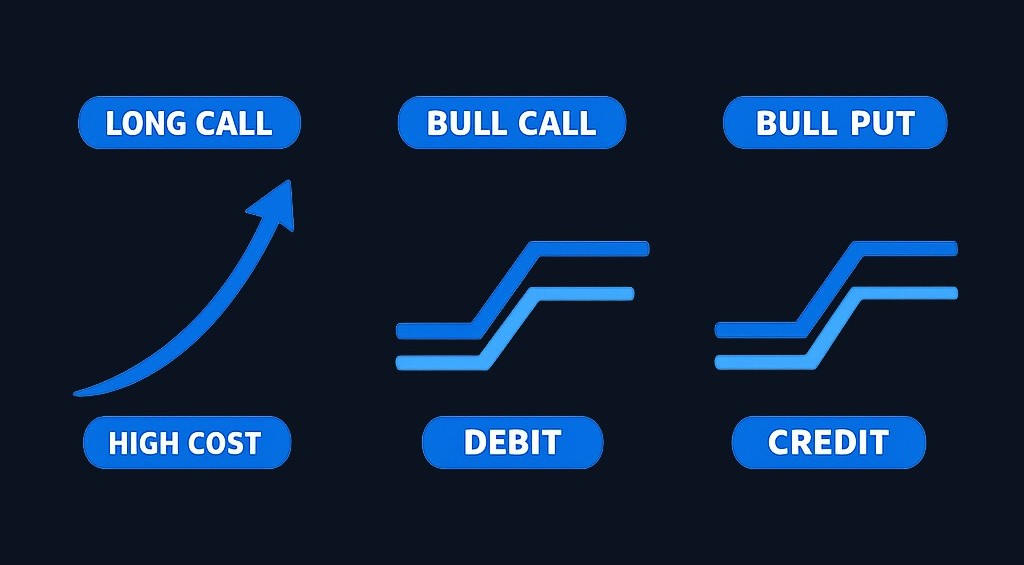
Bull call spread vs long call vs bull put spread
Three related positions are easy to confuse. This is a high-level comparison, not a recommendation of one over another.
| Bull call spread | Long call | Bull put spread | |
|---|---|---|---|
| Built from | Buy call A, sell call B | Buy one call | Sell put B, buy put A |
| Entered for | Net debit | Debit (premium paid) | Net credit |
| Outlook | Moderately bullish | Bullish | Moderately bullish |
| Maximum profit | Capped: (B − A) − net debit | Large, unlimited in theory | Capped: net credit |
| Maximum loss | Net debit | Premium paid | (B − A) − net credit |
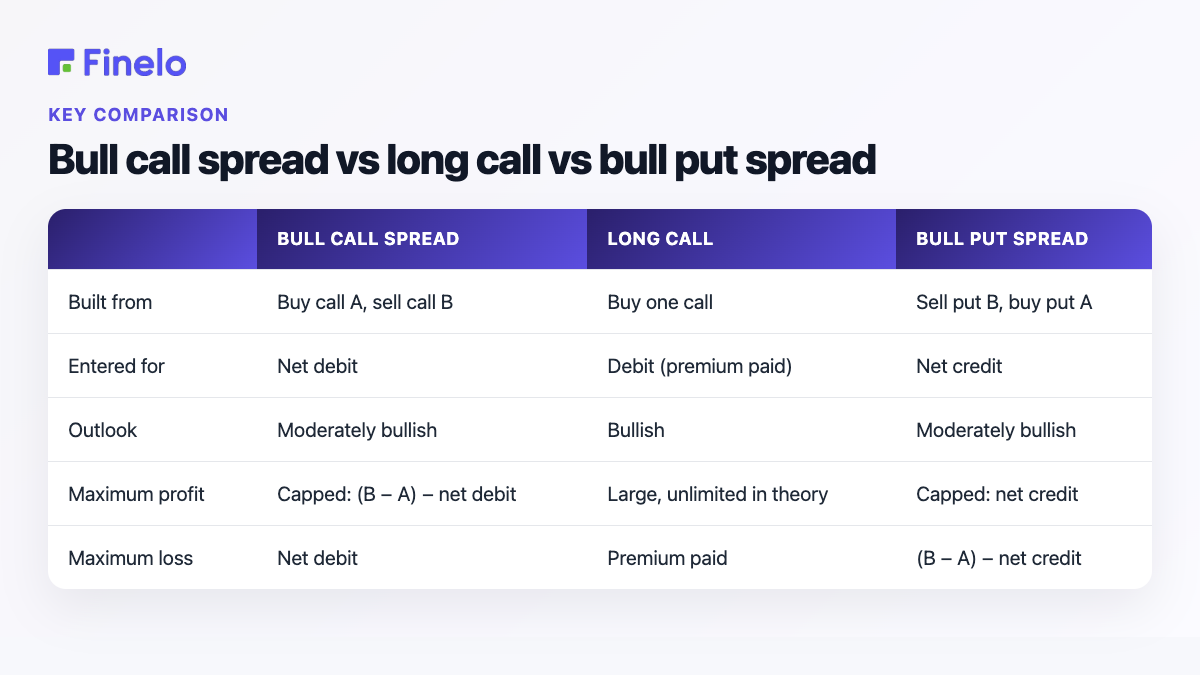
One thing worth knowing: a bull call spread and a bull put spread at the same strikes and expiration have essentially the same risk and reward at expiration, a near-equivalence that follows from put-call parity. They are built differently, one for a debit and one for a credit, and in practice early exercise, dividends, and margin can create minor differences before expiration. The choice usually comes down to pricing, liquidity, cash-flow timing, and assignment preferences, details for a later stage of learning.
Next steps
A bull call spread is a clear example of how two simple options combine into a position with a defined shape: capped cost, capped gain, and a known breakeven. Understanding it is a solid step up from single calls and puts.
Understanding a strategy and being ready to trade it are not the same thing.
If the basics still feel shaky, start with the options trading for beginners guide, and read the implied volatility guide to understand a key input to spread pricing. For a strategy with a very different risk profile, see the strangle option strategy. When you want hands-on practice, a simulator lets you watch how a spread behaves over time without risking money. Inside the Finelo app, you can study positions like this on real market data with virtual funds. There are no deposits, no withdrawals, and no broker connection — it is a closed practice loop, so the only cost of a wrong read is the lesson. To weigh up other users' experiences, read Finelo reviews, and for account questions, use the Finelo support center. Finelo is an educational product, not a brokerage, so verify current features through Finelo before relying on any specific detail.
Finelo is an educational product, not a brokerage. The simulator uses virtual funds and real market data, and final trading and investing decisions are yours, made through your own brokerage account when you choose to act. This article is for education and is not financial advice. Options trading carries significant risk and is not suitable for everyone.
Frequently asked questions
Is a bull call spread the same as a call debit spread?
Yes. "Bull call spread" and "call debit spread" are two names for the same strategy: buying a lower-strike call and selling a higher-strike call, on the same underlying and expiration, for a net debit. You may also see "debit call spread" or "long call spread." They all describe the identical position.
How do you calculate max profit, max loss, and breakeven?
Maximum loss equals the net debit you paid. Maximum profit equals the difference between the two strikes minus the net debit. Breakeven equals the lower strike plus the net debit. Remember to multiply the per-share figures by 100, since one standard contract covers 100 shares of the underlying.
When would someone use a bull call spread instead of buying a call?
Traders describe using it when they expect a moderate rise rather than a large one, and want to lower the upfront cost of a long call. Selling the higher-strike call reduces that cost but caps the profit. It is a trade-off — cheaper entry and defined risk for giving up the bigger upside.
What is the difference between a bull call spread and a bull put spread?
A bull call spread is built from two calls for a net debit; a bull put spread is built from two puts for a net credit. At the same strikes and expiration they have nearly identical risk and reward, so the difference is mostly construction, cash-flow timing, and assignment considerations rather than the payoff shape.
What are the risks of a bull call spread?
You can lose the entire net debit if the underlying does not rise enough, your upside is capped above the higher strike, the short call can be assigned, and two legs add costs. Defined risk means the maximum loss is known in advance, but it is still a real loss of the full amount paid.
bull call spreadoptions tradingtrading education
Practice trading with Finelo
Practice in a simulator, learn with bite-sized lessons, and build confidence before risking real money.
About the author
Finelo Team
The Finelo Team creates practical investing and trading education designed to help beginners learn faster with structured challenges, simulator practice, and bite-sized lessons.
Keep reading — Related articles

Trading
What Is SPAN Margin: Learn the Concept & Risk Controls
SPAN margin is an exchange-level, risk-based margin framework that calculates required collateral for futures and options by assessing portfolio risk across prescribed market scenarios rather than using a flat per‑contract rate.
Finelo Team
Trading
What Is Portfolio Margin: Learn the Concept & Risk Controls
Portfolio margin is a risk-based method that applies scenario analysis to eligible positions in an approved margin account.
Finelo Team
Trading
What Is NQ in Trading: Learn the Concept & Risk Controls
In trading, NQ is the ticker symbol for the E-mini Nasdaq-100 futures contract, listed on CME Group's exchange.
Finelo Team