Options trading is buying and selling contracts that give you the right, but not the obligation, to buy or sell a stock (or another asset) at a set price before a set date. A call option is the right to buy; a put option is the right to sell. You pay a price called the premium for that right, and one standard equity contract usually covers 100 shares of the underlying stock. Because a small premium can control a larger position, options carry leverage, which magnifies gains and losses alike.
Options Trading for Beginners: A Plain-English Guide to How Options Work
A beginner's guide to options trading: what options are, how calls and puts work, key terms like strike, premium, and expiration, the risks, and how to start learning safely.
14 min read
Practice trading with Finelo
Practice in a simulator, learn with bite-sized lessons, and build confidence before risking real money.
Want to learn more?
Practice in a simulator, learn with bite-sized lessons, and build confidence before risking real money.
Explore FineloExplore Finelo's 28-day challenges
Turn learning into a daily habit with guided challenge paths.
This guide is for complete beginners who want to understand what options are and how they work before going anywhere near a trade. It is a plain-English foundation, not a strategy to make money. The honest recommended next step is to learn the concepts thoroughly, practice in a simulator, and take the risks seriously, because options are complex, higher-risk instruments, and many beginners lose money on them.
This page is for learning purposes only and is not financial advice. Options trading carries significant risk and is not suitable for everyone.
Who This Guide Is For
This guide is for you if you keep hearing about calls, puts, and options and want a clear explanation without anyone assuming you already trade. It answers the what and the how it works, but deliberately does not tell you what to trade, because that is personal, risk-dependent, and beyond the scope of general education.
It fits if you are:
- New to options and want the fundamentals in plain English.
- Trying to understand calls, puts, strikes, premiums, and expiration.
- Wondering whether options suit a beginner, and how to learn safely.
Understanding options makes you a better-informed investor even if you never trade a single one.
What Is an Option? The Contract Basics
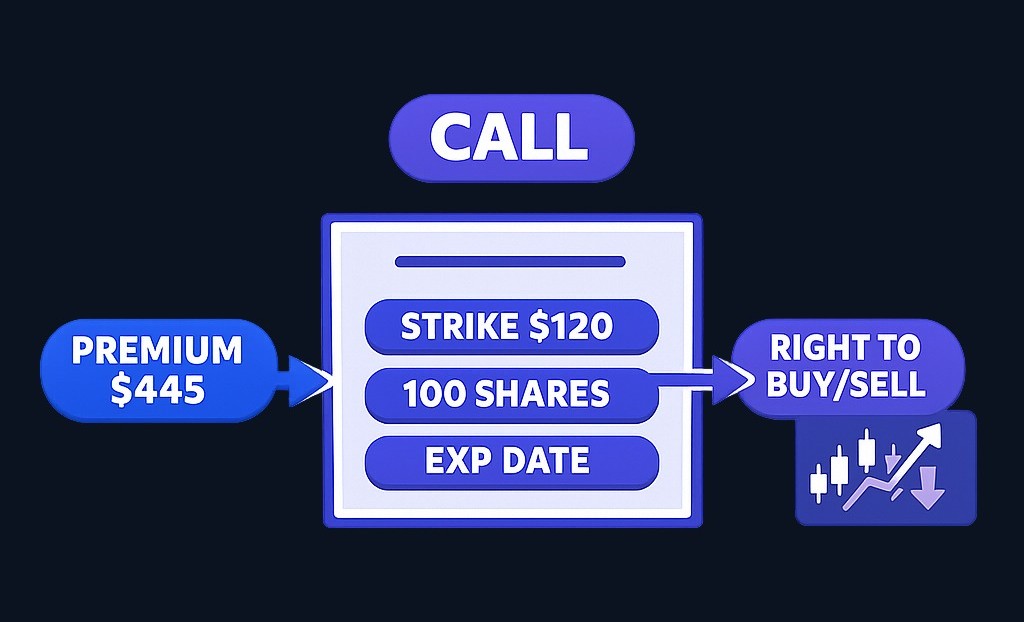
An option is a contract between two parties, a buyer and a seller, based on an underlying asset that is usually a stock, an ETF, or an index. The contract spells out a few things: the underlying it is based on, a strike price (the agreed price for buying or selling), an expiration date (when the contract ends), and how many units it covers. For standard stock options, one contract represents 100 shares of the underlying, so the premiums you see quoted per share are multiplied by 100 to get the real cost.
Two style details are worth knowing early. American-style options can be exercised on any business day up to and including expiration, while European-style options, which are often index options, can only be exercised at expiration. And options are wasting assets: they have a finite life and lose time value as expiration approaches. That single feature, a built-in clock, is one of the biggest differences from owning stock outright, where you can simply wait.
Calls vs Puts
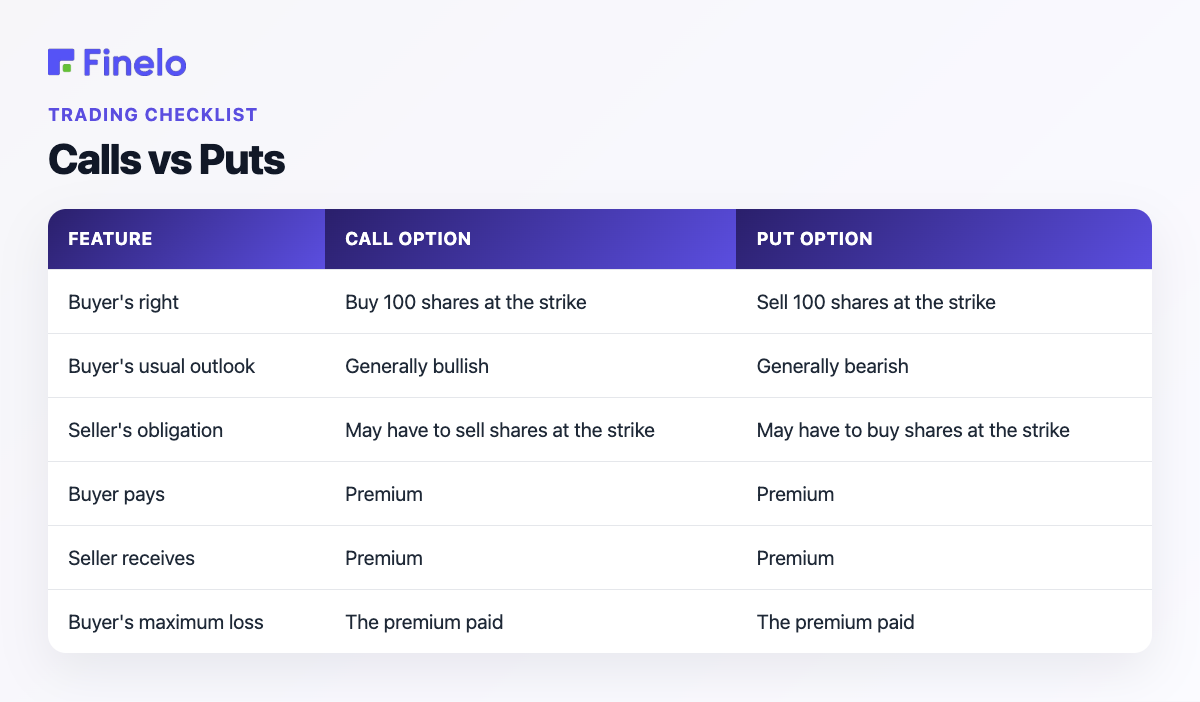
There are only two basic types of option: calls and puts. A call gives its holder the right to buy the underlying at the strike price. A put gives its holder the right to sell the underlying at the strike price. For every buyer there is a seller on the other side who takes on the opposite obligation.
| Feature | Call option | Put option |
|---|---|---|
| Buyer's right | Buy 100 shares at the strike | Sell 100 shares at the strike |
| Buyer's usual outlook | Generally bullish | Generally bearish |
| Seller's obligation | May have to sell shares at the strike | May have to buy shares at the strike |
| Buyer pays | Premium | Premium |
| Seller receives | Premium | Premium |
| Buyer's maximum loss | The premium paid | The premium paid |
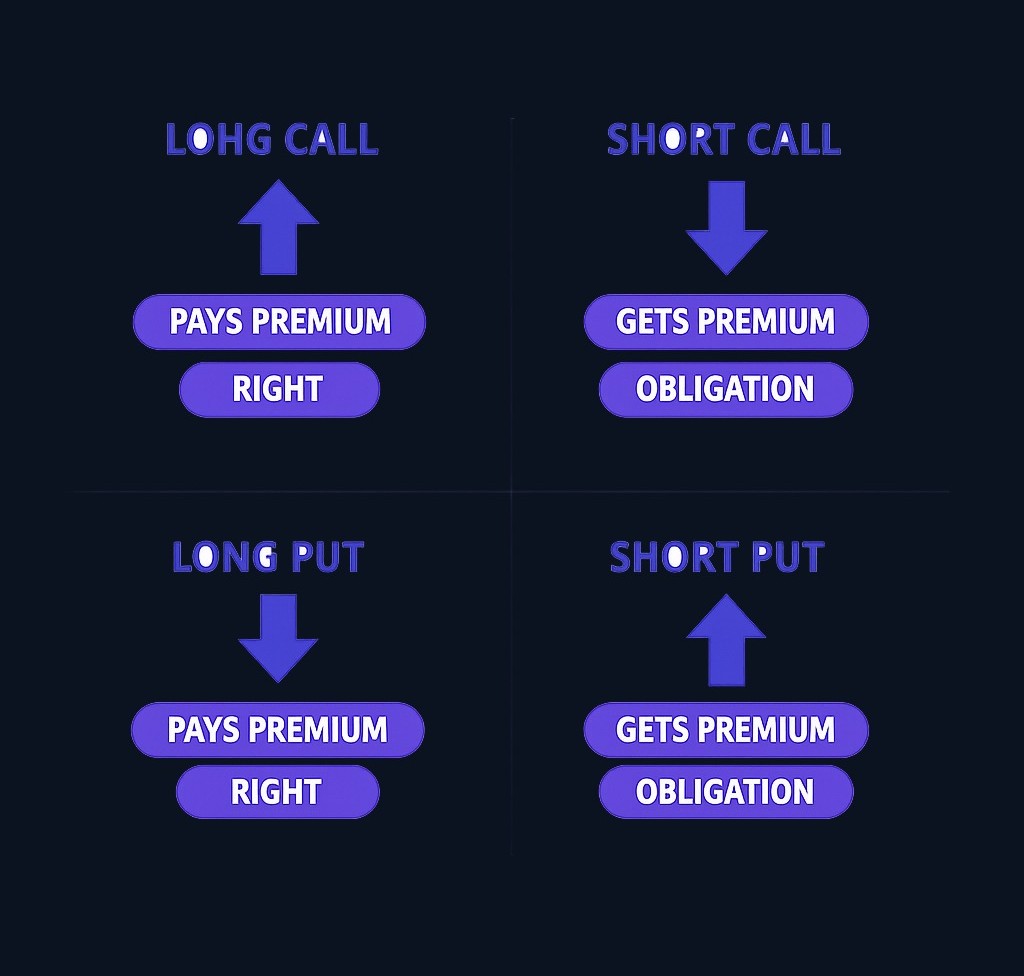
That gives four basic positions: long a call, short a call, long a put, and short a put. Buying (going long) an option costs a premium and risks that premium. Selling (going short) an option collects a premium but takes on an obligation, and as the risk section explains, that obligation can become expensive. A rough way to hold it in your head: buyers pay for a right, and sellers get paid to take on a duty.
Buyer vs Seller: Rights and Obligations
The single most important distinction for a beginner is between the buyer (the holder) and the seller (the writer) of an option.
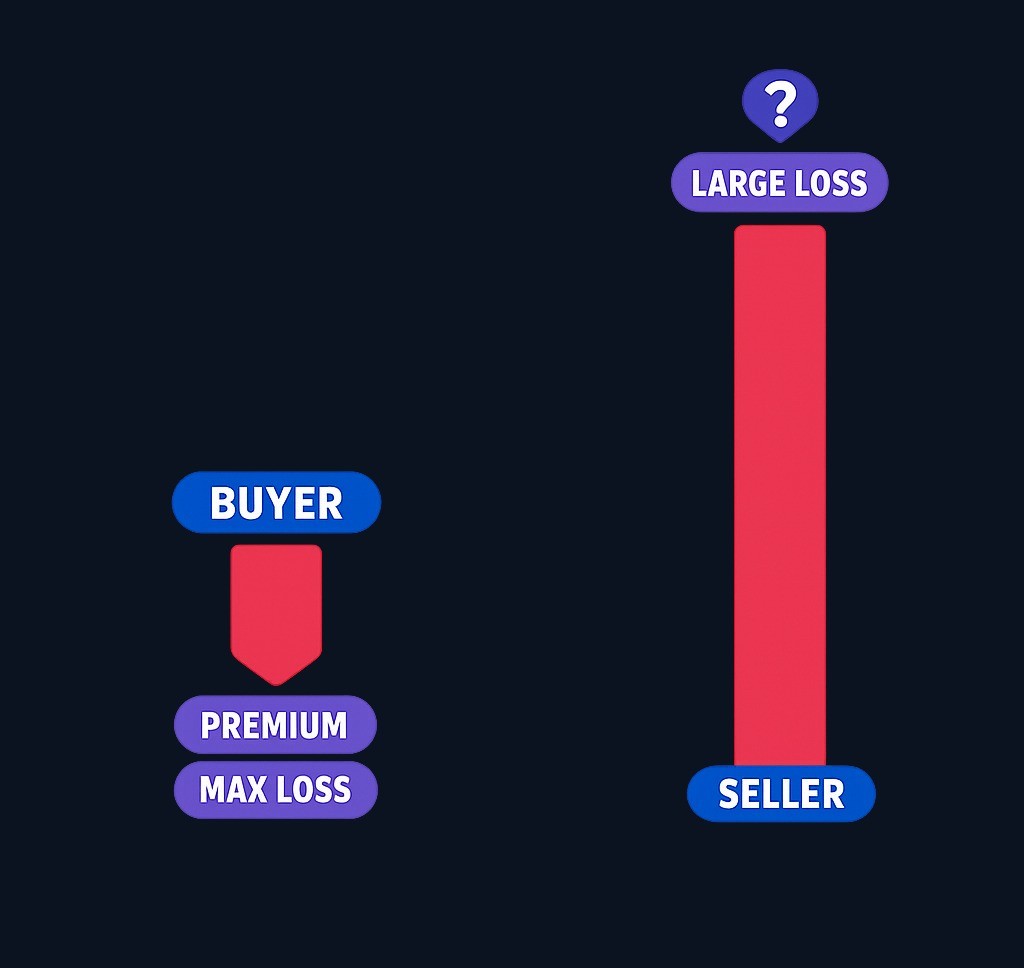
The buyer pays the premium and receives a right. The most a buyer can lose is the premium paid, which is the defined, limited downside of buying options. The seller receives the premium up front and takes on an obligation to fulfill the contract if the buyer exercises it. When a long option is exercised, the matching short option is assigned, meaning the seller has to deliver on the deal.
Here is the warning that matters most for sellers. A short (sold) option can be assigned at essentially any time for American-style options, even before expiration, and a naked (uncovered) short call can expose the seller to very large, theoretically unlimited losses if the underlying keeps rising. A short put is less extreme, since a stock can fall no lower than zero, but the loss there can still be heavy. This gap between defined-risk buying and potentially large-risk selling is exactly why beginners are usually steered toward simpler, defined-risk approaches, and why option selling requires higher broker approval levels.
Defined risk for buyers, potentially large risk for sellers: that asymmetry is the first thing to internalize.
Key Terms Every Beginner Needs
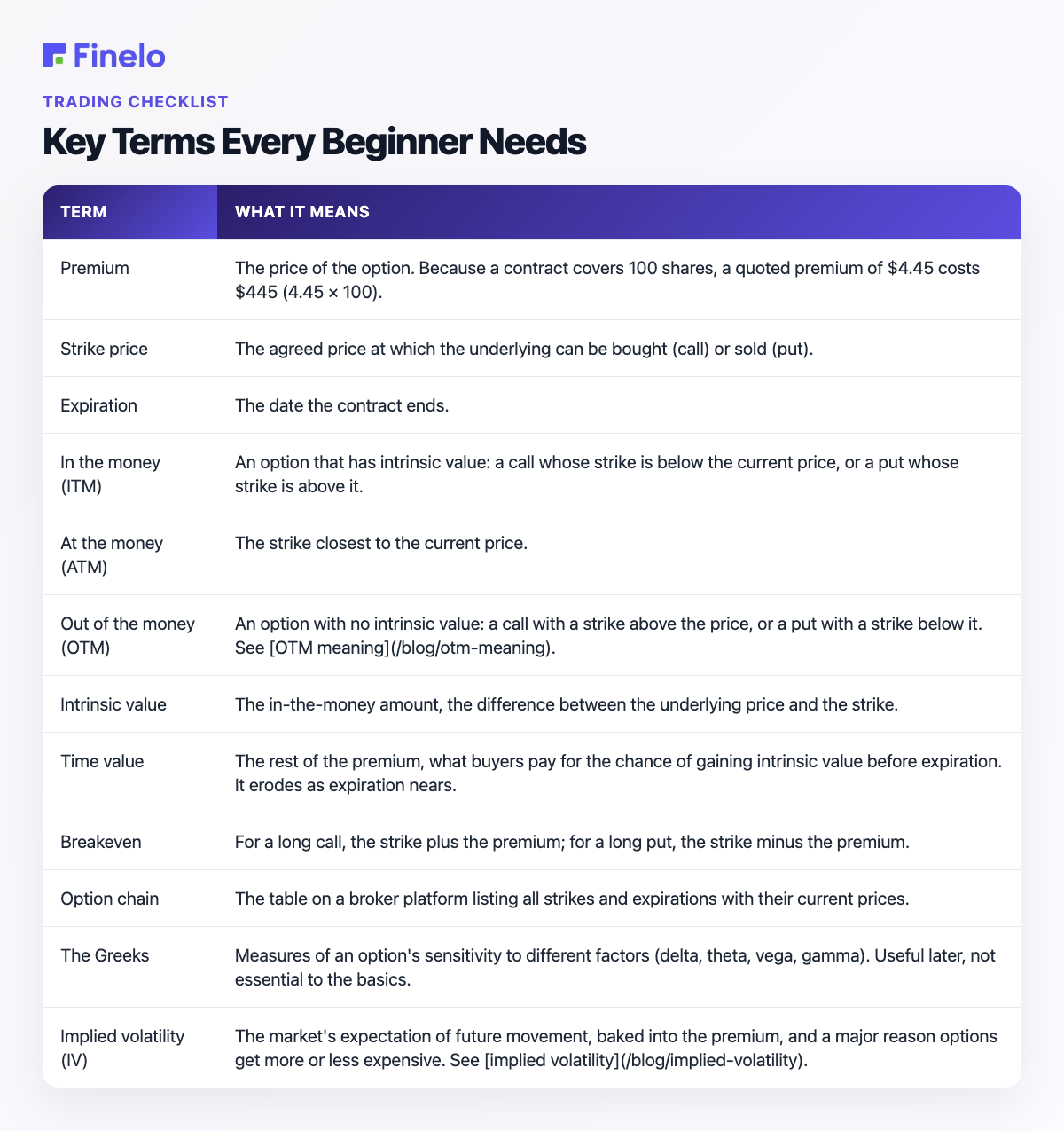
A handful of terms unlock almost everything else. Keep this glossary nearby as you read the rest of the page.
| Term | What it means |
|---|---|
| Premium | The price of the option. Because a contract covers 100 shares, a quoted premium of $4.45 costs $445 (4.45 × 100). |
| Strike price | The agreed price at which the underlying can be bought (call) or sold (put). |
| Expiration | The date the contract ends. |
| In the money (ITM) | An option that has intrinsic value: a call whose strike is below the current price, or a put whose strike is above it. |
| At the money (ATM) | The strike closest to the current price. |
| Out of the money (OTM) | An option with no intrinsic value: a call with a strike above the price, or a put with a strike below it. See OTM meaning. |
| Intrinsic value | The in-the-money amount, the difference between the underlying price and the strike. |
| Time value | The rest of the premium, what buyers pay for the chance of gaining intrinsic value before expiration. It erodes as expiration nears. |
| Breakeven | For a long call, the strike plus the premium; for a long put, the strike minus the premium. |
| Option chain | The table on a broker platform listing all strikes and expirations with their current prices. |
| The Greeks | Measures of an option's sensitivity to different factors (delta, theta, vega, gamma). Useful later, not essential to the basics. |
| Implied volatility (IV) | The market's expectation of future movement, baked into the premium, and a major reason options get more or less expensive. See implied volatility. |
Do not feel you have to master the Greeks or implied volatility to grasp the basics. They matter, and you will meet them again, but calls, puts, premium, strike, expiration, and moneyness are the load-bearing ideas.
How Options Trading Works, Step by Step (Educational)
If you searched for how to trade options, here is the conceptual arc, described to explain how it works rather than as instructions to follow.
Someone forms a view about an underlying, say they think a stock might rise. They open the option chain, the table on a broker platform that lists every strike and expiration with its current price, and see calls and puts spread across many strikes and dates, each with its own premium. A buyer who wanted upside exposure might buy a call, paying the premium up front, knowing the most they can lose is that premium. From there, the option's value changes constantly with three things at once: the underlying's price, the time left before expiration, and implied volatility.
Before expiration, many positions are simply closed out, sold back at the current premium, rather than exercised, which locks in whatever gain or loss has built up. A long option still in the money at expiration is generally exercised automatically; one that is out of the money expires worthless and the buyer loses the premium. That is the full life cycle: open, watch the value move, then close, exercise, or expire. Whether any of it is a good idea depends entirely on the person's knowledge, risk tolerance, and situation.
With options, being right about direction but wrong about timing can still lose money.
Practice trading with Finelo
Practice in a simulator, learn with bite-sized lessons, and build confidence before risking real money.
A Simple Worked Example
Here is one hypothetical with round numbers:
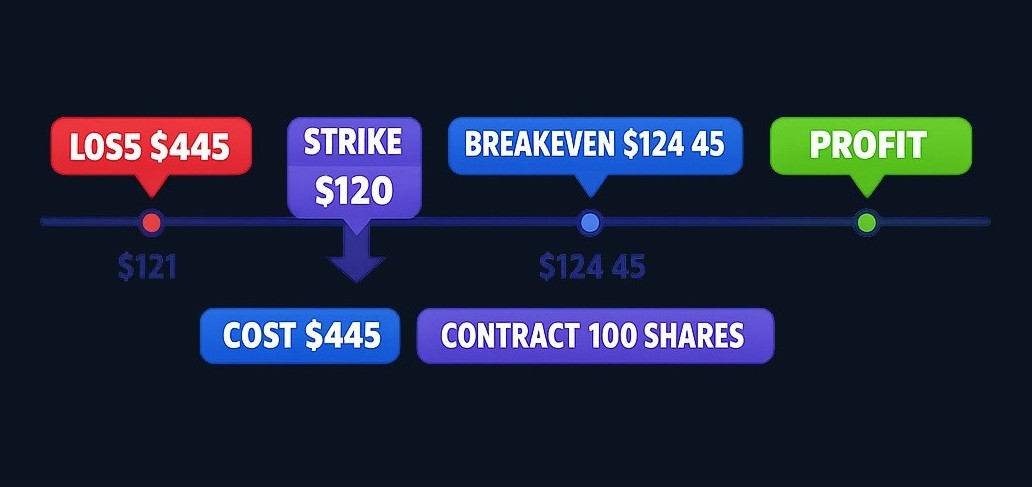
Suppose a stock trades at $121. A beginner is studying a call with a $120 strike that costs a $4.45 premium. Because one contract covers 100 shares, buying it would cost $445 (4.45 × 100). The breakeven at expiration would be $124.45, the $120 strike plus the $4.45 premium. If the stock finished below $120 at expiration, the call would expire worthless and the whole $445 would be gone. If it finished right at $124.45, the position would roughly break even. If it finished above $124.45, the position would be worth more than was paid. The point of the example is the structure — defined cost, leverage, a breakeven, and a time limit — and not a suggestion to place this trade.
Why Options Are Risky
Options are not a shortcut, and this is the most important section on the page. Regulators and brokers state plainly that options involve significant risk and are not suitable for all investors.
- Leverage cuts both ways. The same leverage that can amplify a gain can amplify a loss, and losses can happen fast.
- Options expire. They are wasting assets. Time value erodes every day, and an out-of-the-money option can go to zero at expiration. Being right about direction but wrong about timing can still lose the whole premium.
- Buyers can lose 100% of the premium. That is the defined downside of buying: the entire premium is at risk.
- Sellers can lose far more. Writing options, especially uncovered ones, can lead to very large or, for naked calls, theoretically unlimited losses, and short options can be assigned unexpectedly.
- It is genuinely complex. Prices move with the underlying, with time, and with implied volatility all at once, which catches many beginners off guard.
Treat any claim that options are an easy or reliable income source with deep skepticism. You generally must be approved by a broker before you can trade options at all, and the higher-risk approaches require higher approval levels for a reason.
Beginner Strategies, at a High Level
You will see "options strategies for beginners" everywhere. It helps to recognize the names, but this page describes them only as concepts with risk notes, not as instructions to follow.
- Long call or long put. The simplest positions, with risk limited to the premium. Directional and sensitive to timing.
- Covered call. Selling a call against shares you already own. It generates premium but caps your upside and still carries the stock's full downside.
- Cash-secured put. Selling a put while holding enough cash to buy the shares if assigned. It generates premium but obligates you to buy at the strike.
- Spreads (for example, verticals). Combining options to define both risk and reward. More moving parts, and still real risk.
Which of these, if any, is appropriate is a personal decision that depends on your knowledge, goals, account approval, and risk tolerance. It is exactly the kind of thing to learn thoroughly and practice before doing anything with real money.
How to Start Learning Options Safely
If you decide to keep going, the safest path front-loads education and practice.
- Learn the fundamentals first. Make calls, puts, premium, strike, expiration, and the risks second nature before anything else.
- Practice without real money. Use a paper-trading account or simulator to watch how option prices behave over time and around events, with no financial risk. See paper trading for beginners.
- Understand the costs. Commissions, fees, and the bid-ask spread all matter, and were deliberately left out of the simple example above.
- Know the approval levels. Brokers assign options approval tiers, and the higher-risk strategies require higher tiers for a reason.
- Start small and defined-risk, if at all. Many educators suggest that beginners who do proceed keep positions tiny and stick to defined-risk approaches.
- Read the risk disclosures. Brokers require you to receive the standardized options risk disclosure document before trading; read it rather than clicking through, because it spells out exactly how these instruments can lose money.
A simulator is a low-pressure place to build this fluency. Inside the Finelo app, you can study how options and other instruments behave and practice buy, sell, and hold decisions on real market data with virtual funds. There are no deposits, no withdrawals, and no broker connection — it is a closed practice loop, so the only cost of a wrong read is the lesson. Finelo is an educational product, not a brokerage, so verify current features and availability through Finelo before relying on any specific detail.
The honest beginner move is to learn thoroughly and practice before risking a cent.
Download the Beginner PDF
Want a printable copy of this guide? Download the Options Trading for Beginners PDF for a glossary and risk-focused reference you can keep while you learn. It is educational material, not trading advice.
Next Steps
Options are one of the more complex corners of investing, so the smartest first move is to build a solid foundation and practice before ever risking money. Get comfortable with calls and puts, the key terms, and above all the risks, then reinforce it in a simulator where mistakes cost nothing but time.
For a deeper look at what drives an option's price, read the implied volatility guide. When you want structured, hands-on learning, visit Finelo or open the Finelo app. To weigh up other users' experiences, read Finelo reviews. For product or account questions, use the Finelo support center.
A solid foundation and honest practice beat any shortcut, especially with options.
Finelo is an educational product, not a brokerage. The simulator uses virtual funds and real market data, and final trading and investing decisions are yours, made through your own brokerage account when you choose to act. This article is for education and is not financial advice. Options trading carries significant risk and is not suitable for everyone.
Frequently asked questions
What is the difference between a call and a put?
A call gives the holder the right to buy the underlying at the strike price and generally reflects a bullish view. A put gives the holder the right to sell at the strike and reflects a bearish one. In both cases the buyer pays the premium and the seller takes on the matching obligation.
How much money do I need to start trading options?
There is no single figure. It depends on the premiums, the number of contracts, and your broker's requirements, and selling options can tie up significant collateral. More important than any minimum is being approved for options, understanding the risks, and using only money you can afford to lose. Practicing in a simulator first costs nothing.
Is options trading good or risky for beginners?
Options carry significant risk and are not suitable for everyone. Buyers can lose all of the premium, sellers can face large losses, and options expire, so timing matters. They can be worth understanding, but beginners are best served by learning thoroughly and practicing before risking real money, rather than treating them as quick income.
What are the best options strategies for beginners?
This is educational, not advice, so there is no "best" to recommend. Commonly cited beginner-friendly concepts include long calls or puts (defined risk), covered calls, and cash-secured puts, each with its own trade-offs. Which, if any, suits you depends on your knowledge, goals, approval level, and risk tolerance.
How do I learn options trading?
Start with the fundamentals — calls, puts, premium, strike, expiration, and the risks — until they feel second nature. Then practice in a paper-trading account or simulator to watch how option prices behave without risking money. Structured lessons and reputable sources help, and it is wise to avoid anyone promising easy or guaranteed profits.
TradingBeginnerOptionsMarkets
Practice trading with Finelo
Practice in a simulator, learn with bite-sized lessons, and build confidence before risking real money.
About the author
Finelo Team
The Finelo Team creates practical investing and trading education designed to help beginners learn faster with structured challenges, simulator practice, and bite-sized lessons.
Keep reading — Related articles

Trading
What Is SPAN Margin: Learn the Concept & Risk Controls
SPAN margin is an exchange-level, risk-based margin framework that calculates required collateral for futures and options by assessing portfolio risk across prescribed market scenarios rather than using a flat per‑contract rate.
Finelo Team
Trading
What Is Portfolio Margin: Learn the Concept & Risk Controls
Portfolio margin is a risk-based method that applies scenario analysis to eligible positions in an approved margin account.
Finelo Team
Trading
What Is NQ in Trading: Learn the Concept & Risk Controls
In trading, NQ is the ticker symbol for the E-mini Nasdaq-100 futures contract, listed on CME Group's exchange.
Finelo Team