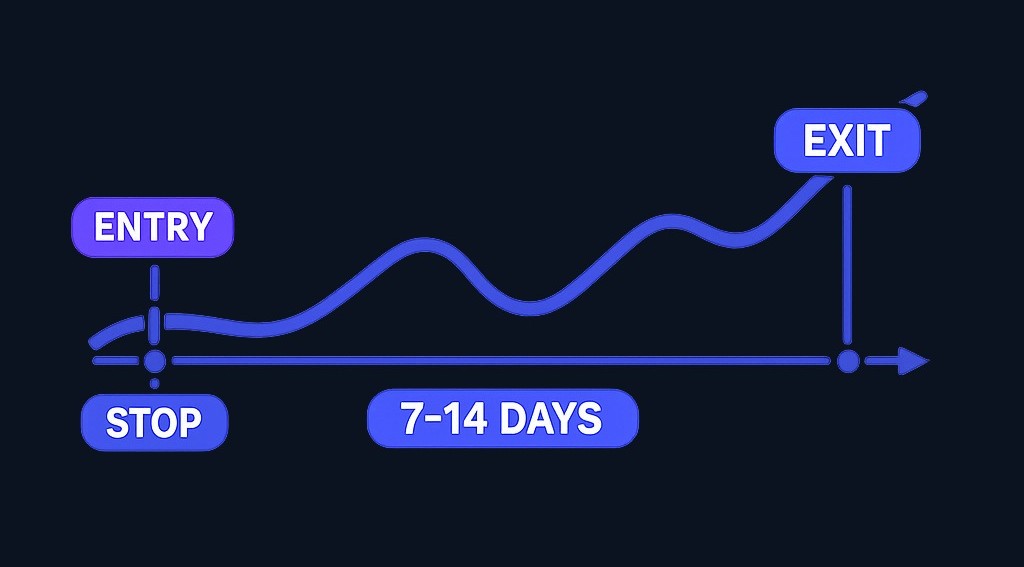
Swing trading is a short-term approach in which a trader holds a position for several days or weeks while trying to capture part of a price move. The goal is not to predict every fluctuation. It is to identify a plausible setup, define an entry and exit in advance, and manage the possibility that the market moves the other way. Charles Schwab likewise describes swing trading as an attempt to capture short-term gains over days or weeks from upward or downward price swings and technical levels such as support and resistance (source).
What is Swing Trading? A Complete Guide

Swing trading is a short-term approach in which a trader holds a position for several days or weeks while trying to capture part of a price move. The goal is not to predict every fluctuation. It is to identify a…
9 min read
Practice trading with Finelo
Practice in a simulator, learn with bite-sized lessons, and build confidence before risking real money.
Want to learn more?
Practice in a simulator, learn with bite-sized lessons, and build confidence before risking real money.
Explore FineloExplore Finelo's 28-day challenges
Turn learning into a daily habit with guided challenge paths.
This guide is for beginners who want to understand how swing trading works before risking money. It explains common strategies, practical tools, and the risks that can turn an attractive chart into a losing trade.
How Swing Trading Works
A swing trader looks for a market move that may continue or reverse over a relatively short window. The process usually begins with a broad question—“Is this asset trending, ranging, or breaking out?”—and becomes a specific trade plan.
A basic plan defines:
- the asset and direction of the trade;
- the condition that would trigger an entry;
- the price or condition that would invalidate the idea;
- one or more potential exit points;
- the amount of capital exposed; and
- the maximum loss the trader is prepared to accept.
Suppose a stock has been rising, pauses for several sessions, and then moves above the upper edge of that pause. A swing trader might interpret the move as a breakout and consider entering only after the price meets a predetermined confirmation rule. The trader would also identify the level at which the breakout thesis is no longer valid. This is a hypothetical setup, not a prediction. Schwab identifies a bullish-flag breakout as a classic swing-trade setup and presents it as an illustrative example rather than a guaranteed outcome (source).
Swing trading vs. day trading vs. investing
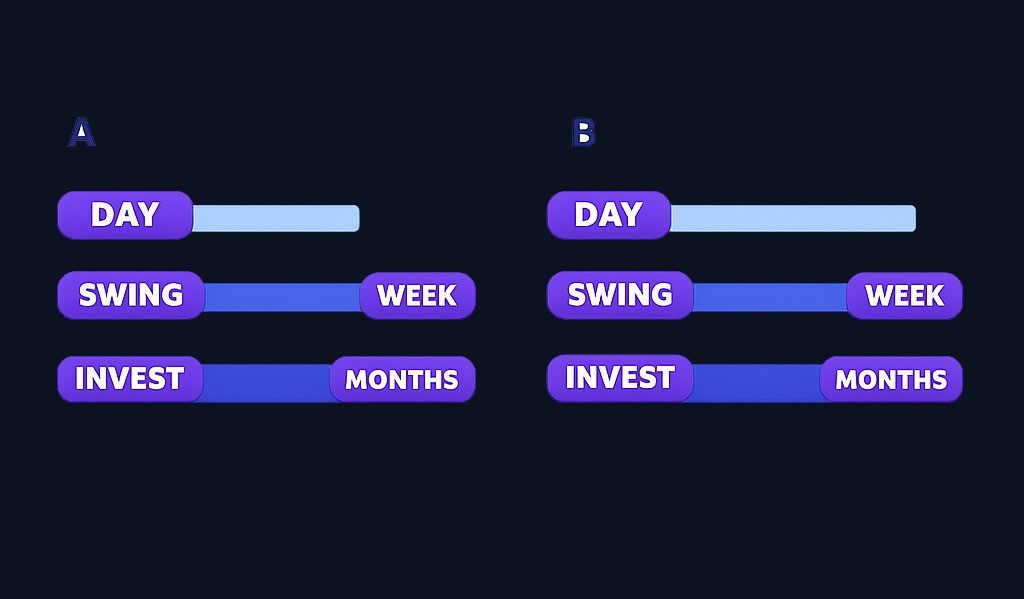
The clearest distinction is the intended holding period and the type of move being targeted.
| Approach | Typical focus | Position management | Main practical challenge |
|---|---|---|---|
| Day trading | Intraday price movement | Positions are generally opened and closed during the trading day | Requires frequent monitoring and quick decisions |
| Swing trading | Moves developing over days or weeks | Positions may remain open overnight and across several sessions | Exposure to price gaps and changing conditions between sessions |
| Longer-term investing | Business or market development over a longer horizon | Positions may be held through many short-term fluctuations | Requires patience and tolerance for longer periods of uncertainty |
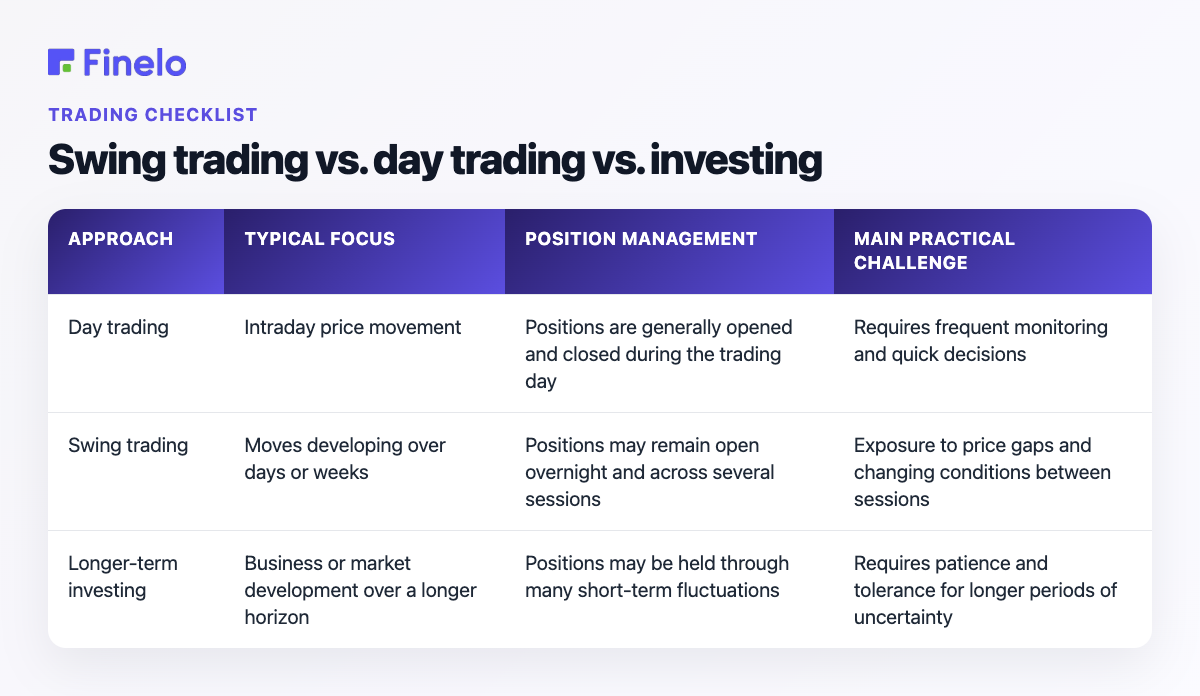
For example, a day trader may react to a price move that develops during one session. A swing trader may wait for a multi-day pattern to form, while a long-term investor may view the same short-term movement as irrelevant to the original investment thesis.
Common Swing Trading Strategies
No strategy works in every market. A useful strategy is one with clear conditions, defined risk, and rules that the trader can follow consistently.
Trend pullback
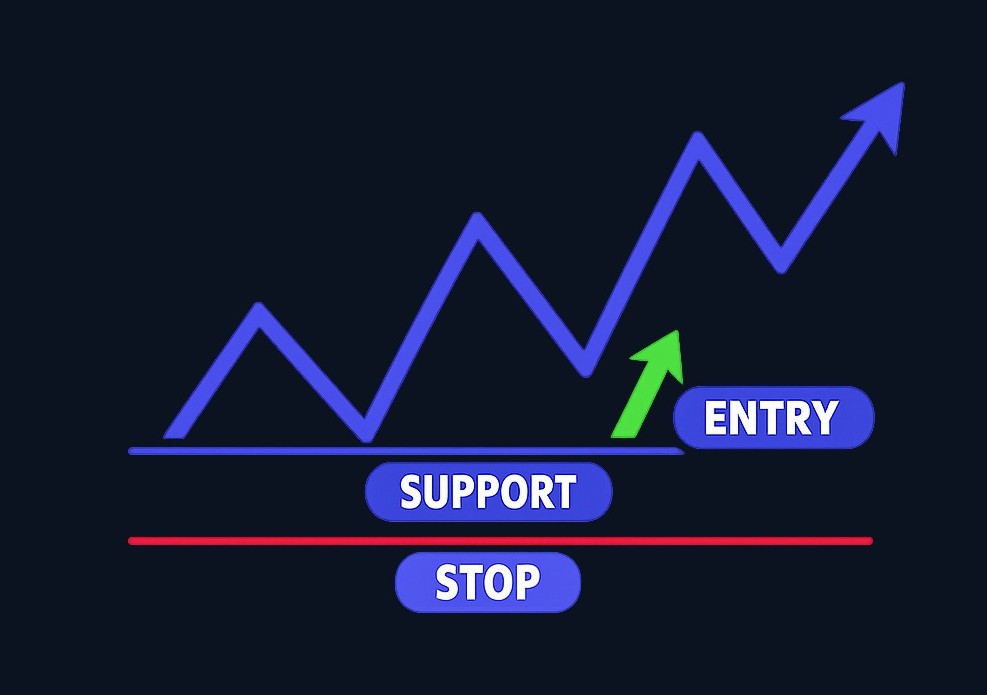
In a trend-pullback strategy, the trader first identifies a broader upward or downward trend. Instead of entering after an extended move, the trader waits for price to pull back toward an area that previously attracted buyers or sellers.
For example, imagine an asset making a sequence of higher highs and higher lows. It then declines toward a prior support area. A trader might watch for evidence that selling pressure is fading before considering an entry. If the price continues falling through the level, the setup may be invalidated.
Breakout
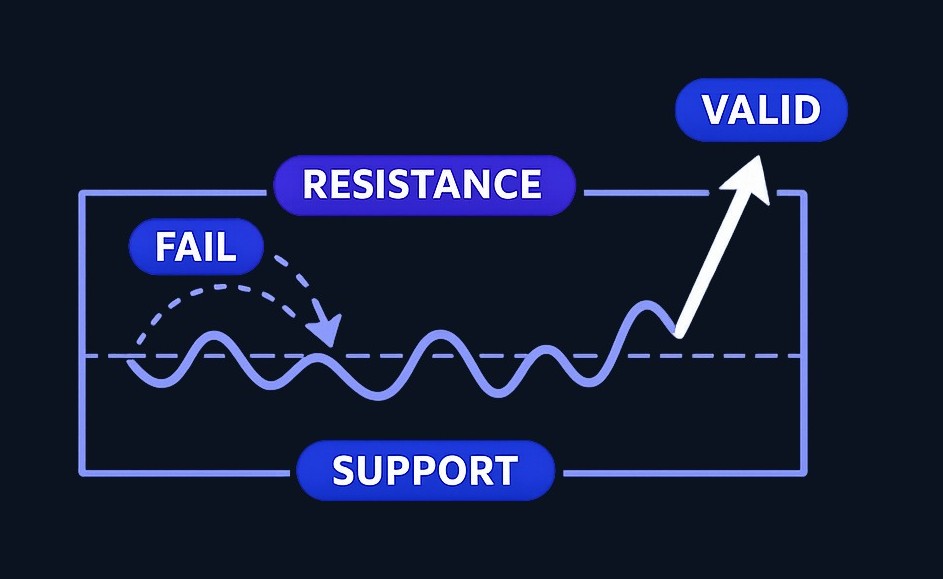
A breakout occurs when price moves beyond a level that had contained it, such as resistance above a trading range. Traders may also watch volume or a retest of the broken level, but additional confirmation can mean entering later at a less favorable price.
Consider an asset that has traded between two clear levels for two weeks. A move above the upper boundary could become a long setup. However, if the price quickly returns to the range, the breakout may have failed. The key is to decide what counts as a valid break and a failed break before entering.
Support-and-resistance bounce
This approach looks for price to reject a well-observed support or resistance area. The trade thesis is that the range will continue rather than break.
For example, if price has repeatedly fallen toward the same zone and recovered, a trader may watch for another bounce. The risk is that repeated tests can weaken a level; what looks like another bounce opportunity may instead become a breakdown.
Momentum continuation
Momentum traders look for a strong move that may persist after a brief pause. The challenge is avoiding entries after much of the move has already occurred.
A hypothetical example is a stock that advances sharply, consolidates in a narrow range, and then resumes moving upward. A trader may require the price to clear the consolidation before acting. If the move is already far from a logical invalidation level, the potential loss may be too large relative to the planned reward.
Choosing a strategy by risk tolerance
| If you prefer... | A framework to study | Important trade-off |
|---|---|---|
| Waiting for an established direction | Trend pullbacks | A pullback can become a full trend reversal |
| Acting when price leaves a defined range | Breakouts | False breakouts can reverse quickly |
| Using nearby chart levels to define risk | Support-and-resistance bounces | The level can fail instead of holding |
| Following strong price movement | Momentum continuation | Late entries can create poor risk-to-reward |
| Lower uncertainty while learning | Observation or simulated practice | Practice cannot fully reproduce the emotions or execution of risking money |
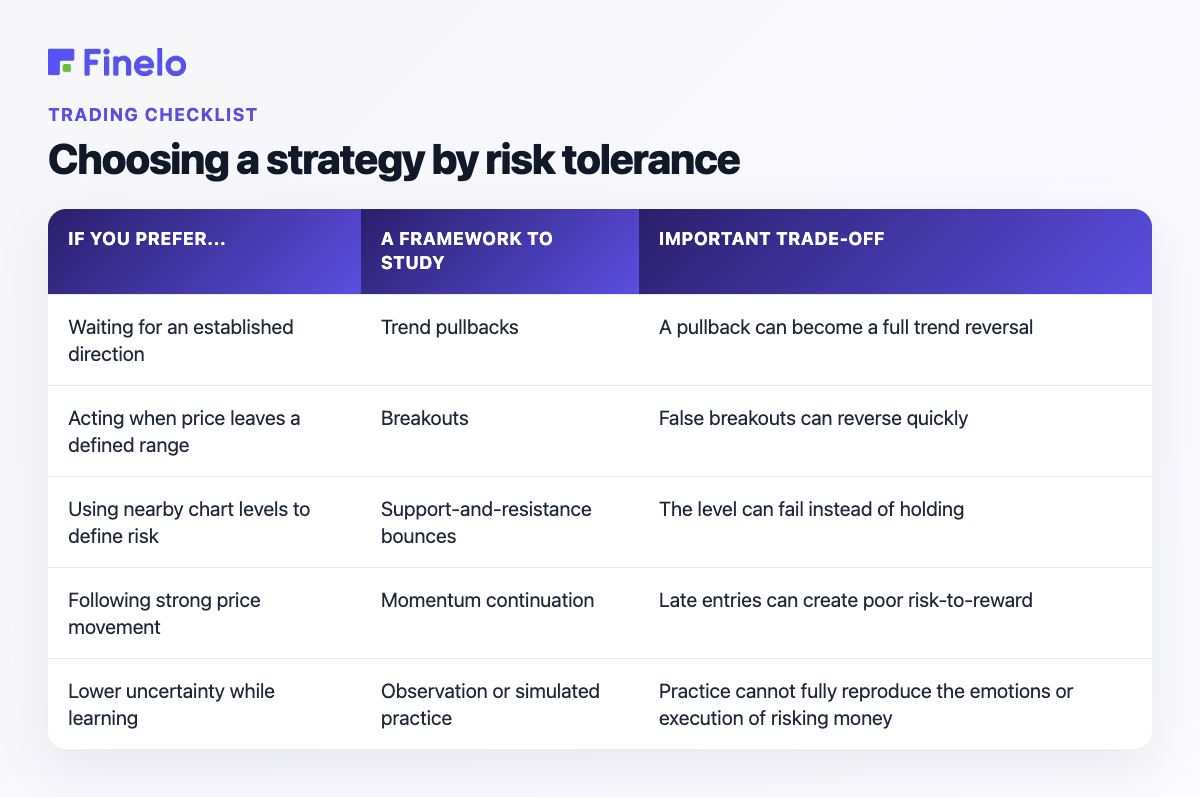
Lower risk tolerance does not make one live-trading strategy “safe.” It may instead be a reason to avoid live swing trading, reduce exposure, or continue learning without committing capital.
A Swing Trading Checklist
Indicators can organize information, but they do not remove uncertainty. Rather than collecting dozens of signals, traders can use a short checklist that connects each observation to a decision.
- Market context: Is the broader market trending, ranging, or unusually volatile?
- Price structure: Are highs and lows moving in a consistent direction?
- Key levels: Where are support, resistance, the potential entry, and the invalidation point?
- Momentum: Is the move strengthening, slowing, or diverging from recent behavior?
- Volume: Does trading activity support the price move, or is participation fading?
- Timing: Are there known events that could disrupt the setup while the position is open?
- Risk-to-reward: Is the planned upside sufficient to justify the amount at risk?
- Position size: Would the planned loss remain manageable if the trade fails?
- Exit rules: What triggers a profit-taking exit, a loss-cutting exit, or a time-based exit?
- Recordkeeping: Can the decision and result be reviewed objectively later?
For example, a breakout may look appealing on price alone. The checklist could reveal that the entry is far above the invalidation point, an event is approaching, or the potential target offers little room before another resistance area. Passing on that trade can be as important as finding one.
Practice trading with Finelo
Practice in a simulator, learn with bite-sized lessons, and build confidence before risking real money.
Risks and Challenges of Swing Trading
Swing trading can produce losses, including a loss larger than expected when price changes sharply. Because positions remain open across sessions, they are exposed to news, market repricing, and overnight gaps. An order designed to exit at a particular level may not always result in execution at that exact price.
Other important risks include:
- False signals: A breakout, reversal, or indicator signal may fail without warning.
- Volatility: Wider price swings can increase both opportunity and potential loss.
- Concentration: Putting too much capital into one idea magnifies the damage if it fails.
- Leverage and short-selling risk: These can create losses that develop faster or behave differently from a straightforward unleveraged purchase.
- Costs: Frequent transactions, spreads, financing, taxes, and other charges can affect results.
- Emotional pressure: Fear, impatience, and overconfidence can override a well-designed plan.
- Strategy drift: Changing rules after entering can turn a defined trade into an open-ended hope.
Imagine a trader buys after a breakout and plans to exit if price falls below the former resistance level. Overnight, unexpected news causes the asset to open well below that point. The trader may face a larger loss than planned. This example shows why a stop level is a risk-management tool, not a guarantee of a particular exit price.
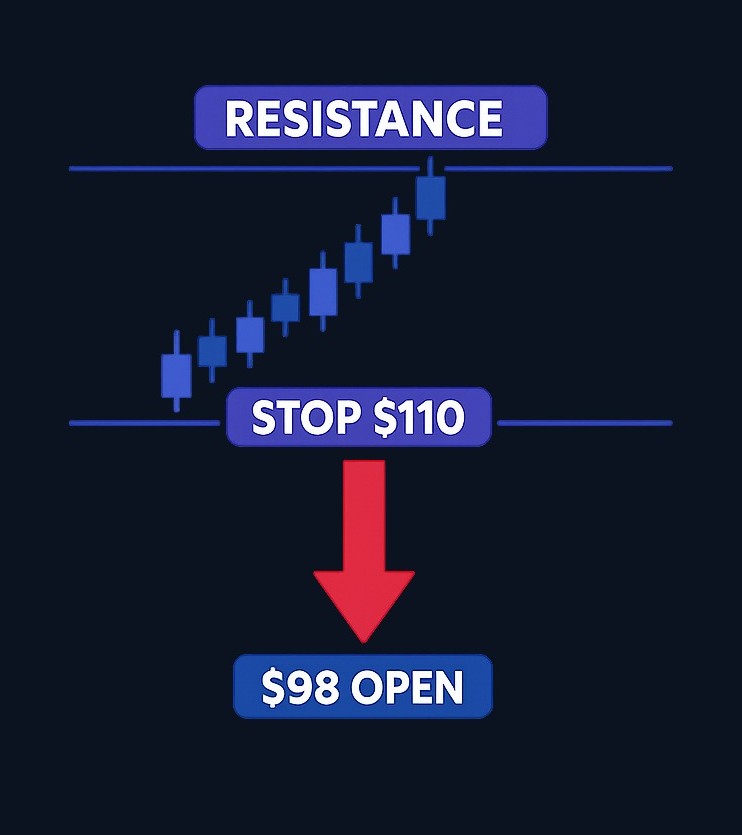
Risk management begins before entry. A trader can define the maximum acceptable loss, size the position around that limit, and avoid committing money needed for essential expenses. These steps cannot eliminate loss, but they can prevent a single idea from carrying unlimited importance.
Common Mistakes to Avoid
Many swing-trading errors come from inconsistent decisions rather than a lack of indicators.
- Entering without an invalidation point. If nothing can prove the idea wrong, there is no disciplined basis for exiting.
- Chasing an extended move. Entering after a rapid advance can leave little upside before a pullback and a distant logical stop.
- Risking too much on one trade. Conviction does not make an uncertain outcome certain.
- Moving the exit to avoid accepting a loss. Widening risk after entry changes the original plan.
- Taking every signal. A setup may be technically valid but unsuitable because of market context, costs, or poor reward relative to risk.
- Overfitting indicators. Adding more tools until past charts look perfect can produce rules that fail in new conditions.
- Ignoring the trading journal. Without records, it is difficult to separate a repeatable process from luck.
For example, a trader sees a price approaching resistance and buys before the breakout because they fear missing the move. The price then reverses. The mistake was not merely that the trade lost; it was that the trader abandoned the entry rule before the setup existed.
Tools and Resources for Swing Traders
A practical workflow does not require every available indicator. It requires tools that support planning, execution, and review.
- Charting: Price history, volume, time-frame selection, and drawing tools for key levels.
- Screening: Filters that narrow a broad market to assets matching defined criteria.
- Alerts: Notifications for price levels or conditions, reducing the need to stare at a screen.
- Order controls: Order types supported by the trader’s broker, understood before use.
- Calendar and news awareness: A way to identify scheduled events that may affect an open position.
- Trading journal: A record of the setup, entry, risk, exit, result, and whether rules were followed.
- Education and simulation: Structured learning and risk-free practice before live decisions.
Suppose a trader screens for assets in an uptrend, creates alerts near potential pullback zones, and records each qualified setup in a journal. This workflow is more useful than switching between indicators without a defined question. Beginners can use educational resources such as Finelo to build their understanding, but should verify the suitability, costs, and risks of any real trade independently.
Is Swing Trading Right for You?
Swing trading may appeal to someone who wants a more active approach than long-term investing but does not intend to trade continuously throughout the day. It still requires preparation, periodic monitoring, comfort with short-term losses, and the discipline to follow predefined rules.
Before trading, ask:
- Can I explain the setup without relying on a hunch?
- Can I accept the planned loss without changing the rules?
- Do I have time to monitor open positions?
- Do I understand the instrument, order types, and potential costs?
- Am I using money I can afford to put at risk?
- Have I tested whether I can follow the process consistently?
If the answer to any of these is no, the sensible next step may be more education, observation, or simulated practice. For example, a beginner could choose one setup, review historical examples, and record hypothetical entries and exits for several weeks. The purpose is to evaluate the process—not to manufacture an impressive backtest or assume future results will match past charts.
Frequently asked questions
How long does a swing trade last?
Swing trades commonly target moves developing over days or weeks, although a trade may end sooner if its entry thesis fails or its exit condition is reached. The intended holding period should be part of the plan rather than a reason to keep an unsuccessful trade open.
What are the best indicators for swing trading?
There is no universally best indicator. Moving averages, momentum measures, volume, and support or resistance can answer different questions. A small set of tools tied to explicit rules is generally easier to evaluate than many overlapping indicators. For example, a trader might use price structure to identify the trend and volume only to assess participation in a breakout.
How much money do you need to start swing trading?
There is no single appropriate amount. It depends on the asset, transaction costs, account rules, position sizing, and how much loss the individual can tolerate. A safer first step is to build a plan and practice it without risking essential funds. This article is educational and does not provide a personalized capital recommendation.
Can beginners learn swing trading?
Beginners can learn the concepts, but understanding a chart is different from managing a live position under uncertainty. Start with market structure, risk, order behavior, and recordkeeping. Then practice one simple setup and review whether the rules were followed. The first goal should be a repeatable decision process, not a promised return.
TradingBeginnerStrategiesMarkets
Practice trading with Finelo
Practice in a simulator, learn with bite-sized lessons, and build confidence before risking real money.
About the author
Finelo Team
The Finelo Team creates practical investing and trading education designed to help beginners learn faster with structured challenges, simulator practice, and bite-sized lessons.
Keep reading — Related articles

Trading
What Is SPAN Margin: Learn the Concept & Risk Controls
SPAN margin is an exchange-level, risk-based margin framework that calculates required collateral for futures and options by assessing portfolio risk across prescribed market scenarios rather than using a flat per‑contract rate.
Finelo Team
Trading
What Is Portfolio Margin: Learn the Concept & Risk Controls
Portfolio margin is a risk-based method that applies scenario analysis to eligible positions in an approved margin account.
Finelo Team
Trading
What Is NQ in Trading: Learn the Concept & Risk Controls
In trading, NQ is the ticker symbol for the E-mini Nasdaq-100 futures contract, listed on CME Group's exchange.
Finelo Team