Stock capitulation means a point in a market decline when many investors “surrender” and sell, often out of fear, loss fatigue, or forced liquidation. In practical terms, it is mass selling after an extended drop, usually marked by a sharp price fall and unusually heavy trading volume. Financial sources describe capitulation as the moment investors give up hope of recovering recent losses and accept selling at a loss as prices accelerate downward Investopedia, Corporate Finance Institute.
What is Stock Capitulation? Understanding Its Meaning and Implications

Stock capitulation means a point in a market decline when many investors “surrender” and sell, often out of fear, loss fatigue, or forced liquidation.
13 min read
Practice trading with Finelo
Practice in a simulator, learn with bite-sized lessons, and build confidence before risking real money.
Want to learn more?
Practice in a simulator, learn with bite-sized lessons, and build confidence before risking real money.
Explore FineloExplore Finelo's 28-day challenges
Turn learning into a daily habit with guided challenge paths.
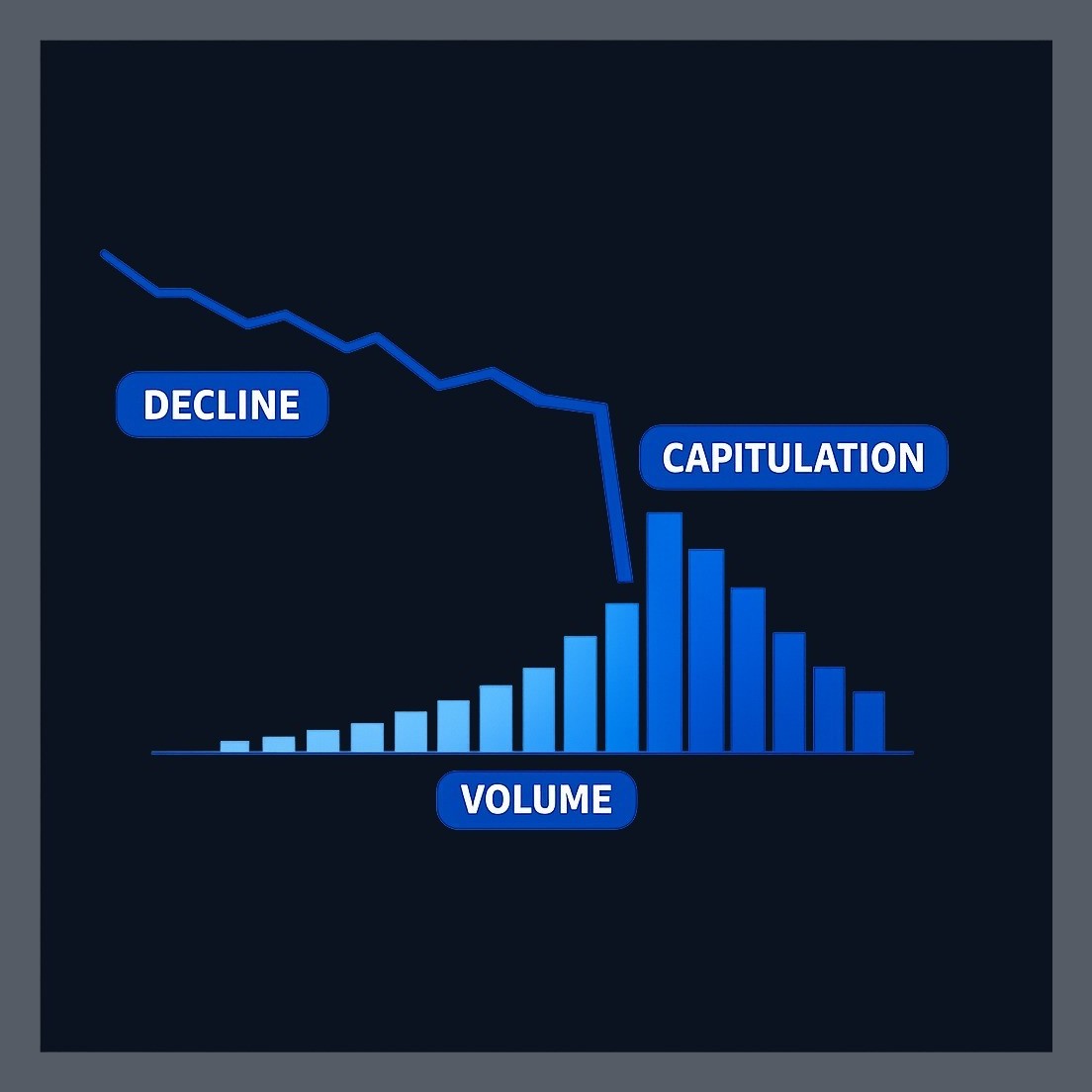
For beginners, traders, and long-term investors, the key point is this: capitulation can signal extreme pessimism, but it does not automatically mean the bottom is in or that buying is safe.
Introduction to Stock Capitulation
Capitulation is often described as “surrender” because investors stop holding out for a rebound and sell to avoid further losses. It can happen in an individual stock, a sector, or the broader market. The common ingredients are a prior decline, rising fear, and a rush to exit positions.
A simple example: imagine a stock has been falling for weeks after disappointing news. At first, some shareholders hold on, hoping the decline is temporary. Then the price drops again, financial headlines become more negative, and more investors decide they cannot tolerate further losses. Selling accelerates. Volume spikes. The stock falls quickly. That final wave of anxious selling is what market participants often call capitulation.
This page is for readers who want to understand the meaning of stock capitulation, how to recognize it, and how to respond without turning a stressful market event into an impulsive decision.
The Mechanics of Capitulation
Capitulation usually develops in stages rather than appearing out of nowhere. It often follows an extended price decline, when investors have already absorbed losses and confidence is weak. As prices fall further, selling pressure can intensify because more holders decide to exit at the same time.
The psychological driver is loss avoidance. Investors may start with a long-term thesis, but repeated declines can make that thesis feel less credible. Fear spreads, and the desire to stop the pain can become stronger than the desire to wait for a recovery. Investopedia describes capitulation as mass panic selling during a downturn, where anxiety can feed the decline and produce steep losses Investopedia.
There can also be mechanical pressure. Some investors are not simply choosing to sell; they may be forced to. For example, investors who bought on margin may face a margin call if the market drops far enough, requiring them to deposit more cash or sell holdings The Motley Fool. That forced selling can add fuel to an already emotional market.
A practical example
Consider an investor who bought a stock using borrowed money through a margin account. The stock falls sharply. The broker requires more collateral. If the investor cannot add cash, they may have to sell shares, even if they believe the stock could recover later. Multiply that situation across many investors, and forced liquidation can intensify a capitulation-like move.
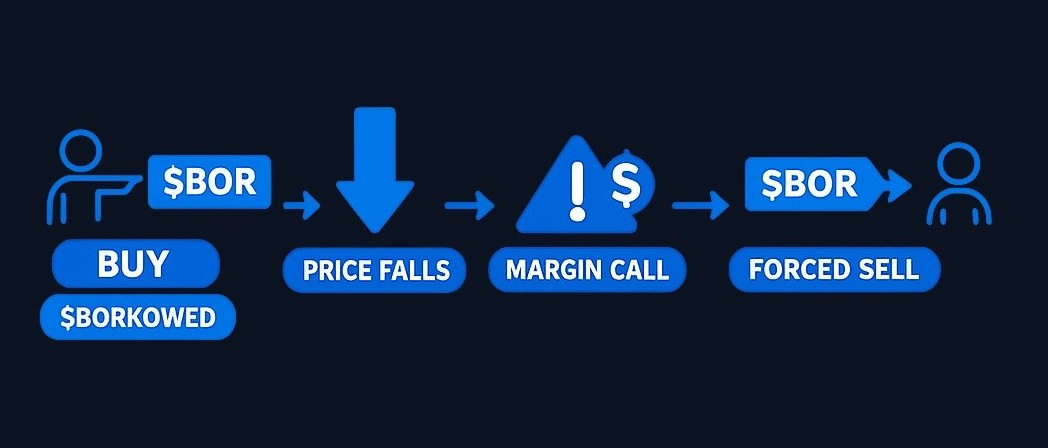
This is why capitulation is not only about emotion. It is also about market structure, leverage, liquidity, and timing.
Identifying Capitulation: Key Indicators
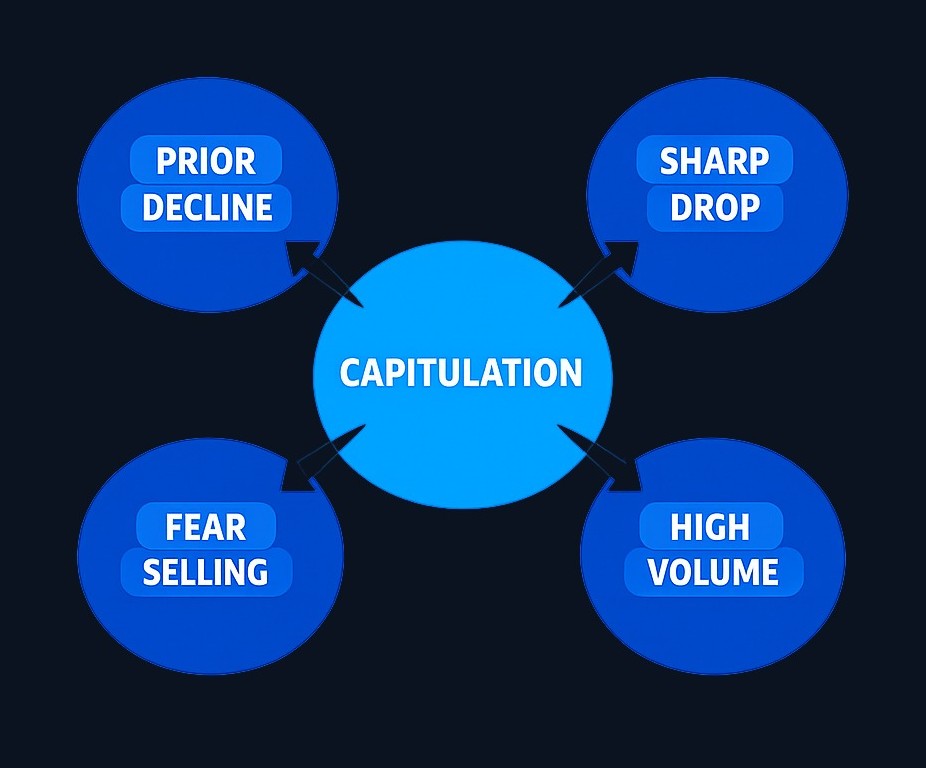
There is no single indicator that proves capitulation has occurred. It is usually identified after combining several clues: price action, volume, sentiment, and the context of the prior decline.
Corporate Finance Institute notes that capitulation can often be identified by heavy selling volume and a sharp price drop after an extended period of decline Corporate Finance Institute. That combination matters because a sharp drop without prior weakness may simply be a reaction to new information, while heavy volume without a steep decline may reflect ordinary repositioning.
| Capitulation clue | What it may look like | Why it matters | Risk-aware interpretation |
|---|---|---|---|
| Extended prior decline | A stock or market has already been falling for a meaningful period | Capitulation usually follows accumulated losses, not calm conditions | A prior decline alone does not mean the selling is over |
| Sharp price drop | Price falls quickly in a short period | Suggests sellers are accepting lower prices to exit | The drop can continue if fundamentals worsen |
| Heavy volume | Trading activity rises well above normal | Indicates broad participation in the selloff | High volume can mark panic, but not always a bottom |
| Fear-driven selling | Investors appear focused on avoiding further losses | Capitulation is tied to surrender and panic selling | Emotional markets can reverse quickly or stay volatile |
| Forced liquidation | Margin calls or risk limits trigger selling | Mechanical selling can accelerate declines | Forced selling can create opportunity, but also severe risk |
| Stabilization attempt | Price stops falling as aggressively after the selloff | May show selling pressure is easing | Confirmation often requires time and discipline |
A useful way to think about capitulation is as a cluster of evidence, not a single signal. If a stock is down sharply on low volume after one bad headline, that may not be capitulation. If it has been declining for weeks, drops hard again, trades on unusually high volume, and investors appear to be selling simply to escape further losses, the case becomes stronger.
A Timeline of a Capitulation Episode
Because precise historical market statistics require verified event data, the most reliable way to understand capitulation is to study the recurring sequence that appears in many selloffs. The pattern below is educational rather than predictive.
| Stage | Market behavior | Investor psychology | Example of what it feels like |
|---|---|---|---|
| 1. Early decline | Prices begin falling | Concern, but many investors remain patient | “This may be a temporary pullback.” |
| 2. Prolonged weakness | The decline continues | Confidence erodes | “Maybe my original thesis was wrong.” |
| 3. Acceleration | Selling becomes faster and more aggressive | Fear rises | “I need to get out before it gets worse.” |
| 4. Capitulation wave | Heavy volume and sharp price drops appear | Investors surrender and accept losses | “I just want the losses to stop.” |
| 5. Aftershock | Prices may bounce, stabilize, or remain volatile | Uncertainty remains high | “Was that the bottom, or just a pause?” |
| 6. Reassessment | Buyers and sellers re-evaluate fundamentals | Discipline becomes important | “What is the risk now, and what evidence has changed?” |
This sequence shows why capitulation is difficult to trade in real time. During the event, fear is high and information can feel chaotic. Afterward, charts may make the moment look obvious, but at the time investors rarely know whether they are seeing a final washout or another leg lower.
Market Reactions During Capitulation
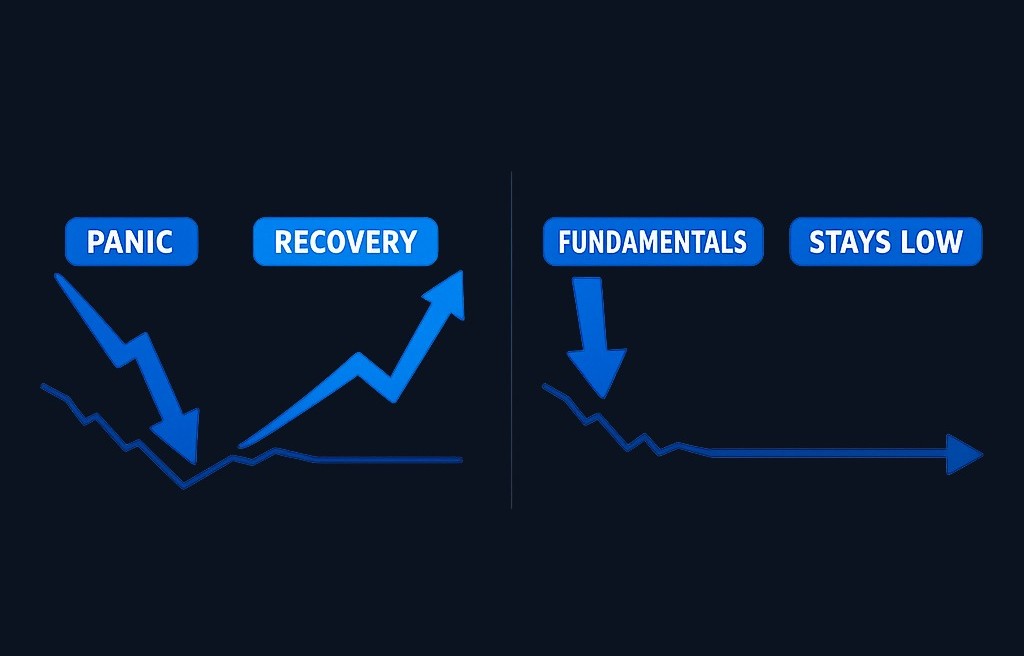
Capitulation does not always produce the same aftermath. Sometimes a sharp selloff is followed by renewed buying interest. Investopedia notes that capitulation is usually followed by renewed interest in heavily hit stocks, reversing the trend Investopedia. However, “usually followed” should not be read as a guarantee that any specific stock or market will recover quickly.
The reaction depends on why the selloff happened. A panic-driven decline in a fundamentally sound business may resolve differently from a decline caused by deteriorating earnings, excessive debt, or a permanent change in the company’s outlook. In one case, investors may later decide the selling went too far. In another, the lower price may reflect real damage.
Here is a practical comparison:
| Situation | Possible capitulation signal | What to examine before acting |
|---|---|---|
| Broad market fear | Many stocks fall together, selling feels indiscriminate | Is the decline mainly sentiment-driven, or are economic conditions changing? |
| Single-stock collapse | One stock falls sharply on company-specific news | Did the business outlook change materially? |
| Leverage-driven selloff | Forced selling or margin pressure appears likely | Could more forced selling still occur? |
| News-driven panic | Investors react quickly to a major headline | Is the market repricing a temporary shock or lasting risk? |
The main lesson is that capitulation can create a moment of extreme pessimism, but pessimism alone is not an investment thesis.
Practice trading with Finelo
Practice in a simulator, learn with bite-sized lessons, and build confidence before risking real money.
Implications for Investors and Traders
Capitulation can matter to both long-term investors and short-term traders, but the response should be different depending on goals, time horizon, and risk tolerance.
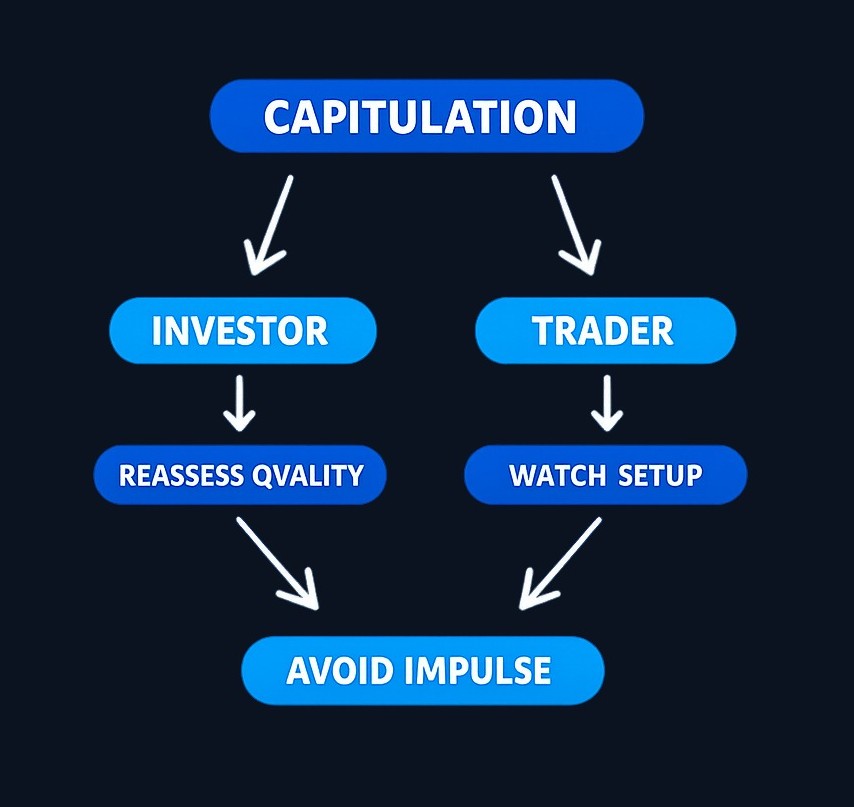
For long-term investors, capitulation may be a prompt to reassess quality, valuation, and portfolio concentration. It is not a reason to abandon a plan automatically, but it is also not a reason to buy blindly. The question is: Has the long-term case changed, or has the price simply moved faster than emotions can handle?
For traders, capitulation can be a volatility event. Some traders watch for high-volume selloffs, reversal attempts, or stabilization after panic selling. But trading around capitulation is risky because prices can overshoot in both directions. A stock that looks “washed out” can still fall further.
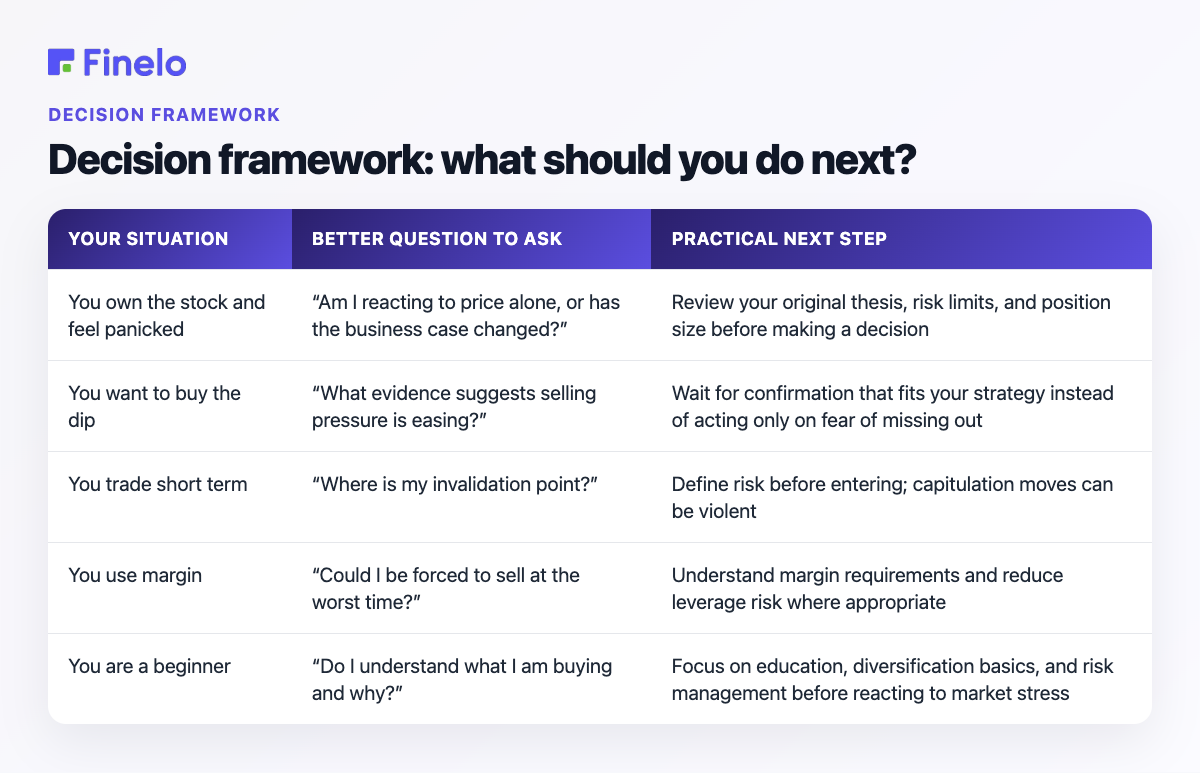
Decision framework: what should you do next?
Use this framework to match your intent to a reasonable next step.
| Your situation | Better question to ask | Practical next step |
|---|---|---|
| You own the stock and feel panicked | “Am I reacting to price alone, or has the business case changed?” | Review your original thesis, risk limits, and position size before making a decision |
| You want to buy the dip | “What evidence suggests selling pressure is easing?” | Wait for confirmation that fits your strategy instead of acting only on fear of missing out |
| You trade short term | “Where is my invalidation point?” | Define risk before entering; capitulation moves can be violent |
| You use margin | “Could I be forced to sell at the worst time?” | Understand margin requirements and reduce leverage risk where appropriate |
| You are a beginner | “Do I understand what I am buying and why?” | Focus on education, diversification basics, and risk management before reacting to market stress |
If you want a more structured way to build investing knowledge before making decisions in volatile markets, you can explore Finelo’s learning resources through its wealth growth quiz. Keep any next step educational unless you have evaluated your own risk, costs, and suitability.
Is Capitulation a Buying Opportunity?
Capitulation can be a buying opportunity, but it is not automatically one.
The bullish argument is that capitulation may represent the moment when the most fearful sellers have already exited. If selling pressure is exhausted, even modest buying interest can support a rebound. This is why some investors watch capitulation closely.
The risk is that a stock can look cheap because the market is correctly pricing in worse fundamentals. A falling stock after weak results, rising debt concerns, or a broken business model may not be a bargain just because sentiment is negative. The difference between a temporary panic and a permanent impairment matters.
A disciplined approach is to separate three questions:
- Price: Has the stock fallen sharply?
- Behavior: Is there evidence of panic selling or forced liquidation?
- Fundamentals: Is the long-term value of the business still intact?
Capitulation mainly answers the second question. It does not fully answer the third.
Long-Term Effects of Capitulation on Investments
The long-term effect depends on what the capitulation event reveals. If the selloff is mostly emotional and the underlying asset remains strong, long-term investors may eventually see recovery. If the selloff reflects deep structural problems, the lower price may persist or worsen.
Capitulation can also affect investor behavior long after the event. Someone who sells in panic may become overly cautious, missing future opportunities. Someone who buys too aggressively during a selloff may underestimate risk and take losses if the decline continues. Both reactions are understandable, but neither is a complete strategy.
For long-term investors, the most useful takeaway is not “buy capitulation” or “avoid capitulation.” It is to prepare before it happens:
- Know why you own each investment.
- Decide how much volatility you can tolerate.
- Avoid position sizes that force emotional decisions.
- Be careful with leverage.
- Keep enough liquidity so you are not forced to sell at unfavorable times.
Capitulation tests process. Investors with a clear process are less likely to make rushed decisions when markets are most stressful.
FAQs about Stock Capitulation
What triggers stock capitulation?
Stock capitulation is commonly triggered by an extended decline, rising fear, and a rush to exit positions. It may also be intensified by forced selling, such as margin calls, when investors who borrowed to buy stocks must sell if they cannot add more collateral The Motley Fool.
How can investors identify capitulation?
Investors often look for a combination of heavy selling volume, a sharp price drop, and a prior extended decline. Corporate Finance Institute describes heavy selling volume and a sharp drop after an extended decline as common signs of capitulation Corporate Finance Institute. No signal is perfect, so it is best treated as a probability, not proof.
Is capitulation a good time to buy stocks?
It can be, but not always. Capitulation may indicate extreme pessimism and possible seller exhaustion, but a stock can keep falling if fundamentals continue to weaken. Before buying, investors should examine the reason for the decline, their time horizon, and their risk limits.
Can capitulation happen outside the stock market?
Yes. The same surrender-like behavior can occur in other traded markets when participants panic, liquidate positions, and accept losses. The exact signals may differ by asset class, but the core idea is the same: fear-driven selling after a painful decline.
Conclusion and Next Steps
Stock capitulation means mass selling after a sustained decline, often driven by fear, loss fatigue, or forced liquidation. It is commonly associated with sharp price drops and heavy trading volume, but it is not a guaranteed market bottom.
The best way to respond is to slow down and separate emotion from evidence. Ask what triggered the selloff, whether the underlying investment case has changed, and whether your position size or leverage is forcing a decision. Capitulation can create opportunities, but it can also expose weak assumptions.
A practical next step is to create a simple checklist before the next volatile period: your investment thesis, risk limit, time horizon, and conditions for buying, holding, or selling. That preparation is more useful than trying to predict the exact bottom during panic.
stock capitulation meaningtradingtrading education
Practice trading with Finelo
Practice in a simulator, learn with bite-sized lessons, and build confidence before risking real money.
About the author
Finelo Team
The Finelo Team creates practical investing and trading education designed to help beginners learn faster with structured challenges, simulator practice, and bite-sized lessons.
Keep reading — Related articles

Trading
Options Wheel Strategy: How It Works and Its Risks
The phrase "wheel strategy options" describes a repeatable income approach: sell cash‑secured puts until assigned, buy the stock when assigned, then sell covered calls on the shares to collect more premium and define exit points. This cycle — sell puts → buy stock on assignment → sell covered…
Finelo Team
Trading
Volume Profile Trading: How It Works and Its Limitations
Volume profile trading maps how much volume traded at each price level during a chosen period, revealing levels where the market accepted or rejected price. Traders use the Point of Control (the single price with the highest traded volume), value areas, and volume nodes to identify likely support/resistance…
Finelo Team
Trading
What is Unusual Options Activity and Why Does It Matter?
Unusual options activity (UOA) is a sudden, outsized spike in options trades — volume or open interest — relative to a contract’s recent norms. Traders watch UOA because large, concentrated options orders can signal informed or institutional positioning that sometimes precedes significant stock moves. Example: a single large…
Finelo Team