If you're a beginner, "trading vs investing" can feel like a fork in the road with no signpost. Both involve markets. Both can grow money or lose it. So which do you learn first?
Trading vs Investing for Beginners: Which Should You Learn First?
Trading and investing both involve markets, but they differ in timeframe, decision style, risk, and learning path. Here is how beginners can compare them.
8 min read
Practice trading with Finelo
Practice in a simulator, learn with bite-sized lessons, and build confidence before risking real money.
Want to learn more?
Practice in a simulator, learn with bite-sized lessons, and build confidence before risking real money.
Explore FineloExplore Finelo's 28-day challenges
Turn learning into a daily habit with guided challenge paths.
This guide compares trading vs investing for beginners in a practical, neutral way. Not "which one makes more money," because that depends on things no article can know about you, but "which learning path fits what you want to practice first: fast, hands-on decisions, or slower, long-term portfolio thinking?"
We'll keep it scan-friendly: the core difference, the skills each path builds, a side-by-side comparison, and a few honest questions to help you choose. No hype, and no pretending one is secretly better than the other.
The simplest difference between trading and investing
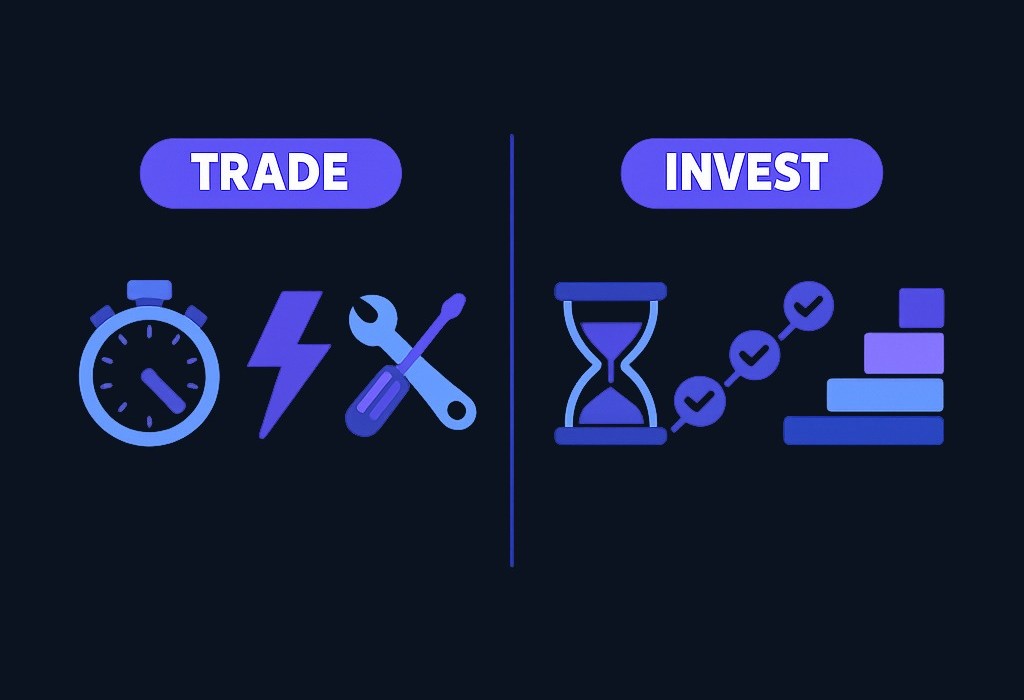
Here's the difference between trading and investing: trading is about shorter-term decisions, investing about longer-term ownership.
A trader makes active decisions over shorter timeframes, trying to act on price movements. An investor buys and holds for the long run, letting a portfolio grow over years. That's the heart of stock trading vs investing: one is an active strategy built on frequent decisions, the other leans toward a passive strategy built on patience.
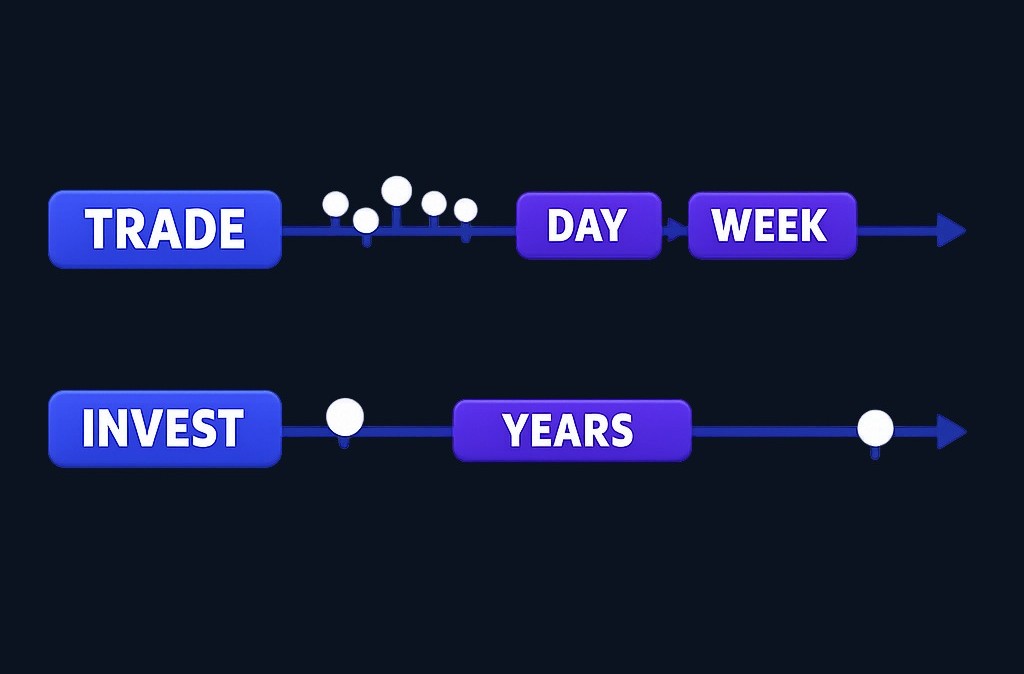
Put simply, whether you frame it as trading vs investing or investing vs trading, it's a difference in decision style and timeframe, not a contest. Both are legitimate ways to engage with markets, and plenty of people do both. Neither is "better." They just ask different things of you.
Time horizon: short-term decisions vs long-term planning
The clearest divider is time horizon.
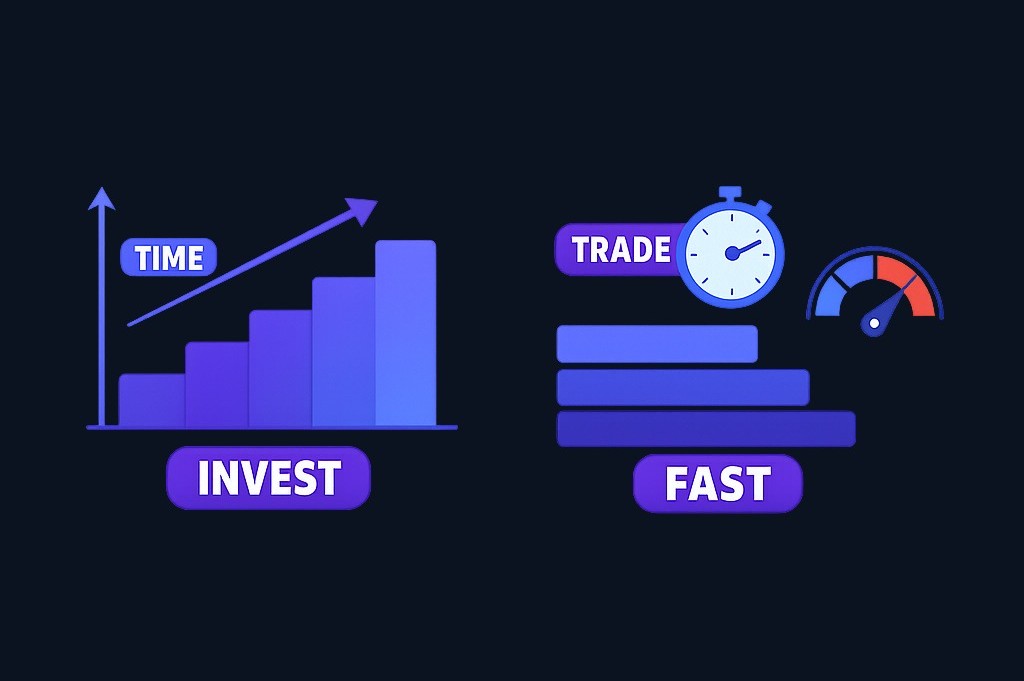
Short-term trading lives in days, hours, or minutes. You're making decisions often, and you feel every move the market makes. Long-term investing lives in years. You make fewer decisions, and the plan is usually to buy and hold through the ups and downs.
Time also does different work in each. In long-term investing, time is meant to be an ally through compounding, where returns can build on earlier returns over many years. In active trading, time is pressure: decisions come faster, and there's less room to be slow. Framing it as active trading vs long-term investing makes the trade-off clear without ranking one above the other.
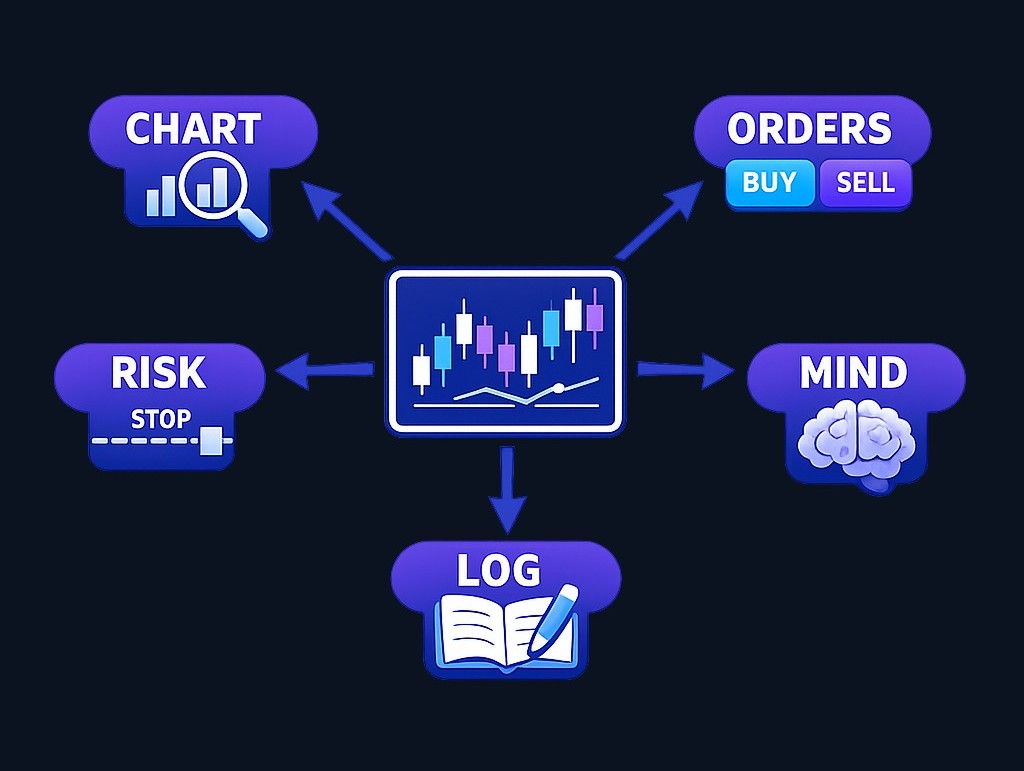
Skills beginners need for trading
Trading is a hands-on skill set. If you want to learn trading for beginners style, these are the muscles you'd build:
- Reading charts. Basic technical analysis: trends, levels, and what a pattern might mean.
- Placing orders. Market and limit orders, and knowing the difference before it costs you.
- Risk management. Position sizing, stops, and loss limits, so one bad call doesn't undo many good ones.
- Emotional discipline. Trading psychology is half the game. Fast feedback tempts fast mistakes.
- Journaling and review. Writing down decisions and reviewing them is how practice turns into skill.
- Simulator practice. Rehearsing all of the above with virtual funds first, where a mistake costs a note, not money.
The common thread is that trading rewards active, disciplined decision-making under market volatility. It's a skill you practice, not a switch you flip.
Skills beginners need for investing
Investing asks for a different, calmer set of skills. To learn investing for beginners style, you'd focus on:
- Setting goals. What is the money for, and how far away is it? An investing plan starts here.
- Diversification. Spreading money across holdings so no single one sinks you. Diversification is the closest thing to a free lunch in markets.
- Understanding asset types. The basics of stocks, ETFs, and mutual funds, and how they differ.
- Long-term thinking. Sitting through market volatility without abandoning a sound plan.
- Portfolio basics. How the pieces fit together, rebalancing, and keeping costs low.
- A little fundamental analysis. Fundamental analysis looks at the health of what you own, rather than its short-term price chart.
Where trading rewards quick reactions, investing rewards patience and consistency. Different temperament, different toolkit.
Practice trading with Finelo
Practice in a simulator, learn with bite-sized lessons, and build confidence before risking real money.
Risk and time commitment compared
If you're deciding where to start, this side-by-side is the fastest way to feel the difference. (These are general tendencies, not rules, and every person and plan varies.)
| Factor | Trading (short-term) | Investing (long-term) |
|---|---|---|
| Decision frequency | Often, sometimes daily | Occasional, periodic reviews |
| Volatility exposure | You feel every swing | You ride swings out over time |
| Attention required | High, hands-on | Lower, more hands-off |
| Core skills to learn | Charts, risk control, discipline | Diversification, patience, planning |
| Emotional intensity | Higher, fast feedback | Lower, slower feedback |
| Costs to understand | More frequent transaction costs | Fewer trades, plus tax considerations to learn |
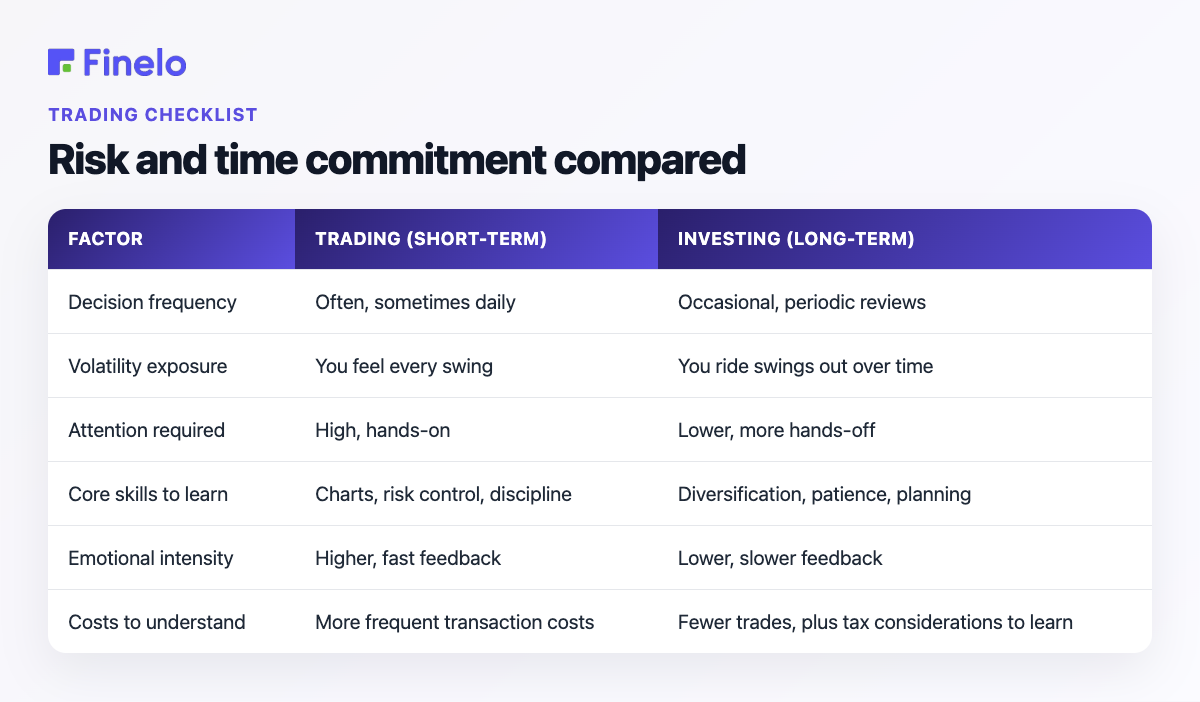
A note on that last row: both paths involve costs and taxes worth understanding, but this is a topic to learn about, not something to take as advice here. The point of the table isn't to pick a winner. It's to show that the two paths ask for different amounts of your time commitment and attention.
Can you learn both at the same time?
Yes, you can, and many people eventually do. But there's a catch worth knowing early.
Trading and investing run on opposite instincts. Trading trains you to act on short-term moves; investing trains you to ignore them. Learn them at the same time without separating the ideas, and the habits can bleed together, like checking your long-term portfolio every hour because your trading brain wants action.
So the practical answer is: learning both is fine, but keep the concepts in separate boxes. Practice short-term trading decisions as one skill, and long-term investing principles as another, so the discipline of one doesn't quietly undermine the other.
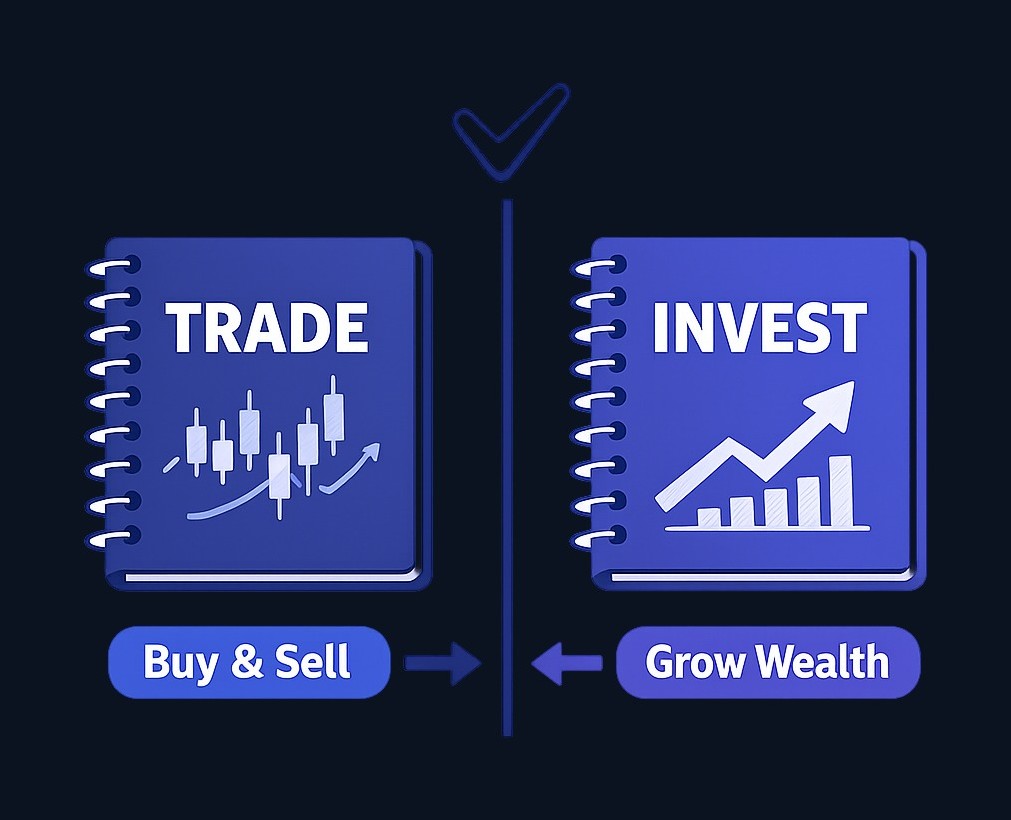
A simple trick some beginners use is to keep a separate journal for each: one for trading practice, one for investing notes. Two notebooks, two mindsets, and far less chance of the habits blurring together.
Which path should you learn first?
When it comes to trading vs investing for beginners, there's no universal answer to "trading or investing which is better" to start with, because it depends on what you want to practice, not on which is superior. Instead of advice, here are a few honest questions to point yourself in a direction:
- What are you curious about? Reading charts and making quick decisions, or building a portfolio meant to grow over years?
- How much time do you have? Active trading asks for regular attention. Long-term investing asks for less, day to day.
- Which skill do you want first? Hands-on risk management and fast decisions, or patient planning and diversification?
- What's your tolerance for swings? Not as financial advice, but as self-knowledge: do frequent ups and downs energize you or stress you out? Your honest risk tolerance is a clue about where to start learning, not a verdict.
- Curious about AI? Both paths now have AI-assisted analysis worth exploring as a learning aid.
Answer those and a direction usually appears. And if you're mostly curious how long any of this takes to get comfortable with, our companion guide How long does it take to learn trading? sets realistic expectations.
How Finelo Challenges map to each path
The useful reframe for trading vs investing for beginners is Finelo's whole approach here: the question isn't which path earns more, it's which learning path you're ready to practice. Each maps to a structured starting point, so you can learn by doing with virtual funds instead of guessing.
- Drawn to short-term decisions? The Trading Challenge builds chart-reading, risk, and discipline through hands-on practice.
- Drawn to long-term portfolio thinking? The Investing Challenge focuses on goals, diversification, and planning.
- Curious how AI assists either path? Finelo AI covers AI-assisted analysis for both trading and investing, as a study tool rather than a decision-maker.
- Not sure yet? That's fine. If you're weighing which Finelo challenge to choose, browsing the full set of Finelo Challenges works as a challenge chooser, letting you match a path to what you actually want to learn.
Explore Finelo Challenges and choose the path that matches what you want to learn first. There's no wrong starting point, only the one that keeps you curious enough to continue.
Finelo is an educational product, not a brokerage. Brokerage connection availability depends on your region. The simulator uses virtual funds and real market data, and final trading and investing decisions are yours, made through your own brokerage account when you choose to act. This article is for education and is not financial advice.
Frequently asked questions
Is trading harder than investing?
Not harder exactly, but more hands-on. Trading usually asks for more frequent decisions, active risk control, and emotional discipline under fast feedback. Investing has its own learning curve around long-term planning, diversification, and patience. They're different kinds of difficulty, so "harder" depends on which skills come naturally to you and which you'd need to build.
Should beginners learn investing before trading?
Many beginners do start with investing basics, since long-term principles are a calmer entry point, but there's no rule. The right first step depends on what you actually want to understand and practice. If short-term decision-making is what draws you in, starting there can keep you engaged. This is about learning order, not financial advice.
Can you learn both at the same time?
Yes, but it helps to keep the concepts separate. Short-term trading trains you to act on price moves, while long-term investing trains you to look past them. If you study both at once, consciously box the ideas apart so trading habits don't creep into your investing plan, or vice versa. Many people learn one well first, then add the other.
Which Finelo challenge should I choose?
Choose based on the skill you want to build. Pick the Trading Challenge for hands-on trading practice, the Investing Challenge for long-term investing basics, or Finelo AI if you want to explore AI-assisted analysis in either path. If you're undecided, browsing the challenges is a low-pressure way to see which topic pulls you in first.
trading vs investingbeginner investingbeginner tradingFinelo Challenges
Practice trading with Finelo
Practice in a simulator, learn with bite-sized lessons, and build confidence before risking real money.
About the author
Finelo Team
The Finelo Team creates practical investing and trading education designed to help beginners learn faster with structured challenges, simulator practice, and bite-sized lessons.
Keep reading — Related articles

Trading
Options Wheel Strategy: How It Works and Its Risks
The phrase "wheel strategy options" describes a repeatable income approach: sell cash‑secured puts until assigned, buy the stock when assigned, then sell covered calls on the shares to collect more premium and define exit points. This cycle — sell puts → buy stock on assignment → sell covered…
Finelo Team
Trading
Volume Profile Trading: How It Works and Its Limitations
Volume profile trading maps how much volume traded at each price level during a chosen period, revealing levels where the market accepted or rejected price. Traders use the Point of Control (the single price with the highest traded volume), value areas, and volume nodes to identify likely support/resistance…
Finelo Team
Trading
What is Unusual Options Activity and Why Does It Matter?
Unusual options activity (UOA) is a sudden, outsized spike in options trades — volume or open interest — relative to a contract’s recent norms. Traders watch UOA because large, concentrated options orders can signal informed or institutional positioning that sometimes precedes significant stock moves. Example: a single large…
Finelo Team