Most beginners want to know what to buy. The more useful question is what happens when you're wrong.
Risk Management in Trading: A Beginner's Guide to Position Size, Loss Limits, and Practice
Risk management is the discipline of deciding how much you'd lose, where you'd exit, and when to stop — before you place a trade. A beginner-first guide to position size, loss limits, and risk-free practice.
8 min read
Practice trading with Finelo
Practice in a simulator, learn with bite-sized lessons, and build confidence before risking real money.
Want to learn more?
Practice in a simulator, learn with bite-sized lessons, and build confidence before risking real money.
Explore FineloExplore Finelo's 28-day challenges
Turn learning into a daily habit with guided challenge paths.
Risk management in trading is the discipline of answering that question before you place a trade: how much you'd lose, where you'd exit, and when you'd stop for the day. It isn't the boring part that comes after strategy. For a beginner, it's the foundation that decides whether you last long enough to get any good.
This guide keeps it beginner-first and practical. No formulas you'll never use, and no promise that any of this makes trading safe. Risk management doesn't remove risk; it helps you plan for it. Here's how to think about size, losses, and practice without putting real money on the line.
What risk management means in trading
Risk management in trading means planning what can go wrong before it does, and deciding in advance how you'll respond. If you're wondering how to manage trading risk as a beginner, it starts here.
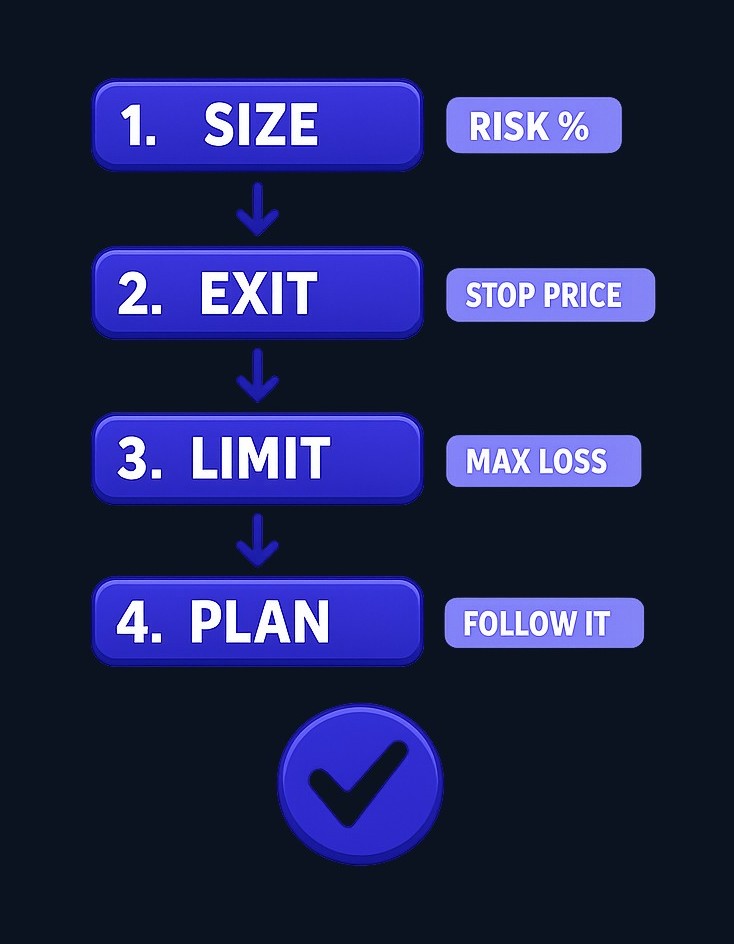
In practice, it comes down to four questions you answer before entering a trade:
- Size. How much of the account is exposed on this one idea? This is your trade risk against your total account risk.
- Exit. Where will you get out if you're wrong? That pre-decided line is your exit plan.
- Limit. How much are you willing to lose in a day or a session before you stop?
- Review. Afterwards, did you follow the plan, regardless of whether the trade won?
Bundle those together and you have the core of trading risk management for beginners: a simple risk limit system. None of it tells you what to trade. It tells you how to survive being wrong, which beginners are, often, on the way to learning.
Why beginners should learn risk before strategies
Most people arrive wanting a strategy, an edge, a setup. But a strategy decides when you act; risk management decides how much it costs when you're wrong.
Here's the uncomfortable math. A mediocre approach with disciplined risk control can keep you in the game for a long time. A brilliant approach with no risk control can end your account in a week, because a few oversized losses undo a pile of small wins. A run of losing trades is called a drawdown, and a deep one is what quietly ends accounts long before any strategy gets a chance to work. Capital preservation isn't caution for its own sake; it's what keeps the learning process alive.
This is really about emotional discipline under market uncertainty. You can't control whether a trade works. You can control how much it can hurt you and whether you stick to your own rules. Learn that first, and every strategy you study afterwards has somewhere safe to be tested.
Position size explained simply
Position sizing is just deciding how big a trade is relative to your account. It's the single most practical risk tool a beginner has, and it requires no prediction at all.
A simple hypothetical shows the idea. Say you're practicing with a hypothetical $10,000 virtual account and decide to risk no more than 1% of it, or $100, on a single trade. If your plan says you'd exit when price moves $2 against your entry, then $100 ÷ $2 works out to a position of about 50 units. (These figures are illustrative examples for learning, not recommendations.)
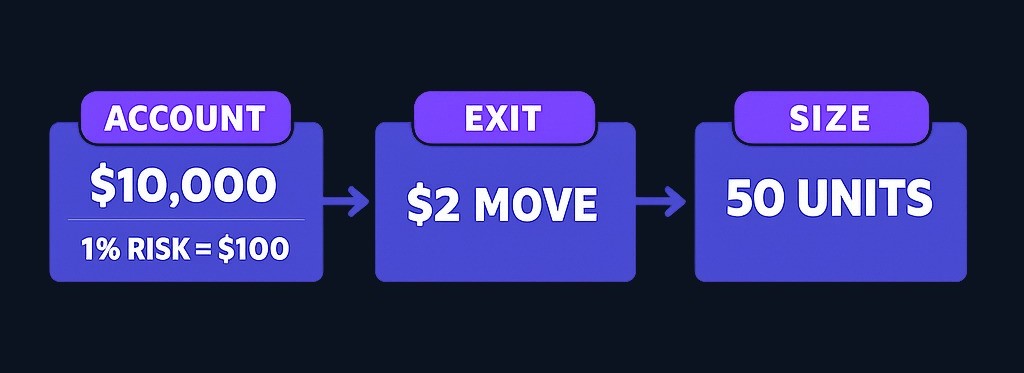
Notice what just happened: your position size fell out of your risk decision, not the other way around. That's the whole point of position sizing in trading. You decide what you're willing to lose, then the size follows.
For position sizing for beginners, two ideas matter more than any formula. First, smaller is more forgiving while you're learning. Second, the same dollar size is riskier in a wild market than a calm one, because price can travel further against you. Sizing is where risk tolerance stops being a feeling and becomes a number.
Loss limits and exit planning
An exit plan answers one question: at what point do you admit this trade isn't working?
The most common tool is the stop-loss order, a pre-set level where you'd close a losing position. Learning how a stop loss in trading works is one of the first real risk skills, because deciding it before you enter is what makes it useful; deciding it mid-trade, while you're hoping, is how small losses become large ones. Some traders also set a take-profit order to lock in a gain at a planned level. Neither guarantees an outcome but both turn a vague intention into a decision your trading plan can hold you to.
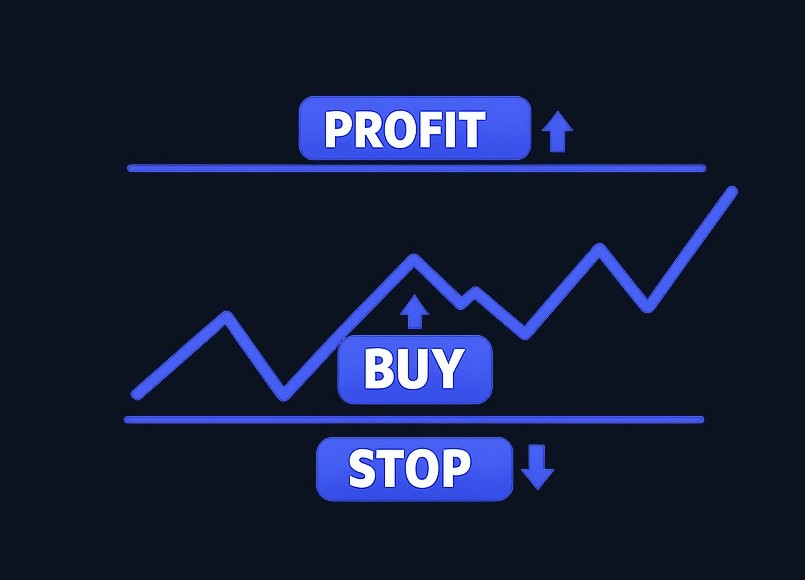
Beyond the single trade sits the daily loss limit: a line that says "if I'm down this much today, I'm done." Loss limits like this exist to stop a bad hour from becoming a bad week, and to keep a normal drawdown from snowballing into the kind that ends an account. The same logic applies to practice: if a simulator session is going badly and you notice yourself trading to "get it back," the right move is to close the laptop, not place another trade.
Knowing when to stop is part of risk management too. Stepping away is a decision, not a failure.
Practice trading with Finelo
Practice in a simulator, learn with bite-sized lessons, and build confidence before risking real money.
Risk/reward ratio: useful idea, not a guarantee
A risk/reward ratio compares what you're risking to what you're aiming to gain. Risk $100 to target $200 and you have a 1:2 trading risk reward ratio. On paper, that sounds great.
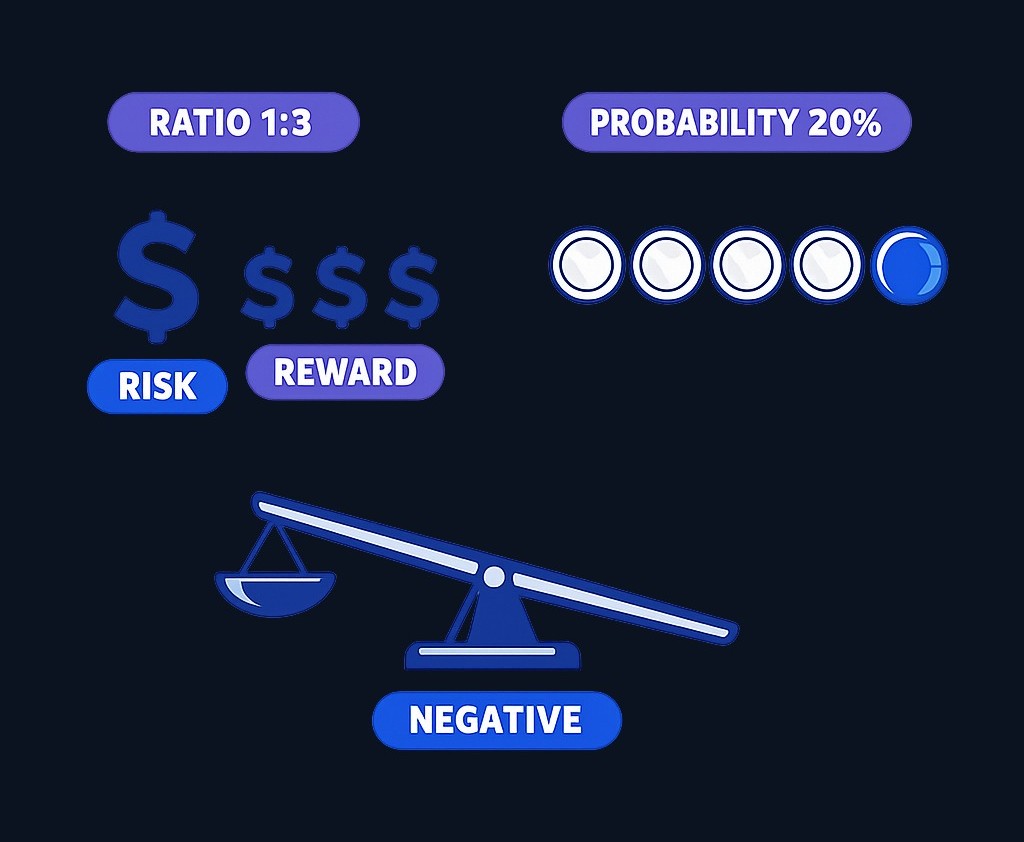
But a ratio is only half the picture, and beginners over-trust it. A trade with a beautiful 1:3 ratio still loses money if it only works one time in five. What matters is the combination of how often you're right (probability) and how much you make or lose when you are — sometimes called expectancy. A good ratio with a low probability can have negative expectancy, which is a formal way of saying it loses over time.
So treat the trading risk reward ratio as a planning tool that keeps your targets honest, not as a promise about results. It helps you avoid trades where you're risking a lot to make a little. It does not tell you which trades will win.
Common beginner risk mistakes
Most early damage comes from a short, repeatable list. These are the classic beginner trading mistakes on the risk side:
- Risking too much per trade. One oversized loss can erase many careful wins. Size down.
- Trading with no stop. "I'll just watch it" is not an exit plan. Decide the line in advance.
- Moving exits mid-trade. Sliding your stop-loss order further away because the trade went against you is how a small loss becomes a painful one.
- Overtrading. Overtrading out of boredom or FOMO adds risk without adding edge. Volume isn't progress.
- Revenge trading. Revenge trading to win back a loss is emotion making decisions your plan should be making.
- Overleveraging. Leverage and margin let you control a larger position than your balance, which magnifies losses just as much as gains. Many beginners learn the basics without leverage at all, precisely because it shrinks the room to be wrong.
- Ignoring volatility. A calm market and a turbulent one call for different sizes. Treating them the same is how a normal-looking trade becomes an outsized one.
- No journal. Without a trading journal, you can't tell a bad decision from an unlucky one, so you repeat both.
Few of these are about picking the right trade. Almost all of them are about managing the wrong one.
How to practice risk management without real money
The safest place to build these habits is a simulator, where the only thing at stake is the lesson. Simulator practice lets you rehearse size, stops, and limits with virtual funds, so a mistake costs you a note in your journal instead of real money.
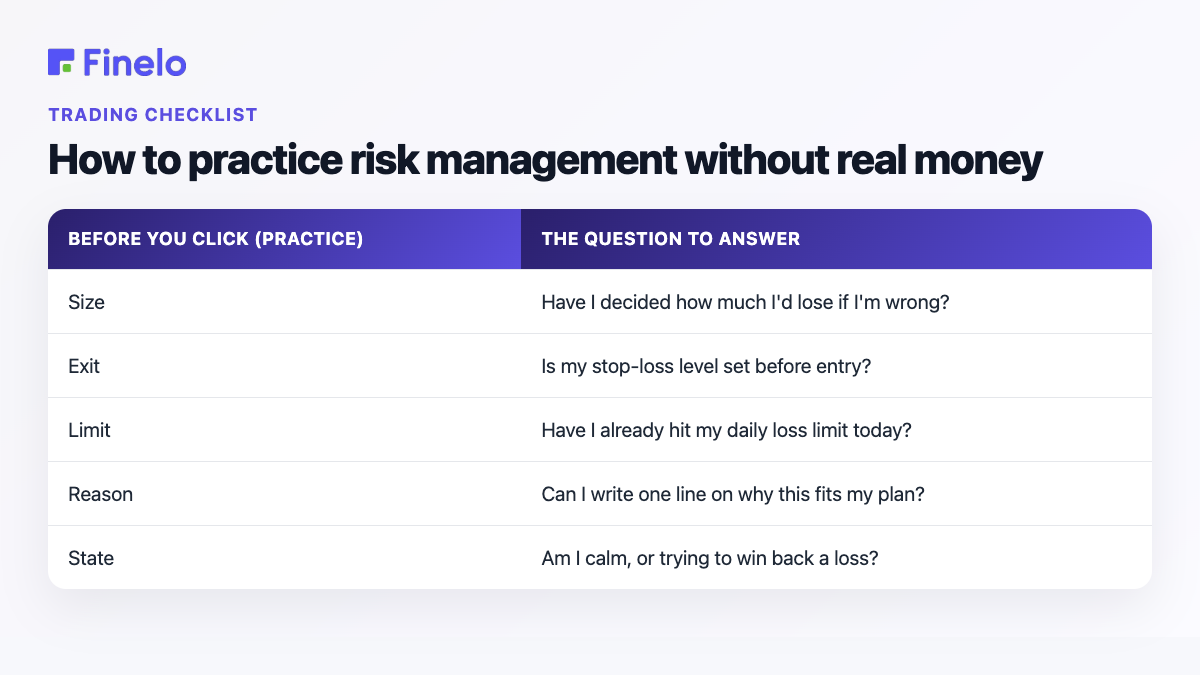
Run a simple pre-trade checklist before every practice trade:
| Before you click (practice) | The question to answer |
|---|---|
| Size | Have I decided how much I'd lose if I'm wrong? |
| Exit | Is my stop-loss level set before entry? |
| Limit | Have I already hit my daily loss limit today? |
| Reason | Can I write one line on why this fits my plan? |
| State | Am I calm, or trying to win back a loss? |
Then keep a short trading journal with risk-focused prompts: Did I size the trade the way I planned? Did I respect my exit, or move it? Did any decision come from emotion rather than the plan? Over a couple of weeks, the answers reveal your real risk habits, not the ones you think you have.
A note on backtesting: running rules against historical data (backtesting) can show how an idea behaved in the past, but it isn't the same as practicing live decisions under uncertainty. Both have a place; neither predicts the future. If you want a guided place to practice all of this, the Finelo trading simulator pairs short lessons with virtual-funds practice and a built-in review habit.
How a structured trading challenge can help
Doing this alone takes discipline most beginners haven't built yet. That's where a structured path helps: it sequences the concepts, gives you something to practice each day, and builds the review habit for you.
The Trading Challenge is designed as a learning sprint, not a profit path. It walks you through fundamentals and has you practice them with virtual funds, one concept at a time. The broader Finelo Challenges extend the same idea across more topics. The goal isn't to make you money this week; it's to make the habits stick before real money is ever involved.
That's the frame for everything above: risk management is how you decide how much uncertainty you're willing to practice with, before the market decides for you.
Finelo is an educational product, not a brokerage. Brokerage connection availability depends on your region. The simulator uses virtual funds and real market data, and final trading and investing decisions are yours, made through your own brokerage account when you choose to act. This article is for education and is not financial advice.
Frequently asked questions
What is risk management in trading?
It's the process of planning a trade's size, exit, and loss limits, then reviewing the decision afterwards, so potential losses are considered before you ever enter. It doesn't tell you what to trade or remove the chance of losing. It's a way to decide, in advance, how much being wrong is allowed to cost you.
What is position sizing?
Position sizing means deciding how large a trade is relative to your account or practice account. Instead of starting with how many shares you want, you start with how much you're willing to lose, and let the size follow from that. It's the most practical risk tool a beginner has, and it needs no market prediction.
Can risk management prevent losses?
No. Risk management can't eliminate losses or remove market risk — losing trades are part of trading. What it can do is limit how much any single trade or session costs you and improve your process discipline. Think of it as managing exposure and planning downside, not as a shield that makes trading safe.
How can beginners practice risk management?
Use a simulator with virtual funds, set hypothetical size and loss limits, run a pre-trade checklist, and journal every decision. Then review whether you actually followed the plan. Practicing the habit when nothing real is at stake is the lowest-pressure way to build it before any real money is involved.
TradingBeginner Guide
Practice trading with Finelo
Practice in a simulator, learn with bite-sized lessons, and build confidence before risking real money.
About the author
Finelo Team
The Finelo Team creates practical investing and trading education designed to help beginners learn faster with structured challenges, simulator practice, and bite-sized lessons.
Keep reading — Related articles
Trading
Understanding Walk Forward Analysis in Trading
Brief educational note: this article is educational — not investment advice — and trading involves the risk of loss.
Finelo Team
Trading
VWAP vs Moving Average: Formulas, Uses, and Limits
VWAP weights price by recorded volume over a defined period, while a moving average summarizes a sequence of prices over a rolling lookback.
Finelo Team
Trading
Volume Profile vs Market Profile: What Each Chart Measures
Volume Profile groups traded volume by price level.
Finelo Team


