A put ratio spread is an options strategy that buys one higher-strike put and sells a larger number of lower-strike puts, usually two, with the same expiration. In a common 1x2 structure, the trader buys one in-the-money put and sells two out-of-the-money puts below the current stock price Option Alpha. It can work best when you expect a controlled move lower toward the short strike—not a sharp collapse. The trade can offer attractive profit potential near the short strike, but the extra short put creates meaningful downside risk if the underlying falls too far.
Put Ratio Spread: Strategies, Examples, and Insights

A put ratio spread is an options strategy that buys one higher-strike put and sells a larger number of lower-strike puts, usually two, with the same expiration.
13 min read
Practice trading with Finelo
Practice in a simulator, learn with bite-sized lessons, and build confidence before risking real money.
Want to learn more?
Practice in a simulator, learn with bite-sized lessons, and build confidence before risking real money.
Explore FineloExplore Finelo's 28-day challenges
Turn learning into a daily habit with guided challenge paths.
What Is a Put Ratio Spread?
A put ratio spread combines a long put spread with an additional short put. The classic version is:
- Buy 1 higher-strike put
- Sell 2 lower-strike puts
- Use the same expiration date for all options
This is why it is often called a 1x2 put ratio spread. The long put benefits if the underlying moves lower. The two short puts collect premium, but they also create extra exposure below the short strike. Option Alpha describes the structure as a bear put spread with a naked put sold at the same strike as the short put in the spread Option Alpha.
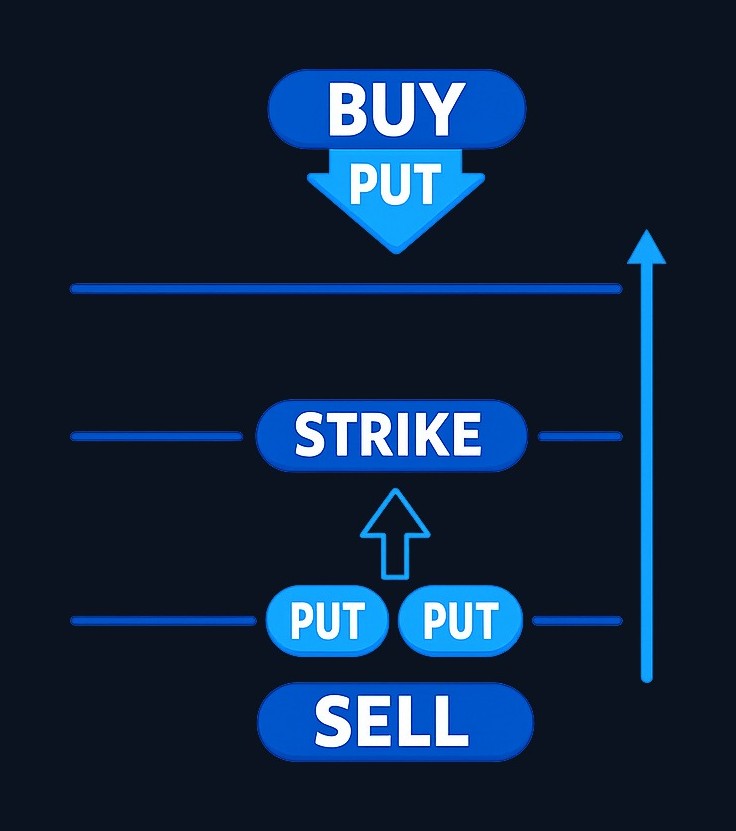
The key idea is not simply “bearish.” A put ratio spread is more precise than that. It is designed around a target zone. The best outcome typically occurs if the underlying settles near the short put strike at expiration, where the long put has intrinsic value and the short puts may expire worthless or with limited impact Option Alpha.
Think of it as a strategy for a measured decline, not a disaster hedge.
How to Set Up a Put Ratio Spread
A put ratio spread starts with a view on direction, price target, volatility, and risk tolerance. The setup process is less about finding “cheap options” and more about matching the strikes to a specific market thesis.
Step 1: Define the market thesis
Ask: “Where do I reasonably expect the underlying to be by expiration?”
A put ratio spread is generally more suitable when you expect the price to decline toward a specific area. If you expect a large, fast selloff far below that area, the extra short put can become a problem.
Step 2: Choose the expiration
All legs use the same expiration date in the standard structure Option Alpha. Shorter expirations may respond more sharply to time decay and price movement, while longer expirations give the trade more time to develop. Neither is automatically better; the choice should match your thesis and risk plan.
Step 3: Select the strikes
A typical structure uses:
- A higher-strike long put, often closer to or above the current market price
- Two lower-strike short puts, placed near the price area where you expect the underlying may settle
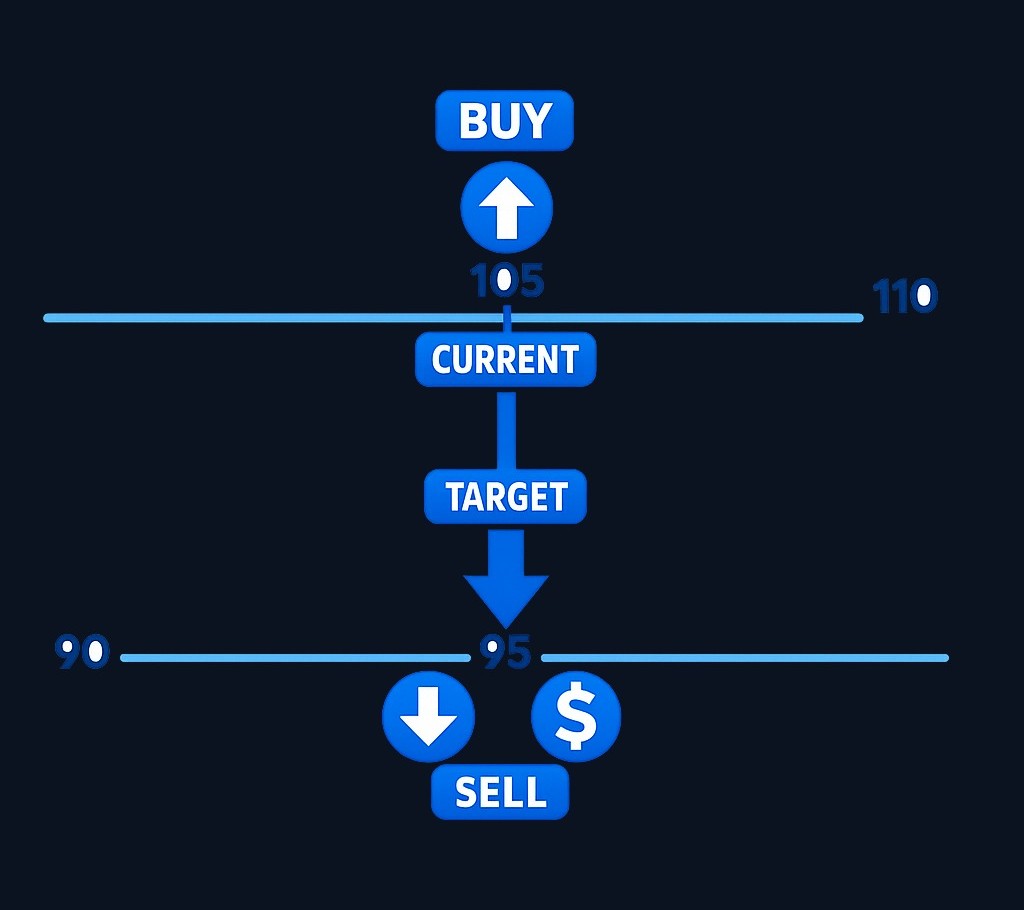
For example, if a stock is trading at 100 and you expect a moderate decline toward 95, a simplified hypothetical structure might be:
- Buy 1 put with a 105 strike
- Sell 2 puts with a 95 strike
- Same expiration
This example is not a recommendation; it simply shows the mechanics. The short strike represents the target zone, while the long put helps the position benefit from a move lower.
Step 4: Check whether the trade opens for a debit or credit
A put ratio spread may be opened for a net debit or a net credit depending on strikes, volatility, and option premiums. This matters because the opening premium changes the breakeven points and the risk profile.
Before entering, calculate the expiration payoff and decide in advance what you will do if the underlying moves sharply below the short strike.
Profit and Loss Potential
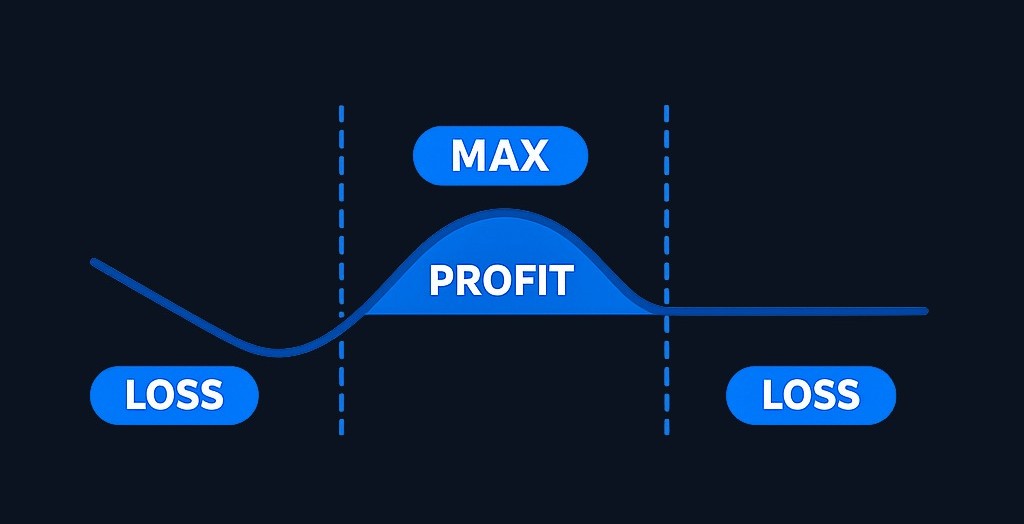
The payoff of a put ratio spread depends heavily on where the underlying finishes at expiration. The structure has three main zones.
Let:
- K1 = higher long put strike
- K2 = lower short put strike
- N = net premium, where a credit is positive and a debit is negative
At expiration, the simplified profit/loss formula is:
P/L = max(K1 - stock price, 0) - 2 × max(K2 - stock price, 0) + N
Payoff framework
| Expiration price | What happens | General result |
|---|---|---|
| Above the long put strike | All puts expire out of the money | Profit or loss equals the net opening credit or debit |
| Between the long and short strikes | Long put gains value; short puts expire worthless | Profit increases as price moves toward the short strike |
| At the short strike | Long put usually has maximum useful intrinsic value before short puts hurt the trade | Often the best expiration area |
| Below the short strike | Short puts begin losing value faster than the long put gains | Downside risk grows as price falls |
The maximum profit is generally reached near the short strike. Option Alpha describes the ideal expiry outcome as the underlying finishing at the short-put strike: the short contracts lapse worthless while the long put carries the spread’s intrinsic value Option Alpha.
Maximum profit
Using the formula above, maximum profit near the short strike is approximately:
Maximum profit = K1 - K2 + N
If the trade was opened for a debit, N is negative. If it was opened for a credit, N is positive.
Maximum loss
Unlike a simple debit spread, the extra short put adds significant downside risk. Below the short strike, the position behaves like it has one uncovered short put after accounting for the long put. For a stock or ETF, the underlying cannot fall below zero, so the theoretical loss is not infinite, but it can still be large.
At zero, the expiration result would be:
P/L at zero = K1 - 2K2 + N
If that number is negative, it represents the worst-case expiration loss for a non-negative underlying price.
Breakeven points
There may be one or two breakeven points depending on whether the trade opens for a debit or credit.
- Upper breakeven for a debit trade:
K1 + NBecause N is negative, this is below the long strike. - Downside breakeven:
2K2 - K1 - N
If the trade opens for a credit, the upper side may remain profitable above the long strike, but the downside breakeven is still critical.
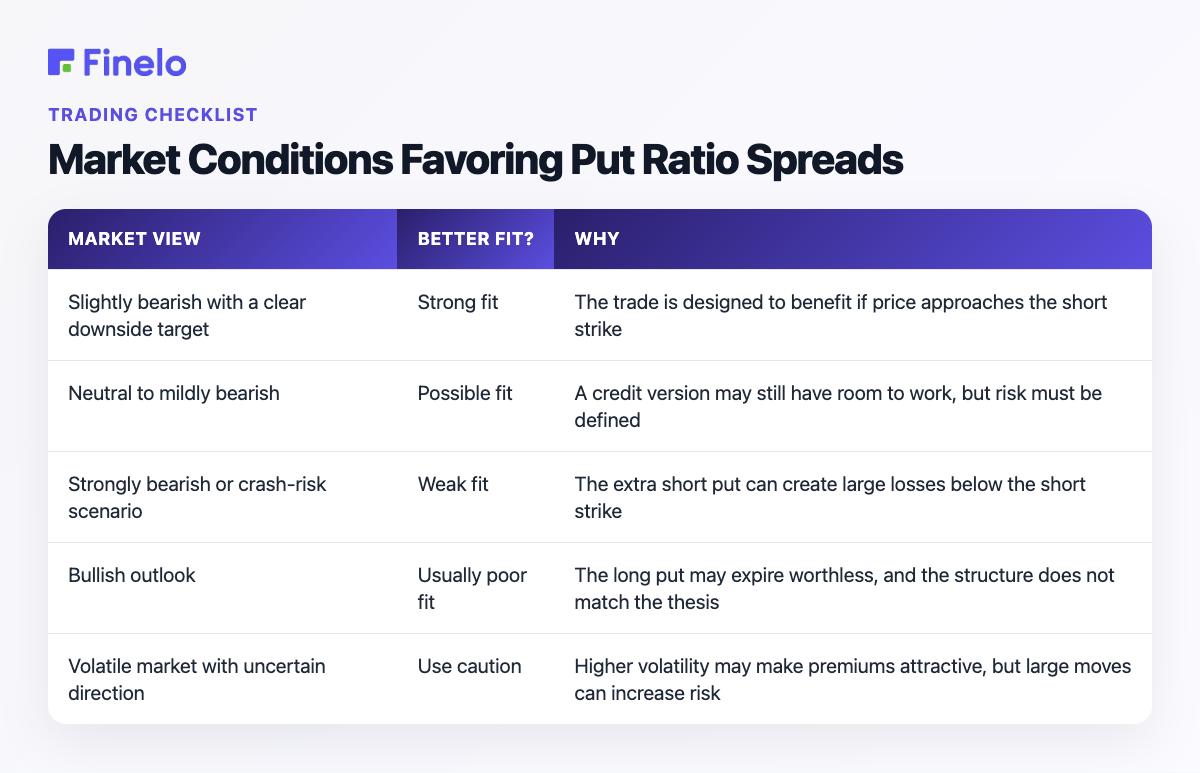
Market Conditions Favoring Put Ratio Spreads
The best market condition for a put ratio spread is a controlled bearish move toward a defined price target. The strategy is usually less suitable when your outlook is extremely bearish, because a sharp drop below the short strike can turn the extra short put into the dominant risk.
A useful decision framework:
| Market view | Better fit? | Why |
|---|---|---|
| Slightly bearish with a clear downside target | Strong fit | The trade is designed to benefit if price approaches the short strike |
| Neutral to mildly bearish | Possible fit | A credit version may still have room to work, but risk must be defined |
| Strongly bearish or crash-risk scenario | Weak fit | The extra short put can create large losses below the short strike |
| Bullish outlook | Usually poor fit | The long put may expire worthless, and the structure does not match the thesis |
| Volatile market with uncertain direction | Use caution | Higher volatility may make premiums attractive, but large moves can increase risk |
Can you use put ratio spreads in volatile markets? Yes, but carefully. Volatility can make short option premium look appealing, yet the same environment can also increase the chance of a large move through the short strike. The question is not only “Is premium high?” but “Can I tolerate the downside exposure if the move continues?”
Common Mistakes to Avoid
The biggest mistakes with put ratio spreads usually come from treating the trade like a simple bearish spread. It is not. The extra short put changes the risk profile.
Mistake 1: Ignoring the downside tail
A trader may focus on the appealing payoff near the short strike while underestimating what happens below it. Always calculate the downside breakeven and the estimated loss at lower prices before entering.
Mistake 2: Choosing strikes without a target
The short strike should not be random. It should represent the area where your thesis says the underlying could settle. If you cannot explain why that strike makes sense, the trade may be more speculative than strategic.
Mistake 3: Using the strategy when you expect a major selloff
If your forecast is “this could fall much further,” a put ratio spread may be the wrong tool. A long put or defined-risk put spread may align better with that view because they do not add the same extra short-put exposure.
Mistake 4: Forgetting assignment and margin risk
Short puts can create obligations. Before trading any ratio spread, understand your broker’s margin requirements, assignment rules, transaction costs, and whether the position fits your account size and experience.
Mistake 5: Waiting until expiration to think about adjustments
The adjustment plan should exist before entry. Decide what price level, loss level, or volatility change would cause you to reduce risk.
Practice trading with Finelo
Practice in a simulator, learn with bite-sized lessons, and build confidence before risking real money.
Adjusting Your Position
Adjustments are not about rescuing every trade. They are about controlling risk when the original thesis changes.
One common hedge is to buy additional long puts, which reduces the ratio and can convert the position into a more traditional bull or bear put spread depending on the updated outlook Option Alpha.
Here is a practical adjustment framework:
| Market movement | What it may mean | Possible response |
|---|---|---|
| Price drifts toward the short strike | Thesis may be working | Monitor profit target and time remaining |
| Price stalls above the long strike | Directional thesis may not be developing | Consider whether time decay or opportunity cost justifies staying in |
| Price moves below the short strike | Downside risk is increasing | Consider reducing short-put exposure or adding long puts |
| Volatility expands sharply | Option values may change quickly | Recalculate payoff and margin impact |
| Expiration approaches near the short strike | Profit zone may be near | Consider whether holding through expiration adds assignment risk |
If the market moves against you to the downside, the main goal is to reduce the uncovered short-put exposure. That may mean buying back one short put, buying another long put, closing the entire position, or rolling only if the new position has a clear risk/reward profile. Rolling should not be used to avoid recognizing a loss without a new thesis.
Worked Hypothetical Example
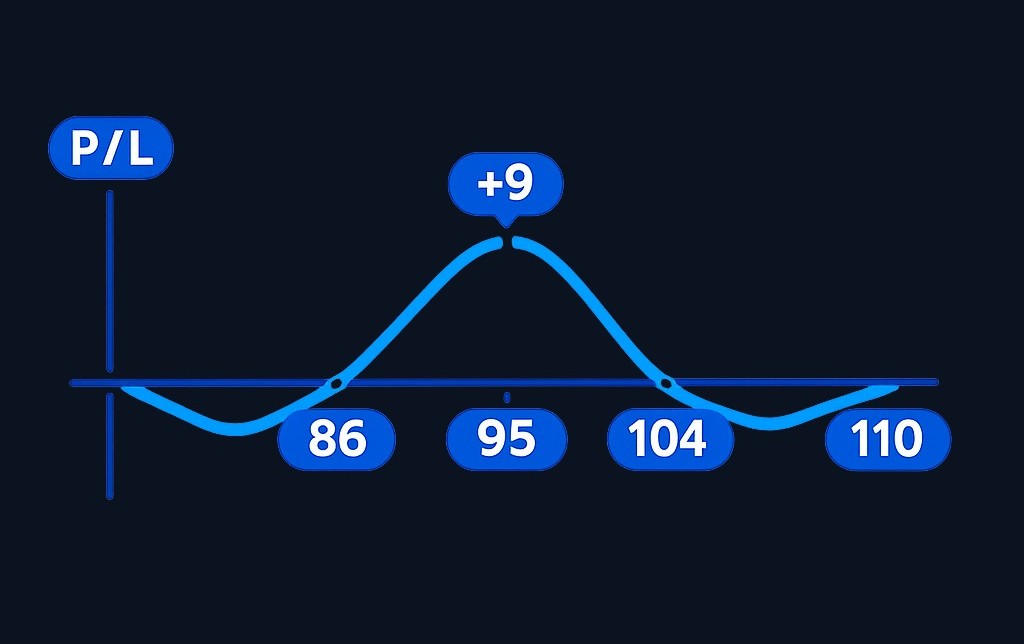
Suppose an underlying trades at 100. A trader expects a moderate decline toward 95 by expiration, but not a collapse. They consider a 1x2 put ratio spread:
- Buy 1 put at the 105 strike
- Sell 2 puts at the 95 strike
- Same expiration
Assume the position opens for a net debit of 1. In formula terms, N = -1.
The maximum profit near the short strike would be:
105 - 95 - 1 = 9
The upper breakeven would be:
105 - 1 = 104
The downside breakeven would be:
2 × 95 - 105 - (-1) = 86
So the simplified expiration map looks like this:
Above 105: limited loss of 1 debit
At 104: upper breakeven
At 95: best zone, about 9 profit
At 86: downside breakeven
Below 86: losses increase as price falls
This example shows why the strategy is highly target-dependent. A move from 100 to 95 may help. A move from 100 to 75 may hurt. The same bearish direction can produce very different outcomes depending on how far the price moves.
Put Ratio Spread vs. Other Put Strategies
A put ratio spread is not automatically better than a long put, bear put spread, or short put spread. It solves a specific problem: expressing a moderately bearish target while using short-option premium to shape the payoff.
| Strategy | Best suited for | Main tradeoff |
|---|---|---|
| Long put | Strong bearish move or hedge | Defined risk, but premium cost may be high |
| Bear put spread | Moderate bearish move | Defined risk, but capped profit |
| Cash-secured or short put | Neutral to bullish view | Premium income, but downside ownership risk |
| Put ratio spread | Moderate bearish move toward a target strike | Attractive target-zone payoff, but extra downside risk |
If you want defined risk, a standard put spread may be cleaner. If you want open-ended downside participation, a long put may be more direct. If you expect a controlled decline and understand the short-put exposure, a put ratio spread may be worth evaluating.
FAQs About Put Ratio Spreads
What is the best market condition for using a put ratio spread?
The best fit is a moderately bearish market where you expect the underlying to move toward a specific lower price, often near the short strike. It is usually not ideal for a crash scenario because losses can increase below the short strike.
How do I calculate potential profit and loss?
Use the expiration formula: max(K1 - price, 0) - 2 × max(K2 - price, 0) + N. Maximum profit is typically near the short strike: K1 - K2 + N. Downside breakeven is commonly 2K2 - K1 - N.
What are the main risks?
The major risk is the extra short put. If the underlying falls far below the short strike, the short puts can lose more than the long put gains. Assignment, margin requirements, transaction costs, and tax treatment should also be reviewed before trading.
What are the tax implications of trading put ratio spreads?
Tax treatment depends on your jurisdiction, account type, holding period, and the exact instruments used. Because options tax rules can be complex, consider consulting a qualified tax professional rather than relying on general strategy descriptions.
Conclusion and Next Steps
A put ratio spread is a target-based options strategy: buy one higher-strike put, sell two lower-strike puts, and aim for a controlled move toward the short strike. Its appeal is the payoff near that target zone. Its danger is the added downside exposure if the underlying falls too far.
Before using one, calculate the full expiration payoff, identify both breakevens, check the worst-case downside scenario, and decide how you would adjust before the trade moves against you.
If you are still building your options foundation, consider structured investing education before placing complex trades. Finelo offers financial education resources through its learning platform at Finelo. This article is educational only and is not personalized financial advice.
put ratio spreadtradingtrading education
Practice trading with Finelo
Practice in a simulator, learn with bite-sized lessons, and build confidence before risking real money.
About the author
Finelo Team
The Finelo Team creates practical investing and trading education designed to help beginners learn faster with structured challenges, simulator practice, and bite-sized lessons.
Keep reading — Related articles

Trading
Options Wheel Strategy: How It Works and Its Risks
The phrase "wheel strategy options" describes a repeatable income approach: sell cash‑secured puts until assigned, buy the stock when assigned, then sell covered calls on the shares to collect more premium and define exit points. This cycle — sell puts → buy stock on assignment → sell covered…
Finelo Team
Trading
Volume Profile Trading: How It Works and Its Limitations
Volume profile trading maps how much volume traded at each price level during a chosen period, revealing levels where the market accepted or rejected price. Traders use the Point of Control (the single price with the highest traded volume), value areas, and volume nodes to identify likely support/resistance…
Finelo Team
Trading
What is Unusual Options Activity and Why Does It Matter?
Unusual options activity (UOA) is a sudden, outsized spike in options trades — volume or open interest — relative to a contract’s recent norms. Traders watch UOA because large, concentrated options orders can signal informed or institutional positioning that sometimes precedes significant stock moves. Example: a single large…
Finelo Team