A strangle is an options strategy that uses a call and a put at different out-of-the-money strikes, both on the same underlying and with the same expiration. There are two versions, and they have almost opposite risk profiles. A long strangle buys both options for a net debit and profits from a big move in either direction, with risk limited to the total premium paid. A short strangle sells both options for a net credit and profits if the underlying stays quiet between the strikes, but it carries undefined risk and can lose far more than it collects.
Strangle Option Strategy: Long vs Short, and the Risks
A strangle is an options strategy that uses a call and a put at different out-of-the-money strikes. A long strangle profits from a big move in either direction with risk limited to the premium paid; a short strangle profits if the underlying stays quiet, but carries undefined risk.
11 min read
Practice trading with Finelo
Practice in a simulator, learn with bite-sized lessons, and build confidence before risking real money.
Want to learn more?
Practice in a simulator, learn with bite-sized lessons, and build confidence before risking real money.
Explore FineloExplore Finelo's 28-day challenges
Turn learning into a daily habit with guided challenge paths.
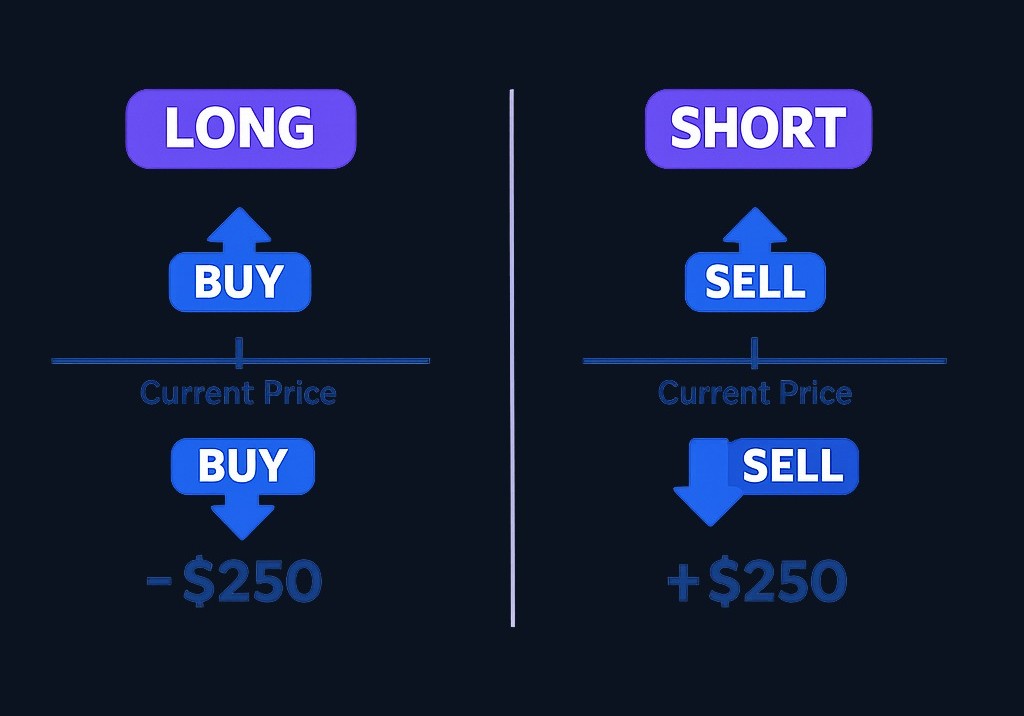
That difference matters more than anything else here: buying a strangle, sometimes written as an option strangle, is a defined-risk position, while selling one is an advanced position with potentially unlimited losses on the call side.
This page is for readers who already understand basic calls and puts. If they are still fuzzy, read the options trading for beginners guide first, then come back. It explains the structure and mechanics; it does not tell you to trade either version, or which strikes or expiration to pick.
This page is for learning purposes only and is not financial advice. Options trading carries significant risk and is not suitable for everyone. Short strangles carry potentially unlimited risk.
Who this guide is for
The strangle strategy is worth understanding if you have the basics down — calls, puts, strike, premium, and expiration. It answers the what and the how it works, not whether you should trade it.
Use it as a learning path if you are:
- Comfortable with basic calls and puts and ready for a two-leg strategy.
- Trying to understand volatility-based positions rather than directional ones.
- Confused about long versus short strangles, or strangle versus straddle.
- Curious how a position can profit from movement in either direction.
- Studying strategies before ever risking real money.
Long strangle: buy an OTM call and an OTM put
A long strangle is built by buying two options with the same expiration on the same underlying:
- Buy an out-of-the-money call, at a strike above the current price.
- Buy an out-of-the-money put, at a strike below the current price.
You pay a premium for each, so the position costs a net debit, and that total debit is the most you can lose. The idea is to profit from a large move in either direction: a rally gives the call intrinsic value, a drop gives the put intrinsic value, and the leg that does not work expires worthless.
Because both strikes are out of the money, a long strangle costs less than an at-the-money straddle on the same underlying. The trade-off is that it needs a bigger move, since the price has to clear a strike and then travel far enough to recover the premium paid on both legs.
Cheaper than a straddle, but it needs a larger move to get anywhere.
Long strangle payoff and breakevens
A long strangle has two breakevens, one on each side, because it can profit in either direction. Using the total premium paid across both legs:
- Upper breakeven = call strike plus total premium.
- Lower breakeven = put strike minus total premium.
- Maximum loss = total premium paid, if the underlying finishes at or between the strikes.
- Maximum profit is uncapped as the price rises, and large but capped to the downside, since the underlying can only fall to zero.
Plotted at expiration, the payoff looks like a wide valley: a flat maximum loss between the two strikes, then rising profit once the price clears either breakeven. Option prices are quoted per share and one standard contract covers 100 shares, so dollar figures are the per-share numbers multiplied by 100.
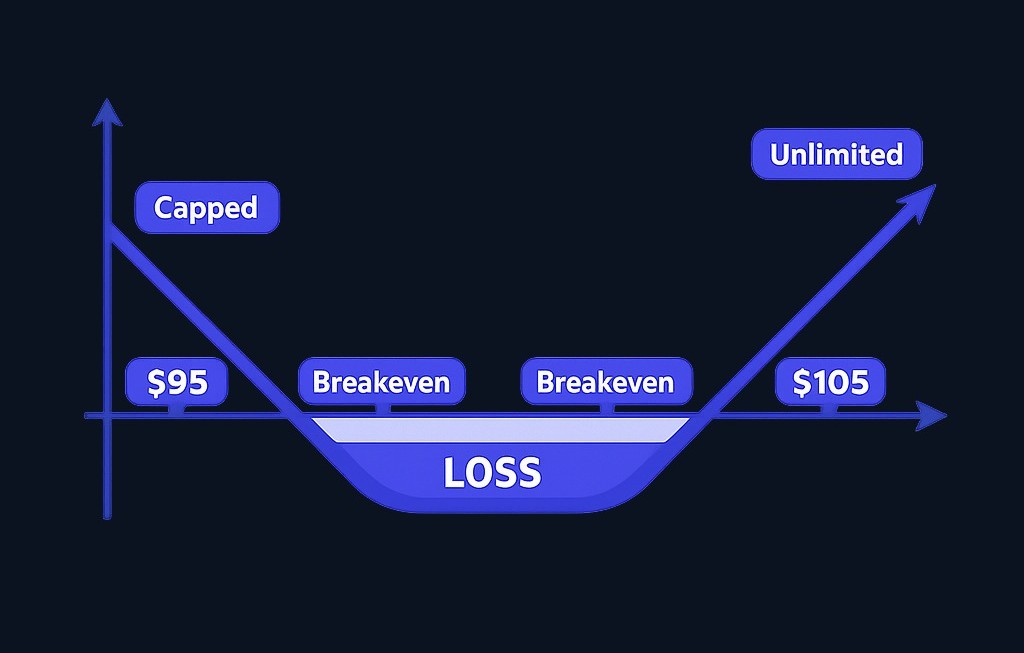
One detail that trips people up: the flat maximum loss applies only between the strikes. Between a strike and its breakeven, the position has recovered some value but still shows a net loss.
A worked example
Here is one hypothetical:
Suppose a stock trades near $100 and someone is studying a long strangle: buying the $105 call for $2.00 and the $95 put for $2.00, both with the same expiration. The total premium is $4.00 per share, which is $400 for one strangle (multiplied by 100).
From the formulas, the maximum loss is that $400, realized if the stock finishes anywhere between $95 and $105. The upper breakeven is $105 plus $4.00, or $109. The lower breakeven is $95 minus $4.00, or $91. So the stock has to finish above $109 or below $91 just to break even, roughly 9 percent in either direction. At $107, the call is worth $2.00 and the put is worthless, so the position is worth $200 against the $400 paid, a partial loss rather than the full amount. The example shows the structure — two out-of-the-money legs, a total debit, two breakevens, and the need for a substantial move — not a suggestion to place it.
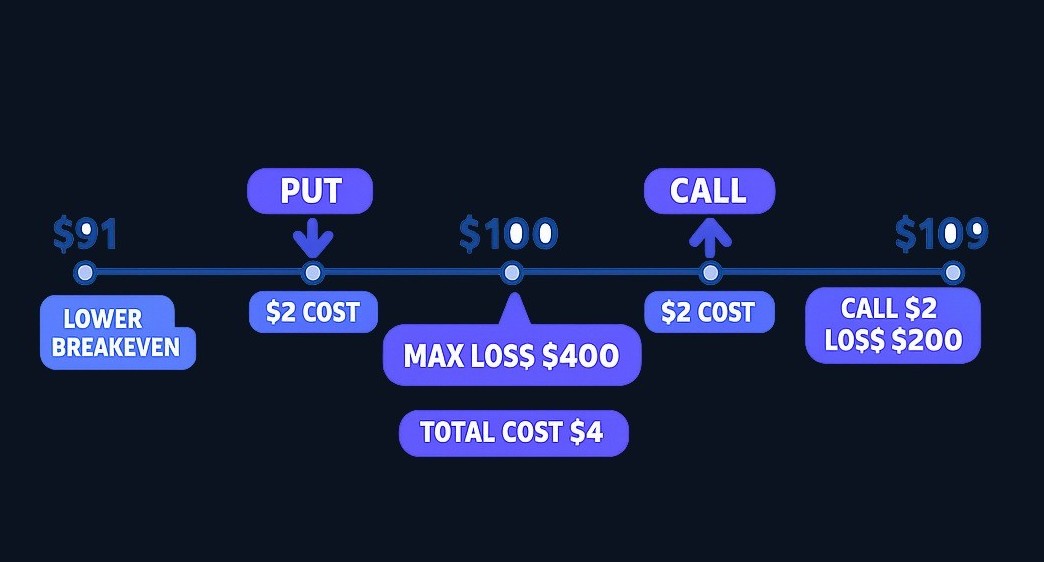
Illustrative example only. Round numbers, not a real quote or a recommendation.
Short strangle: sell an OTM call and an OTM put
A short strangle flips the position. Instead of buying the two out-of-the-money options, you sell them, collecting a net credit. It profits if the underlying stays quiet and finishes between the strikes, so both options expire worthless and the seller keeps the credit. That credit is the maximum profit, and it is the whole of the upside.
Here is the warning that matters, and it is not a footnote. Because both legs are sold uncovered, a short strangle has undefined risk. A sharp rally can produce theoretically unlimited losses on the short call, since there is no ceiling on how high a price can go. A sharp fall produces substantial losses on the short put, capped only by the underlying reaching zero. The most you can make is the credit; the most you can lose is far greater and, on the upside, has no fixed limit.
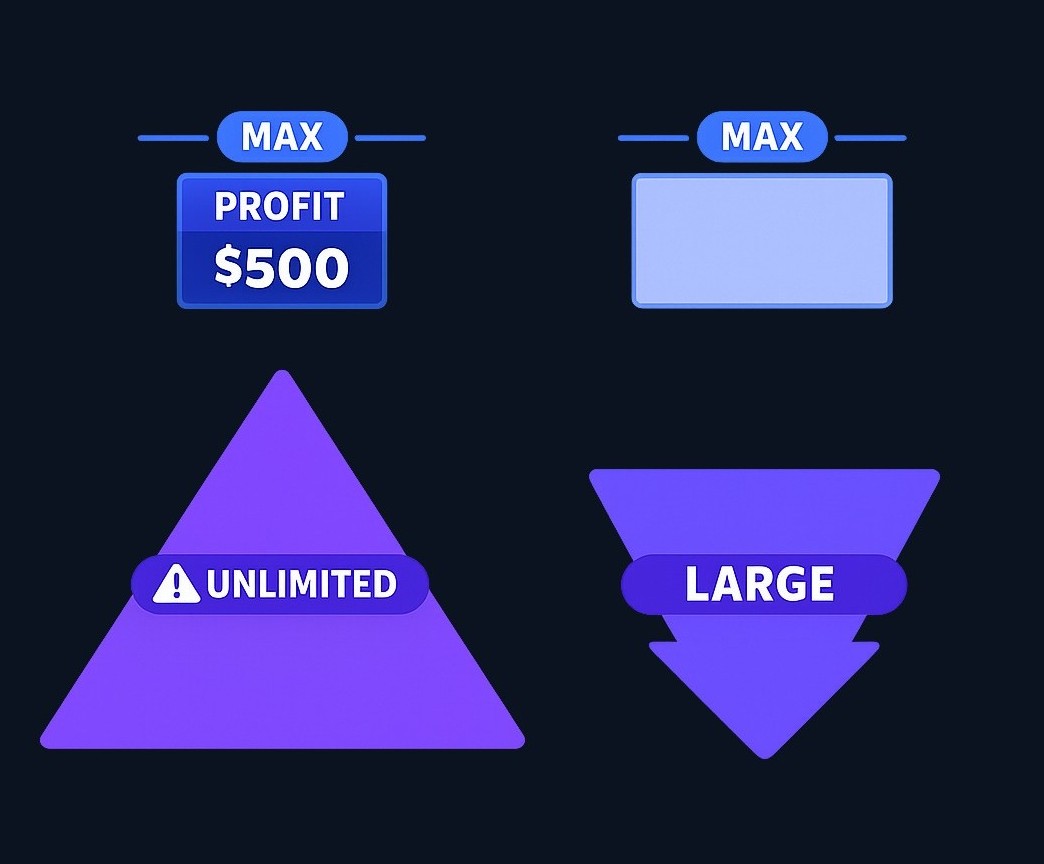
Short strangles also require significant margin, and because American-style equity options can be exercised early, the short legs can be assigned before expiration. A sudden rise in implied volatility hurts the position even before the underlying moves much.
You will see the short strangle described elsewhere as a premium-collection or income strategy. That framing understates what is actually happening: a small, capped credit is being collected against a large and, on one side, unbounded tail risk. It is classified as an advanced strategy and is not appropriate for beginners.
A capped credit against uncapped risk is not income; it is a risk transfer.
The role of volatility
More than most strategies, strangles live and die on volatility. The implied volatility guide covers it in depth.
A long strangle is net long vega, so it generally benefits when implied volatility rises and is hurt when it falls. This is why buying a strangle into a scheduled event such as an earnings report can disappoint. The anticipated move is already priced into the premiums, and once the event passes, implied volatility can collapse in a single session, an effect known as IV crush. Time decay (theta) compounds it, chipping away at both long legs every day.
With a long strangle, you can be right about the direction and still lose money.
A short strangle sits on the other side of that trade. It generally benefits from falling or low implied volatility and from the passage of time, and it is threatened by large moves and rising volatility. One side wants calm and the other wants movement, which is why neither version is a simple directional bet.
Practice trading with Finelo
Practice in a simulator, learn with bite-sized lessons, and build confidence before risking real money.
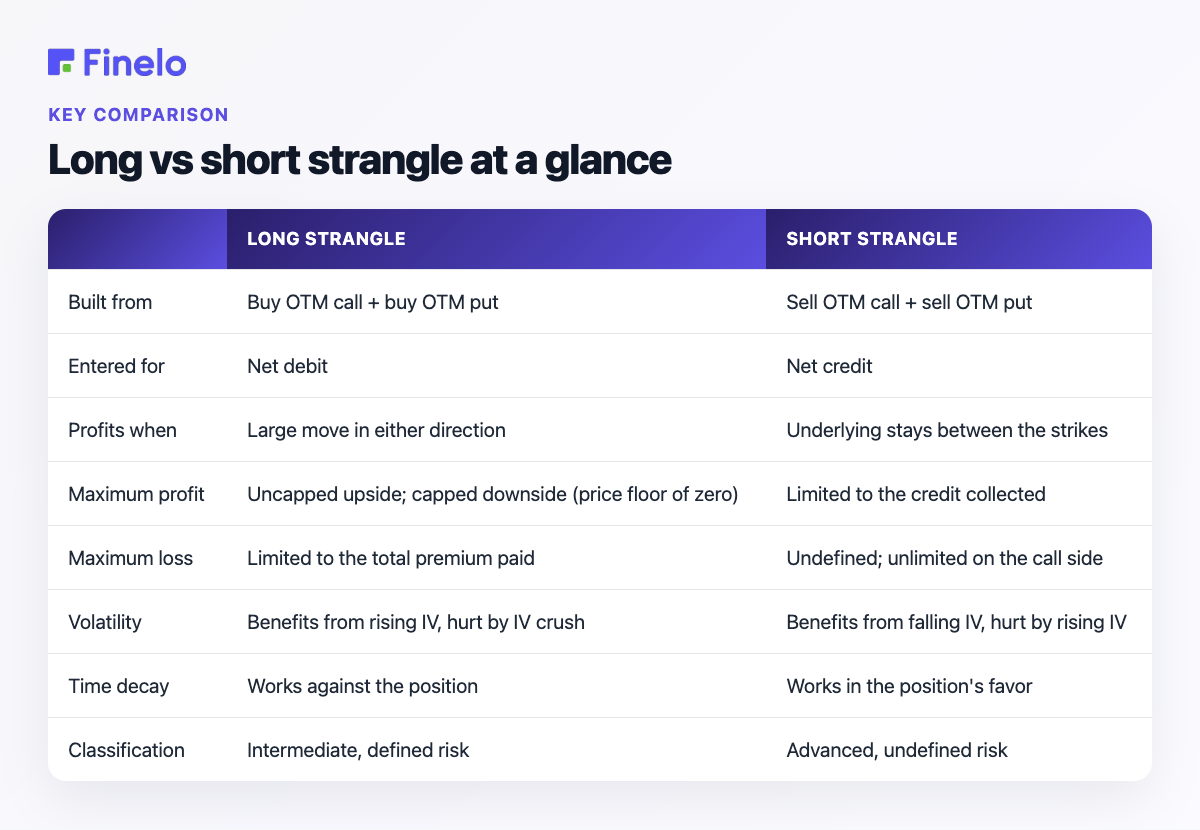
Long vs short strangle at a glance
This is a high-level comparison, not a recommendation of either version.
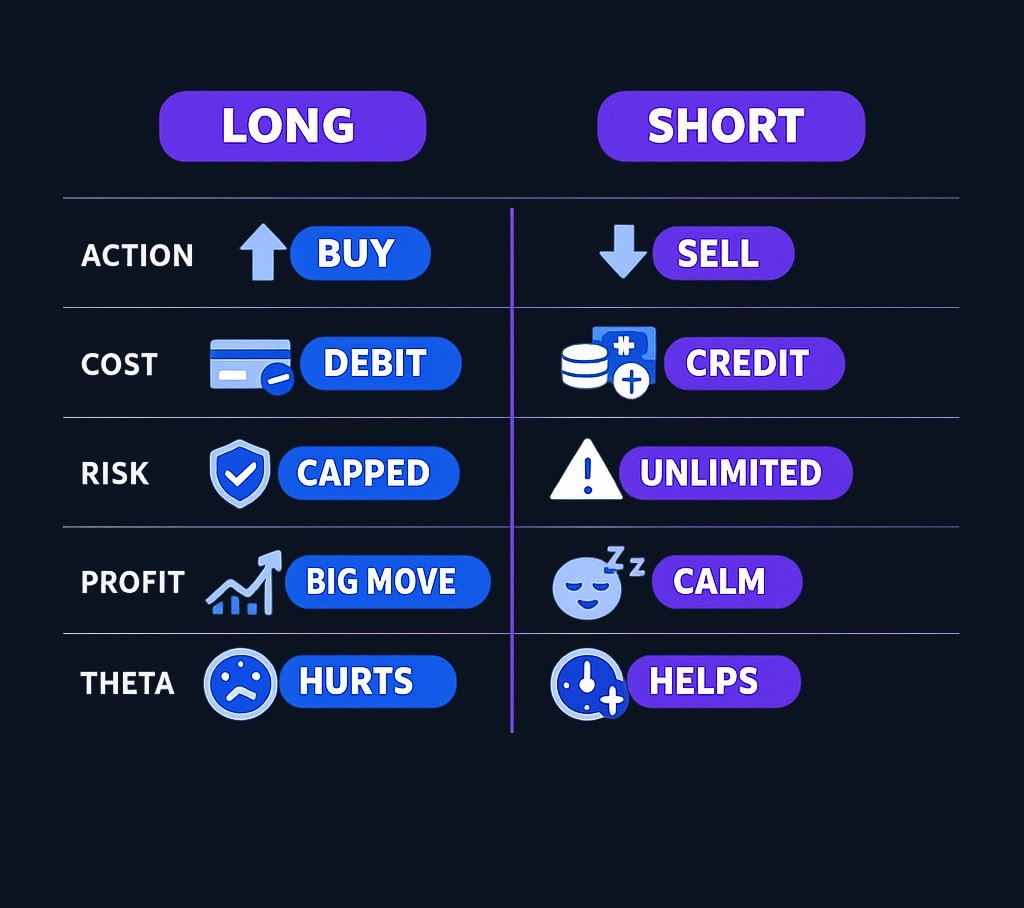
| Long strangle | Short strangle | |
|---|---|---|
| Built from | Buy OTM call + buy OTM put | Sell OTM call + sell OTM put |
| Entered for | Net debit | Net credit |
| Profits when | Large move in either direction | Underlying stays between the strikes |
| Maximum profit | Uncapped upside; capped downside (price floor of zero) | Limited to the credit collected |
| Maximum loss | Limited to the total premium paid | Undefined; unlimited on the call side |
| Volatility | Benefits from rising IV, hurt by IV crush | Benefits from falling IV, hurt by rising IV |
| Time decay | Works against the position | Works in the position's favor |
| Classification | Intermediate, defined risk | Advanced, undefined risk |
Strangle vs straddle
Strangles and straddles are close cousins and often confused. Both are two-leg, volatility-based positions using a call and a put with the same expiration. The difference is strike selection, and everything else follows from it.
| Strangle | Straddle | |
|---|---|---|
| Strikes | Call and put at different OTM strikes | Call and put at the same strike, usually ATM |
| Cost (long version) | Cheaper | More expensive |
| Move needed (long version) | Larger | Smaller |
| Breakevens | Wider apart | Closer together |
| Time decay, as a share of premium (long version) | More sensitive | Less sensitive |
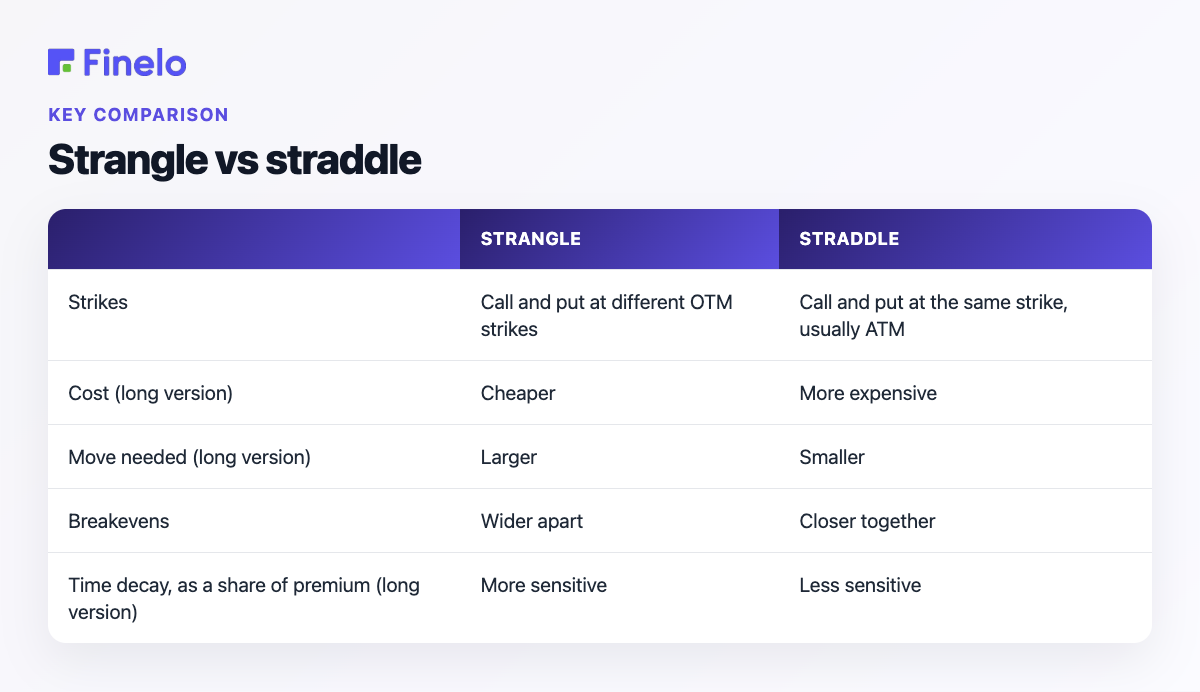
In short, a long strangle is cheaper but needs a larger move, while a long straddle costs more and starts paying off sooner. Two consequences cut against the "cheaper is better" instinct: because a strangle's breakevens sit further apart, there is a greater chance of losing the entire premium if it is held to expiration, and a long strangle loses proportionally more to time decay than a comparable straddle. Cheaper up front does not mean safer.
Risks and things to watch
Both versions carry real risk, but they are different in kind, and the short version is different in scale.
- Long strangle: you need a big move. If the underlying sits still, both legs can expire worthless and the entire premium is gone. Quiet markets, time decay, and IV crush all work against it.
- Short strangle: potentially unlimited losses. Selling uncovered options exposes the seller to losses far greater than the credit collected, theoretically unlimited on the call side. Advanced only.
- Assignment and margin. Short legs can be assigned early, and short strangles tie up significant margin, which can force decisions at the worst moment.
- Event timing. Buying into a known event usually means paying inflated premiums; selling into one means taking on outsized risk precisely when the move is most likely.
- Two legs, two sets of costs. Commissions and bid-ask spreads on both legs matter, especially for a long strangle that already needs a substantial move.
Whether either version is appropriate for anyone depends on their knowledge, options approval level, and risk tolerance, and it is exactly the kind of thing to learn thoroughly and practice before risking real money, if at all.
Understanding a strategy and being ready to trade it are not the same thing.
Next steps
A strangle is a clear example of a volatility-based position: one version betting on a large move, the other on calm, with risk profiles that are nearly mirror images. Understanding both, especially the undefined risk of the short version, matters more than memorizing the payoff shape.
Read the implied volatility guide next, since volatility drives strangles more than almost anything else, and see the bull call spread for a defined-risk strategy by comparison. A simulator lets you watch how a two-leg position behaves over time without risking money. Inside the Finelo app, you can study positions like this on real market data with virtual funds. There are no deposits, no withdrawals, and no broker connection — it is a closed practice loop, so the only cost of a wrong read is the lesson. To weigh up other users' experiences, read Finelo reviews, and for account questions, use the Finelo support center. Finelo is an educational product, not a brokerage, so verify current features through Finelo.
Finelo is an educational product, not a brokerage. The simulator uses virtual funds and real market data, and final trading and investing decisions are yours, made through your own brokerage account when you choose to act. This article is for education and is not financial advice. Options trading carries significant risk and is not suitable for everyone.
Frequently asked questions
What is the difference between a long and short strangle?
A long strangle buys the two options for a net debit and needs a big move; its maximum loss is the premium paid. A short strangle sells them for a net credit and wants the underlying to stay put; its maximum profit is the credit collected, but its potential loss is undefined.
What are the breakevens on a long strangle?
There are two. The upper breakeven is the call strike plus the total premium paid, and the lower breakeven is the put strike minus the total premium. The underlying must finish beyond one of them at expiration for the position to profit. Finishing between the strikes means losing the full premium.
What is the difference between a straddle and a strangle?
A straddle uses a call and a put at the same strike, usually at the money, while a strangle uses different out-of-the-money strikes. A long straddle costs more but profits from a smaller move; a long strangle is cheaper but needs a bigger one and loses proportionally more to time decay.
Is a short strangle risky?
Yes, seriously so. It sells uncovered options, so a large move can cause losses far exceeding the credit collected, with theoretically unlimited risk on the call side. It also requires margin and can be assigned early. It is an advanced strategy, not suitable for beginners, and should never be treated as safe income.
When do traders use a strangle?
Traders describe using a long strangle when they expect a large move but are unsure of the direction, accepting that a big move is needed to profit. A short strangle is described for expectations of low movement, though its severe risk means only experienced, approved traders use it. This is context, not a recommendation.
strangle optionoptions tradingtrading education
Practice trading with Finelo
Practice in a simulator, learn with bite-sized lessons, and build confidence before risking real money.
About the author
Finelo Team
The Finelo Team creates practical investing and trading education designed to help beginners learn faster with structured challenges, simulator practice, and bite-sized lessons.
Keep reading — Related articles

Trading
What Is SPAN Margin: Learn the Concept & Risk Controls
SPAN margin is an exchange-level, risk-based margin framework that calculates required collateral for futures and options by assessing portfolio risk across prescribed market scenarios rather than using a flat per‑contract rate.
Finelo Team
Trading
What Is Portfolio Margin: Learn the Concept & Risk Controls
Portfolio margin is a risk-based method that applies scenario analysis to eligible positions in an approved margin account.
Finelo Team
Trading
What Is NQ in Trading: Learn the Concept & Risk Controls
In trading, NQ is the ticker symbol for the E-mini Nasdaq-100 futures contract, listed on CME Group's exchange.
Finelo Team