China set a stronger daily reference rate for the yuan on September 18, extending a move that has drawn attention back to the world's most closely managed major currency.
China Sets a Stronger Yuan Fix at 6.7521: What It Means for USD/CNY
China set its September 18 yuan reference rate at 6.7521 per dollar. Learn how the official fixing differs from market rates and why the move matters.
6 min read
Practice trading with Finelo
Practice in a simulator, learn with bite-sized lessons, and build confidence before risking real money.
Want to learn more?
Practice in a simulator, learn with bite-sized lessons, and build confidence before risking real money.
Explore FineloExplore Finelo's 28-day challenges
Turn learning into a daily habit with guided challenge paths.
The official central parity table published by China's State Administration of Foreign Exchange, or SAFE, listed 6.7521 yuan per U.S. dollar for September 18. That was stronger than 6.7580 one day earlier and 6.7795 on September 7. In USD/CNY terms, a lower number represents a stronger yuan because fewer yuan are required to buy one dollar.
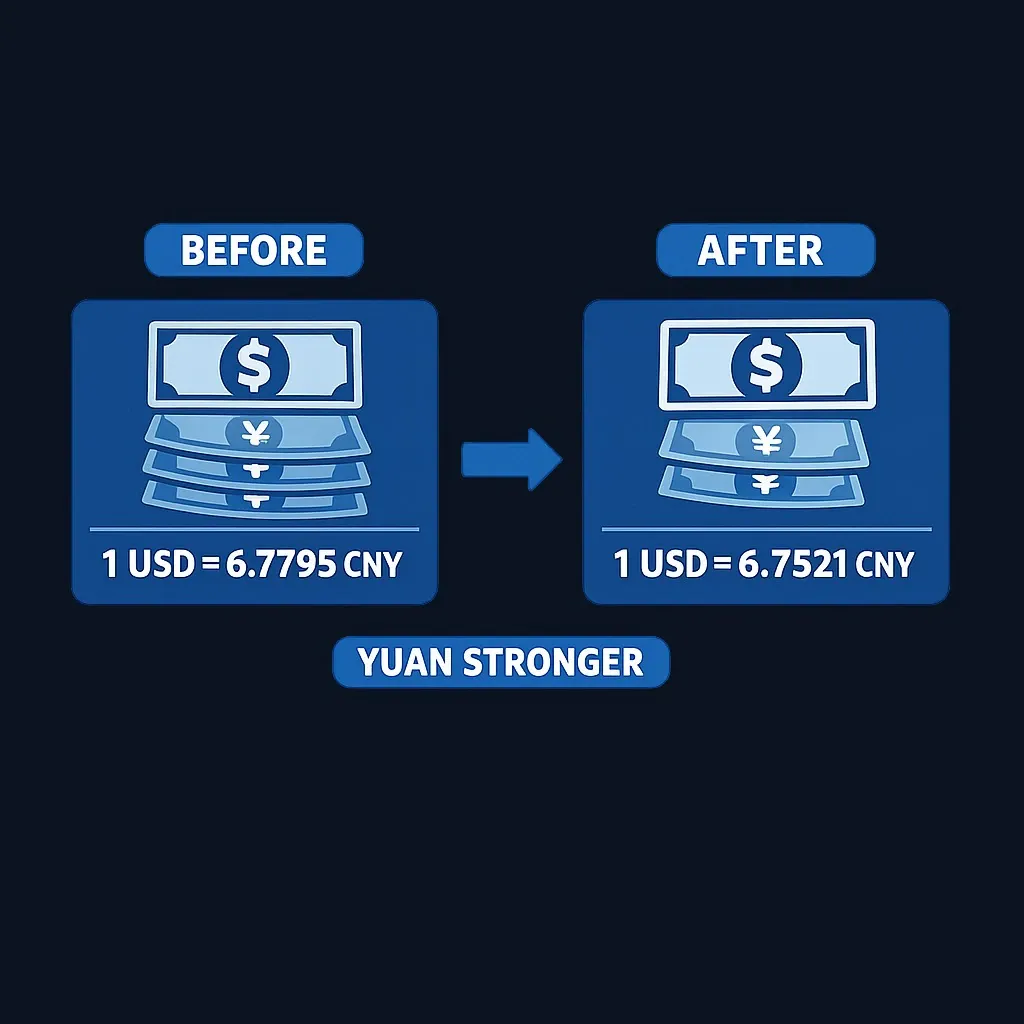
Market reporting also described the offshore yuan reaching its strongest level since 2022. That market quote and the official fixing are related, but they are not interchangeable. Understanding the distinction is the key to reading this story correctly.
Data check: Rates and source pages in this article were reviewed on September 18, 2026. Currency prices can change continuously. This article is educational and does not recommend a currency trade or investment.
What changed in the official fixing?
China publishes a central parity rate on each trading day. The rate is commonly called the fixing because it provides a policy reference point for onshore currency trading.
The recent official sequence shows a clear direction:
| Date | Yuan per U.S. dollar | What it indicates |
|---|---|---|
| September 7 | 6.7795 | Starting point for this comparison |
| September 14 | 6.7698 | Stronger yuan fixing |
| September 17 | 6.7580 | Further strengthening |
| September 18 | 6.7521 | Strongest fixing in this sequence |
From September 7 through September 18, the reference rate strengthened by about 0.4%. That percentage may look small, but daily moves in major currencies are often measured in fractions of a percent.
The fixing is best understood as a policy signal and trading reference—not as a guaranteed market price available for every transaction.
Fixing, onshore yuan, and offshore yuan are different
Three quotations may appear in reports about China's currency:
- The central parity rate is the official daily reference rate. SAFE's table is the primary source used for the 6.7521 figure in this article.
- CNY generally refers to yuan traded in mainland China's onshore market.
- CNH generally refers to yuan traded offshore, most prominently in Hong Kong.

Onshore and offshore prices can diverge because they operate under different market conditions. Cross-border capital flows, liquidity, interest-rate expectations, and demand for dollars can all affect the two markets.
That is why a report that the offshore yuan traded near one level should not be presented as if the People's Bank of China officially fixed the currency at that same level.
The U.S. Federal Reserve's H.10 release provides another useful reference for spot-market history. Its latest completed weekly table showed the yuan at 6.7080 per dollar on September 11. The publication schedule differs from China's daily fixing schedule, so dates must be matched before comparing figures.
Practice trading with Finelo
Practice in a simulator, learn with bite-sized lessons, and build confidence before risking real money.
Why would a stronger yuan matter?
A currency move changes relative prices across borders, although the effect is rarely immediate or one-for-one.
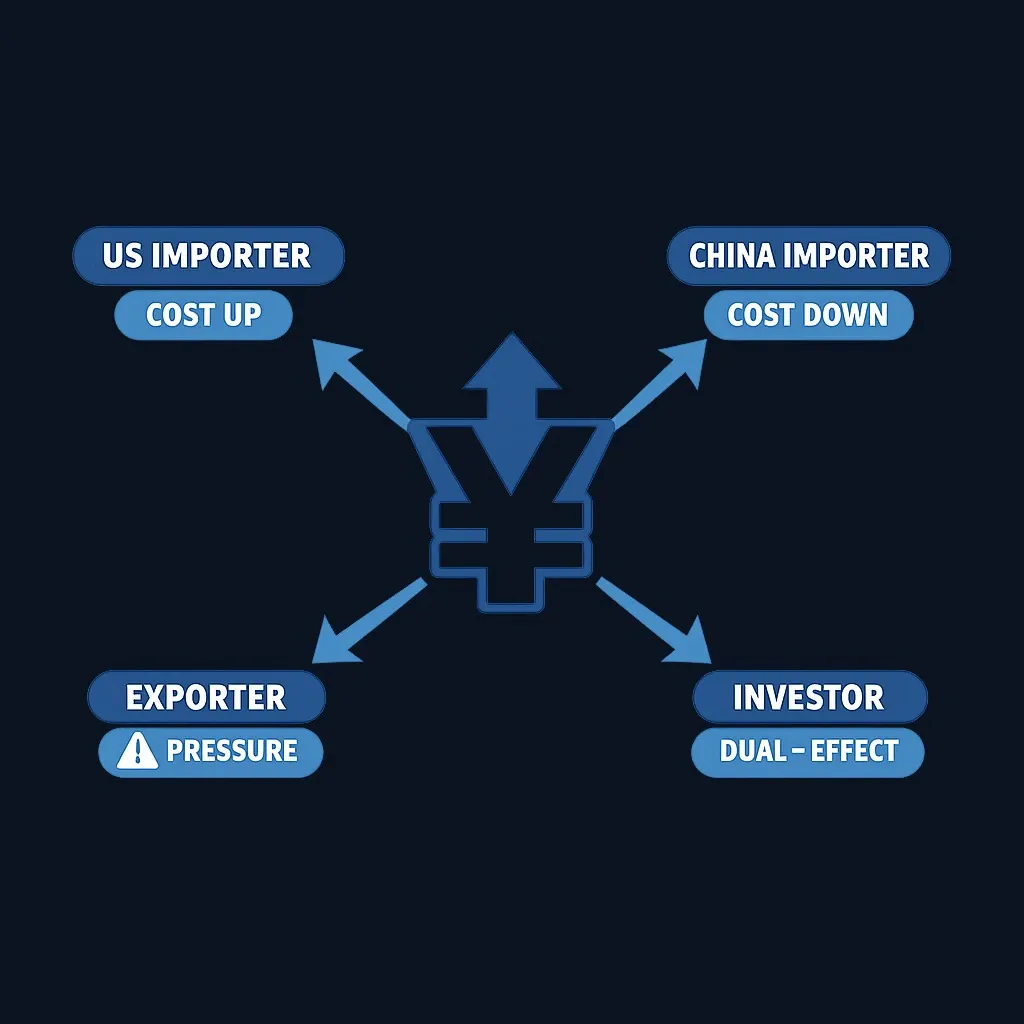
For U.S. importers: a stronger yuan can raise the dollar cost of Chinese goods if suppliers keep yuan prices unchanged. Contracts, hedging, shipping costs, tariffs, and profit margins can soften or delay the effect.
For Chinese importers: a stronger yuan can make dollar-priced commodities or equipment less expensive in yuan terms, all else equal.
For multinational companies: reported revenue and profit can change when foreign results are translated into a company's home currency. The operational business may be unchanged even while the translated number moves.
For investors: an unhedged foreign asset combines the asset's local return with the currency movement. A U.S. investor can therefore experience a different return from an investor measuring the same asset in yuan. Our guide to currency-hedged ETFs explains the same translation effect in a broader portfolio context.
None of these relationships works in isolation. A stronger currency can reduce some import costs while creating pressure for exporters. The result depends on pricing power, contract currency, hedging, and how long the move lasts.
Does a stronger fixing predict the next move?
Not reliably.
A series of stronger fixings can indicate that policymakers are comfortable with, or are seeking to guide, a stronger reference level. But the next market move still depends on many variables: economic data, interest-rate expectations in China and the United States, trade flows, capital movement, and changes in global risk appetite.
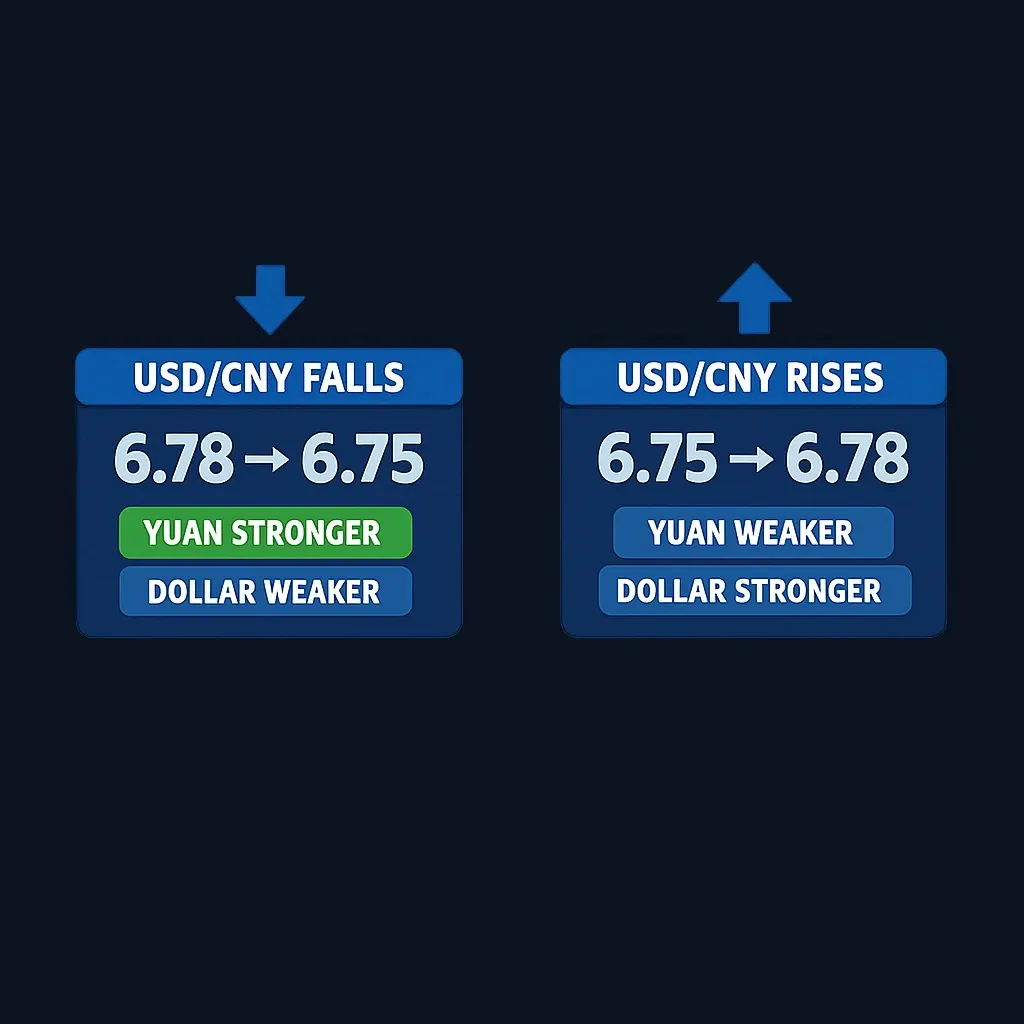
It is also important not to reverse the quotation. If USD/CNY falls from 6.78 to 6.75, the yuan strengthened and the dollar weakened against it. If USD/CNY rises, the opposite is true.
The practical takeaway
The verified development is straightforward: China's official central parity strengthened to 6.7521 yuan per dollar on September 18, continuing a sequence of lower USD/CNY fixings.
The useful lesson is broader. A currency headline may refer to an official fixing, an onshore spot rate, or an offshore rate. Before drawing a conclusion, check which market the number describes, the observation time, and whether the quotation is yuan per dollar or dollars per yuan.
Finelo does not provide investment advice. This article is for informational and educational purposes only. Exchange rates are volatile, and past movements do not predict future results.
Primary sources: SAFE — RMB central parity rates, Federal Reserve — H.10 foreign exchange rates, SAFE — foreign-exchange administration update
Secondary story reference: Yahoo Finance/Bloomberg — Chinese yuan reaches its strongest level since 2022
Frequently asked questions
What was China's yuan fixing on September 18, 2026?
China's official central parity table listed 6.7521 yuan per U.S. dollar for September 18, compared with 6.7580 on September 17 and 6.7795 on September 7.
Does a lower USD/CNY rate mean a stronger yuan?
Yes. USD/CNY states how many yuan buy one U.S. dollar. When the number falls, fewer yuan are needed to buy a dollar, so the yuan has strengthened against the dollar.
Is the yuan fixing the same as the market exchange rate?
No. The fixing is an official daily reference rate. The onshore and offshore yuan also trade in markets, so quoted spot rates can differ from the fixing.
Chinese yuanUSD/CNYPBOCexchange ratescurrenciesChina
Practice trading with Finelo
Practice in a simulator, learn with bite-sized lessons, and build confidence before risking real money.
About the author
Finelo Team
The Finelo Team creates practical investing and trading education designed to help beginners learn faster with structured challenges, simulator practice, and bite-sized lessons.
Keep reading — Related articles

News
U.S. Gas Prices Reach $4.46: What the Increase Means for Inflation and Household Costs
The EIA's U.S. all-grades gasoline average reached $4.455 per gallon. See what changed, why regions differ and how fuel prices affect inflation.
Finelo Team
News
BOJ Raises Its Policy Rate to 1.25%: What the Decision Means for the Yen
The BOJ raised its overnight policy-rate target to around 1.25%. Learn why the yen can still weaken after a rate increase and what the decision says.
Finelo Team

News
The September Effect Explained: What the Stock Market Data Really Says
September has delivered the S&P 500's weakest average monthly return since 1928, but the result is not a reliable trading signal. Here is how to read the seasonality data.
Finelo Team


