Last editorial review: September 8, 2026
Currency-Hedged ETFs: Costs, Risks, and When Hedging May Fit
Currency-hedged ETFs aim to remove or reduce the effect of foreign-exchange moves on a fund’s returns by using derivatives or cash instruments to offset currency fluctuations. Hedging can…
14 min read
Practice investing with Finelo
Build practical investing skills with guided lessons, simulator practice, and structured challenges.
Want to learn more?
Build practical investing skills with guided lessons, simulator practice, and structured challenges.
Explore FineloExplore Finelo's 28-day challenges
Turn learning into a daily habit with guided challenge paths.
U.S. scope: This article discusses U.S. institutions, financial products, tax rules, and dollar examples unless stated otherwise. Rules and product terms may change; verify current official guidance for your situation.
Quick answer
Currency-hedged ETFs aim to remove or reduce the effect of foreign-exchange moves on a fund’s returns by using derivatives or cash instruments to offset currency fluctuations. Hedging can reduce volatility from exchange-rate swings but adds cost and complexity; it’s most useful when currency moves are likely to dominate the asset returns or when you want clearer exposure to foreign asset performance. For background definitions, see Finelo’s learning pages on ETFs and hedges in Finelo’s learning hub.
Introduction to Currency Hedged ETFs
Currency-hedged ETFs (exchange-traded funds) are funds that combine exposure to foreign assets (stocks, bonds, commodities) with a strategy intended to neutralize changes in the exchange rate between the investor’s home currency and the asset’s currency. The goal is to make the fund’s performance reflect the underlying asset returns, not currency moves.
Hedged share classes or ETFs are commonly offered so investors can pick exposure with or without currency management. Investors choose hedged ETFs when they prefer returns driven primarily by the asset (for example, foreign equities or bonds) rather than by the FX rate between currencies.
This article explains how hedging works, when it helps or hurts, practical trade-offs, a decision framework, and short illustrative scenarios so you can evaluate whether hedging fits your objectives.
How Currency Hedging Works
Explain the mechanics and tools so you can see what your fund actually does and why it costs money.
Basic mechanics — offsetting FX exposure
A hedged ETF seeks to offset (or "hedge") the currency exposure that arises when the fund holds assets denominated in another currency. Rather than leaving that FX exposure open, the fund manager uses instruments that gain when the underlying currency falls and lose when it rises — ideally cancelling the currency effect on total returns. Managers commonly implement this via short-dated forward contracts, FX swaps, or futures.
Note: the specific instruments and tenor vary by provider and by market. Hedging is rarely perfect; residual exposure can remain between rebalancing dates.
Common hedging instruments (conceptual)
- FX forwards and swaps: Over-the-counter contracts that lock in an exchange rate for a future settlement date. Often used because they can be tailored to amount and maturity.
- FX futures: Exchange-traded standardized contracts; easier to access but less flexible in size and maturity.
- Options and collars: Used less frequently for consistent, systematic hedging because options add premium costs and embed non-linear payoffs.
These are broad descriptions of methods managers use; check individual fund documents for exact mechanics.
Rebalancing horizon and hedge ratios
Managers choose a hedge ratio (commonly near 100% for "fully hedged" products) and a rebalancing frequency (weekly, monthly, or quarterly). Rebalancing frequency matters: more frequent rebalancing keeps the hedge closer to the target but increases transaction and roll costs; less frequent rebalancing reduces trading costs but allows greater drift between the underlying currency exposure and the hedge.
Roll costs, carry, and opportunity
Hedging is not free. The rolling of forward contracts or futures can produce a positive or negative carry depending on interest-rate differentials between the two currencies. That carry becomes a recurring cost or a modest benefit for the fund. Over time, these costs accumulate and can noticeably affect returns relative to an unhedged ETF.
Practical example (illustrative)
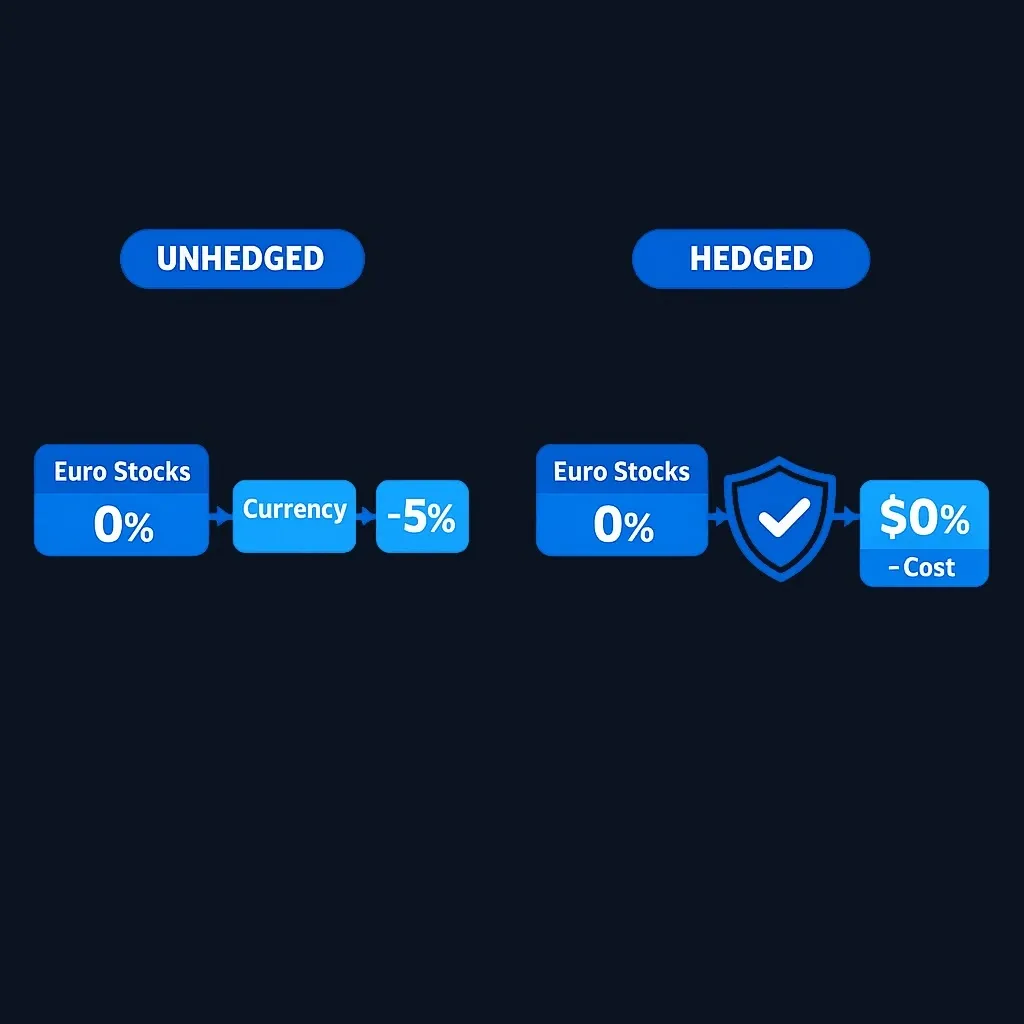
Imagine a U.S. investor holds a European equity ETF. If the euro falls 5% versus the dollar while European equities are flat in local terms, an unhedged ETF would show about a 5% loss in USD; a perfectly hedged ETF would aim to preserve the 0% local-equity return (ignoring hedging costs). This illustrates the point: hedging isolates asset performance from currency moves, but it does not eliminate costs or market risk.
Benefits of Investing in Currency Hedged ETFs
This section covers the upside reasons people choose hedged ETFs and when those benefits matter.
Reduced return volatility tied to FX
Hedged ETFs can reduce headline volatility caused by exchange-rate swings. That helps investors who want a clearer read on the foreign market’s asset returns or who need predictable currency-adjusted cash flows (for example, corporate treasuries or liability-matching investors).
Better comparability to domestic assets
If your goal is to compare a foreign equity market’s performance against domestic stocks, hedged ETFs make that comparison more apples-to-apples by stripping out currency noise.
Protection when currency depreciation could overwhelm asset returns
When currency moves are expected to be large relative to expected asset returns, a hedge can prevent currency losses from dominating portfolio outcomes.
Use cases — when hedging tends to be attractive
- Fixed-income portfolios where yield differences and currency swings can materially change coupon values in domestic terms.
- Investors with home-currency liabilities who need predictable cash flows.
- Short- to medium-term horizon investors who want to avoid near-term currency swings.
Illustrative scenario
A conservative investor allocating to foreign government bonds to fund a future domestic liability may prefer a hedged bond ETF because currency depreciation could otherwise reduce the effective value of coupons and principal in domestic terms.
Risks Associated with Currency Hedged ETFs
Outline the trade-offs and downsides so you can weigh benefits against costs and structural limits.
Educational note: This content is educational, not financial or investment advice. Investing can involve loss.
Direct costs: hedging fees and drag
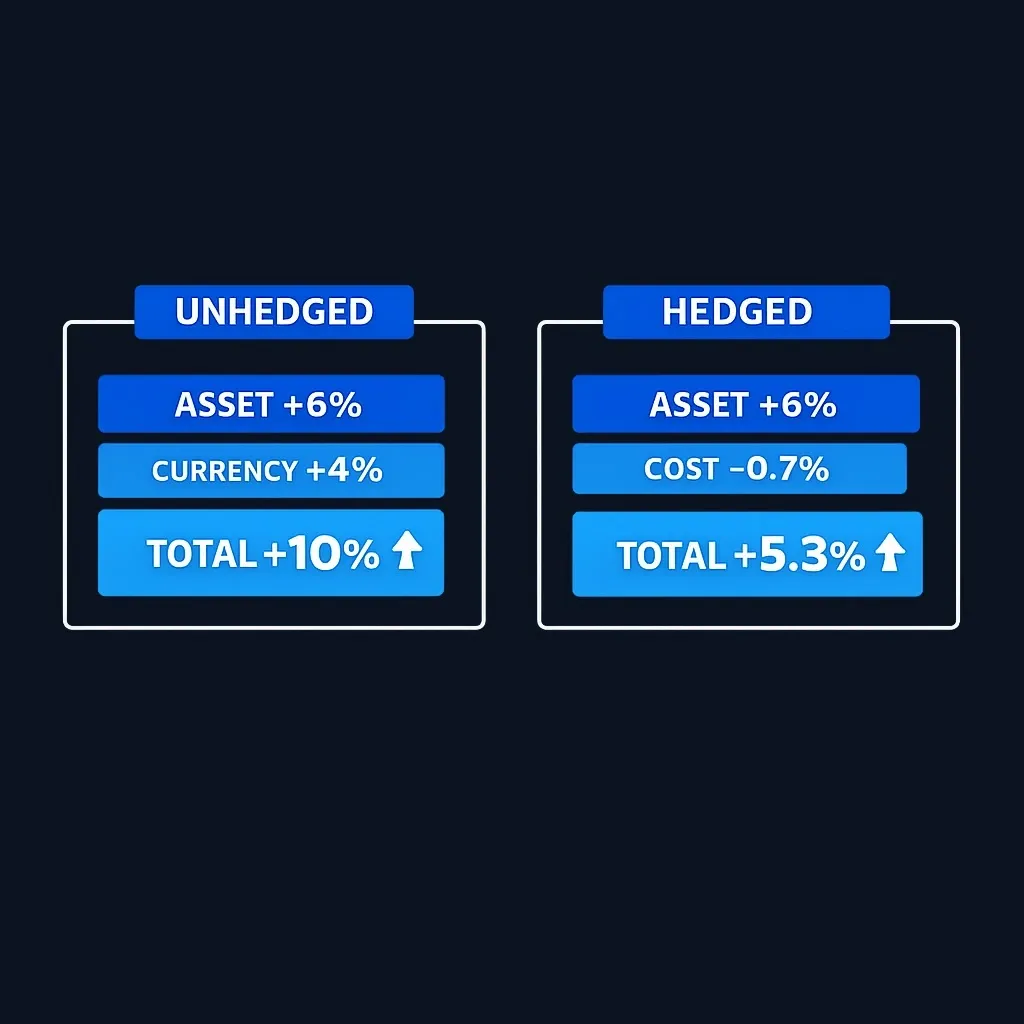
Hedging introduces explicit and implicit costs: transaction fees, bid/ask spreads, derivative funding costs, and carry or roll costs. Those costs act as a drag on returns versus an unhedged ETF when the home currency is stable or moves favorably.
The process of hedging — particularly for leveraged or inverse currency-linked products — can be exposed to rapid exchange-rate moves and the high cost of hedging in volatile markets, which raises the fund’s risk profile (Fidelity).
Basis risk and imperfect hedges
Hedging is not perfect. Mismatches in tenor, counterparty risk on OTC contracts, timing differences at rebalance, and management errors can leave residual currency exposure (basis risk).
Opportunity cost
If the foreign currency strengthens, an unhedged investor benefits; a hedged fund would miss that gain, and the hedging costs further reduce net returns.
Liquidity and operational complexity
Hedging requires active operations and access to FX markets. In stressed markets, the cost or ability to roll hedges can change quickly, potentially increasing tracking error or costs.
Tax considerations (overview)
Currency hedging can complicate tax reporting depending on jurisdiction and whether gains/losses from derivatives are taxed differently than portfolio gains. Consult a tax professional for jurisdiction-specific details.
Summary risk checklist (use before buying)
- Are hedging costs justified given the investment horizon?
- Does the fund disclose hedge instruments, frequency, and cost?
- Can the investor accept missing out on favorable currency moves?
- Are tax and reporting implications acceptable?
Cite fund documents and service providers before acting.
Comparative Analysis of Currency Hedging Strategies
A concise comparison table compresses different approaches, followed by guidance on choosing between them.
Comparison table — hedging strategies (qualitative)
| Strategy | Typical instruments | Cost profile | Precision | Best for |
|---|---|---|---|---|
| Systematic full hedge | FX forwards, swaps | Moderate (ongoing roll/transaction costs) | High when rebalanced frequently | Investors wanting consistent home-currency exposure |
| Partial hedge (e.g., 50–80%) | Forwards or futures sized less than exposure | Lower cost, some FX exposure remains | Medium | Investors balancing cost vs. FX exposure |
| Time-limited hedges | Forwards with shorter tenors | Costs concentrated around roll dates | Varies with tenor | Short-term tactical hedging |
| Dynamic / tactical hedge | Options, collars, active sizing | Higher and potentially asymmetric cost | Potentially better downside protection | Investors seeking protection against big moves |
| No hedge | None | None | 0 (full FX exposure) | Long-term investors who accept FX volatility |
How to compare in practice
- If you need predictable domestic-currency cash flows, prioritize higher hedge ratios despite cost.
- If you expect the foreign currency to appreciate over your horizon, an unhedged approach may be preferable.
- Evaluate rebalancing frequency and stated hedge costs in the fund prospectus; more frequent rolling increases costs but reduces drift.
Practical checklist for fund selection
- Read the fund’s prospectus or factsheet: look for stated hedge ratio, instruments used, and rebalancing frequency.
- Compare ongoing fees (expense ratio) plus any explicit hedging costs.
- Check liquidity of the ETF and its underlying instruments.
- Confirm whether the fund uses USD- or home-currency-settled derivatives and what counterparties they use.
Performance Metrics of Currency Hedged ETFs
You won’t find a single rule; here’s how to analyze and compare hedged vs unhedged performance without relying on unsupported historical claims.
What to look at in fund performance reports
- Total return in home currency vs. underlying local-currency benchmark.
- Tracking error to the hedged benchmark.
- Cost components: expense ratio + hedging carry/roll cost.
- After-tax returns if your jurisdiction taxes derivative gains differently.
Interpreting differences (framework)
- Break total return into two components — local asset return and currency return.
- Compare the hedged ETF’s home-currency return to:
- a) the local-currency return of the underlying index, and
- b) the unhedged ETF’s home-currency return.
- Attribute the gap to hedging costs, imperfect hedge execution, and currency moves.
This decomposition clarifies whether a hedged ETF delivered value relative to its stated goal (isolation from FX).
Example decomposition (illustrative math)
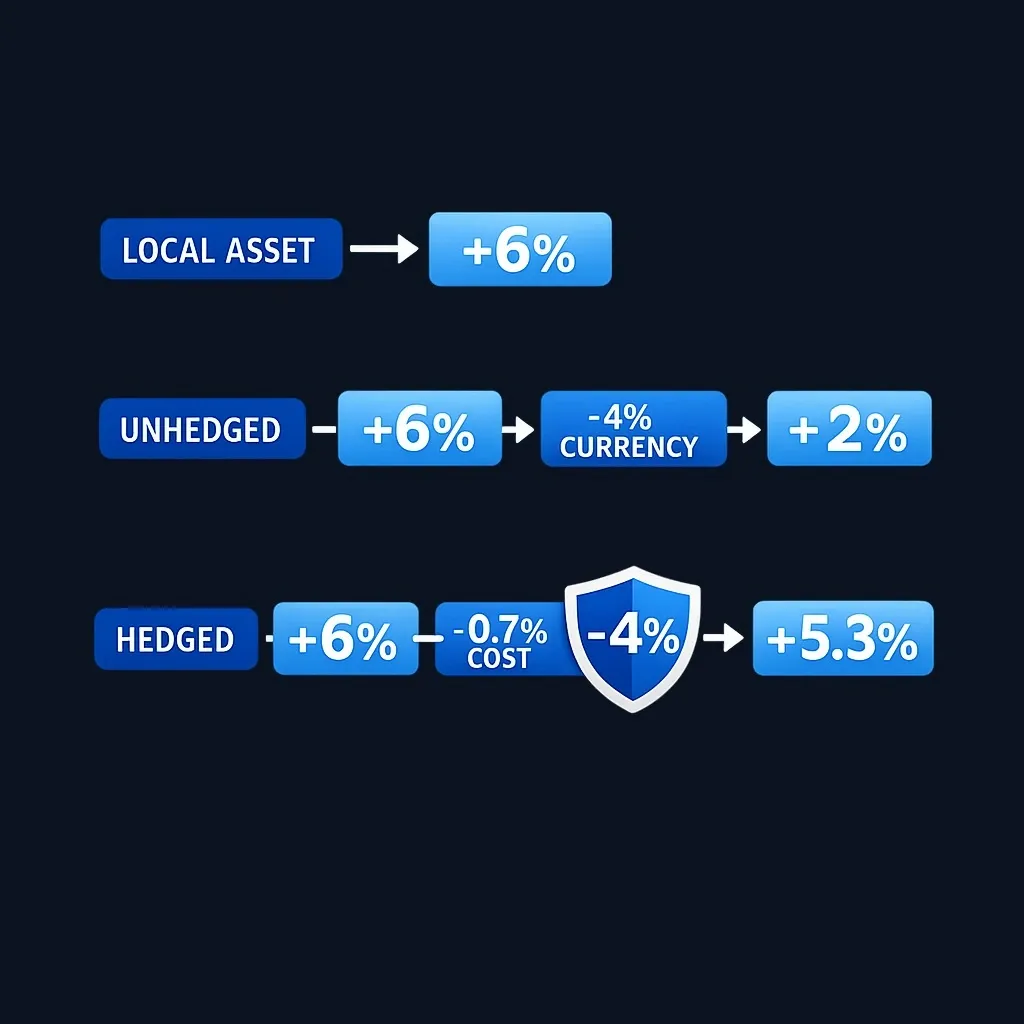
- Assume local asset return = +6% (in local currency).
- Currency moves = −4% (depreciation vs home currency).
- Unhedged home-currency return ≈ +2% (6% − 4%).
- Hedged ETF return ≈ 6% − hedging cost (for example, −0.7%) → ≈ +5.3%.
The hedged ETF outperformed the unhedged ETF in this scenario because it prevented the currency drag, but note the hedged return is reduced by hedging costs.
How geopolitical events alter outcomes
Geopolitical shocks can drive sudden currency moves that overwhelm asset returns; in those periods, hedging can materially change domestic-currency outcomes. Conversely, currency appreciation driven by policy or rates can make unhedged positions outperform hedged ones.
Practice investing with Finelo
Build practical investing skills with guided lessons, simulator practice, and structured challenges.
Case Studies: Illustrative Examples of Hedged ETF Use
We provide realistic, anonymized scenarios to show how investors use hedged ETFs. These are hypothetical illustrations to demonstrate decision-making, not claims about real funds.
Case study 1 — Liability-matching investor (illustrative)
A pension-plan manager must pay future obligations denominated in domestic currency. She buys hedged foreign bond ETFs to capture credit exposure while minimizing FX risk. Over a three-year horizon, the hedge reduces volatility in funding ratios and makes cash flows easier to forecast. The manager accepts the steady hedging cost in exchange for predictability.
Key lesson: Hedging favors investors with domestic-currency liabilities who value predictability over potential FX gains.
Case study 2 — Tactical investor expecting currency depreciation (illustrative)
An asset allocator believes a foreign currency will weaken in the near term relative to their home currency. They shift to hedged foreign equity ETFs to avoid the anticipated currency drag while maintaining equity exposure. If the currency move occurs, the hedged fund helps preserve local asset returns in home-currency terms; if the currency instead strengthens, the hedged position may lag an unhedged alternative.
Key lesson: Hedged ETFs can implement a view on currency without changing equity exposure, but they carry the opportunity cost if the view is wrong.
Case study 3 — Long-term buy-and-hold investor (illustrative)
A long-term investor with a global equity allocation worries less about short-term FX noise. They choose an unhedged ETF to capture both asset and currency returns, reasoning that currency fluctuations often mean-revert over long horizons. Over long periods, the investor accepts higher volatility for the chance of currency appreciation.
Key lesson: Horizon and belief about currency mean-reversion influence hedging decisions.
What to know before deciding
This section helps you translate the analysis into a personal decision.
Key questions to ask yourself
- What is your investment horizon? Shorter horizons favor hedging for predictability; longer horizons can tolerate FX swings.
- Do you have home-currency liabilities or expenses? If yes, hedging may be more valuable.
- How much cost am I willing to pay for reduced currency volatility?
- Can I manage or tolerate tax and reporting complexities from derivatives?
Due diligence steps before buying a hedged ETF
- Read the fund prospectus and factsheet for hedging process, instruments, and frequency.
- Compare hedged and unhedged share classes for the same strategy.
- Check liquidity and average trading volumes.
- Ask about counterparties, collateral, and how the fund manages failed rolls in stressed markets.
Common mistakes and how to avoid them
- Mistake: Expecting hedging to eliminate all risk. Fix: Treat hedging as risk reduction for currency only — market risk remains.
- Mistake: Ignoring hedging costs. Fix: Include both expense ratio and estimated hedging carry in performance expectations.
- Mistake: Switching between hedged and unhedged frequently. Fix: Avoid frequent switches unless you have a clear, evidence-based tactical view; turnover can increase costs and tax events.
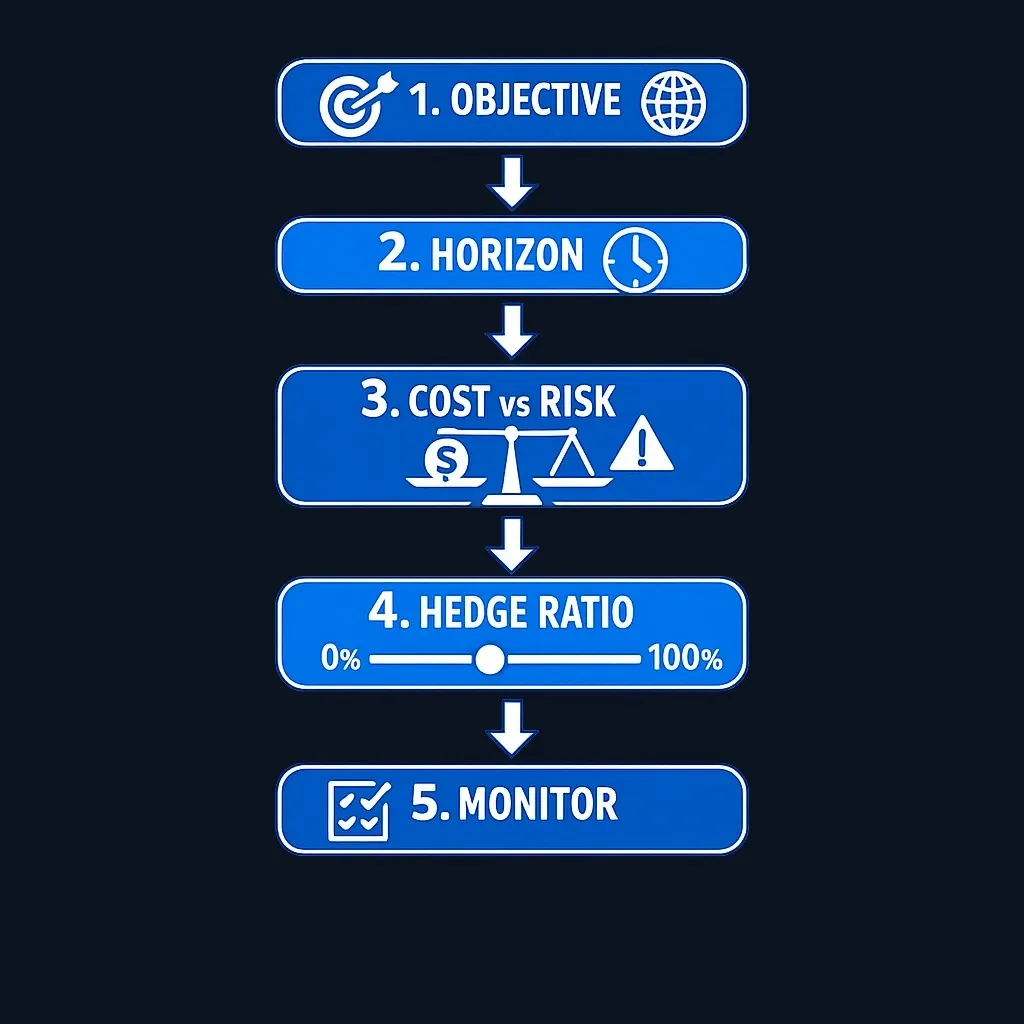
Decision framework
A short, practical flow to help choose hedged vs unhedged.
Step 1 — Define objective
Decide whether your priority is predictable home-currency cash flows or capturing total global returns (asset + currency).
Step 2 — Set horizon and constraints
If horizon < 3 years and you need predictability → tilt toward hedged. If horizon is long and you can accept volatility → unhedged is reasonable.
Step 3 — Estimate cost vs expected FX impact
Compare likely hedging costs (from fund docs) to the potential currency volatility you expect to face. If expected currency moves exceed hedging costs in a downside scenario that matters to you, hedging can make sense.
Step 4 — Choose hedge ratio and products
Decide on full vs partial hedging. Full hedges favor liability-matching; partial hedges balance cost vs exposure.
Step 5 — Plan monitoring and tax implications
Set a monitoring cadence and confirm tax treatment with a professional.
Use this framework as a starting point; tailor assumptions to your goals, time horizon, liquidity needs, and risk tolerance.
Frequently Asked Questions about Currency Hedged ETFs
What is a currency-hedged ETF?
A currency-hedged ETF pairs exposure to foreign assets with a strategy designed to offset changes in exchange rates so the fund’s home-currency return mirrors local-asset performance. Check product documents to see how the fund implements hedges and how often they rebalance.
How does currency hedging work?
Hedging typically uses FX forwards, swaps, or futures to lock in exchange rates or offset currency exposure; managers roll or rebalance these positions on a set schedule. Hedging reduces currency-driven volatility but creates ongoing costs and may not be perfect.
What are the benefits of investing in currency-hedged ETFs?
Hedged ETFs reduce the impact of FX moves on your domestic-currency returns, improving predictability and making performance comparisons to domestic assets cleaner. They are useful when currency moves may overwhelm the underlying asset returns or when you need cash-flow certainty.
When should I consider using currency-hedged ETFs?
Currency-hedged ETFs may be relevant when an investor is evaluating domestic-currency liabilities, a shorter measurement horizon, or a deliberate reduction in foreign-exchange exposure. An unhedged fund preserves both the foreign-asset and currency exposure. Compare the fund prospectus, hedge ratio, derivatives, expense ratio, tracking difference, tax effects, and potential outcomes rather than assuming either structure will outperform.
Conclusion and Next Steps
Currency-hedged ETFs are a tool to manage currency risk, not a universal improvement to returns. They trade predictable home-currency exposure and reduced FX volatility for explicit hedging costs, operational complexity, and the potential to miss favorable currency moves. Use the decision framework here to align hedging with your horizon, liabilities, and cost tolerance.
If you want a practical next step, compare the hedged and unhedged share classes of any fund you’re considering and read the prospectus language on hedging implementation. Learn more about ETFs and hedging basics in Finelo’s learning hub.
Sources and Further Verification
More from Finelo
- Art Investing for Beginners: Costs, Liquidity, Valuation, and Risks
- Business Development Companies: Yields, Fees, Risks, and How to Evaluate BDCs
- Crypto Staking for Beginners: How It Works, Costs, Rewards, and Risks
Disclaimer
This article is provided by Finelo for educational and informational purposes only. Finelo does not provide financial, investment, tax, legal, or insurance advice. Consider your circumstances and consult an appropriately qualified professional before making financial decisions.
InvestingBeginner GuideFinancial Education
Practice investing with Finelo
Build practical investing skills with guided lessons, simulator practice, and structured challenges.
About the author
Finelo Team
The Finelo Team creates practical investing and trading education designed to help beginners learn faster with structured challenges, simulator practice, and bite-sized lessons.
Keep reading — Related articles
Investing
Yield to Call vs Yield to Maturity: Assumptions and Bond Risks
Yield to call (YTC) estimates a bond's yield if the issuer redeems it on an eligible call date; yield to maturity (YTM) estimates yield if it remains outstanding to final maturity.
Finelo Team

Investing
Will My Employer Know If I Take a 401(k) Loan?
Who this page is for: readers new to 401(k) loans who want a practical, privacy‑focused explanation — what your employer can see, how to limit visibility, and the financial tradeoffs to weigh.
Finelo Team
Investing
What Medical Expenses Qualify for a 401(k) Hardship Withdrawal?
Before you decide, confirm three things with your plan administrator:
Finelo Team