Last editorial review: September 8, 2026
Business Development Companies: Yields, Fees, Risks, and How to Evaluate BDCs
A Business Development Company (BDC) is a type of registered, closed‑end investment fund that gives public investors access to private‑market lending and equity investments in small and…
9 min read
Practice investing with Finelo
Build practical investing skills with guided lessons, simulator practice, and structured challenges.
Want to learn more?
Build practical investing skills with guided lessons, simulator practice, and structured challenges.
Explore FineloExplore Finelo's 28-day challenges
Turn learning into a daily habit with guided challenge paths.
U.S. scope: This article discusses U.S. institutions, financial products, tax rules, and dollar examples unless stated otherwise. Rules and product terms may change; verify current official guidance for your situation.
Quick answer
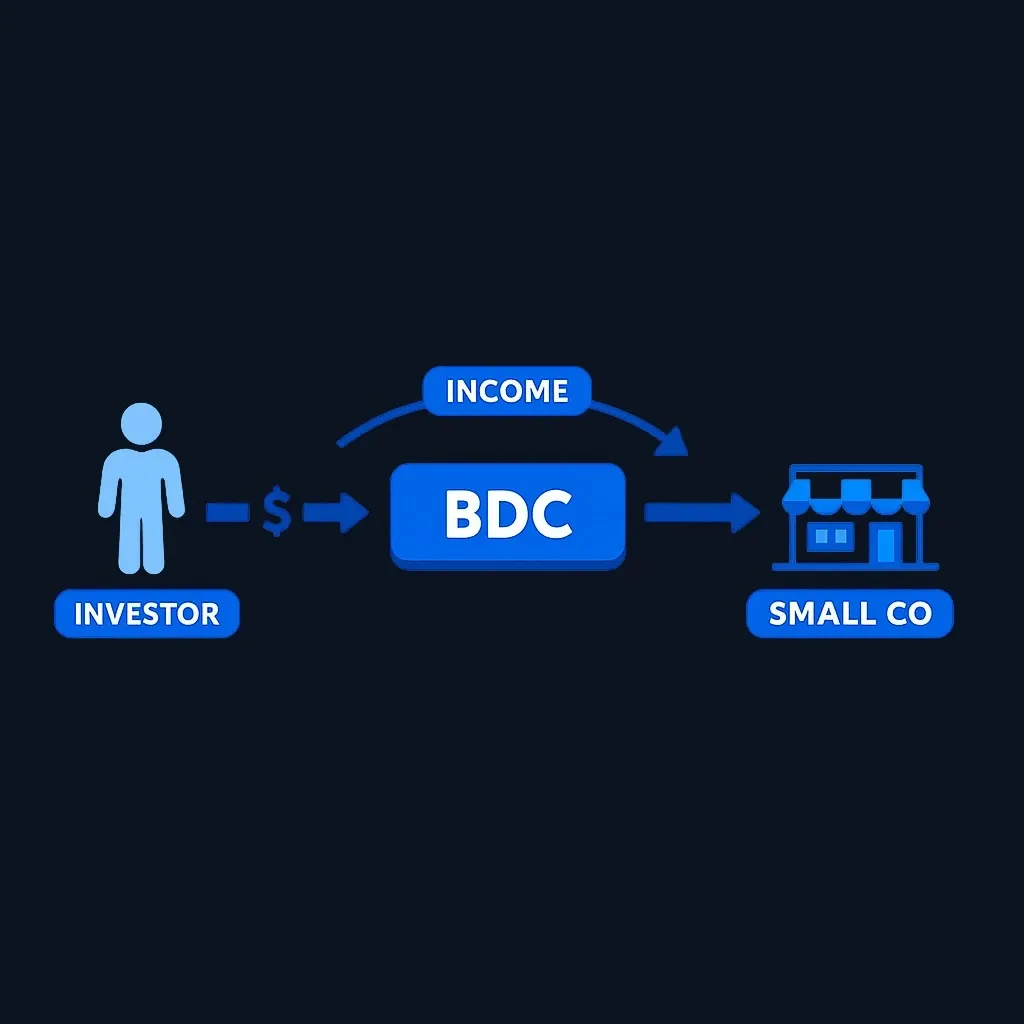
A Business Development Company (BDC) is a type of registered, closed‑end investment fund that gives public investors access to private‑market lending and equity investments in small and mid‑sized U.S. companies BDCs are a type of closed‑end investment fund. BDCs were created to channel capital and often managerial assistance to smaller firms under U.S. securities rules.
How to approach BDC research
Finelo provides educational content about investment structures and tools for comparing vehicles. Verify costs, eligibility, and suitability with official documents before acting.
Introduction to Business Development Companies
Business Development Companies are investment vehicles formed to invest capital in smaller, often privately held or small public companies. Many BDCs are structured as closed‑end funds and trade publicly, while others are sold as non‑traded or private offerings; the format affects disclosure, liquidity, and investor eligibility. BDCs typically target private‑credit, mezzanine, and growth investments and may provide managerial assistance to portfolio companies. Investor.gov’s overview of publicly traded BDCs explains the structure and its principal risks.
History and Creation of BDCs
Congress created the BDC structure under the Investment Company Act framework in 1980 to expand financing and managerial support for U.S. small and mid‑sized companies. The structure also gave public investors regulated access to investments that had largely been limited to private markets. BDC strategies now include private credit, equity, and combinations of debt and equity.
What to know before deciding
This section covers the legal rules, how BDCs operate, investor benefits, and the main risks you should evaluate. Practical note: this content is educational, not financial or investment advice. Investing involves risk, including loss of principal — review a candidate BDC’s prospectus and SEC filings before investing.
Investment Requirements and Regulations
To qualify and operate as a BDC, a company must meet registration and reporting obligations applicable to closed‑end funds and public companies. BDC qualification generally requires concentrating eligible assets in certain U.S. issuers and offering managerial or developmental assistance to portfolio companies. The exact requirements are technical, so verify them in the company’s filings and Investor.gov’s BDC overview.
Operational Structure of BDCs
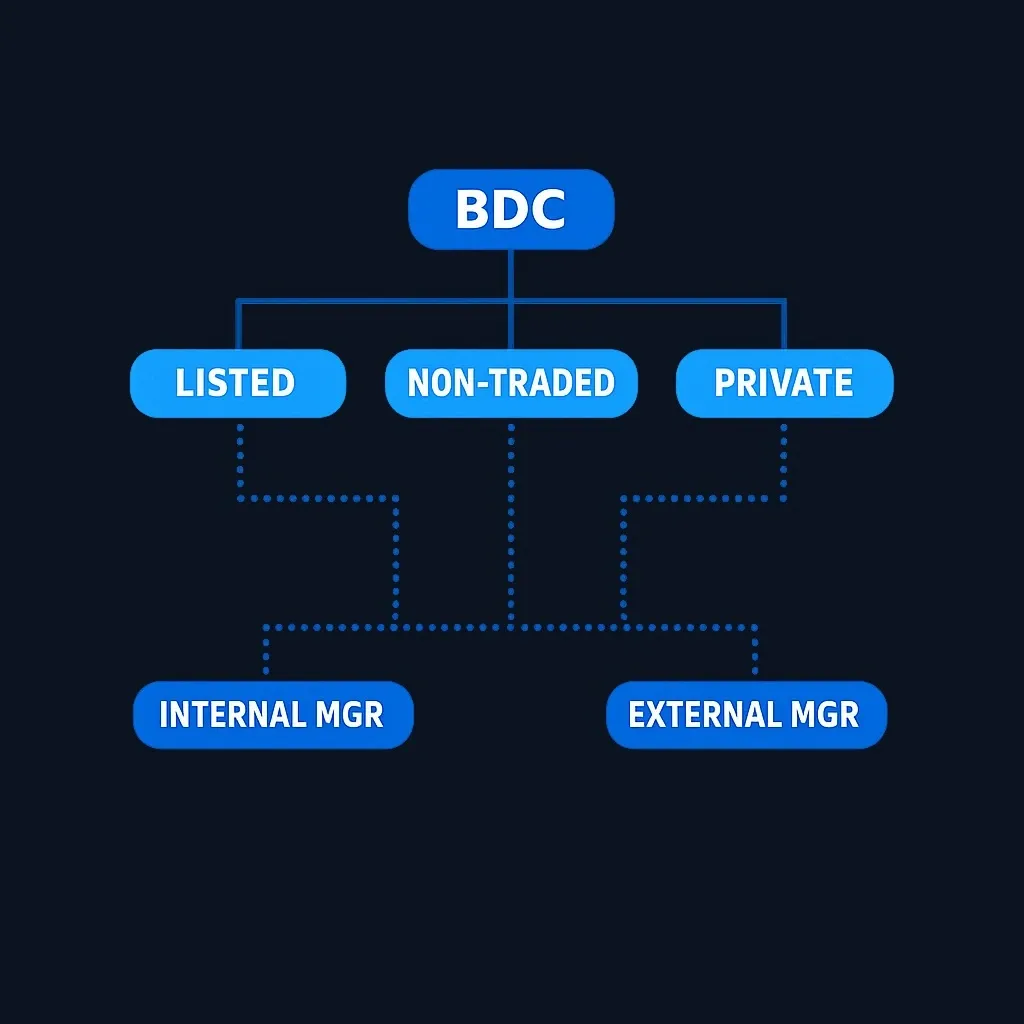
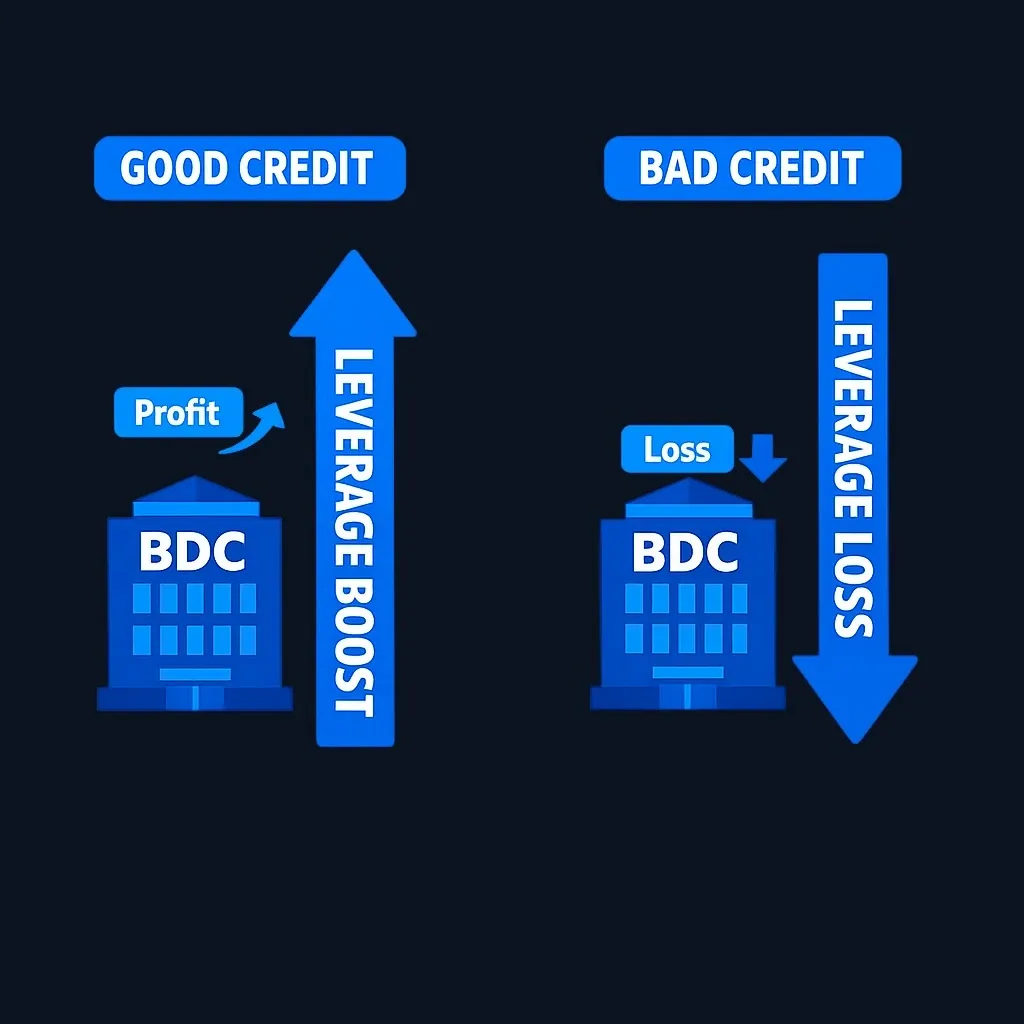
BDCs come in three common forms: listed (publicly traded), non‑traded, and private. Each form can have different liquidity, disclosure, and investor-eligibility rules. A BDC may be internally managed, with employees on its payroll, or externally managed, with an adviser receiving management and incentive fees. Capital sources include public equity, private placements, and debt. Some BDCs use leverage, which can amplify both gains and losses. Manager alignment and fee formulas vary, so check the specific offering documents.
Benefits of Investing in BDCs
- Retail access to private‑market strategies: Publicly traded BDCs give investors exchange-based access to private credit and equity investments that might otherwise be difficult to reach.
- Income orientation: Many BDCs emphasize regular distributions sourced from interest and dividend income generated by their portfolios.
- Diversification: BDCs invest in smaller or privately negotiated deals that may have different cyclical drivers than large‑cap public equities.
Practical tip: assess an individual BDC’s dividend policy, portfolio credit quality, leverage policy, and recent cash‑flow disclosures to judge distribution sustainability.
Risks Associated with BDC Investments
- Credit and economic sensitivity: BDC portfolios often include loans to smaller companies that can default or underperform during downturns.
- Liquidity and suitability differences: Listed BDCs trade on exchanges; non‑traded and private BDCs may have resale restrictions and investor-eligibility requirements.
- Leverage amplification: use of debt increases both potential gains and losses; check a BDC’s leverage policy in its filings.
- Manager and concentration risk: concentrated portfolios or aggressive incentive fees can magnify downside if a few credits deteriorate.
Review the prospectus or offering memorandum for specific risk disclosures and recent portfolio details before making a decision.
Comparative Analysis: BDCs vs. Traditional Private Equity Funds
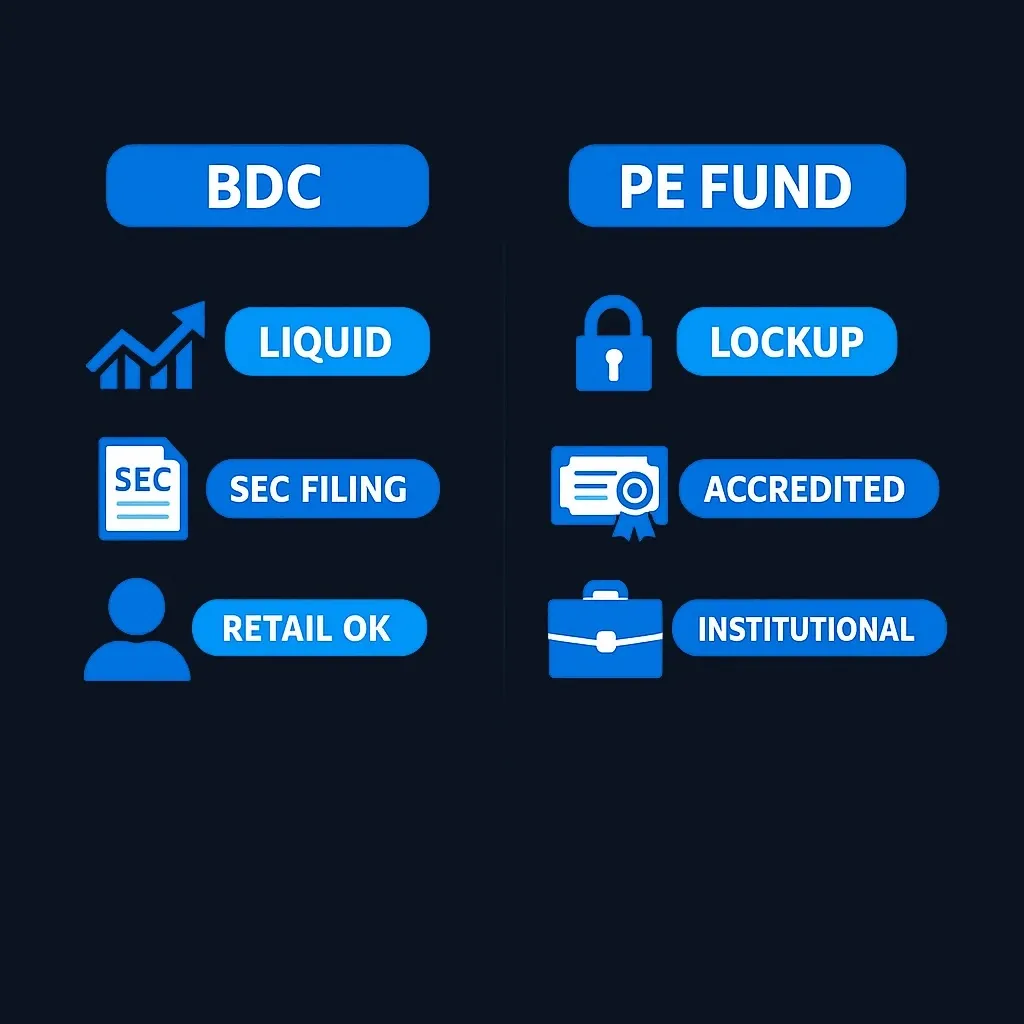
Use this compact comparison to see where BDCs and traditional private equity (PE) funds commonly differ. Confirm specifics in each fund’s documents.
| Attribute | Typical BDC (listed / non‑traded / private) | Typical Traditional Private Equity Fund |
|---|---|---|
| Investor access | Publicly listed BDCs trade on exchanges; non‑traded and private BDCs can be subject to eligibility and distribution restrictions. | Generally limited to accredited or institutional investors via private placements. |
| Liquidity | Listed BDCs provide secondary‑market liquidity; non‑traded and private BDCs may have resale limits. | Long lockups and limited secondary markets are common for PE funds. |
| Regulation & disclosure | Registered closed‑end funds with SEC reporting obligations for listed BDCs BDCs are a type of closed‑end investment fund. | Operate under private placement exemptions with limited public disclosure. |
| Investment focus | Often private credit, mezzanine, and growth investments in smaller firms; many BDCs provide managerial assistance to portfolio companies. | Typically pursue control buyouts, operational turnarounds, or growth equity across a broader company size range. |
How to use the table: a reader comparing the two structures can use liquidity, eligibility, disclosure, fees, and strategy as starting points, then verify the terms of the specific investment.
Practice investing with Finelo
Build practical investing skills with guided lessons, simulator practice, and structured challenges.
Current Trends and Future Outlook for BDCs
Many BDCs focus on private-credit strategies, making their results sensitive to credit spreads, borrower quality, and the small-business cycle. When credit conditions tighten, leveraged private-credit portfolios can experience higher defaults or volatility. Review current portfolio composition, non-accruals, leverage, and management commentary rather than relying on a general industry trend.
Practical observation: track a BDC’s sector mix, weighted‑average maturities, and underwriting standards in investor presentations and filings to assess cycle sensitivity.
Decision framework
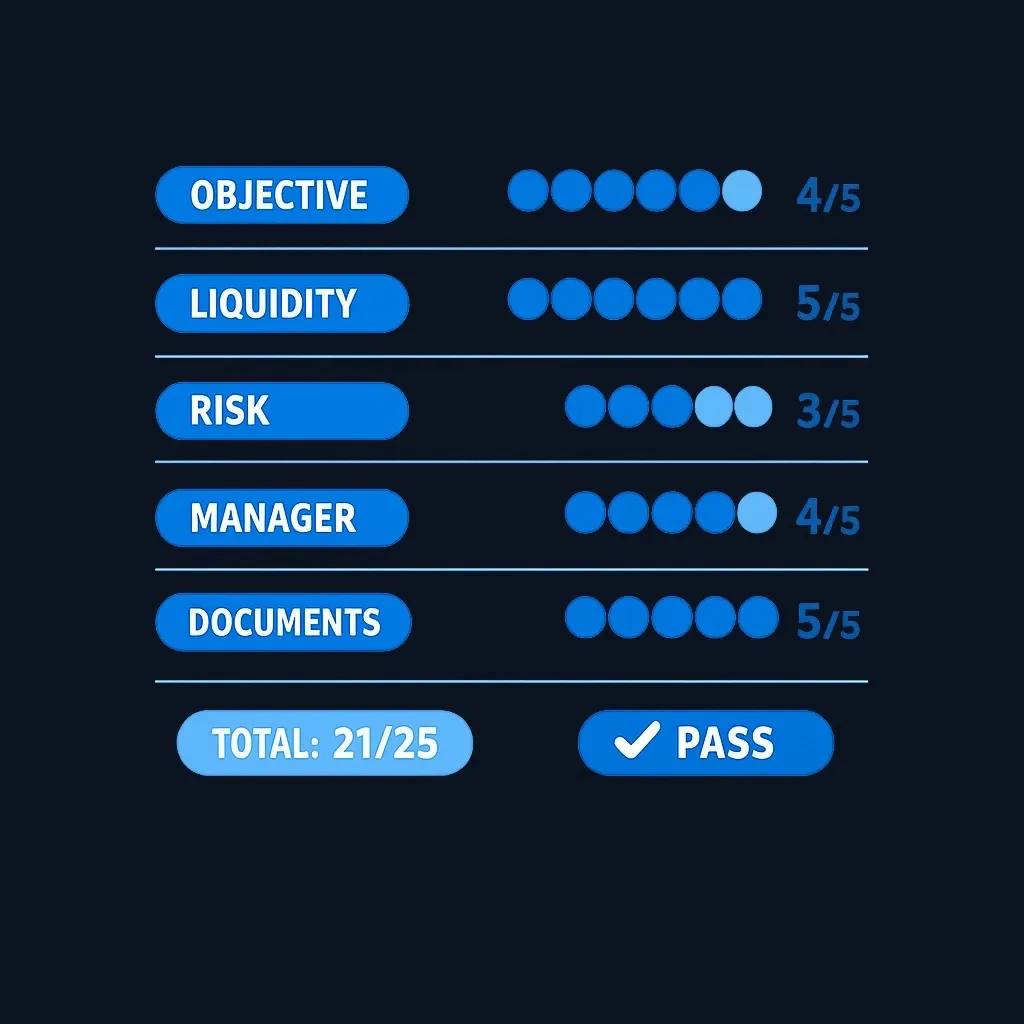
Use this checklist and simple scoring method to decide whether a BDC fits your goals.
- Objective match (Income, growth, private‑market access) — score 1–5.
- Liquidity needs (need tradable shares vs. tolerate lockups) — score 1–5.
- Risk tolerance (credit/default, leverage, concentration) — score 1–5.
- Manager quality and alignment (track record, fees, insider ownership) — score 1–5.
- Document review (recent SEC filings, prospectus, PPM: portfolio, leverage, fees) — score 1–5.
- Valuation/price signal (for listed BDCs, compare market price to reported NAV and recent discount/premium behavior).
Worked example: suppose an investor wants steady income and can tolerate share‑price swings. They might set minimums: Objective ≥4, Liquidity ≥4, Risk Tolerance ≥3, Manager ≥4, Documents ≥4. An evaluated BDC that scores 21 of 25 would pass that investor’s threshold. This framework forces document checks and objective tradeoffs rather than relying on headlines.
Practical mistakes to avoid
- Don’t skip the prospectus — fee formulas, incentive structures, and leverage policies live in legal documents.
- Don’t assume all BDCs act the same — listed, non‑traded, and private structures can differ substantially.
- Don’t ignore manager incentives — external managers with high incentive fees may pursue riskier strategies to earn performance fees.
If you need a repeatable comparison, make a spreadsheet that captures: dividend yield, recent coverage ratio or distributable cash, leverage ratio, top 10 holdings, manager fees, and market price vs. NAV.
FAQ
What is a Business Development Company (BDC)?
A BDC is a type of closed‑end investment fund created to invest in and provide support to smaller or growing companies; many BDCs are publicly traded and subject to SEC reporting BDCs are a type of closed‑end investment fund.
How do BDCs operate?
BDCs raise capital from investors and deploy it into debt and equity of smaller firms. They may provide managerial assistance, and they can be internally or externally managed. Listed, non‑traded, and private structures have different liquidity, disclosure, and eligibility considerations.
What are the benefits of investing in BDCs?
Publicly traded BDCs can offer retail investors exposure to private-market credit and equity, and many target regular distributions. Distributions are not guaranteed, and concentration, credit, leverage, and fee risks vary by company.
How do BDCs differ from private equity funds?
Key differences include investor access, liquidity, and disclosure. Listed BDCs trade publicly, while private equity funds typically require accredited or institutional investors and impose multi-year lockups. Public BDCs also have SEC reporting obligations; Investor.gov provides an overview of the structure and its risks.
Practical next step: pick one BDC you’re interested in, download its most recent prospectus and SEC filings, and score it using the Decision framework above to see whether it fits your objectives. For more educational guides and comparison tools, visit Finelo’s learning hub.
Sources and Further Verification
More from Finelo
- Art Investing for Beginners: Costs, Liquidity, Valuation, and Risks
- Crypto Staking for Beginners: How It Works, Costs, Rewards, and Risks
- Currency-Hedged ETFs: Costs, Risks, and When Hedging May Fit
Disclaimer
This article is provided by Finelo for educational and informational purposes only. Finelo does not provide financial, investment, tax, legal, or insurance advice. Consider your circumstances and consult an appropriately qualified professional before making financial decisions.
InvestingBeginner GuideFinancial Education
Practice investing with Finelo
Build practical investing skills with guided lessons, simulator practice, and structured challenges.
About the author
Finelo Team
The Finelo Team creates practical investing and trading education designed to help beginners learn faster with structured challenges, simulator practice, and bite-sized lessons.
Keep reading — Related articles

Investing
Yield to Call vs Yield to Maturity: Assumptions and Bond Risks
Yield to call (YTC) estimates a bond's yield if the issuer redeems it on an eligible call date; yield to maturity (YTM) estimates yield if it remains outstanding to final maturity.
Finelo Team

Investing
Will My Employer Know If I Take a 401(k) Loan?
Who this page is for: readers new to 401(k) loans who want a practical, privacy‑focused explanation — what your employer can see, how to limit visibility, and the financial tradeoffs to weigh.
Finelo Team

Investing
What Medical Expenses Qualify for a 401(k) Hardship Withdrawal?
Before you decide, confirm three things with your plan administrator:
Finelo Team


