For U.S. readers: This article discusses U.S. rules and financial products. State rules and individual eligibility may differ.
Yield to Call vs Yield to Maturity: Assumptions and Bond Risks
Yield to call (YTC) estimates a bond's yield if the issuer redeems it on an eligible call date; yield to maturity (YTM) estimates yield if it remains outstanding to final maturity.
8 min read
Practice investing with Finelo
Build practical investing skills with guided lessons, simulator practice, and structured challenges.
Want to learn more?
Build practical investing skills with guided lessons, simulator practice, and structured challenges.
Explore FineloExplore Finelo's 28-day challenges
Turn learning into a daily habit with guided challenge paths.
Quick answer
Yield to call (YTC) estimates a bond's yield if the issuer redeems it on an eligible call date; yield to maturity (YTM) estimates yield if it remains outstanding to final maturity. For a callable bond, compare the applicable yield scenarios and the prospectus terms rather than assuming one redemption date. Both measures rely on reinvestment and cash-flow assumptions. Finelo provides financial education, not financial or investment advice. FINRA
Quick comparison answer
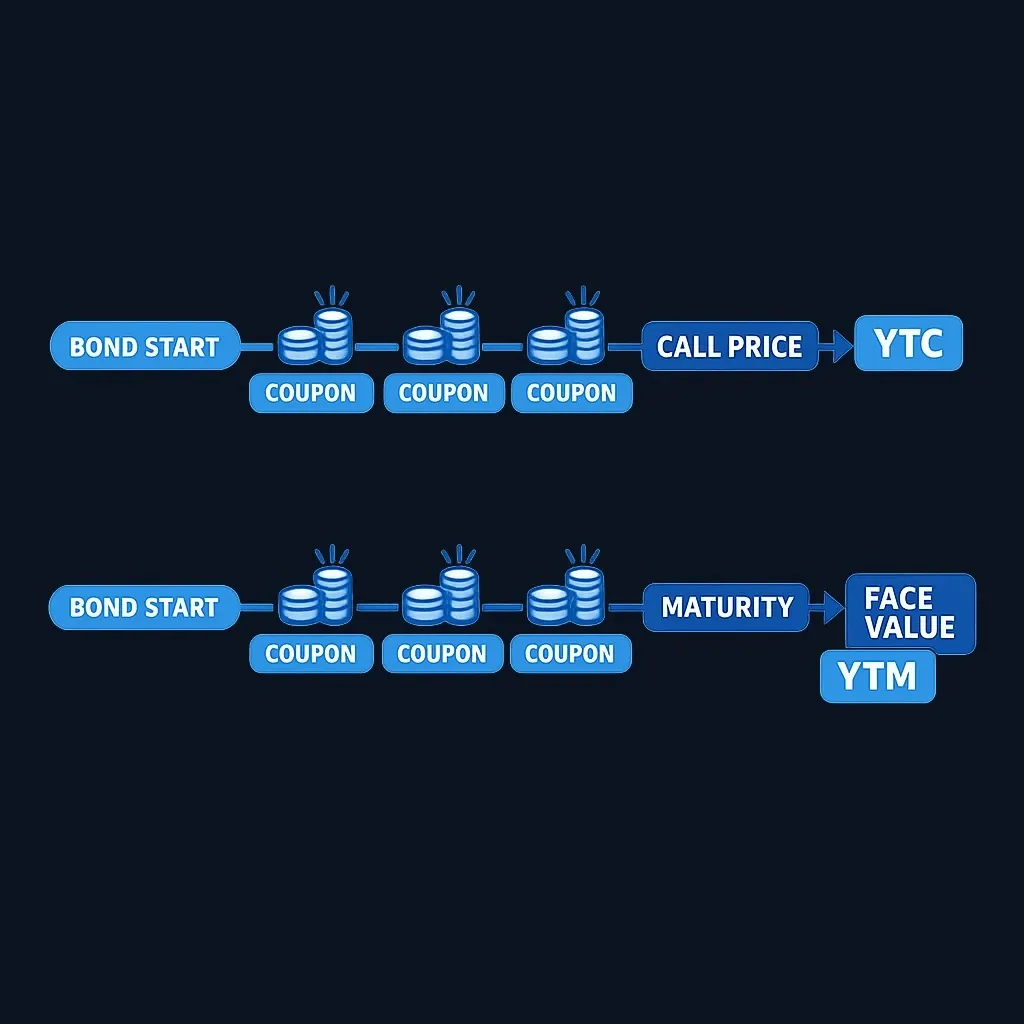
This section gives a concise decision frame: YTC assumes the bond stops at the call date and uses the call price and call date; YTM assumes the bond runs to its scheduled maturity and uses face value and maturity date. These two metrics answer different questions about expected annualized return under competing assumptions, so pick the metric that matches the credible outcome you want to evaluate. For definitions that list both terms among common yield measures, see FINRA’s overview of bond yields and returns.
Educational note: This page is educational, not investment advice. Investing can involve loss; assess suitability, time horizon, taxes, and reinvestment risk before acting.
Side-by-side comparison table
| Criterion | Yield to Call (YTC) | Yield to Maturity (YTM) |
|---|---|---|
| Primary question answered | What annualized return do I get if the issuer calls the bond at the call date and price? | What annualized return do I get if I hold the bond until final maturity and receive face value? |
| When to compute it | Callable bonds where early redemption is possible or likely | All bonds; especially noncallable bonds or callable bonds judged unlikely to be called |
| Inputs used | Current price, coupon cash flows up to call date, call price, time to call | Current price, coupon cash flows through maturity, face (par) value, time to maturity |
| Core assumption | Issuer redeems on the call date at the stated call price | No early redemption; bond runs full term |
| Use in decision-making | Stress-test the “called” scenario and compare with reinvestment options | Baseline return assuming no early redemption; common benchmark |
| Where to learn standard definitions | See FINRA’s investor primer on bond yields and returns. | See FINRA’s investor primer on bond yields and returns. |
Notes on the table: the rows describe conceptual differences and the core inputs; for worked formulas or numerical solutions you solve for the discount rate that sets present value of cash flows equal to price (use a financial calculator or spreadsheet).
Decision criteria
Use the following checklist to decide which metric to compute and compare.
-
Is the bond callable? — If no, YTM is the relevant single-rate metric. If yes, compute YTC as well as YTM to see how much early-call risk matters. (Definitions of yield-to-call and yield-to-maturity are grouped in FINRA’s yield primer.)
-
What is the call schedule and call price? — A short call window or a call price close to par makes the called outcome more material. If the call date is far away and the call price very unfavorable to the issuer, the bond is less likely to be called.
-
Interest-rate environment and issuer incentives — If market rates drop below the bond's coupon, issuers may have an incentive to refinance, increasing call risk. If rates rise, a call may be less attractive. FINRA explains both call risk and the inverse relationship between bond prices and market rates in its bond investor guide.
-
Investment horizon and reinvestment plans — If you plan to reinvest proceeds at current market rates, compare the post-call reinvestment alternatives. YTC reflects only cash flows to the call date; it does not guarantee you can reinvest coupons at the same rate.
-
Yield-to-worst and conservative planning — For callable issues, also check yield-to-worst (the lowest yield under any permitted early redemption); FINRA lists yield-to-worst among common yield measures to consider.
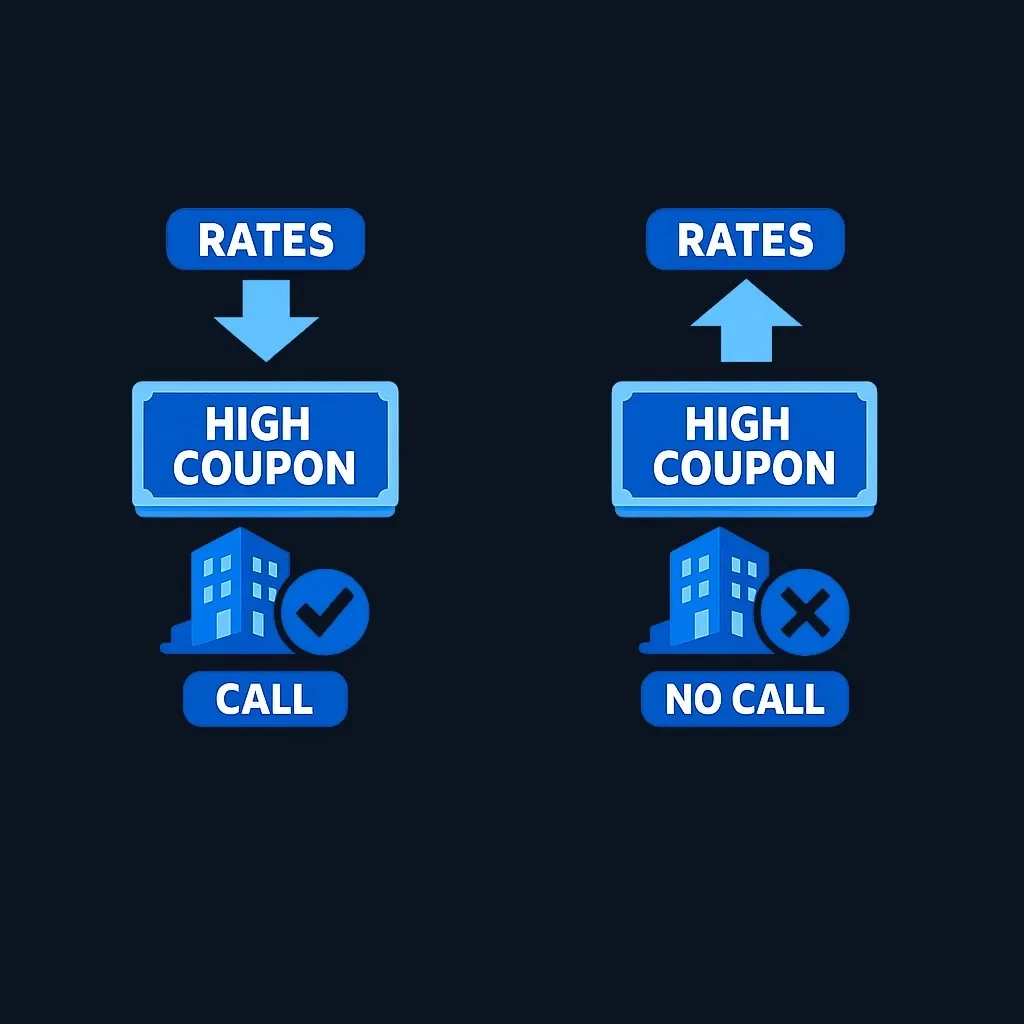
How to apply the checklist: compute YTM and YTC, then ask whether the call scenario is credible given the issuer and market. If the call scenario is plausible and materially lowers your yield, treat YTC (or yield-to-worst) as the conservative planning metric.
Practice investing with Finelo
Build practical investing skills with guided lessons, simulator practice, and structured challenges.
When to choose each option
Practically, use these guidelines tied to investor goals and bond attributes.
-
Prefer YTC when:
- The bond is callable and market/issuer conditions make early redemption plausible.
- You need a conservative estimate of return that recognizes the issuer’s right to repay early.
- You are comparing a callable bond priced above par (premium bonds are more often called because issuers can refinance at lower rates).
-
Prefer YTM when:
- The bond is noncallable or callability is unlikely for the expected horizon.
- You want the baseline return assuming no early redemption, especially for long-term planning.
- You are comparing noncallable issues or constructing buy-and-hold models.
Decision framework (quick): Is the bond callable? If no → use YTM. If yes → ask “is a call likely given coupon vs market rates and call terms?” If likely → use YTC or yield-to-worst; if unlikely → YTM may still be appropriate.
Hypothetical examples
Below are compact scenarios showing how to apply the framework without numeric fabrication.
-
Short call window, high coupon vs market: A callable bond issued several years ago carries a coupon well above current market rates and has an upcoming call date. The issuer can lower its interest expense by calling and refinancing, so compute YTC to see the conservative yield and compare reinvestment options.
-
Long call protection, coupon near market: A bond has long call protection and a coupon close to current yield levels. Even though callable, the long call protection period reduces the realistic chance of an early call; weigh YTM more heavily but check YTC at the earliest permitted call date.
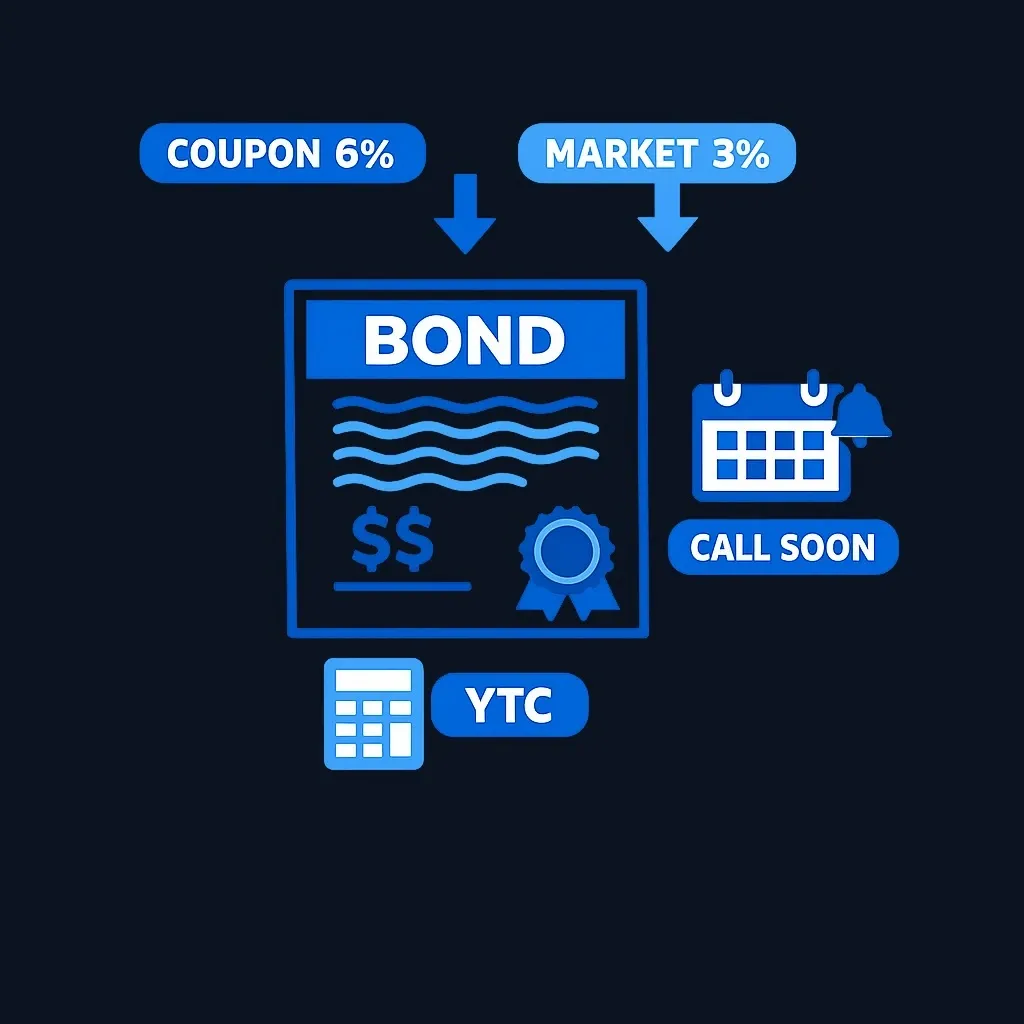
For terminology and standard yield measures, FINRA’s primer lists yield-to-call among commonly used yield metrics.
Tradeoffs and caveats
Three practical tradeoffs to watch.
-
Reinvestment risk vs call risk — YTC truncates the timeline and may force reinvestment sooner than planned; YTM assumes coupons are reinvested at the internal rate you solved for, which may be optimistic. Neither metric guarantees future reinvestment rates.
-
Conservative planning: yield-to-worst — For callable bonds, a conservative investor often compares YTM, YTC, and yield-to-worst (the lowest among feasible redemption scenarios) to see downside yield outcomes; this conservative view is recommended in investor education materials.
-
Price sensitivity and convexity — Shorter cash-flow horizons (as in a call) generally reduce interest-rate sensitivity for that scenario. That reduces price volatility under the called outcome but shifts the investor’s exposure to reinvestment-rate variability.
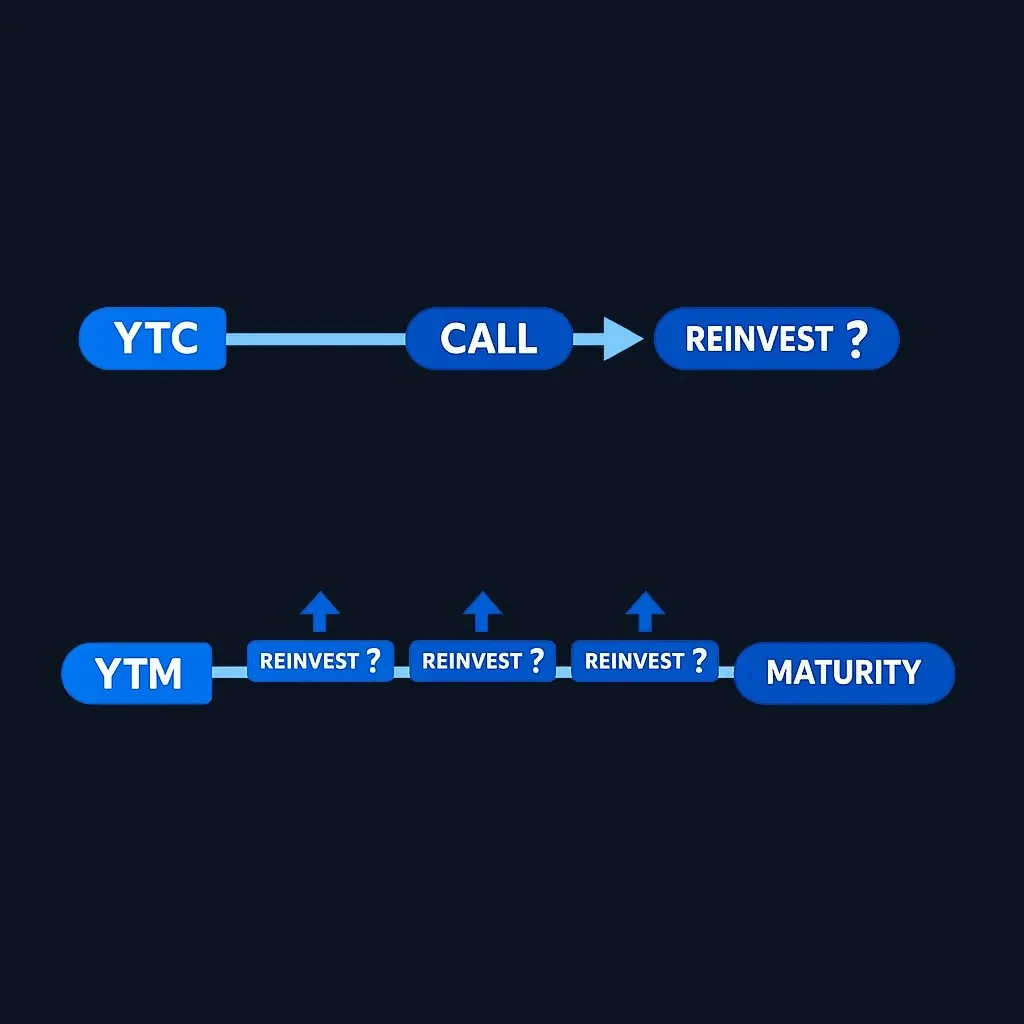
Market-rate reminder: bond prices and yields generally move inversely; as market yields rise, existing fixed-rate bond prices generally fall, and vice versa. This relationship affects call incentives but does not predict whether an issuer will exercise a specific call option.
Practical mistakes and how to avoid them
- Mistake: Using YTM alone for a deeply callable premium bond. Fix: Compute YTC and yield-to-worst to capture downside scenarios.
- Mistake: Forgetting call schedules and call prices. Fix: Read the bond’s prospectus or official statement to find exact call terms before relying on any yield metric.
- Mistake: Treating YTC/YTM as guaranteed realized returns. Fix: Treat them as yield metrics under alternate assumptions, not guarantees of future earned return.
FAQ
What is yield to maturity (YTM)?
YTM is the single internal rate of return that discounts all scheduled coupon payments and the repayment of principal at maturity to the bond’s current price. It assumes you hold the bond to final maturity and reinvest coupons at the same rate implicit in that calculation; see FINRA for yield definitions.
How is yield to call (YTC) calculated?
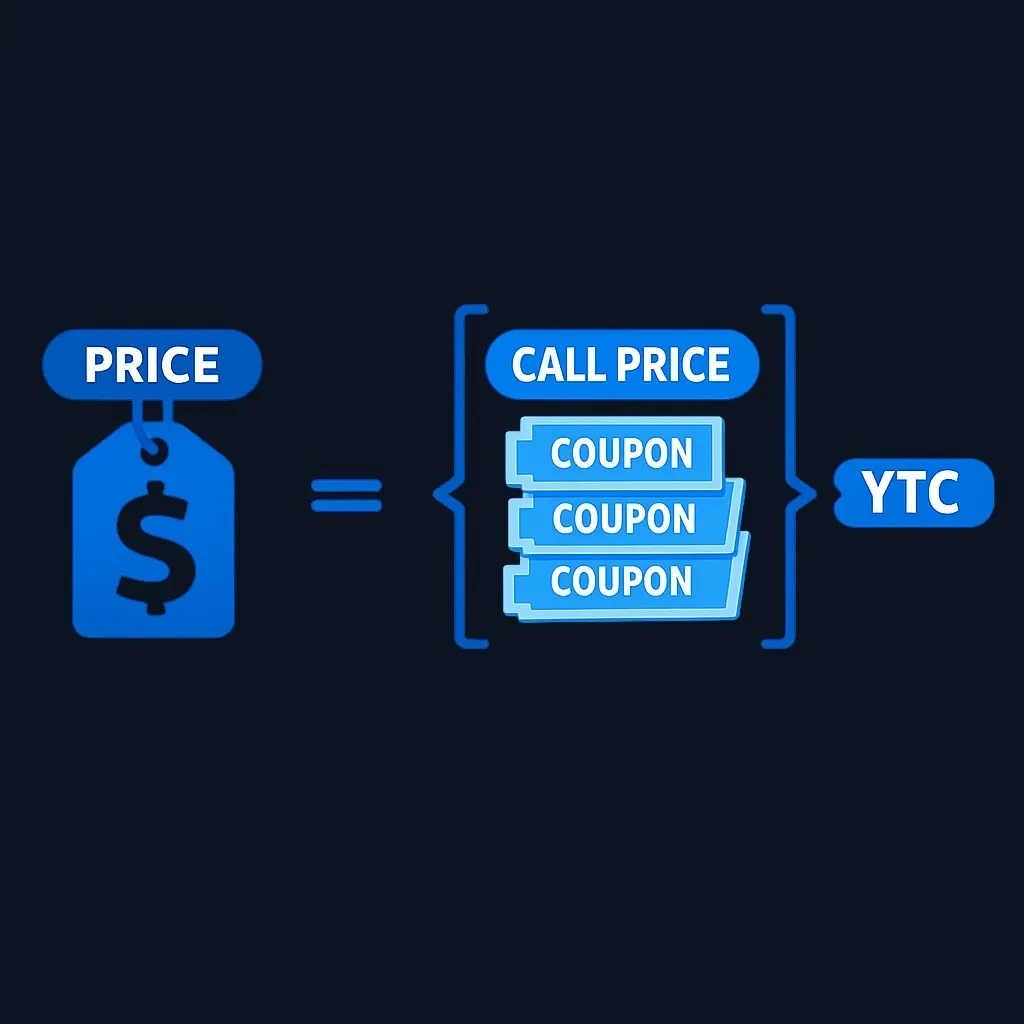
YTC is calculated like YTM but uses cash flows only up to the bond’s call date and uses the call price instead of par at final maturity. Practically, you solve for the discount rate that equates the present value of coupons through the call date plus the call price to the current market price. FINRA lists YTC among common yield measures investors should consider.
What are callable bonds and why do issuers call them?
A callable bond gives the issuer the contractual right to repay the bond before its stated maturity under the dates, prices, and notice terms in the offering documents. Falling market rates can increase the issuer's refinancing incentive, but the contractual terms and issuer decision control the outcome.
Why do bond prices fall when interest rates rise?
When market interest rates rise, newly issued bonds may offer higher yields, which can reduce the market value of comparable existing fixed-rate bonds. FINRA describes this general inverse relationship while noting that credit quality, liquidity, maturity, and other features also affect price.
Conclusion
Yield to call and yield to maturity answer different planning questions. Use YTM as the baseline “held to maturity” return and use YTC (and yield-to-worst) to stress-test callable bonds and produce conservative return estimates. Always read the bond’s call provisions, compute both metrics for callable issues, and factor in reinvestment risk and current market rates before deciding.
Next step: if you want a hands-on exercise, compute both YTM and YTC for a callable bond using a spreadsheet IRR/RATE function and compare the two outcomes under realistic reinvestment assumptions. Learn more about fixed-income fundamentals at the Finelo Blog: Finelo Blog.
InvestingFinancial Education
Practice investing with Finelo
Build practical investing skills with guided lessons, simulator practice, and structured challenges.
About the author
Finelo Team
The Finelo Team creates practical investing and trading education designed to help beginners learn faster with structured challenges, simulator practice, and bite-sized lessons.
Keep reading — Related articles
Investing
Will My Employer Know If I Take a 401(k) Loan?
Who this page is for: readers new to 401(k) loans who want a practical, privacy‑focused explanation — what your employer can see, how to limit visibility, and the financial tradeoffs to weigh.
Finelo Team
Investing
What Medical Expenses Qualify for a 401(k) Hardship Withdrawal?
Before you decide, confirm three things with your plan administrator:
Finelo Team
Investing
Treasury Bills vs CDs: Rates, Taxes, Liquidity, and Risk
T‑bills are short‑term U.S. government securities sold at a discount and redeemed at face value; CDs are bank or credit‑union time deposits that pay a stated interest rate for a set term TreasuryDirect — FDIC.
Finelo Team