Quantitative easing (QE) is a monetary policy tool in which a central bank buys large amounts of longer-term securities to put downward pressure on long-term interest rates and stimulate the economy. It is generally considered when the central bank’s usual short-term policy rate has little room to fall. The Federal Reserve describes QE as a tool used when the federal funds rate is constrained by its effective lower bound, typically involving purchases of longer-term Treasury securities and agency mortgage-backed securities (Federal Reserve).
What is Quantitative Easing?
Quantitative easing (QE) is a monetary policy tool in which a central bank buys large amounts of longer-term securities to put downward pressure on long-term interest rates and stimulate the economy. It is generally…
5 min read
Practice trading with Finelo
Practice in a simulator, learn with bite-sized lessons, and build confidence before risking real money.
Want to learn more?
Practice in a simulator, learn with bite-sized lessons, and build confidence before risking real money.
Explore FineloExplore Finelo's 28-day challenges
Turn learning into a daily habit with guided challenge paths.
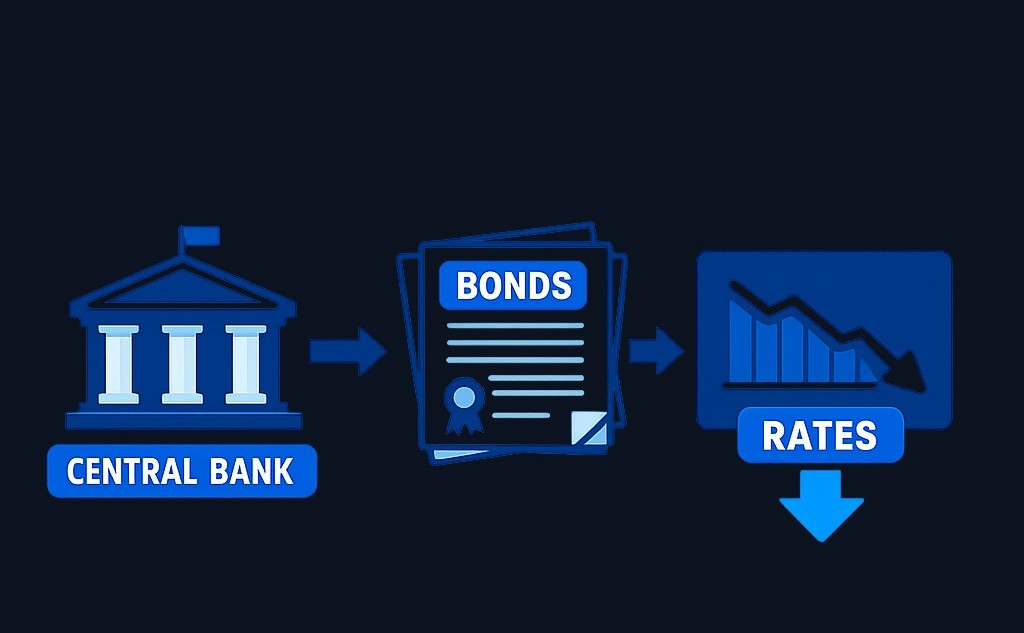
In plain English, QE aims to make financial conditions easier when an ordinary interest-rate cut may not be enough.
How quantitative easing works
Central banks do not simply hand newly created money to households. Under QE, a central bank purchases eligible securities in financial markets. That process changes the mix of assets held by investors: the central bank holds more securities, while sellers hold more liquid balances.
The intended chain of effects looks like this:
- The central bank purchases longer-term securities.
- Greater demand for those securities can raise their prices.
- Because bond prices and yields move in opposite directions, yields can decline.
- Lower benchmark yields may feed into broader borrowing costs and financial conditions.
- Easier conditions may encourage borrowing, investment and spending.
- Stronger demand may support economic activity and move inflation toward the central bank’s objective.
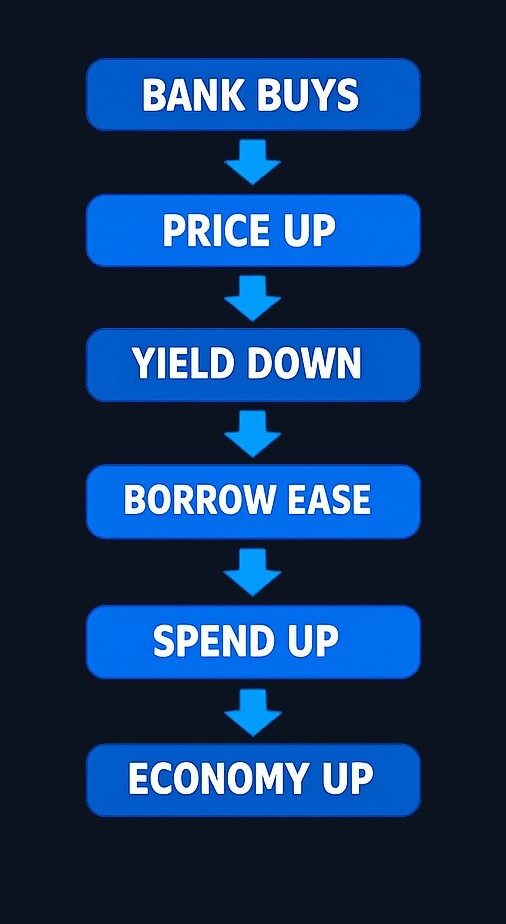
This is a transmission mechanism, not a guaranteed sequence. Banks, businesses and households may react differently depending on confidence, debt levels and the wider economy. QE can influence financial conditions, but it cannot force anyone to borrow, lend or spend.
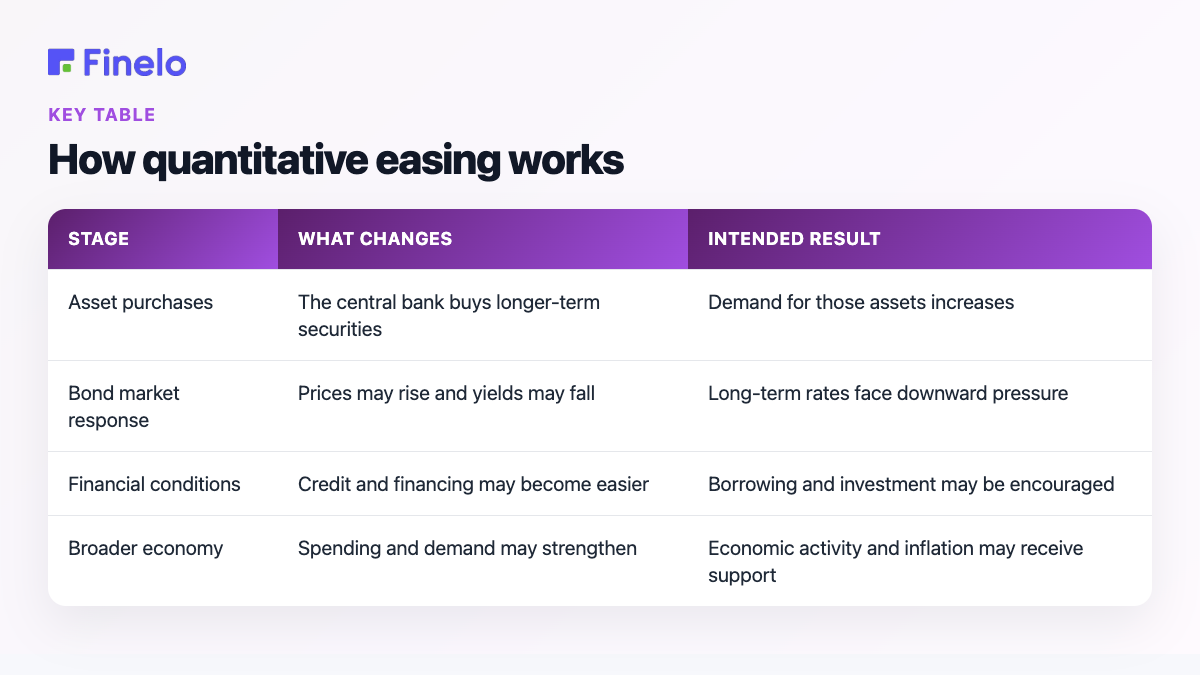
| Stage | What changes | Intended result |
|---|---|---|
| Asset purchases | The central bank buys longer-term securities | Demand for those assets increases |
| Bond market response | Prices may rise and yields may fall | Long-term rates face downward pressure |
| Financial conditions | Credit and financing may become easier | Borrowing and investment may be encouraged |
| Broader economy | Spending and demand may strengthen | Economic activity and inflation may receive support |
What is the purpose of quantitative easing?
The main purpose of QE is economic stimulus when conventional monetary policy is constrained. The Federal Reserve’s explanation identifies downward pressure on long-term interest rates as QE’s primary route for providing stimulus.
QE may be intended to:
- ease longer-term financial conditions;
- support the flow of credit;
- encourage spending and investment;
- reduce the risk of persistently weak demand;
- help a central bank pursue its economic objectives.
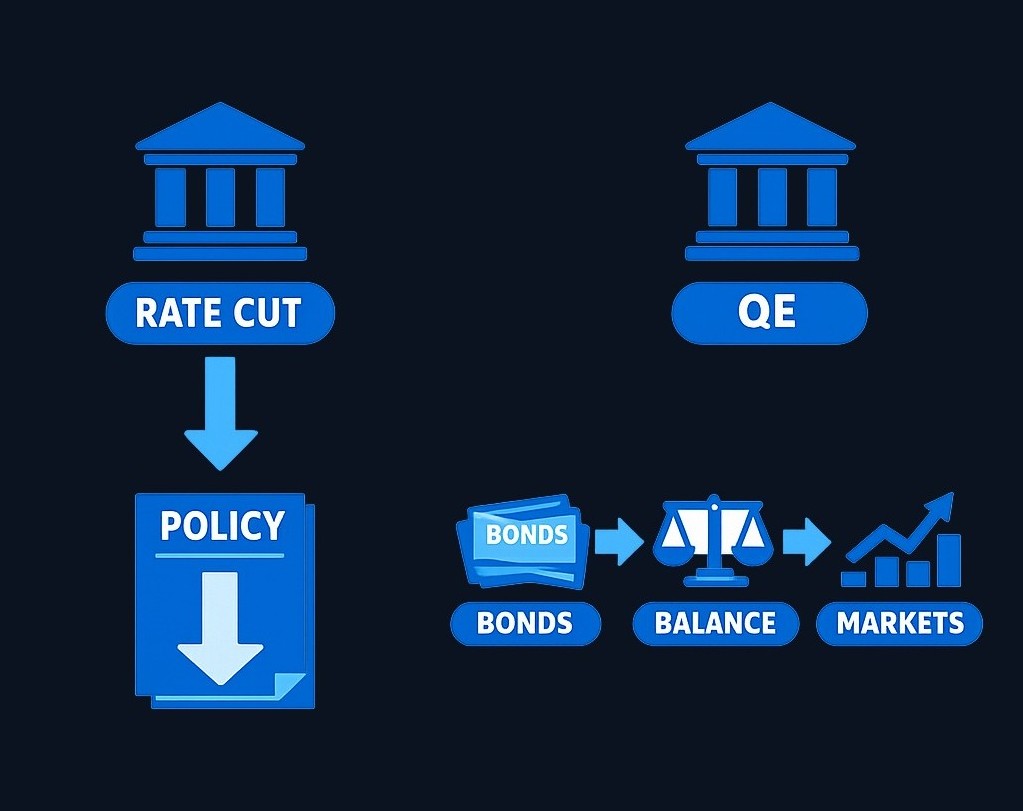
QE is therefore different from a routine cut in a short-term policy rate, even though both aim to make monetary policy more supportive. A rate cut changes the central bank’s policy rate directly. QE works through the central bank’s balance sheet and purchases of longer-term assets.
Benefits, limits and risks
The potential benefit of QE is that it gives a central bank another way to support the economy when short-term rates are already very low. By targeting longer-term financial conditions, it may reach borrowing costs that matter for businesses, housing and other long-lived investments.
However, QE involves important tradeoffs.
Asset prices may rise as investors adjust their portfolios, which can benefit people who already own financial or property assets more than those who do not. Cheaper financing does not necessarily reach every household or business equally. If demand strengthens too much relative to the economy’s ability to supply goods and services, inflation pressure may increase. Extended periods of easy financial conditions may also encourage excessive borrowing or risk-taking.
The long-term effects are difficult to isolate because QE is normally used when the economy is already under unusual stress. Outcomes depend on the scale and timing of purchases, expectations about future policy, the health of the financial system and how governments, businesses and consumers respond. It is safer to view QE as one influence on the economy rather than a switch that produces a fixed result.
Practice trading with Finelo
Practice in a simulator, learn with bite-sized lessons, and build confidence before risking real money.
How QE can affect savings, loans and investments
QE can affect personal finances indirectly through interest rates, asset prices, inflation and the labor market.
For savers, lower market interest rates may mean lower returns on some cash savings and newly issued fixed-income products. For borrowers, easier financial conditions may contribute to lower borrowing costs, although the rate an individual receives also depends on the lender, loan type, credit profile and market conditions.
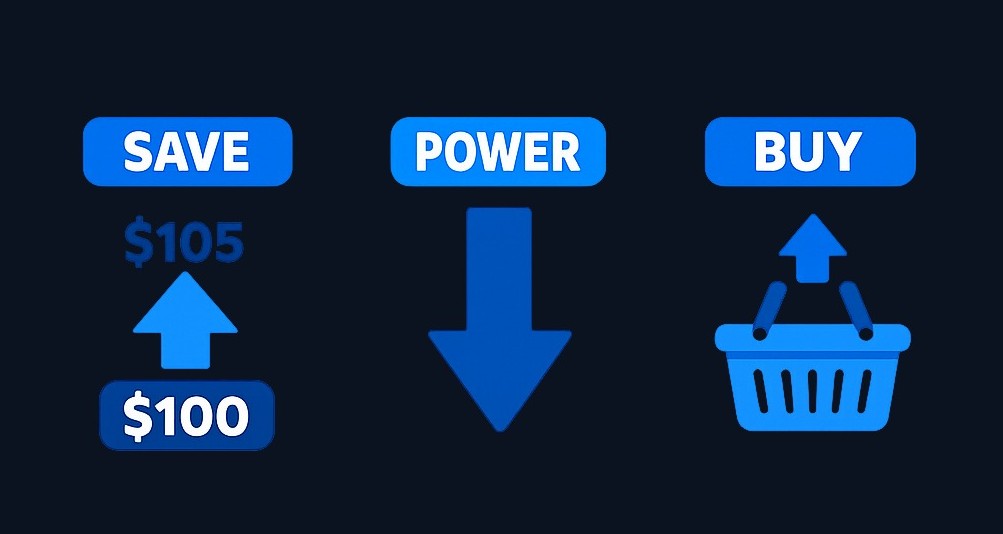
Investors may see changes in bond yields and asset valuations as portfolios adjust. But QE does not make any investment safe or ensure that prices will rise. Inflation also matters: even if the amount in a savings account grows, its purchasing power can fall when prices rise faster than the return earned.
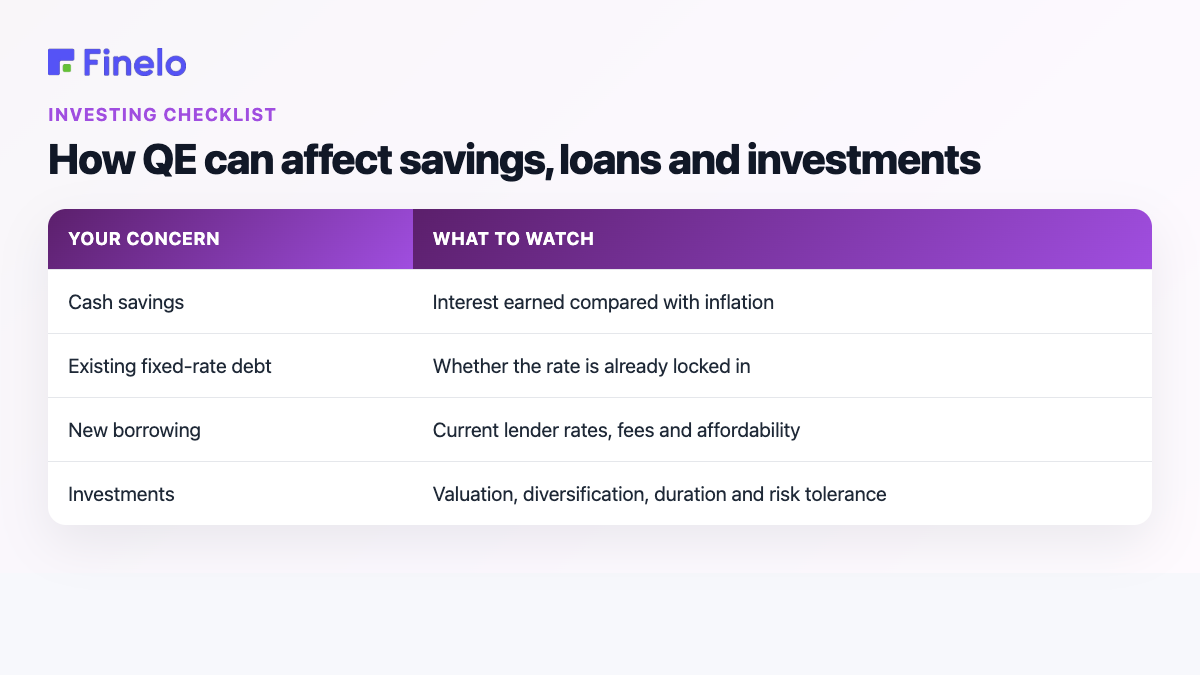
When assessing the personal impact, separate four questions:
| Your concern | What to watch |
|---|---|
| Cash savings | Interest earned compared with inflation |
| Existing fixed-rate debt | Whether the rate is already locked in |
| New borrowing | Current lender rates, fees and affordability |
| Investments | Valuation, diversification, duration and risk tolerance |
These are educational considerations, not a forecast or personalized financial advice.
Quantitative tightening: the reverse direction
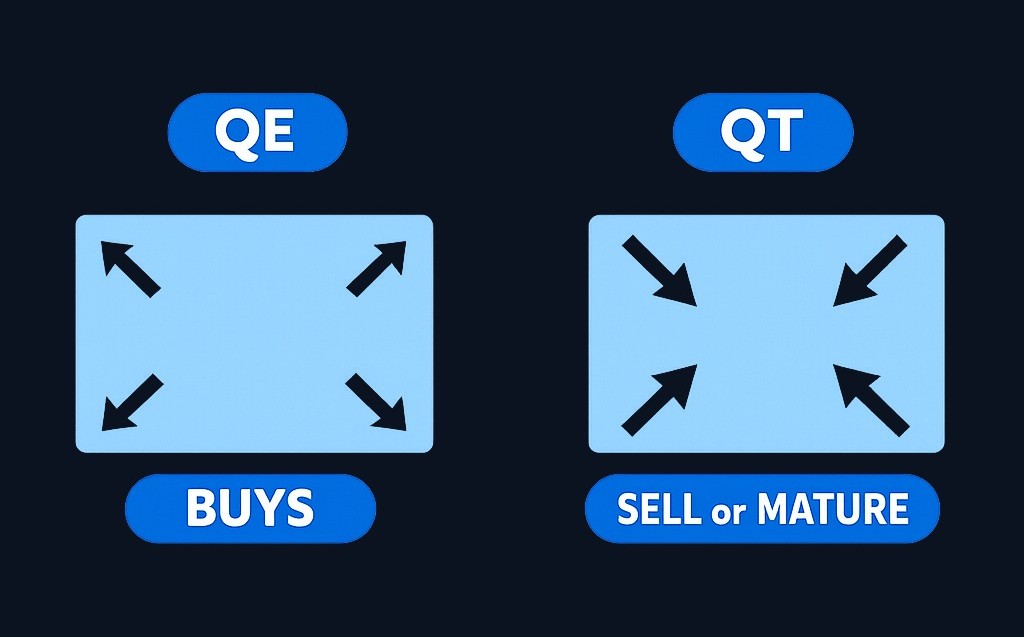
Quantitative tightening (QT) moves the central bank’s balance sheet in the opposite direction. Instead of adding to its holdings through QE, the central bank allows assets to mature without replacing all of them, sells assets, or uses a combination of both.
QE and QT should not be understood as perfectly symmetrical. The economy may be in a different condition when purchases are unwound, and markets may respond differently to gradual balance-sheet reduction than they did to the original purchases. QT can remove some monetary accommodation, but its effects depend on implementation and expectations.
It is also important not to label every central-bank asset purchase as QE. The Federal Reserve notes that reserve-management purchases and QE have distinct purposes and economic implications (Federal Reserve).
QE in different economies
The basic idea of QE can be applied in different countries, but programs need not use the same assets, scale or design. Those differences reflect each economy’s financial system, available securities, policy framework and circumstances.
This is why comparisons among the United States, the United Kingdom, the euro area or Japan require care. A program’s label alone does not establish what was purchased, why it was introduced or what effects followed. For any specific episode, check the relevant central bank’s announcement, balance-sheet information and explanation of its objectives before drawing conclusions.
The bottom line
The best short answer to “What is quantitative easing?” is this: QE is a central bank’s large-scale purchase of longer-term securities to lower long-term rates and provide economic stimulus when ordinary rate policy is constrained.
For beginners, the most useful next step is to follow the mechanism—asset purchases, bond yields, financial conditions and spending—while keeping the limits in view. QE may support an economy, but its effects are indirect, uneven and shaped by the circumstances in which it is used.
Frequently asked questions
Does quantitative easing mean printing money?
“Printing money” is an oversimplification. QE expands a central bank’s balance sheet through asset purchases and the creation of central-bank reserves. It is not the same as distributing physical banknotes to the public.
Can QE cause hyperinflation?
QE may contribute to inflation pressure if it helps demand grow faster than available supply, but hyperinflation is not an automatic result. Inflation outcomes depend on many forces, including expectations, production capacity, fiscal policy, credit creation and how quickly money circulates through the economy.
How quickly does QE affect the economy?
There is no fixed timetable. Financial markets may react quickly to an announcement, while changes in borrowing, spending, hiring and prices may take longer and may be difficult to separate from other events.
What should I do after learning about QE?
When QE is announced or discussed, look beyond the initial announcement. Identify the assets being purchased, the stated policy objective, the expected duration and the conditions for ending or reversing the program. Then consider how changes in rates and inflation could affect your savings, debts and investments without assuming a certain market outcome.
Financial LiteracyBeginnerStrategiesMonetary PolicyPersonal Finance
Practice trading with Finelo
Practice in a simulator, learn with bite-sized lessons, and build confidence before risking real money.
About the author
Finelo Team
The Finelo Team creates practical investing and trading education designed to help beginners learn faster with structured challenges, simulator practice, and bite-sized lessons.
Keep reading — Related articles

Financial Literacy
UGMA vs UTMA Accounts: Taxes, Control, and Which Fits Your Child
U.S. scope: This article discusses United States institutions, product conventions, and dollar examples unless stated otherwise. Rules can vary by state and provider and may change. The UK…
Finelo Team
Financial Literacy
Teaching Kids About Money by Age: A Practical Plan from 5 to 18
U.S. scope: This article discusses United States institutions, product conventions, and dollar examples unless stated otherwise. Rules can vary by state and provider and may change. The UK…
Finelo Team
Financial Literacy
Renting vs Buying a Home: The Break‑Even Math for Young Families
Neither renting nor buying is universally better — it’s a math problem plus a life question. Buying trades large up‑front and exit costs plus ongoing ownership expenses for equity,…
Finelo Team