GDP, or gross domestic product, is the total value of goods and services produced within a country during a given period. In plain language, it is a broad scorecard for the size and direction of an economy. The Federal…
•6 min read
Practice trading with Finelo
Practice in a simulator, learn with bite-sized lessons, and build confidence before risking real money.
GDP, or gross domestic product, is the total value of goods and services produced within a country during a given period. In plain language, it is a broad scorecard for the size and direction of an economy. The Federal Reserve describes GDP as a comprehensive measure of economic activity and monitors its changes as an indicator of overall economic health.
Explore Finelo's 28-day challenges
Turn learning into a daily habit with guided challenge paths.
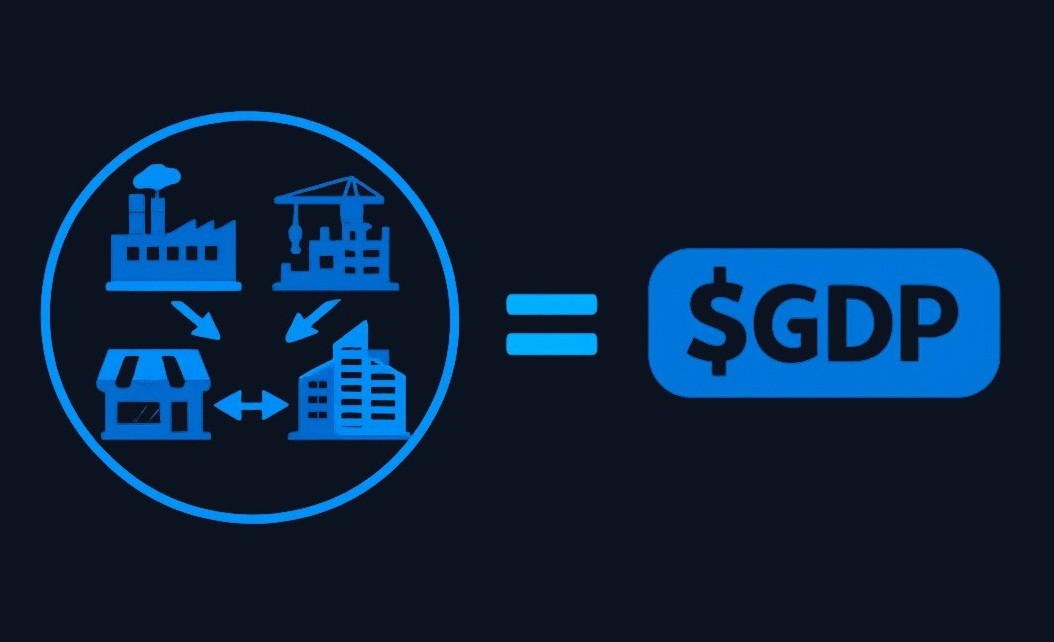
GDP measures the total value of all goods and services produced within a country's borders during a specific time period. It serves as a
This guide is for beginners who want to understand economic reports before using them as financial context. GDP is also useful to businesses and policymakers, but it is not a complete measure of prosperity. It shows whether production is expanding or shrinking. It does not show how income is distributed or how every household experiences that change.
Finelo treats the topic as financial education, uses official evidence for its core claims, and keeps a clear boundary between economic context and predictions about investment performance.
How is GDP Calculated?
Economists can approach GDP from three directions. The UK government’s GDP explainer identifies expenditure, income, and output measures and notes that, in theory, all three should produce the same total:
Production approach: Add the value created by producers across the economy. To avoid double counting, this focuses on value added at each stage rather than repeatedly counting the full value of intermediate goods.
Expenditure approach: Add spending on final goods and services. A common framework is GDP = C + I + G + (X − M), where C is household consumption, I is investment, G is government spending, X is exports, and M is imports.
Income approach: Add income generated through production, such as compensation and business income, together with the adjustments required by national accounting.
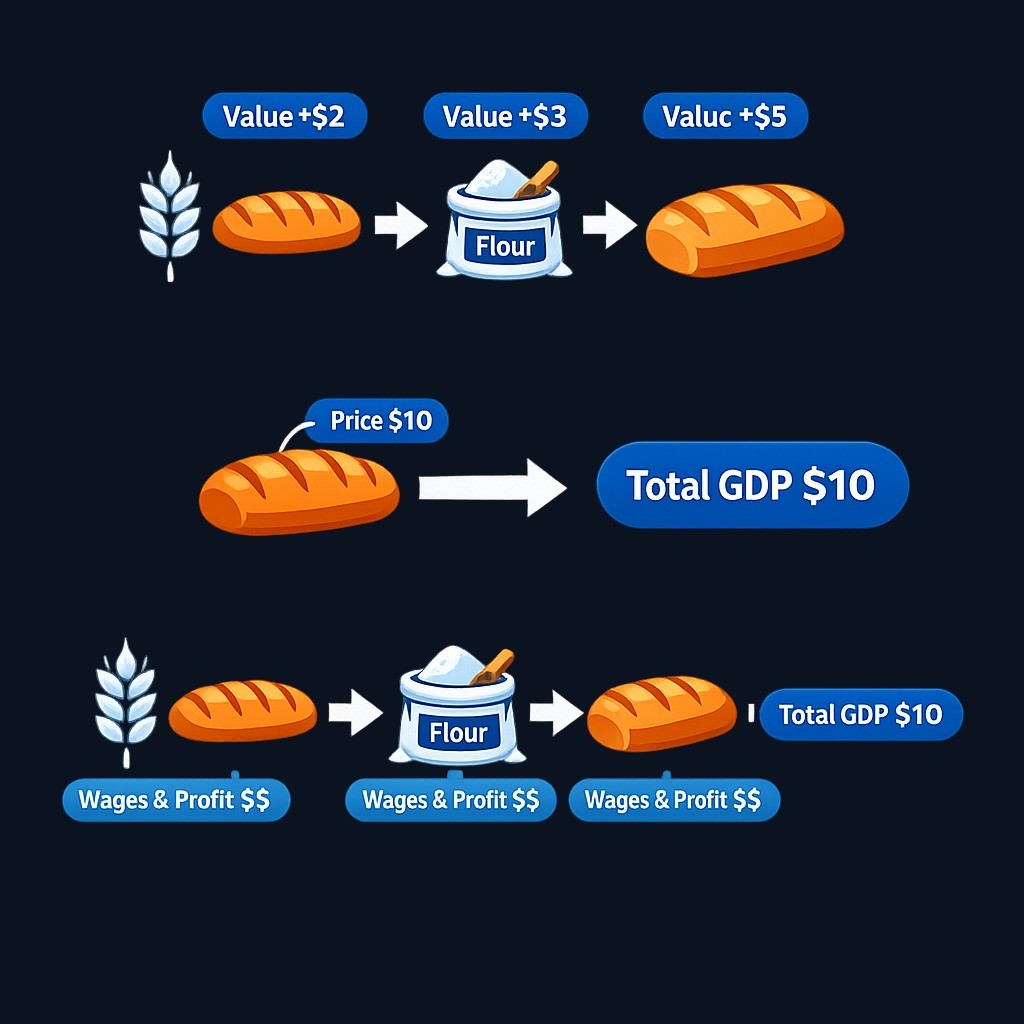
Consider a loaf of bread. Counting the grain, flour, and finished loaf at their full sale prices would count some production more than once. The production approach tracks the value added by the farmer, miller, and baker. The expenditure approach records the final loaf. The income approach records the income created during production.
The bread example shows how production, expenditure, and income approaches track the same economic activity. The production
GDP can also be viewed by sector. Agriculture, manufacturing, construction, and services each contribute value. A country may therefore record overall GDP growth even when one sector contracts, provided that expansion elsewhere is larger.
Nominal, real, and per-capita GDP
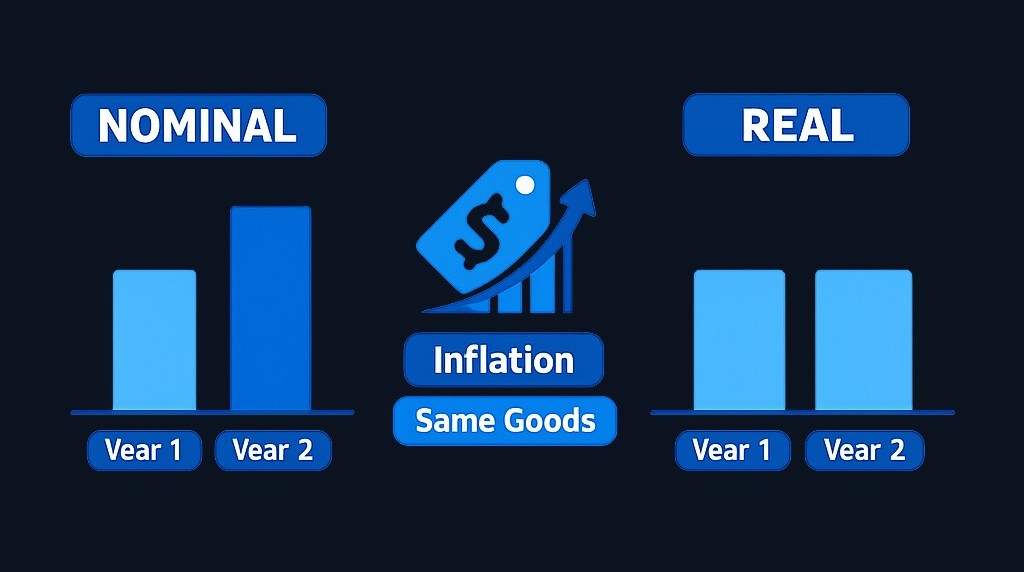
Nominal GDP values production at current prices. It can rise because an economy produces more, because prices increase, or because both occur. Real GDP accounts for changing prices to remove the effect of inflation, as explained in the GOV.UK guide to real and nominal GDP. GDP per capita divides GDP by the population and offers a rough view of average economic output per person.
For example, if spending rises only because prices increase, nominal GDP may grow while real production changes little. That distinction is why reports about “GDP growth” are clearer when they specify whether the figure is nominal or real.
When prices rise but production stays flat, nominal GDP increases while real GDP remains unchanged. Real GDP removes the inflation
The Importance of GDP
GDP helps readers organize several economic questions: Is overall production rising? Which spending categories or sectors are driving the change? Is growth still visible after accounting for price changes? Governments and central banks watch these patterns when assessing economic conditions, while businesses may consider them when planning hiring, investment, or inventory.
For households, GDP is background context rather than a personal forecast. Stronger output can coincide with more business activity. It does not guarantee that every worker’s pay, job security, or living standard will improve. A short-term decline also affects industries and households differently.
Distribution: Total output does not show who receives the resulting income. GDP may grow while gains remain concentrated.
Non-market activity: Unpaid household work and other activity without a market transaction may not appear in the total.
Quality of life: GDP does not directly measure health, leisure, safety, social connection, or life satisfaction.
Environmental costs: Production can add to GDP while also using natural resources or creating damage that the summary figure does not fully communicate.
Composition: The same GDP total can come from very different mixes of household consumption, investment, government activity, and trade.
The practical lesson is to read GDP alongside inflation, employment, household income, population, productivity, and broader well-being measures. No single indicator can answer every economic question.
Practice trading with Finelo
Practice in a simulator, learn with bite-sized lessons, and build confidence before risking real money.
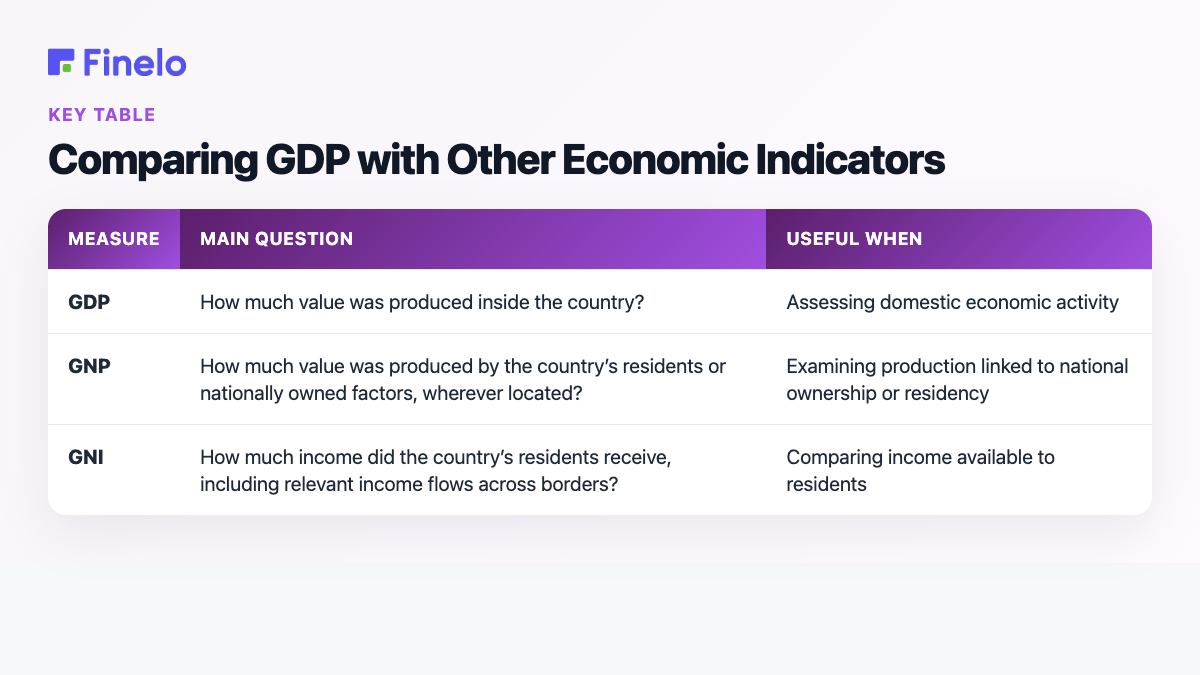
These measures are related, but their boundaries differ:
Measure
Main question
Useful when
GDP
How much value was produced inside the country?
Assessing domestic economic activity
GNP
How much value was produced by the country’s residents or nationally owned factors, wherever located?
Examining production linked to national ownership or residency
GNI
How much income did the country’s residents receive, including relevant income flows across borders?
Comparing income available to residents
Reference table from this guide — Comparing GDP with Other Economic Indicators.
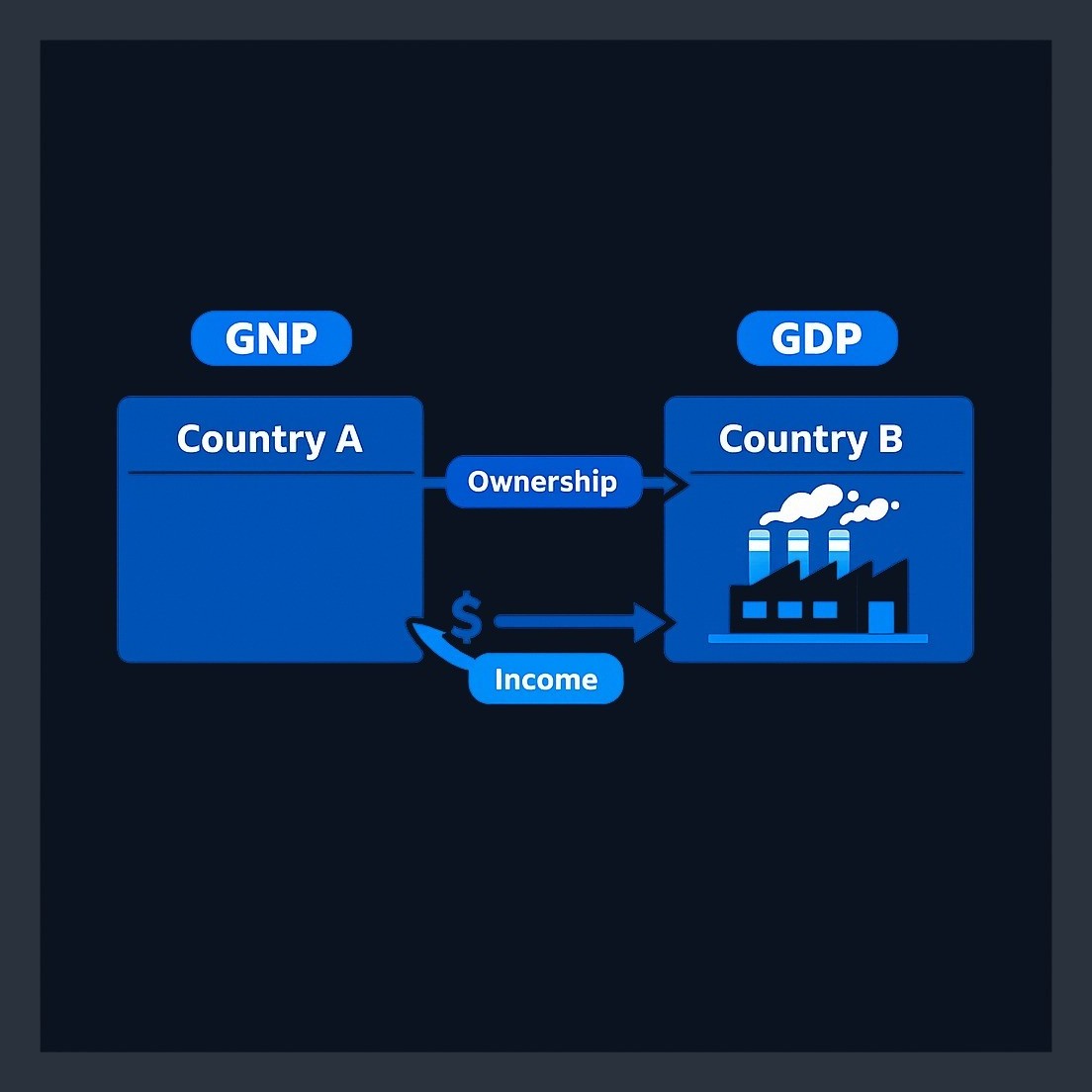
Imagine a company owned by residents of Country A operating a factory in Country B. The factory’s production is part of Country B’s GDP because it occurs there. The cross-border ownership and income flows become more relevant when interpreting GNP or GNI. In economies with substantial overseas investment or foreign-owned domestic production, the gap between these measures may be especially informative.
A factory in Country B owned by residents of Country A contributes to Country B's GDP (because production happens there) but affects Country A's GNP and GNI (because ownership and income flow back to Country A). This distinction matters most in economies with
Case Studies: GDP in Action
Real GDP can compare how economies recover from the same shock. A Federal Reserve analysis compared the United States with Canada, the euro area, and the United Kingdom after the COVID crisis. It found that U.S. real GDP had returned to its pre-pandemic trend, while the recovery in other advanced economies was weaker relative to their pre-pandemic trends. The case shows why the path of real GDP can be more informative than one reported reading.
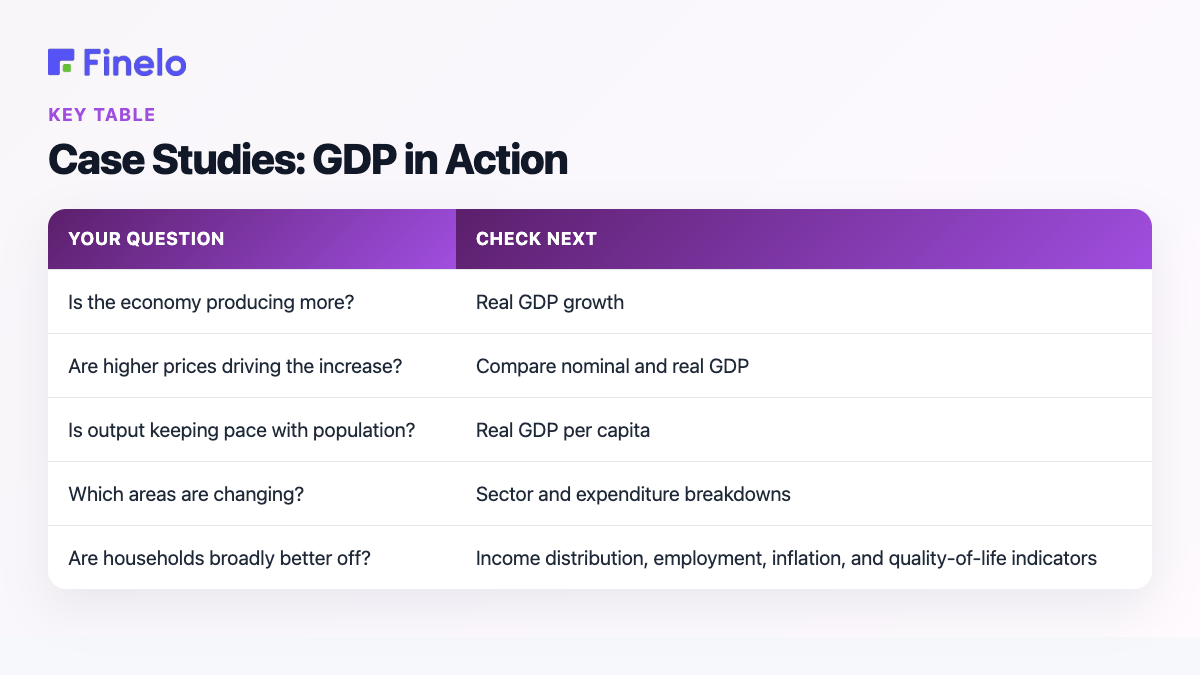
Use this framework when reading any GDP case:
Your question
Check next
Is the economy producing more?
Real GDP growth
Are higher prices driving the increase?
Compare nominal and real GDP
Is output keeping pace with population?
Real GDP per capita
Which areas are changing?
Sector and expenditure breakdowns
Are households broadly better off?
Income distribution, employment, inflation, and quality-of-life indicators
Reference table from this guide — Case Studies: GDP in Action.
Sector detail adds another layer. Suppose services expand while manufacturing contracts. Total GDP could still rise. Yet the result may feel different in a manufacturing region than in a city led by services. If population and prices also rise quickly, real GDP per person may improve less than the overall total suggests.
Future of GDP Measurement
Measurement can evolve as statistical agencies gain better data and refine how they capture changing forms of production. GDP’s main purpose remains measuring economic output. Its future value will also depend on complementary indicators. The European Commission’s “beyond GDP” work, for example, considers well-being, sustainability, social inclusion, and quality of life.
For financial education, the most useful development is not a more complicated statistic but a clearer dashboard. Ask whether reported growth is real or nominal, broad-based or concentrated, and whether output per person is also rising. Then compare the result with inflation, employment, and household income.
Your next step is to apply the decision table to the next GDP release you read. Check whether the number is real or nominal, total or per capita, and broad-based or driven by one sector.
One GDP release cannot establish what an investment will do next. Before making a financial decision, examine the asset, its risks and costs, and whether it fits your circumstances. Economic data can improve context. It cannot remove uncertainty or guarantee returns.
Frequently asked questions
What is the simplest definition of GDP?
GDP is the value of goods and services produced within a country over a particular period. It measures domestic production, not personal wealth or overall happiness.
Does a higher GDP mean everyone is richer?
No. A higher total indicates greater measured production, but it does not show how income is shared, how living costs changed, or whether every household benefited.
What is the difference between GDP growth and economic well-being?
GDP growth describes a change in measured output. Economic well-being is broader and can include income security, health, environmental conditions, leisure, and access to services.
What should I do after reading a GDP report?
Check whether the figure is real or nominal, compare it with the previous period and population growth, identify the sectors behind the change, and review inflation, employment, and income data before drawing conclusions. For investing decisions, treat GDP as educational context rather than a stand-alone signal, and consider your own risks, costs, and suitability.
The Finelo Team creates practical investing and trading education designed to help beginners learn faster with structured challenges, simulator practice, and bite-sized lessons.