The intrinsic value of a stock is an estimate of what one share is truly worth based on the company’s financial data, future prospects, and business fundamentals—not simply what the stock trades for today. In practical terms, you calculate intrinsic value by estimating future cash flows or dividends, discounting them back to today, and comparing that estimate with the current market price. Intrinsic value is commonly described as a stock’s worth independent of its current market price, based on financial analysis and other value-driving factors Interactive Brokers.
What is the Intrinsic Value of Its Stock?

The intrinsic value of a stock is an estimate of what one share is truly worth based on the company’s financial data, future prospects, and business fundamentals—not simply what the stock trades for today.
15 min read
Practice investing with Finelo
Build practical investing skills with guided lessons, simulator practice, and structured challenges.
Want to learn more?
Build practical investing skills with guided lessons, simulator practice, and structured challenges.
Explore FineloExplore Finelo's 28-day challenges
Turn learning into a daily habit with guided challenge paths.
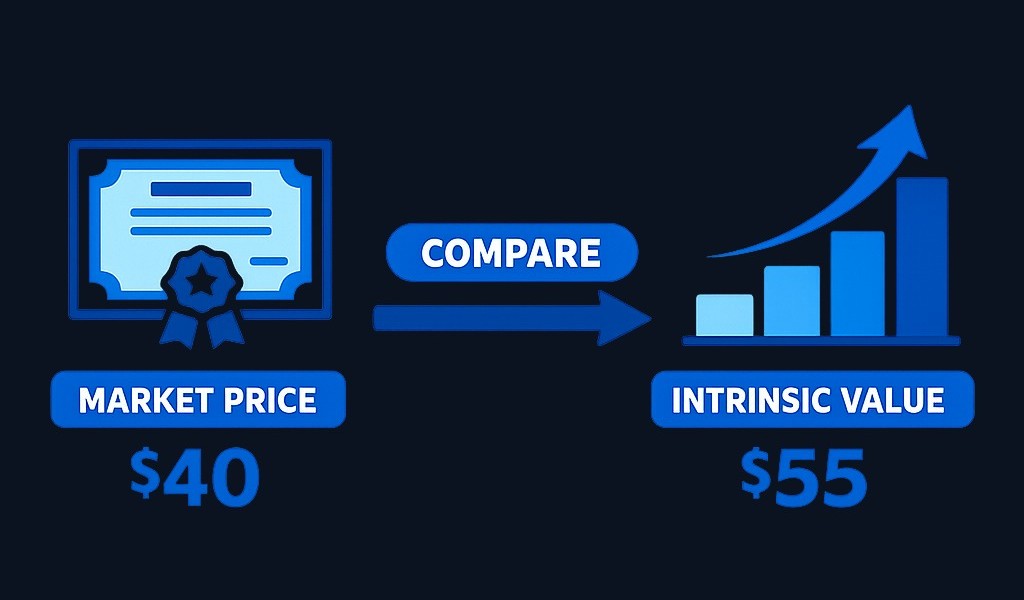
If your estimate is higher than the market price, the stock may appear undervalued. If it is lower, the stock may appear overvalued. That conclusion depends heavily on your assumptions.
Introduction to Intrinsic Value
Intrinsic value is a way to ask: “What is this business worth per share if I look past today’s market noise?” It is not the same as the latest stock quote. A stock quote reflects what buyers and sellers are willing to pay right now. Intrinsic value tries to estimate the underlying worth of the company itself.
One useful definition is that intrinsic value measures what a stock is worth independently of its current market price, using financial data, prospects, and other relevant factors Interactive Brokers. Study.com similarly separates a stock’s underlying estimate from outside market forces, including the economic backdrop, market cycles, price action, and public policy Study.com.
That does not mean intrinsic value is perfectly objective. Two investors can analyze the same company and reach different values because they use different growth assumptions, risk estimates, or valuation methods.
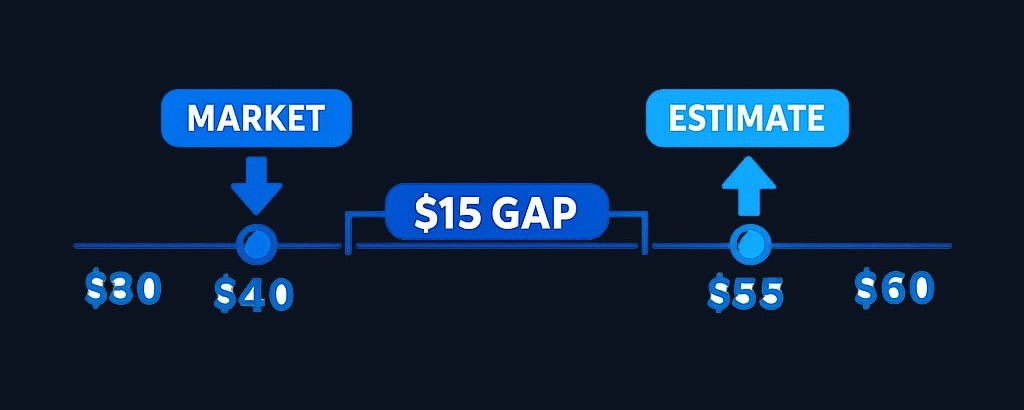
Simple example: Suppose a stock trades at $40. After estimating the company’s future cash flows and discounting them to today, you estimate intrinsic value at $55 per share. That does not prove the stock will rise to $55. It only means your analysis suggests the business may be worth more than the market currently prices it.
Why Intrinsic Value Matters
Intrinsic value matters because it gives investors a framework for separating price from value. The market price tells you what a stock costs today. Intrinsic value asks whether that price is reasonable relative to the company’s fundamentals.
Value-oriented investors often use this idea to look for businesses trading below their estimated worth. One supplied source explains that after estimating intrinsic value across businesses, a long-term investor may choose stocks trading at prices below intrinsic value FutureSearch. This is the basic logic behind “buying at a discount,” though it never guarantees a profitable outcome.
Intrinsic value can also help investors avoid overpaying for popular companies. A strong business can still be a poor investment if the market price already assumes unrealistic growth. Conversely, an unpopular company can be attractive only if its fundamentals support a higher value than the current price suggests.
A quick decision framework
| If your situation is... | What intrinsic value helps you do | Sensible next step |
|---|---|---|
| You are new to stock analysis | Understand the difference between price and value | Learn one simple valuation model before comparing stocks |
| You already own a stock | Re-check whether the original thesis still makes sense | Update assumptions using current financial information |
| You are considering buying | Estimate whether the current price offers a margin of safety | Compare intrinsic value with market price and risk factors |
| You are comparing several companies | Rank opportunities by value, quality, and uncertainty | Avoid relying on one metric alone |
Example: Imagine two companies both trade at $50 per share. Company A has consistent free cash flow, manageable debt, and realistic growth prospects. Company B has uncertain cash flow and depends on aggressive future expansion. The same $50 price may be more attractive for Company A if your intrinsic value estimate is higher and more reliable.
Methods to Calculate Intrinsic Value
There is no single perfect formula for intrinsic value. The best method depends on the type of company, the quality of its financial data, and whether it pays dividends or generates meaningful cash flow. Value investors generally believe intrinsic value can be calculated by analyzing a company’s business, financial metrics, and future prospects Investopedia.
Here are the most common approaches.
1. Discounted cash flow analysis
Discounted cash flow, often called DCF, estimates the present value of a company’s future cash flows. This method is especially useful for companies with meaningful, analyzable cash generation.
The basic idea:
- Estimate future free cash flow.
- Choose a discount rate that reflects risk.
- Discount future cash flows back to today.
- Add a terminal value if estimating beyond the forecast period.
- Adjust for debt and cash if valuing the whole company.
- Divide by shares outstanding to estimate value per share.
Free cash flow is the cash left after a company covers operating expenses and major capital investments, and it can be used for growth, debt reduction, dividends, or buybacks Investopedia.
Illustrative example using a well-known company context: Suppose you are analyzing a mature, globally recognized company such as Apple, but you use simplified hypothetical numbers for learning—not actual Apple financial data.
Assume:
| Input | Hypothetical value |
|---|---|
| Current free cash flow | $100 billion |
| Expected annual cash-flow growth for 5 years | 4% |
| Discount rate | 9% |
| Long-term growth after year 5 | 2.5% |
| Net cash adjustment | $50 billion |
| Shares outstanding | 15 billion |
A simplified DCF would estimate each year’s future cash flow, discount those amounts back to today, estimate a terminal value, add net cash, and divide by shares. If the final estimate came to $170 per share and the stock traded at $150, your model would suggest the stock may be undervalued by $20 per share.
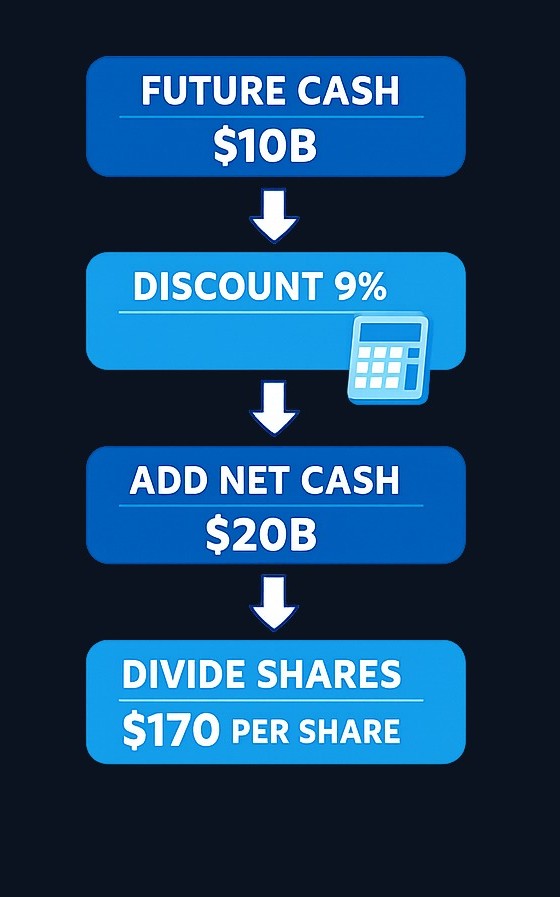
But that result is only as good as the assumptions. If the growth estimate falls from 4% to 2%, or the discount rate rises from 9% to 11%, the intrinsic value estimate could drop meaningfully.
2. Dividend discount model
The dividend discount model estimates intrinsic value based on future dividends. It is most useful for stable companies with a consistent dividend history. It is less useful for companies that do not pay dividends or that reinvest most of their cash into growth.
A simplified version asks: “What are the company’s future dividends worth today?” The investor estimates the next dividend, expected dividend growth, and a required return.
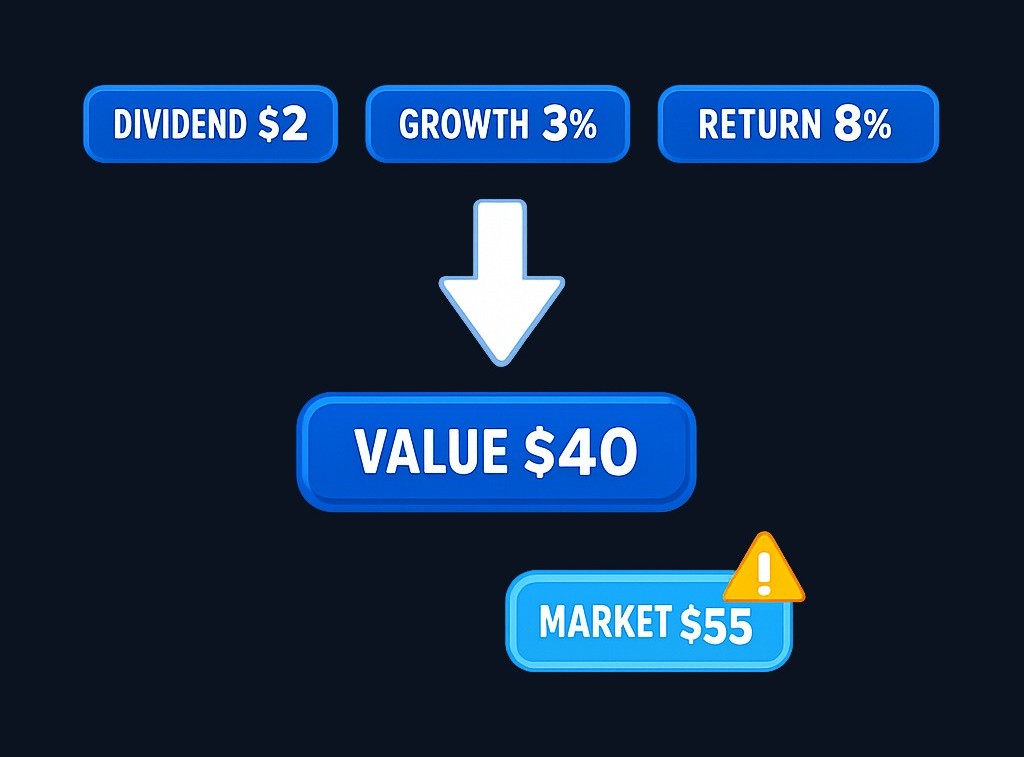
Example: Suppose a company is expected to pay a $2 dividend next year. If you require an 8% return and expect dividends to grow 3% per year, a simplified dividend model would value the stock based on the spread between required return and growth. If the estimate is $40 per share and the stock trades at $55, the model suggests the price may be too high for a dividend-focused investor.
3. Asset-based valuation
Asset-based valuation focuses on what a company owns minus what it owes. It can be useful for businesses where assets are central to value, such as financial firms, real estate-heavy companies, or companies being evaluated for liquidation value.
This approach is usually less useful for companies whose main value comes from brand, software, network effects, or future growth.
Example: A company owns valuable real estate, equipment, and cash, but the market prices the entire company below the estimated value of those assets after liabilities. An asset-based investor might investigate whether the stock is undervalued. However, the assets may not be easy to sell, and accounting values may not reflect real-world market values.
4. Relative valuation as a cross-check
Relative valuation compares a stock with similar companies using metrics such as price-to-earnings, price-to-sales, or enterprise-value ratios. This is not pure intrinsic value, but it can help test whether your estimate seems reasonable.
Example: If your DCF says a company is worth far more than peers, you should ask why. Is the company growing faster? Is it more profitable? Does it have lower risk? If not, the DCF assumptions may be too optimistic.
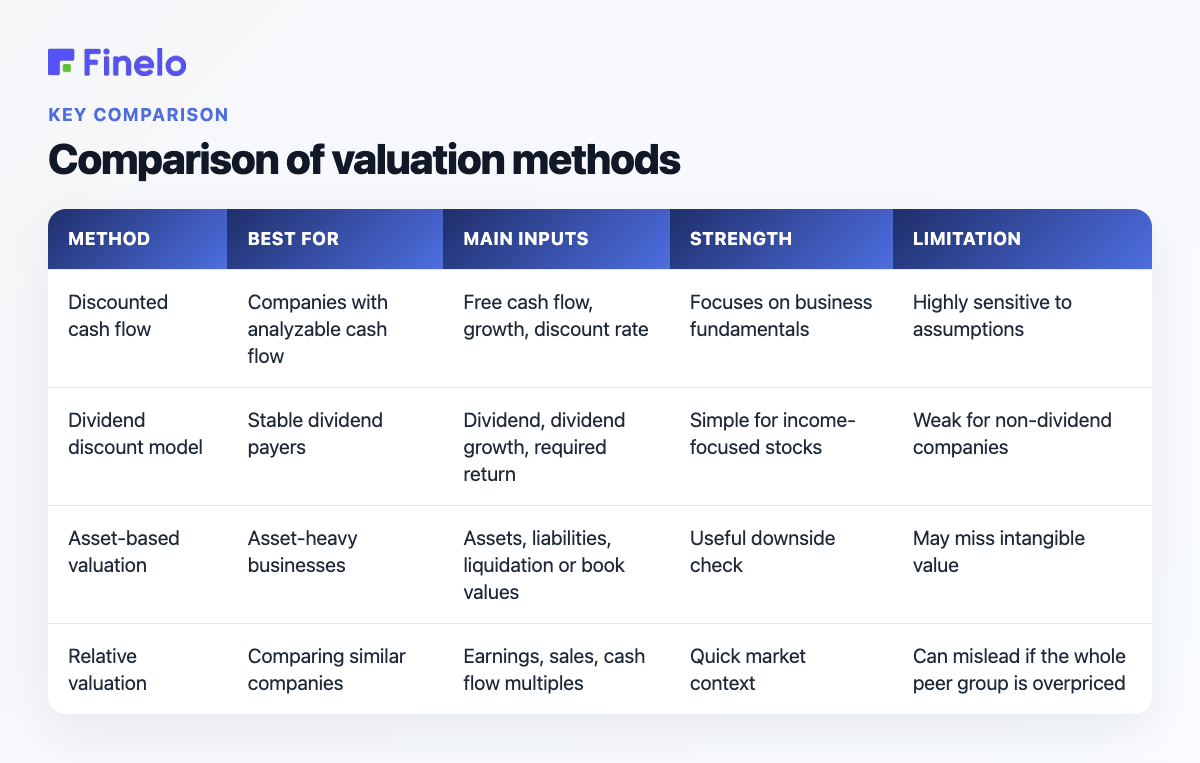
Comparison of valuation methods
| Method | Best for | Main inputs | Strength | Limitation |
|---|---|---|---|---|
| Discounted cash flow | Companies with analyzable cash flow | Free cash flow, growth, discount rate | Focuses on business fundamentals | Highly sensitive to assumptions |
| Dividend discount model | Stable dividend payers | Dividend, dividend growth, required return | Simple for income-focused stocks | Weak for non-dividend companies |
| Asset-based valuation | Asset-heavy businesses | Assets, liabilities, liquidation or book values | Useful downside check | May miss intangible value |
| Relative valuation | Comparing similar companies | Earnings, sales, cash flow multiples | Quick market context | Can mislead if the whole peer group is overpriced |
Factors Influencing Intrinsic Value
Intrinsic value changes when the underlying assumptions about a business change. It is not a fixed number carved in stone. Because intrinsic value is based on financial data, prospects, and other factors that can influence price Interactive Brokers, any change in those inputs can affect the estimate.
Key factors include:
- Revenue growth: Faster sustainable growth can increase estimated value.
- Profit margins: Higher margins can improve future cash flow.
- Free cash flow: Cash generation supports reinvestment, debt reduction, dividends, or buybacks Investopedia.
- Debt levels: More debt can increase risk and reduce equity value.
- Competitive advantage: Stronger advantages can make future cash flows more durable.
- Management quality: Capital allocation decisions can affect long-term value.
- Interest rates and discount rates: A higher required return generally lowers present value.
- Industry conditions: Regulation, cyclicality, technology shifts, and demand trends can change assumptions.
Example: Suppose a company’s intrinsic value estimate is $80 per share based on steady 5% annual cash-flow growth. If new competitors reduce pricing power and expected growth falls to 2%, the estimate may drop. The stock’s market price might not react immediately, but the underlying value case has changed.
Checklist: what to review before trusting an intrinsic value estimate
- Are the revenue and cash-flow assumptions realistic?
- Is the discount rate appropriate for the company’s risk?
- Does the company have debt that could reduce equity value?
- Is the business cyclical or highly dependent on one product?
- Are margins stable, improving, or under pressure?
- Does the company generate free cash flow, or only accounting profits?
- How much does the valuation change if growth is lower than expected?
- Have you compared the estimate with peers or other valuation methods?
Practice investing with Finelo
Build practical investing skills with guided lessons, simulator practice, and structured challenges.
Comparing Intrinsic Value to Market Price
The market price is observable. Intrinsic value is estimated. That difference is central to stock analysis.
A stock may trade above or below intrinsic value because investors disagree about the future. Market price can be influenced by sentiment, short-term news, liquidity, and broader economic conditions. Intrinsic value attempts to focus on the internal value of the stock and can ignore external aspects such as investor sentiment, market cycles, and economic trends Study.com.
The comparison is usually interpreted like this:
| Intrinsic value vs. market price | Possible interpretation | Risk-aware view |
|---|---|---|
| Intrinsic value is above market price | Stock may be undervalued | Check whether assumptions are too optimistic |
| Intrinsic value is close to market price | Stock may be fairly valued | Look for better margin of safety |
| Intrinsic value is below market price | Stock may be overvalued | Strong companies can still be expensive |
| Estimates vary widely | Valuation is uncertain | Use caution or demand a larger margin of safety |
Example: You estimate a stock’s intrinsic value at $100. It trades at $70. At first glance, that looks undervalued. But if a small change in your discount rate lowers the value to $75, the margin of safety is thin. If multiple conservative scenarios still produce values above $70, the case may be stronger.
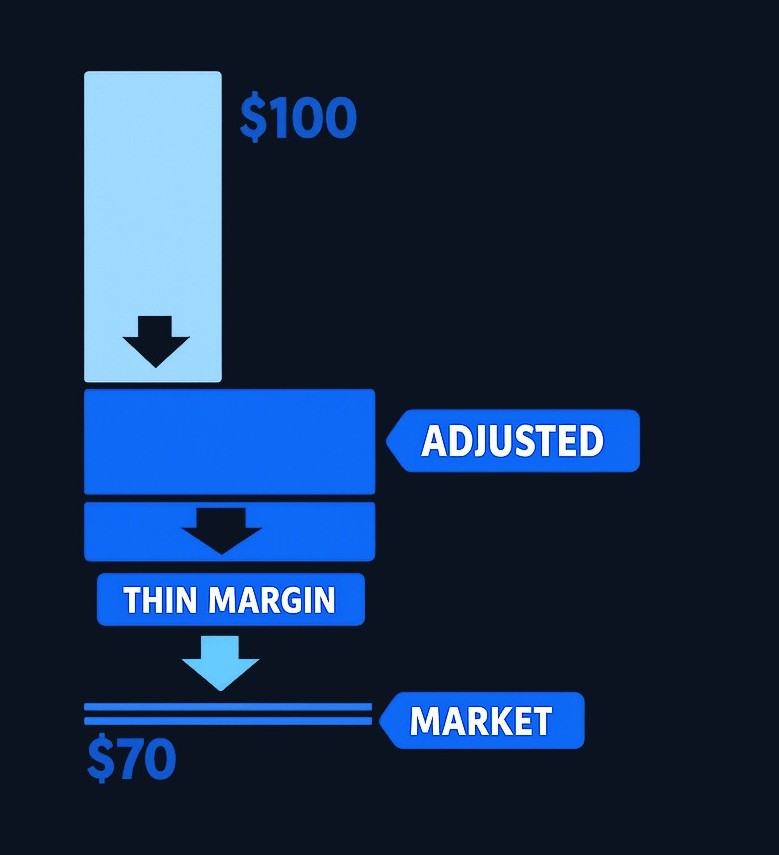
This is why intrinsic value should not be treated as a precise target price. It is better understood as a range. A careful investor might say, “My estimate is $90 to $110,” rather than “This stock is definitely worth $100.”
Common Mistakes in Calculating Intrinsic Value
Intrinsic value can be useful, but it is easy to misuse. The biggest mistakes usually come from overconfidence, weak assumptions, or relying on one model without context.
Mistake 1: Treating the estimate as exact
A valuation model can produce a precise number, but that does not make the number precise. A spreadsheet may show $83.47 per share, yet the real conclusion might be “probably worth somewhere between $70 and $95 depending on growth and risk.”
Example: If one investor uses a 7% discount rate and another uses 10%, their intrinsic value estimates may differ sharply. Neither number is automatically correct.
Mistake 2: Using unrealistic growth assumptions
Small changes in long-term growth can have large effects on valuation. This is especially true in DCF models, where future cash flows drive much of the value.
Example: A company grew quickly for three years. An investor assumes that growth will continue for ten more years without considering competition, market saturation, or margin pressure. The resulting intrinsic value may be too high.
Mistake 3: Ignoring free cash flow quality
Accounting earnings and cash generation are not always the same. Free cash flow matters because it represents cash available after operating costs and significant capital investments Investopedia.
Example: A company reports profits but must spend heavily each year to maintain its assets. If those capital needs are underestimated, intrinsic value may be overstated.
Mistake 4: Comparing unrelated companies
Relative valuation works best when comparing similar businesses. A high-growth software company and a slow-growing utility may deserve very different valuation multiples.
Example: If Company A trades at 30 times earnings and Company B trades at 12 times earnings, Company B is not automatically cheaper. It may have lower growth, higher debt, or more cyclical earnings.
Mistake 5: Forgetting that value changes over time
Intrinsic value changes as financial performance, competitive position, risk, and expectations change. A stock that looked undervalued last year may no longer be undervalued if earnings weaken or debt rises.
Example: A retailer may look cheap based on last year’s profits. But if demand falls and inventory problems reduce future cash flow, the intrinsic value estimate should be updated.
Conclusion and Next Steps
The best answer to “what is the intrinsic value of its stock?” is: it is your estimate of the stock’s fundamental worth per share, based on the company’s financial performance, future prospects, and risk—not merely its current market price. Intrinsic value is useful because it helps investors compare what a stock may be worth with what the market currently charges.
To calculate it, start with a method that fits the company:
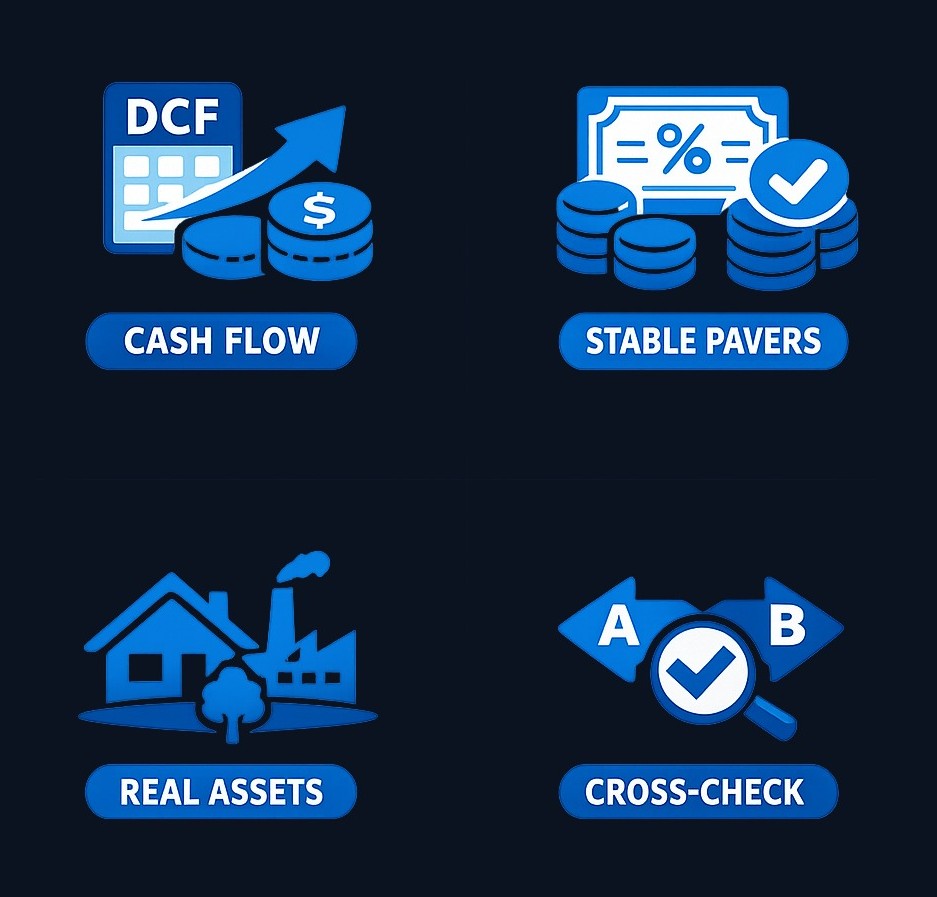
- Use discounted cash flow for companies with analyzable cash flow.
- Use a dividend model for stable dividend payers.
- Use asset-based valuation for asset-heavy businesses.
- Use relative valuation as a reality check, not the only answer.
After reading, your next step is to choose one company, gather its financial data, build a simple valuation range, and test how sensitive your estimate is to growth and discount-rate assumptions. If you are still learning the basics, Finelo can be used as part of a broader financial education routine, but valuation work should remain educational and should not replace your own risk, cost, and suitability checks.
FAQs about Intrinsic Value
How do I calculate the intrinsic value of a stock?
Start by choosing a valuation method that fits the company. For many businesses, investors use discounted cash flow: estimate future free cash flow, discount it back to today, adjust for cash and debt, and divide by shares outstanding. For dividend-focused companies, a dividend discount model may be more appropriate. For asset-heavy companies, asset-based valuation may be useful.
How can I tell if a stock is undervalued based on intrinsic value?
A stock may appear undervalued if your estimated intrinsic value is higher than the current market price by enough to allow for uncertainty. Long-term investors may look for stocks trading below estimated intrinsic value FutureSearch. However, the conclusion depends on whether your assumptions are conservative and well supported.
What is the difference between intrinsic value and market value?
Market value is the price investors are currently willing to pay in the market. Intrinsic value is an estimate of what the stock is worth based on business fundamentals, independent of the current market price Interactive Brokers.
What factors should I consider when determining intrinsic value?
Consider free cash flow, revenue growth, profit margins, debt, competitive position, management quality, industry risk, and the discount rate. Free cash flow is especially important because it shows cash left after operating expenses and major investments Investopedia.
what is the intrinsic value of its stock?investingtrading education
Practice investing with Finelo
Build practical investing skills with guided lessons, simulator practice, and structured challenges.
About the author
Finelo Team
The Finelo Team creates practical investing and trading education designed to help beginners learn faster with structured challenges, simulator practice, and bite-sized lessons.
Keep reading — Related articles

Investing
Stock Scanner vs Screener: Key Differences Explained
A stock scanner watches the market continuously for live events and unusual activity; a stock screener filters a static universe of stocks by written criteria (ratios, indicators, timeframes) so you can evaluate candidates. For example, Benzinga describes its product as a "full‑blown, real‑time scanner" for saved scans and…
Finelo Team
Investing
Stock Alert Apps: Features, Costs, and How to Compare
Stock alert apps watch prices, indicators, or news and notify you when pre-set conditions happen — letting you act without constant screen time. Many traders use alerting tools to monitor breakouts and time entries, for example Benzinga Pro’s alerting is relied on by day traders Benzinga Pro. This…
Finelo Team
Investing
Social Investing Apps: Features, Risks, and How to Compare
Finelo is an investment-learning and financial-education product. This page helps readers evaluate a social investing app without treating crowd activity as a trade instruction.
Finelo Team


