The S&P 500 is a stock market index designed to show how a broad group of leading large-cap U.S. companies is performing. Rather than checking hundreds of stocks individually, investors can look at the index for a quick picture of an important part of the U.S. equity market. S&P Dow Jones Indices describes it as a gauge of large-cap U.S. equities that includes 500 leading companies and covers approximately 80% of available market capitalization (S&P Dow Jones Indices).
What Is the S&P 500? A Complete Overview
The S&P 500 is a stock market index designed to show how a broad group of leading large-cap U.S. companies is performing. Rather than checking hundreds of stocks individually, investors can look at the index for a…
7 min read
Practice investing with Finelo
Build practical investing skills with guided lessons, simulator practice, and structured challenges.
Want to learn more?
Build practical investing skills with guided lessons, simulator practice, and structured challenges.
Explore FineloExplore Finelo's 28-day challenges
Turn learning into a daily habit with guided challenge paths.
You cannot buy the index itself. However, investment funds can seek to track it, giving investors a practical way to gain exposure to the companies it represents.
What the S&P 500 represents
An index is a measurement tool. The S&P 500 combines the price movements of many constituent companies into a single index level. When that level rises, the combined value represented by the index has increased; when it falls, that value has decreased.
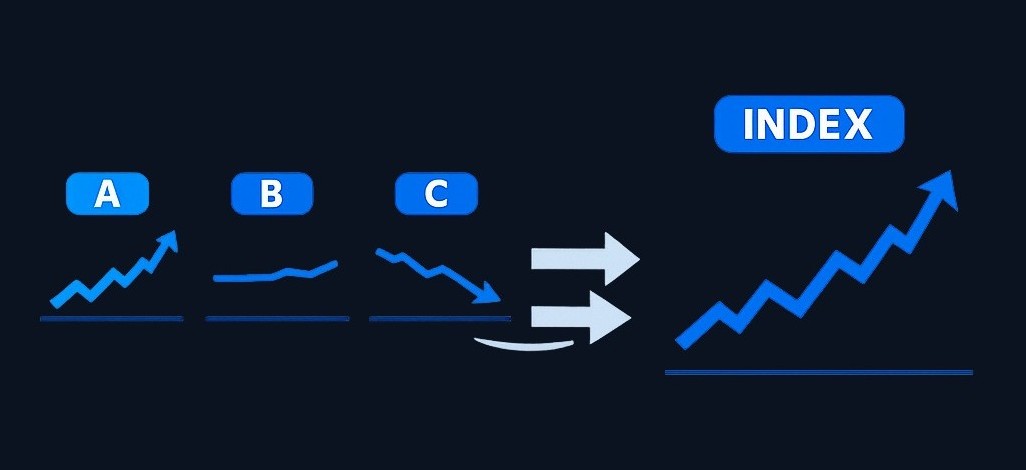
This makes the S&P 500 useful as:
- A snapshot of large U.S. companies
- A benchmark for comparing an investment portfolio or fund
- A reference point in discussions about the U.S. stock market
- A foundation for index-tracking funds
The index has changed significantly over time. It began as an index of 233 companies in 1923 and expanded to 500 companies in 1957. Today, it offers a big-picture view of stock market activity without requiring investors to monitor hundreds of separate stocks (Fidelity).
That broad view is valuable, but it has limits. The S&P 500 does not represent every public company, every asset class, or every country. It is best understood as one influential lens on the market—not a complete picture of the global economy or an individual investor’s financial situation.
What companies are included in the S&P 500?
The S&P 500 contains leading large-cap U.S. companies. Its constituents are not permanently fixed: companies can be added or removed, so any static list will eventually become outdated.
This changing membership matters. An index is meant to remain representative of the market segment it measures. When the business landscape changes, the set of companies representing that landscape may change as well. Investors using an index-tracking product should therefore expect the fund’s holdings to evolve as the underlying index evolves.
It is also important to distinguish between “500 companies” and equal influence. A company’s effect on the index depends on its weight, not simply its presence. Two constituents can both be included while contributing very differently to daily index movements.
Practical takeaway: consult the index provider or your fund’s current holdings when you need an up-to-date constituent list. Do not assume a company is included because it is large, well known, or was part of the index in the past.
How is the S&P 500 calculated?
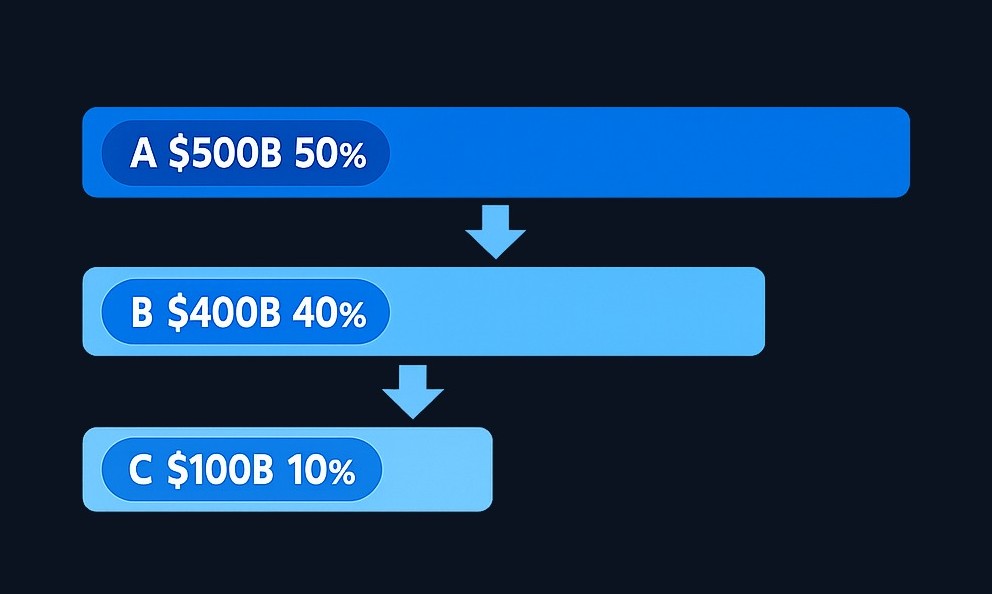
The central idea is market-cap weighting. Market capitalization is the market value represented by a company’s shares. In a market-cap-weighted index, larger constituents receive larger weights, so their price movements generally affect the index more than the movements of smaller constituents.
Here is a simplified illustration:
| Company | Relative size in a hypothetical index | Effect of the same percentage move |
|---|---|---|
| Company A | Large | Greater |
| Company B | Medium | Moderate |
| Company C | Small | Lower |
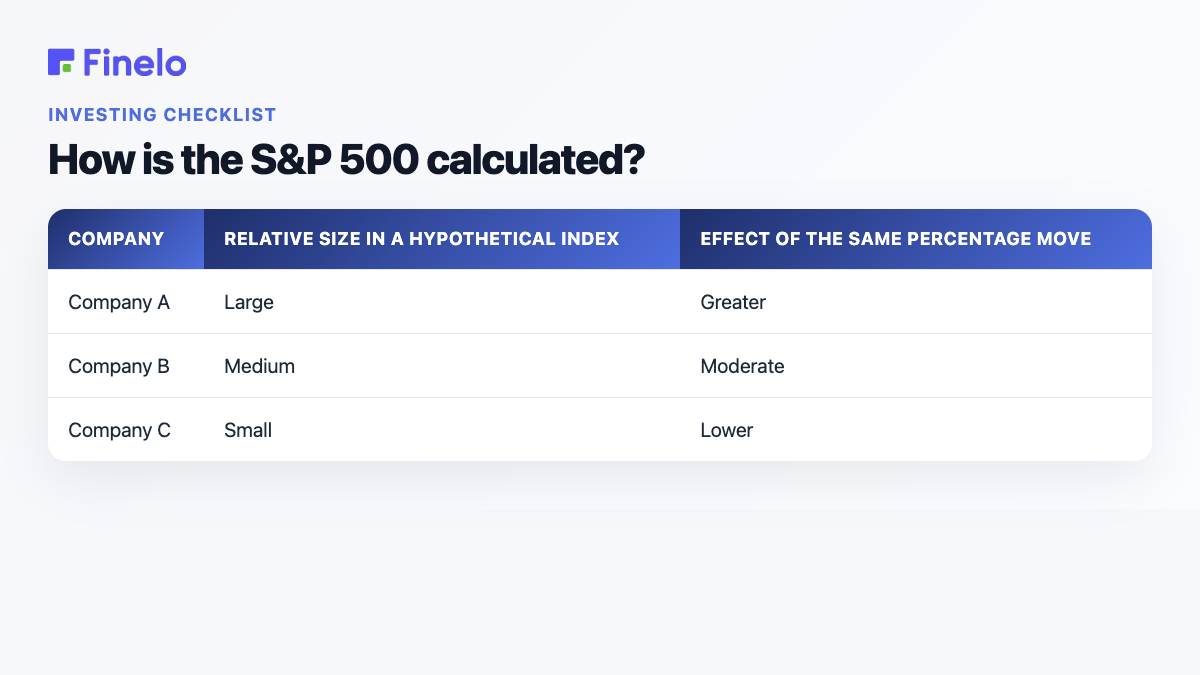
If all three stocks move by the same percentage, Company A has the largest effect because it has the largest weight. This is why the S&P 500 should not be interpreted as a vote in which every constituent has equal power.
The calculation also explains why the index can rise even when many constituents fall—or fall even when many rise. A strong move among heavily weighted companies can outweigh smaller moves elsewhere.
For investors, the practical lesson is concentration awareness. Holding an S&P 500 tracking fund spreads exposure across many companies, but the portfolio is not evenly divided among them. Changes in the largest constituents may have an outsized effect on results.
How should you interpret historical performance?
Historical S&P 500 performance shows how the index behaved during a selected past period. The result depends on several choices:
- The start and end dates
- Whether the measure uses price return or includes reinvested distributions
- Whether figures are shown before or after investment costs
- Whether the comparison accounts for inflation
Because these choices can produce different numbers, “the historical return of the S&P 500” is not a complete question by itself. A careful comparison must use the same period and return method throughout.
Economic events can affect the index through company earnings expectations, interest rates, consumer demand, financing conditions, and investor sentiment. Different sectors may respond differently, but market-cap weighting means the response of the largest constituents can be especially important to the overall index.
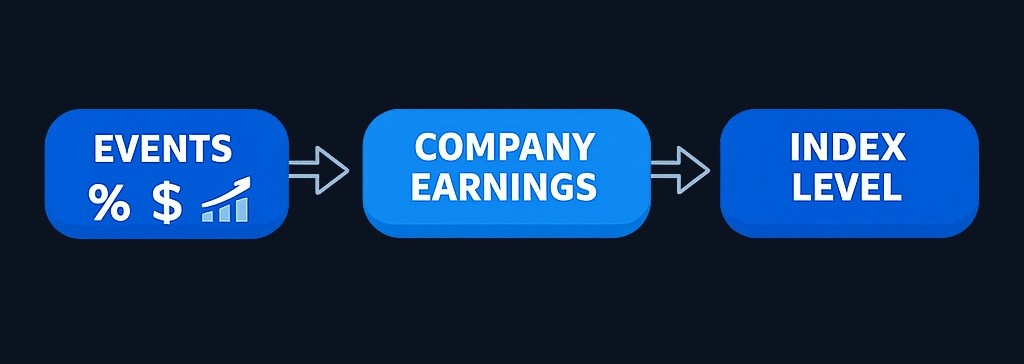
Past performance is descriptive, not predictive. A long-term chart can provide context about market cycles and volatility, but it cannot tell an investor what the next year—or the next decade—will deliver.
Practice investing with Finelo
Build practical investing skills with guided lessons, simulator practice, and structured challenges.
How can you invest in the S&P 500?
Because the S&P 500 is an index rather than a security, investors typically seek exposure through an index mutual fund or exchange-traded fund that aims to track it. These products pool money and hold a portfolio intended to follow the index’s movements, subject to fund costs and tracking differences.
Use this checklist when comparing options:
- Confirm the benchmark. Make sure the product actually tracks the S&P 500 rather than a similarly named strategy.
- Review total costs. Consider the expense ratio and any account, trading, currency, or tax-related costs that may apply.
- Check how it trades. ETFs trade on an exchange, while mutual fund transactions generally follow the fund’s dealing process.
- Look at tracking. A fund’s result may differ from the index because of fees, portfolio management, cash holdings, or operational factors.
- Understand distributions. Check whether income is paid out or reinvested and how that fits your plan.
- Assess suitability. Consider your time horizon, risk tolerance, need for liquidity, and exposure outside large U.S. companies.
A low quoted fee should not be the only decision factor. The appropriate vehicle depends on the investor’s account, location, tax circumstances, trading habits, and broader portfolio. Verify the product documents and current terms before investing.
S&P 500 vs. other market indices
Different indices answer different questions. Comparing them is useful only after identifying the market each one is intended to measure.
| Index type | Main focus | What the comparison can reveal |
|---|---|---|
| S&P 500 | Leading large-cap U.S. companies | Performance of a broad large-company U.S. segment |
| Narrow large-company index | A smaller group of prominent companies | Whether a few major stocks are leading or lagging |
| Broad U.S. market index | A wider range of U.S. company sizes | How large companies compare with the broader domestic market |
| Small-company index | Smaller public companies | Differences between large- and small-company performance |
| International index | Markets outside the United States | Whether U.S. and non-U.S. equities are moving differently |
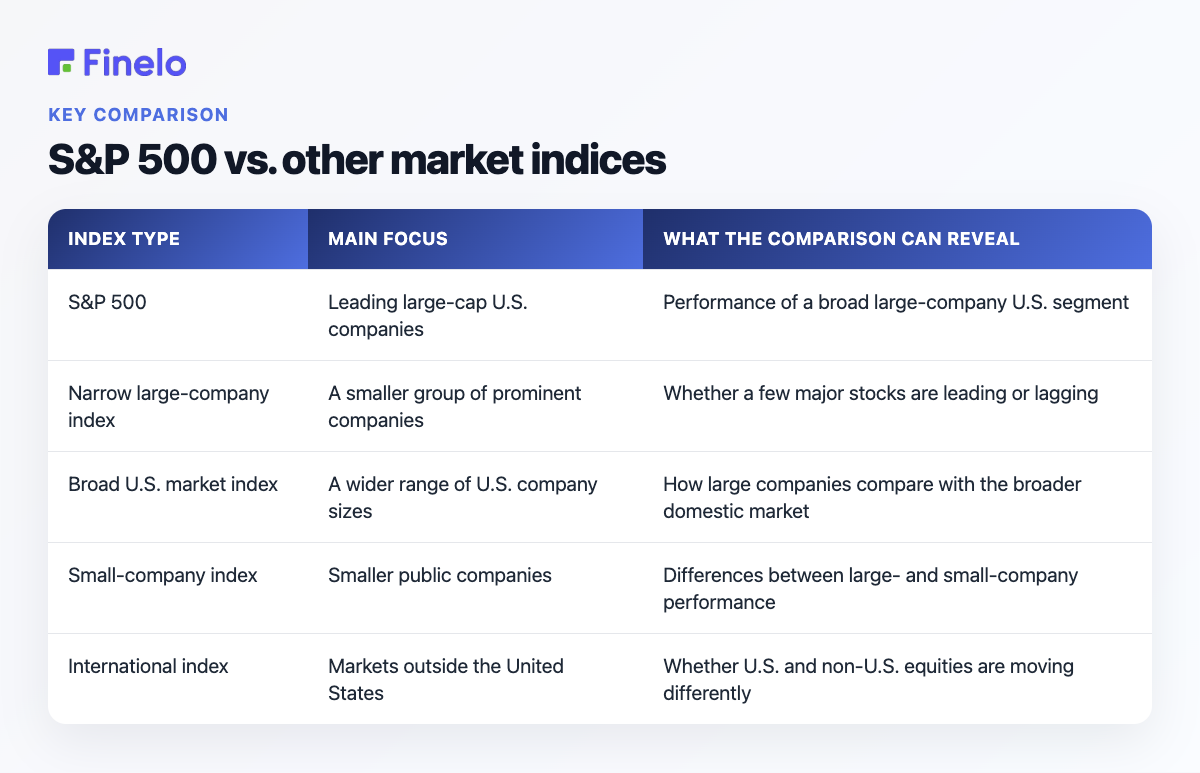
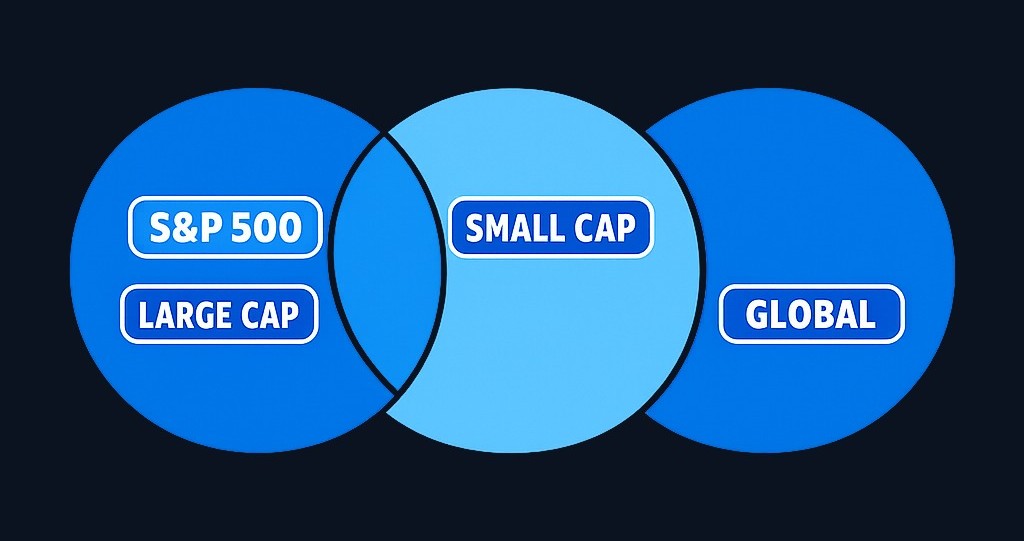
No index is automatically “better” in every situation. An S&P 500 fund may provide broad exposure within its segment while still omitting smaller U.S. companies, international equities, bonds, and other assets. Investors should compare coverage rather than relying on name recognition alone.
Risks and practical limitations
Diversification across many companies does not eliminate risk. An S&P 500 investment can lose value when the market declines, and concentrated weights can make the largest constituents especially influential.
Other limitations include:
- U.S. large-cap focus: The index is not a complete global portfolio.
- Market risk: Broad equity exposure can still experience substantial volatility.
- Concentration risk: The biggest constituents can dominate index movements.
- Tracking risk: A fund may not match the index exactly.
- Product costs: Fees and other expenses reduce an investor’s result.
- Timing risk: Money needed soon may be exposed to an unfavorable market period.
For beginners, the S&P 500 can be a useful concept to study because it connects index construction, diversification, benchmarks, and passive investing. That educational value does not make an S&P 500 product suitable for every person or goal.
The bottom line
The simplest answer to “What is the S&P 500?” is that it is an index used to measure the performance of leading large-cap U.S. companies. Its market-cap-weighted design means the largest constituents have the most influence, and its changing membership helps it continue representing its target market segment.
Your next step is to decide what you need from the index: a market benchmark, a learning tool, or possible investment exposure. If you are considering a fund, compare its benchmark, costs, tracking approach, distributions, risks, and fit with your wider plan. You can also use Finelo to continue building your understanding of investing concepts before making financial decisions.
Frequently asked questions
Is the S&P 500 the same as the stock market?
No. It measures a major segment of the U.S. stock market, but it does not include every U.S. company or assets outside that segment.
Can I buy the S&P 500 directly?
No. It is an index, not a tradable security. Investors generally use a mutual fund or ETF designed to track it.
Does the S&P 500 contain exactly 500 stocks?
Its name refers to 500 leading companies, but company and share-class details can make the number of securities represented different from the number of companies. For current details, check the index provider’s constituent data.
Is an S&P 500 fund enough diversification?
It can diversify exposure across many large U.S. companies, but it does not cover every company, country, or asset class. Whether it is sufficient depends on the investor’s objectives and overall portfolio.
InvestingBeginnerIndexesMarkets
Practice investing with Finelo
Build practical investing skills with guided lessons, simulator practice, and structured challenges.
About the author
Finelo Team
The Finelo Team creates practical investing and trading education designed to help beginners learn faster with structured challenges, simulator practice, and bite-sized lessons.
Keep reading — Related articles

Investing
I Bonds vs EE Bonds in 2026: Rates, Rules, and Which to Buy for the Long Run
Series I and Series EE savings bonds are both U.S. Treasury retail savings bonds sold on TreasuryDirect. They share ownership, tax treatment, and redemption rules; the key difference is the…
Finelo Team
Investing
Coverdell ESA vs 529 Plan: Limits, Flexibility, and Which to Choose
Quick answer (one minute) Both a Coverdell Education Savings Account (Coverdell ESA) and a 529 plan let money grow tax‑free and be withdrawn tax‑free for qualified education expenses. The…
Finelo Team
Investing
CD vs High Yield Savings Account: Where to Park Your Cash in 2026
Hero answer — CD vs high yield savings account in one line A CD (certificate of deposit) and a high yield savings account are both low‑risk, federally insured homes for cash — the difference…
Finelo Team