The Russell 2000 is a stock market index designed to track the small-cap segment of the US equity market. It contains approximately 2,000 of the smallest US companies selected by market capitalization and represents about 10% of the US market, according to an SEC-hosted fund disclosure.
What is the Russell 2000? A Deep Dive into the Index
The Russell 2000 is a stock market index designed to track the small-cap segment of the US equity market. It contains approximately 2,000 of the smallest US companies selected by market capitalization and represents…
7 min read
Practice investing with Finelo
Build practical investing skills with guided lessons, simulator practice, and structured challenges.
Want to learn more?
Build practical investing skills with guided lessons, simulator practice, and structured challenges.
Explore FineloExplore Finelo's 28-day challenges
Turn learning into a daily habit with guided challenge paths.
In practical terms, the index is a benchmark: it helps investors see how a broad group of smaller public companies is performing. It is not a stock, fund, or account that you can buy directly. To seek similar exposure, investors generally use an index-tracking fund or build a portfolio of individual small-cap stocks.
What the Russell 2000 measures
“Small-cap” refers to companies with relatively small stock-market values compared with large, established corporations. Market capitalization is calculated by multiplying a company’s share price by the number of shares outstanding.
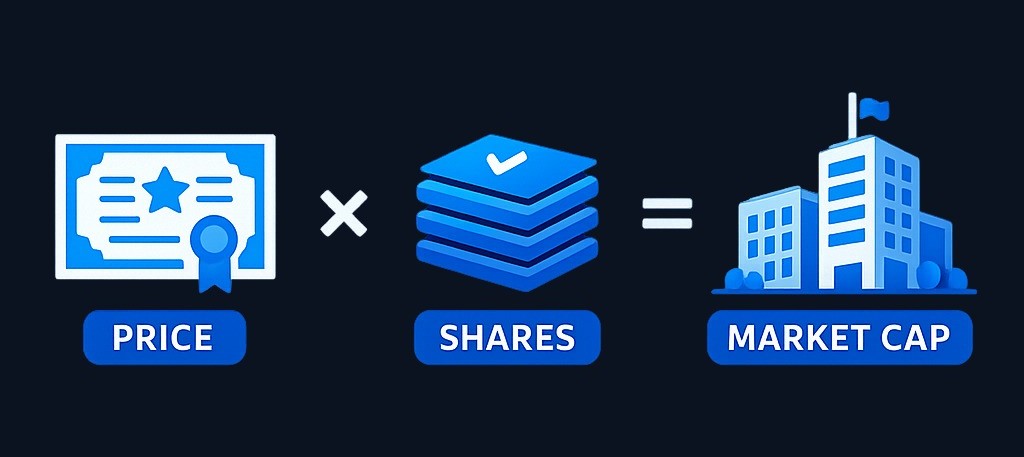
The Russell 2000 combines many such companies into one benchmark. That makes it more informative than following a handful of individual small-cap stocks. If one company has an unusually strong or weak day, its movement is viewed within a much broader market segment.
The index can help answer questions such as:
- Are smaller US companies generally rising or falling?
- Is the small-cap segment keeping pace with large-cap stocks?
- How is a small-cap portfolio performing relative to a broad benchmark?
- Does an investor already have meaningful small-company exposure?
The important distinction is that an index measures a market; it does not remove investment risk. A diversified index can reduce dependence on any single company, but the entire small-cap segment can still decline.
What types of companies are included?
Russell 2000 constituents are public US companies toward the smaller end of the market-cap spectrum. “Small” is relative here. These are exchange-traded businesses, not necessarily early-stage startups or local private companies.
The index spans many business models and industries. Its composition can therefore include established niche operators, growing regional businesses, and companies whose results are more sensitive to changes in financing conditions or domestic demand.
Market-cap selection also means membership is not a permanent quality award. A company may become larger or smaller as its share price, share count, or business circumstances change. Investors should not assume that inclusion proves a company is profitable, financially strong, or suitable for a particular portfolio.
How the Russell 2000 compares with other indices
The easiest way to understand the Russell 2000 is to compare the market segment it represents with the segments emphasized by other familiar benchmarks.
| Benchmark type | Main emphasis | What it can tell an investor | Key limitation |
|---|---|---|---|
| Russell 2000 | Smaller US public companies | How the US small-cap segment is behaving | Does not represent the whole US stock market |
| Large-cap index | Larger, more established companies | How major corporations are performing | May say little about smaller businesses |
| Technology-heavy index | Companies concentrated in or influenced by technology-related sectors | How a growth- and technology-oriented group is performing | Sector concentration can dominate the result |
| International small-cap index | Smaller companies outside the US | How foreign small caps are behaving | Currency, country, and market-structure differences complicate comparisons |
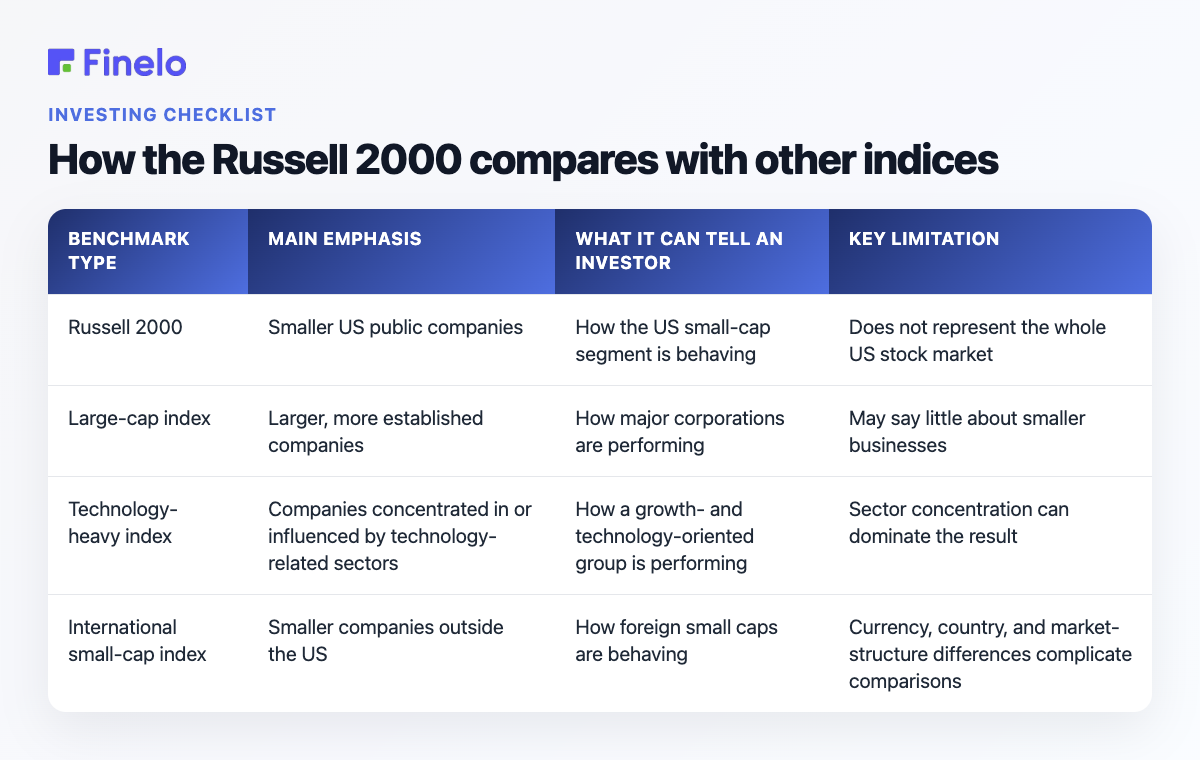
These benchmarks are not interchangeable. A large-cap index can rise while the Russell 2000 falls because the underlying companies face different conditions. Likewise, a technology-heavy benchmark may be driven by a relatively narrow group of businesses, whereas a broad small-cap benchmark reflects another part of the economy.
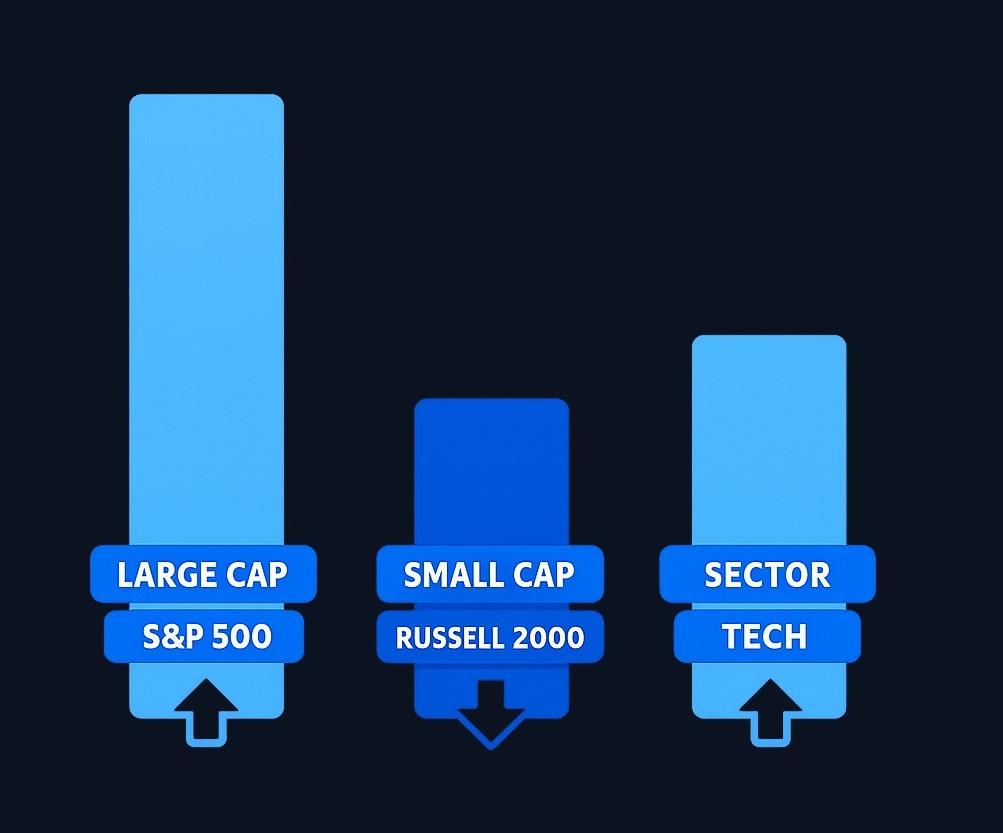
For portfolio analysis, the useful question is not “Which index is always best?” No index leads in every environment. A better question is: “Which market segment does this benchmark represent, and what role would that exposure play alongside my other holdings?”
What drives Russell 2000 performance?
The index moves when the market values of its constituent companies change. Over shorter periods, investor expectations and market sentiment can have a strong effect. Over longer periods, business fundamentals such as revenue, profitability, debt, and cash generation matter.
Several forces are especially useful to monitor when analyzing small-cap performance:
Interest rates and access to capital
Smaller companies may have different borrowing needs and financing options from large corporations. Changes in interest rates or credit availability can alter their costs, expansion plans, and perceived risk. This does not mean every constituent reacts in the same way, but financing conditions can influence the segment broadly.
Economic expectations
When investors become more confident about business activity, they may become more willing to own shares in smaller companies. During periods of uncertainty, they may prefer companies perceived as more established or financially resilient. This relationship is not mechanical, so economic reports should be considered alongside company fundamentals and valuations.
Sector composition
Index performance depends partly on which industries have the greatest influence at a given time. Before drawing conclusions from a rally or decline, check whether the move is broad or concentrated in a few sectors.
Valuation
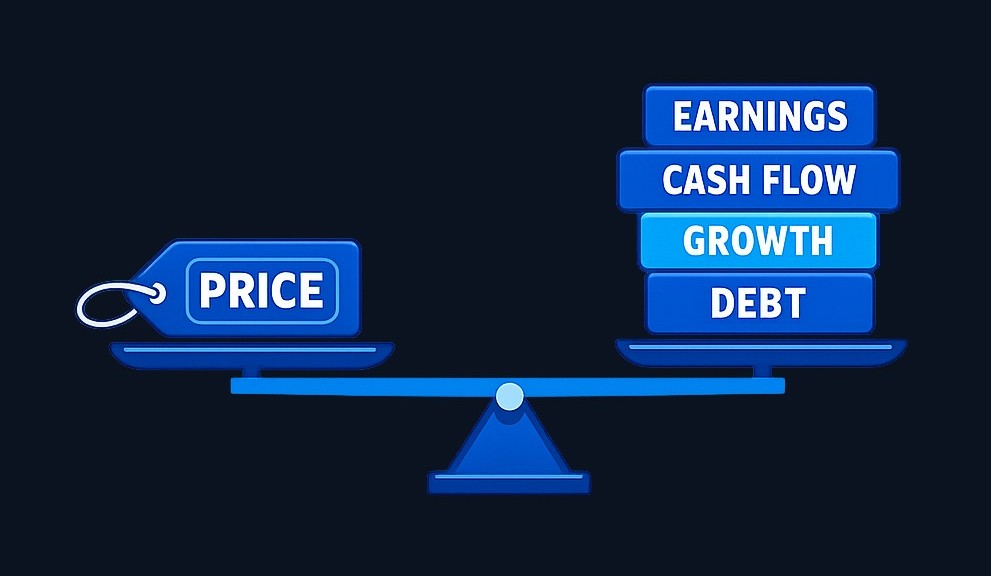
Strong businesses can still be poor investments if their shares are bought at prices that assume unrealistic growth. Conversely, a low valuation may reflect genuine financial problems. Comparing prices with earnings, cash flow, balance-sheet strength, and realistic growth expectations provides more context than the index level alone.
Practice investing with Finelo
Build practical investing skills with guided lessons, simulator practice, and structured challenges.
How to evaluate historical performance
A single return number rarely tells the full story. When reviewing a Russell 2000 chart or fund factsheet, use a consistent framework:
- Choose a meaningful period. A few weeks can be dominated by sentiment. Multi-year periods show more market environments, though past results still cannot predict future returns.
- Use total return when available. Price return and total return are different measures; confirm which one a chart displays.
- Compare like with like. Use the same dates, return type, and currency when comparing benchmarks.
- Look beyond the endpoint. Two investments can finish with similar returns while taking very different paths.
- Review drawdowns and recovery time. Consider how far an investment fell and how long it took to recover, not just its final gain.
- Account for investable-product costs. A tracking fund’s result can differ from its benchmark because of fees, trading costs, taxes, and tracking differences.
This approach is more dependable than selecting a fund because the Russell 2000 recently outperformed—or avoiding small caps solely because it recently lagged.
How can you invest in the Russell 2000?
You cannot purchase the index itself. The usual choices are a fund designed to track it or a portfolio of individual companies from the small-cap universe.
An index-tracking fund
An exchange-traded fund or mutual fund can provide broad exposure in a single holding. Before investing, verify:
- The benchmark the fund actually tracks
- Its expense ratio and other costs
- How closely its returns have followed the benchmark
- Trading liquidity and bid-ask spreads, where applicable
- Distribution and tax treatment
- Whether the position fits your time horizon and risk tolerance
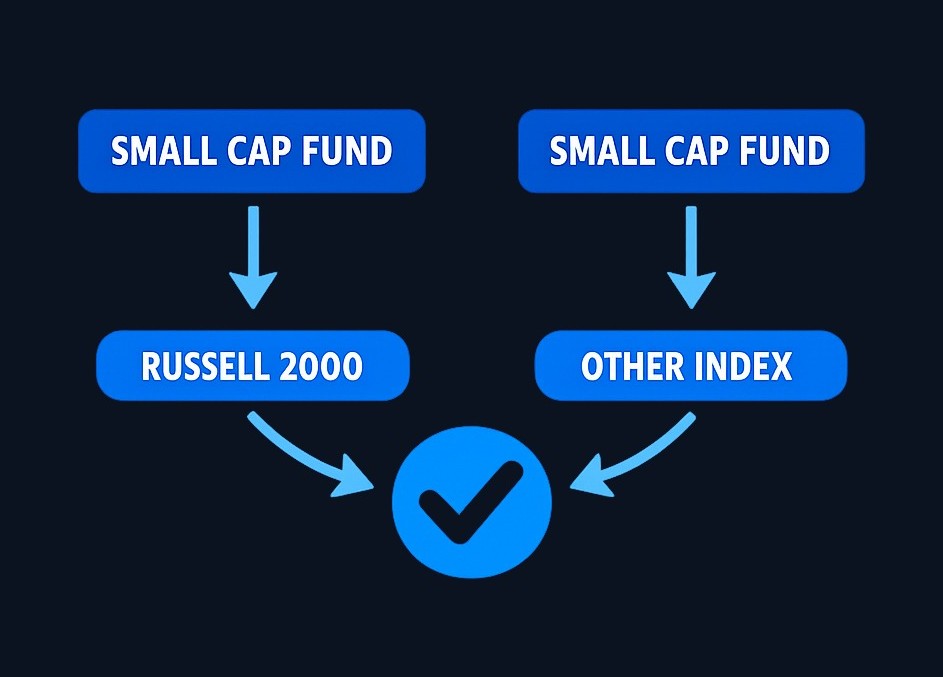
Fund names can sound similar, so confirm the stated index rather than relying on “small-cap” in the product name.
Individual small-cap stocks
Buying individual constituents offers more control but also requires more research. Investors need to assess each company’s finances, competitive position, management, valuation, and liquidity. Concentrating money in a few names also increases company-specific risk.
For beginners seeking general small-cap exposure, a diversified fund may be simpler to analyze than dozens of separate businesses. That is an educational observation, not a recommendation: suitability depends on the investor’s full financial situation.
Benefits and risks to consider
The Russell 2000 offers a broad view of an equity segment that can be underrepresented in portfolios dominated by large companies. Small-cap exposure may also behave differently from large-cap or international holdings, which can make it useful in portfolio construction.
The tradeoffs matter just as much:
- Smaller companies may have less diversified operations.
- Their shares may be less liquid.
- Financing conditions can affect them differently.
- Business setbacks can have an outsized impact.
- A small-cap fund can decline even though it owns many companies.
- Diversification across many stocks does not guarantee a profit or prevent loss.
The appropriate allocation, if any, depends on goals, investment horizon, existing holdings, capacity for loss, and the costs of the chosen product.
Practical next steps
Start by checking your current investments for existing small-cap exposure. Then compare any Russell 2000-tracking funds using the same criteria: benchmark, costs, tracking, liquidity, distributions, and risk. Finally, decide whether the exposure serves a defined portfolio purpose rather than reacting to recent performance.
Finelo provides financial education for people building their investing knowledge. Whatever learning resource you use, verify fund documents and costs independently, and consider professional advice if you need guidance tailored to your circumstances.
Frequently asked questions
Is the Russell 2000 the entire US stock market?
No. It focuses on the small-cap segment. The verified description says its approximately 2,000 companies represent about 10% of the US market, so it should not be treated as a complete US-market benchmark.
Is every Russell 2000 company a good investment?
No. Membership reflects index rules and market size, not a promise of quality or future performance. Each company still carries operational, financial, and valuation risks.
Does the Russell 2000 pay dividends?
The index is a measurement, so it does not make payments. A fund that tracks it may receive dividends from portfolio companies and handle them according to the fund’s own distribution policy. Check the product documents for details.
Is the Russell 2000 suitable for beginners?
It can be a useful benchmark for learning about small-cap stocks, but investing suitability is personal. A beginner should understand volatility, diversification, fees, and how small-cap exposure fits with the rest of a portfolio before acting.
InvestingBeginnerIndexesMarkets
Practice investing with Finelo
Build practical investing skills with guided lessons, simulator practice, and structured challenges.
About the author
Finelo Team
The Finelo Team creates practical investing and trading education designed to help beginners learn faster with structured challenges, simulator practice, and bite-sized lessons.
Keep reading — Related articles

Investing
I Bonds vs EE Bonds in 2026: Rates, Rules, and Which to Buy for the Long Run
Series I and Series EE savings bonds are both U.S. Treasury retail savings bonds sold on TreasuryDirect. They share ownership, tax treatment, and redemption rules; the key difference is the…
Finelo Team
Investing
Coverdell ESA vs 529 Plan: Limits, Flexibility, and Which to Choose
Quick answer (one minute) Both a Coverdell Education Savings Account (Coverdell ESA) and a 529 plan let money grow tax‑free and be withdrawn tax‑free for qualified education expenses. The…
Finelo Team
Investing
CD vs High Yield Savings Account: Where to Park Your Cash in 2026
Hero answer — CD vs high yield savings account in one line A CD (certificate of deposit) and a high yield savings account are both low‑risk, federally insured homes for cash — the difference…
Finelo Team