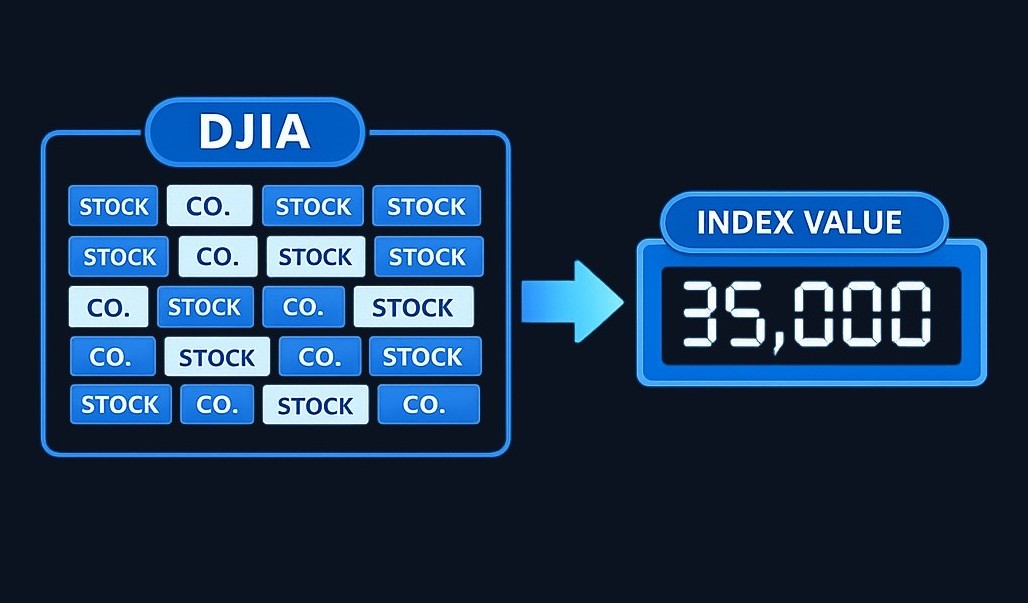
The Dow Jones Industrial Average (DJIA), often called “the Dow,” is a stock market index made up of 30 blue-chip U.S. company stocks. It acts as a compact benchmark: when the financial news says the Dow rose or fell, it is describing the combined movement of this selected basket—not every stock or the entire economy. Investor.gov explains that a market index tracks a basket representing a market or sector and identifies the DJIA as an index of 30 blue-chip U.S. stocks (Investor.gov).
What is the Dow Jones Industrial Average?
The Dow Jones Industrial Average (DJIA), often called “the Dow,” is a stock market index made up of 30 blue-chip U.S. company stocks. It acts as a compact benchmark: when the financial news says the Dow rose or fell…
6 min read
Practice investing with Finelo
Build practical investing skills with guided lessons, simulator practice, and structured challenges.
Want to learn more?
Build practical investing skills with guided lessons, simulator practice, and structured challenges.
Explore FineloExplore Finelo's 28-day challenges
Turn learning into a daily habit with guided challenge paths.
For beginners, the Dow is most useful as a quick market reference. It should not be treated as a complete picture of U.S. stocks or as a signal to buy or sell.
How the Dow works
Every index needs rules that determine which holdings matter most. The DJIA is price-weighted. That means a company with a higher share price has more influence on the index’s movement than a company with a lower share price, regardless of the companies’ relative sizes. FINRA summarizes the effect plainly: the higher a component’s stock price, the more weight it has in determining the index’s value (FINRA).
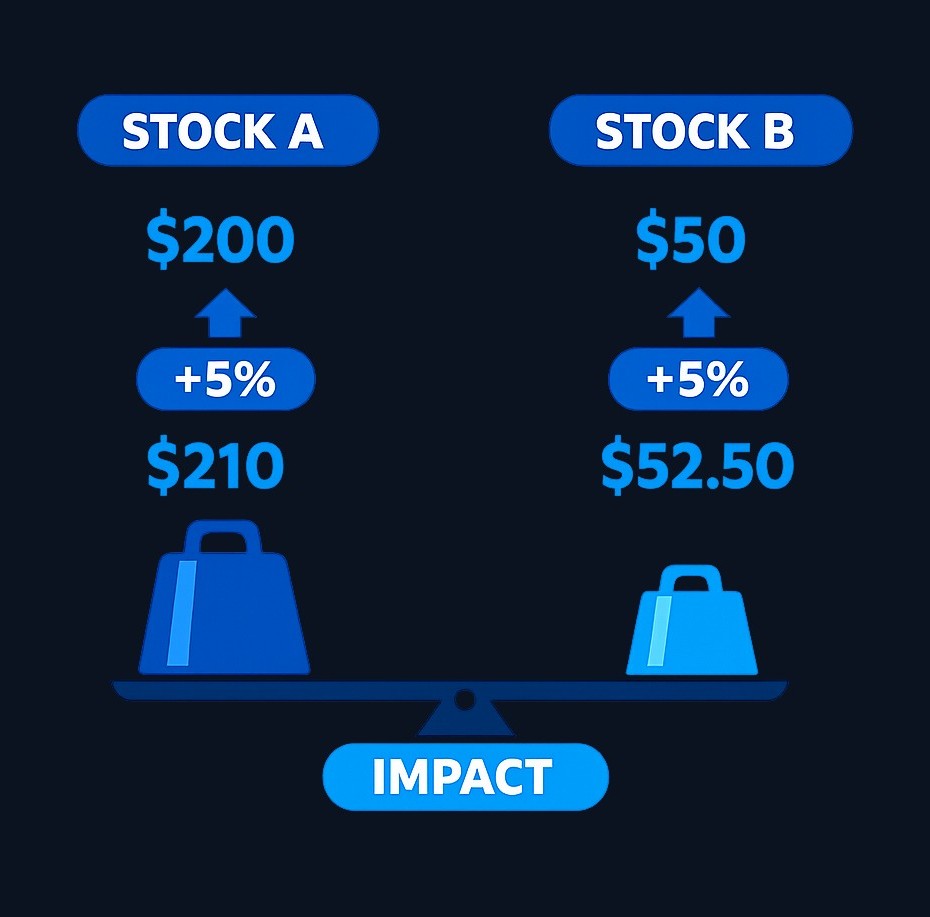
Consider a simplified example with two hypothetical Dow stocks:
- Stock A trades at $200 and rises 5%, gaining $10 per share.
- Stock B trades at $50 and rises 5%, gaining $2.50 per share.
Although both stocks gained the same percentage, Stock A would exert more influence because its dollar-price change was larger. The real DJIA calculation is more involved, but this example captures the key implication of price weighting.
This structure also explains why “the Dow gained 300 points” is not the same as saying every component rose or that the typical U.S. stock had an equally strong day. A few influential components can shape the reported movement.
What companies are in the DJIA?
The DJIA contains 30 established U.S. companies, but readers should use a current constituent list when they need the names. Index membership can be reviewed over time, so an undated list in an article or social post may become stale.
Rather than memorizing the lineup, understand what the list is intended to do: provide a small basket of prominent companies that can serve as a recognizable market benchmark. The number 30 also reveals an important limitation. The Dow can summarize the movement of its selected companies, but it cannot show what is happening in every listed business, smaller company, or market segment.
If you are checking the current components for research or an investment decision, verify both the publication date and the index provider’s latest information before relying on the list.
What moves the Dow?
The index moves when its component share prices move. Those prices can react to many kinds of information, including:
- Company earnings, forecasts, leadership changes, and product news
- Interest-rate expectations and inflation reports
- Employment, consumer spending, and broader economic data
- Geopolitical events and changes in investor sentiment
- Industry-specific developments
Price weighting adds another layer: an identical dollar move in two components has a similar direct effect on the index, while an identical percentage move can have different effects when their share prices differ.
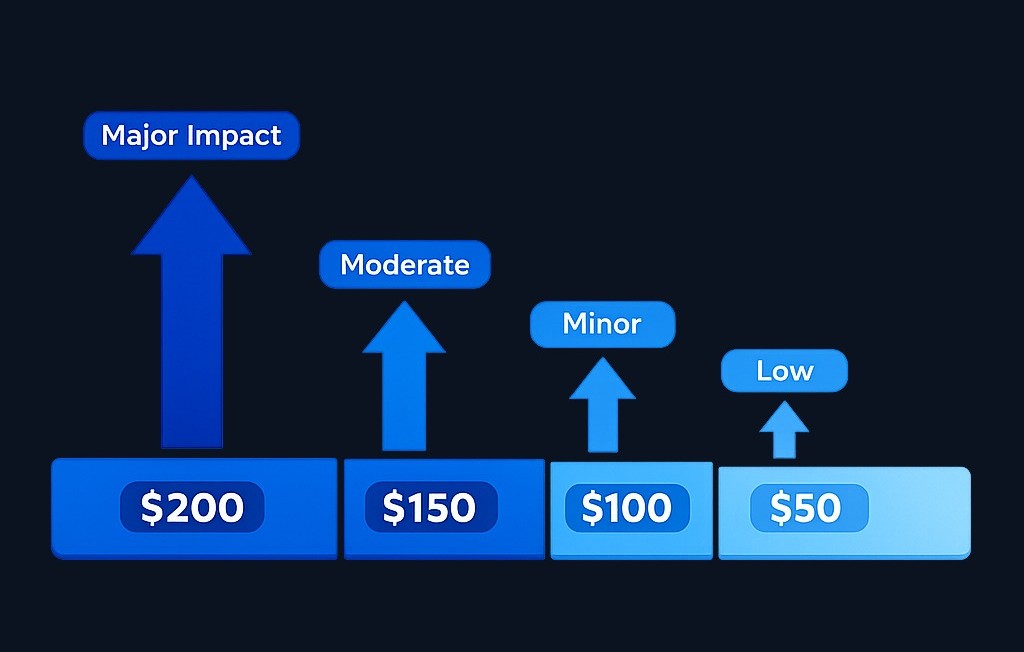
This is why a Dow move needs context. Ask whether the change was broad across many components or concentrated in a few, whether other indexes moved similarly, and what news may have influenced prices. A single session can reflect short-term reactions rather than a lasting economic trend.
DJIA vs. other stock market indexes
The Dow is only one lens on the market. Investor.gov lists it alongside indexes such as the S&P 500 and Wilshire 5000, illustrating that different baskets can represent different slices of the market (Investor.gov).
| Question | DJIA | A broader index |
|---|---|---|
| What does it track? | A selected basket of 30 blue-chip U.S. stocks | A larger basket defined by that index’s rules |
| How is influence assigned? | By share price | Often by another method, such as company size |
| Main strength | Simple, familiar snapshot | Wider coverage of companies or segments |
| Main limitation | Narrow selection and price weighting | May be less concise and can still omit parts of the market |
| Best use | Quick benchmark and news context | Broader market or portfolio comparison |
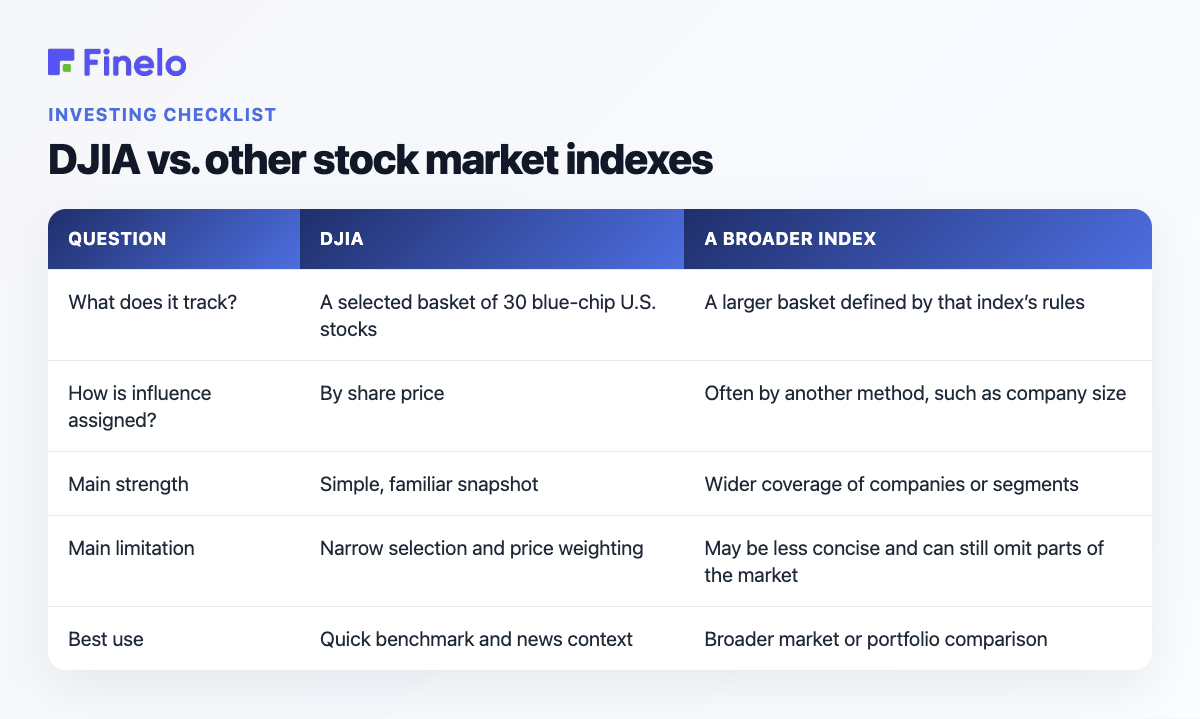
Neither lens is automatically “better.” The useful choice depends on the question. If you want to understand a Dow update, examine the DJIA. If you want a broader view of U.S. equities, compare it with a wider benchmark rather than relying on the Dow alone.
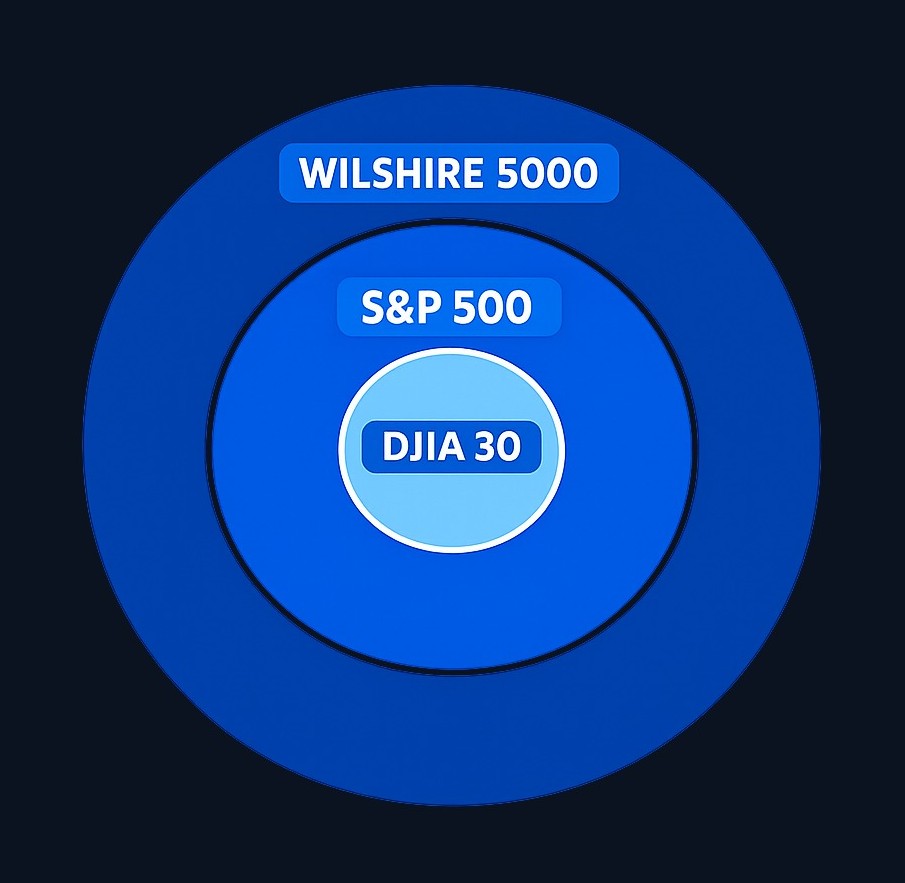
It is also better to compare like with like. A portfolio focused on one industry, company size, or geography may need a benchmark that resembles those holdings more closely.
Practice investing with Finelo
Build practical investing skills with guided lessons, simulator practice, and structured challenges.
Is the Dow an economic indicator?
The DJIA is often discussed as a sign of market mood because its components are widely recognized companies. Still, it directly measures stock-price movement within a specific basket—not employment, household income, inflation, or economic output.
The stock market and economy can influence each other, but they are not interchangeable. Markets look forward and can move on changing expectations. Economic data describes different aspects of present or past activity. Therefore, a rising Dow does not prove that every household or business is doing well, just as a falling Dow does not by itself establish that the whole economy is contracting.
A balanced reading combines the Dow with other market indexes, relevant economic data, and the time horizon being examined.
How can you invest in the Dow?
You cannot buy an index value itself. Investors commonly seek similar exposure through mutual funds or exchange-traded funds designed to mimic an index. FINRA specifically notes that mutual funds and ETFs may suit investors looking to replicate the performance of benchmarks such as the DJIA or S&P 500 (FINRA).
Before choosing any fund, review:
- What index it tracks and how closely its holdings follow that index
- Fees and trading costs
- Whether dividends are distributed or reinvested
- Tax considerations for your account and location
- Concentration risk and how the fund fits with your other holdings
An index-tracking product can simplify access, but it does not remove market risk. Its value can fall, and past performance cannot determine future results. This article is educational rather than personalized financial advice.
Strengths and limitations of the DJIA
The Dow’s appeal is clarity. It turns the movement of 30 stocks into one widely followed number and provides a common reference point for market conversations.
Its simplicity creates tradeoffs:
- Thirty companies cannot represent every part of the U.S. stock market.
- Price weighting gives greater influence to higher-priced shares, not necessarily larger businesses.
- A reported point move may be driven by only part of the basket.
- The index says little about diversification, valuation, risk tolerance, or whether an investment suits a particular person.
The practical lesson is not to ignore the Dow. It is to use it for the job it can do: provide a quick benchmark, then widen the analysis when making decisions.
A practical next-step framework
| Your goal | Useful next step |
|---|---|
| Understand today’s Dow move | Check the percentage move, not only the point change, and see whether the move was broad |
| Learn what the Dow represents | Review its current constituents and weighting method |
| Compare overall market conditions | Look at broader indexes and relevant economic data |
| Consider an index fund | Read the fund’s objective, holdings, fees, risks, and tax details |
| Build investing knowledge | Practice comparing benchmarks before committing money |
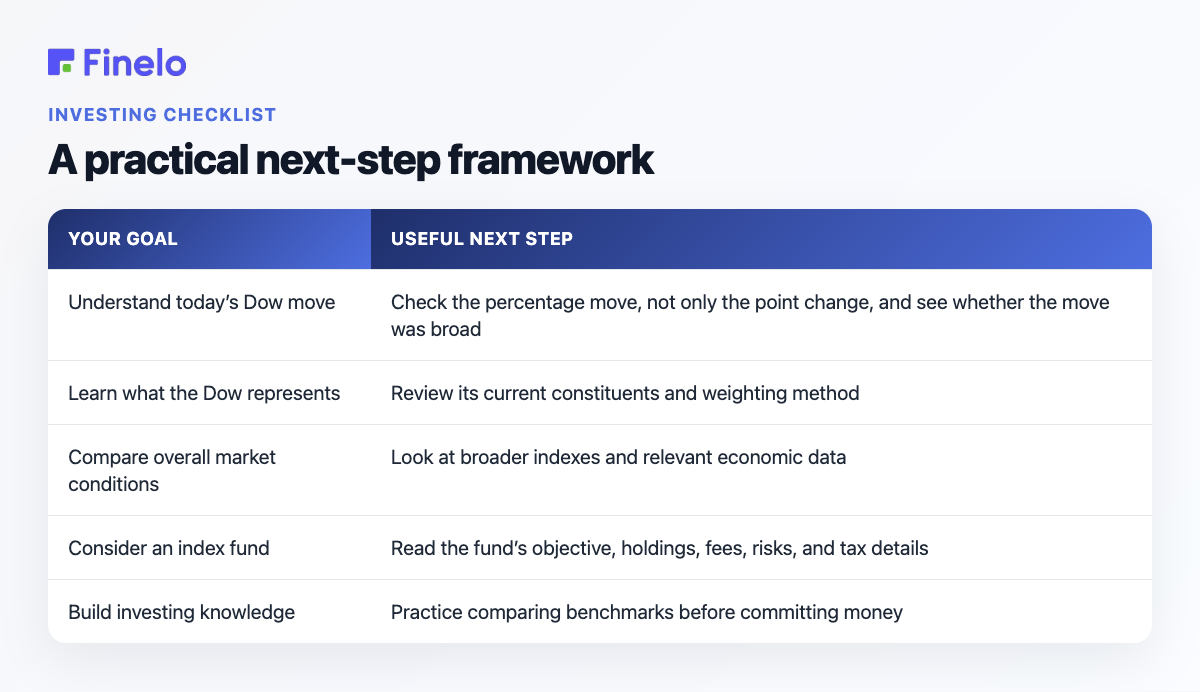
For beginners, the most valuable habit is to ask what a number includes, how it is calculated, and what it leaves out. Finelo’s educational focus can help readers build that questioning mindset before acting on market reports.
Frequently asked questions
Is the Dow the same as the stock market?
No. It tracks a basket of 30 blue-chip U.S. stocks, while the stock market contains many more companies and segments.
Why can one company affect the Dow so much?
Because the DJIA is price-weighted. A higher-priced component has more influence on the index’s value than a lower-priced component.
Is a higher Dow always good for investors?
Not necessarily. The effect depends on what an investor owns, the time period, costs, diversification, and personal circumstances. A higher index level does not mean every stock or portfolio increased.
Should beginners follow the Dow?
Yes, as one reference point. Pair it with broader benchmarks and learn how each index is constructed before drawing conclusions or making investment decisions.
InvestingBeginnerIndexesMarkets
Practice investing with Finelo
Build practical investing skills with guided lessons, simulator practice, and structured challenges.
About the author
Finelo Team
The Finelo Team creates practical investing and trading education designed to help beginners learn faster with structured challenges, simulator practice, and bite-sized lessons.
Keep reading — Related articles

Investing
I Bonds vs EE Bonds in 2026: Rates, Rules, and Which to Buy for the Long Run
Series I and Series EE savings bonds are both U.S. Treasury retail savings bonds sold on TreasuryDirect. They share ownership, tax treatment, and redemption rules; the key difference is the…
Finelo Team
Investing
Coverdell ESA vs 529 Plan: Limits, Flexibility, and Which to Choose
Quick answer (one minute) Both a Coverdell Education Savings Account (Coverdell ESA) and a 529 plan let money grow tax‑free and be withdrawn tax‑free for qualified education expenses. The…
Finelo Team
Investing
CD vs High Yield Savings Account: Where to Park Your Cash in 2026
Hero answer — CD vs high yield savings account in one line A CD (certificate of deposit) and a high yield savings account are both low‑risk, federally insured homes for cash — the difference…
Finelo Team