Tax-loss harvesting is an investing strategy in which you sell an investment that has fallen below its tax basis, realizing the loss so it can potentially reduce the effect of realized gains elsewhere in a taxable portfolio. The portfolio may then be reinvested in a different asset that still fits the investor’s plan.
What is Tax Loss Harvesting?

Tax-loss harvesting is an investing strategy in which you sell an investment that has fallen below its tax basis, realizing the loss so it can potentially reduce the effect of realized gains elsewhere in a taxable…
8 min read
Practice investing with Finelo
Build practical investing skills with guided lessons, simulator practice, and structured challenges.
Want to learn more?
Build practical investing skills with guided lessons, simulator practice, and structured challenges.
Explore FineloExplore Finelo's 28-day challenges
Turn learning into a daily habit with guided challenge paths.
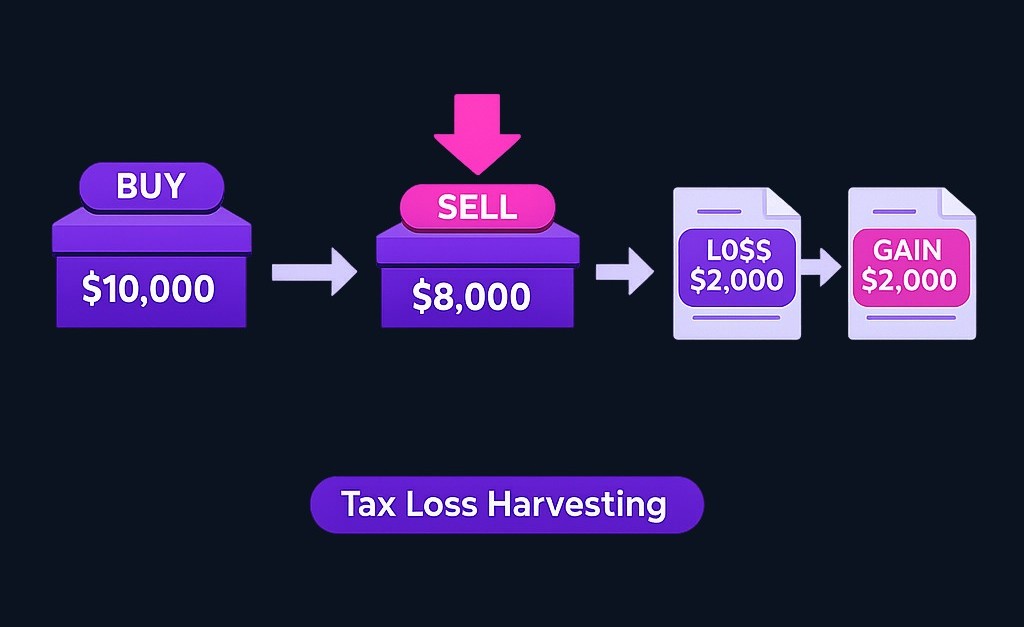
The idea sounds simple, but a useful decision involves more than finding a red number on a screen. You need to consider taxes, trading costs, portfolio exposure, timing rules, and whether the replacement investment still supports your long-term goals. Tax-loss harvesting can improve tax efficiency in the right situation, but it does not turn an unsuccessful investment into a profit or remove investment risk.
This Finelo guide is designed as investing education for beginners. It explains the decision process, but it does not execute trades or replace advice based on your own tax circumstances.
How tax-loss harvesting works
An investment’s market decline is only an unrealized loss while you continue to hold it. Selling converts that decline into a realized loss. For tax purposes, the calculation begins with the relationship between the sale proceeds and the investment’s adjusted basis.
The IRS explains that a sale produces a capital gain when the amount realized exceeds adjusted basis and a capital loss when it is lower. Basis is generally connected to what the owner paid, although individual circumstances can make the calculation more complex.
A basic tax-loss harvesting workflow looks like this:
- Review investments held in taxable accounts.
- Identify positions currently worth less than their adjusted basis.
- Decide whether selling still makes sense from an investment perspective.
- Estimate how the realized loss may interact with realized gains and the investor’s broader tax situation.
- Choose whether and how to reinvest without unintentionally undermining the intended tax treatment.
- Keep records of the original basis, sale, replacement purchase, and related costs.
Consider a simplified hypothetical example. An investor paid $10,000 for Investment A, which is now worth $8,000. Selling would create a $2,000 realized loss before considering fees or basis adjustments. Suppose the same investor had separately realized a $2,000 gain from Investment B. The loss may help offset the gain, subject to the tax rules that apply to the investor.
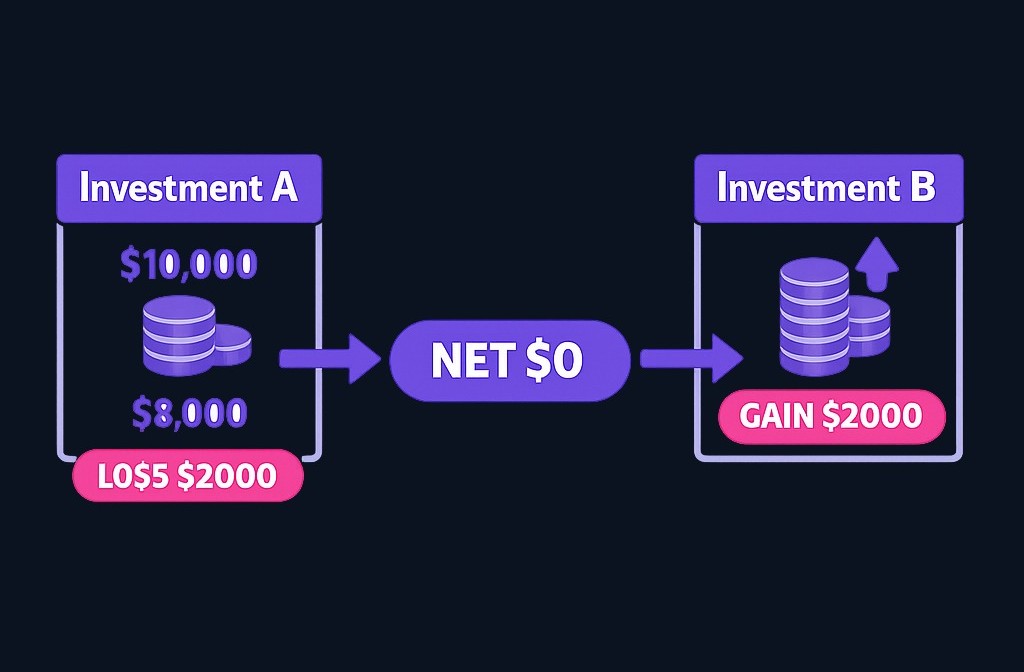
This example illustrates the mechanism, not a guaranteed tax result. Account type, holding period, other transactions, local taxes, and personal circumstances can all affect the outcome.
Realized loss versus economic loss
Tax-loss harvesting changes when a loss is recognized for tax purposes; it does not erase the economic loss. If an investment fell from $10,000 to $8,000, the portfolio still lost $2,000 of value before costs. The strategy seeks to make that loss more useful within a wider tax and investment plan.
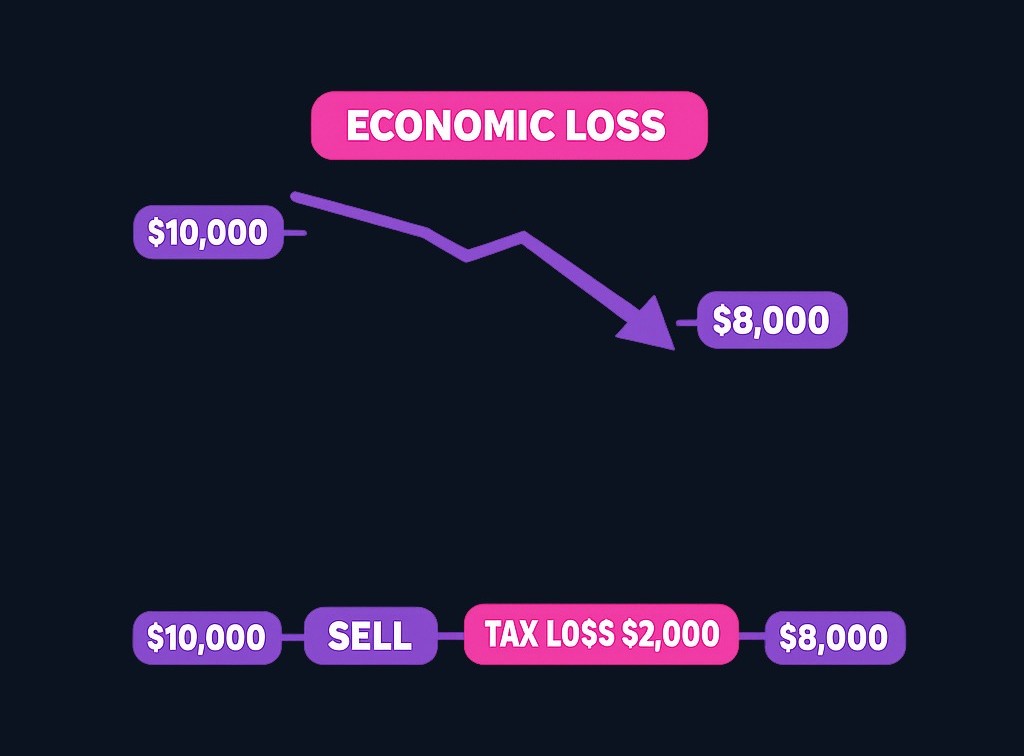
That distinction matters because tax considerations should not be allowed to dominate the portfolio decision. Selling a sound investment solely for a possible tax benefit may create a new problem if the replacement has different risk, cost, or return characteristics.
Potential benefits and trade-offs
The main potential benefit is tax efficiency. A realized loss may reduce the net gains that remain after gains and losses are considered together. Under current U.S. federal rules, if capital losses exceed capital gains, an individual may generally use the lesser of the remaining net loss or $3,000 to lower income; the limit is $1,500 for someone married filing separately. A net capital loss above the applicable limit can be carried forward to later years, according to the IRS guidance on capital losses.
Tax-loss harvesting can also support portfolio maintenance. Reviewing losing positions creates an opportunity to ask whether the original investment thesis still holds, whether a position has become too large or too small, and whether the portfolio’s allocation still matches its intended risk level.
However, every potential benefit has a corresponding trade-off:
| Decision factor | Possible advantage | Important trade-off |
|---|---|---|
| Realizing a loss | May improve the portfolio’s tax efficiency | The loss reflects a real decline in value |
| Reinvesting proceeds | Can maintain market exposure | The replacement may behave differently |
| Selling a weak holding | Can remove an investment that no longer fits | A later recovery may be missed |
| Rebalancing at the same time | Can bring allocation closer to plan | More trades can create costs and complexity |
| Harvesting repeatedly | Can capture opportunities throughout the year | Frequent activity increases monitoring and recordkeeping |
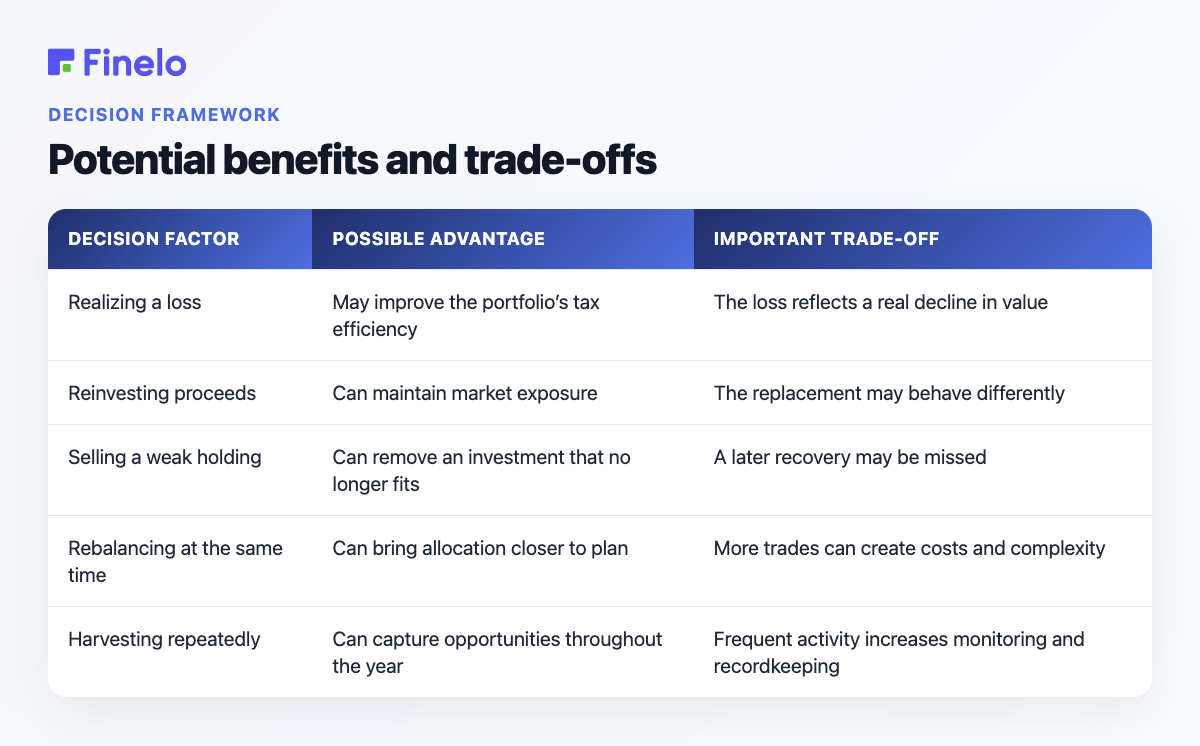
Tax savings should therefore be treated as one input, not the sole objective. A transaction that produces a tax benefit but leaves the investor with an unsuitable portfolio is not an obvious success.
A practical decision framework
Tax-loss harvesting is most relevant to investors with taxable investments, unrealized losses, and a reason to realize those losses within a broader plan. It may be less relevant when there are no suitable loss positions, the investments are held in accounts where current gains and losses are not treated in the same way, or the transaction would materially disrupt the desired portfolio.
Use this framework before acting:
1. Confirm that there is a real harvesting opportunity
Compare current value with adjusted basis rather than relying only on the price change shown for a position. Purchases made at different times may have different bases, and previous adjustments can matter.
2. Define the purpose of the sale
Ask what the transaction is meant to achieve:
- Offset a realized gain
- Exit an investment that no longer fits
- Rebalance the portfolio
- Create flexibility for future tax planning
If the only answer is “because the price is down,” the decision needs more analysis.
3. Evaluate the replacement
Decide whether you need continued exposure to the same part of the market. If so, assess whether an alternative investment offers an acceptable mix of risk, diversification, cost, and expected behavior. A replacement should be selected for portfolio fit, not merely because it makes the sale convenient.
4. Check transaction restrictions and tax consequences
Tax systems may restrict a loss when the investor quickly reacquires the same or a sufficiently similar investment. Related transactions across accounts or by related parties may also matter. Because the supplied evidence does not establish the rules for every situation, investors should verify the current requirements that apply before selling and repurchasing.
5. Compare the likely benefit with the total cost
Include commissions if applicable, bid-ask spreads, fund costs, advisory fees, and the risk of being out of the market. A small potential benefit can be overwhelmed by trading friction or an unsuitable replacement.
6. Document the decision
Save trade confirmations and basis records, and note why the replacement was chosen. Good documentation makes later tax preparation easier and helps prevent an isolated tax tactic from drifting away from the investment plan.
Practice investing with Finelo
Build practical investing skills with guided lessons, simulator practice, and structured challenges.
A simple tax-savings estimator
You can use a rough estimate to decide whether a harvesting opportunity deserves closer review:
Potential immediate tax effect = usable realized loss × applicable tax rate
For example, if a hypothetical $2,000 realized loss is fully usable against gains taxed at a hypothetical 15% rate, the estimated immediate effect would be:
$2,000 × 0.15 = $300
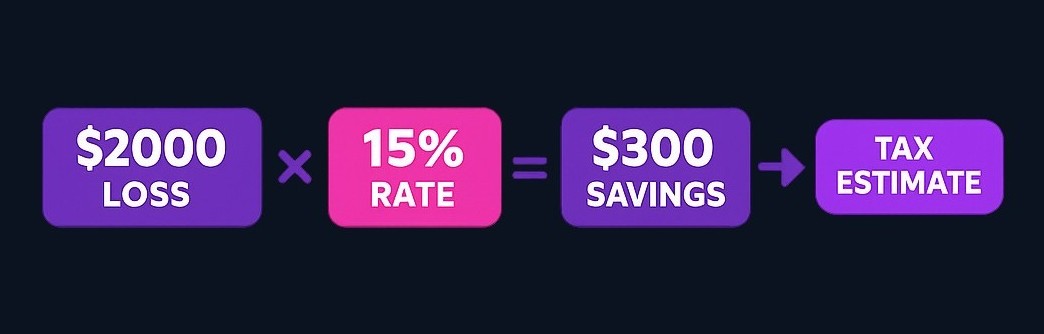
This is only a screening calculation. It does not account for transaction costs, basis changes, the tax treatment of a replacement investment, future gains, different rates, or state and local rules. It also assumes the entire loss is usable in the way modeled. Federal limits can restrict how much excess net capital loss lowers income in one year, while a larger unused amount may carry forward; verify the current IRS capital-loss rules and replace the hypothetical rate with one relevant to the type of gain and personal tax situation.
For a more realistic estimate, compare two paths:
- Harvest: estimated current tax effect minus trading costs and any expected disadvantage from the replacement.
- Hold: no realized loss now, continued exposure to the existing investment, and a later tax result that depends on the eventual sale.
The better path is not automatically the one with the larger current-year tax effect. Deferring tax, changing basis, or switching investments can shift consequences into the future rather than eliminate them.
Common mistakes to avoid
Letting taxes drive the entire investment decision
Taxes matter, but portfolio quality comes first. Do not exchange a diversified, low-cost holding for a poorly understood alternative merely to realize a loss.
Ignoring timing and repurchase rules
Selling and quickly buying back the same or a similar investment may prevent the loss from receiving the treatment you expected. Review all potentially connected transactions before placing trades, including automatic purchases and activity in other accounts.
Looking Only at the Position’s Displayed Return
The displayed return may not equal the tax loss available. Adjusted basis, multiple purchase lots, reinvested distributions, and prior transactions can change the calculation.
Forgetting costs
Even when a platform charges no visible commission, trading may still involve spreads, fund expenses, taxes, or time out of the market. Compare the expected benefit with all meaningful costs.
Harvesting too little or too late
Waiting until the final days of a tax year can compress decision-making and reduce replacement choices. Periodic reviews can reveal opportunities earlier, although frequent trading for its own sake is not the goal.
Assuming federal and state treatment is identical
State and local tax rules may differ from federal treatment. A strategy assessed only through a federal lens may produce a misleading estimate of the overall result.
Next steps
Start by listing taxable holdings, adjusted basis, current value, unrealized gain or loss, and any gains already realized. Then identify only the positions that would still be reasonable to sell without weakening the portfolio. Before trading, verify the current tax restrictions, estimate costs, and decide what the proceeds should own next.
Tax-loss harvesting is best understood as a portfolio and tax-management tool—not a shortcut to better returns. Used carefully, it may make an existing loss more useful. Used carelessly, it can add cost, complexity, and unintended exposure. This article is educational and does not replace advice based on your individual financial and tax circumstances.
Frequently asked questions
Is tax-loss harvesting right for every investor?
No. It is mainly a consideration for investors who hold assets in taxable accounts and have unrealized losses that may be useful within their tax plan. The benefit may be limited when there are no realized gains, transaction costs are high, or an appropriate replacement is difficult to find.
What investments can be used for tax-loss harvesting?
The starting point is an investment in a taxable account whose current value is below its adjusted basis. Whether a particular asset and replacement are suitable depends on the applicable tax rules and the investor’s portfolio objectives.
How often should a portfolio be reviewed?
There is no single schedule that fits everyone. Reviews can be tied to regular portfolio checkups, major market movements, realized gains, or changes in the investor’s tax situation. The purpose is to make deliberate decisions, not to encourage constant trading.
Can I do tax-loss harvesting myself?
Some investors can review basis, lots, gains, losses, and replacement choices themselves. More complex portfolios may justify help from a qualified tax professional or financial professional, particularly when several accounts, jurisdictions, related-party transactions, or large gains are involved.
InvestingBeginnerTaxesMarkets
Practice investing with Finelo
Build practical investing skills with guided lessons, simulator practice, and structured challenges.
About the author
Finelo Team
The Finelo Team creates practical investing and trading education designed to help beginners learn faster with structured challenges, simulator practice, and bite-sized lessons.
Keep reading — Related articles

Investing
I Bonds vs EE Bonds in 2026: Rates, Rules, and Which to Buy for the Long Run
Series I and Series EE savings bonds are both U.S. Treasury retail savings bonds sold on TreasuryDirect. They share ownership, tax treatment, and redemption rules; the key difference is the…
Finelo Team
Investing
Coverdell ESA vs 529 Plan: Limits, Flexibility, and Which to Choose
Quick answer (one minute) Both a Coverdell Education Savings Account (Coverdell ESA) and a 529 plan let money grow tax‑free and be withdrawn tax‑free for qualified education expenses. The…
Finelo Team
Investing
CD vs High Yield Savings Account: Where to Park Your Cash in 2026
Hero answer — CD vs high yield savings account in one line A CD (certificate of deposit) and a high yield savings account are both low‑risk, federally insured homes for cash — the difference…
Finelo Team