Venture capital (VC) is money invested in young businesses in exchange for equity, or an ownership stake. It is generally aimed at startups and early-stage companies that need capital to develop a product, hire people, enter markets, or expand. UK government guidance defines venture capital as equity investment at the startup and early-development stages. It contrasts VC with private equity investment in more established businesses (GOV.UK).
What is Venture Capital?
Venture capital (VC) is money invested in young businesses in exchange for equity, or an ownership stake. It is generally aimed at startups and early-stage companies that need capital to develop a product, hire people…
9 min read
Practice investing with Finelo
Build practical investing skills with guided lessons, simulator practice, and structured challenges.
Want to learn more?
Build practical investing skills with guided lessons, simulator practice, and structured challenges.
Explore FineloExplore Finelo's 28-day challenges
Turn learning into a daily habit with guided challenge paths.
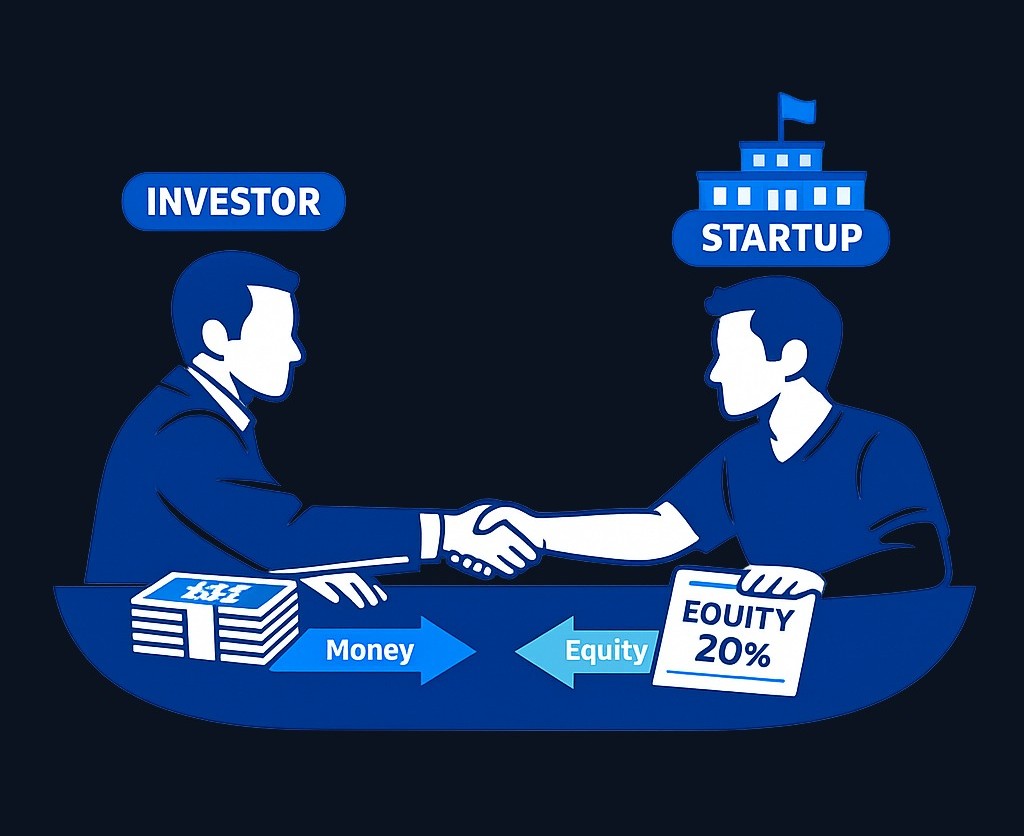
VC can give a startup resources to grow before it can fund that growth from its own operations. The tradeoff is that founders give up some ownership and accept new investors who may influence major decisions.
How Venture Capital Works
Venture capital connects businesses seeking growth funding with investors willing to accept substantial uncertainty. Equity investors provide money in exchange for company shares. They expect the company to use that money to build value, although a profitable outcome is never assured (GOV.UK).
The process usually involves three groups:
- Founders build the company and seek funding.
- Venture capital firms evaluate opportunities, invest, and oversee a portfolio of companies.
- Limited partners supply capital to a venture fund. The VC managers choose and oversee the individual investments.
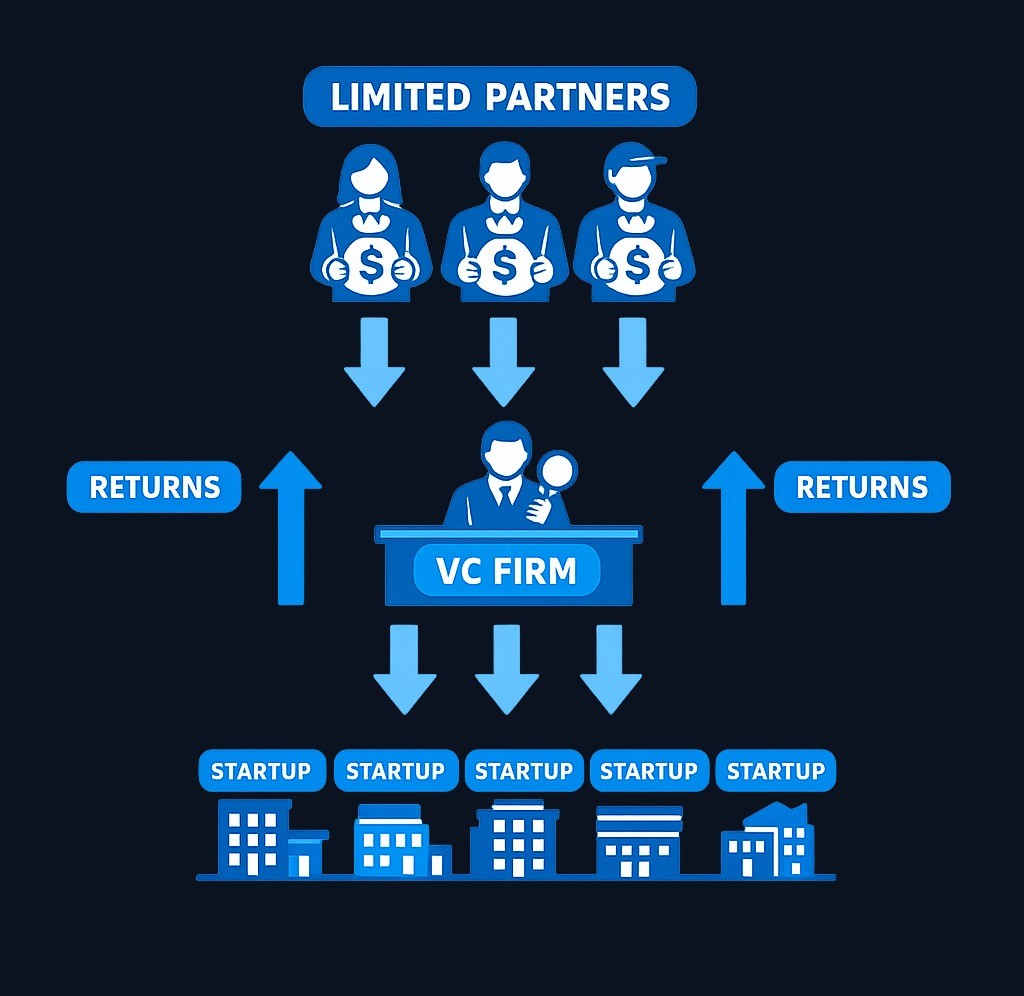
A VC firm does not simply hand over money. Before investing, it conducts due diligence: examining the team, product, market, business model, financial assumptions, legal structure, and major risks. If the firm wants to proceed, it proposes deal terms.
Those terms commonly address the company’s valuation, the investor’s ownership, board participation, voting rights, information rights, and what happens in a future sale or financing. Both sides negotiate because the stated investment amount does not tell the whole story. A smaller investment with founder-friendly terms may be more attractive than a larger offer that sharply reduces control or creates difficult obligations.
After a deal closes, the startup uses the capital according to its operating plan. Investors monitor progress and may help with recruitment, introductions, strategy, or later fundraising. Their involvement varies: some are active partners, while others take a lighter approach.
VC is typically a long-term investment. Rather than receiving regular loan repayments, an investor depends on a future opportunity to sell the ownership stake. Government guidance notes that VCs raise money from other investors and usually seek an exit when a company is acquired or lists its shares publicly (GOV.UK). There is no guaranteed exit, and a startup may fail before one occurs.
Stages of Venture Capital Investment
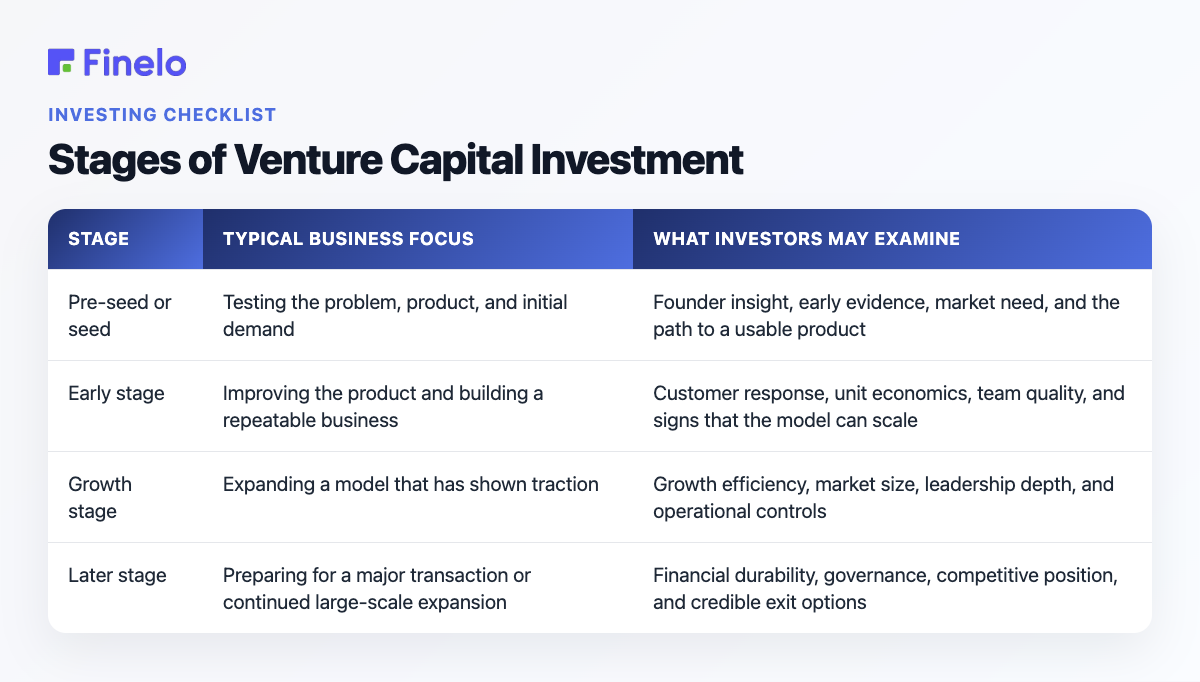
Startup financing is often described in stages, but the labels are flexible. Two companies at the same named round may have very different levels of revenue, risk, or maturity.
| Stage | Typical business focus | What investors may examine |
|---|---|---|
| Pre-seed or seed | Testing the problem, product, and initial demand | Founder insight, early evidence, market need, and the path to a usable product |
| Early stage | Improving the product and building a repeatable business | Customer response, unit economics, team quality, and signs that the model can scale |
| Growth stage | Expanding a model that has shown traction | Growth efficiency, market size, leadership depth, and operational controls |
| Later stage | Preparing for a major transaction or continued large-scale expansion | Financial durability, governance, competitive position, and credible exit options |
A financing round is usually meant to fund progress toward the next set of milestones. A seed-stage business might use capital to finish a product and test demand. A later-stage company might focus on expanding into new markets or strengthening the organization needed to operate at greater scale.
As a company raises additional rounds, its ownership becomes divided among more shareholders. Founders and early employees can experience dilution: their percentage ownership falls when new shares are issued. Dilution is not automatically good or bad. The key question is whether the new capital and support create enough value to justify the smaller percentage.
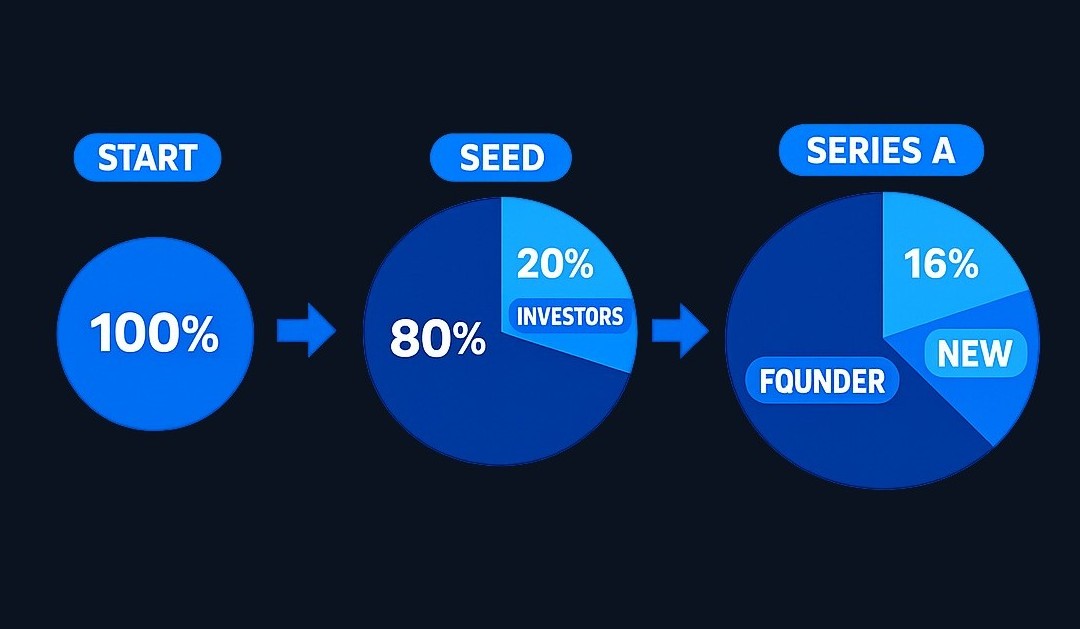
The cycle can end in several ways. A company may be acquired, become publicly traded, remain private for an extended period, return limited proceeds, or close. Because outcomes are uncertain, VC firms evaluate investments as part of a portfolio rather than assuming every company will succeed.
The Role of Venture Capital in Innovation
VC is most relevant when a company has a credible opportunity to grow but cannot reasonably finance that opportunity through current cash flow alone. It can accelerate product development, hiring, distribution, or geographic expansion. If a startup hires engineers, salespeople, support staff, or operations specialists, the funding can also translate into job creation—but only if the business plan and demand justify those roles.
Venture investment can support experimentation that would be difficult under a short repayment schedule. A startup can spend time developing technology or testing a market without making monthly principal payments on the investment itself. That flexibility does not remove pressure. It changes the source of pressure from scheduled debt repayment to ambitious growth milestones and investor expectations.
VC can also provide relationships and experience. A suitable investor may understand the company’s industry, know potential executives or commercial partners, and recognize challenges the founders have not encountered before.
These benefits are not automatic. Capital can magnify a strong strategy, but it can also magnify waste. Hiring too quickly, expanding before demand is proven, or pursuing growth simply to satisfy fundraising expectations can weaken a company.
Geography matters because investor networks, industries, talent, customers, and regulations are not evenly distributed. However, founders should not assume that a well-known startup hub is the only place to find capital. The more useful question is where the investors with relevant stage, sector, check size, and geographic appetite are located.
Practice investing with Finelo
Build practical investing skills with guided lessons, simulator practice, and structured challenges.
Benefits and Challenges of Venture Capital
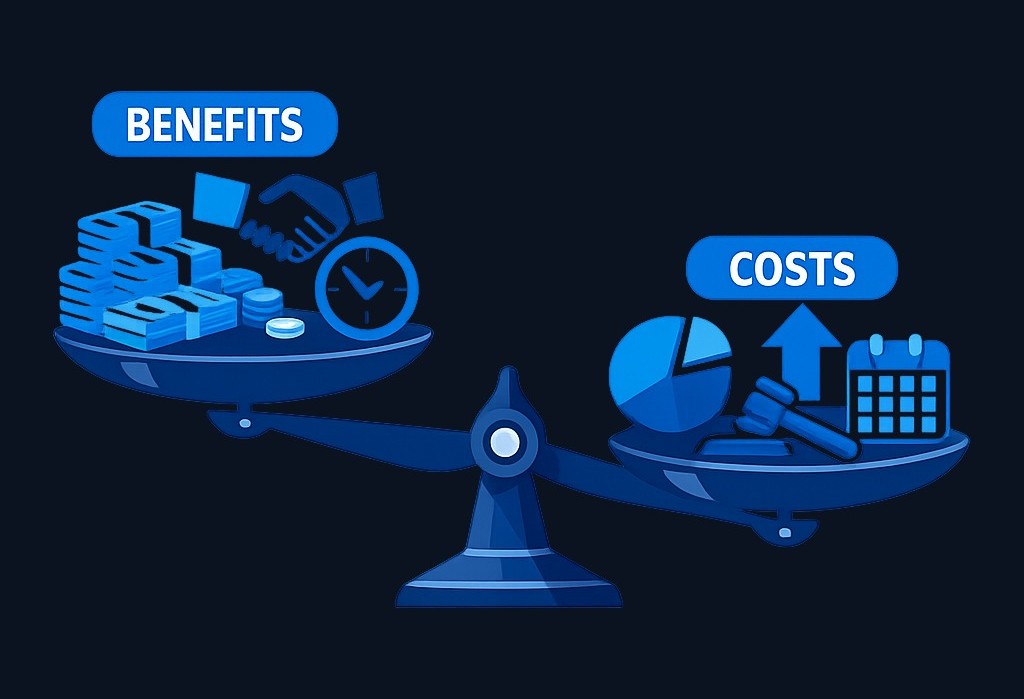
Venture capital is one tool, not the default answer for every startup. Its main potential benefits are access to growth capital, time to develop the business, and support from experienced investors. Its main costs are dilution, shared control, and pressure to pursue a large outcome.
Founders should compare VC with the company’s actual needs and the consequences of each funding source.
| Funding option | What the provider receives | Potential fit | Main tradeoff |
|---|---|---|---|
| Venture capital | Equity and negotiated investor rights | A business pursuing rapid, capital-intensive growth | Dilution, oversight, and pressure for a large outcome |
| Angel investment | Usually equity, often from an individual | Earlier funding needs or a smaller round | Terms, expertise, and involvement vary widely |
| Debt | Repayment with interest | A business that can support scheduled payments | Repayment obligations remain even if growth slows |
| Crowdfunding | Depends on the model: rewards, products, debt, or equity | A business with a reachable community or customer story | Campaign effort, disclosure, platform rules, and fulfillment risk |
| Bootstrapping | No outside investor ownership | A business able to grow from founder resources or operating cash | Slower growth and concentrated personal or business risk |
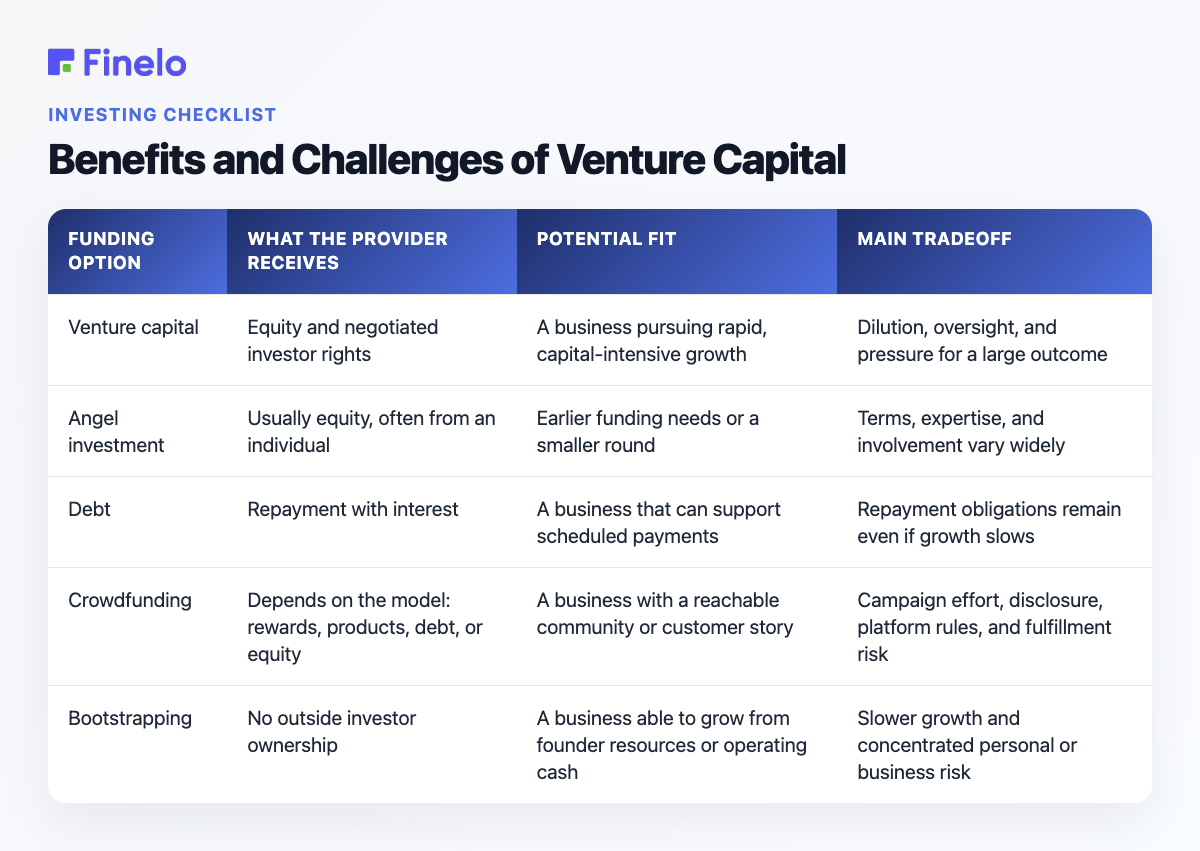
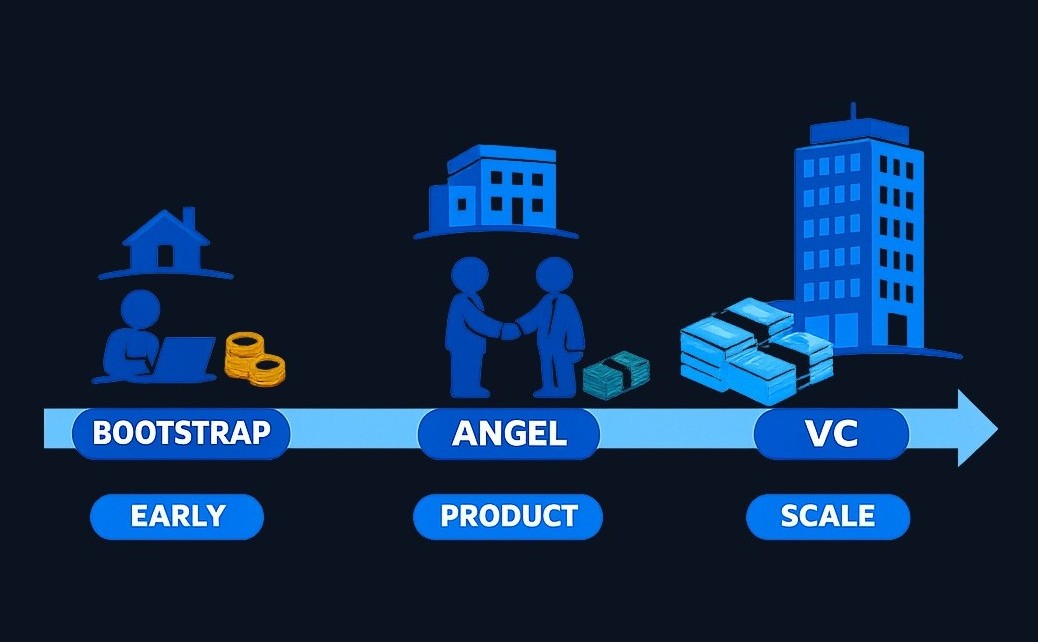
The best option may also be a sequence or combination. A founder could bootstrap early testing, raise angel capital for product development, and seek VC only after gaining evidence that a larger opportunity exists. Funding strategy should follow the business rather than a desire to collect impressive round labels.
Risks and ethical questions
For founders, the clearest benefit is access to capital without treating the investment as a conventional loan. Other possible advantages include strategic input, recruiting help, credibility with commercial partners, and support in future rounds.
The costs can be significant:
- Loss of ownership: Each equity round can reduce the founders’ percentage stake.
- Reduced autonomy: Investors may receive board seats or approval rights over important actions.
- Growth pressure: The company may be encouraged to pursue a scale and timeline that fit a venture portfolio.
- Fundraising distraction: Preparing materials, meeting investors, negotiating, and conducting diligence can consume management time.
- Misaligned expectations: Founders and investors may disagree about spending, leadership, further financing, or an exit.
- Failure risk: More money does not guarantee a viable product, durable demand, or a successful outcome.
VC also raises broader ethical questions. A growth-first strategy can affect employees, customers, communities, competitors, and the environment. Founders should ask not only whether a plan can scale, but whether its incentives encourage responsible behavior. Investors should consider how governance, workforce decisions, data use, product safety, and social impact fit into diligence and oversight.
Access is another concern. Investment decisions are made through human networks and judgment, so founders without established connections may face additional barriers. A sound evaluation process should focus on evidence and relevant risks while actively checking whether familiarity or pattern-matching is excluding capable teams.
How Venture Capitalists Evaluate a Startup
There is no universal scorecard, but founders can prepare around a practical set of questions:
- Is the problem meaningful? The company should explain who experiences it and why solving it matters.
- Why this solution? Investors need to understand the product’s value and what makes adoption plausible.
- Why this team? Relevant experience, execution ability, integrity, and learning speed all matter.
- How large could the opportunity become? VC economics tend to favor businesses that can grow far beyond a small local market.
- What evidence exists? Depending on the stage, this might include research, prototypes, customer conversations, usage, revenue, or retention.
- What could break the plan? Competition, regulation, technical difficulty, customer concentration, and weak economics should be addressed honestly.
- What will this round achieve? A clear use of funds links the requested capital to measurable operating milestones.
Founders should research each firm before making contact. A strong target list matches the startup’s stage, sector, location, financing needs, and values. A personalized introduction is useful, but a concise direct approach can still work when it quickly explains the problem, solution, evidence, team, and reason for contacting that investor.
Before accepting an offer, founders should examine the full term sheet with qualified legal and financial professionals. Valuation matters, but governance rights, liquidation terms, future dilution, founder restrictions, and decision authority can matter just as much.
Case Study: A Startup’s VC Decision
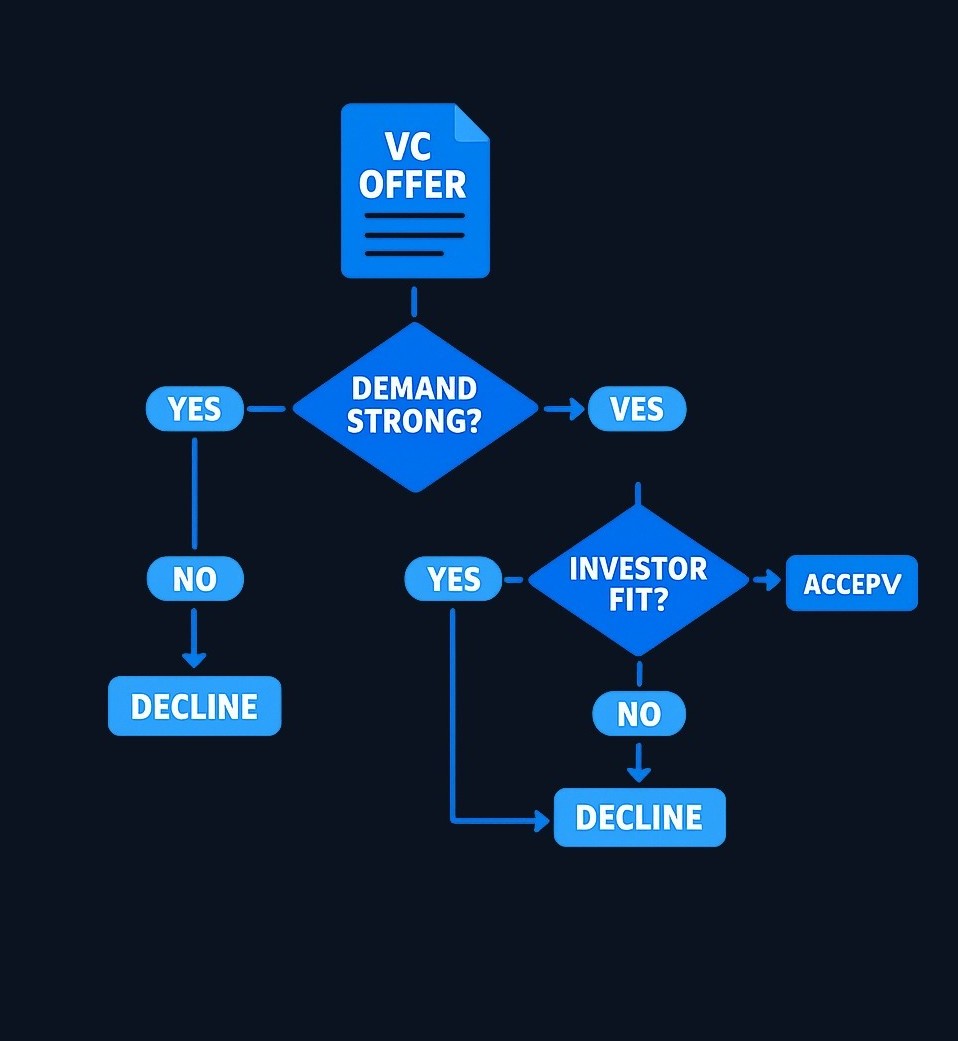
Consider a fictional software startup that has built a useful product and won a small group of loyal customers. Demand is promising, but the company needs to hire engineers and sales staff before revenue can cover those costs.
The founders have three broad choices. They can grow slowly from customer revenue, borrow money and accept repayments, or raise equity. A VC offer would provide more room to hire and expand. In return, the investor would receive shares and a role in major decisions.
The founders should not decide from the investment amount alone. They need to test the plan:
- Is demand strong enough to justify faster hiring?
- What milestone will the funding reach?
- How much ownership will the founders give up?
- Which decisions will require investor approval?
- Does the investor understand the market?
- What happens if growth is slower than expected?
If the evidence for rapid expansion is weak, taking VC could increase pressure without solving the core problem. If demand is strong and the investor is well matched, the funding could help the company act sooner. The lesson is simple: venture capital is useful when it fits a credible plan, not merely because it is available.
Conclusion and Next Steps
Venture capital may be worth exploring when the company can make productive use of substantial funding, has a potentially large market, and is prepared for shared ownership and investor oversight. It may be a poor fit when the founders want to preserve control, the business can grow sustainably from revenue, or the likely outcome is not large enough to match a venture investor’s expectations.
Use this checklist before fundraising:
- Define the amount needed and the milestones it should fund.
- Compare equity financing with debt, crowdfunding, angel capital, and bootstrapping.
- Model how multiple rounds could affect ownership.
- Decide which governance rights are acceptable.
- Identify investors whose focus matches the company.
- Prepare both the growth case and the downside risks.
- Get professional advice before signing binding documents.
For readers learning how investments and business funding fit together, Finelo offers a starting point for continuing financial education. Educational material can improve your questions, but it does not replace legal, tax, or personalized financial advice.
Frequently asked questions
What is the main difference between venture capital and private equity?
Both involve equity investment, but venture capital generally focuses on startups and early-development businesses, while private equity is often associated with more established companies ([GOV.UK](https://www.gov.uk/hmrc-internal-manuals/international-manual/intm519010)). The boundaries can vary in everyday industry usage.
Do startups have to repay venture capital?
Venture capital is equity, not a conventional loan with scheduled principal repayments. Investors receive ownership and accept the risk that the stake may lose value. The company must still follow the rights and obligations in its investment agreements.
How do founders find venture capital investors?
Start by identifying firms that invest in the relevant stage, industry, geography, and round size. Then prepare a clear explanation of the problem, product, evidence, team, funding need, and planned milestones. Introductions can help, but relevance and clarity are more important than contacting the largest possible number of firms.
Can an individual invest in venture capital?
Access depends on the investment structure, eligibility rules, location, and provider. Venture investments can be illiquid and highly uncertain, so anyone considering them should review the risks, fees, time horizon, and suitability with an appropriately qualified professional.
InvestingBeginnerPrivate MarketsMarkets
Practice investing with Finelo
Build practical investing skills with guided lessons, simulator practice, and structured challenges.
About the author
Finelo Team
The Finelo Team creates practical investing and trading education designed to help beginners learn faster with structured challenges, simulator practice, and bite-sized lessons.
Keep reading — Related articles

Investing
I Bonds vs EE Bonds in 2026: Rates, Rules, and Which to Buy for the Long Run
Series I and Series EE savings bonds are both U.S. Treasury retail savings bonds sold on TreasuryDirect. They share ownership, tax treatment, and redemption rules; the key difference is the…
Finelo Team
Investing
Coverdell ESA vs 529 Plan: Limits, Flexibility, and Which to Choose
Quick answer (one minute) Both a Coverdell Education Savings Account (Coverdell ESA) and a 529 plan let money grow tax‑free and be withdrawn tax‑free for qualified education expenses. The…
Finelo Team
Investing
CD vs High Yield Savings Account: Where to Park Your Cash in 2026
Hero answer — CD vs high yield savings account in one line A CD (certificate of deposit) and a high yield savings account are both low‑risk, federally insured homes for cash — the difference…
Finelo Team