OTM means “out of the money.” In options trading, an OTM option is a call or put option with zero intrinsic value; any price it still has comes from time value and other external factors, often called extrinsic value out-of-the-money definition. A call is OTM when its exercise price sits above the underlying market price; for a put, the relationship is reversed OTM call and put examples.
Understanding OTM: Out of the Money Explained
OTM means “out of the money.” In options trading, an OTM option is a call or put option with zero intrinsic value; any price it still has comes from time value and other external factors, often called extrinsic value out...
11 min read
Practice trading with Finelo
Practice in a simulator, learn with bite-sized lessons, and build confidence before risking real money.
Want to learn more?
Practice in a simulator, learn with bite-sized lessons, and build confidence before risking real money.
Explore FineloExplore Finelo's 28-day challenges
Turn learning into a daily habit with guided challenge paths.
This guide is for beginners who want a clear, practical explanation before using OTM in trading or encountering the same abbreviation in mutual fund payment setup.
What Does OTM Mean in Trading?
In options, “money-ness” describes the relationship between an option’s strike price and the current market price of the underlying asset. OTM is one of three common categories:
- OTM — out of the money
- ATM — at the money
- ITM — in the money
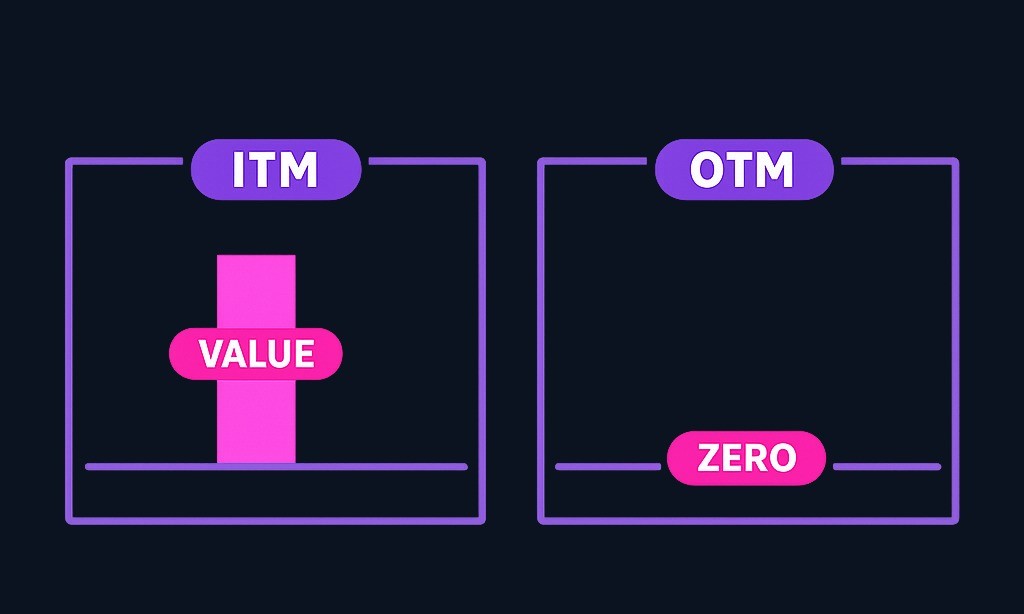
An OTM option does not currently have intrinsic value. That does not mean it has no price before expiration. It may still trade for a premium because the market assigns value to time remaining, volatility expectations, and other external factors. For OTM options, that premium is entirely extrinsic value because the option has zero intrinsic value OTM premium explanation.
Simple example
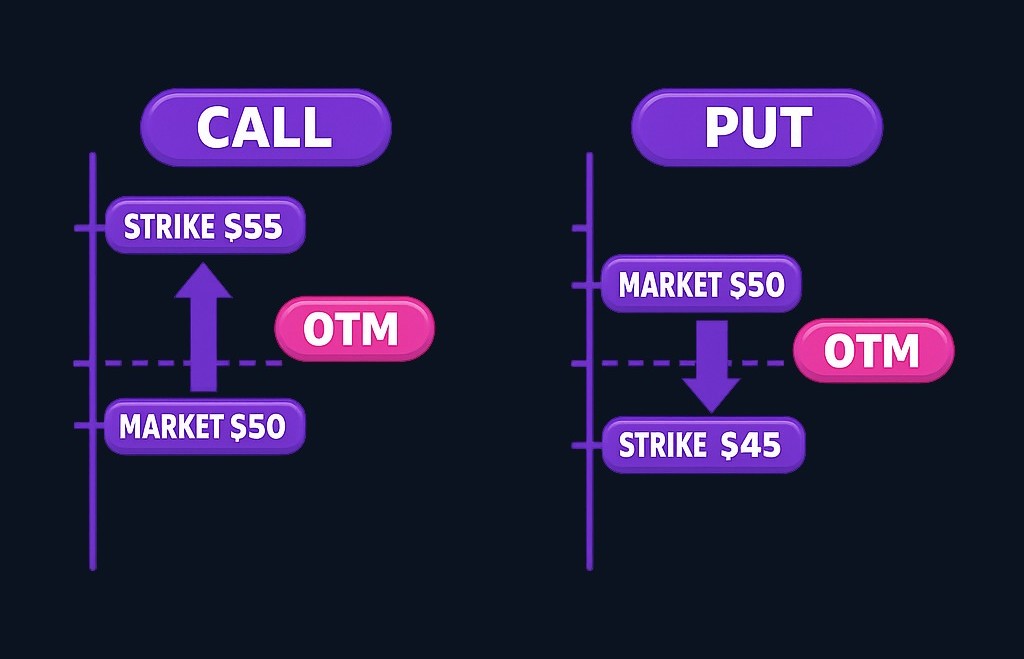
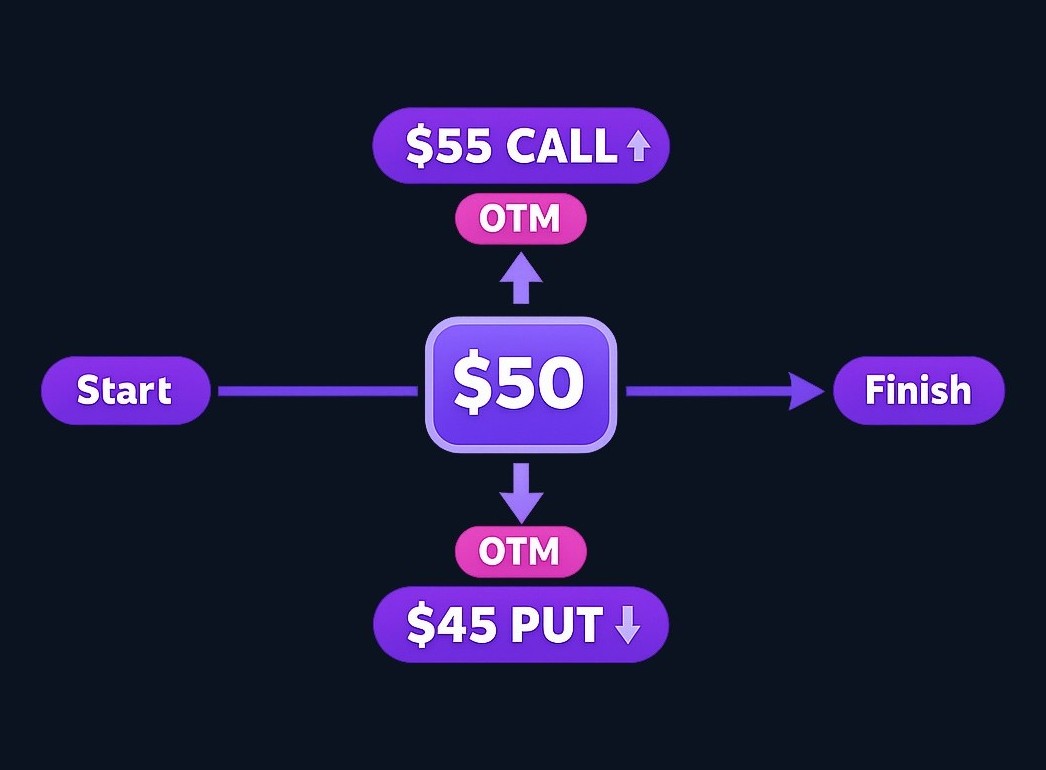
Suppose a stock is trading at $50.
- A $55 call option is OTM because the call’s strike price is above the current stock price.
- A $45 put option is OTM because the put’s strike price is below the current stock price.
In both cases, the option would need the underlying asset to move favorably before it could become in the money.
OTM vs ITM vs ATM Options
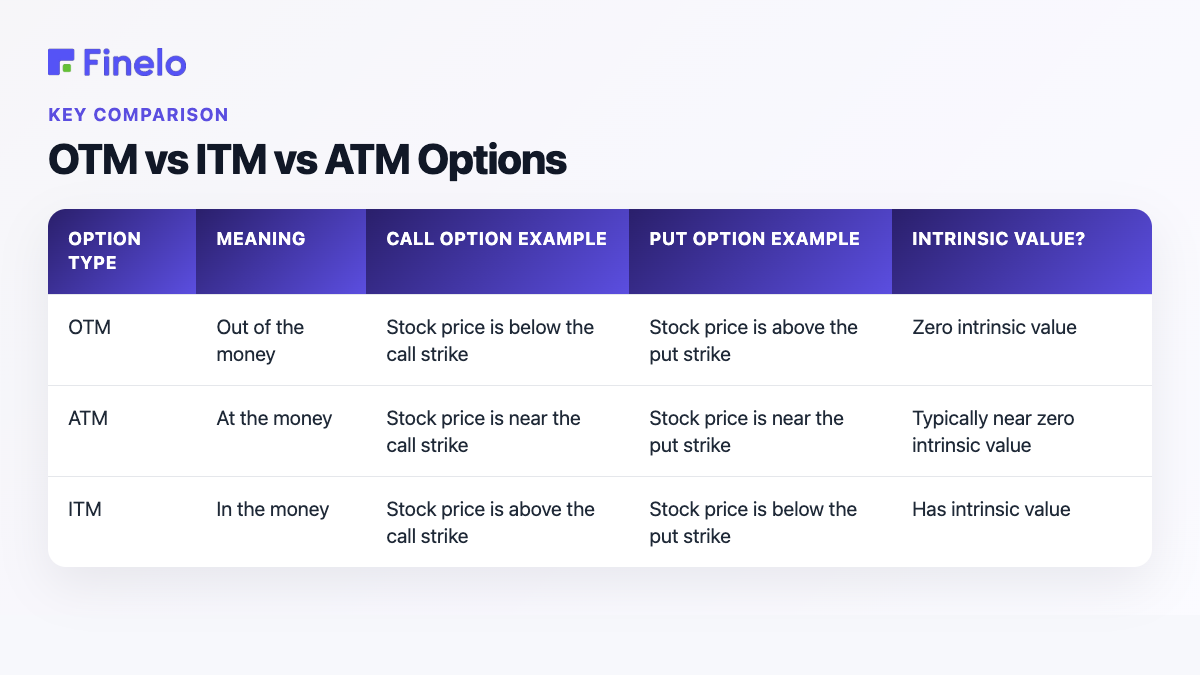
The easiest way to understand OTM is to compare it with ITM and ATM options.
| Option type | Meaning | Call option example | Put option example | Intrinsic value? |
|---|---|---|---|---|
| OTM | Out of the money | Stock price is below the call strike | Stock price is above the put strike | Zero intrinsic value |
| ATM | At the money | Stock price is near the call strike | Stock price is near the put strike | Typically near zero intrinsic value |
| ITM | In the money | Stock price is above the call strike | Stock price is below the put strike | Has intrinsic value |
At expiration, an ITM contract has intrinsic value when the underlying has moved beyond its strike in the favorable direction; an OTM contract has none ITM vs OTM intrinsic value.
Why the distinction matters
Money-ness affects how an option behaves. An OTM option is not currently profitable to exercise based on intrinsic value alone. Its price depends on whether there is still enough time and uncertainty for the market to assign extrinsic value.
That is why a trader should not look only at whether an option is “cheap” or “expensive” in dollar terms. The key question is: What has to happen before expiration for this option to gain intrinsic value?
Characteristics of OTM Options
OTM options have a few defining traits.
1. They have no intrinsic value
This is the core meaning of OTM. If an option is out of the money, its value is not based on immediate exercise value. Any premium reflects extrinsic value OTM value composition.
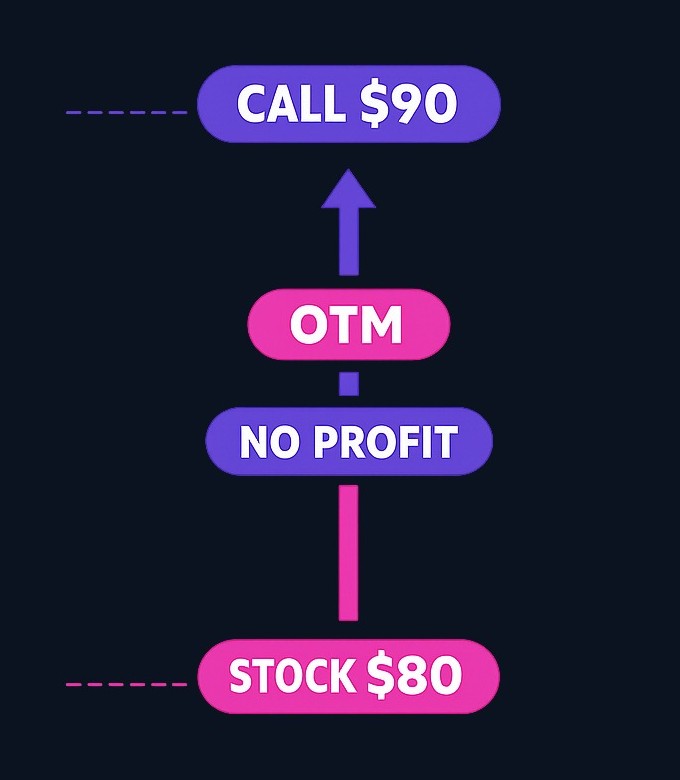
Example: If a stock trades at $80 and a call option has a $90 strike, the call is OTM. Exercising the right to buy at $90 would not make sense when the market price is $80, so the option has no intrinsic value at that moment.
2. Calls and puts become OTM in opposite ways
A call and a put respond differently to the same price level.
- A call option is OTM when the underlying asset’s market price is lower than the strike price.
- A put option is OTM when the underlying asset’s market price is higher than the strike price OTM call and put conditions.
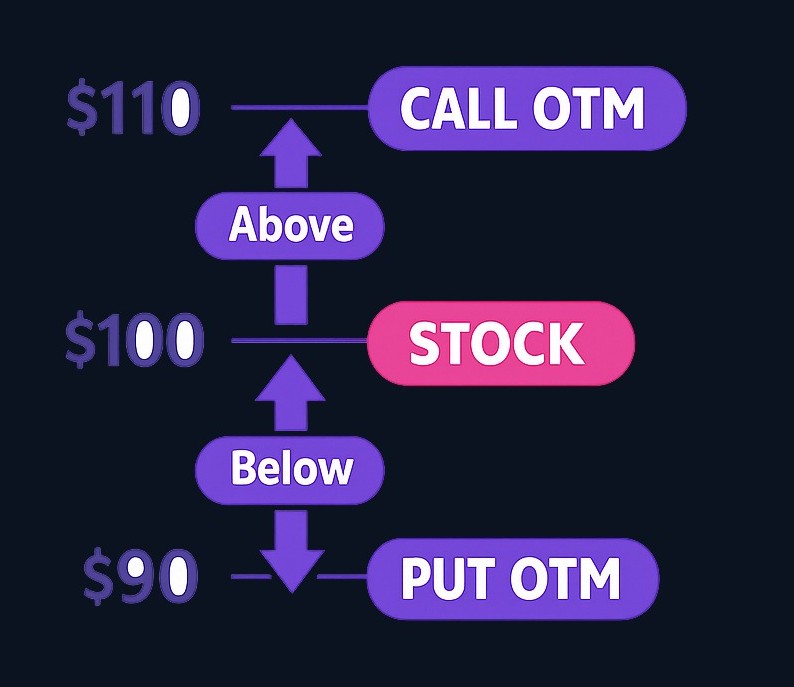
Example: If a stock is at $100:
- A $110 call is OTM.
- A $90 put is OTM.
Both are out of the money, but for opposite reasons.
3. Time matters
Before expiration, an OTM option may still have value because there is time for the underlying asset to move. At expiration, however, an OTM option has zero intrinsic value expiring OTM options.
Example: A $60 call on a stock trading at $55 may still have value with several weeks left. If the stock is still below $60 at expiration, the call remains OTM and has no intrinsic value.
Examples of OTM Options
The following examples are hypothetical and simplified. They are designed for education, not as trade recommendations.
Example 1: OTM call option
A trader is watching a stock trading at $40. They believe the stock may rise over the next month, so they consider a call option with a $45 strike.
- Current stock price: $40
- Call strike price: $45
- Status: OTM
The call is OTM because the stock price is below the strike price. For the call to have intrinsic value at expiration, the stock would need to rise above $45. Until then, the call’s value is based on extrinsic factors rather than intrinsic value.
Example 2: OTM put option
A trader is watching a stock trading at $70. They believe the stock may fall, so they consider a put option with a $65 strike.
- Current stock price: $70
- Put strike price: $65
- Status: OTM
The put is OTM because the stock price is above the strike price. For the put to have intrinsic value at expiration, the stock would need to fall below $65.
Example 3: OTM becoming ITM
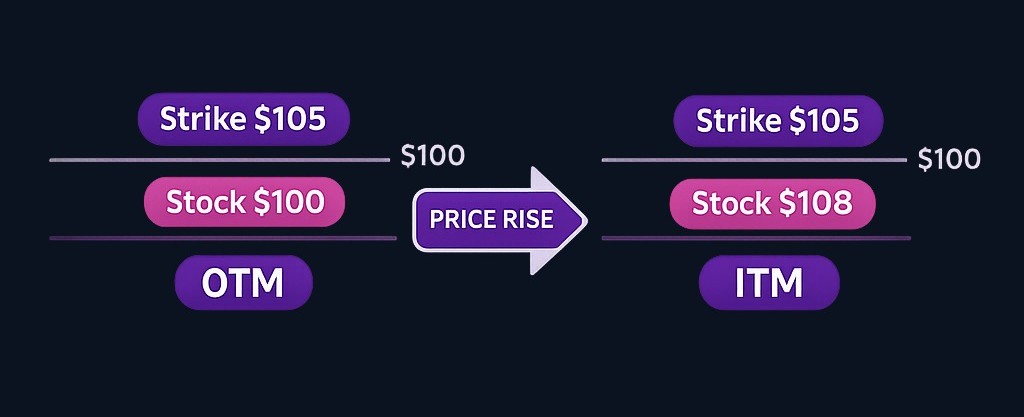
A stock trades at $100, and a $105 call is OTM. Later, the stock rises to $108. The same call is no longer OTM because the stock price is now above the strike price.
This illustrates a key point: OTM is not permanent. It is a snapshot of the relationship between the market price and strike price at a given time.
Practice trading with Finelo
Practice in a simulator, learn with bite-sized lessons, and build confidence before risking real money.
Risks and Benefits of OTM Options
OTM options can be useful in certain strategies, but they are not automatically better or safer than ITM or ATM options. The main issue is that an OTM option must move into the money before it has intrinsic value.
Potential benefits
OTM options may appeal to traders who want to express a view that the underlying asset will move meaningfully before expiration. Because the option starts with zero intrinsic value, the trader is mainly paying for the possibility that time and price movement will make the contract more valuable.
Example: A trader expects a stock at $30 to rise sharply. Instead of focusing on a strike close to $30, they review a $35 call. That call is OTM. The trade depends on the stock moving far enough, soon enough, for the option to gain value.
The benefit is not guaranteed profit. It is simply that OTM options can be used to structure a defined options view around a specific price level and time frame.
Key risks
The biggest risk is that an OTM option can expire with no intrinsic value. For expiring OTM options, intrinsic value is zero OTM at expiration.
Other practical risks include:
- The move may not happen. The underlying asset may never reach the strike.
- The move may happen too late. Time remaining can matter as much as direction.
- The option may lose extrinsic value. Since an OTM option’s premium is entirely extrinsic value, changes in time and market expectations can affect it OTM extrinsic value.
- The strategy may not fit the trader’s risk tolerance. Options can be complex, and the right structure depends on costs, objectives, and suitability.
Educationally, a useful question is: What exact price move is required, by what date, for this OTM option to make sense? If that answer is unclear, the trade probably needs more analysis.
A Simple Decision Framework for OTM Options
Use this framework to match your intent with the next step. It does not tell you what to buy or sell; it helps you ask better questions.
| Reader intent | What to check | Practical next step |
|---|---|---|
| “I want to understand what OTM means.” | Compare stock price with strike price. | Identify whether the option is OTM, ATM, or ITM before considering strategy. |
| “I’m considering an OTM call.” | Is the current market price below the call strike? | Estimate what price move would be needed before expiration. |
| “I’m considering an OTM put.” | Is the current market price above the put strike? | Define the downside move needed for the put to gain intrinsic value. |
| “I want lower complexity.” | Do I understand intrinsic value, extrinsic value, and expiration? | Keep learning before placing trades. |
| “I saw OTM in a mutual fund context.” | Does OTM mean One Time Mandate instead of out of the money? | Review the fund platform’s official payment and mandate instructions. |
If you are still learning options terminology, Finelo’s educational approach can help you build a foundation before comparing real strategies or platforms.
OTM in Mutual Funds: One Time Mandate
OTM can also mean One Time Mandate in a mutual fund or investment payment context. This is different from “out of the money.”
In this context, OTM generally refers to an authorization that allows scheduled or future investment payments according to the process set by the fund platform, bank, or payment provider. The exact setup steps, limits, cancellation rules, and approval requirements can vary, so investors should rely on the official documents from their mutual fund platform or financial institution.
Example: avoiding abbreviation confusion
Imagine someone reads, “Complete your OTM before starting SIP investments.” In that sentence, OTM likely refers to a payment mandate process, not an options contract.
Now compare that with: “The $120 call is OTM while the stock trades at $110.” In that sentence, OTM clearly means out of the money.
The abbreviation is the same, but the context changes the meaning.
Key Takeaways and Next Steps
OTM most often means out of the money in options trading. An OTM option has zero intrinsic value, and its premium is made up of extrinsic value such as time value and other external factors OTM meaning. A call is OTM when the market price is below the strike price; a put is OTM when the market price is above the strike price call and put OTM rules.
Before trading OTM options, make sure you can answer three questions:
- Is the option a call or a put?
- Where is the strike price relative to the current market price?
- What must happen before expiration for the option to gain intrinsic value?
If you see OTM in a mutual fund setting, pause and confirm whether it means One Time Mandate instead. The right interpretation depends entirely on context.
FAQs About OTM
What is the best answer for “OTM meaning”?
In options trading, OTM means out of the money. It describes an option with zero intrinsic value; any value it has is extrinsic value OTM definition. In mutual fund payment contexts, OTM may instead mean One Time Mandate.
Can OTM options become profitable?
An OTM option can move into the money if the underlying asset moves beyond the strike price in the favorable direction. For a call, that means the market price rises above the strike. For a put, it means the market price falls below the strike. Whether a trade is profitable also depends on the premium paid, timing, costs, and strategy.
What is the main risk of trading OTM options?
The main risk is that the option may remain out of the money through expiration. Expiring OTM options have zero intrinsic value OTM expiration value. Traders should understand the required price move, expiration date, and total risk before using them.
How do I know whether OTM means options or mutual funds?
Look at the surrounding terms. If you see words like strike price, call, put, premium, expiration, or intrinsic value, OTM likely means out of the money. If you see words like mandate, bank, SIP, registration, or payment authorization, OTM may mean One Time Mandate.
otm meaningtradingtrading education
Practice trading with Finelo
Practice in a simulator, learn with bite-sized lessons, and build confidence before risking real money.
About the author
Finelo Team
The Finelo Team creates practical investing and trading education designed to help beginners learn faster with structured challenges, simulator practice, and bite-sized lessons.
Keep reading — Related articles

Trading
Options Wheel Strategy: How It Works and Its Risks
The phrase "wheel strategy options" describes a repeatable income approach: sell cash‑secured puts until assigned, buy the stock when assigned, then sell covered calls on the shares to collect more premium and define exit points. This cycle — sell puts → buy stock on assignment → sell covered…
Finelo Team
Trading
Volume Profile Trading: How It Works and Its Limitations
Volume profile trading maps how much volume traded at each price level during a chosen period, revealing levels where the market accepted or rejected price. Traders use the Point of Control (the single price with the highest traded volume), value areas, and volume nodes to identify likely support/resistance…
Finelo Team
Trading
What is Unusual Options Activity and Why Does It Matter?
Unusual options activity (UOA) is a sudden, outsized spike in options trades — volume or open interest — relative to a contract’s recent norms. Traders watch UOA because large, concentrated options orders can signal informed or institutional positioning that sometimes precedes significant stock moves. Example: a single large…
Finelo Team


