Last editorial review: September 28, 2026
Term life vs. accidental death insurance
Compare broad term-life protection with accident-only coverage, including exclusions, underwriting, and the family income gap.
10 min read
Practice trading with Finelo
Practice in a simulator, learn with bite-sized lessons, and build confidence before risking real money.
Want to learn more?
Practice in a simulator, learn with bite-sized lessons, and build confidence before risking real money.
Explore FineloExplore Finelo's 28-day challenges
Turn learning into a daily habit with guided challenge paths.
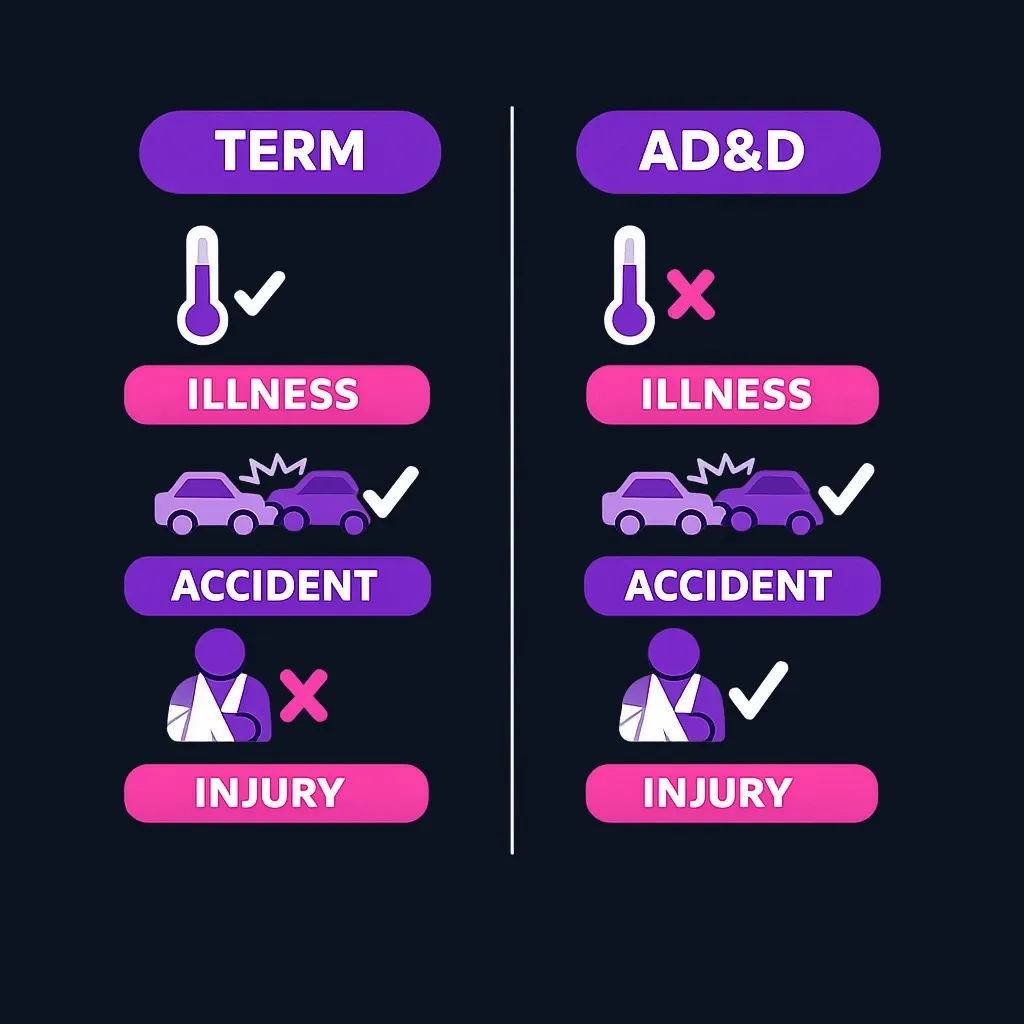
Term life insurance generally covers death from a broad range of causes during the policy term, subject to exclusions and contract rules. Accidental death insurance covers qualifying deaths caused by accidents. Accidental death and dismemberment insurance, or AD&D, can also pay for specified serious injuries.
These are different scopes of protection. A lower premium does not make a narrower policy an equivalent replacement.
Compare what triggers payment
| Feature | Term life | Accidental death or AD&D |
|---|---|---|
| Death from illness | Generally covered, subject to policy terms | Generally not covered |
| Accidental death | Generally covered, subject to policy terms | Must meet the policy's accident definition and conditions |
| Serious nonfatal injury | Not part of basic death coverage | May be covered under AD&D for specified losses |
| Main question | Amount, term, underwriting, and exclusions | Covered events, exclusions, time limits, and benefit schedule |
The Texas insurance regulator's life-insurance guide provides an overview of life coverage and policy choices. Read the proposed policy for the exact events it covers.
Start with the financial need
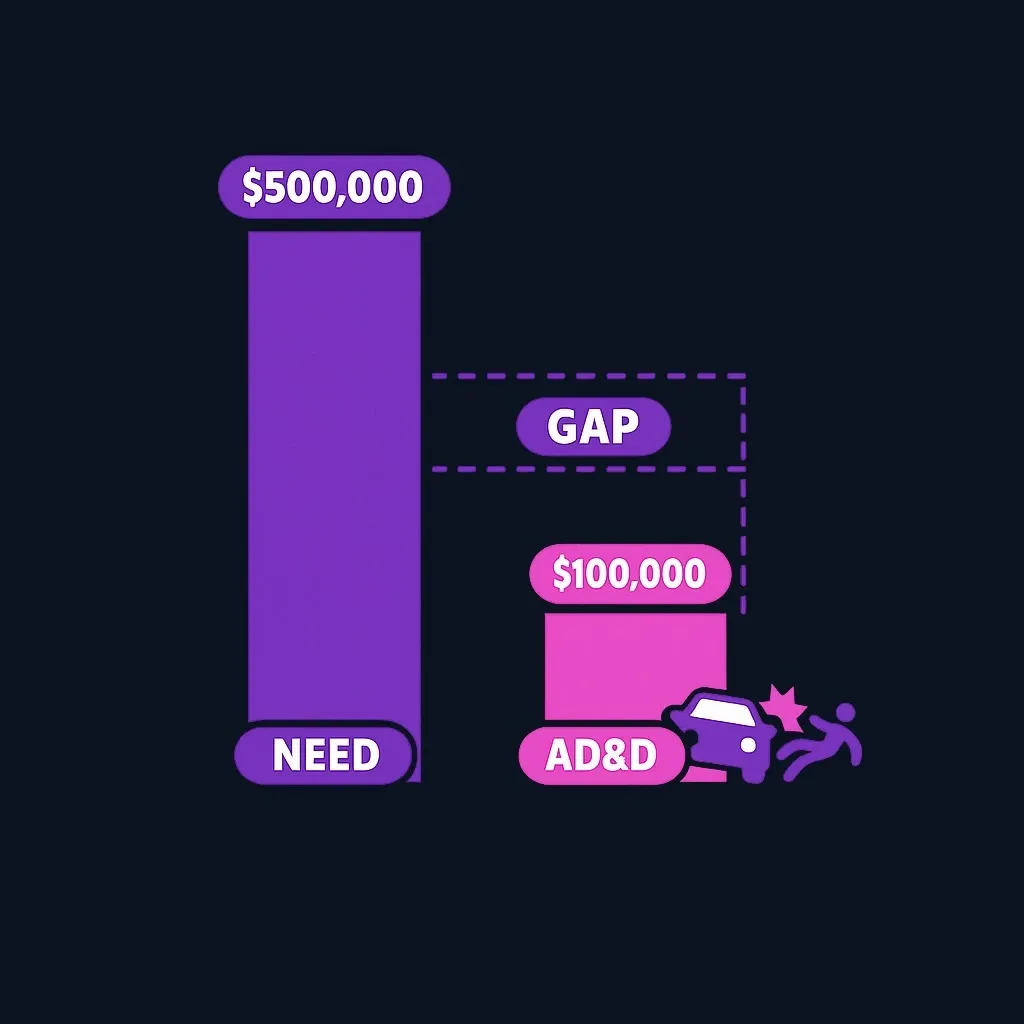
If a family needs income replacement regardless of whether death results from illness or an accident, accident-only coverage leaves a substantial gap. It may serve as supplemental protection, but it should be evaluated for the narrower benefit it provides.
For a hypothetical household needing $500,000 of support, a $100,000 accident-only benefit does not provide $500,000 of general life protection. The amount and the trigger both matter.
Check the contract and existing benefits
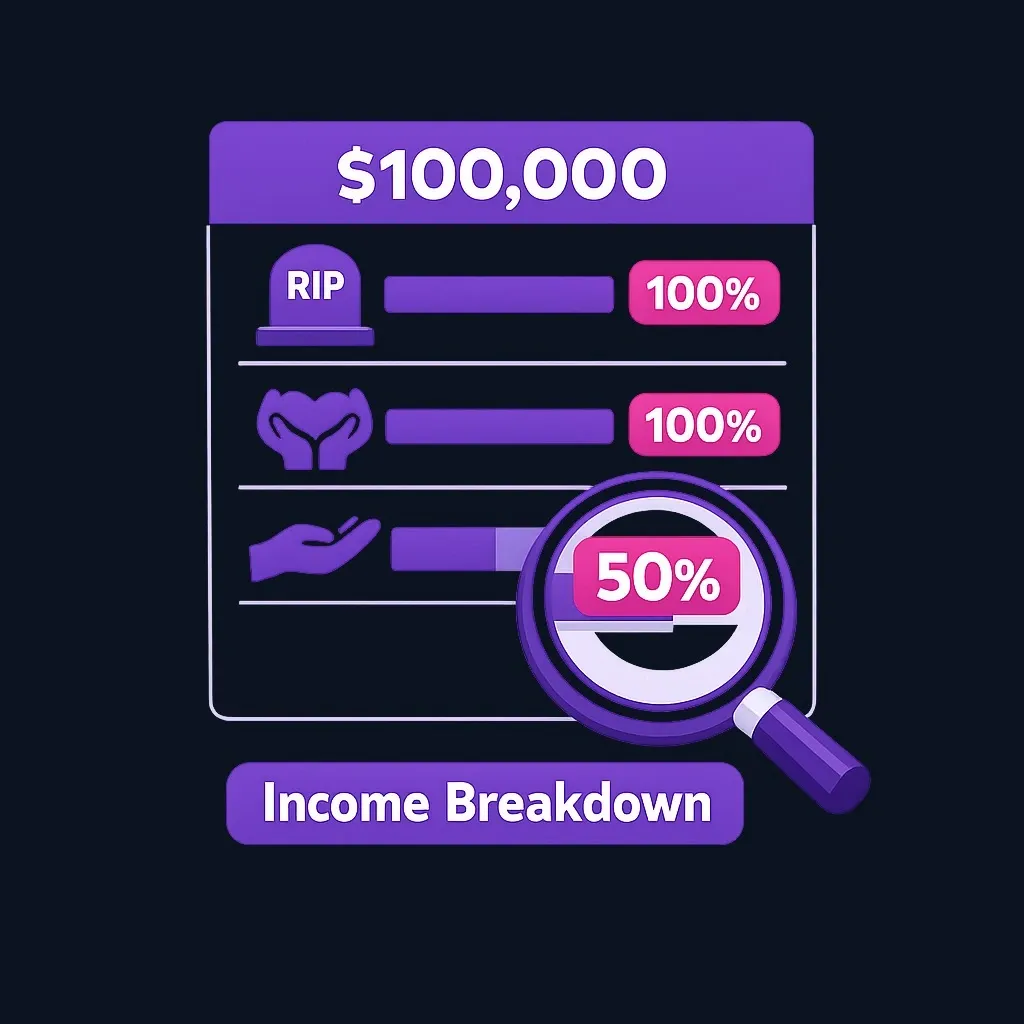
Review employer coverage, portability after leaving work, exclusions, benefit reductions, and any conversion rights. AD&D payouts for nonfatal injuries may be a percentage of the policy amount, not the full amount for every injury.
Obtain quotes based on the same insured person and intended duration. Confirm that the coverage addresses the household's main financial risk rather than choosing solely from the premium or the largest advertised accidental-death amount.
Identify the risk the family is trying to insure
A household that depends on someone's income can face a financial gap whether death follows illness or an accident. Term life generally addresses a broader range of covered causes during the term, subject to its exclusions and conditions. Accident-only coverage answers a narrower question about specified events.
That distinction matters even when the accident policy is easier to obtain or has a lower premium. A less expensive product can cover less risk. Compare the benefit trigger as carefully as the benefit amount so the household does not mistake supplementary protection for its main income-replacement plan.
Read accident definitions and injury schedules closely
For accidental-death coverage, examine the definition of a covered accident, exclusions, and any required relationship between the accident and the death. For AD&D, also read the schedule of qualifying injuries and the percentage payable for each loss. The headline benefit is not necessarily what every covered injury pays.
If the coverage is through an employer, check whether it continues after leaving the job and whether any continuation option is available. Employer benefits can be useful, but the family should know what would remain after a job change or retirement.
Practice trading with Finelo
Practice in a simulator, learn with bite-sized lessons, and build confidence before risking real money.
Compare the insurance need and the offered contracts separately
Estimate the amount and duration of protection needed, then examine which products can address it. A quote should identify premiums, whether they change during the term, underwriting requirements, exclusions, and any rider. Do not assume an accident rider is inexpensive without seeing its actual cost.
If health limits access to term insurance, review the available options honestly. Narrow coverage can still have a role, but its limitations should remain visible in the household plan. A licensed professional can help explain available contracts without turning an accident-only benefit into a promise of broader protection.
What is Term Life Insurance?
Term life is a time-limited life-insurance policy that pays a specified death benefit if the insured dies within the policy term. Government consumer guides describe term life as one of the standard types of life insurance used to provide financial protection for defined periods or obligations (for example, while you’re paying a mortgage or raising children). Key features to understand:
- Time-limited coverage: you pick a term (commonly 10, 20, or 30 years with many insurers) and the policy ends at term expiration unless renewed or converted. The Texas guide covers types of life insurance and how policies work generally.
- Death benefit: pays beneficiaries a lump sum on the insured’s death during the term. Subject to policy conditions and exclusions.
- Use cases: replacing lost income, covering mortgage balances, or meeting short-to-medium-term financial obligations while premiums are usually lower than permanent life for comparable coverage amounts.
Note: policy wording, underwriting (medical checks), and exclusions vary by insurer; always read the policy and ask the insurer what’s excluded.
What is Accidental Death Insurance?
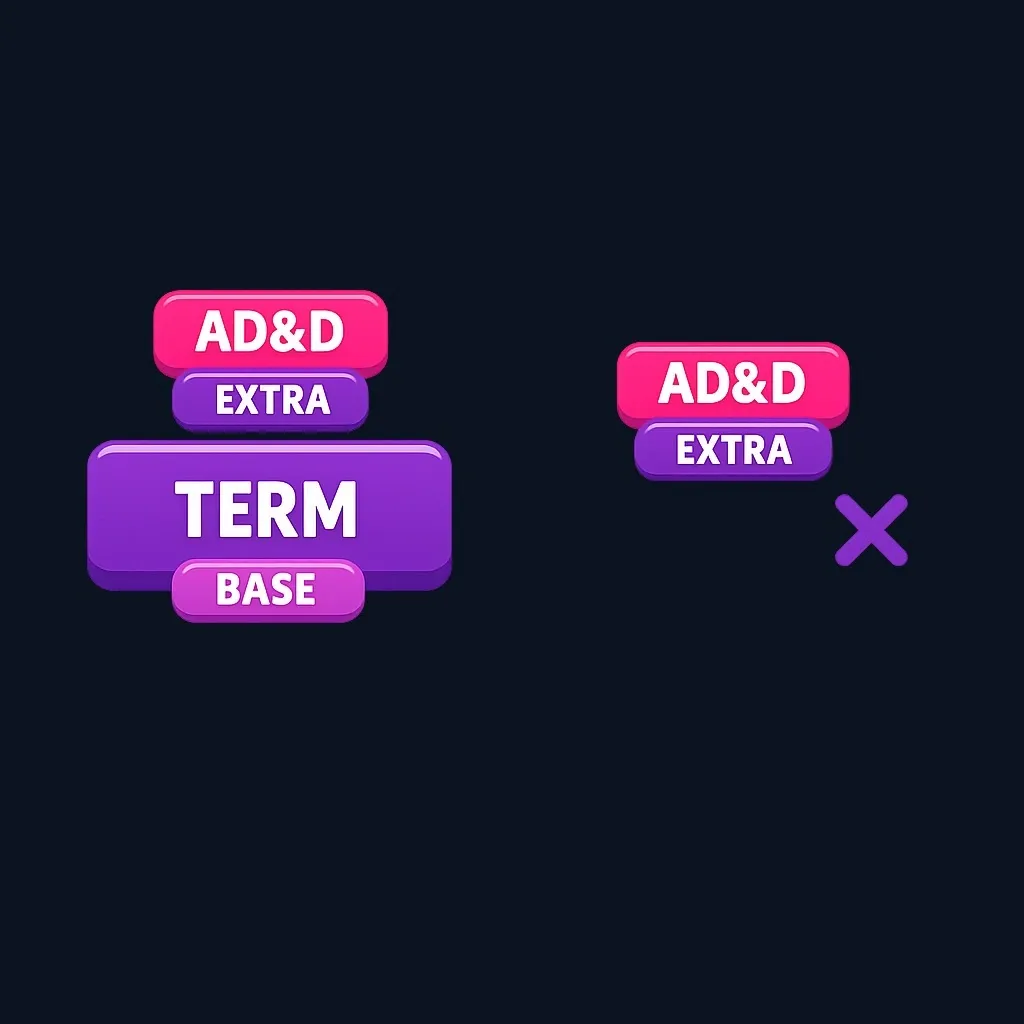
Accidental-death-only insurance pays for death from qualifying accidents. Accidental Death & Dismemberment (AD&D) adds specified injury benefits and is a related, but different, narrower product that pays a benefit only if specified accidental events cause death or defined losses (for example, loss of limb or eyesight). AD&D is frequently offered as a rider you can add to a life policy or as a standalone policy and is described by insurers as covering death and certain injuries that result directly from accidents. Typical characteristics insurers list:
- Accident-only payout: benefits are payable for death or covered injuries resulting directly from an accident. Illnesses and most non-accidental deaths are not covered.
- Dismemberment benefits: many AD&D policies include a schedule of benefits for severe injuries (for example, a percentage of the principal sum for loss of one limb).
- Separate pricing: AD&D may be offered alongside other coverage or on its own. Compare the actual charge and qualifying losses; a lower price would not make its narrower benefits equivalent to term life.
Because AD&D covers a narrower set of causes, it should be treated as supplemental protection rather than a replacement for basic life insurance for most households.
How to compare your options
Use this short checklist to decide which product aligns with your objectives.
- Primary goal: Replace lost income or cover dependents? Choose term life. If you want a low-cost add-on for accidental scenarios, AD&D can supplement term life.
- Coverage breadth: Compare term-life coverage for covered causes of death with accident-only protection. Neither should be described as covering every possible cause or circumstance.
- Budget and premium sensitivity: Compare actual premiums alongside covered events. Equal face amounts can represent very different protection, and the narrower product is not automatically the better value.
- Current employer benefits: Check whether your employer offers life or AD&D coverage, who pays the premium, the benefit limits, and what happens when employment ends. Include confirmed coverage in the household comparison.
- Health and underwriting: If you have health issues that make term life expensive or unavailable, AD&D may be easier to obtain, but it won’t cover non-accidental death — weigh the tradeoff carefully.
Hypothetical example: A parent compares $500,000 of term-life coverage for 20 years with $100,000 of accident-only coverage. The amounts and covered causes of death differ, so the accident policy is not an equivalent substitute. A rider may supplement a base policy, but its price and exclusions require a separate quote and review.
When to choose each option
Term life is generally the right choice when:
- Your goal is to protect dependents against the loss of financial support from death by illness or accident.
- You need a defined face amount for a mortgage, tuition, or income replacement.
Consider AD&D when:
- You want supplementary protection for specified accidental losses and have compared its actual cost and exclusions with the household’s other coverage.
- You work in a high-accident-risk occupation and want extra accidental coverage on top of life insurance (confirm occupational exclusions first).
Combining coverage: A life policy and an accident benefit may work together, but read each benefit separately. For example, the federal employees’ plan includes specified AD&D benefits in certain coverage for employees. That is one plan’s design, not a promise about an employer’s or individual insurer’s policy.
Tradeoffs and caveats
- Narrow scope: AD&D responds to specified accidental losses. Death from illness or other non-accidental causes falls outside that purpose, leaving a different exposure from term life.
- Riders vs. standalone policies: An accident rider can be convenient, but check whether it includes dismemberment or only an extra death benefit. Compare the benefit schedule and price with any separate or employer coverage.
- Exclusions and fine print: AD&D policies commonly exclude deaths from intoxication, suicide, war, or certain hazardous activities; term life policies can include contestability periods and limited exclusions (for example, suicide clauses early in the policy) — read policy wording carefully.
- Claims and documentation: Claims processes differ by insurer; accidental claims often require proof the death or injury was accidental and related documentation. Contact your insurer or employer benefits administrator for exact steps.
- Cost tradeoff: Even when the quoted AD&D premium is affordable, it does not substitute for broader death-benefit coverage; choosing AD&D to save premiums at the cost of core coverage can be risky for dependents.
Common mistakes and how to avoid them:
- Mistake: Buying AD&D instead of term life to save money. Fix: Calculate the real coverage your dependents need (income replacement, debts, education) and compare how a term policy meets those needs.
- Mistake: Assuming employer AD&D or life insurance is sufficient. Fix: Check coverage amounts, portability, and whether coverage ends when you leave the job; buy personal term life if employer-provided coverage is inadequate.
What is the main difference between term life and AD&D insurance?
Term life provides a death benefit for most causes of death during the policy term, while AD&D pays only for death or specified injuries caused directly by accidents.
Can I add AD&D coverage to my life insurance policy?
Possibly. Ask your insurer whether an available rider includes both accidental death and dismemberment or accidental death alone. An employer may also offer group coverage. Availability, qualifying losses, price, and continuation rights depend on that specific contract.
Is AD&D insurance worth it if I already have life insurance?
AD&D may supplement other insurance for specified accidental losses. Compare its actual price and exclusions; it does not replace coverage for death from illness or other non-accidental causes.
How do I choose how much term life coverage I need?
Estimate financial needs such as income replacement for dependents, mortgage and debt payoff, education costs, and final expenses. Match the term length to the period when protection is required. For a consumer-level checklist and examples, review your liabilities and future obligations and compare quotes from multiple insurers.
To choose how long that protection should last, compare Term life insurance laddering vs. one policy.
This guide covers U.S. rules. Finelo provides financial education, not personalized financial, investment, tax, or legal advice.
Financial LiteracyU.S. GuideFinancial Education
Practice trading with Finelo
Practice in a simulator, learn with bite-sized lessons, and build confidence before risking real money.
About the author
Finelo Team
The Finelo Team creates practical investing and trading education designed to help beginners learn faster with structured challenges, simulator practice, and bite-sized lessons.
Keep reading — Related articles
Financial Literacy
USDA vs. FHA loan
Compare location and income eligibility, down payments, credit conditions, and upfront and annual program charges for a home purchase.
Finelo Team
Financial Literacy
Term life insurance laddering vs. one policy
Compare several term policies ending at different times with one policy, using coverage needs, costs, and future insurability.
Finelo Team

Financial Literacy
Tax withholding vs. estimated payments
Coordinate payments during the year using the 2026 safe-harbor thresholds, prior-year conditions, and payment-timing rules.
Finelo Team


