Last editorial review: September 28, 2026
Term life insurance laddering vs. one policy
Compare several term policies ending at different times with one policy, using coverage needs, costs, and future insurability.
9 min read
Practice trading with Finelo
Practice in a simulator, learn with bite-sized lessons, and build confidence before risking real money.
Want to learn more?
Practice in a simulator, learn with bite-sized lessons, and build confidence before risking real money.
Explore FineloExplore Finelo's 28-day challenges
Turn learning into a daily habit with guided challenge paths.
Laddering means buying several term life policies with different end dates. A single level-term policy provides one stated coverage amount during its covered term. A ladder can match protection to obligations that shrink over time, but it also means your coverage intentionally falls as policies expire.
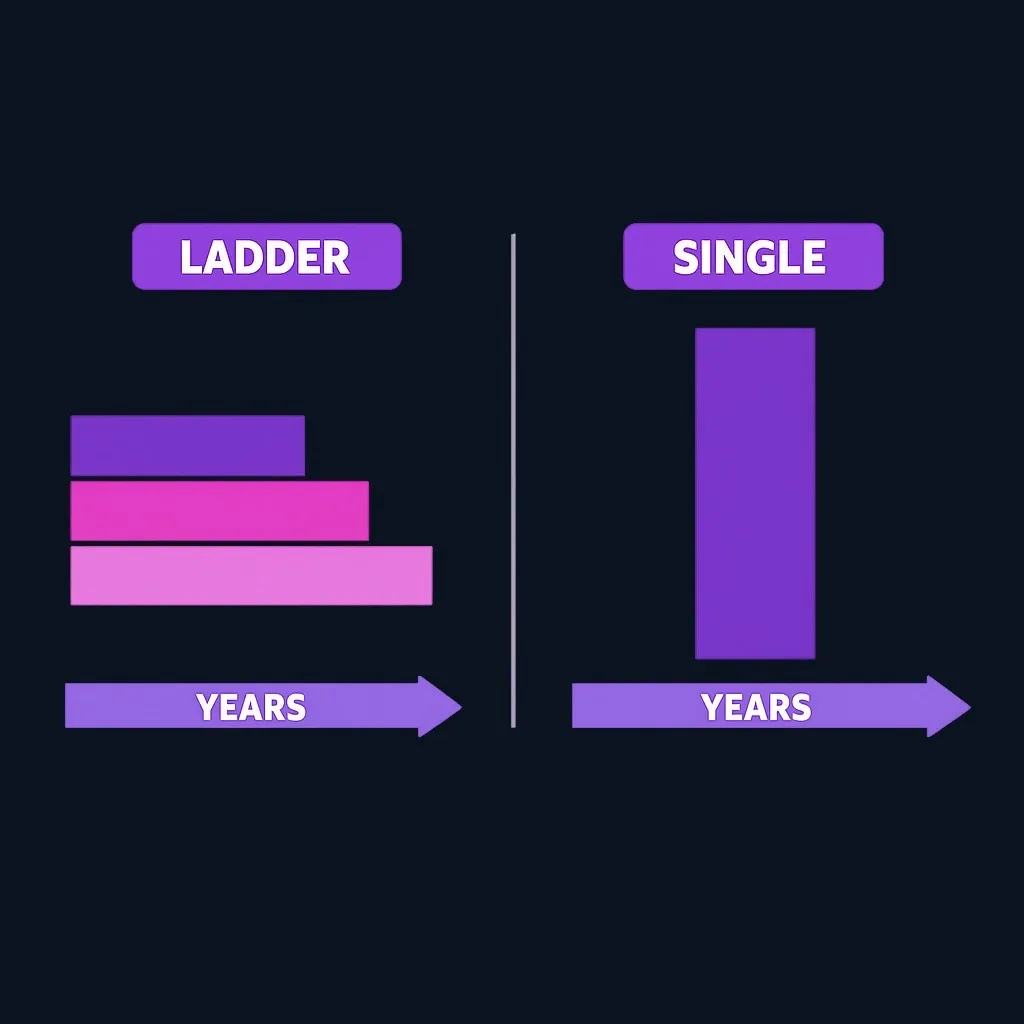
Savings are possible, not guaranteed. Compare actual quotes for the same person and the same coverage needs.
A simple coverage example
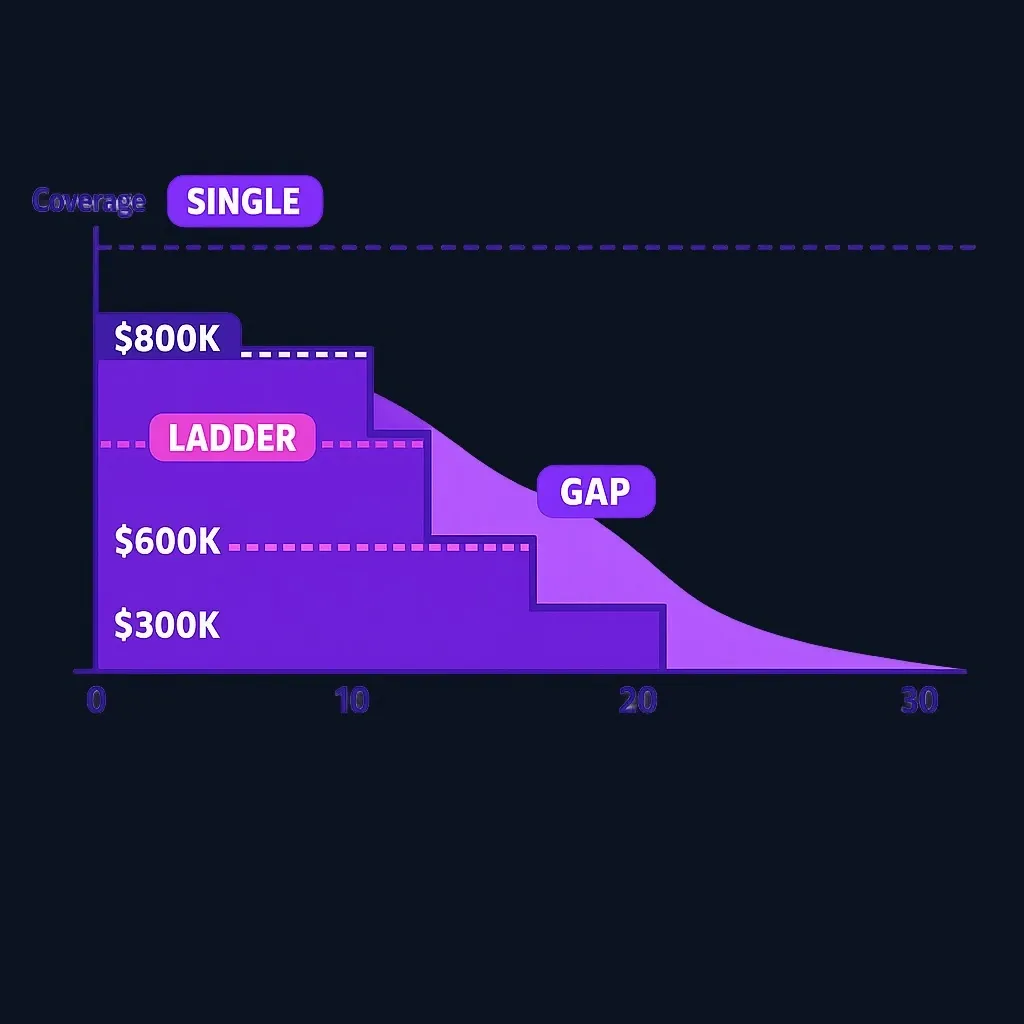
Suppose a household chooses these hypothetical policies:
| Policy | Coverage | Term |
|---|---|---|
| Short-term need | $200,000 | 10 years |
| Mortgage and family need | $300,000 | 20 years |
| Longer-term need | $300,000 | 30 years |
The total starts at $800,000, falls to $600,000 after ten years, and falls to $300,000 after twenty years, assuming the remaining policies stay in force. One $800,000 thirty-year policy would maintain more protection later, so the two approaches are not identical coverage.
The Texas insurance regulator's life-insurance guide explains term insurance, renewal, and conversion features. Verify the rules in your state and the contracts offered.
Test whether the need really declines
Will the mortgage be repaid on schedule? Will dependents become financially independent? Could future care needs or reduced savings keep the insurance need higher than expected?
Buying extra coverage later can require new underwriting and may cost more or be unavailable. Do not design a ladder around an assumption that replacement insurance will always be easy to obtain.
Compare cost and administration
Add all premiums, policy fees, and any conversion features. Multiple policies require more payment dates and beneficiary records. A single policy may be easier to manage, even when a ladder looks cheaper initially.
Request both designs from the same set of assumptions and compare protection year by year. Choose the structure that fits the household's likely obligations, while retaining enough margin if those obligations last longer than planned.
Build the coverage timeline before choosing policies
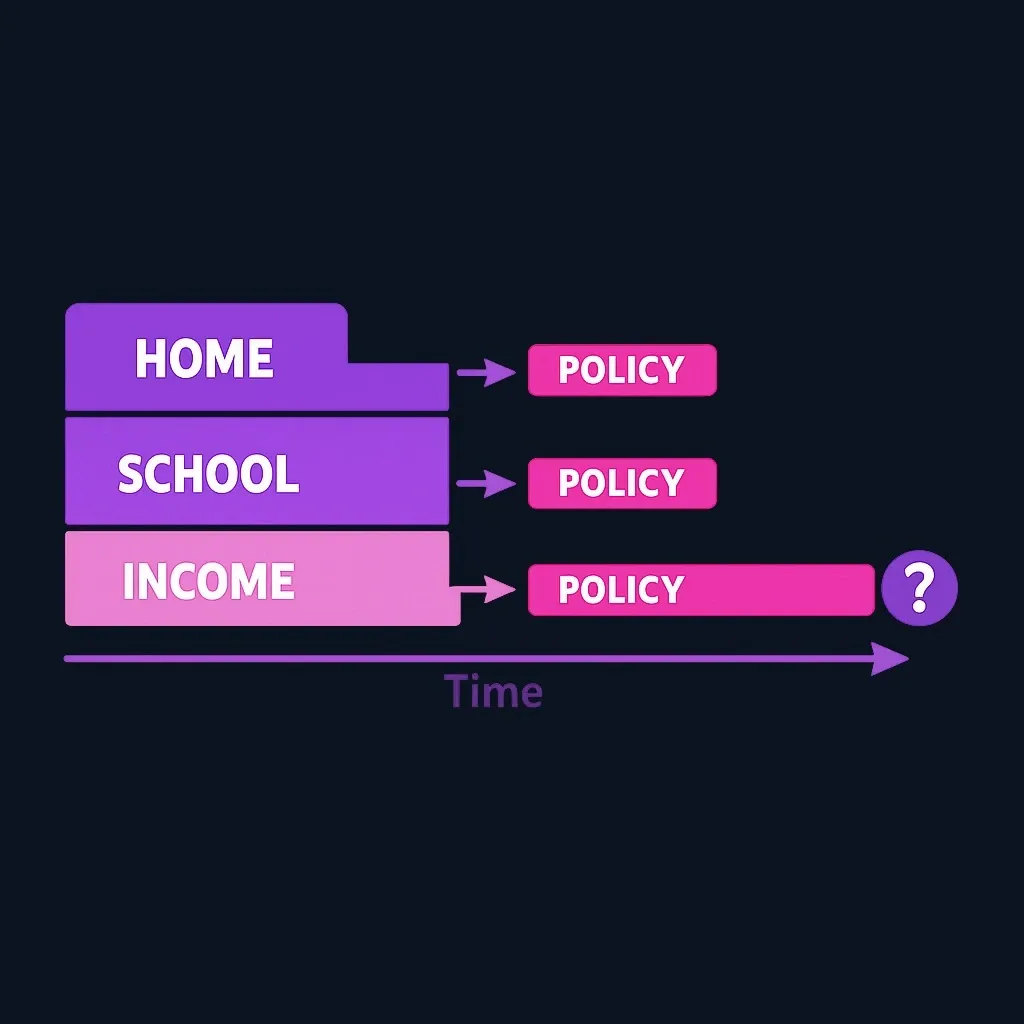
Start with the people who would depend on the benefit. List housing costs, replacement for the insured person's income or unpaid care, education plans, debts, and transition expenses. Then note which needs are likely to end and which could remain. A mortgage's scheduled payoff date is easier to identify than the date a family will no longer need support.
Subtract resources that would realistically be available to survivors without counting the same asset twice. An emergency fund needed for the household's own resilience may not be interchangeable with retirement savings intended for decades later. Employer life coverage also deserves a separate check because its availability may change with the job.
The resulting schedule may decline, remain fairly level, or be uncertain. Laddering is most understandable when each policy layer corresponds to a need that can reasonably be expected to shrink. A single policy may be easier to manage when the need is stable or the family wants a larger cushion against those forecasts being wrong.
Practice trading with Finelo
Practice in a simulator, learn with bite-sized lessons, and build confidence before risking real money.
Compare total premiums and coverage over the same years
Ask for quotes using the same insured person, underwriting assumptions, start date, and optional features. Then lay out the annual premiums and total coverage for each year. Comparing only the first monthly premium can hide what happens when shorter layers end.
The ladder and the single long-term policy may start with the same benefit but provide very different protection later. That difference is part of the price comparison. Paying less because coverage ends sooner is not the same as receiving identical coverage at a discount.
Do not assume you can cheaply buy another policy when a layer expires. New coverage can depend on age, health, available products, and underwriting at that time. Renewal or conversion provisions, if included, have their own terms and deadlines. Read each contract separately.
Plan for the household that does not follow the forecast
Imagine the mortgage is refinanced for a longer term, a child needs support longer, or one partner leaves paid work. Those changes can leave a scheduled reduction in insurance arriving before the need disappears. Review the coverage after major life changes while there is still time to evaluate available options.
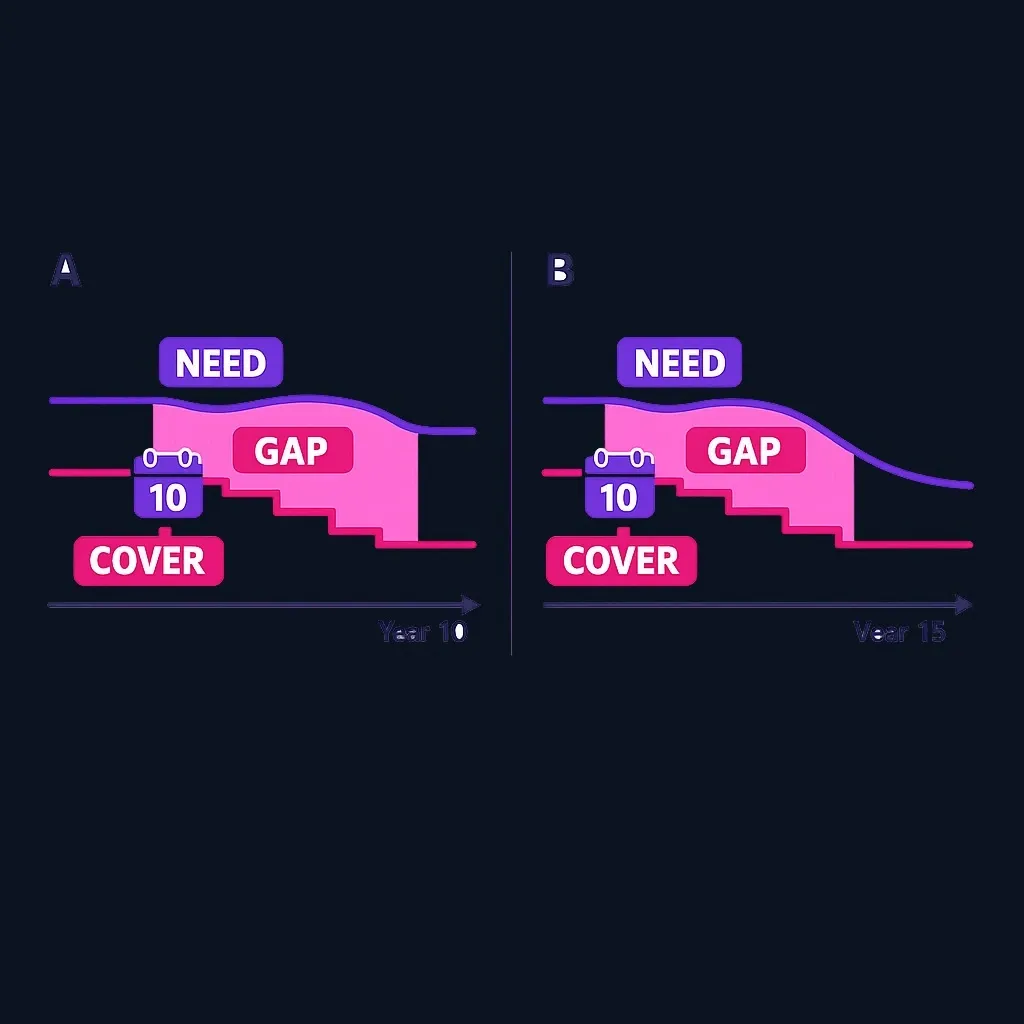
The administrative burden is also real. Keep a policy summary with insurer, amount, end date, premium schedule, beneficiaries, and any conversion deadline. Make sure the person who would handle a claim knows where that information is stored. Several policies are manageable, but they should not depend on one person's memory.
A single policy also needs review. Its simplicity does not prove the amount remains appropriate, and the end of its term can create a large coverage drop all at once. Whichever structure you choose, the useful test is whether its payment and protection schedule continues to match the household's needs.
How to compare your options
Use the following five questions as a decision framework to assess whether laddering or a single policy fits your situation.
- What obligations do you need to cover, and when do they end?
- Map obligations survivors would actually face to approximate end dates. Some debts, including eligible federal student loans, may be discharged at death, so do not automatically insure every current balance as a survivor obligation. Laddering explicitly matches coverages to those end dates.
- Example: If your mortgage is 20 years but you expect college costs for your kids over the next 10 years, ladder a 20-year policy sized for the mortgage and a 10-year policy sized for education.
- How important is month-to-month cost now versus long-term predictability?
- If cost is a priority, obtain actual quotes for both structures. A ladder carries less coverage in later years, so any saving should be considered alongside that reduction.
- If you prefer a single stable premium and coverage horizon, a single policy is simpler to budget for.
- How comfortable are you with managing paperwork and renewal windows?
- Laddering increases administrative tasks (multiple policies, premium payments, renewal dates). If you want “set and forget,” a single policy reduces complexity.
- Will future insurability or conversion options matter?
- If you may need to convert term to permanent coverage later, check each policy’s conversion features. A broader insurance plan can combine term and permanent coverage, but that adds a separate product decision; conversion rights vary by policy and insurer.
- What is your tolerance for replacing coverage later?
- Buying new coverage after a policy expires can require new underwriting. A longer policy can maintain its contracted coverage despite later health changes while it remains in force and its conditions are met; it does not guarantee eligibility for additional coverage.
Worked example — married couple, ages 35 and 33:
- Needs: $500k mortgage (20 years), $200k education fund (10 years), plus $300k long-term income protection (30 years).
- Hypothetical ladder: $500,000 for 20 years, $200,000 for 10 years, and $300,000 for 30 years. Coverage starts at $1 million, falls to $800,000 after ten years, and to $300,000 after twenty years if the remaining policies stay active.
When laddering is likely better
- You have time-limited liabilities (mortgage, a child’s education, business loan) that will disappear before your longest-run financial needs do. Laddering lets coverage drop as obligations fall, potentially reducing premiums compared with maintaining the initial coverage for the full period.
- You want more control over how much coverage you carry at each life stage and are willing to manage multiple policies.
Hypothetical situation: A parent expects education costs and a mortgage to decline over time. Before using a ladder, they test whether the household could still manage if those obligations lasted longer than planned. The schedule should follow a realistic needs estimate, not merely a preferred premium.
When a single policy is likely better
- You want administrative simplicity or expect your coverage needs to remain constant for the policy term (for example, long-term income replacement or estate planning).
- You prefer fewer renewal and billing dates and a single contract that may be easier to track and convert if conversion rights exist.
Compare any premium saving with both the lower future benefit and the added administration. A household may reasonably value one policy’s simplicity even when a ladder has a lower quoted price.
Tradeoffs and caveats
- Administrative overhead: multiple policies mean multiple application records, bills, and renewal windows. Missed payments or overlooked renewals can create coverage gaps. Keep a central calendar and a secure file for policy numbers and beneficiary designations.
- Replacing coverage later may be harder: When a term ends and you want new coverage, insurers will typically require underwriting; if health has declined, replacement premiums can be higher. Laddering assumes some obligations will end, not that you can always replace protection cheaply later.
- Conversion and mixing product types: Adding permanent coverage to a term ladder is a separate cost and product choice. Confirm conversion windows and conditions for each term policy rather than assuming a right to convert whenever a layer ends.
- Cost savings vary: Compare actual quotes, underwriting outcomes, policy fees, riders, and premium guarantees. A ladder is not inherently cheaper for every person or set of needs.
- Beneficiary clarity: Multiple policies require consistent beneficiary designations and communication to survivors; ensure beneficiaries know which policy to claim and how to contact each insurer.
- Tax and legal considerations: Life insurance rules and tax treatment can vary by jurisdiction. This article is educational; consult a tax or legal professional for implications in your situation.
Common mistakes and how to avoid them
- Mistake: Assuming laddering always saves money. Fix: Run broker or insurer quotes for both laddering and a single policy for your exact ages and coverage needs.
- Mistake: Losing track of policy end dates. Fix: Set calendar reminders well before each term expires and keep a single policy summary document.
- Mistake: Not checking conversion rights. Fix: Before buying, confirm whether each term policy allows conversion to permanent coverage and under what conditions.
What is life insurance laddering?
Laddering is buying multiple term policies with different lengths and amounts so coverage falls as financial needs expire, rather than carrying one constant large policy.
How does laddering work in practice?
You identify major time-bound obligations (mortgage, education, loans), then buy term policies that cover those obligations for their expected durations. Over time, as debts are paid, fewer policies remain in force.
What are the main advantages of laddering?
Advantages include better alignment of coverage to needs and potentially lower premiums for a declining coverage schedule; however, savings depend on personal factors and insurer pricing.
What are the main disadvantages of laddering?
Disadvantages include higher administrative complexity, the risk of coverage gaps if policies lapse or are overlooked, and potential higher cost to obtain replacement coverage later if health changes.
If the mortgage is your main concern, compare Mortgage protection insurance vs. term life insurance.
This guide covers U.S. rules. Finelo provides financial education, not personalized financial, investment, tax, or legal advice.
Financial LiteracyU.S. GuideFinancial Education
Practice trading with Finelo
Practice in a simulator, learn with bite-sized lessons, and build confidence before risking real money.
About the author
Finelo Team
The Finelo Team creates practical investing and trading education designed to help beginners learn faster with structured challenges, simulator practice, and bite-sized lessons.
Keep reading — Related articles

Financial Literacy
USDA vs. FHA loan
Compare location and income eligibility, down payments, credit conditions, and upfront and annual program charges for a home purchase.
Finelo Team
Financial Literacy
Term life vs. accidental death insurance
Compare broad term-life protection with accident-only coverage, including exclusions, underwriting, and the family income gap.
Finelo Team

Financial Literacy
Tax withholding vs. estimated payments
Coordinate payments during the year using the 2026 safe-harbor thresholds, prior-year conditions, and payment-timing rules.
Finelo Team