Last editorial review: September 28, 2026
USDA vs. FHA loan
Compare location and income eligibility, down payments, credit conditions, and upfront and annual program charges for a home purchase.
10 min read
Practice trading with Finelo
Practice in a simulator, learn with bite-sized lessons, and build confidence before risking real money.
Want to learn more?
Practice in a simulator, learn with bite-sized lessons, and build confidence before risking real money.
Explore FineloExplore Finelo's 28-day challenges
Turn learning into a daily habit with guided challenge paths.
USDA and FHA programs can help eligible buyers finance a primary home, but they solve different qualification problems. USDA guaranteed loans have property-location and household-income requirements and can offer no down payment. FHA loans are available more broadly by location and can allow a low down payment.
This comparison concerns USDA's guaranteed program. The USDA direct-loan program has different rules.
Compare eligibility first
| Feature | USDA guaranteed loan | FHA loan |
|---|---|---|
| Location | Eligible rural areas, including some communities beyond what buyers expect | No equivalent USDA rural-area restriction |
| Income | Program household-income limits apply | No equivalent USDA household-income cap |
| Down payment | May allow 100% financing for eligible borrowers | As low as 3.5% for qualifying borrowers |
| Program costs | Guarantee-related fees apply | Mortgage-insurance premiums apply |
Check the property and household through the USDA guaranteed-loan program. The CFPB FHA overview explains FHA's role and basic features. Lenders still apply underwriting requirements.
Eligibility includes more than the down payment
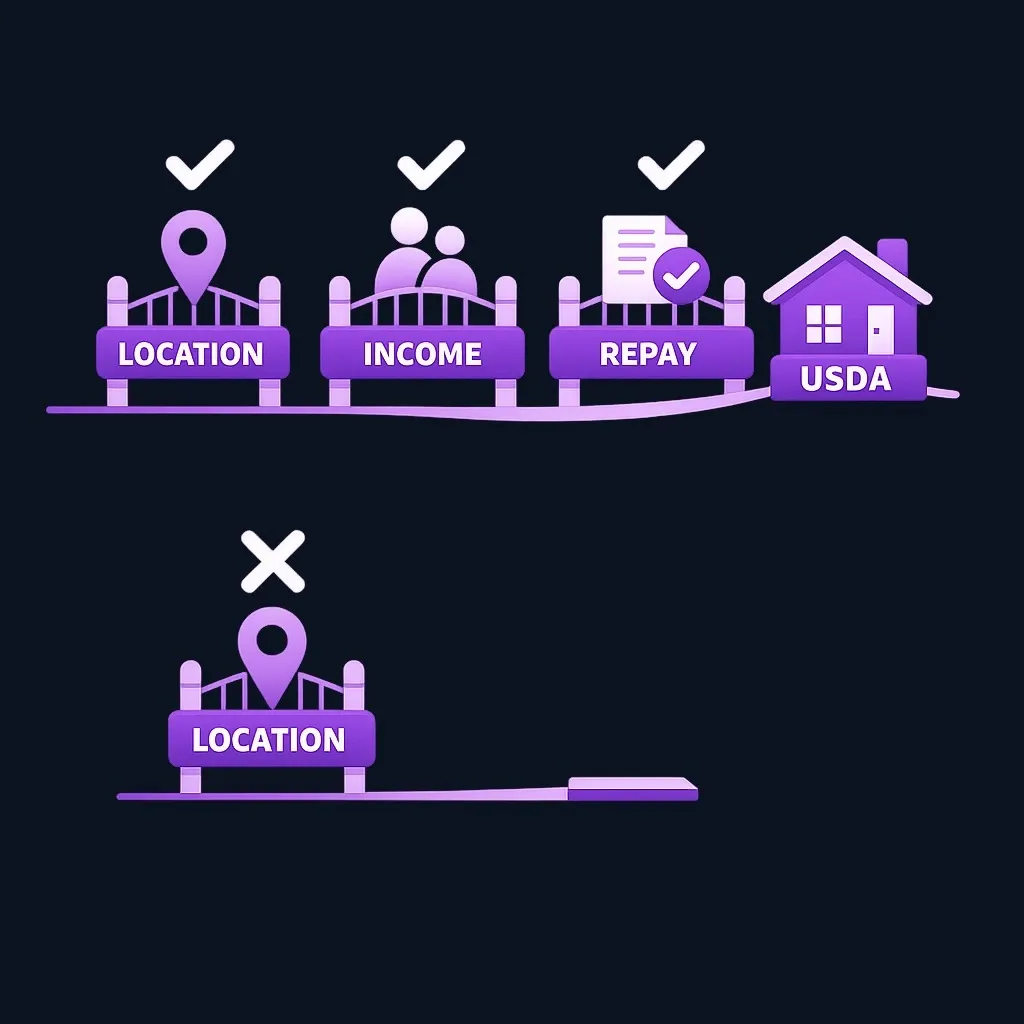
USDA checks the property location and household income as well as repayment ability. Income used for program eligibility is not necessarily identical to the income a lender uses to qualify you for a payment. An eligible address alone does not establish that the household qualifies.
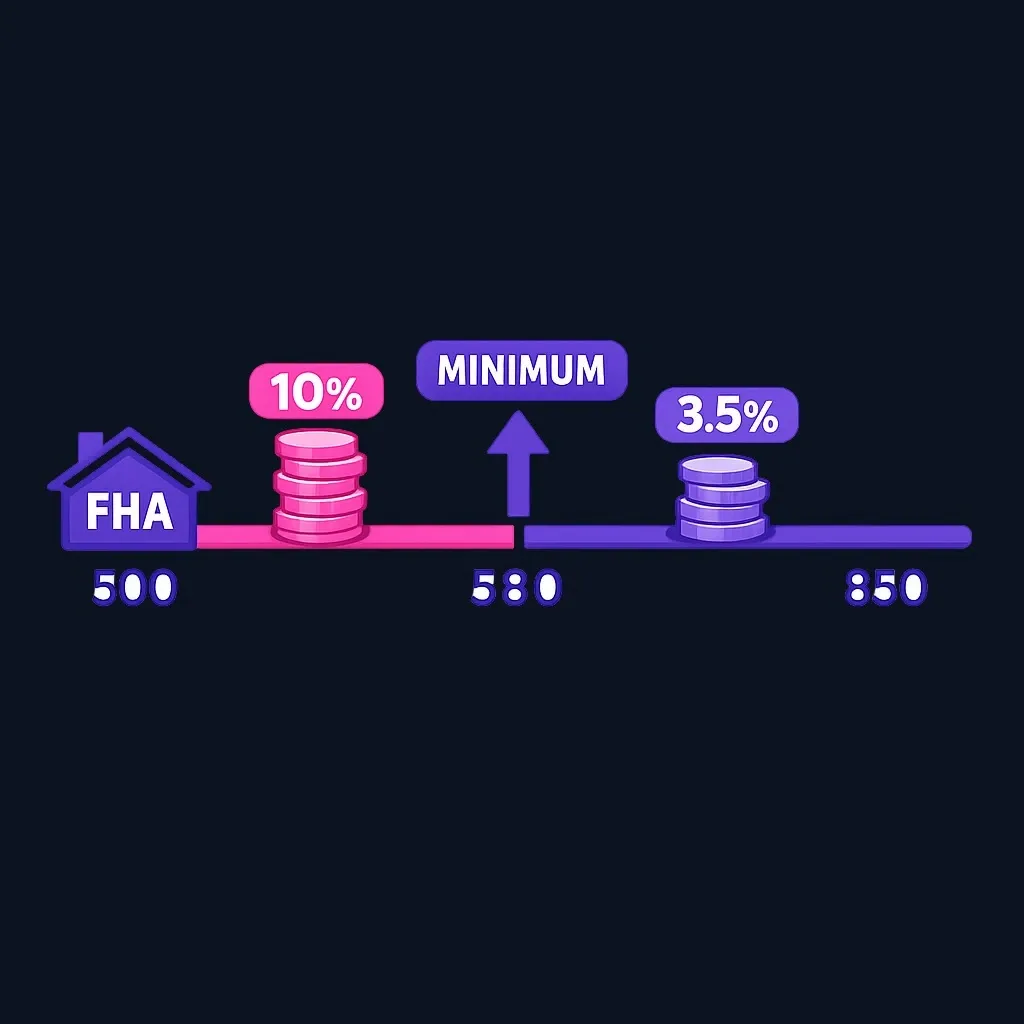
FHA’s 3.5% minimum down payment is tied to qualifying credit: HUD’s credit-score framework permits maximum financing at scores of 580 or higher, while scores from 500 through 579 are limited to 90% loan-to-value, implying at least 10% down. These are program thresholds, not a promise that every lender accepts the minimum. See HUD’s credit-score policy and the current FHA handbook access page. A lender also evaluates debts, income, credit history, and the property.
Include upfront and recurring program charges
For USDA fiscal year 2026, the official fee notice specifies a 1% upfront guarantee fee and a 0.35% annual fee based on the average scheduled unpaid principal balance. Fiscal year 2026 ends September 30, 2026; use the applicable notice for a later transaction.
FHA’s published mortgage-insurance schedule includes a 1.75% upfront premium for most forward mortgages. Annual premiums vary by loan amount, term, and loan-to-value ratio. For the ordinary 30-year, 96.5%-loan-to-value example below, the published schedule’s annual rate is 0.55%. That rate should not be applied to every FHA loan.
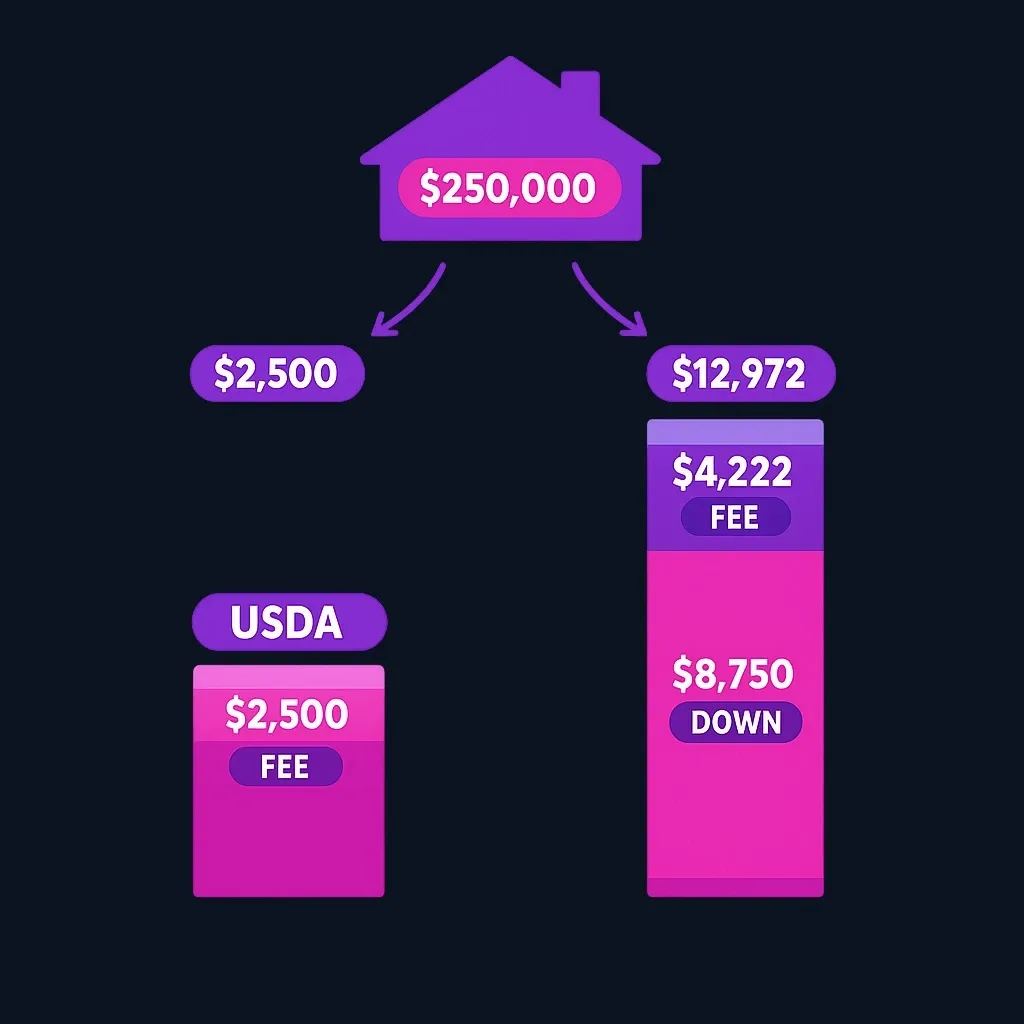
On the same hypothetical $250,000 purchase, assume the upfront program charge is paid in cash in both cases. USDA with no down payment and a $250,000 loan would have a $2,500 upfront fee. FHA with 3.5% down starts with a $241,250 base loan, and its upfront premium would be $4,221.88. That gives $2,500 versus $12,971.88 for the down payment plus upfront program charge, before all other closing costs. Financing a charge changes the calculation and balance; this example does not finance it or assume identical interest rates.
No down payment does not mean no cash needed
Closing costs, prepaid taxes and insurance, inspections, and reserves can still matter. Ask what can be financed, paid by another permitted party, or covered through an eligible assistance program. Do not assume every cost can be added to the loan.
For a hypothetical $250,000 purchase, a 3.5% down payment is $8,750 before other costs. A no-down-payment option may reduce that initial requirement but still needs a full cash-to-close and payment comparison.
Compare the complete loan
Request written estimates using the same purchase price and term. Include principal and interest, program fees or mortgage insurance, property taxes, insurance, and closing costs. Check how long recurring program charges apply.
Confirm current income and loan limits, property eligibility, and lender requirements. Choose from the programs you actually qualify for, then compare total cost and a payment that leaves room for maintenance and ordinary living expenses.
Confirm eligibility before shopping on payment alone
For USDA guaranteed loans, check the actual property address and the household-income rules. A home does not have to match an everyday image of a farm to be in an eligible area, but an address outside the approved area does not become eligible because the borrower meets the income test. Confirm both before relying on the program.
For FHA, check the applicable loan limit, borrower qualifications, and property requirements. FHA insurance supports eligible lending; it is not a promise that every lender will approve an applicant at the program's minimum thresholds. Lenders can apply their own underwriting standards within the program.
Practice trading with Finelo
Practice in a simulator, learn with bite-sized lessons, and build confidence before risking real money.
Build a complete cash-to-close estimate
A low or zero down payment does not remove other costs of buying. Include inspections, appraisal-related costs where applicable, closing charges, prepaid taxes and insurance, and any required reserves. Ask which amounts can be financed or paid through permitted assistance and which must come from your available funds.
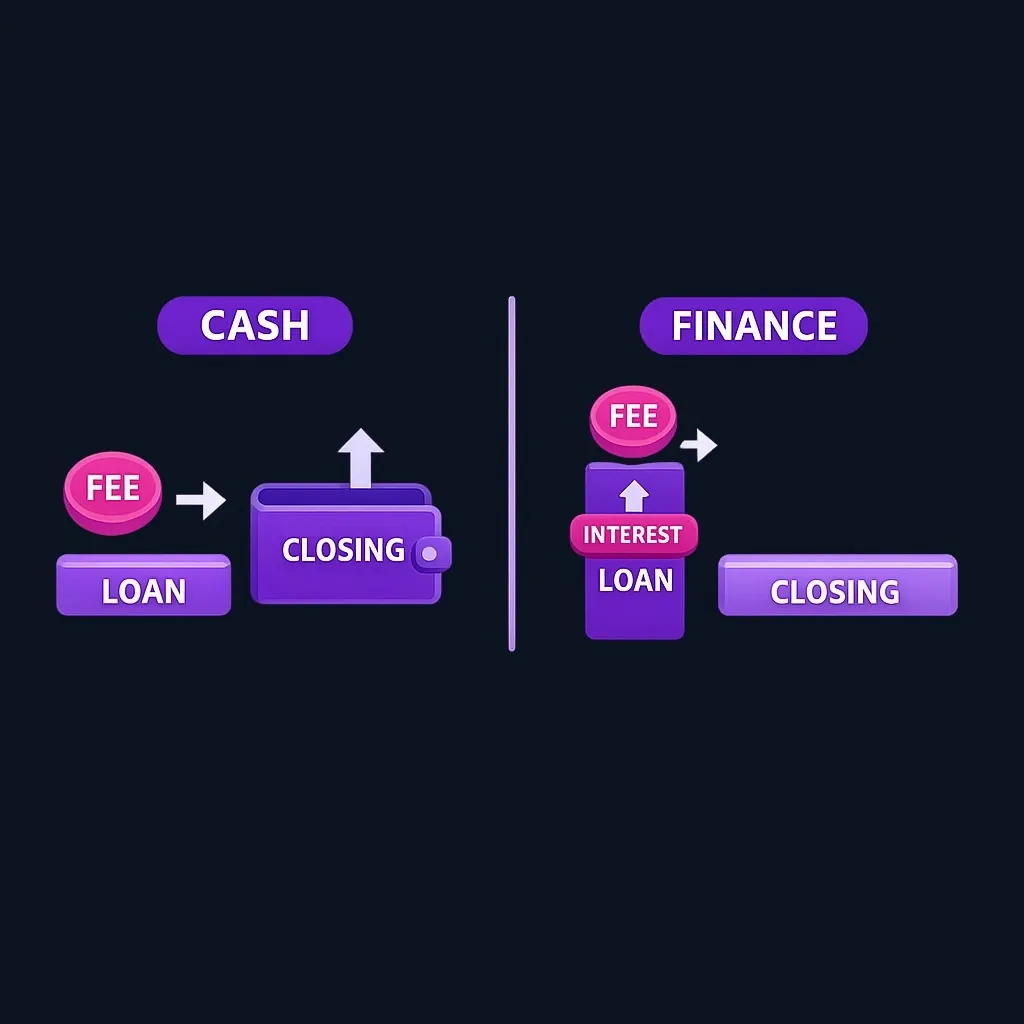
Keep the treatment of upfront program fees consistent in the comparison. Financing a fee changes the loan balance and future interest; paying it in cash changes the closing budget. Two estimates can look different simply because one finances the charge and the other does not.
Test the monthly housing budget beyond the loan payment
Compare principal and interest, ongoing program charges, taxes, homeowners insurance, and association fees if any. Set aside a realistic amount for maintenance as well. The lender's approval and the household's comfortable budget are related but not identical limits.
Use the program notices for the relevant closing or guarantee period. The FY2026 USDA fee schedule has a stated period, and a transaction after that period needs the applicable notice. Keep dated written estimates so changes in rates or fees can be identified rather than mistaken for differences inherent in USDA versus FHA.
Understanding USDA Loans
USDA loans (officially Guaranteed Loan Program by the U.S. Department of Agriculture) are designed to expand homeownership in eligible rural areas. They target low- to middle-income borrowers and are intended to make purchase financing affordable for households who meet location and income rules.
Key features and eligibility (what to expect)
-
Zero down payment option: USDA guaranteed loans commonly permit no down payment for eligible buyers and properties.
-
Geographic and income rules: USDA lending is tied to eligible rural/semirural locations and borrower income limits. Check local USDA eligibility and income limits when considering this program.
-
Credit and underwriting: USDA states that its guaranteed program has no minimum credit-score requirement, but applicants must demonstrate an ability and willingness to manage debt. Participating lenders assess the file and may set their own credit standards. Do not assume USDA will approve a borrower rejected for a conventional loan.
How the process usually flows
- Confirm property is in an eligible USDA area and your household income fits program limits.
- Gather income, employment, and asset documents.
- Consider a lender approved to originate USDA guaranteed loans and apply.
- Lender processes the file and submits the guarantee request to USDA. Steps and practical tips are summarized in lender guides and application walkthroughs. Practical takeaway: USDA’s ability to finance the purchase without a down payment can reduce the initial cash requirement. It does not eliminate closing costs or establish that its total cash requirement is lower than every alternative. Confirm the applicable fee notice with the lender.
Understanding FHA Loans
FHA loans are mortgages from private lenders that receive mortgage insurance and regulatory backing from the Federal Housing Administration. They are intended to expand access to mortgage credit for borrowers who might not qualify for conventional financing.
Key features and eligibility (what to expect)
-
Low down payment: Borrowers with credit scores that meet FHA rules can often put down as little as 3.5% of purchase price.
-
Nationwide availability: FHA loans are available across the U.S. Loan limits vary by county and high-cost areas have higher limits. FHA does not impose the same rural location restrictions as USDA.
-
Credit flexibility: FHA underwriting is typically more permissive on credit history than many conventional programs; lenders apply FHA guidelines and overlays.
How the process usually flows
- Check FHA loan limits for your county and review down-payment needs.
- Gather employment, income, and asset documents.
- Apply with an FHA-approved lender.
- Complete underwriting and close once the loan meets FHA requirements. See lender walkthroughs for step-by-step application details. Practical takeaway: FHA may be an option for borrowers who meet its down-payment and credit requirements. Compare the actual offer with other programs available to you, including recurring mortgage-insurance costs; FHA is not automatically the least expensive or easiest option.
When to Choose USDA Loans
Use USDA when these conditions apply to you and you’ve checked program limits.
Typical scenarios where USDA may be the better fit
- You qualify by household income and the property sits in a USDA-eligible rural area. USDA’s primary mission is to serve buyers in these locations.
- You do not have funds for a down payment and need financing that can provide 100% financing.
- You have compared actual USDA and FHA offers for the same property and find the USDA combination of cash required, payment, fees, and term suitable. USDA states that individual lenders determine interest rates; the program label does not guarantee the lowest rate.
Checklist before choosing USDA
- Confirm property eligibility with USDA area maps or your lender.
- Run your household income against USDA limits for your area.
Caveat: If your purchase is not in an eligible area or your income is above program thresholds, USDA is not available. Always verify eligibility and fees with an approved USDA lender.
When to Choose FHA Loans
FHA may suit you when geography or credit profile makes USDA impractical.
Typical scenarios where FHA may be the better fit
- You need a nationally available program without rural/area restrictions. FHA loans are available nationwide.
- You meet FHA and lender credit requirements and can fund the down payment required for your qualifying profile. The 3.5% minimum is not available to every credit score.
- You want a straightforward path where loan limits and MIP schedules are well documented and lenders have standardized FHA procedures.
Checklist before choosing FHA
- Check county loan limits to ensure the target property falls within FHA limits for loan amount.
Caveat: FHA mortgage insurance often cannot be canceled except in limited scenarios; this can raise long-term cost compared with other loan types. Confirm MIP duration and cancelation possibilities with lenders and FHA guidance.
What are the eligibility requirements for USDA loans?
USDA guaranteed loans require the property to be in a USDA-eligible rural area and household income must meet program limits; lenders and USDA will also evaluate credit, income stability, and the borrower’s ability to repay.
What are the benefits of FHA loans?
FHA loans allow lower down payments (commonly about 3.5%) and tend to have more flexible credit underwriting than many conventional loans, making them a common option for buyers with limited savings or imperfect credit.
How do I choose between USDA and FHA loans?
Start with location: if the home is not in an eligible USDA area, USDA is not available. If it is eligible, get lender quotes for both programs that include upfront and annual fees, interest rate, and monthly payment—then compare total cost against your cash available and credit profile using the eligibility and cost comparisons above.
What are the costs associated with each loan type?
Both can involve interest, lender and third-party closing charges, prepaid taxes and insurance, and program-specific charges. USDA guaranteed loans have the applicable upfront guarantee and annual fees. FHA loans have upfront and annual mortgage-insurance premiums. Compare the actual loan estimates, including whether upfront charges are paid in cash or financed, and how long recurring charges continue. The numerical example above isolates down payment and upfront program charges; it is not a complete closing estimate.
When comparing an eligible mortgage offer, also weigh Mortgage points vs. a larger down payment.
This guide covers U.S. rules. Finelo provides financial education, not personalized financial, investment, tax, or legal advice.
Financial LiteracyU.S. GuideFinancial Education
Practice trading with Finelo
Practice in a simulator, learn with bite-sized lessons, and build confidence before risking real money.
About the author
Finelo Team
The Finelo Team creates practical investing and trading education designed to help beginners learn faster with structured challenges, simulator practice, and bite-sized lessons.
Keep reading — Related articles
Financial Literacy
Term life vs. accidental death insurance
Compare broad term-life protection with accident-only coverage, including exclusions, underwriting, and the family income gap.
Finelo Team
Financial Literacy
Term life insurance laddering vs. one policy
Compare several term policies ending at different times with one policy, using coverage needs, costs, and future insurability.
Finelo Team

Financial Literacy
Tax withholding vs. estimated payments
Coordinate payments during the year using the 2026 safe-harbor thresholds, prior-year conditions, and payment-timing rules.
Finelo Team