Last editorial review: September 28, 2026
Tax withholding vs. estimated payments

Coordinate payments during the year using the 2026 safe-harbor thresholds, prior-year conditions, and payment-timing rules.
8 min read
Practice trading with Finelo
Practice in a simulator, learn with bite-sized lessons, and build confidence before risking real money.
Want to learn more?
Practice in a simulator, learn with bite-sized lessons, and build confidence before risking real money.
Explore FineloExplore Finelo's 28-day challenges
Turn learning into a daily habit with guided challenge paths.
Withholding sends tax to the IRS through an employer or other payer. Estimated payments are payments you make directly. Many households use both, especially when wages are combined with freelance, investment, or retirement income.
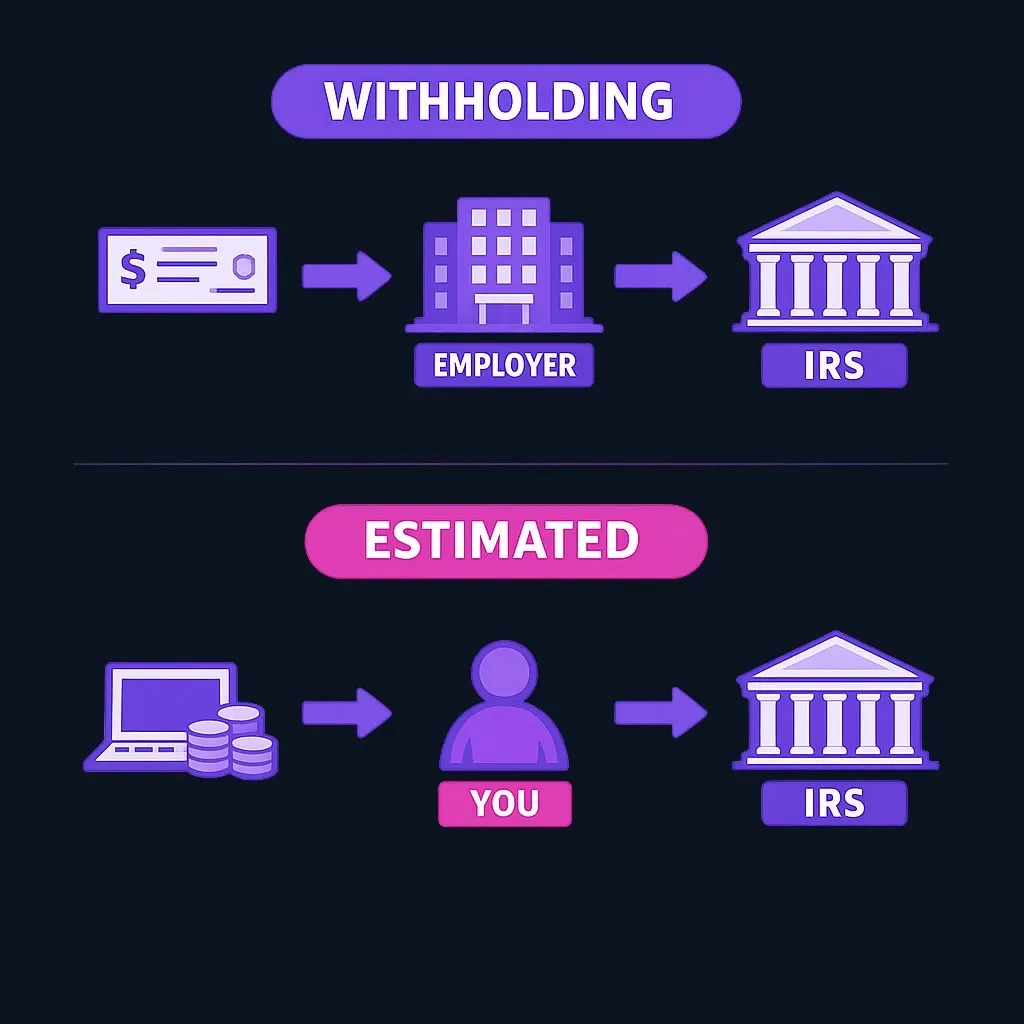
The objective is to pay enough during the year, not just to settle the balance when filing.
Compare the methods
| Withholding | Estimated payments |
|---|---|
| Deducted from eligible payments | Sent directly by the taxpayer |
| Adjusted through the appropriate withholding request | Based on your tax estimate and payment schedule |
| Often simpler for regular wages or pensions | Useful for income without sufficient withholding |
| Generally treated as paid evenly through the year for penalty purposes | Timing of each payment matters |
The IRS estimated-tax guide explains when additional payments may be needed. The IRS withholding estimator can help with relevant wage and pension situations.
Check the safe-harbor rules carefully
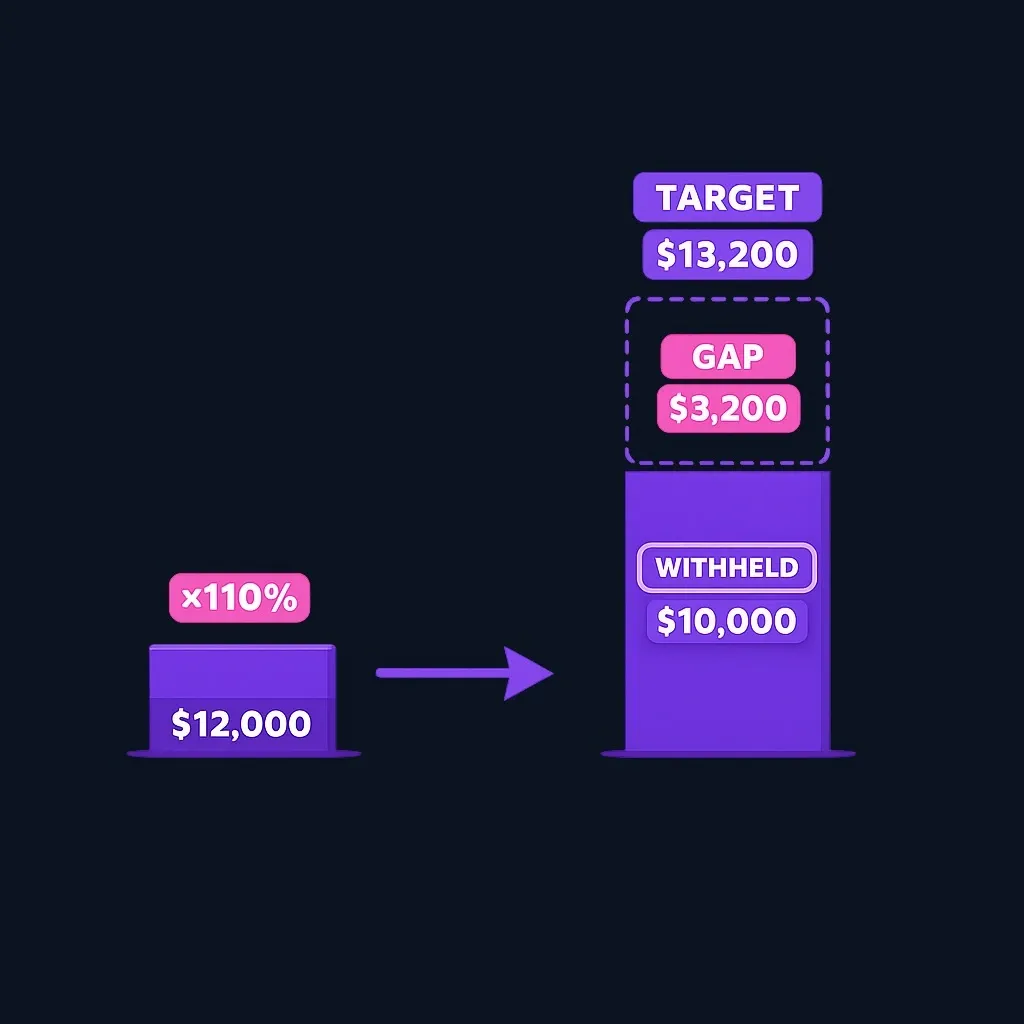
For 2026, the general safe-harbor comparison is 90% of your 2026 tax or 100% of your 2025 tax, whichever is smaller. The prior-year option requires a 2025 return covering a full 12 months. If your 2025 adjusted gross income exceeded $150,000—or $75,000 if married filing separately for 2026—the prior-year percentage generally becomes 110%.
You generally do not need estimated payments if you expect to owe less than $1,000 after withholding and refundable credits. Farming, fishing, and some other situations have special rules. IRS Publication 505 for 2026 explains the thresholds and exceptions.
These rules can protect against a penalty without covering the entire final tax bill. A safe harbor is not a promise that you will owe nothing at filing.
For example, assume the prior-year option is available, your 2025 tax was $12,000, and the 110% rule applies. That safe-harbor amount is $13,200. If projected withholding is $10,000, the remaining amount is $3,200, which could be covered through additional timely withholding or estimated payments. This simplified example does not establish that $13,200 covers the full 2026 tax bill or that a late estimated payment avoids earlier-period penalties.
Match payments to income timing
A hypothetical employee with side-business income might increase wage withholding instead of making separate estimated payments. Someone with a large, irregular gain may need a more detailed calculation.
Estimated-payment periods are not simply four equal calendar quarters. For uneven income, the annualized-income method may be relevant. Paying everything late in the year may not fix earlier underpayments in the same way that additional withholding can.
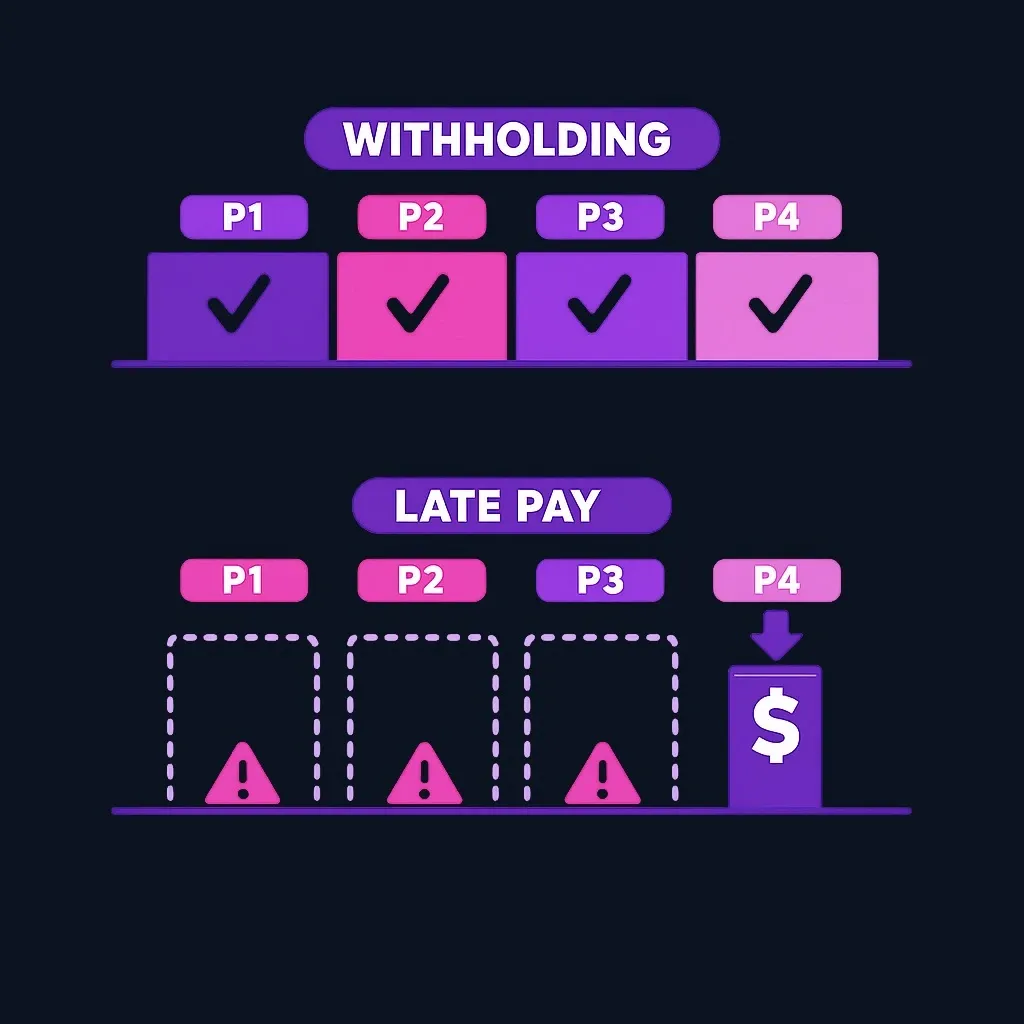
Update the estimate after a major income change and keep payment confirmations by tax year. Compare total withholding and estimated payments with the projected return so each source of income is accounted for once.
Start with the annual target, then address timing
Estimate the year's tax using expected income, deductions, credits, and filing status. Then determine the required payment target under the applicable safe-harbor or current-year rules. A safe harbor can protect against an underpayment penalty without guaranteeing that no additional tax will be due at filing.
List payments already made through payroll, pensions, other withholding, and estimated installments. The remaining amount needs a schedule. Federal estimated-payment periods are not simply four identical calendar quarters, and income earned unevenly can require a different calculation from a steady salary.
Choose the payment source that can actually carry the adjustment
An employee may be able to change payroll withholding, while a self-employed person without enough withholding opportunities may need direct estimates. A retiree can sometimes coordinate withholding from a pension or other eligible payment with estimates for investment income. The payment method does not change the underlying tax calculation.
If making a late-year adjustment, check the timing rules carefully. Withholding is generally treated differently from an estimated payment made on one specific date. That distinction can matter when earlier installments were insufficient. Do not assume a large January payment retroactively fixes every earlier period.
Practice trading with Finelo
Practice in a simulator, learn with bite-sized lessons, and build confidence before risking real money.
Make a reserve plan for income without withholding
When self-employment income or investment proceeds arrive, set aside a calculated amount for tax before committing the rest. Use an estimate based on the whole return rather than a percentage copied from someone else's business. Include relevant state obligations in a separate calculation.
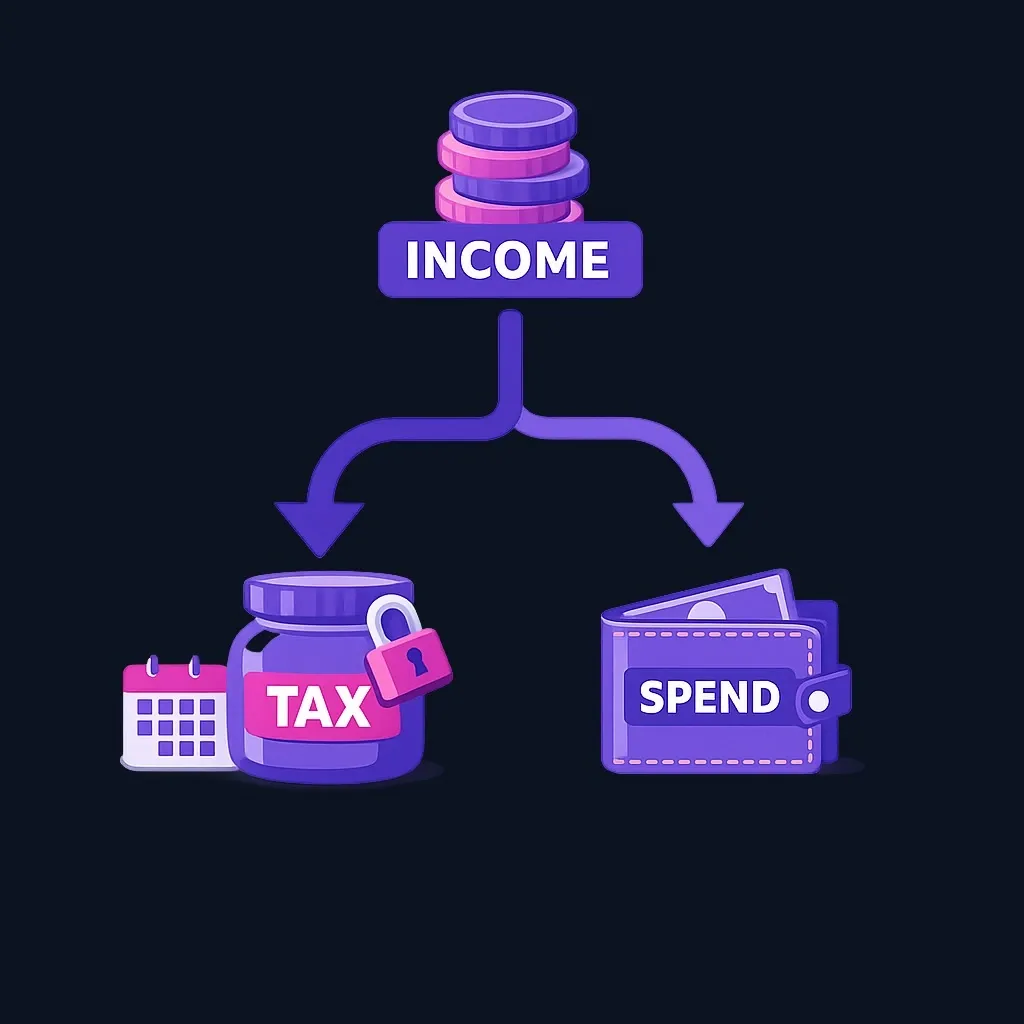
For irregular income, update the projection after a major payment or sale. Keep records showing when income was received and payments were made. Those dates may support an annualized-income calculation where appropriate, but that method requires the applicable forms and computation.
Review the result during the year
A new job, a spouse's income change, a bonus, a retirement distribution, or a large gain can make the original estimate stale. Review year-to-date withholding and projected remaining income rather than waiting until the return is due. A small adjustment made with several pay periods left can be easier to manage than a large catch-up payment.
Retain payment confirmations with the tax year and payment type. Check that payments were applied to the intended account and period. At filing, reconcile all withholding and estimates so an accurately funded tax bill does not become an apparent shortfall because a payment was omitted from the return.
How to compare your options
A short framework to decide which method fits your situation.
Income source mix
- Mostly W-2 wages or pension? Withholding generally covers regular payroll income.
- Significant untaxed income (freelance, investment, rental)? Estimated payments likely needed.
Control and cash flow preferences
- Prefer steady, paycheck-deducted amounts? Withholding smooths payments across the year.
- Prefer to manage cash and pay in chunks? Estimated payments require a schedule that meets IRS due dates; personal cash-flow preferences do not change those deadlines.
Penalty risk and timing
- For penalty calculations, withholding is generally allocated evenly across the payment due dates unless actual withholding dates are used under the applicable rules; estimated payments are the mechanism for taxpayers to make comparable payments when payers don’t withhold. Use the IRS estimator or the estimated taxes guidance to evaluate underpayment risk (Tax Withholding Estimator, Estimated Taxes).
Administrative effort
- Withholding: one form to your employer and the employer handles remittance.
- Estimated payments: you calculate, schedule, and remit payments yourself.
When to choose each option
Concrete scenarios to help you choose.
Choose withholding when
- You receive regular wages or most income from an employer or pension. The IRS estimator is designed to help you find the right withholding level for W-2 or pension payers.
- You prefer automatic, low-effort payment and simpler year-end filing.
Choose estimated payments when
- You receive significant income that a payer does not withhold for (self-employment, investment income, rental income). The IRS explains estimated tax obligations for taxpayers in this situation.
- You want to control timing of payments to match cash flow, and you’re comfortable tracking quarterly obligations.
Mixed approach
Many taxpayers use both: maintain reasonable withholding and make estimated payments for supplemental income. Use the estimator where it covers your situation, and the Publication 505 worksheets for estimated-tax calculations, particularly when self-employment tax or other complex items apply. Example (hypothetical): If a retiree receives a pension with modest withholding but also has investment distributions, they might increase pension withholding for simplicity and avoid making separate estimated payments. This is an illustrative scenario, not tax advice.
Tradeoffs and caveats
Common pitfalls and how to avoid them.
Underpayment risk
If your combined withholding and estimated payments are too low, you may face underpayment penalties. The IRS provides guidance on estimated taxes and related rules—review it carefully to assess risk.
Over-withholding vs cash availability
Over-withholding results in a larger refund at tax time but reduces your available cash during the year. If you prefer keeping cash, aim for accurate withholding using the IRS estimator.
Mid-year changes
Life events (job change, large capital gain, divorce, new child) can change your tax picture. Revisit withholding and estimated payments when your income or deductions change. The IRS estimator is intended to help you update withholding choices for employers or pension payers.
Recordkeeping and proof
Keep records of estimated payments and evidence of withholding amounts (pay stubs, Form 1099s, W-2). Proper records simplify year-end filing and penalty disputes.
State-level rules
State tax agencies may treat withholding and estimated payments differently. Check your state tax agency guidance for details; the IRS pages focus on federal tax rules.
What is the difference between tax withholding and estimated payments?
Withholding is money your employer or payer deducts and sends to the IRS on your behalf; estimated payments are amounts you send directly when you have income not covered by withholding. See the IRS pages for official definitions and guidance (Tax Withholding Estimator, Estimated Taxes).
How do I adjust my W-4 for withholding?
Use the IRS Tax Withholding Estimator to identify whether your current withholding is sufficient, then submit an updated Form W-4 to your employer to change payroll withholding based on the estimator’s recommendations.
When are estimated tax payments due?
The IRS publishes the schedule and instructions for estimated tax payments on its Estimated Taxes page and in Publication 505; check those official resources for the current year’s due dates.
What are the consequences of not making estimated payments?
Failing to make required estimated payments or keeping withholding too low can result in penalties for underpayment. Consult the IRS guidance on estimated taxes and Publication 505 for details and calculations.
For retirement benefits specifically, read Should you have taxes withheld from Social Security.
This guide covers U.S. rules. Finelo provides financial education, not personalized financial, investment, tax, or legal advice.
Financial LiteracyU.S. GuideFinancial Education
Practice trading with Finelo
Practice in a simulator, learn with bite-sized lessons, and build confidence before risking real money.
About the author
Finelo Team
The Finelo Team creates practical investing and trading education designed to help beginners learn faster with structured challenges, simulator practice, and bite-sized lessons.
Keep reading — Related articles

Financial Literacy
USDA vs. FHA loan
Compare location and income eligibility, down payments, credit conditions, and upfront and annual program charges for a home purchase.
Finelo Team

Financial Literacy
Term life vs. accidental death insurance
Compare broad term-life protection with accident-only coverage, including exclusions, underwriting, and the family income gap.
Finelo Team

Financial Literacy
Term life insurance laddering vs. one policy
Compare several term policies ending at different times with one policy, using coverage needs, costs, and future insurability.
Finelo Team