Asset allocation means deciding how much of your investment portfolio goes into different asset classes, such as stocks, bonds, and cash. For many beginners, a reasonable starting point is a simple diversified mix based on time horizon, risk tolerance, and financial goals—not a “perfect” universal percentage.
Explore Finelo's 28-day challenges
Turn learning into a daily habit with guided challenge paths.
A beginner with a long time horizon might consider a growth-oriented allocation such as more stocks and fewer bonds, while someone investing for a nearer-term goal may prefer more bonds or cash. Common educational examples include conservative, moderate, and aggressive portfolios, but these are examples only—not personalized financial advice.
The recommended next step is to learn the basics, write down your goal and timeline, choose an allocation you can stick with during market volatility, and review it periodically. If you are unsure about suitability, taxes, costs, or risk, consider speaking with a qualified financial advisor.
Asset allocation 101
At its simplest, asset allocation is the structure of your portfolio. Instead of asking, “Which single investment should I buy?” asset allocation asks, “How should my money be spread across different types of investments?” That shift matters because your mix of assets is one of the main drivers of how much risk you take and how your portfolio may behave over time.
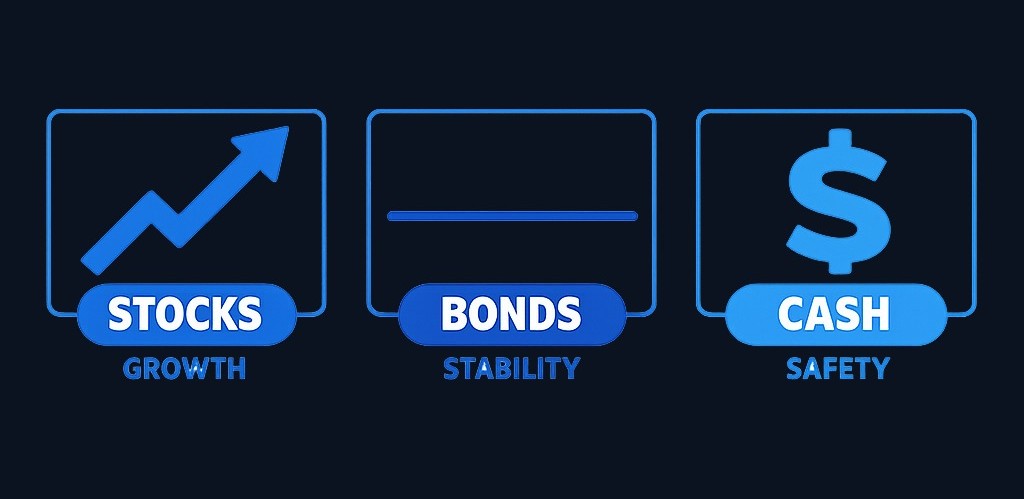
The three basic asset categories most beginners hear about are stocks, bonds, and cash or cash equivalents. Stocks generally represent ownership in companies and may offer growth potential, but they can also move sharply up and down. Bonds are loans to governments or companies and are often used to add income or stability, though they still carry risks. Cash is useful for short-term needs and emergency savings, but it may not keep pace with inflation over long periods.
The three main asset classes for beginners: stocks offer growth potential with volatility, bonds provide stability with moderate risk, and cash offers safety but limited long-term returns.
For example, imagine a new investor named Maya who wants to invest for retirement several decades away. If she puts all of her money in cash, she may avoid stock market swings, but she could miss long-term growth opportunities. If she puts everything in stocks, she may have more growth potential but also more volatility. Asset allocation gives her a middle path: a portfolio based on her goal, her timeline, and her ability to stay calm when markets move.
Here is a beginner-friendly view of the main asset classes:
Asset class
Typical role in a portfolio
Main risks to understand
Beginner example
Stocks
Long-term growth potential
Market volatility, company risk, possible losses
Broad stock funds or diversified equity investments
Bonds
Stability, income, diversification
Interest rate risk, credit risk, inflation risk
Government or investment-grade bond funds
Cash
Short-term safety and liquidity
Inflation risk, lower long-term growth potential
Savings, money market funds, short-term reserves
Other assets
Additional diversification in some portfolios
Complexity, fees, liquidity, valuation risk
Real estate funds, commodities, or alternatives, if suitable
This table is educational and simplified. The right investment mix depends on the investor, account type, costs, tax situation, and available investment options.
What to know before deciding
A good beginner asset allocation is not based on age alone. Age can be useful because it often relates to time horizon, but it does not capture the full picture. Two investors of the same age may have different emergency savings, income stability, debt, family obligations, retirement goals, and comfort with market declines.
The first question is: When do you need the money? Time horizon affects how much short-term volatility you may be able to accept. If you are investing for a goal 20 or 30 years away, temporary market declines may be easier to withstand than if you need the money in two years. For short-term goals, cash or lower-volatility assets may be more appropriate than a stock-heavy portfolio.
The second question is: How much risk can you tolerate in real life? Many beginners think they have high risk tolerance when markets are rising, then discover their limits during a downturn. A portfolio is only useful if you can stick with it through uncomfortable periods. If a 30% stock market decline would cause you to sell everything, an aggressive allocation may not be suitable even if your time horizon is long.
The third question is: What is the purpose of the money? Retirement savings, a home down payment, education savings, and general wealth-building can all require different investment strategies. A beginner investor saving for retirement may choose a different mix than someone building a near-term cash reserve. That is why a “good” allocation is always based on context.
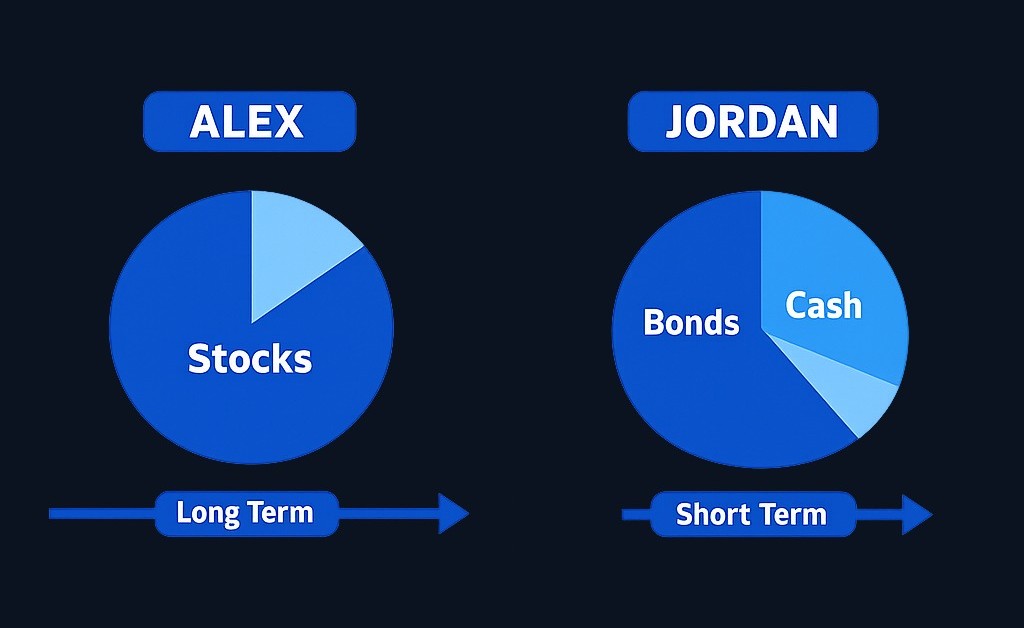
Consider two beginner scenarios. Alex is 28, has an emergency fund, and is investing for retirement decades away. A growth-oriented portfolio may fit Alex’s long-term goal, if Alex understands the risk. Jordan is 45 and saving for a home purchase in three years. Even if Jordan is comfortable with risk, a stock-heavy allocation may be too volatile for that short timeline.
Alex (28, long timeline) may consider a growth-focused portfolio, while Jordan (45, short timeline) may need a conservative approach for a near-term goal. Time horizon shapes allocation strategy.
Decision framework
A practical beginner framework starts with three inputs: your goal, your time horizon, and your risk tolerance. Once those are clear, you can choose an allocation that is simple enough to maintain. Simplicity matters because beginners often make mistakes when they own too many overlapping funds, chase recent returns, or change strategy whenever the market gets noisy.
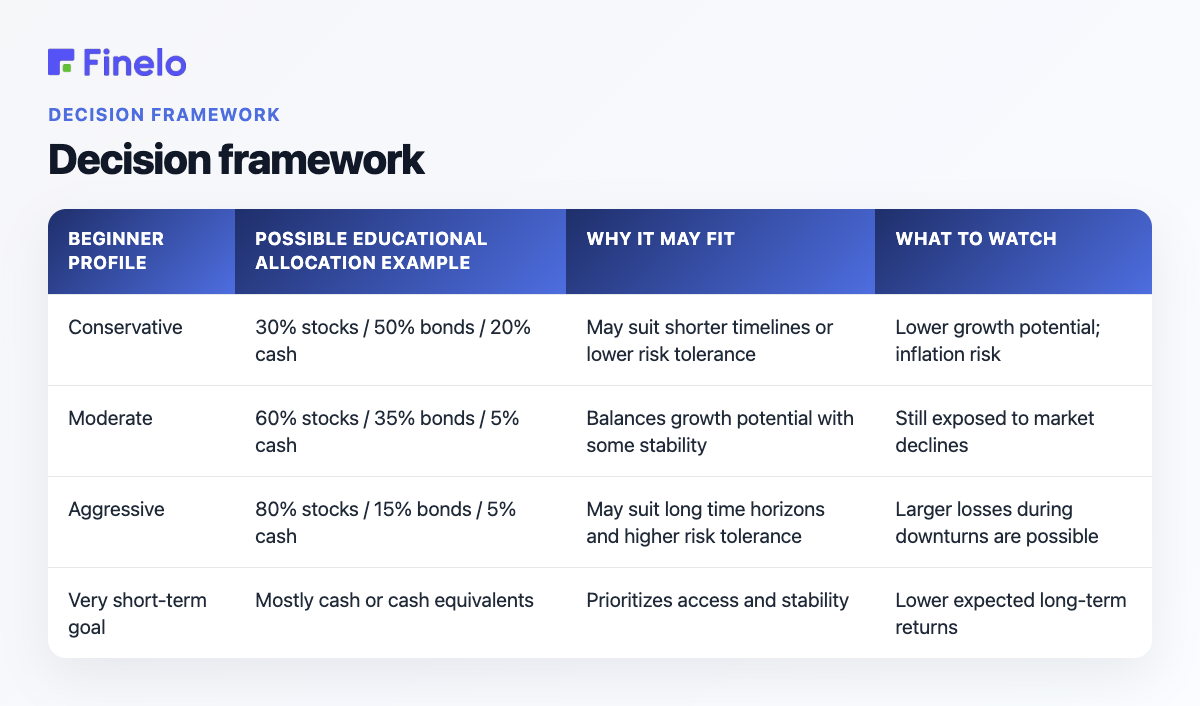
The examples below are not recommendations. They are educational models that show how different allocations can reflect different investor profiles. Before making investment decisions, verify risk, costs, tax implications, and suitability for your own situation.
Beginner profile
Possible educational allocation example
Why it may fit
What to watch
Conservative
30% stocks / 50% bonds / 20% cash
May suit shorter timelines or lower risk tolerance
Lower growth potential; inflation risk
Moderate
60% stocks / 35% bonds / 5% cash
Balances growth potential with some stability
Still exposed to market declines
Aggressive
80% stocks / 15% bonds / 5% cash
May suit long time horizons and higher risk tolerance
Larger losses during downturns are possible
Very short-term goal
Mostly cash or cash equivalents
Prioritizes access and stability
Lower expected long-term returns
Reference table from this guide — Decision framework.
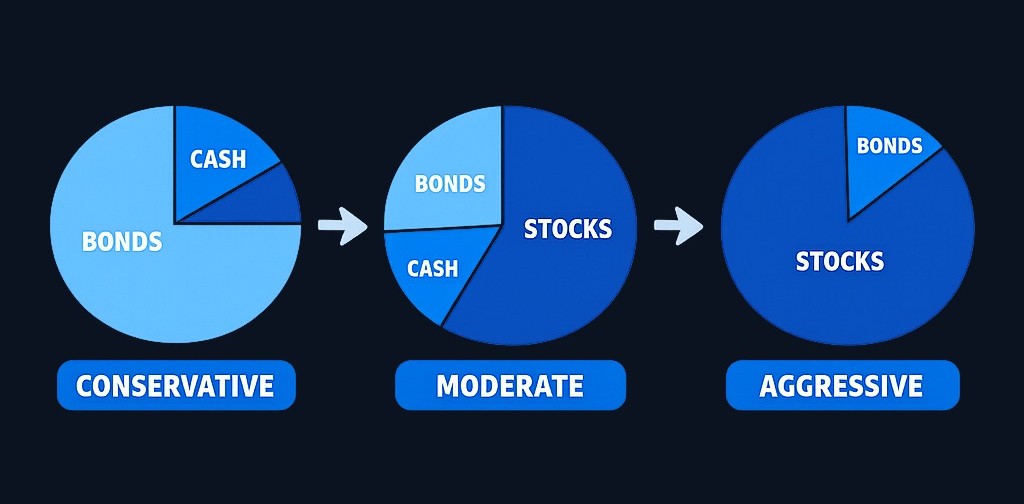
A beginner can use this table as a conversation starter, not as a prescription. For instance, a 60/35/5 mix may look moderate on paper, but it can still lose value during market downturns. If that would make you abandon the plan, a more conservative allocation may be easier to follow.
Three sample allocations ranging from conservative (more bonds and cash) to aggressive (more stocks). These are educational
A useful decision checklist is:
Name the goal. Retirement, house, education, general investing, or another purpose.
Set the time horizon. Decide whether the money is needed in months, years, or decades.
Estimate risk tolerance. Ask how you would react if the portfolio dropped 10%, 20%, or more.
Choose a simple allocation. Avoid unnecessary complexity while you are learning.
Diversify within each category. Owning one stock is different from owning a broad stock fund.
Review periodically. Revisit your mix when your goals, timeline, or risk tolerance changes.
This framework is also useful if you use an investing education tool or simulator. Finelo is an investment learning and financial education product. Readers who want to keep learning can explore the Finelo app page at https://finelo.com/app or compare broader company information at https://finelo.com/about-us. Review official pages for current feature and plan details.
A beginner’s guide to diversification and rebalancing
Asset allocation tells you the broad mix. Diversification tells you not to concentrate too much of that mix in one company, sector, country, or bond issuer. A beginner might say, “I own stocks,” but if that means only one technology stock, the portfolio is not very diversified. Diversification spreads exposure so one investment has less power to dominate the outcome.
For example, Priya decides on a moderate allocation of 60% stocks and 40% bonds. If her stock portion is entirely one company, her portfolio depends heavily on that company’s performance. If instead her stock portion is spread across many companies and industries, she still has stock market risk, but she has reduced single-company risk. Diversification does not eliminate losses, but it can help manage avoidable concentration risk.
Rebalancing is the maintenance step. Over time, market movements can push your portfolio away from its original allocation. If stocks rise strongly, a 60% stock portfolio might become 70% stocks. If stocks fall, it might become 50% stocks. Rebalancing means bringing the portfolio back toward its intended mix, usually on a schedule or when allocations drift beyond a chosen range.
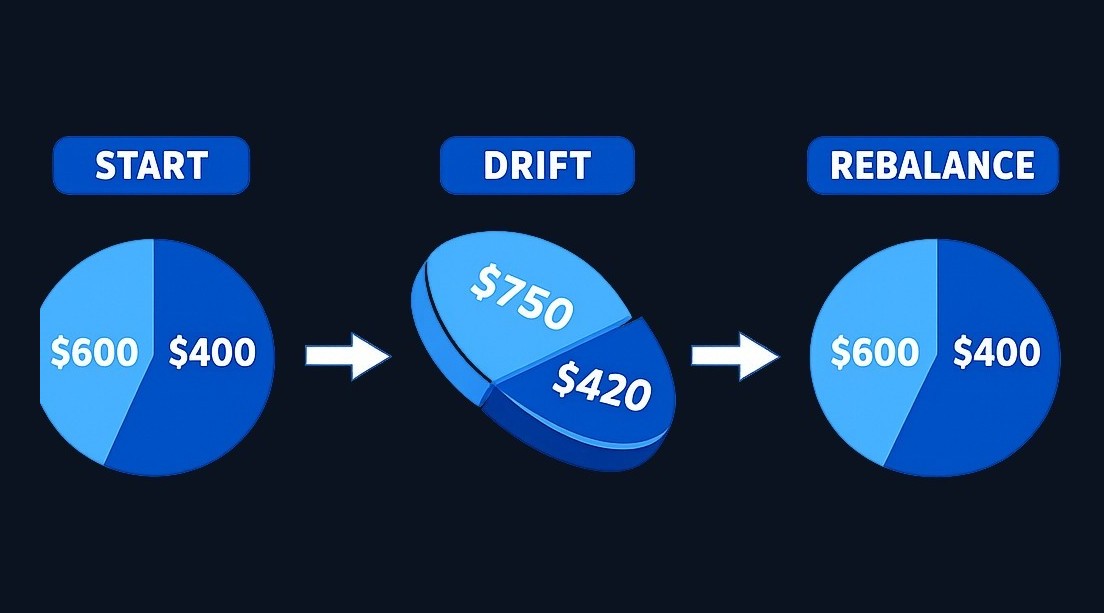
Suppose a beginner starts with $1,000 in a 60/40 educational model: $600 in stocks and $400 in bonds. After a strong stock market year, the portfolio becomes $750 in stocks and $420 in bonds. The investor now has more stock exposure than planned. Rebalancing could mean directing new contributions to bonds or selling a small amount of stocks to restore the target mix, depending on account type, taxes, transaction costs, and available options.
A portfolio starts at 60% stocks ($600) and 40% bonds ($400). After stocks rise, it drifts to 64% stocks ($750) and 36% bonds ($420).
Practice investing with Finelo
Build practical investing skills with guided lessons, simulator practice, and structured challenges.
Time horizon is one of the most important parts of beginner asset allocation. The longer your investment horizon, the more time you may have to recover from market declines. The shorter your timeline, the more damaging a poorly timed downturn can be. That is why money needed soon is usually treated differently from money intended for retirement decades away.
For a long-term retirement investor, a higher stock allocation may make sense from an educational perspective because stocks have historically offered higher long-term returns than cash or many bonds, while also carrying higher volatility. For a short-term goal, the priority often shifts from growth to preserving access to funds.
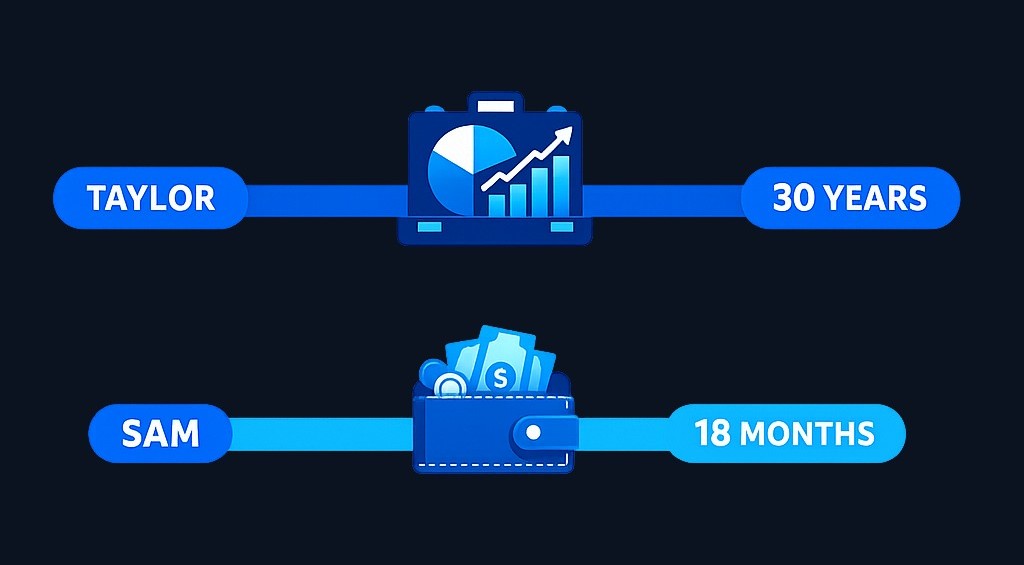
Consider this simple scenario. Taylor is investing for retirement 30 years from now and can tolerate market swings. Taylor may choose a more aggressive allocation while continuing to learn about risk management. Sam is saving for a home purchase in 18 months. Sam may decide that stock market volatility is not worth the risk for that goal and may keep most of that money in cash or lower-volatility options.
Taylor invests for 30 years and may tolerate a stock-heavy portfolio. Sam needs funds in 18 months and may prefer cash or low-volatility
This does not mean every young investor should be aggressive or every older investor should be conservative. It means the allocation should be based on the job that money needs to do. A retirement account, emergency fund, and house down payment fund may each need a different strategy.
Common mistakes beginners should avoid
One common mistake is chasing recent returns. If stocks have recently performed well, beginners may want to increase stock exposure after the gains have already happened. If markets fall, they may want to sell after losses. This behavior can turn a reasonable allocation into an emotional cycle of buying high and selling low.
Another mistake is confusing asset allocation with picking investments. A beginner may spend hours choosing between two similar stock funds while ignoring whether the overall portfolio is 90% stocks or 50% stocks. The big-picture mix often matters more than small differences between similar investments.
Beginners also sometimes forget about cash needs. Investing money that may be needed for rent, emergency expenses, taxes, or near-term purchases can create pressure to sell at a bad time. Before choosing an investment allocation, it is usually wise to separate short-term reserves from long-term investing money.
A final mistake is never revisiting the plan. Your financial life changes. Your income, goals, family situation, debt, and time horizon may shift. A good allocation at one stage may not be suitable forever, so periodic review is part of responsible investing education.
Practical examples of beginner asset allocation
Here are three educational examples that show how asset allocation can change based on risk profile. These are not personalized recommendations, and they do not guarantee any result.
Conservative beginner example:
Nina is investing for a goal seven years away and knows she gets nervous during market declines. She might study a portfolio with 30% stocks, 50% bonds, and 20% cash. This type of allocation may reduce volatility compared with a stock-heavy portfolio, but it may also limit long-term growth potential.
Moderate beginner example:
Omar is investing for retirement and wants growth, but he does not want the full volatility of an all-stock portfolio. He might study a 60% stock, 35% bond, and 5% cash allocation. This mix still carries investment risk, but it may feel more manageable than an aggressive portfolio.
Aggressive beginner example:
Leah is young, has an emergency fund, and is investing for a goal decades away. She might study an 80% stock, 15% bond, and 5% cash allocation. This type of portfolio can experience large swings, so it is only educationally appropriate for someone who understands volatility and can avoid panic selling.
The key lesson is that “good” does not mean highest possible return. A good asset allocation is one that is aligned with the investor’s goals, timeline, risk tolerance, and behavior. The best-looking portfolio on paper is not useful if the investor cannot stick with it.
What to do after reading
If you are new to investing, start by writing a one-page plan. Include your goal, time horizon, current savings, risk comfort, and a sample allocation you want to research further. Then compare that allocation with lower-risk and higher-risk alternatives so you understand the tradeoffs.
You can continue learning through Finelo’s educational pages, including the Finelo app page, AI investing education page, and Finelo reviews page. Verify current features, availability, and any pricing or subscription details on official pages before making decisions. For billing or account questions, use the official support page.
This article is educational and should not be treated as financial advice. Before investing, review risk, fees, account terms, tax considerations, and suitability. If you need guidance for your specific situation, consider consulting a qualified financial professional.
Frequently asked questions
What is a good asset allocation for beginners?
A good beginner asset allocation is a diversified mix of stocks, bonds, and cash based on your time horizon, risk tolerance, and financial goals. There is no single best allocation for everyone. Educational examples often range from conservative portfolios with more bonds and cash to aggressive portfolios with more stocks.
Is 60/40 a good beginner portfolio?
A 60% stock and 40% bond portfolio is a common educational example of a moderate allocation. It may appeal to investors who want growth potential but also some exposure to bonds. However, it can still lose value, and it may not fit every investor’s goals, timeline, or risk tolerance.
How much should a beginner invest in stocks?
The amount depends on when you need the money and how much volatility you can handle. A long-term investor may study a higher stock allocation, while someone investing for a short-term goal may prefer less stock exposure. Beginners should avoid choosing a stock percentage based only on recent returns.
What is the difference between asset allocation and diversification?
Asset allocation is the split among asset classes, such as stocks, bonds, and cash. Diversification is how spread out your investments are within those asset classes. For example, owning many companies through a broad stock fund is usually more diversified than owning one individual stock.
How often should beginners rebalance?
Many investors review their allocation on a regular schedule, such as annually, or when the portfolio drifts meaningfully from the target mix. The right approach depends on costs, taxes, account type, and personal preference. Beginners should understand rebalancing before making changes.
Should I change my asset allocation when the market falls?
Not automatically. Market declines can be stressful, but changing your allocation during panic may lock in poor decisions. It is better to have a plan before volatility happens and review whether your goals, time horizon, or risk tolerance have truly changed.
Do I need a financial advisor to choose an asset allocation?
Not always, but an advisor can help if your situation is complex or you are unsure about taxes, retirement planning, debt, account types, or suitability. Educational tools can help you learn the concepts, but they are not a substitute for personalized advice.
The Finelo Team creates practical investing and trading education designed to help beginners learn faster with structured challenges, simulator practice, and bite-sized lessons.