The 10-K is a company's audited annual report filed with the SEC once a year; the 10-Q is its unaudited quarterly update, filed three times a year for the fiscal quarters that do not end the year. The 10-K is comprehensive - business description, risk factors, audited financial statements - while the 10-Q is a slimmer progress report. This page is for investors comparing 10-k vs 10-q and deciding which filing to read, when, and for what. Learn the differences below, then practice reading real filings with guided lessons in the Finelo app.
10-K vs 10-Q: Understanding Key Differences in Financial Reporting
The 10-K is a company's audited annual report filed with the SEC once a year; the 10-Q is its unaudited quarterly update, filed three times a year for the fiscal quarters that do not end the year. The 10-K is…
7 min read
Practice investing with Finelo
Build practical investing skills with guided lessons, simulator practice, and structured challenges.
Want to learn more?
Build practical investing skills with guided lessons, simulator practice, and structured challenges.
Explore FineloExplore Finelo's 28-day challenges
Turn learning into a daily habit with guided challenge paths.
What the 10-K and 10-Q are
Both are mandatory for SEC reporting companies subject to the applicable Exchange Act requirements, and both are free through the SEC's EDGAR database. The official Form 10-K and Form 10-Q instructions define the requirements.
The Form 10-K is the annual report. It tells the company's full story once per fiscal year: what the business does, what could go wrong, how management explains the results, and the complete financial statements checked by an independent auditor. Legal and regulatory weight is highest here.
The Form 10-Q is the quarterly report. It updates investors between annual filings with condensed financial statements, a shorter management discussion, and disclosure of material changes. Companies file it for each of the first three fiscal quarters; the fourth quarter's results fold into the 10-K.
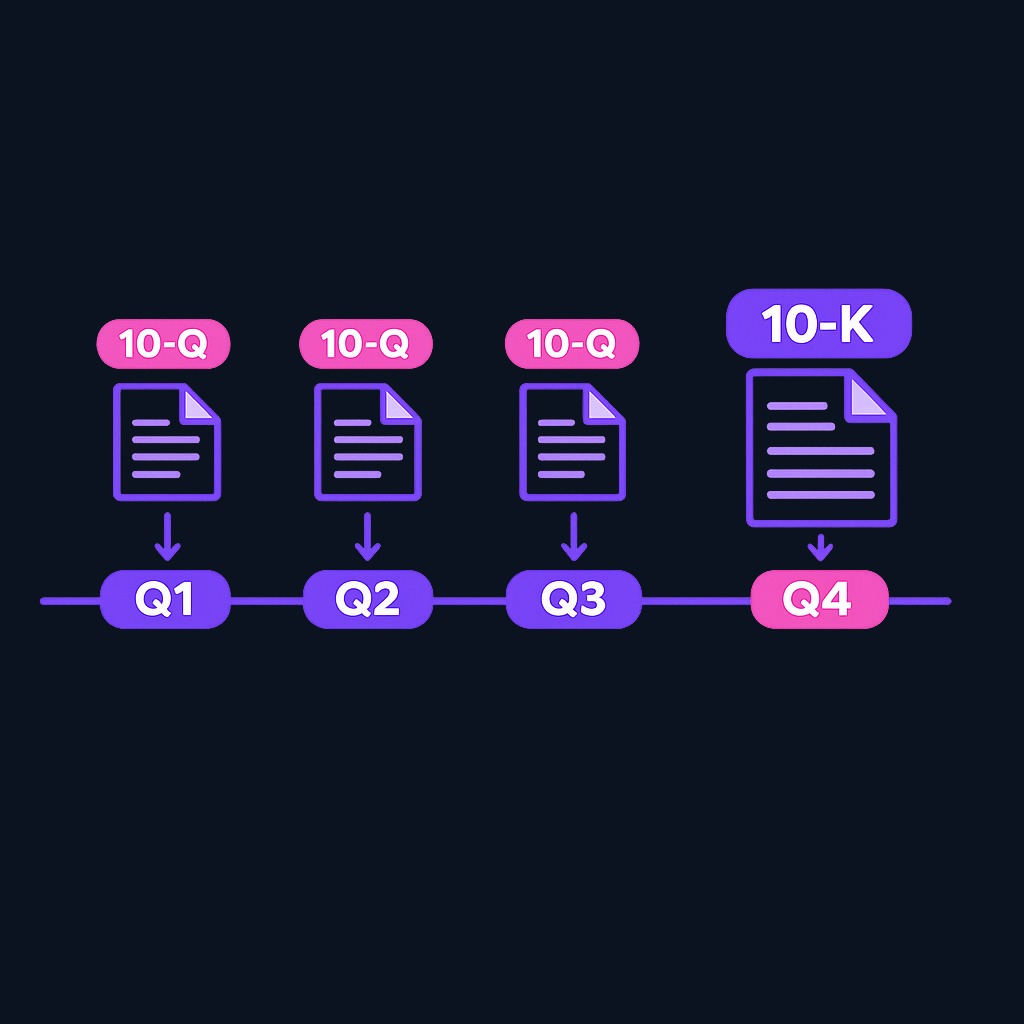
Together they form a rhythm: one deep audit-grade portrait a year, plus three interim check-ins.
Key differences between the 10-K and 10-Q
| Feature | 10-K | 10-Q |
|---|---|---|
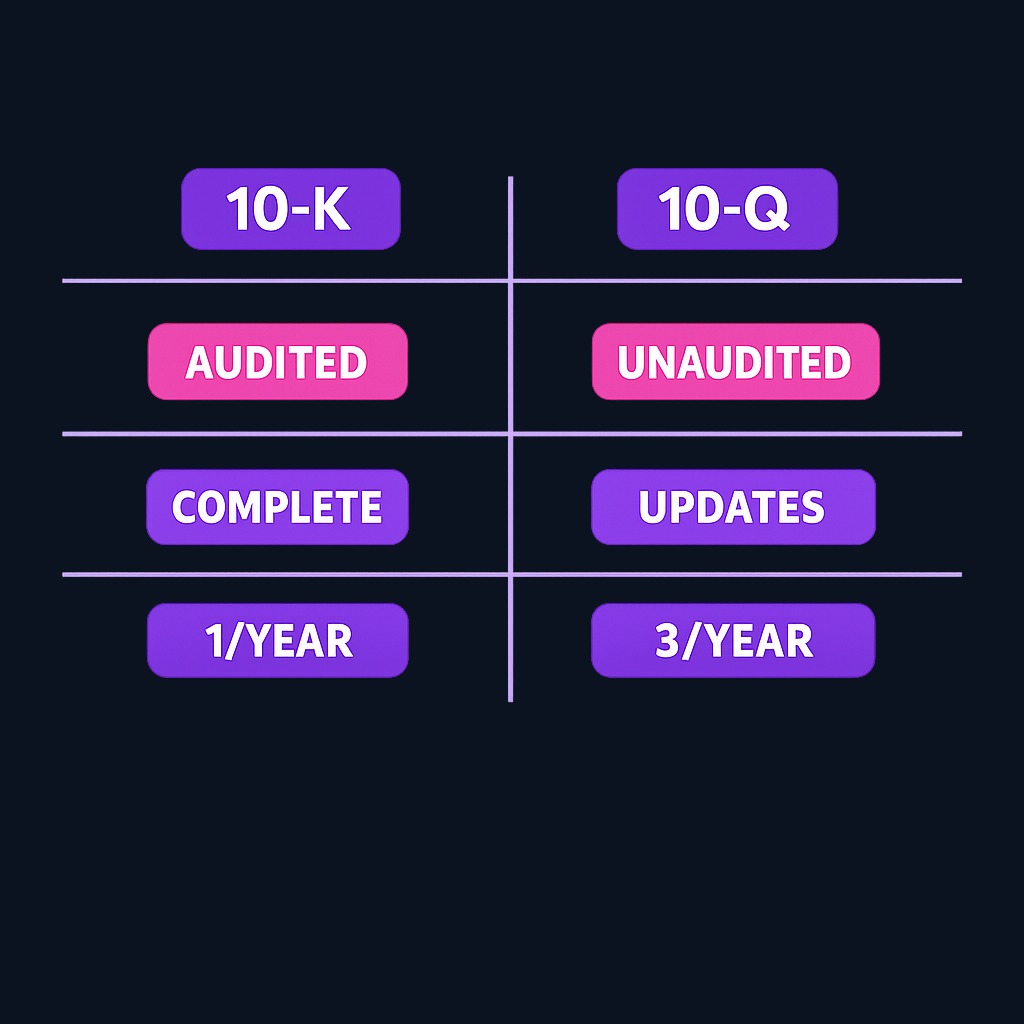
| Frequency | Annual | Quarterly (three times a year) |
| Audit status | Audited by an independent accountant | Unaudited, though reviewed |
| Depth | Full business description, risk factors, detailed notes | Condensed statements, updates on material changes |
| Deadline after period end | 60 days for large accelerated filers, 75 for accelerated filers, and 90 for other filers | 40 days for large accelerated and accelerated filers; 45 days for other filers |
| Best use | Understanding the whole business | Tracking trends and catching changes early |
Three differences matter most in practice. Audit assurance: 10-K numbers carry an auditor's opinion; 10-Q numbers do not, so year-end adjustments occasionally revise what quarterly reports suggested. Completeness: only the 10-K contains the full risk-factor section, business overview, and comprehensive footnotes; the 10-Q discloses changes rather than restating everything. Timeliness: the 10-Q arrives faster and more often, making it the better instrument for spotting inflection points between annual reports.
Why both filings matter for investors
The 10-K is where fundamental analysis starts. Reading how a company describes its own competitive position, which risks its lawyers insist on listing, and how the footnotes explain accounting choices tells you things no summary or headline can. Long-term investors often learn more from the risk factors and management's discussion than from the income statement itself.
The 10-Q is where theses get tested. Revenue trajectory, margin drift, inventory buildup, and cash-flow swings show up quarter by quarter, months before they compound into an annual result. A deteriorating trend flagged in two consecutive 10-Qs rarely comes as a surprise by the time the 10-K confirms it.
Used together, the filings protect investors from two opposite mistakes: judging a company on a single dramatic quarter, and holding a stale annual view while the business quietly changes underneath it.

How to read each filing efficiently
For a 10-K, a practical reading order: start with the business description to understand what actually generates revenue; scan the risk factors for the specific, unusual ones rather than boilerplate; read management's discussion and analysis (MD&A) for the causal story behind the numbers; then work through the financial statements and their footnotes, where accounting policies and commitments hide.
For a 10-Q, go straight to comparisons: this quarter versus the same quarter last year for revenue, margins, and operating cash flow; the balance sheet versus year-end for debt, inventory, and receivables; and the MD&A for anything management newly discloses. Check the legal proceedings and risk-factor updates for changes since the last 10-K - new language there is rarely accidental.
In both documents, footnotes reward attention. Revenue recognition, segment detail, debt covenants, and off-balance-sheet obligations live in the notes, not the headline statements.
What quarter-to-quarter changes can reveal
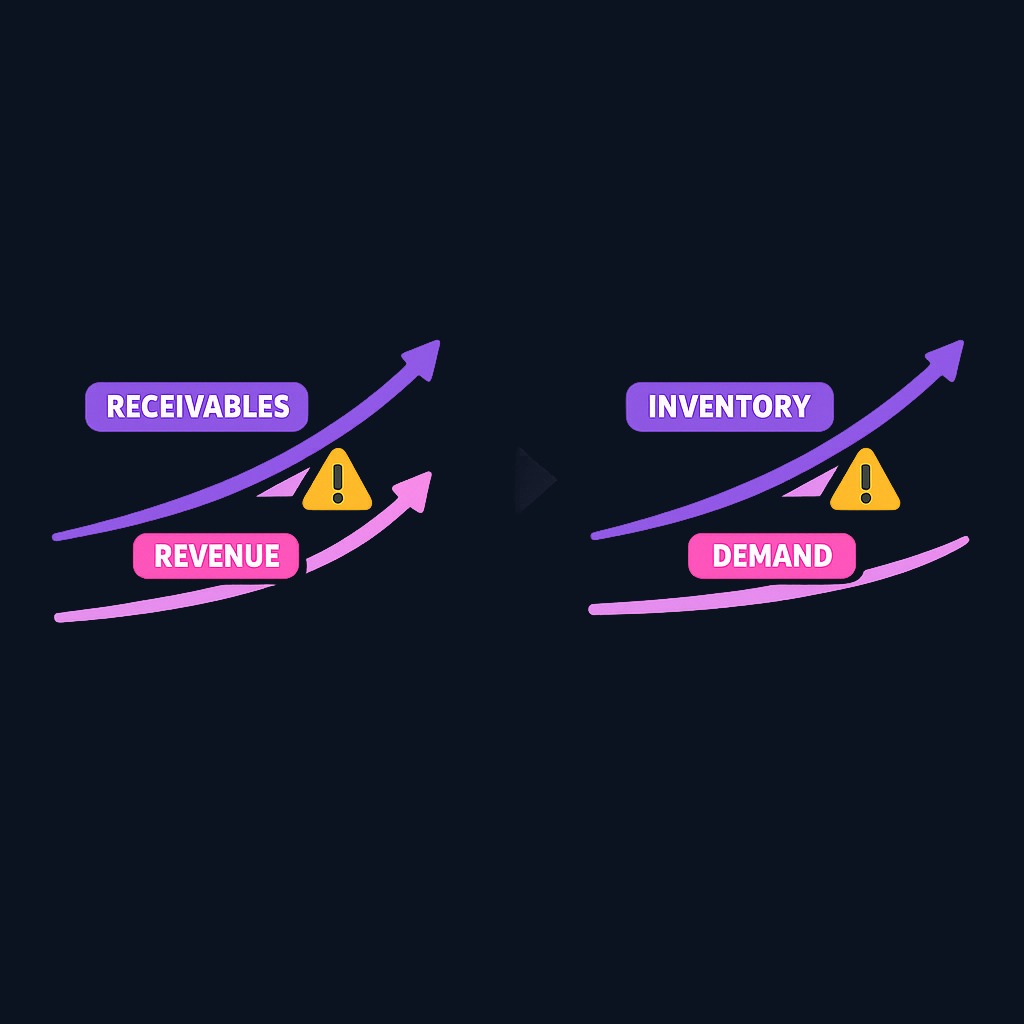
Small shifts in a 10-Q often front-run big stories. Receivables growing much faster than revenue can flag customers paying slowly or aggressive revenue recognition. Inventory swelling ahead of demand hints at markdowns to come. A new paragraph in legal proceedings, a tweak to risk-factor language, or a change in segment reporting can each foreshadow developments that only become headlines quarters later. Seasonal businesses complicate raw comparisons, which is why the same-quarter-last-year comparison is the default discipline.
Practice investing with Finelo
Build practical investing skills with guided lessons, simulator practice, and structured challenges.
Common pitfalls when analyzing these filings
- Treating unaudited numbers as final. Fourth-quarter adjustments and audit findings can revise the picture the 10-Qs painted.
- Comparing adjacent quarters in seasonal businesses. Retailers' holiday quarters dwarf their spring ones; compare year over year.
- Skipping footnotes. The statements summarize; the notes explain. Most negative surprises were disclosed in a note first.
- Reading only one year. Risk factors and MD&A gain meaning when you compare how the language changed from last year's filing.
- Ignoring the fourth quarter. Since there is no Q4 10-Q, derive fourth-quarter results by subtracting nine-month figures from the annual ones.
What to know before deciding
Neither filing is a substitute for the other, and neither is a buy signal by itself. Filings are backward-looking by nature, and even the fastest 10-Q arrives weeks after the quarter closes, so markets often reprice before you finish reading. Companies also differ in disclosure quality: two firms in the same industry can describe identical economics with very different candor. Finally, filings complement - not replace - earnings releases and investor presentations, which arrive sooner but are marketing documents by comparison. The regulatory filings are where precision and legal accountability live.
Decision framework: which filing to read when
- New to the company? Read the latest 10-K first, cover to cover. It is the foundation everything else updates.
- Already own the stock? Read each 10-Q within days of filing, focused on trend comparisons and changed language.
- Something odd in the news? Check the most recent filing's legal proceedings, risk factors, and subsequent-events note.
- Comparing two companies? Use both firms' 10-Ks for structure and economics, then align their latest 10-Qs for current momentum.
- Short on time? MD&A plus the cash flow statement in either filing delivers the highest insight per page.
FAQ
What is the main difference between a 10-K and a 10-Q?
The 10-K is the audited annual report with the company's full business description, risk factors, and complete financial statements. The 10-Q is a shorter, unaudited quarterly update focused on interim results and material changes.
Why is there no 10-Q for the fourth quarter?
Fourth-quarter results are reported within the annual 10-K, so a separate quarterly filing would duplicate it. Investors back out Q4 numbers by subtracting the first nine months from the full-year figures.
Are 10-Q financial statements reliable if they are unaudited?
They are prepared under the same accounting standards and reviewed by auditors, but without a full audit opinion. They are broadly dependable while remaining subject to year-end adjustment.
Where can I read a company's 10-K and 10-Q for free?
Every filing is publicly available through the SEC's EDGAR system, searchable by company name or ticker, and most companies mirror them in the investor-relations section of their websites.
Conclusion and next steps
The 10-K gives you the audited, complete portrait once a year; the 10-Q gives you three timely progress reports in between. Read the 10-K to understand the business, read the 10-Qs to monitor it, and pay special attention whenever the language changes between filings. The investors who consistently catch problems early are usually the ones comparing notes sections nobody else bothered to read. To build that skill methodically, work through real-filing exercises in Finelo's structured lessons.
InvestingFundamental AnalysisFinancial StatementsBeginner
Practice investing with Finelo
Build practical investing skills with guided lessons, simulator practice, and structured challenges.
About the author
Finelo Team
The Finelo Team creates practical investing and trading education designed to help beginners learn faster with structured challenges, simulator practice, and bite-sized lessons.
Keep reading — Related articles
Investing
Tax-gain harvesting vs. tax-loss harvesting
Compare realizing investment gains with realizing losses, including holding periods, wash sales, offsets, and portfolio tradeoffs.
Finelo Team

Investing
Stable value fund vs. money market fund
Compare investment structure, contract protections, transfer restrictions, net yields, and access inside a retirement account.
Finelo Team

Investing
Single-life vs. joint-life annuity
Compare income for one lifetime with continued payments to a survivor, using equal premiums and matching guarantee terms.
Finelo Team


