Treasury stock is a company's own shares that it has bought back from investors and now holds itself. These shares pay no dividends, carry no votes, and are excluded from shares outstanding. Companies hold treasury stock to return cash to shareholders, offset dilution from employee stock options, or keep shares ready for future deals.
What is Treasury Stock and Why is it Important?
Treasury stock is a company's own shares that it has bought back from investors and now holds itself. These shares pay no dividends, carry no votes, and are excluded from shares outstanding. Companies hold treasury…
6 min read
Practice investing with Finelo
Build practical investing skills with guided lessons, simulator practice, and structured challenges.
Want to learn more?
Build practical investing skills with guided lessons, simulator practice, and structured challenges.
Explore FineloExplore Finelo's 28-day challenges
Turn learning into a daily habit with guided challenge paths.
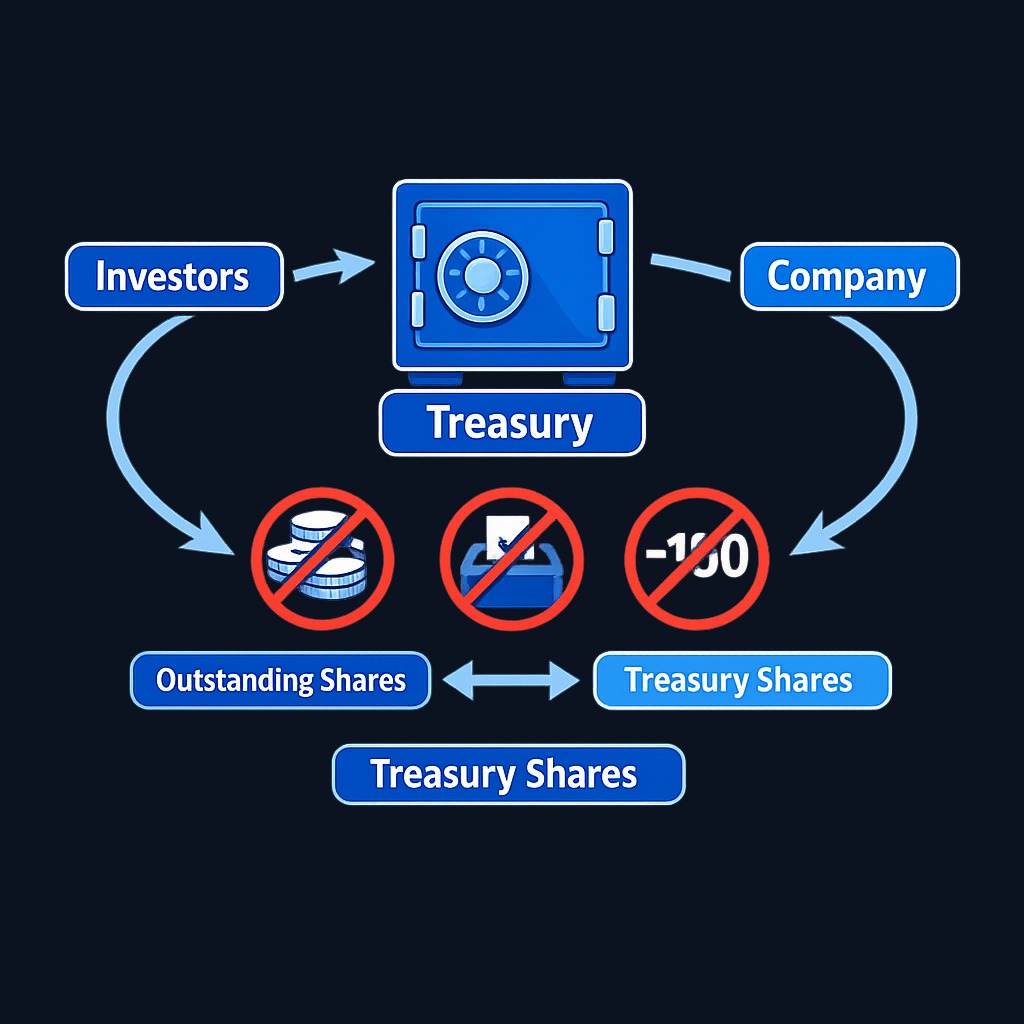
This page is for investors who see "treasury stock" as a negative line on a balance sheet and want to know what it means for their shares. You will learn how buybacks work, the accounting behind them, and what to watch for. Everything here is educational, not financial advice.
How companies use treasury stock
When a company repurchases its own shares, those shares move from the market into the corporate treasury. Managers reach for buybacks for several reasons:
- Returning cash to shareholders. Fewer shares outstanding means each remaining share represents a larger slice of the business, and earnings per share rises even when total profit is flat.
- Offsetting dilution. Companies that pay employees with stock options and share grants buy back shares so the total count does not balloon over time.
- Signaling confidence. A board authorizing a repurchase is often read as management believing the stock is undervalued, though the signal is not proof.
- Funding future needs. Treasury shares can be reissued for acquisitions, employee plans, or capital raises without registering brand-new shares.
- Defending against takeovers. Reducing freely floating shares can make accumulating a controlling stake harder.
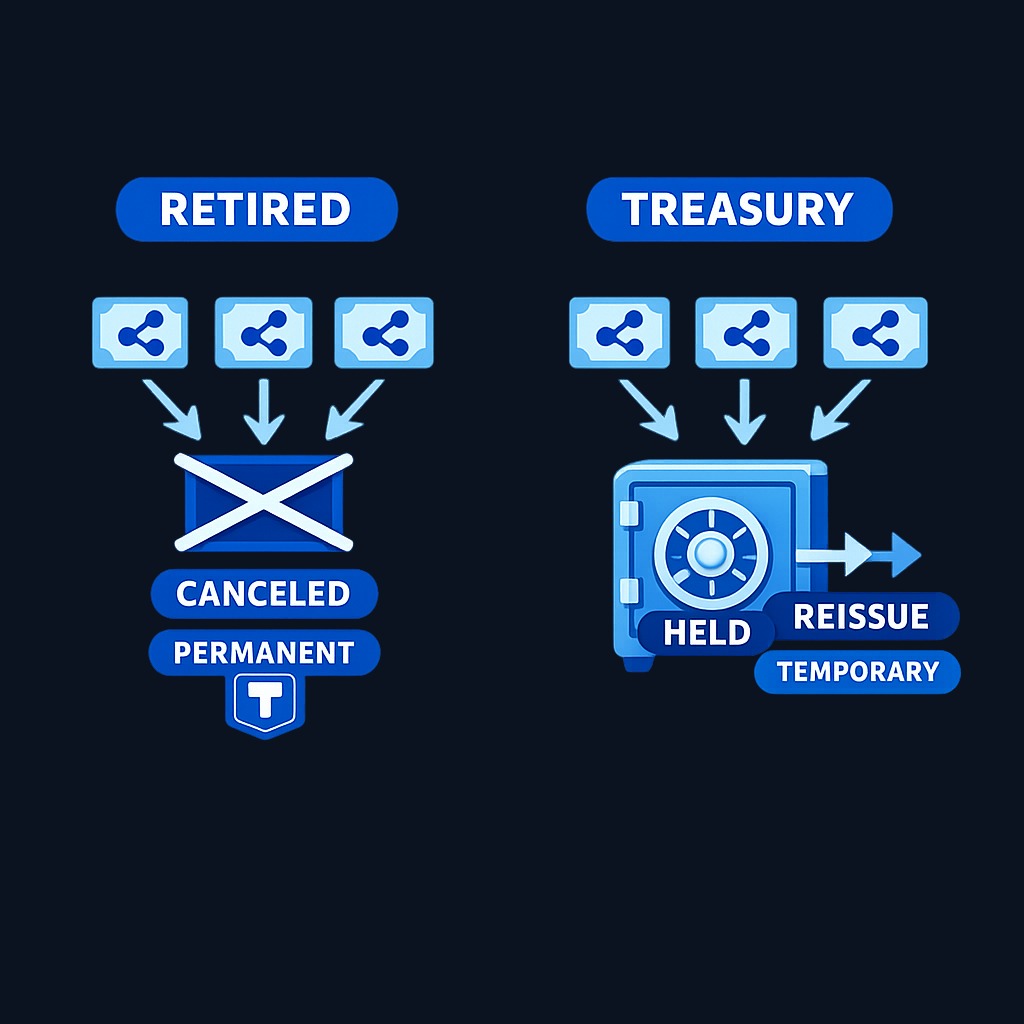
A company can hold treasury shares indefinitely, reissue them, or retire them permanently. Retirement removes the shares from existence, while held treasury stock can quietly return to the market later, a difference that matters for long-term dilution.
Accounting for treasury stock
On the balance sheet, treasury stock appears as a contra-equity account: a negative line inside shareholders' equity. If a company spends $100 million buying back shares, equity falls by $100 million. The shares are recorded at their repurchase cost under the common cost method, and no gain or loss ever runs through the income statement when they are later reissued; differences adjust equity accounts instead.
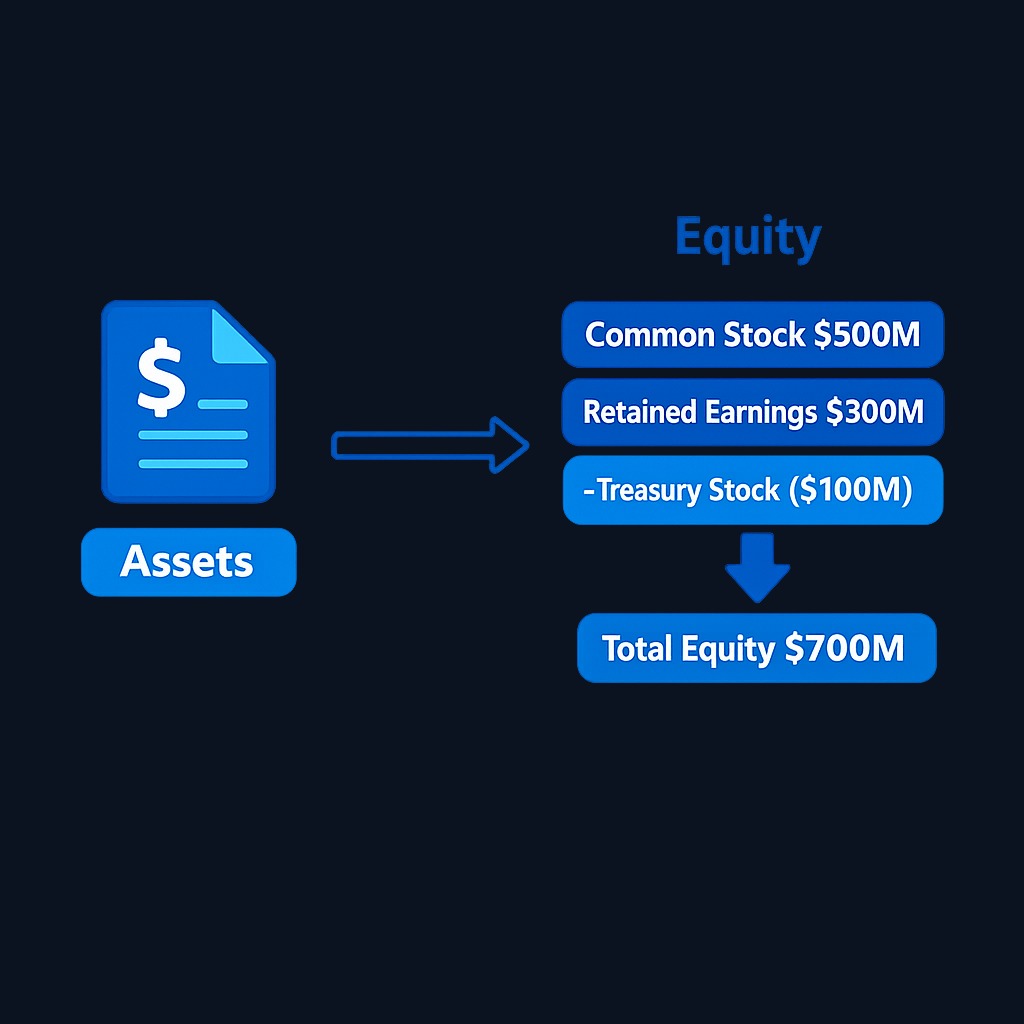
Two share counts matter here. Issued shares include everything the company has ever sold and not retired. Outstanding shares equal issued shares minus treasury stock. Dividends and voting rights attach only to outstanding shares, and per-share metrics like EPS use outstanding (or weighted-average outstanding) counts. Heavy buyback programs can push equity surprisingly low, and occasionally negative, without implying the business is unhealthy, which is one more reason to read balance sheets in context.
The treasury stock method
The treasury stock method is a separate but related concept: a calculation used to estimate diluted shares outstanding. It assumes all in-the-money options and warrants are exercised, and that the company uses the cash received to buy back as many shares as possible at the average market price.
A quick example
Suppose employees hold 1 million options with a $20 strike price while the stock trades at $40. Exercise brings in $20 million, which repurchases 500,000 shares at $40. Net new shares: 1,000,000 - 500,000 = 500,000 added to the diluted count.
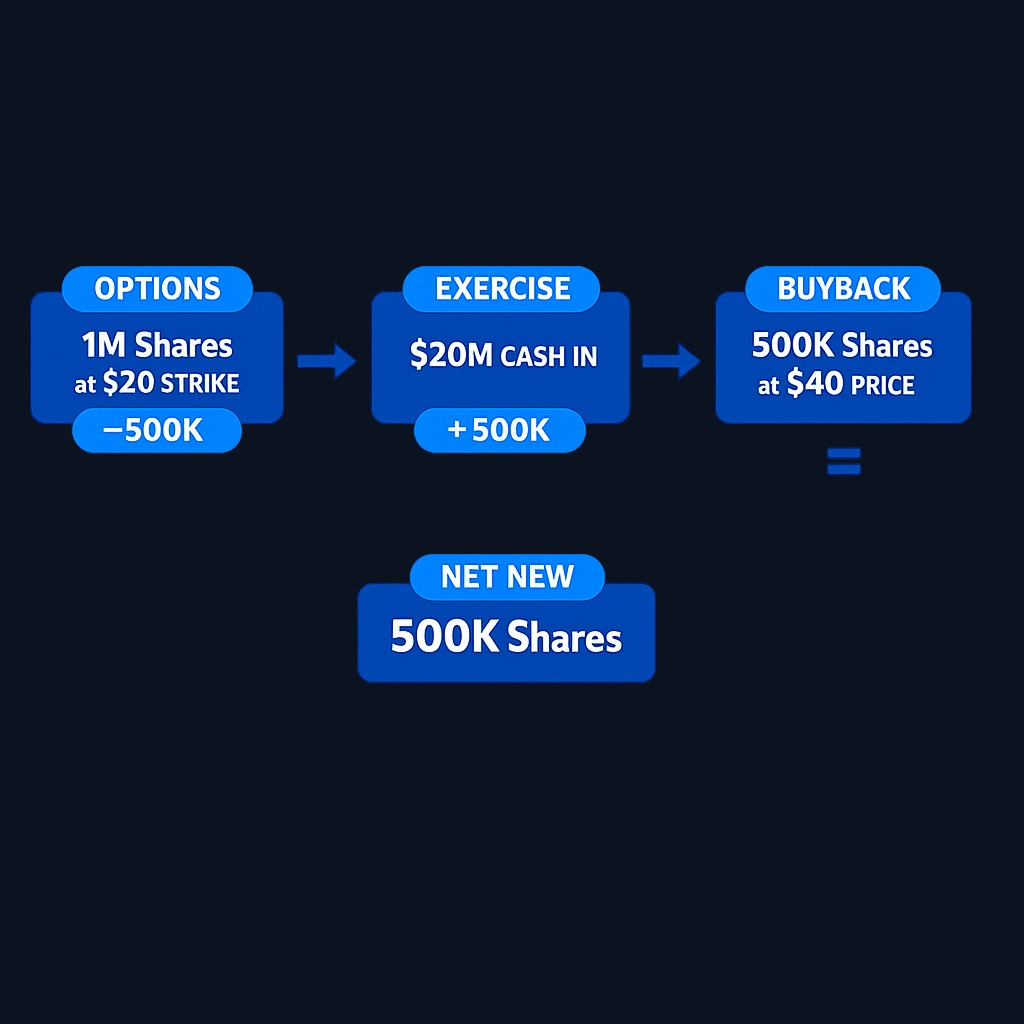
| Step | Amount |
|---|---|
| Options exercised | 1,000,000 shares |
| Cash received (at $20 strike) | $20M |
| Shares repurchased at $40 | 500,000 |
| Net dilution | 500,000 shares |
Diluted EPS, which uses this method, gives a more conservative view of your ownership than basic EPS. When the gap between basic and diluted counts is wide, stock-based pay is a meaningful cost worth tracking.
Practice investing with Finelo
Build practical investing skills with guided lessons, simulator practice, and structured challenges.
Impact on shareholders and market perception
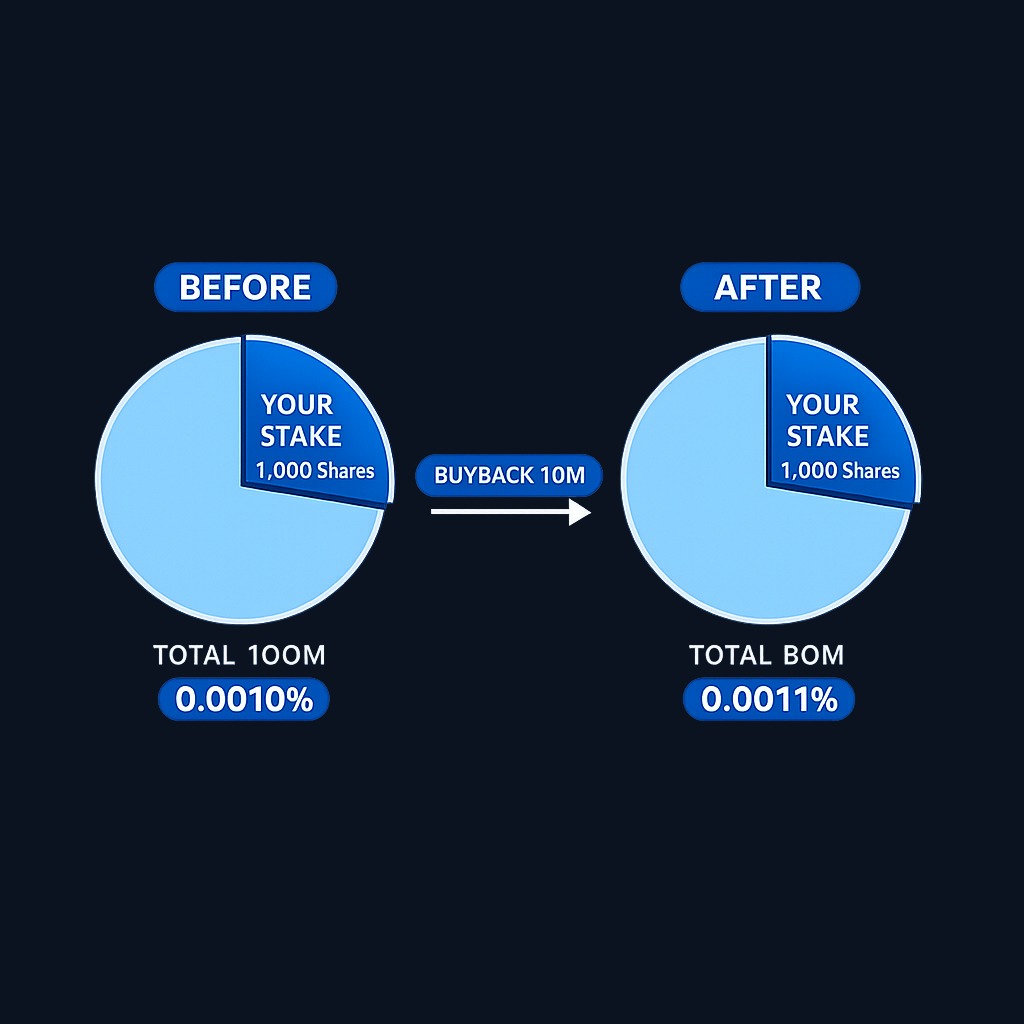
Buybacks concentrate ownership. If you own 1,000 shares of a company with 100 million shares outstanding and it repurchases 10 million, your stake rises from 0.0010% to about 0.0011% without you buying anything. EPS and often return on equity improve mechanically, which can support the share price.
Perception cuts both ways. Investors may cheer repurchases as disciplined capital return, or criticize them when a company buys back stock at high prices, funds buybacks with debt, or starves investment in growth to do it. The same dollar spent on repurchases cannot fund research, acquisitions, or dividends, so the smartest question is always about opportunity cost: was this the best available use of the cash?
What to know before deciding
Treasury stock changes per-share math, so verify the details before reading too much into a buyback headline. Check whether outstanding shares are actually falling over several years, how repurchases are funded, and whether diluted counts tell a different story than basic counts. Company filings disclose repurchase activity, authorization sizes, and average prices paid. Key risks to weigh:
- Buying high destroys value. Repurchasing shares above intrinsic value transfers wealth from remaining shareholders to sellers.
- Debt-funded buybacks add fragility. Borrowing to shrink the share count can strain the balance sheet when conditions turn.
- EPS optics can mislead. Rising per-share earnings from a shrinking denominator is not the same as a growing business.
- Reissuance can dilute again. Held treasury shares can return to the market for compensation plans or deals.
- Rules and taxes apply. Repurchases operate under securities regulations, and recent tax rules in some jurisdictions add costs to corporate buybacks; verify current treatment before assuming after-tax outcomes.
None of these make treasury stock inherently bad. They simply mean a buyback announcement deserves the same scrutiny as any other capital-allocation decision. Taxes also shape your personal outcome: selling shares into a buyback can realize gains, and the IRS overview of capital gains and losses explains how those are treated. Weigh buybacks against alternatives like dividends and reinvestment, and treat the accounting effects as arithmetic, not achievement.
Case studies and real-world patterns
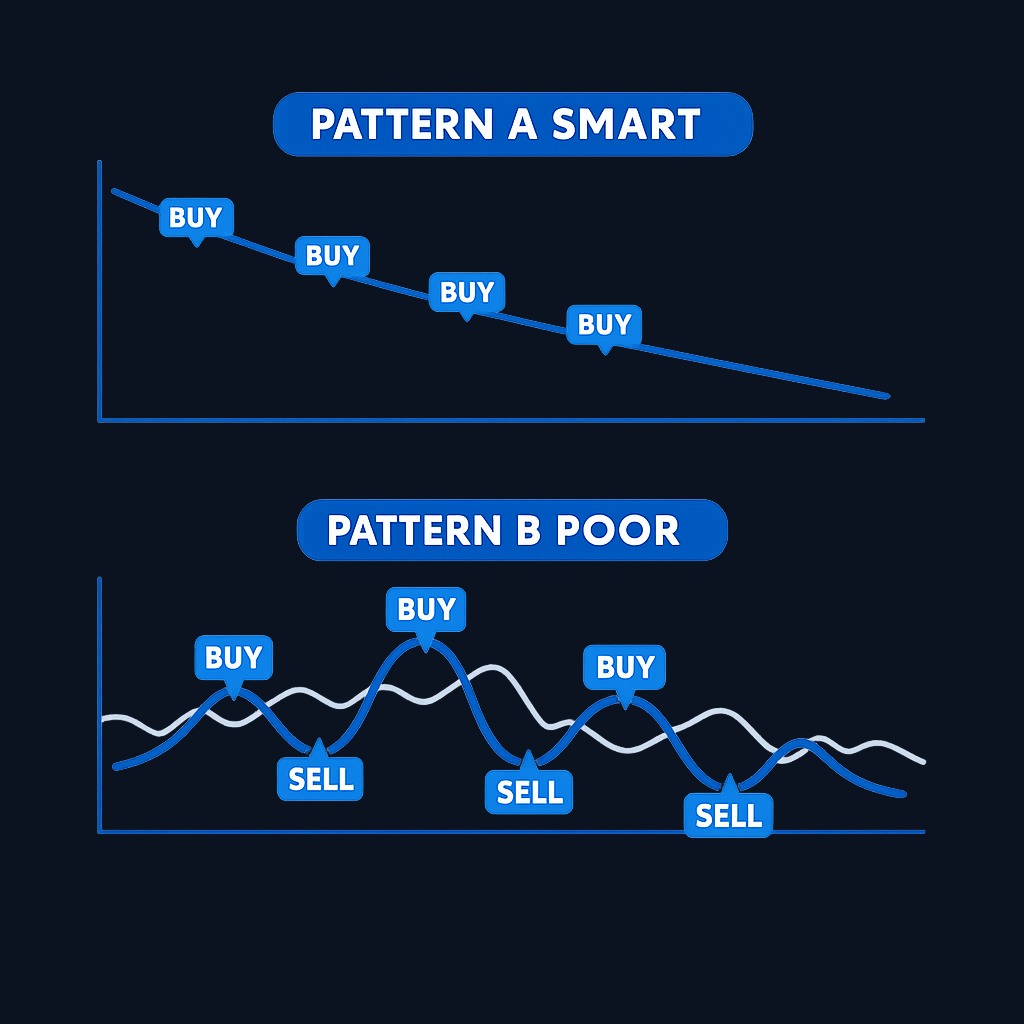
Consider two contrasting patterns seen repeatedly across markets. In the first, a mature, cash-rich company repurchases shares steadily across years, through both strong and weak markets. The share count falls meaningfully, long-term holders' ownership compounds, and per-share results outpace total company growth. Systematic, valuation-aware buybacks like this have been a major driver of shareholder returns at many large firms.
In the second pattern, a company aggressively buys back stock near cycle peaks, sometimes with borrowed money, then halts repurchases and issues new shares after the price collapses. The effect is buying high and selling low with shareholders' capital. The lesson for investors: check the price history of a company's repurchases, how they were funded, and whether the share count actually declines over time, since offsetting option grants can absorb entire buyback programs.
Conclusion and next steps
Treasury stock is repurchased equity a company holds in its own vault: no votes, no dividends, and a negative line in shareholders' equity. It matters because buybacks reshape per-share ownership, earnings math, and capital allocation, for better or worse depending on price and funding.
Next steps: pull up a company you follow, find treasury stock in the equity section of its balance sheet, and compare shares outstanding today with five years ago. Then check what the company paid for repurchases versus today's price.
Frequently asked questions
Does treasury stock pay dividends or vote?
No. Shares held in treasury receive no dividends and carry no voting rights. They sit outside the outstanding share count until reissued or retired.
Why is treasury stock negative on the balance sheet?
Because it is a contra-equity account recorded at repurchase cost. It represents equity the company bought back, so it reduces total shareholders' equity rather than sitting as an asset.
What is the difference between retired shares and treasury shares?
Retired shares are canceled permanently and cannot return. Treasury shares remain issued and can be reissued later for compensation, acquisitions, or capital raises, which can dilute existing holders again.
Is a buyback better than a dividend?
Neither is universally better. Buybacks add value when shares are repurchased below intrinsic value and flexibility matters; dividends provide predictable cash income. Tax treatment and your goals determine which suits you.
treasurystock
Practice investing with Finelo
Build practical investing skills with guided lessons, simulator practice, and structured challenges.
About the author
Finelo Team
The Finelo Team creates practical investing and trading education designed to help beginners learn faster with structured challenges, simulator practice, and bite-sized lessons.
Keep reading — Related articles
Investing
Tax-gain harvesting vs. tax-loss harvesting
Compare realizing investment gains with realizing losses, including holding periods, wash sales, offsets, and portfolio tradeoffs.
Finelo Team
Investing
Stable value fund vs. money market fund
Compare investment structure, contract protections, transfer restrictions, net yields, and access inside a retirement account.
Finelo Team
Investing
Single-life vs. joint-life annuity
Compare income for one lifetime with continued payments to a survivor, using equal premiums and matching guarantee terms.
Finelo Team