Methodology note: “Duration” is not one interchangeable statistic. Macaulay duration is the present-value-weighted average timing of cash flows. Modified duration estimates price sensitivity to a change in yield for an option-free bond; effective duration is used when cash flows can change as rates change. Bond-fund fact sheets may report effective duration. The approximation is ΔP/P ≈ −duration × Δyield for small parallel yield changes, before convexity. See the CFA Institute reading on yield-based duration measures.
Bond Duration Explained: Understanding Its Importance in Investing
Bond duration measures how sensitive a bond's price is to interest rate changes: as a working rule, a bond with a duration of 5 years loses roughly 5% of its price if rates rise one percentage point, and gains roughly 5%…
9 min read
Practice investing with Finelo
Build practical investing skills with guided lessons, simulator practice, and structured challenges.
Want to learn more?
Build practical investing skills with guided lessons, simulator practice, and structured challenges.
Explore FineloExplore Finelo's 28-day challenges
Turn learning into a daily habit with guided challenge paths.
Bond duration measures how sensitive a bond's price is to interest rate changes: as a working rule, a bond with a duration of 5 years loses roughly 5% of its price if rates rise one percentage point, and gains roughly 5% if rates fall by the same amount. Duration also represents the weighted average time until you receive a bond's cash flows. This page is for investors who want bond duration explained in plain language - what it means, what moves it, and how to use it when building a portfolio. Read the fundamentals below, then reinforce them with interactive lessons in the Finelo app.
What is bond duration?
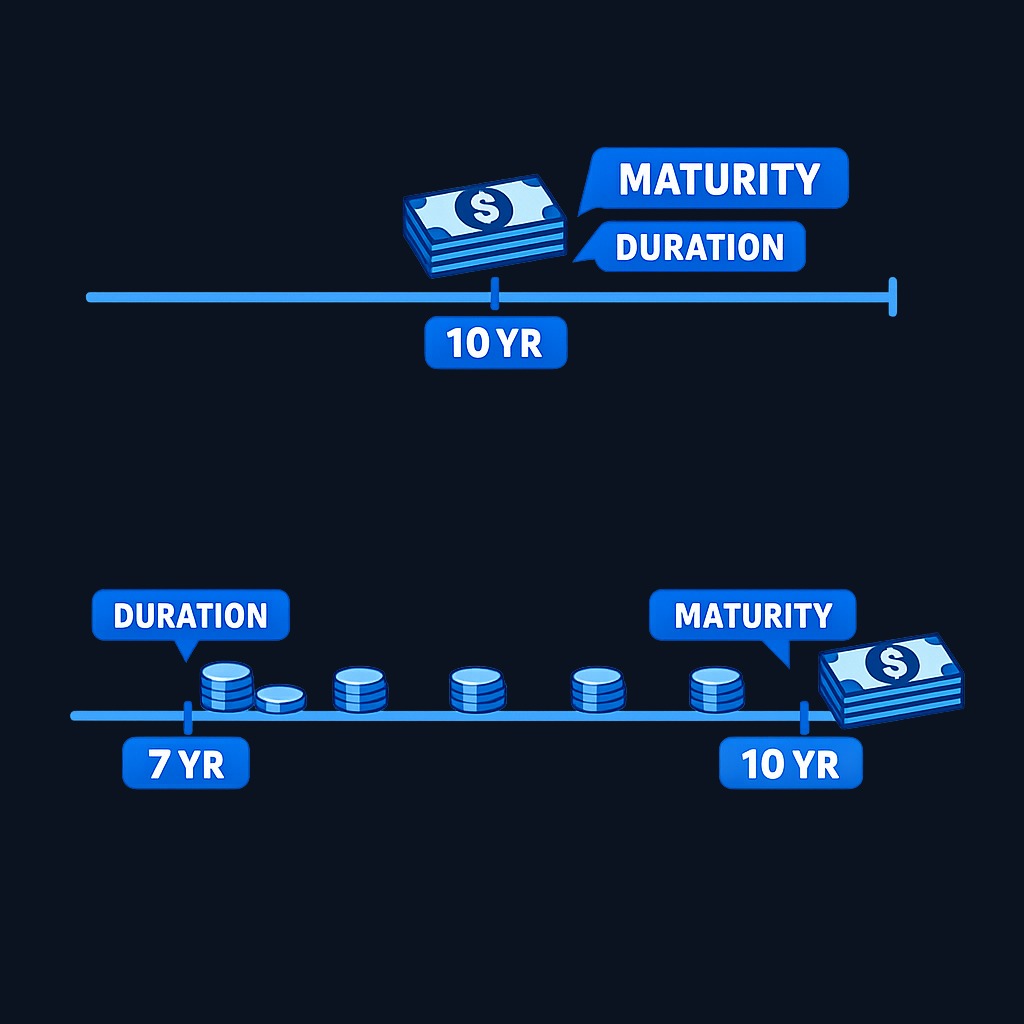
Duration compresses a bond's entire payment schedule into one number. Formally, Macaulay duration is the weighted average time, in years, until an investor receives the bond's cash flows - every coupon and the final principal - with each payment weighted by its share of the bond's present value.
A zero-coupon bond pays everything at maturity, so its duration equals its maturity. A coupon-paying bond returns money along the way, so its duration is always shorter than its maturity. The bigger the coupons, the sooner the average dollar comes back, and the lower the duration.
Modified duration estimates first-order price sensitivity for an option-free bond. A fund fact sheet may instead report effective duration, especially when holdings have embedded options. In either case, a duration of 6.2 estimates an approximately opposite 6.2% price move for a small parallel one-percentage-point yield change, before convexity and subject to the measure's assumptions.
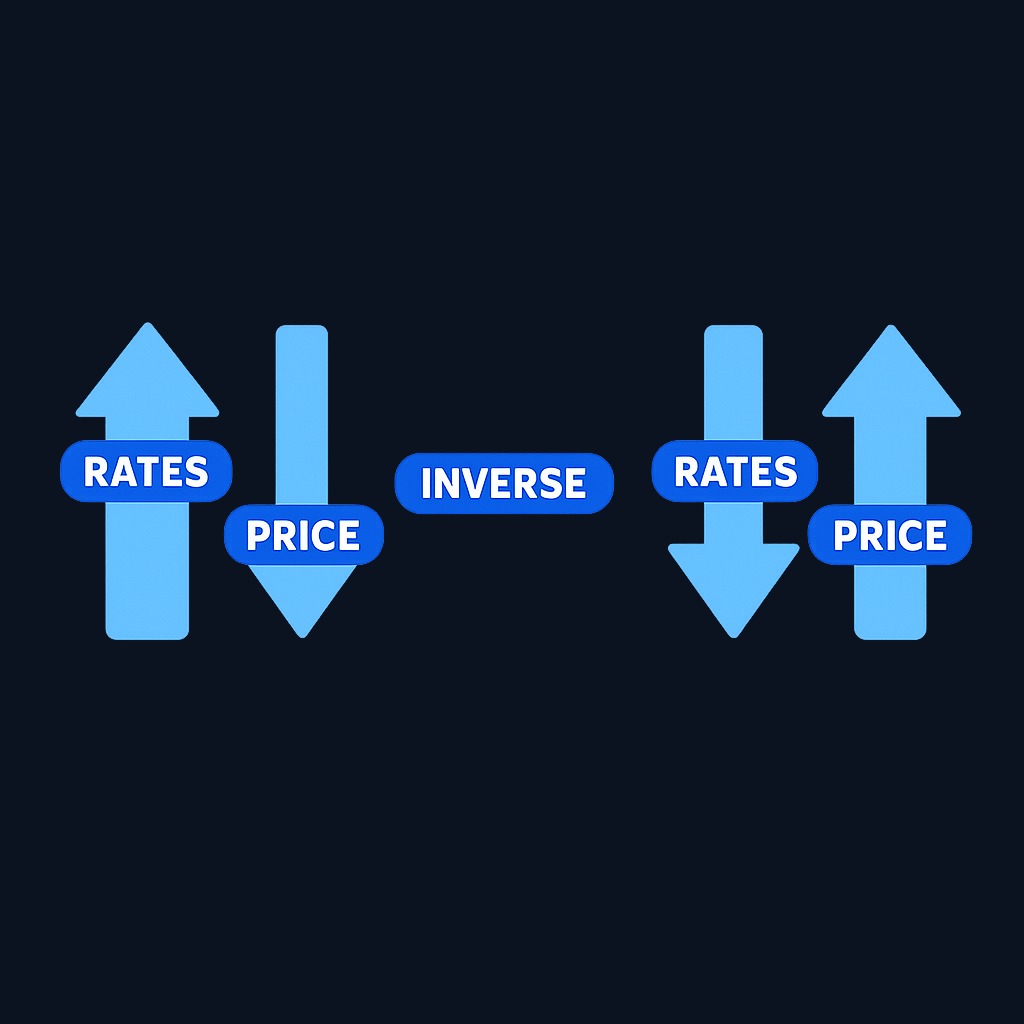
The inverse relationship is the heart of it. Bond prices and interest rates move in opposite directions, because existing bonds with fixed coupons become more or less attractive as new bonds arrive with higher or lower yields. Duration quantifies how strongly a given bond feels that seesaw.
Why duration matters for investors
Duration is the single most useful risk number in fixed income. Three reasons:
- It prices interest rate risk. Two bonds with the same yield can behave very differently when rates move. Duration tells you which one will swing harder.
- It supports liability-matching analysis. Duration matching can reduce first-order sensitivity to parallel yield shifts when asset and liability durations are aligned, but it relies on assumptions about curve movements, cash flows, convexity, and rebalancing. It does not guarantee that money needed in three years will be unaffected by rates.
- It makes portfolios comparable. A portfolio's duration is the weighted average of its holdings. That single number lets you compare a short-term Treasury fund to a long corporate fund and know instantly which carries more rate risk.
Interest rate changes ripple from central bank policy through the entire bond market, and benchmark rates are tracked publicly - the Federal Reserve publishes current Treasury yields across maturities in its H.15 selected interest rates release. When those yields shift, duration estimates how every bond and bond fund reprices.
Factors that affect duration
| Factor | Effect on duration |
|---|---|
| Longer maturity | Raises duration - cash flows arrive later |
| Higher coupon rate | Lowers duration - more money returns early |
| Higher prevailing yields | Lower duration - distant payments weigh less in present value |
| Zero coupon | Duration equals maturity - everything arrives at the end |
Maturity is the dominant factor: a 30-year bond has far more duration than a 2-year note, all else equal. Coupons pull the other way, since fat coupon payments return your capital sooner. Yield levels matter more subtly - when yields are high, far-off payments are discounted more heavily, shortening effective duration.
Bonds with embedded options complicate the picture. A callable bond may be redeemed early when rates fall, so analysts use "effective duration," which accounts for how the option changes expected cash flows.
Duration and interest rate risk in practice
The rule of thumb: price change ≈ −duration × change in yield. A bond fund with a duration of 7 should fall about 7% if yields rise one percentage point, and rise about 7% if yields fall by the same.
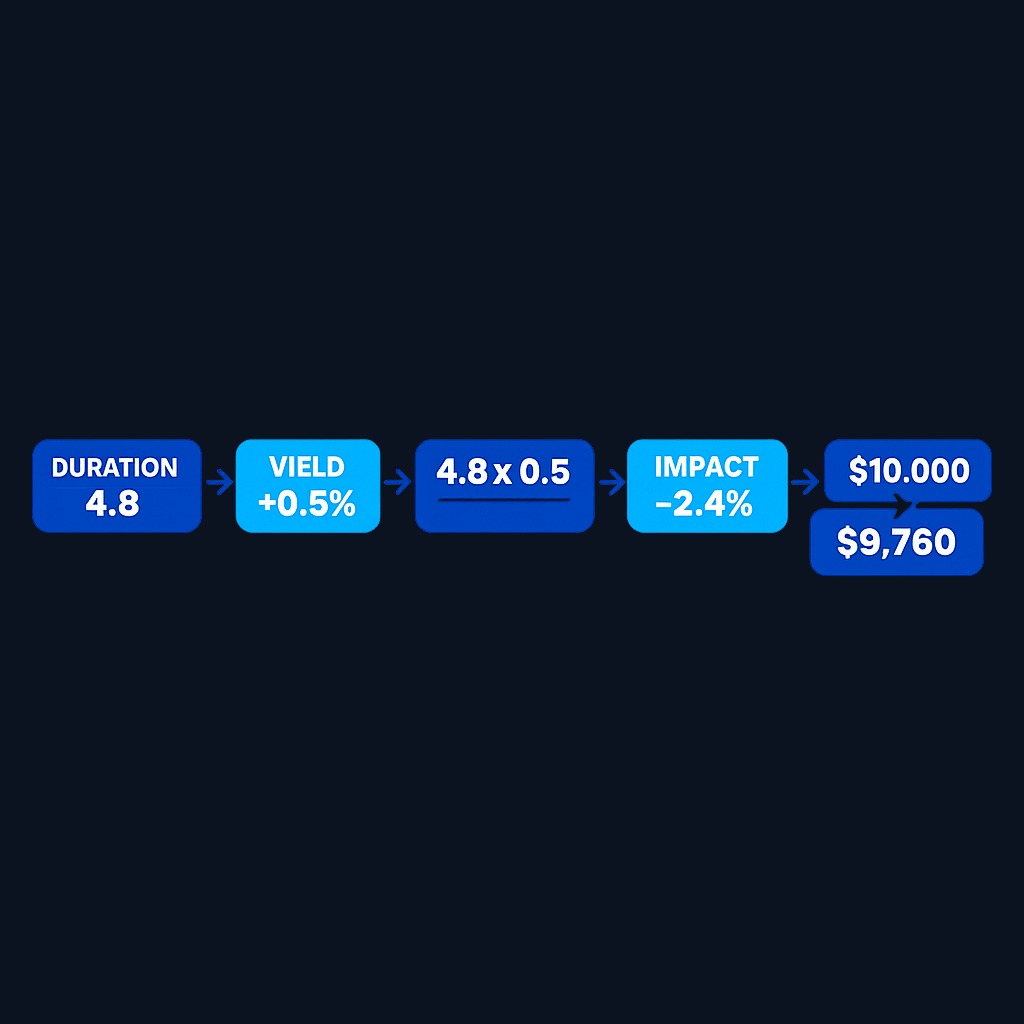
Worked example: you hold a bond with a modified duration of 4.8. Market yields climb from 4.0% to 4.5% - a half-point rise. Estimated price impact: −4.8 × 0.5 = −2.4%. A $10,000 position would decline to roughly $9,760, before accounting for the coupon income you continue to earn.
That last clause matters. Duration describes price moves, not total return. Coupons keep arriving, and if you hold a bond to maturity, you still receive face value regardless of the interim swings, assuming the issuer pays as promised. Rate risk hits hardest when you must sell before maturity or when you hold long-duration funds with no fixed maturity date.
The estimate is also linear while reality is curved, which brings in convexity.
Convexity: a deeper look
Duration is a straight-line approximation of a curved relationship. The true price-yield curve of a plain bond bends in the investor's favor: prices rise more when yields fall than they drop when yields rise by the same amount. That curvature is convexity.
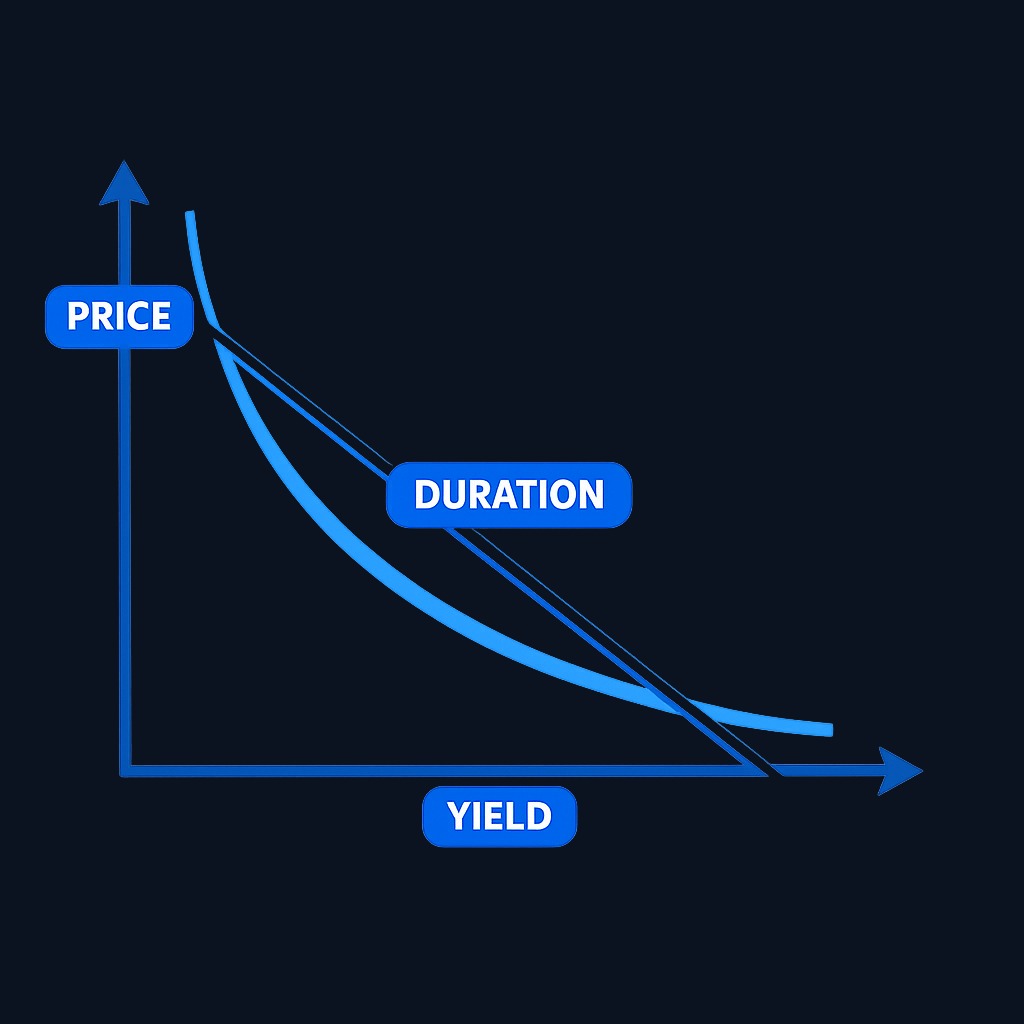
For small yield moves, duration alone predicts prices well. For big moves - a full percentage point or more - duration alone overstates losses and understates gains on ordinary bonds. Analysts add a convexity term to sharpen the estimate.
Most long-term investors do not need to compute convexity by hand. The practical takeaways: duration-based estimates are approximations, they are least accurate for large rate shocks and long maturities, and callable bonds can exhibit negative convexity, meaning their upside is capped when rates fall because the issuer refinances.
Practice investing with Finelo
Build practical investing skills with guided lessons, simulator practice, and structured challenges.
Practical applications of duration
Choosing funds deliberately
Bond fund names rarely reveal risk, but the fact sheet's duration does. Deciding between a short-duration fund near 2 and a core fund near 6 is really a decision about how much rate sensitivity you are willing to hold.
Matching duration to your horizon
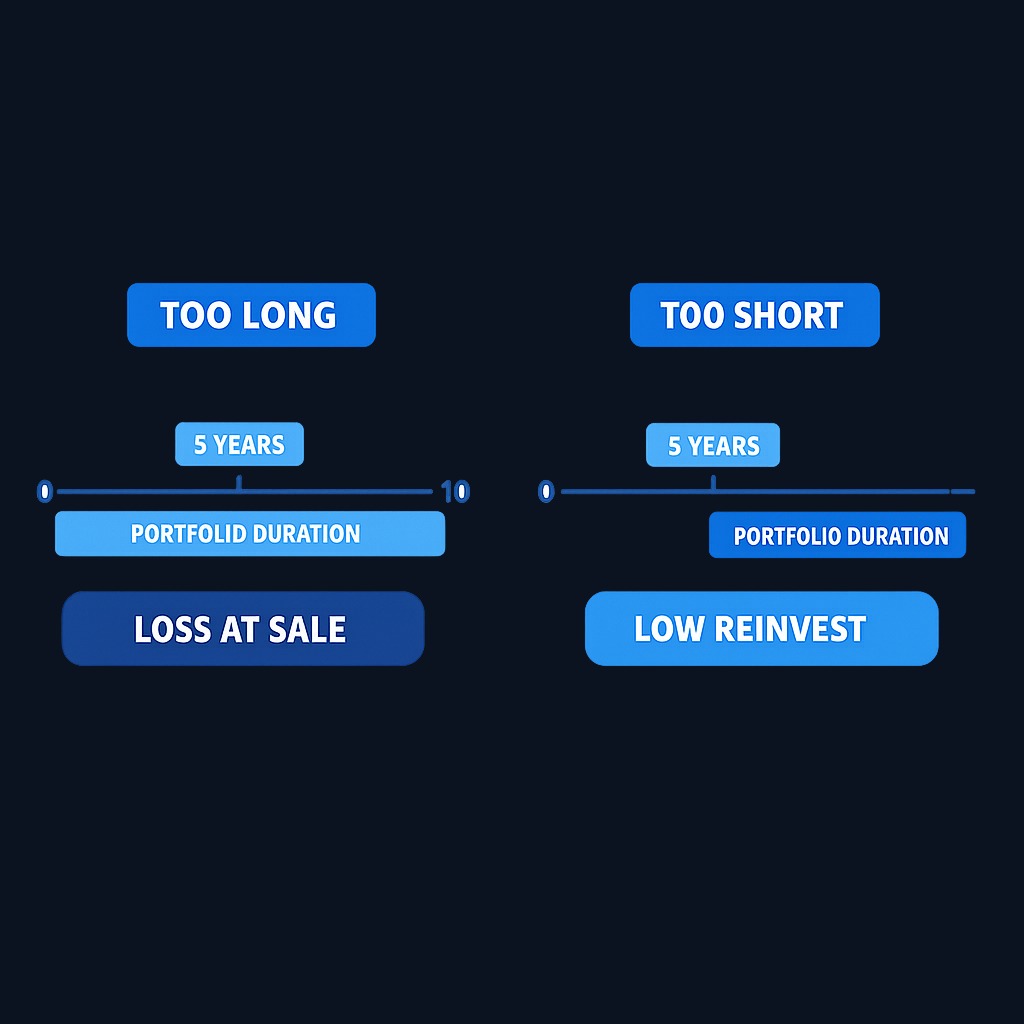
If your spending need is five years away, a portfolio duration near five means rate rises hurt prices now but boost reinvestment income for roughly offsetting effect by the horizon. Mismatches in either direction add risk: too long and a rate spike forces losses at sale time; too short and falling rates leave you reinvesting at ever-lower yields.
Positioning around rate views
Some investors shorten duration when they expect rates to rise and extend it when they expect cuts. This is a market-timing bet, and it can misfire like any forecast - but duration is the dial such investors turn, and understanding it keeps their bets sized deliberately rather than accidentally.
Building ladders
A bond ladder staggers maturities so a slice of the portfolio matures each year. Ladders naturally spread duration across the curve and convert rate risk into a reinvestment schedule, which many income-focused investors find easier to live with.
What to know before deciding
Duration is a powerful summary, but it is one number describing one risk. It says nothing about credit risk - a high-yield bond can default no matter how short its duration. It assumes parallel yield moves, while real yield curves twist and steepen. And it drifts over time: portfolio duration changes as bonds age and as managers trade, so yesterday's fact sheet is an estimate, not a contract. Check duration alongside credit quality, fees, and your actual time horizon before choosing any bond investment, and re-check it periodically rather than once.
Decision framework: using duration in your portfolio
- Write down your horizon. When will you actually need the money?
- Read the duration of every bond holding or fund from its latest fact sheet or disclosure.
- Compare portfolio duration to your horizon. Large mismatches deserve a deliberate reason.
- Stress-test with the rule of thumb. Multiply duration by a plausible rate move and ask whether you could tolerate that swing without selling.
- Recheck after big rate moves or fund changes, since duration itself shifts with markets and portfolio turnover.
FAQ
What does a duration of 5 years mean?
First identify the measure. A Macaulay duration of five years describes weighted cash-flow timing. A modified or effective duration of five estimates an approximately 5% opposite price move for a small one-percentage-point yield change, subject to convexity and the measure's assumptions.
Is higher or lower duration better?
Neither is better in general. Higher duration means bigger gains if rates fall and bigger losses if they rise; lower duration means stability but less upside. The right level depends on your horizon and risk tolerance.
How is duration different from maturity?
Maturity is the date the principal repays. Duration weighs every payment - coupons included - by when it arrives, so it is shorter than maturity for any coupon-paying bond and equal to maturity only for zero-coupon bonds.
Does duration matter if I hold to maturity?
Less. Held to maturity, an individual bond returns face value regardless of interim price swings, credit permitting. Duration still matters for funds without a maturity date and whenever you might sell early.
Conclusion and next steps
Duration turns the vague worry "what if rates change?" into an estimate you can use: multiply by the rate move, and you have the approximate price impact. Learn to read it on every fund fact sheet, match it deliberately to your time horizon, and remember its limits - it is a linear guess at a curved world and it ignores credit risk entirely. To make the concept stick, practice comparing durations and simulating rate scenarios with Finelo's interactive lessons.
InvestingFundamental AnalysisBondsBeginner
Practice investing with Finelo
Build practical investing skills with guided lessons, simulator practice, and structured challenges.
About the author
Finelo Team
The Finelo Team creates practical investing and trading education designed to help beginners learn faster with structured challenges, simulator practice, and bite-sized lessons.
Keep reading — Related articles
Investing
Tax-gain harvesting vs. tax-loss harvesting
Compare realizing investment gains with realizing losses, including holding periods, wash sales, offsets, and portfolio tradeoffs.
Finelo Team
Investing
Stable value fund vs. money market fund
Compare investment structure, contract protections, transfer restrictions, net yields, and access inside a retirement account.
Finelo Team

Investing
Single-life vs. joint-life annuity
Compare income for one lifetime with continued payments to a survivor, using equal premiums and matching guarantee terms.
Finelo Team