Last editorial review: September 28, 2026
401(k) hardship withdrawal vs. loan: what changes for your savings?
Compare permanent withdrawals with plan loans, including tax treatment, borrowing limits, repayment, and the risk of leaving your job.
10 min read
Practice investing with Finelo
Build practical investing skills with guided lessons, simulator practice, and structured challenges.
Want to learn more?
Build practical investing skills with guided lessons, simulator practice, and structured challenges.
Explore FineloExplore Finelo's 28-day challenges
Turn learning into a daily habit with guided challenge paths.
A hardship withdrawal takes money out of your retirement account permanently. A 401(k) loan creates a repayment obligation to the plan. Both can provide cash, but the better starting question is whether you can cover the expense without putting your future retirement income under pressure.
Neither option is available in every plan. Ask your administrator what your plan permits before building a budget around either one.
Compare the main differences
| Question | Hardship withdrawal | 401(k) loan |
|---|---|---|
| Who can use it? | Participants with a qualifying immediate and heavy financial need | Participants whose plans allow loans and who meet the rules |
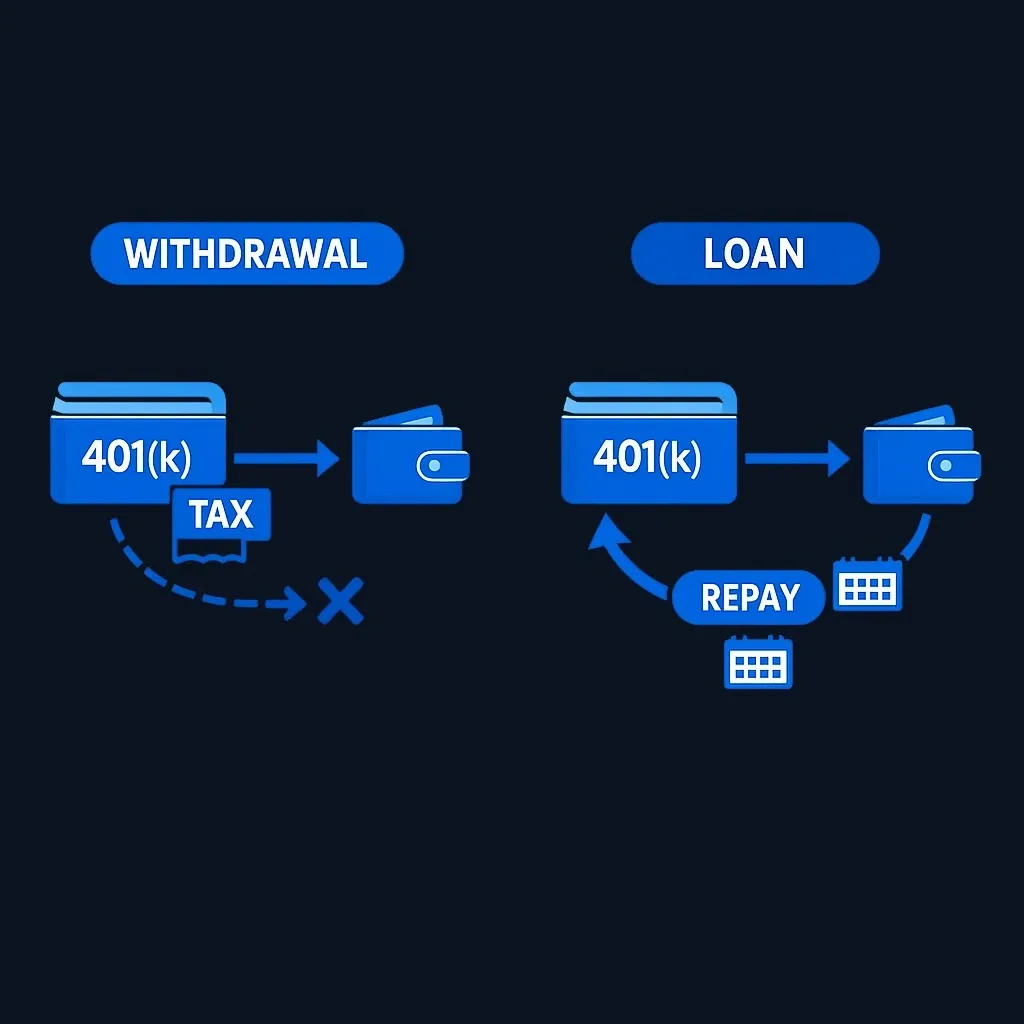
| Do you repay it? | No; hardship distributions generally cannot be rolled over | Yes, under the plan's repayment schedule |
| Is there a tax cost? | The taxable portion is income; an additional early-distribution tax may apply | Generally no immediate tax if the loan follows the rules |
| What happens to invested savings? | The withdrawn money leaves the account | Borrowed money is outside the market while outstanding |
Qualifying for hardship does not automatically mean qualifying for an exception to the 10% additional tax. These are separate tests. See the IRS hardship distribution guidance.
How much can you borrow, and for how long?
For a participant with no recent or outstanding plan loans, the federal ceiling is generally the smaller of $50,000 or half the vested balance. A plan may permit a limited exception up to $10,000 when half the balance is smaller. Plans can set lower limits; recent borrowing can reduce the available amount. With a $40,000 vested balance and no other loans, the usual ceiling is $20,000, not the full account balance.
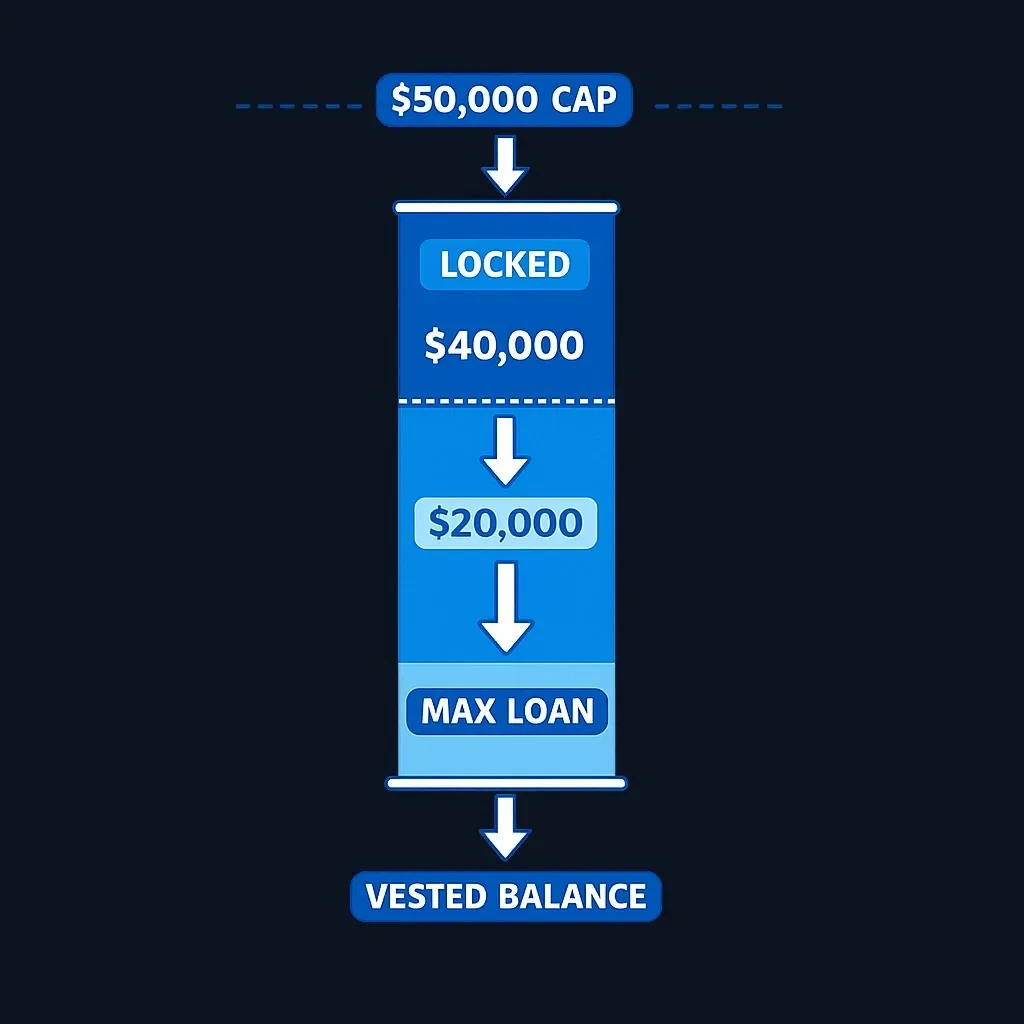
Repayment normally must finish within five years, with substantially equal principal-and-interest payments at least quarterly. A loan used to buy your principal residence can qualify for a longer term. These rules come from the IRS retirement-plan loan FAQs.
The maximum available amount is not an affordability target. A $5,000 loan repaid over five years requires more than $83.33 a month once interest is included, plus any fees. If the expense arose because your ordinary budget is already short, adding that payment may leave the original problem unresolved.
The loan risk people overlook
Loan repayments have to fit your monthly budget. They also do not replace regular contributions. If repayments force you to cut contributions, you may lose some employer matching money.
Leaving a job can change the repayment requirements. A default treated as a deemed distribution differs from a plan loan offset, where the plan reduces your account balance. Some qualified offsets have an extended rollover deadline; that does not mean the plan must keep accepting loan payments. The IRS loan FAQs explain the distinction.
A practical way to compare
Suppose you need $5,000. For a withdrawal, calculate how much you must take out to receive $5,000 after any tax and withholding. For a loan, ask for the actual payment schedule, fees, and consequences of leaving your job. These are hypothetical planning steps, not a product quote.
Then compare both options with insurance reimbursements, an affordable payment arrangement, or available savings. Avoid assuming that another loan is safer simply because it leaves the retirement account untouched.
Before deciding, get three things in writing: eligibility, the amount you would receive, and what happens if your circumstances change. A source can explain federal rules; your plan documents determine the options actually available to you.
Practice investing with Finelo
Build practical investing skills with guided lessons, simulator practice, and structured challenges.
Work backward from the cash you actually need
Start with the bill and its due date. The amount you need to receive is not necessarily the amount you would remove from the plan. A taxable withdrawal can create a separate tax bill, while a loan creates a series of future cash commitments. Neither becomes affordable simply because the balance shown on your retirement statement is large enough.
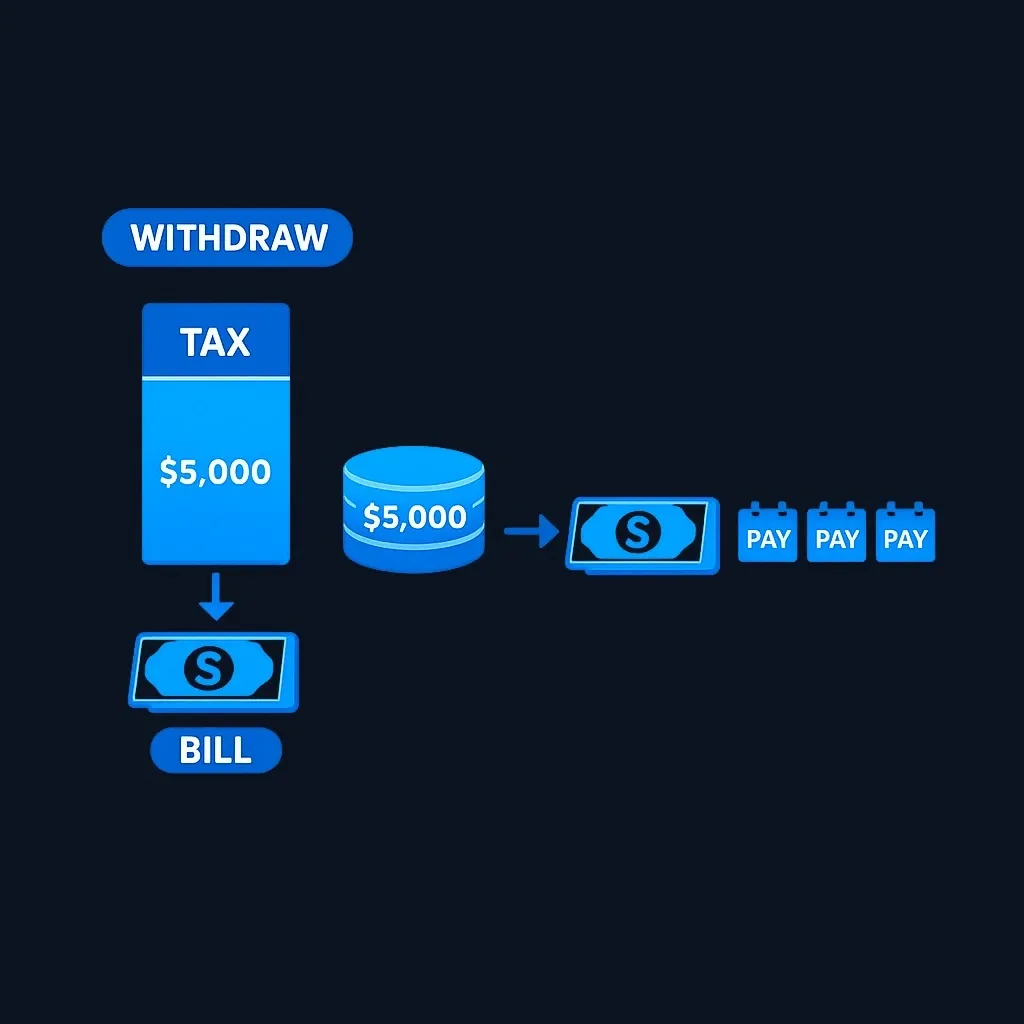
For a loan, ask for a repayment schedule showing each payroll deduction, interest, and any setup or maintenance fees. Put that deduction into the same budget as rent, utilities, insurance, food, and other debt. A plan may approve a loan that your household would struggle to repay after a reduction in work hours. Test that situation before relying on uninterrupted employment.
For a withdrawal, separate ordinary income tax from any additional early-distribution tax. Eligibility for hardship access answers whether the plan can release money; it does not answer every tax question. Ask whether the estimate includes state tax and whether withholding will cover the liability. Money withheld is a tax prepayment, not necessarily the final tax cost.
Also check the problem behind the immediate bill. A one-time expense and a recurring monthly shortfall call for different responses. Using retirement money to cover a recurring deficit may leave the same problem next month with fewer savings. A payment arrangement with the biller, an insurance reimbursement, or a change to ongoing expenses may alter how much you need from the plan. Compare those possibilities on their actual cost and availability, rather than assuming every outside loan is preferable.
What is a 401(k) Hardship Withdrawal?
A hardship withdrawal (also called a hardship distribution) lets you take money from your 401(k) before retirement to pay for an immediate and heavy financial need. The IRS notes many plans permit withdrawals for qualifying events, though plan rules vary.
- Qualifying need: The IRS and plan rules require an "immediate and heavy financial need". Your administrator can explain the documentation or certification required under your plan.
- Taxes and penalty: Hardship distributions are generally taxable as ordinary income. They may avoid the 10% early-withdrawal penalty only if they meet applicable exceptions or you are age 59½+.
- No repayment or rollover: A hardship distribution cannot be repaid to the plan or rolled over. New ordinary contributions do not reverse the distribution.
- Contributions and matching: Plans may not suspend elective contributions as a condition of a hardship distribution made after 2019. Matching still depends on your contributions and the plan’s matching formula.
What is a 401(k) Loan?
A 401(k) loan is when you borrow from your vested account balance and repay it back into your account, typically with interest. Plans and the IRS impose rules you must follow; consult your plan documents and the IRS guidance before borrowing.
- Repayment requirement: Loans must be repaid under the plan’s schedule. If you fail to repay, the outstanding balance can be treated as a distribution and taxed.
- Job change risk: If you leave your job before repaying a loan, your employer may require immediate repayment. Unpaid amounts can be reported as a taxable distribution and subject to the 10% early-withdrawal penalty if applicable.
- Plan rules vary: Whether your plan permits loans, the maximum loan amount, and repayment terms are set by your plan documents and IRS rules — check the plan documents with your administrator.
How to compare your options
Use these practical criteria to pick between a hardship withdrawal and a loan:
- Urgency and qualification: If your situation meets the IRS/plan definition of an immediate, heavy financial need and you cannot use other sources, a hardship withdrawal may be allowed; expect taxes and permanent loss of that money.
- Ability to repay: If you can repay on schedule and have stable employment, a 401(k) loan preserves the chance to restore your savings (though you may miss market returns while the loan is outstanding).
- Job mobility risk: If you expect to change jobs soon, a loan is riskier because unpaid balances may be treated as a distribution at job separation.
- Tax consequences and penalties: Compare whether your hardship need truly qualifies for penalty relief; otherwise, withdrawals incur income tax and potentially the 10% penalty if under age 59½.
A practical sequence for comparing costs:
- Can accessible savings, insurance, or an affordable payment arrangement cover the expense? Compare their actual costs and risks before touching retirement money.
- If your plan allows loans, compare the payment schedule and job-change terms with your budget. Stable employment helps but does not guarantee repayment.
- If not eligible for a loan or you genuinely meet hardship criteria and need the cash now, consider a hardship distribution while understanding tax and long-term impacts.
When to choose a hardship withdrawal
Consider a hardship withdrawal when:
- You genuinely meet your plan’s and the IRS’s "immediate and heavy financial need" standard and can document it, and
- You have no viable alternatives (emergency savings, insurance, asset sale, credit) and you accept the permanent reduction in retirement savings and the tax consequences.
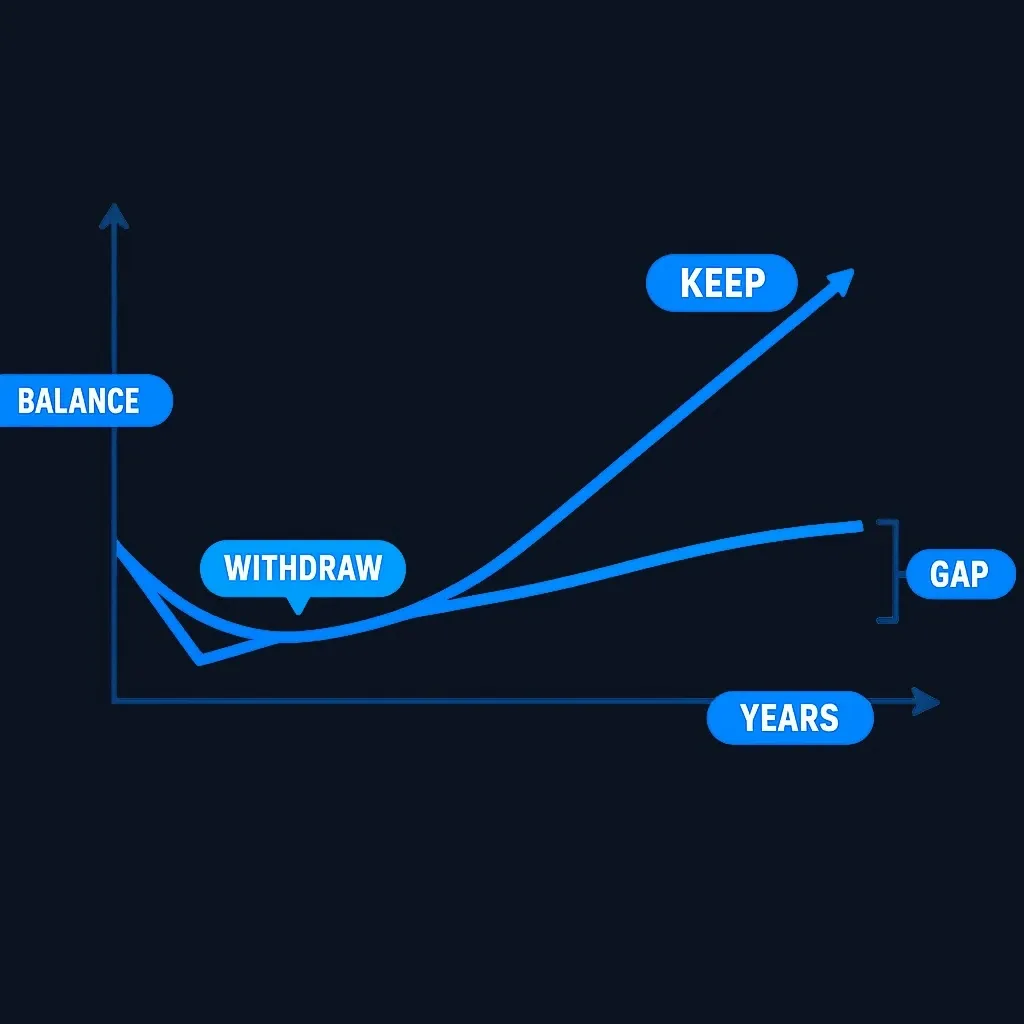
Caveat: Even when allowed, withdrawals can substantially reduce long-term retirement growth because withdrawn dollars stop compounding inside the account.
When to choose a 401(k) loan
Consider a 401(k) loan when:
- Your plan permits loans, you can reasonably meet the repayment schedule, and you expect to remain employed long enough to repay, and
- You prefer to avoid a permanent taxable distribution and want the option to restore your account balance through repayments.
Caveat: If you leave your job before the loan is repaid, the unpaid balance may be treated as taxable income and could trigger an early-withdrawal penalty if you are under 59½.
Tradeoffs and caveats
- Future growth vs. immediate relief: Withdrawals remove principal permanently, which lowers future compounding and retirement income potential. Loans temporarily reduce invested assets but restore principal if repaid; however, while the loan is outstanding you give up the market exposure on the borrowed amount.
- Taxes and penalties: Previously untaxed withdrawals are taxable; loans are not taxable if repaid properly, but a default can create a taxable deemed distribution. An eligible plan loan offset has different rollover rules, so ask which event occurred before calculating the tax.
- Plan variability: Plans differ in whether they allow hardship distributions or loans, how they define hardship, and repayment rules — always check your plan documents and confirm with your plan administrator.
- Employment and timing risk: Loans carry job-separation risk; withdrawals have immediate tax impact. Factor your job outlook into the decision.
What are the eligibility requirements for a 401(k) hardship withdrawal?
Eligibility depends on your plan and IRS rules; the distribution must meet an "immediate and heavy financial need" and your employer may require documentation showing you could not meet the need through other means.
What are the tax consequences of a 401(k) loan?
A properly administered 401(k) loan is not treated as a taxable distribution while it is being repaid according to plan and IRS rules; however, if the loan is not repaid (for example, after leaving your employer), the outstanding balance may be treated as a distribution and taxed, possibly with a 10% early-withdrawal penalty if applicable.
How do I decide between a hardship withdrawal and a loan?
Compare (1) whether you meet the hardship standard, (2) your ability to repay a loan and job stability, (3) the tax and penalty consequences, and (4) the long-term retirement impact. If you can repay and your plan allows loans, a loan usually preserves the chance to restore savings; if you truly qualify for hardship and have no alternatives, a withdrawal may be the only option.
What happens if I leave my job with an outstanding 401(k) loan?
Check the plan’s repayment and offset notice. A default can create a taxable deemed distribution that cannot be rolled over. If the plan instead offsets your balance, an eligible offset may be rolled over using other money; a qualifying separation-related offset can have a deadline through your tax-return due date, including extensions. Any early-distribution tax depends on the applicable exceptions.
For plan-specific eligibility and repayment questions, contact your administrator and review the IRS guidance linked above.
If debt is driving the decision, first compare changing future contributions with taking money out in our guide to Should you stop contributing to a 401(k) to pay off debt.
This guide covers U.S. rules. Finelo provides financial education, not personalized financial, investment, tax, or legal advice.
InvestingU.S. GuideFinancial Education
Practice investing with Finelo
Build practical investing skills with guided lessons, simulator practice, and structured challenges.
About the author
Finelo Team
The Finelo Team creates practical investing and trading education designed to help beginners learn faster with structured challenges, simulator practice, and bite-sized lessons.
Keep reading — Related articles
Investing
Tax-gain harvesting vs. tax-loss harvesting
Compare realizing investment gains with realizing losses, including holding periods, wash sales, offsets, and portfolio tradeoffs.
Finelo Team

Investing
Stable value fund vs. money market fund
Compare investment structure, contract protections, transfer restrictions, net yields, and access inside a retirement account.
Finelo Team

Investing
Single-life vs. joint-life annuity
Compare income for one lifetime with continued payments to a survivor, using equal premiums and matching guarantee terms.
Finelo Team