Accretive means an action increases a company's earnings per share (EPS). Dilutive means it decreases EPS. Analysts apply the accretive vs dilutive test to mergers, stock issuance, buybacks, and convertible securities. The math is simple: recalculate earnings and share count after the event, and compare the new EPS to the old one.
Accretive vs Dilutive: What These Terms Mean for Investors

Learn what accretive vs dilutive means for earnings per share, how analysts run the math on deals and share issuance, and how to react as an investor.
8 min read
Practice investing with Finelo
Build practical investing skills with guided lessons, simulator practice, and structured challenges.
Want to learn more?
Build practical investing skills with guided lessons, simulator practice, and structured challenges.
Explore FineloExplore Finelo's 28-day challenges
Turn learning into a daily habit with guided challenge paths.
This page is for investors who see "the deal is expected to be accretive" in headlines and want to know what that claim really tells them. You will get the calculation, a worked merger example, the common causes on each side, and a framework for judging deal news. Everything here is educational, not financial advice. Start by learning the definitions, then practice the math on a deal you have seen in the news.
What accretive and dilutive mean
Both labels describe the effect of a corporate action on earnings per share. EPS is the portion of a company's profit allocated to each outstanding share. When an action raises that number, it is accretive. When it lowers it, it is dilutive.
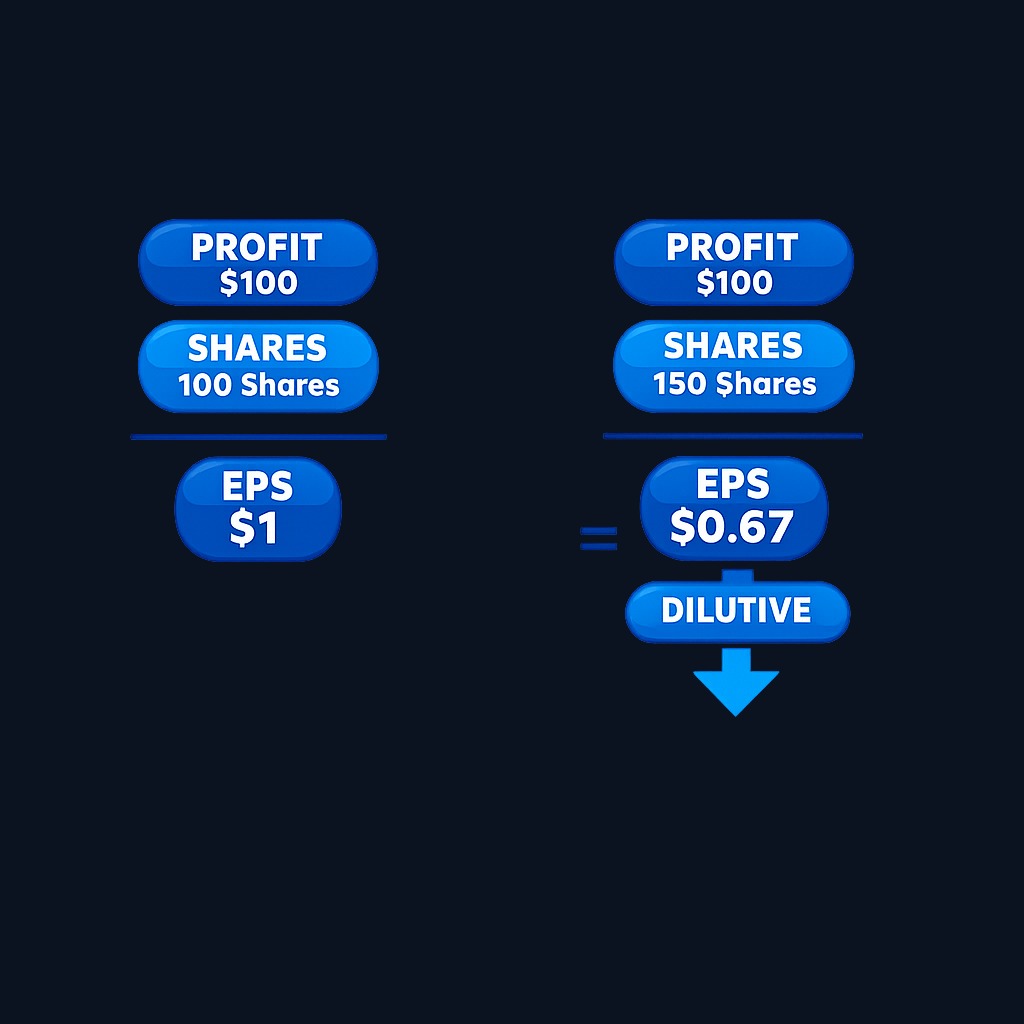
The most common trigger is share count. The SEC's small-business glossary defines dilution as what happens when a company issues new shares and leaves existing stockholders with a smaller ownership percentage. More shares chasing the same profit means less profit per share. Accretion is the mirror image: profit grows faster than the share count, or the share count shrinks while profit holds steady.
Keep one distinction in mind from the start. Ownership dilution (your percentage stake falls) and earnings dilution (EPS falls) usually travel together, but they are not identical. A company can issue shares to buy a business so profitable that EPS rises even though your ownership percentage fell.
The EPS math behind the labels
The test always compares two numbers:
EPS before = current net income ÷ current shares outstanding
EPS after = combined or adjusted net income ÷ new shares outstanding
If EPS after is higher, the action is accretive. If lower, dilutive. If roughly equal, analysts call it neutral.
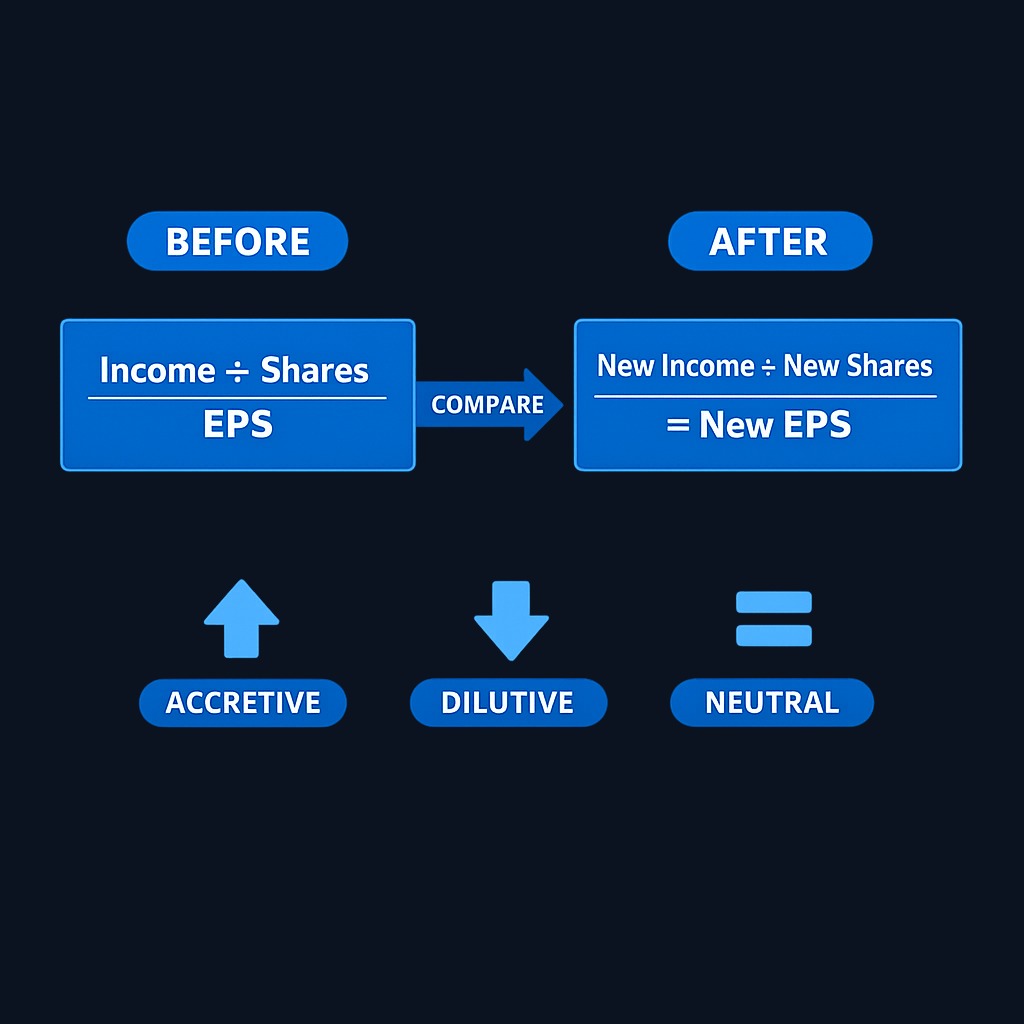
For an acquisition, "combined net income" means the buyer's earnings plus the target's earnings, minus deal costs such as interest on new debt, and plus any cost savings the merger is expected to create. Those projected savings, often called synergies, are estimates. The share count changes only if the buyer pays with its own stock.
Companies also report two EPS versions on every income statement. Basic EPS uses shares actually outstanding. Diluted EPS adds the shares that would exist if options, warrants, and convertible securities were exercised, which the SEC's glossary describes as the common stock equivalents of convertible instruments. Diluted EPS is the more conservative lens, and it is the one to watch when a company carries a lot of convertible debt or employee stock options.

Accretive vs dilutive at a glance
| Question | Accretive | Dilutive |
|---|---|---|
| Effect on EPS | Rises | Falls |
| Typical cause | Cheap acquisition, buyback below intrinsic value | Stock-funded deal for a low-profit target, new share issuance |
| Market's usual first read | Positive | Negative |
| Does it prove value creation? | No | No |
The last row matters most. The labels describe arithmetic, not investment quality. A deal can pass the EPS test and still be a bad purchase, which the limitations section below explains.
Common causes of accretion and dilution
On the accretive side:
- Acquiring a company at a low earnings multiple. If the buyer's stock trades at a higher price-to-earnings ratio than the target's purchase multiple, the added earnings usually outrun the added shares.
- Share buybacks. Repurchasing stock shrinks the share count, so the same profit spreads across fewer shares.
- Debt-funded deals with cheap financing. No new shares are issued, so EPS rises as long as the target's earnings exceed the added interest cost.
On the dilutive side:
- Issuing new stock. Secondary offerings, at-the-market programs, and stock-based compensation all raise the share count.
- Convertible bonds and warrants. These become extra shares when exercised, which is why diluted EPS counts them early.
- Buying an unprofitable or expensive target with stock. The share count jumps while near-term earnings barely move.
A useful habit: whenever a company announces any of these events, check the investor presentation for an "EPS impact" slide. Management teams almost always disclose their own accretion or dilution estimate, and comparing that estimate to your own math is a fast quality check.
Practice investing with Finelo
Build practical investing skills with guided lessons, simulator practice, and structured challenges.
Worked example: a merger in numbers
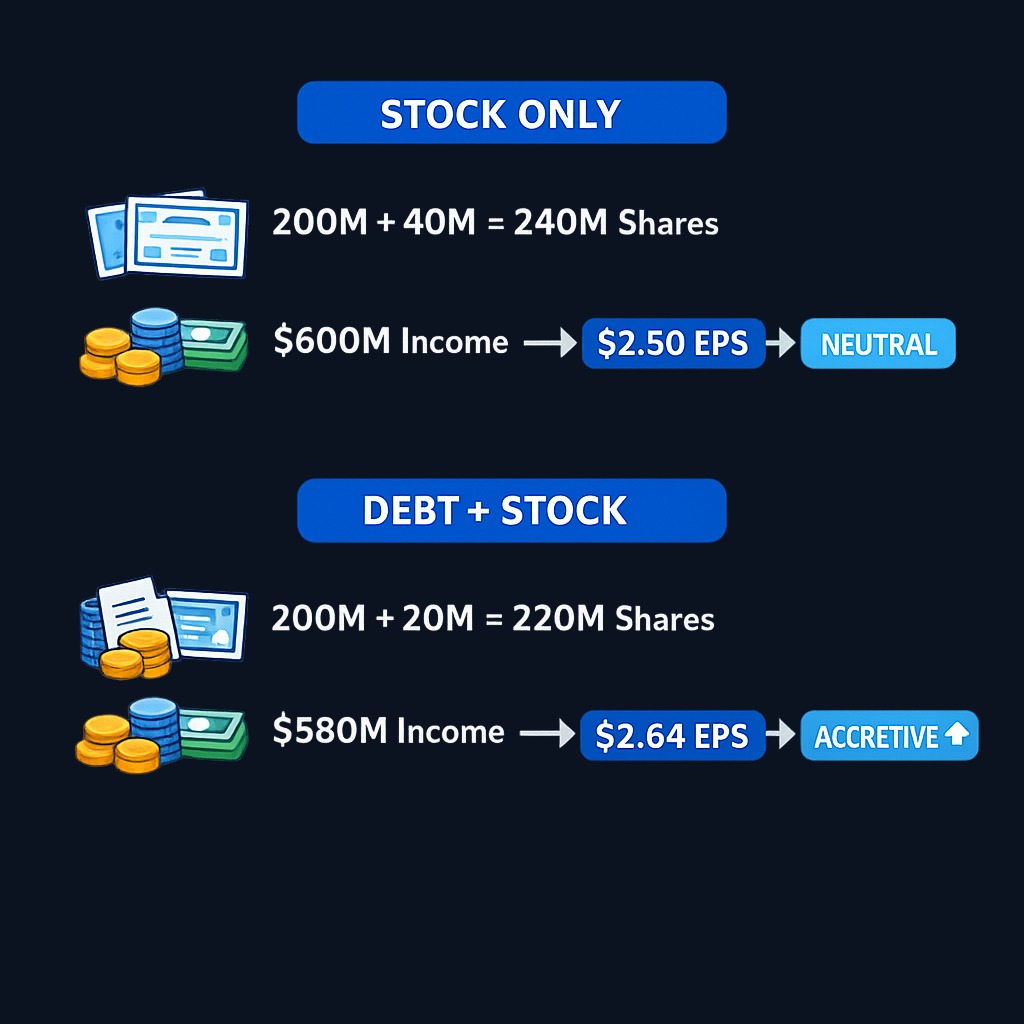
Suppose Buyer Co. earns $500 million in net income with 200 million shares outstanding. Its EPS is $2.50.
It acquires Target Co., which earns $120 million. Buyer pays with new stock, issuing 40 million shares. Deal costs and integration expenses trim $20 million from combined earnings in year one.
- Combined net income: $500M + $120M - $20M = $600 million
- New share count: 200M + 40M = 240 million shares
- New EPS: $600M ÷ 240M = $2.50
This deal lands almost exactly neutral. Now change one input: if Buyer funds half the purchase with debt and issues only 20 million shares, and interest costs cut combined earnings to $580 million, new EPS becomes $580M ÷ 220M = $2.64. The same target, financed differently, turns a neutral deal into an accretive one. Financing structure, not the target's quality, often decides the label.
Limitations: why accretive is not automatically good
The EPS test has real blind spots, and experienced investors treat the label as a starting point:
- Synergy estimates can be wrong. Projected savings are management forecasts. If they fail to materialize, an "accretive" deal quietly becomes dilutive.
- Cheap earnings can be low quality. Buying a declining business at a low multiple is mathematically accretive and strategically dangerous.
- Buybacks can be mistimed. Repurchases raise EPS at any price, including prices that later prove expensive. Accretion without a good purchase price destroys value.
- Short horizons hide costs. Deals are often labeled "accretive by year two." Year one dilution, integration risk, and added debt sit outside the headline.
- EPS ignores the balance sheet. A debt-heavy accretive deal raises risk in ways per-share earnings never show.
Dilution has its own nuance. Issuing shares to fund a genuinely high-return project can be dilutive today and value-creating over time. The arithmetic is a snapshot; the investment case is a film.

What to know before deciding
Before reacting to an accretive or dilutive headline, check four things. First, the financing mix: stock, debt, or cash decides most of the EPS impact. Second, the assumptions: how much of the claimed accretion depends on projected synergies. Third, the timeline: neutral or dilutive in year one is normal for large deals, so find the crossover year management promises. Fourth, diluted EPS: convertible securities and options can make the honest share count much larger than the basic one. If a claim in a press release cannot be tied to numbers in the filing, treat it as marketing.
Decision framework: reading a deal like an analyst
- Recompute the basic math yourself. Combined earnings divided by new share count. If your result differs sharply from management's claim, the difference is usually synergies.
- Strip out the synergies. If the deal is only accretive with full projected savings, classify it as conditional, not accretive.
- Check the price paid, not just the EPS effect. An accretive purchase of a shrinking business is still a shrinking business.
- Look at diluted share count trends over several years. Persistent creep from stock compensation is a slow, permanent dilution that headlines never announce.
- Decide what the label changes for you. For long-term holders, strategy and price matter more than the first-year EPS direction.
A common mistake is treating "accretive" as a buy signal. It only means the arithmetic works at the announced assumptions. The research that follows the label is where the real judgment happens.
Conclusion and next steps
Accretive means EPS goes up; dilutive means EPS goes down. The classification comes from a simple recalculation of earnings over shares, and financing choices often matter more than the target itself. Treat the label as arithmetic to verify, not a verdict to trust: check the synergy assumptions, the price paid, and the diluted share count before drawing conclusions.
Next steps: pick one recent acquisition announcement, pull the buyer's share count and net income, and run the before-and-after EPS math yourself. If you want structured practice reading financial statements and deal metrics, Finelo offers guided investment education for beginners building these skills step by step.
Frequently asked questions
What does it mean when a deal is accretive?
The acquisition is expected to raise the buyer's earnings per share once the companies combine. It reflects the deal's arithmetic, including financing costs and any projected savings, not a guarantee that the acquisition creates long-term value.
Is dilution always bad for shareholders?
No. Dilution lowers your ownership percentage and near-term EPS, but if the raised capital funds projects that earn more than they cost, the long-run value per share can still rise. Persistent dilution without matching growth is the warning sign.
How do stock buybacks affect the accretive vs dilutive question?
Buybacks are accretive by construction: fewer shares mean higher EPS on the same profit. Whether they help shareholders depends on the price paid. Repurchasing overvalued stock spends real cash for a cosmetic EPS boost.
Why do companies report both basic and diluted EPS?
Basic EPS uses shares outstanding today. Diluted EPS adds shares that could exist from options and convertibles, showing the more conservative case. A wide gap between the two signals significant potential dilution ahead.
accretivedilutivetermsmeaninvestors
Practice investing with Finelo
Build practical investing skills with guided lessons, simulator practice, and structured challenges.
About the author
Finelo Team
The Finelo Team creates practical investing and trading education designed to help beginners learn faster with structured challenges, simulator practice, and bite-sized lessons.
Keep reading — Related articles

Investing
Tax-gain harvesting vs. tax-loss harvesting
Compare realizing investment gains with realizing losses, including holding periods, wash sales, offsets, and portfolio tradeoffs.
Finelo Team

Investing
Stable value fund vs. money market fund
Compare investment structure, contract protections, transfer restrictions, net yields, and access inside a retirement account.
Finelo Team

Investing
Single-life vs. joint-life annuity
Compare income for one lifetime with continued payments to a survivor, using equal premiums and matching guarantee terms.
Finelo Team