An index fund is a mutual fund or exchange-traded fund (ETF) that holds the same investments as a market index — such as the S&P 500 — instead of relying on a manager to pick stocks. Its goal is simple: match the index's return, not beat it. The design replicates an index's performance while keeping management effort, and therefore cost, to a minimum. That's why people call it passive investing.
What is an Index Fund?
An index fund is a mutual fund or exchange-traded fund (ETF) that holds the same investments as a market index — such as the S&P 500 — instead of relying on a manager to pick stocks. Its goal is simple: match the…
8 min read
Practice investing with Finelo
Build practical investing skills with guided lessons, simulator practice, and structured challenges.
Want to learn more?
Build practical investing skills with guided lessons, simulator practice, and structured challenges.
Explore FineloExplore Finelo's 28-day challenges
Turn learning into a daily habit with guided challenge paths.
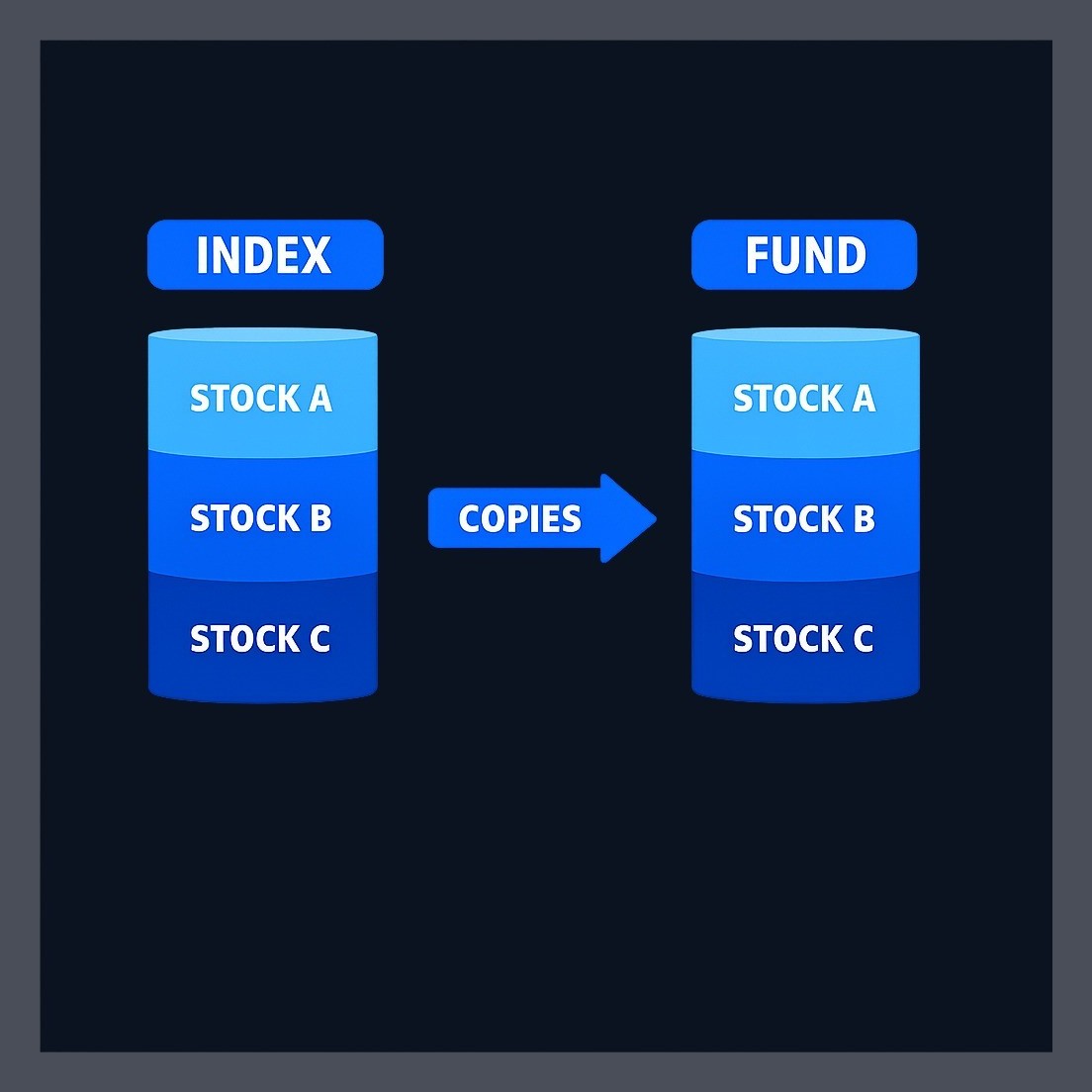
That one choice — copy the market instead of trying to outsmart it — drives everything people like about index funds: low fees, broad diversification, and less hands-on work. This guide covers how they work, what they cost, where they can go wrong, and how to pick one.
How Index Funds Work
Every index fund starts with an index: a rules-based list of securities that represents a slice of the market. The best-known example, the S&P 500, is built from the 500 biggest U.S. companies and widely watched as a barometer of the American economy. Other indexes track small companies, international markets, bonds, or single sectors.
The fund's job is replication. It typically holds a sampling of the securities in its target index, weighted the same way. When the index changes its lineup — adding a growing company, dropping a shrinking one — the fund follows. No analyst judges whether a stock is cheap. The index's rules decide what the fund owns.
What you actually own
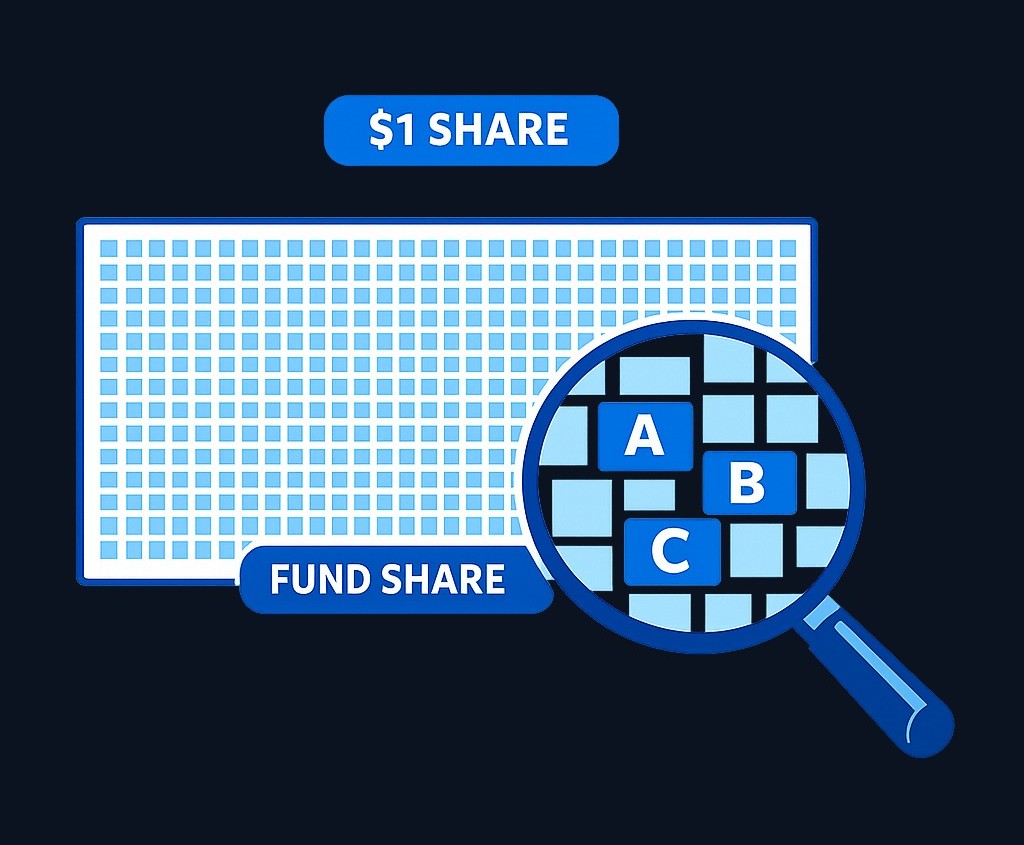
Buy one share of an S&P 500 index fund and you own a tiny slice of all 500 companies. That's the practical magic. A single purchase replaces the impossible chore of buying hundreds of stocks in the right proportions and rebalancing them yourself.
Index fund vs. mutual fund vs. ETF
This confuses almost everyone at first. The cleanest framing: the mutual fund or ETF is the container; indexing is the strategy inside it. The container determines how you buy and sell:
- An index mutual fund trades once per day at the closing price. It usually accepts exact dollar amounts — say, $200 per month.
- An index ETF trades on an exchange all day, like a stock. You can buy or sell any time the market is open.
For a long-term investor making regular contributions, the difference is mostly logistics. The strategy — and most of the outcome — is the same.
Why passive tracking changes the math
The fund pays no researchers to hunt for winners. It doesn't trade on opinions. So its costs stay low, and low turnover — how often a fund buys and sells its holdings — means fewer taxable events. The next section shows why that small fee gap decides so much over decades.
Benefits of Investing in Index Funds
Low costs that compound in your favor
Fund fees show up as an expense ratio: the percentage of your balance the fund keeps each year. Index fund expense ratios generally run from about 0.05% to 0.27% per year. The average index mutual fund charges around 0.06%. Some providers went all the way to zero: 0% expense ratio funds exist, such as the Fidelity ZERO International Index Fund at 0.000%. Fees change, so verify current pricing on each provider's official site.
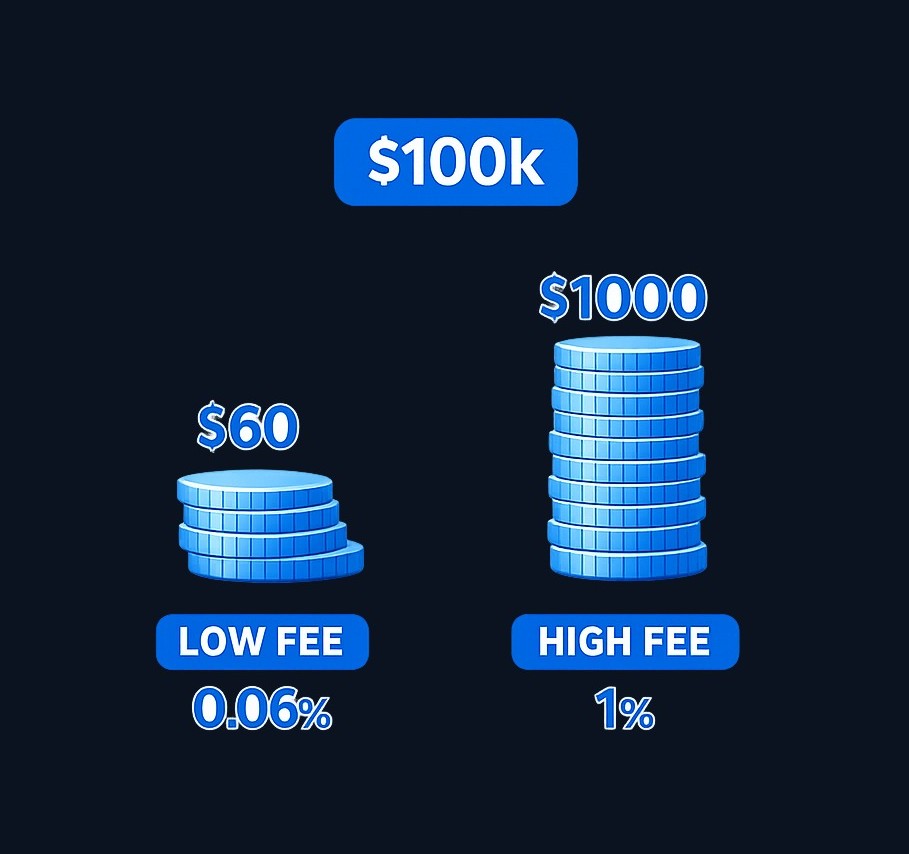
Why obsess over fractions of a percent? Take a hypothetical $100,000 portfolio for one year. A 0.06% expense ratio costs $60. A 1% fund costs $1,000. That $940 gap repeats every year and compounds — money lost to fees never gets a chance to grow. The pricier fund must out-earn the cheap one every year just to break even.
Diversification in one purchase
A broad index fund spreads one purchase across a wide range of companies and sectors. If one company collapses, your portfolio takes a dent, not a knockout. Concentration risk — the beginner mistake of holding three or four favorite stocks — disappears by design.
Tax efficiency
Index funds trade rarely. Low turnover means fewer capital-gains distributions passed to you along the way. The tax bill mostly arrives when you sell: in a taxable account, selling fund shares can trigger capital gains taxes, so weigh that before you trade. Retirement accounts blunt this issue. In a taxable account, it quietly favors passive funds.
Simplicity you'll actually stick with
The underrated benefit: an index fund removes decisions. No researching fund managers. No wondering whether this year's star repeats. For most people, a strategy they can hold for 20 years beats a "perfect" one they abandon in 18 months.
Risks Associated with Index Funds
Index funds are diversified, not bulletproof. Know what they don't protect you from.
Market risk is fully yours. An index fund matches its index in both directions. Whatever risks live in the underlying stocks or bonds live in the fund too, so a broad downturn or recession drags an index fund down with the market it tracks. No manager shifts to cash to soften the fall. Index funds remove single-company risk, not whole-market risk.
Concentration inside the index. Most big indexes are market-cap weighted: the largest companies get the largest share. When a few giants dominate, your "diversified" fund leans hard on their fortunes. One S&P 500 fund diversifies you across 500 companies — not across countries, bonds, or company sizes.
No downside management. "Match the index" feels easy while markets rise. In a bear market, the fund won't sell before the crash or buy the bottom. Your behavior is the strategy: keep holding, keep contributing. Panic-selling turns a temporary drop into a permanent loss.
Tracking isn't perfectly free. Fees and trading friction mean a fund usually returns slightly less than its index. The gap is small for major funds — but it's one more reason cost is your first filter.
Practice investing with Finelo
Build practical investing skills with guided lessons, simulator practice, and structured challenges.
How to Buy Index Funds
A widely used sequence runs goal → research → costs → where to buy → monitor. In practice:
1. Define what the money is for. Retirement in 30 years? A house in 7? The timeline shapes how much belongs in stocks versus stabler holdings — and whether you should invest at all instead of holding cash for near-term needs.
2. Choose the account type. Employer retirement plans and individual retirement accounts offer tax advantages, and their menus usually include index funds. A taxable brokerage account adds flexibility with no contribution limits. Many investors use both.
3. Pick the index before the fund. Decide the exposure you want — U.S. large companies, total U.S. market, international stocks, bonds, or a stock-and-bond blend. Then compare funds tracking that index. Same-index funds are near-interchangeable, which is why competition pushed fees down until 0% options appeared.
4. Compare costs. The cheaper of two same-index funds usually wins. But check two more things: the fund's minimum investment, and whether your brokerage charges a transaction fee to buy it.
5. Order, then automate. Buy through your brokerage or retirement plan. Then set an automatic monthly contribution. It enforces consistency, buys through rising and falling markets, and kills the urge to time your entries.
6. Monitor lightly. Keep an eye on your investments — for an index fund, that means an occasional check that it still tracks its index and your mix still fits your goals. Daily monitoring adds anxiety, not returns.
Comparing Index Funds and Actively Managed Funds
An active fund pays professionals to research securities and trade, trying to beat a benchmark. An index fund is the benchmark, minus a small fee. The decision comes down to cost, predictability, and your odds of picking a winner.
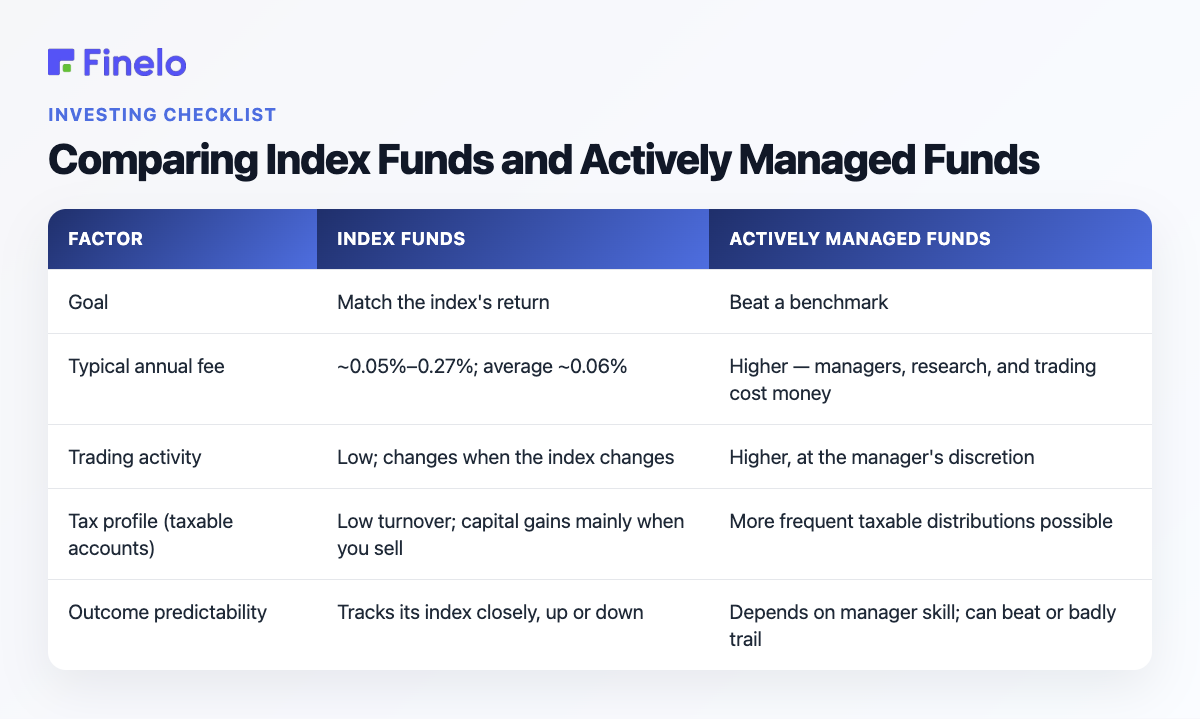
| Factor | Index funds | Actively managed funds |
|---|---|---|
| Goal | Match the index's return | Beat a benchmark |
| Typical annual fee | ~0.05%–0.27%; average ~0.06% | Higher — managers, research, and trading cost money |
| Trading activity | Low; changes when the index changes | Higher, at the manager's discretion |
| Tax profile (taxable accounts) | Low turnover; capital gains mainly when you sell | More frequent taxable distributions possible |
| Outcome predictability | Tracks its index closely, up or down | Depends on manager skill; can beat or badly trail |
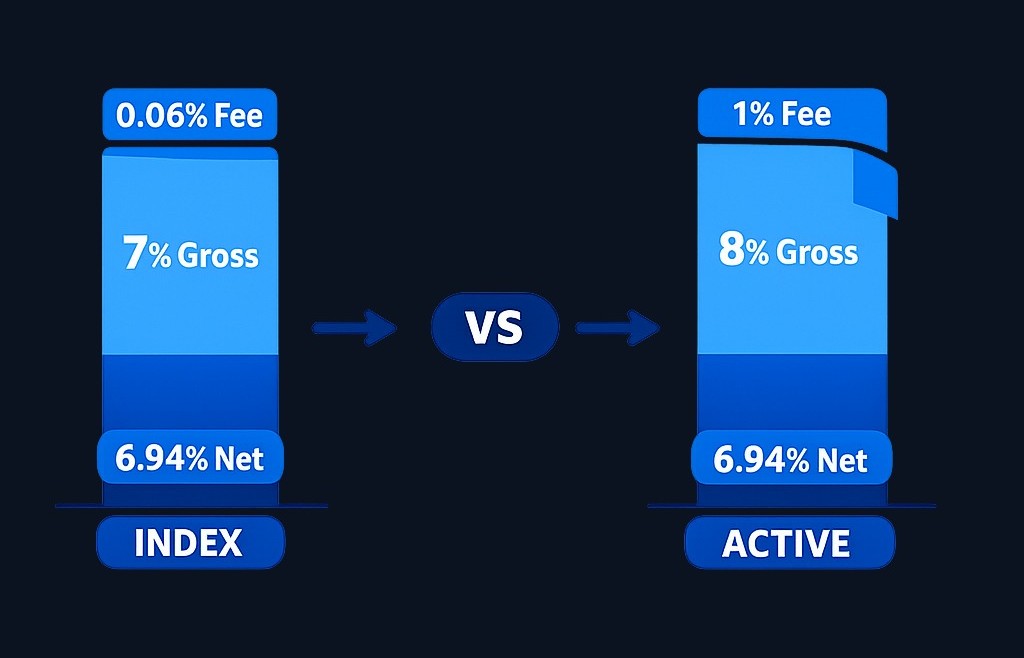
The structural problem for active funds is the fee hurdle. A worked example: an active fund and an index fund both hold assets that return 7% this year. The index fund charging 0.06% hands you 6.94%. The active fund charging 1% must earn 8% — a full point of true outperformance — to hand you the same 6.94%. That hurdle resets every year you hold the fund.
Picking an active fund also means being right twice. The manager must beat the fee handicap year after year. And you must spot that manager in advance — before the winning record exists, because past performance is the one thing you can't buy. The index investor makes neither bet. They take the market's return and keep nearly all of it.
Active management can win — some funds beat their benchmark in any given year. The hard part is knowing which ones will, ahead of time, repeatedly. Without a real edge in manager selection, the index fund keeps the one variable you fully control — cost — at a minimum.
Conclusion and Next Steps
An index fund gives you the market's return for a rock-bottom fee — no stock-picking, no manager roulette. The math favors it: with funds charging about 0.06% on average, or even nothing, you keep nearly everything the market delivers. Pricier alternatives must outperform every year just to match that.
Next steps: define your goal and timeline, pick the account type, choose a broad index, compare expense ratios, and automate contributions. Index funds still carry full market risk. This article is educational, not personalized financial advice — verify costs, risks, and suitability for your own situation before investing.
If you want to build your investing knowledge before committing money, Finelo's Wealth Growth Quiz can match you with a learning path that fits your starting point.
Frequently asked questions
Can I lose money with index funds?
Yes. An index fund carries the full risk of the markets it tracks, and a downturn or recession pulls its value [down](https://www.newyorklife.com/articles/what-are-index-funds-and-how-to-invest). Diversification removes single-company risk, not market risk. That's why index funds suit long time horizons that can ride out declines.
What is the average expense ratio for index funds?
The average index mutual fund charges about 0.06% per [year](https://www.schwab.com/schwab-index-funds-etfs). Typical funds run from roughly 0.05% to [0.27%](https://www.newyorklife.com/articles/what-are-index-funds-and-how-to-invest), and a few charge [nothing](https://www.newyorklife.com/articles/what-are-index-funds-and-how-to-invest). Verify current pricing on the provider's official site.
Can I invest in index funds through a retirement account?
Yes. Employer plans commonly include index funds, and individual retirement accounts at any major brokerage offer a wide selection. A tax-advantaged account also sidesteps the capital gains issues that apply when selling in taxable [accounts](https://www.newyorklife.com/articles/what-are-index-funds-and-how-to-invest).
What is the difference between an index fund and an ETF?
They overlap rather than compete. The ETF or mutual fund is the vehicle; the index fund is the strategy inside [it](https://www.newyorklife.com/articles/what-are-index-funds-and-how-to-invest). Many ETFs are index funds. Many index funds are mutual funds instead. Pick the wrapper based on how you prefer to buy.
InvestingBeginnerIndex FundsMarkets
Practice investing with Finelo
Build practical investing skills with guided lessons, simulator practice, and structured challenges.
About the author
Finelo Team
The Finelo Team creates practical investing and trading education designed to help beginners learn faster with structured challenges, simulator practice, and bite-sized lessons.
Keep reading — Related articles
Investing
Yield to Call vs Yield to Maturity: Assumptions and Bond Risks
Yield to call (YTC) estimates a bond's yield if the issuer redeems it on an eligible call date; yield to maturity (YTM) estimates yield if it remains outstanding to final maturity.
Finelo Team
Investing
Will My Employer Know If I Take a 401(k) Loan?
Who this page is for: readers new to 401(k) loans who want a practical, privacy‑focused explanation — what your employer can see, how to limit visibility, and the financial tradeoffs to weigh.
Finelo Team
Investing
What Medical Expenses Qualify for a 401(k) Hardship Withdrawal?
Before you decide, confirm three things with your plan administrator:
Finelo Team