When interest rates rise, existing bond prices typically fall. The reason is competition: newly issued bonds pay the higher current rates, which makes older bonds with lower payments less attractive — and less valuable if sold before maturity. This exposure is called interest rate risk — the risk that an investment's value fluctuates as rates change.
What Happens to Bonds When Interest Rates Rise?
When interest rates rise, existing bond prices typically fall. The reason is competition: newly issued bonds pay the higher current rates, which makes older bonds with lower payments less attractive — and less valuable…
7 min read
Practice investing with Finelo
Build practical investing skills with guided lessons, simulator practice, and structured challenges.
Want to learn more?
Build practical investing skills with guided lessons, simulator practice, and structured challenges.
Explore FineloExplore Finelo's 28-day challenges
Turn learning into a daily habit with guided challenge paths.
Two details soften this general rule. First, the effect is generally stronger the longer a bond has until maturity — short-term bonds wobble less. Second, investors who hold a bond to its maturity date are less affected, since they still collect full principal at the end. This page is for anyone holding bonds or bond funds and wondering what rising rates mean for them — and what, if anything, to do about it.
The Relationship Between Interest Rates and Bond Prices
A bond is a loan you make to a government or company. It pays fixed interest (the coupon) and returns your principal (the par value) at maturity. Because the coupon is fixed at purchase, the bond's market price must adjust whenever prevailing rates move.
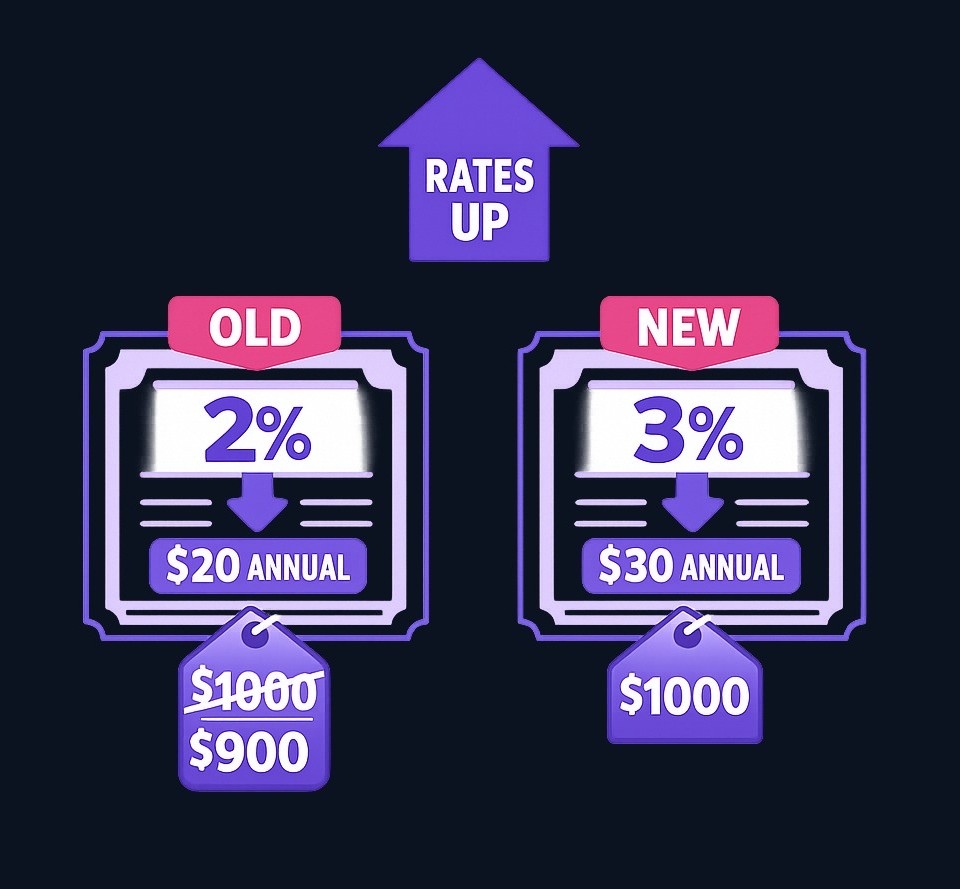
Schwab's paired scenarios show the seesaw in action. An investor buys a 10-year, $1,000 bond with a 2% coupon: $20 a year, $200 over the decade, plus the $1,000 back at maturity. Then rates rise. A second investor buys a comparable 10-year, $1,000 bond paying 3% — $30 a year, $300 over the decade.
| Bond bought before the hike | Bond bought after | |
|---|---|---|
| Par value | $1,000 | $1,000 |
| Coupon | 2% — $20/year | 3% — $30/year |
| 10-year interest | $200 | $300 |
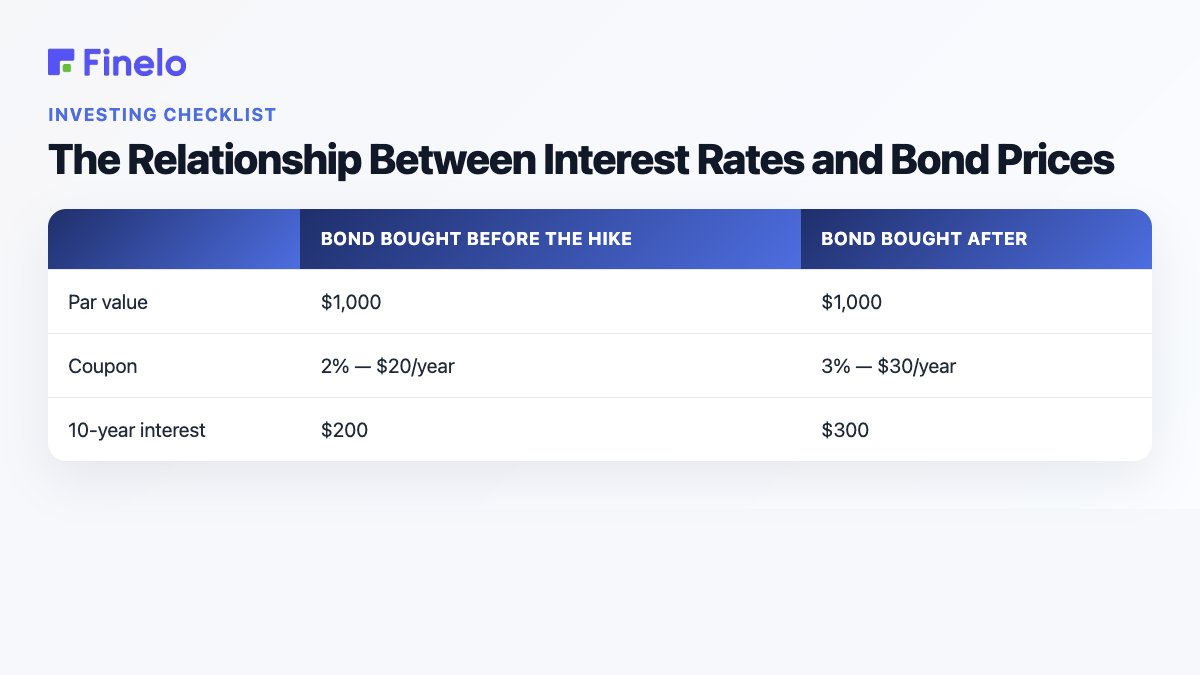
Who would pay full price for the 2% bond when the 3% bond exists? Nobody — so the older bond's market value drops, and selling it early would likely mean accepting less than $1,000. The price falls exactly far enough that the old bond's overall return catches up with the new alternatives. That's the entire inverse relationship in one move: rates up, existing bond prices down — and vice versa.
How Rising Interest Rates Affect Different Types of Bonds
Not all bonds feel a rate hike equally. Two characteristics decide the damage:
Time to maturity — the big one. The price effect of rate changes is generally greater the longer the bond has left to run. The logic: a 30-year bond locks you into below-market payments for decades, while a 2-year bond frees your money soon for reinvestment at the new, higher rates. Professionals measure this sensitivity as duration — the higher a bond's duration, the harder its price moves when rates shift.
Issuer type — the second layer. Government, corporate, and municipal bonds all obey the same rate mechanics, but each carries its own additional risks. Government bonds respond most purely to rate moves, because default worries are minimal. Corporate bonds add credit risk on top: in the economic conditions that often accompany rising rates, investors may also re-examine whether weaker companies can service their debt. Municipal bonds follow the same price mechanics, with tax treatment and local finances as extra variables.
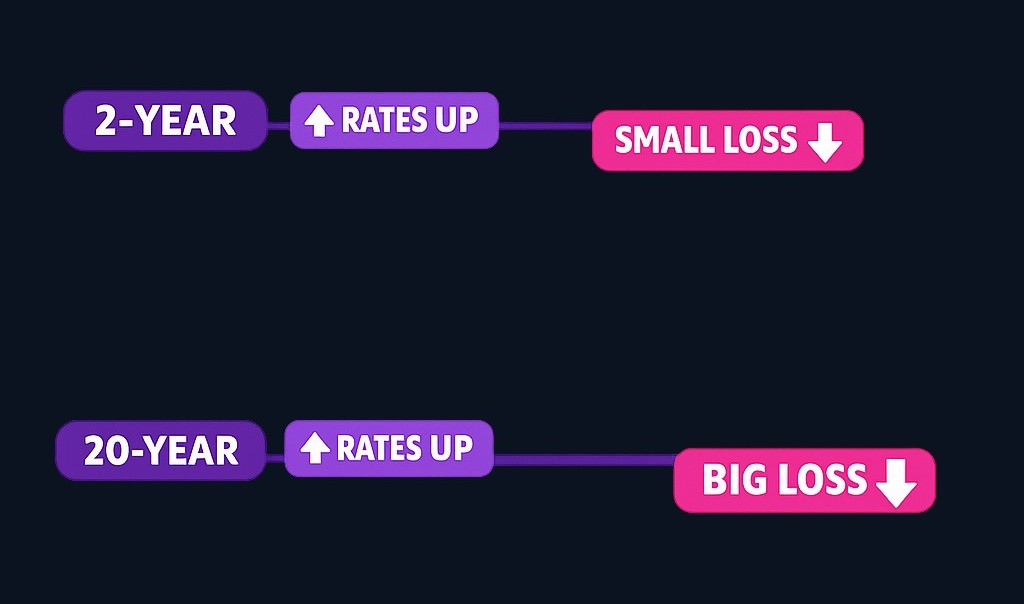
A practical illustration of the maturity effect: two investors both hold bonds paying below-market coupons after a hike. The one holding a 2-year note has two years of subpar income before reinvesting at better rates — a small, temporary drag. The one holding a 20-year bond faces the same shortfall for two decades, so buyers demand a much deeper price discount today. Same event, very different portfolio impact — which is why "how long are my bonds?" is the first question to ask when rates start climbing.
Bond funds deserve a note too: a fund holds many bonds and reports their combined market value, so rising rates show up as an immediate dip in the fund's price — even though the underlying bonds keep paying and maturing.
Practice investing with Finelo
Build practical investing skills with guided lessons, simulator practice, and structured challenges.
Investor Strategies in a Rising Interest Rate Environment
Rising rates feel bad for bondholders in the moment, but the toolbox is bigger than "panic or ignore":
- Decide by holding intention. The central fork: interest rate risk matters far less if you'll hold to maturity, while selling early may force a sale below par. If your bonds fund a goal at a known date and you'll hold until then, paper losses along the way don't change your final outcome — barring issuer default.
- Shorten duration if flexibility matters. Investors expecting to need their money sooner often favor shorter maturities, which are less price-sensitive and roll over faster into higher-paying replacements.
- Build a ladder. Splitting money across bonds maturing in, say, 1 through 5 years means something matures every year. Each maturing rung gets reinvested at current rates — rising rates become a gradual upgrade rather than a shock.
- Reframe the bad news. Higher rates hurt existing prices once, but every new dollar you invest afterward earns more income. For long-horizon savers who keep contributing, a higher-rate world eventually pays better than the low-rate one it replaced.
- Keep bonds in context. Bonds remain the stabilizer in a diversified portfolio. Abandoning them entirely because of rate fears swaps one risk (price dips) for another (a portfolio with no cushion at all).
The mistake to avoid: selling after a rate rise simply because your bond fund shows a loss. The drop already happened; selling converts it from temporary to permanent while forfeiting the higher yields now accruing.
Lessons from Past Rate-Hike Cycles
History's specific numbers vary cycle by cycle, but the recurring patterns are consistent enough to teach three durable lessons.
The pain concentrates at the long end. In rate-rising periods, long-maturity bonds have repeatedly taken the largest price hits, exactly as the maturity principle predicts — while short-term instruments passed through the same episodes with far smaller drawdowns. Investors who matched bond maturities to their actual time horizons experienced hikes as noise; investors holding long bonds for near-term goals experienced them as losses.
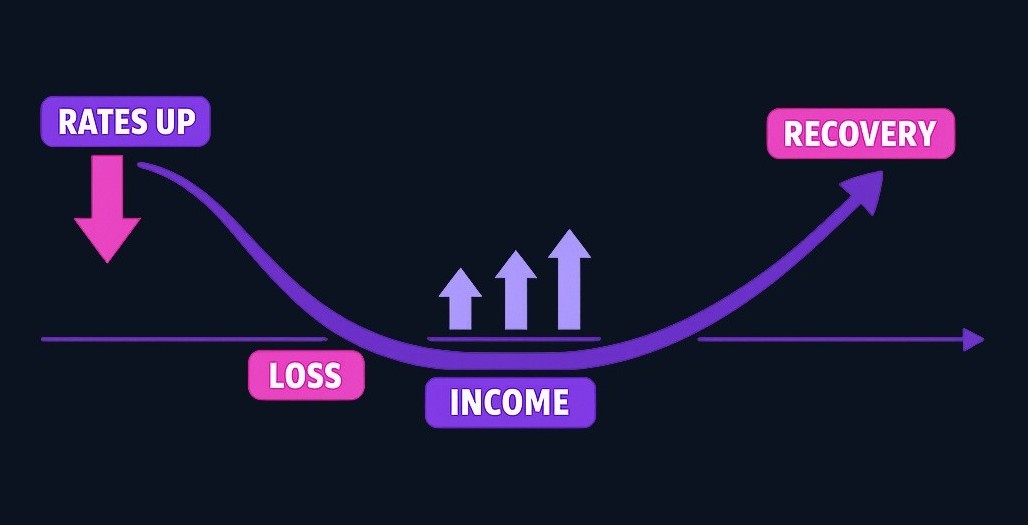
Income eventually heals prices. After a hike cycle, bond portfolios begin reinvesting coupons and maturing principal at the new, higher rates. Over time, that higher income stream offsets the initial price decline — the recovery is built into the machine, provided the investor stays in it.
The effects reach beyond bonds. As Schwab notes, the trade-off between rates and prices ripples through the whole economy, influencing markets well beyond bonds — borrowing costs, stock valuations, savings yields. Understanding the bond seesaw is really a lens on how rate policy touches everything.
The honest caveat: no two cycles repeat exactly, and past patterns are illustrative, not predictive of results anyone can expect. Use history for its mechanics, not as a forecast.
Conclusion and Next Steps
The one-line summary: rates up, existing bond prices down — with longer maturities hit hardest, and holders-to-maturity largely insulated. Your next steps: check the average maturity or duration of what you hold, match it against when you'll actually need the money, and treat rising rates as a reinvestment opportunity rather than only a loss.
This page is educational, not personalized financial advice. Bond outcomes vary by issuer, maturity, and market conditions — verify risks and suitability for your situation before making changes.
Want to understand the machinery behind markets like this one? Finelo's Wealth Growth Quiz matches you with an investing learning path for your level.
Frequently asked questions
Why exactly do bond prices fall when rates rise?
Because new bonds pay more. Your older bond's fixed payments produce less income than currently available alternatives, so buyers will only take it at a [discount](https://www.schwab.com/learn/story/what-happens-to-bonds-when-interest-rates-rise). The price adjusts until old and new bonds offer comparable overall returns.
Are all bonds affected equally?
No. Price sensitivity grows with time to [maturity](https://www.schwab.com/learn/story/what-happens-to-bonds-when-interest-rates-rise) — long bonds swing hardest, short bonds least. Issuer type adds secondary effects, like credit concerns for weaker corporate borrowers.
How can I protect my bond investments from rising rates?
Match maturities to your time horizon, consider shorter durations or a bond ladder for flexibility, and remember that holding to maturity largely sidesteps the price-drop [problem](https://www.schwab.com/learn/story/what-happens-to-bonds-when-interest-rates-rise). Diversification across maturities spreads the exposure.
What is interest rate risk?
It's the risk that an investment's value fluctuates because rates [changed](https://www.schwab.com/learn/story/what-happens-to-bonds-when-interest-rates-rise) — the formal name for everything on this page. All fixed-income investments carry some of it; maturity length decides how much.
InvestingBeginnerBondsInterest RatesMarkets
Practice investing with Finelo
Build practical investing skills with guided lessons, simulator practice, and structured challenges.
About the author
Finelo Team
The Finelo Team creates practical investing and trading education designed to help beginners learn faster with structured challenges, simulator practice, and bite-sized lessons.
Keep reading — Related articles
Investing
Yield to Call vs Yield to Maturity: Assumptions and Bond Risks
Yield to call (YTC) estimates a bond's yield if the issuer redeems it on an eligible call date; yield to maturity (YTM) estimates yield if it remains outstanding to final maturity.
Finelo Team
Investing
Will My Employer Know If I Take a 401(k) Loan?
Who this page is for: readers new to 401(k) loans who want a practical, privacy‑focused explanation — what your employer can see, how to limit visibility, and the financial tradeoffs to weigh.
Finelo Team
Investing
What Medical Expenses Qualify for a 401(k) Hardship Withdrawal?
Before you decide, confirm three things with your plan administrator:
Finelo Team