The most important stock market terms for beginners explain five things: what you own, where it trades, how you place an order, what changes its value, and which risks you accept. Start with stock, share, exchange, index, bid, ask, spread, market order, limit order, volatility, diversification, dividend, ETF, and expense ratio.
Essential Stock Market Terms for Beginners
The most important stock market terms for beginners explain five things: what you own, where it trades, how you place an order, what changes its value, and which risks you accept. Start with stock, share, exchange…
12 min read
Practice investing with Finelo
Build practical investing skills with guided lessons, simulator practice, and structured challenges.
Want to learn more?
Build practical investing skills with guided lessons, simulator practice, and structured challenges.
Explore FineloExplore Finelo's 28-day challenges
Turn learning into a daily habit with guided challenge paths.
You do not need to memorise a giant glossary before learning. Use each term in a decision. “Bid” matters when selling. “Expense ratio” matters when comparing funds. “Volatility” matters when deciding whether you can tolerate sharp price changes. This guide groups the language by the job it performs.
Key Stock Market Terms Explained
Ownership and company terms
| Term | Plain-English meaning | Why it matters |
|---|---|---|
| Stock | A general term for an ownership interest in a company | Tells you that your result is connected to a business, not only a ticker symbol |
| Share | One unit of a company’s stock | Describes how much stock you own |
| Shareholder | A person or organisation that owns shares | May receive rights defined by the share class |
| Equity | Ownership value | Often used as another word for company ownership or stock |
| Common stock | A class of ownership that may include voting rights and possible dividends | Rights vary, so check the company’s share terms |
| Preferred stock | A class with specially defined economic rights that may rank ahead of common stock in some areas | “Preferred” does not mean free from loss |
| Market capitalisation | Share price multiplied by the number of shares outstanding | Helps compare the market value assigned to companies |
| Outstanding shares | Shares currently issued and held by investors | Used in ownership and per-share calculations |
| Dilution | A reduction in an existing holder’s ownership percentage after more shares or share-linked claims are created | More shares can change the value represented by each existing share |
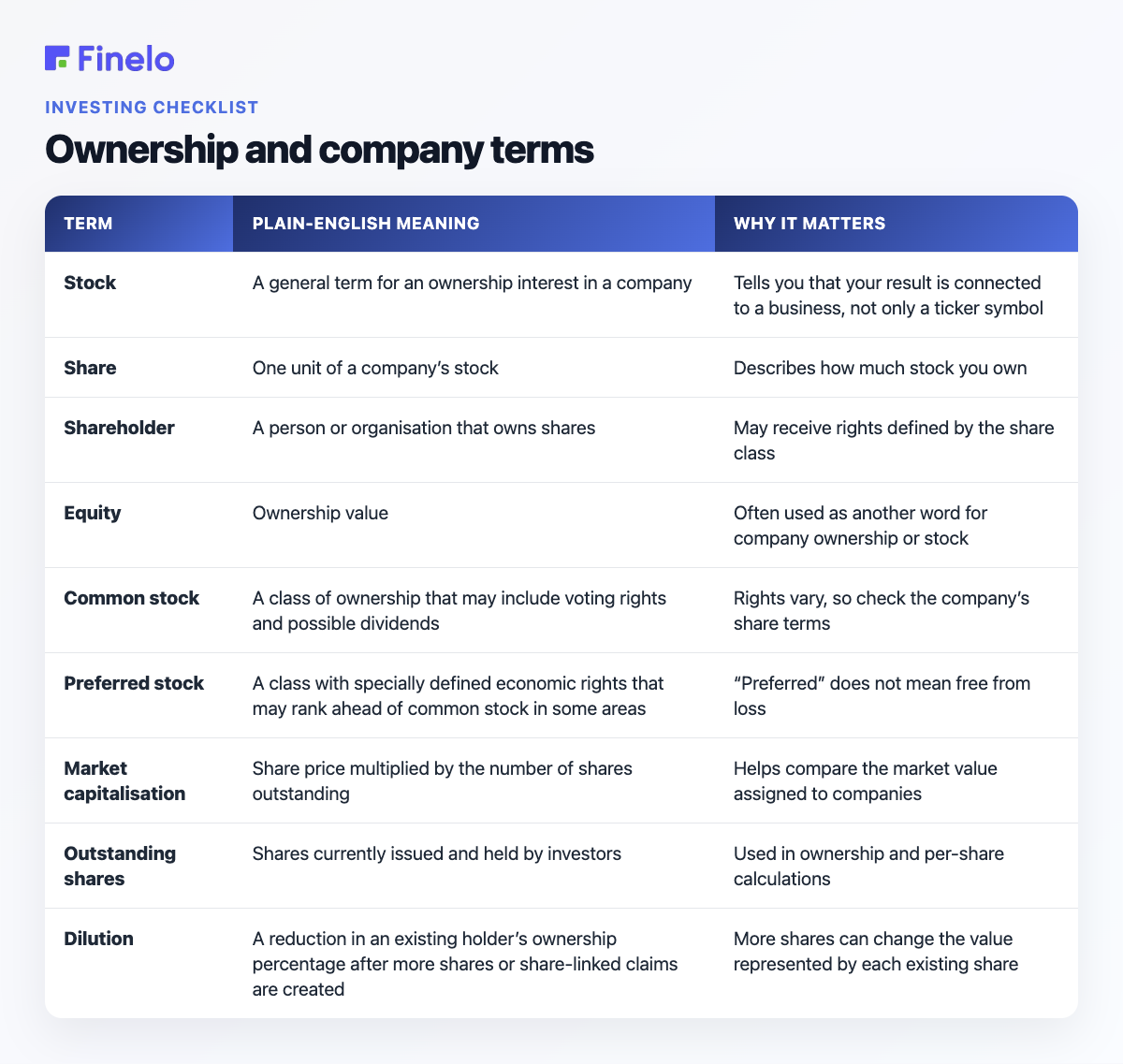
A ticker symbol is only a shorthand label. Before buying, connect it to the company, the share class, and the rights you would own.
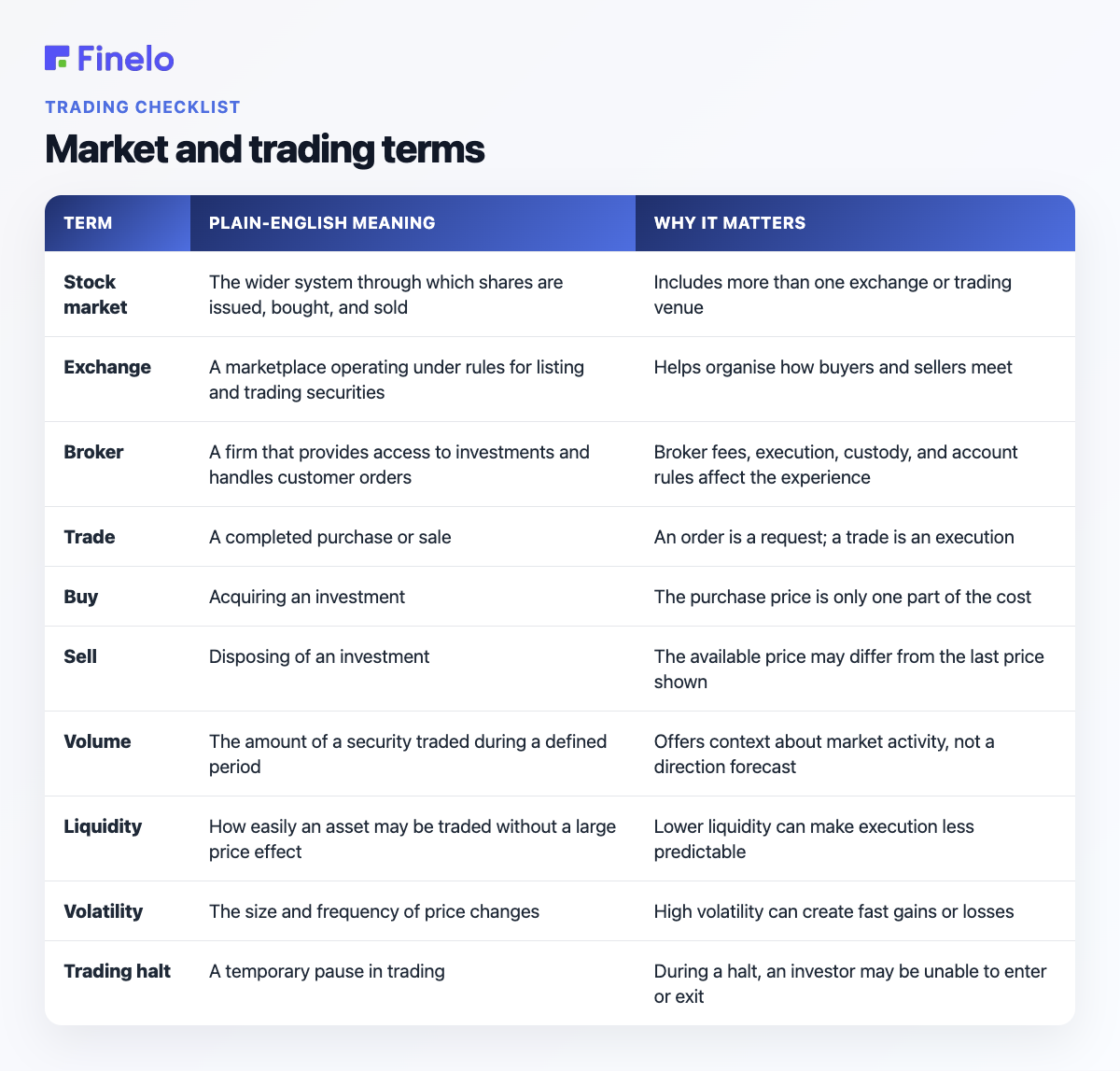
Market and trading terms
| Term | Plain-English meaning | Why it matters |
|---|---|---|
| Stock market | The wider system through which shares are issued, bought, and sold | Includes more than one exchange or trading venue |
| Exchange | A marketplace operating under rules for listing and trading securities | Helps organise how buyers and sellers meet |
| Broker | A firm that provides access to investments and handles customer orders | Broker fees, execution, custody, and account rules affect the experience |
| Trade | A completed purchase or sale | An order is a request; a trade is an execution |
| Buy | Acquiring an investment | The purchase price is only one part of the cost |
| Sell | Disposing of an investment | The available price may differ from the last price shown |
| Volume | The amount of a security traded during a defined period | Offers context about market activity, not a direction forecast |
| Liquidity | How easily an asset may be traded without a large price effect | Lower liquidity can make execution less predictable |
| Volatility | The size and frequency of price changes | High volatility can create fast gains or losses |
| Trading halt | A temporary pause in trading | During a halt, an investor may be unable to enter or exit |
Order terms
| Term | Plain-English meaning | Main trade-off |
|---|---|---|
| Market order | An instruction that generally prioritises execution | The final price may differ from what you expected |
| Limit order | An instruction with a maximum buying price or minimum selling price | Price is controlled, but execution may not happen |
| Stop order | An instruction designed to activate after a trigger price is reached | The eventual execution price may differ from the trigger |
| Fill | The execution of some or all of an order | An order can be fully filled, partly filled, or remain unfilled |
| Slippage | A difference between an expected price and the actual execution price | Fast or thin markets may make the difference more noticeable |
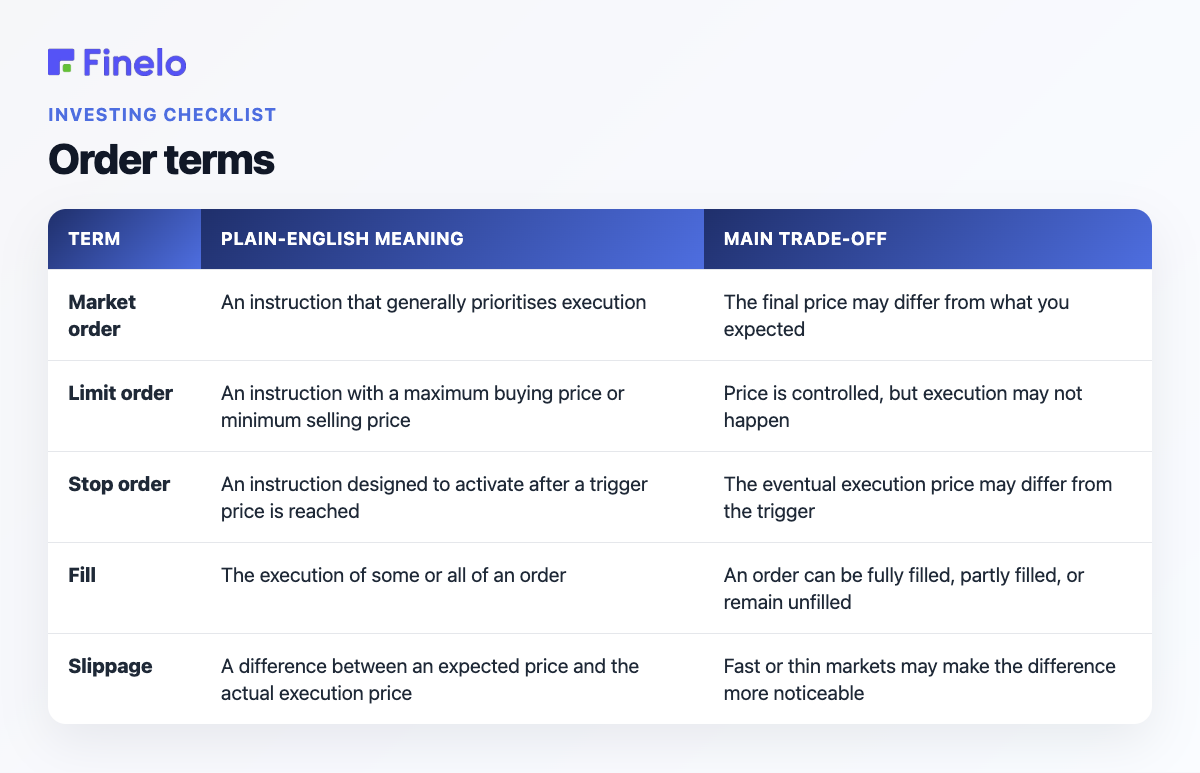
Order behaviour depends on the broker, venue, security, order instructions, and market conditions. Read the provider’s current explanation before using an unfamiliar order type.
Performance and valuation terms
| Term | Plain-English meaning | Useful question |
|---|---|---|
| Capital gain or loss | The difference between a sale price and the relevant purchase cost, before considering every fee or tax rule | Did the position rise or fall after costs? |
| Dividend | A distribution a company may make to shareholders | Can the business support it, and can the amount change? |
| Dividend yield | A dividend amount expressed relative to a share price | Is a high yield reflecting income, falling price, or business stress? |
| Earnings per share | Company earnings allocated on a per-share basis under the chosen calculation | Are earnings improving, and are unusual items involved? |
| Price-to-earnings ratio | Share price compared with earnings per share | What expectations appear built into the price? |
| Total return | The combined result from price movement and distributions | Are you measuring more than price alone? |
| Benchmark | A comparison standard, often an index or relevant alternative | Did the result justify the risk and effort? |
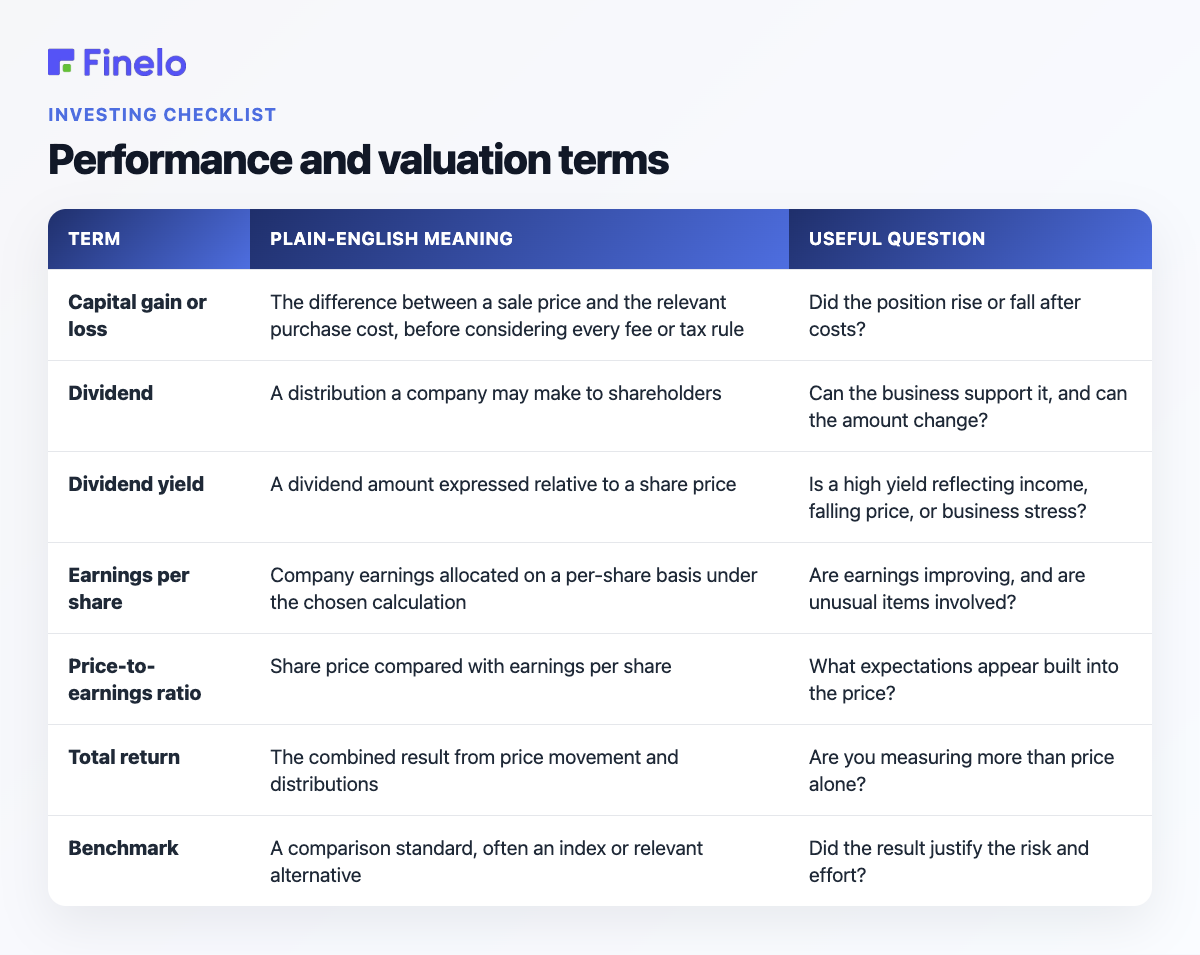
No metric works alone. A ratio may look attractive because a company is undervalued—or because its business is deteriorating.
Understanding Bull and Bear Markets
A bull market describes a sustained period of broadly rising prices or positive expectations. A bear market describes a sustained period of broadly falling prices or negative expectations.
These labels usually refer to a market, index, asset class, or sector—not necessarily every security. A technology sector can fall while another area rises. One stock can gain during a broad decline.
Related market-condition terms
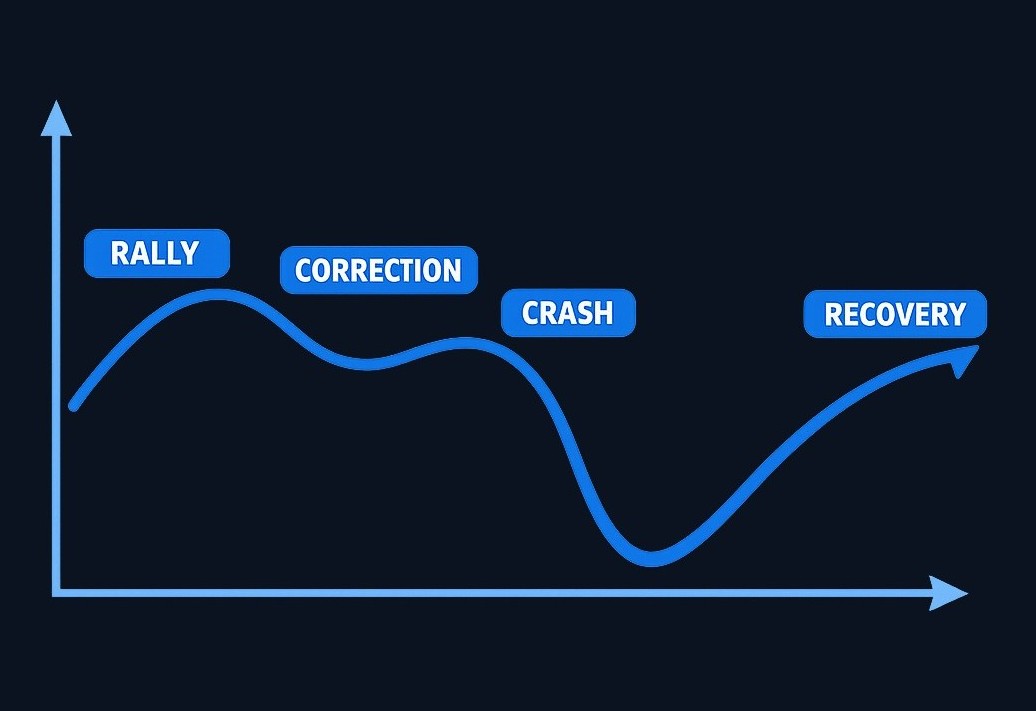
- Rally: A period of rising prices. A rally can occur inside a longer decline.
- Correction: A noticeable decline from a recent level. The word describes price movement, not whether the asset has become fairly valued.
- Crash: A sharp and disruptive fall. It is a descriptive term rather than a precise forecast.
- Recovery: A rise after a decline. Recovery does not mean every investment returns to its prior price.
- Market cycle: A pattern of expansion, enthusiasm, weakness, and recovery. Real cycles do not follow a fixed schedule.
- Sentiment: The overall mood or expectations of market participants.
- Risk-on: Informal language for greater willingness to hold riskier assets.
- Risk-off: Informal language for greater preference for perceived safety or liquidity.
The mistake is turning a label into a trading instruction. “Bull market” does not mean every purchase is sensible. “Bear market” does not mean every company is a bargain.
How psychology affects the language
Labels can change behaviour. During rising markets, words such as momentum, breakout, and fear of missing out may encourage rushed purchases. During falling markets, panic, capitulation, and safe haven may encourage decisions driven by fear.
Translate the label into questions:
- Which market or security is being described?
- Over what period?
- What evidence supports the description?
- Has the price moved more than the underlying business?
- Does this information change my original plan?
The label provides context. Your decision still needs research, risk limits, and a time horizon.
Investment Vehicles: Stocks, ETFs, Funds, and More
An investment vehicle is the structure through which you hold financial assets. Two products can give exposure to similar companies while creating different costs, diversification, trading, and tax considerations.
| Vehicle | What it generally represents | Main questions |
|---|---|---|
| Individual stock | Ownership in one company | Do you understand the business, valuation, concentration, and share class? |
| ETF | A fund designed to trade on an exchange | What does it hold, how is it weighted, and what are its expenses and trading costs? |
| Mutual fund | A pooled investment following its own dealing and pricing rules | How is it managed, when can transactions occur, and which fees apply? |
| Index fund | A fund designed to follow a selected index | Which index, weighting method, and tracking approach does it use? |
| Bond | A debt claim governed by contractual terms | Who is the issuer, when is payment due, and what could cause default or price loss? |
| Option | A contract providing defined rights under specified terms | What is the expiration, strike price, premium, and maximum possible loss? |
| Futures contract | An agreement governed by terms for a future transaction or settlement | How do leverage, margin, settlement, and price moves affect the position? |
| Cash or cash equivalent | Money or a short-term instrument intended to preserve liquidity | What institution holds it, what restrictions apply, and how does inflation affect purchasing power? |
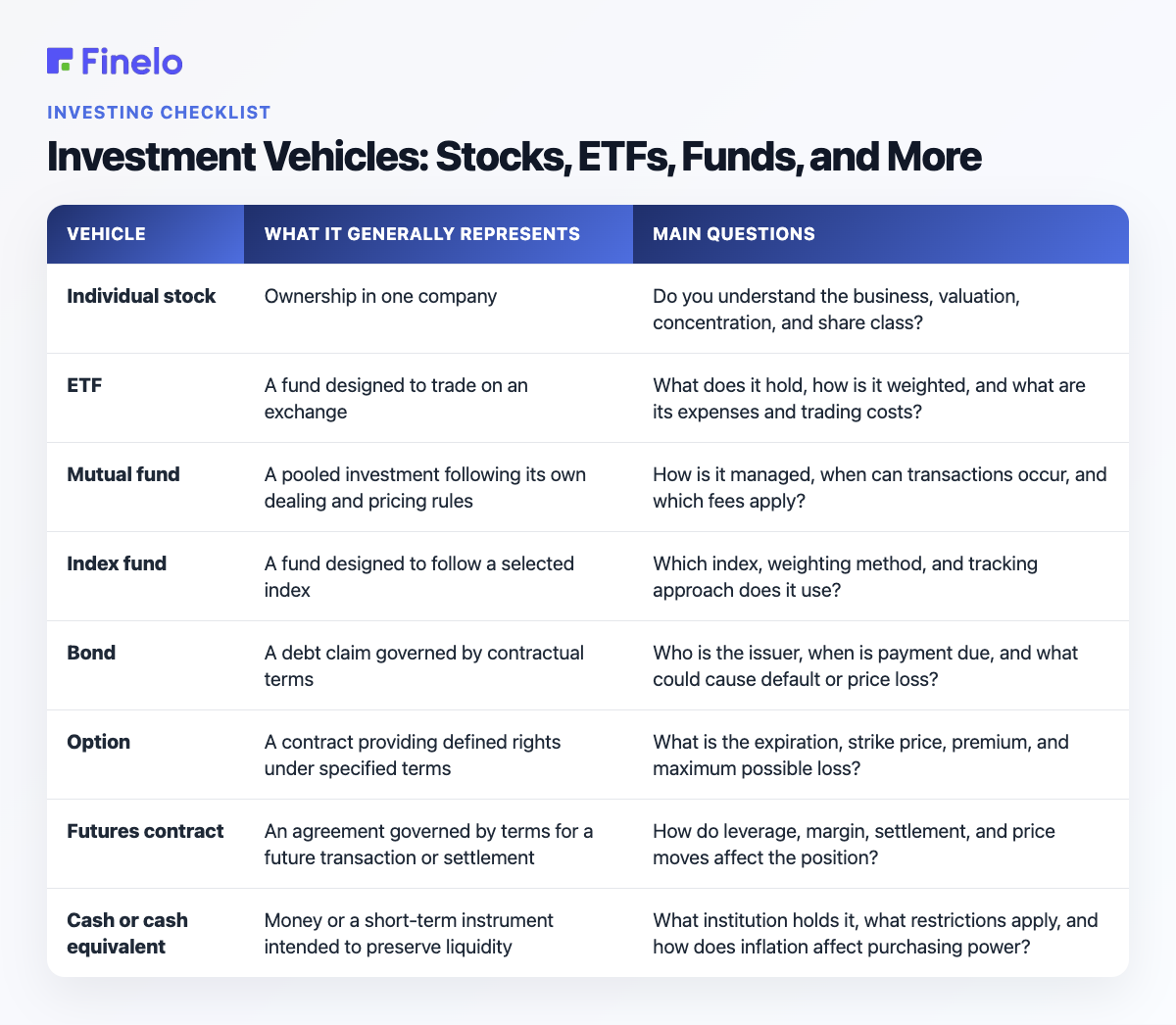
ETF, mutual fund, and index fund are not synonyms
An ETF describes a fund structure that trades on an exchange. A mutual fund uses a different transaction process. An index fund describes a strategy: following an index. An index fund may use an ETF or mutual-fund structure.
Ask two separate questions:
- What does the fund own or follow?
- How is the fund structured, traded, and priced?
This prevents a common error: comparing the label on one product with the structure of another.
Diversification, allocation, and concentration
Diversification means spreading exposure so one holding has less control over the outcome. Asset allocation is how a portfolio is divided among categories such as stocks, bonds, or cash. Concentration means a large share of the portfolio depends on one company, sector, country, currency, or theme.
Owning many securities is not automatically diversified. Several funds may hold the same large companies. Different stocks may depend on the same economic trend.
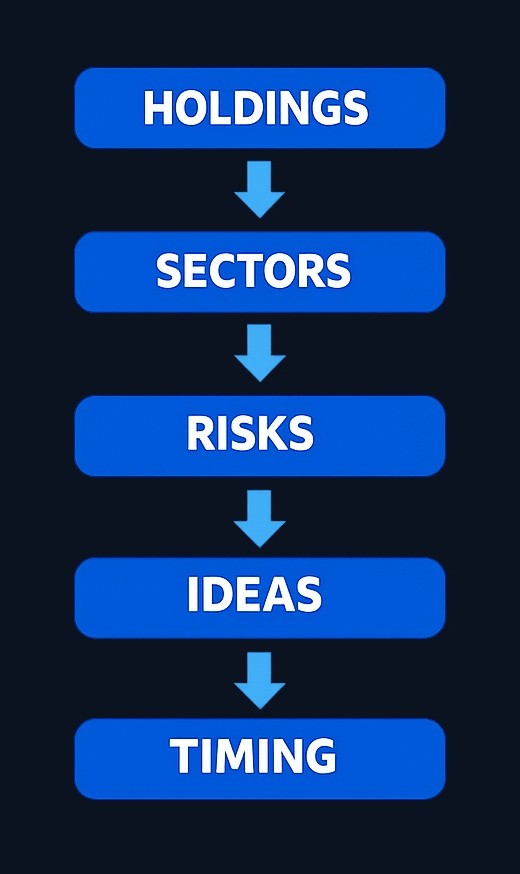
Use a look-through check:
- What are the largest underlying holdings?
- Which sectors and countries dominate?
- Which risks appear in more than one fund?
- How much of the result depends on one idea?
- Does the allocation match when the money may be needed?
Expense ratio and other costs
An expense ratio expresses a fund’s ongoing operating costs relative to assets. It is not the only cost. Depending on the product and account, investors may also encounter spreads, commissions, account fees, advice charges, currency conversion, taxes, or transfer costs.
Compare the full path from deposit to withdrawal. A product advertised with one zero-priced feature may still involve costs elsewhere.
Practice investing with Finelo
Build practical investing skills with guided lessons, simulator practice, and structured challenges.
Why the Bid–Ask Spread Matters
The bid is generally the highest displayed buying price. The ask is generally the lowest displayed selling price. The bid–ask spread is the difference between them.
Here is a hypothetical quote:
Highest displayed bid Lowest displayed ask
49.95 ← 0.05 spread → 50.00
buyer seller
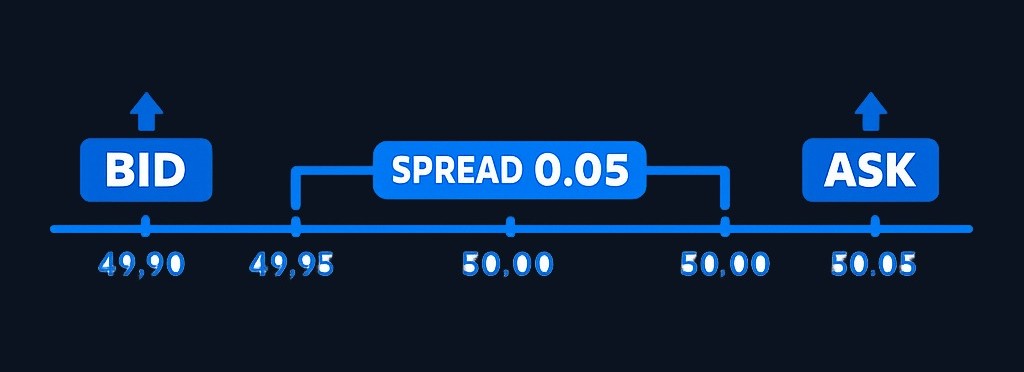
If you submit a market buy order, the order seeks available selling prices. If you submit a market sell order, it seeks available buying prices. The last traded price may sit between those quotes, match one of them, or become stale as the market changes.
Calculating the spread
Spread = ask price − bid price
For the hypothetical quote:
50.00 − 49.95 = 0.05
The percentage spread can be illustrated by dividing the spread by a chosen reference price, such as the midpoint:
Midpoint = (bid + ask) ÷ 2
Percentage spread = spread ÷ midpoint × 100
This is an analytical estimate, not a separate charge shown on a bill. Your actual execution depends on order size, available prices, speed, broker handling, and market conditions.
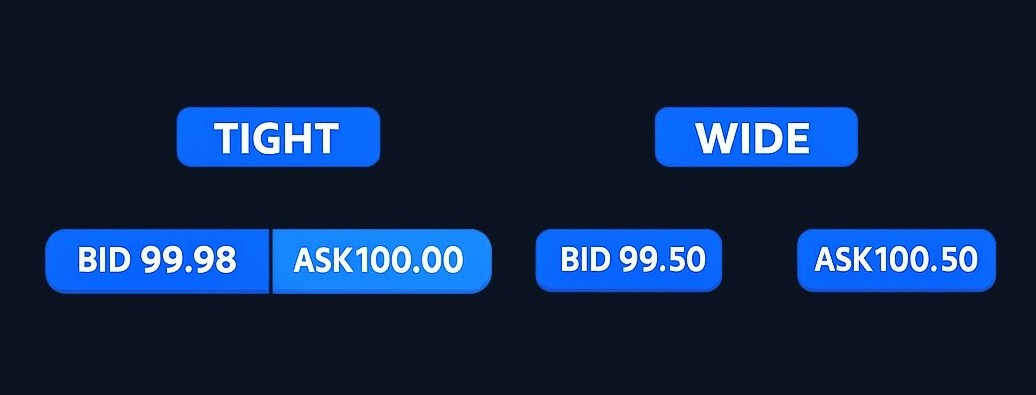
Tight and wide spreads
A tight spread means the bid and ask are relatively close. A wide spread means they are farther apart. Spreads may widen when trading activity is limited, uncertainty rises, or available orders become thin.
A wide spread creates a bigger gap between the price available to an immediate buyer and the price available to an immediate seller. This matters even when a broker lists no commission.
Before trading, check:
- The current bid and ask
- The order size available at each price
- Recent volume
- Whether the quote is live or delayed
- Whether the market is open
- Whether news or a halt affects the security
Do not use a limit order mechanically. A limit can control price, but it may leave you without an execution.
Using Stock Market Terms in Real Decisions
Vocabulary becomes useful when it changes what you check before acting.
Scenario 1: Buying an individual stock
Suppose an investor sees a company mentioned in the news.
Instead of asking only, “Will the price rise?” the investor can use the glossary:
- Share class: Which type of stock would I own?
- Market capitalisation: How much value is the market assigning to the company?
- Volume and liquidity: How actively does it trade?
- Bid and ask: What prices are currently displayed?
- Valuation: What expectations appear reflected in the price?
- Volatility: How large have price changes been?
- Concentration: How much would this position influence the portfolio?
- Time horizon: When might I need the money?
The terms turn a vague idea into a research checklist.
Scenario 2: Choosing between a stock and an ETF
An investor wants exposure to an industry but does not know which company will perform best.
An individual stock creates direct company-specific risk. An industry ETF may provide diversification, but it can still carry sector concentration. The ETF also has an expense ratio and may overlap with funds the investor already owns.
The decision is not “ETF safe, stock risky.” It is:
- Which risks are diversified?
- Which risks remain concentrated?
- What does the fund actually hold?
- What costs apply?
- Which option can I explain and monitor?
Scenario 3: Reading a dividend announcement
A company announces or changes a dividend. A beginner may focus on dividend yield, but yield can rise because the dividend increased or because the stock price fell.
Useful follow-up terms include:
- Cash flow: Is the business generating cash?
- Payout: How much is being distributed?
- Debt: Does the company have competing obligations?
- Total return: What happened to both price and distributions?
- Tax treatment: Which local rules apply to the account and payment?
A dividend is not interest from a bank account. The amount may change, and the share price can fall by more than the income received.
Scenario 4: Choosing an order type
A hypothetical stock shows a bid of 24.80 and an ask of 25.10. The spread is relatively visible.
A market order may execute quickly but offers less price control. A limit order controls the acceptable price but might remain unfilled. The investor should also check liquidity, volume, and whether the quote is current.
The correct choice depends on the goal. Urgency and price control are competing priorities.
Scenario 5: Responding to a market decline
Market news calls the market “bearish,” and an investor feels pressure to sell.
The useful terms are:
- Asset allocation: Has the portfolio moved away from its intended mix?
- Risk tolerance: Is the investor’s emotional and financial ability to handle losses different from expected?
- Time horizon: Is the money needed soon?
- Diversification: Is the decline broad, or is one concentrated position causing most of the damage?
- Rebalancing: Would restoring the planned allocation make more sense than reacting to market news?
Terminology does not remove emotion. It creates a pause between emotion and action.
A five-layer decision framework
Before buying any market product, fill in this card:
| Layer | Write down |
|---|---|
| Ownership | What legal or economic claim am I buying? |
| Vehicle | Is it a stock, ETF, mutual fund, bond, option, or another product? |
| Market | Where and when does it trade, and how liquid is it? |
| Order | Which instruction will I use, and what could happen to execution? |
| Result | Which costs, distributions, risks, and taxes affect the outcome? |
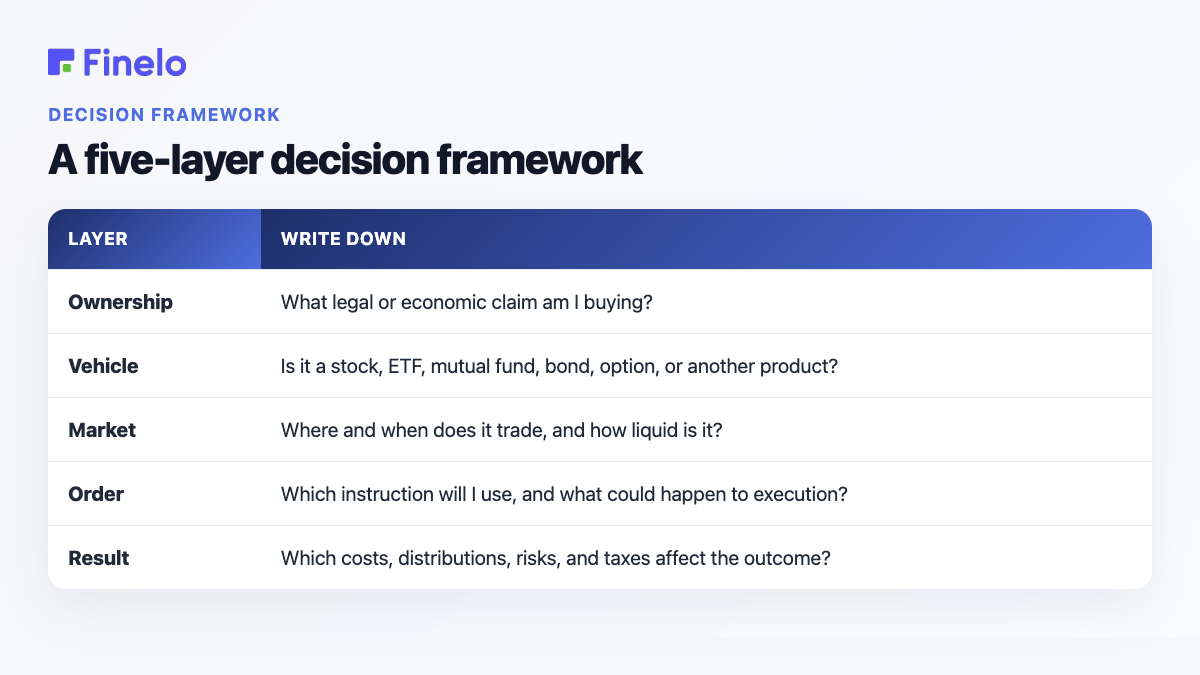
If one row is blank, keep researching.
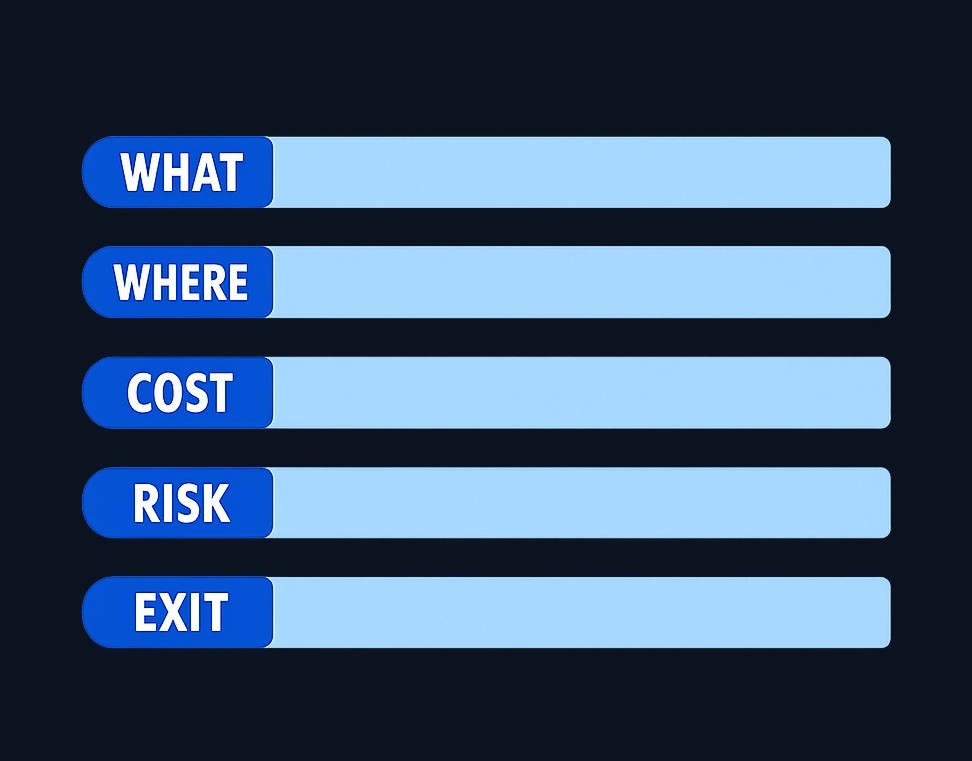
A quick self-test
You understand a term when you can:
- Define it without using more jargon.
- Point to where it appears in an account, quote, fund document, or company report.
- Explain which decision it changes.
- Name one limitation or risk.
- Use it in a hypothetical example.
Flashcards help with definitions. This test checks whether you can apply them.
Next Steps
Choose ten terms from this guide and find each one in a real quote, fund document, company report, or simulated order ticket. Explain what decision the term changes. Then complete the five-layer decision card for one hypothetical investment without using real money.
For a structured educational next step, explore the Finelo AI Investing Challenge. Its official page describes research, portfolio construction, diversification, and simulator practice with virtual funds while keeping final decisions with the user.
Investing and trading involve risk, including the possible loss of capital. Financial vocabulary can improve understanding, but it does not make market outcomes certain or replace personalised professional advice.
Frequently asked questions
What Is the Difference Between a Stock and a Share?
Stock is the general concept of ownership in a company. A share is one unit of that stock. An investor can own stock in a company by holding one or more shares.
How Do Dividends Work?
A dividend is a distribution a company may make to eligible shareholders. The amount and timing can change. Evaluate the company’s finances, the effect on total return, and the tax rules that apply to your account rather than judging the investment by yield alone.
What Is the Difference Between Common and Preferred Stock?
Common and preferred stock are share classes with different rights. Common shares may include voting rights. Preferred shares may have priority for specified distributions or liquidation proceeds. Exact terms vary by company and security.
Are Volatility and Risk the Same?
No. Volatility describes price movement. Risk is broader and can include permanent loss, business failure, poor liquidity, concentration, unsuitable timing, leverage, fraud, or custody problems. A stable price does not prove an investment is low risk.
InvestingBeginnerMarket BasicsGlossaryMarkets
Practice investing with Finelo
Build practical investing skills with guided lessons, simulator practice, and structured challenges.
About the author
Finelo Team
The Finelo Team creates practical investing and trading education designed to help beginners learn faster with structured challenges, simulator practice, and bite-sized lessons.
Keep reading — Related articles

Investing
Yield to Call vs Yield to Maturity: Assumptions and Bond Risks
Yield to call (YTC) estimates a bond's yield if the issuer redeems it on an eligible call date; yield to maturity (YTM) estimates yield if it remains outstanding to final maturity.
Finelo Team

Investing
Will My Employer Know If I Take a 401(k) Loan?
Who this page is for: readers new to 401(k) loans who want a practical, privacy‑focused explanation — what your employer can see, how to limit visibility, and the financial tradeoffs to weigh.
Finelo Team

Investing
What Medical Expenses Qualify for a 401(k) Hardship Withdrawal?
Before you decide, confirm three things with your plan administrator:
Finelo Team