An IRA is an investment account you fund with stocks, bonds, mutual funds, and other assets to build retirement savings. An annuity is an insurance product: you pay a premium, and the insurer guarantees periodic payments starting at a set time, for a set period or for life. An IRA offers growth potential with market risk. An annuity offers a guarantee with less growth potential.
Annuity vs IRA: Understanding Your Retirement Options
An IRA is an investment account you fund with stocks, bonds, mutual funds, and other assets to build retirement savings. An annuity is an insurance product: you pay a premium, and the insurer guarantees periodic…
6 min read
Practice trading with Finelo
Practice in a simulator, learn with bite-sized lessons, and build confidence before risking real money.
Want to learn more?
Practice in a simulator, learn with bite-sized lessons, and build confidence before risking real money.
Explore FineloExplore Finelo's 28-day challenges
Turn learning into a daily habit with guided challenge paths.
This comparison is for anyone deciding where retirement dollars should go. It's also for anyone wondering if they need both. Read the two definitions below. Check the differences and tax rules. Then use the decision table to find your next step.
What is an Annuity?
An annuity is an insurance contract. You pay a premium — all at once or over time. In exchange, the insurer invests that money and sends you fixed payments on a schedule set in the contract: monthly, quarterly, or yearly. Payments can last a set number of years or the rest of your life.

Quick facts about annuities:
- The insurer takes on the investment risk, not you.
- An immediate annuity can be funded with a lump sum, often from a 401(k) or IRA, with payments starting right away.
- A 10% penalty typically applies to withdrawals before age 59½.
- Annuities have no contribution limit, unlike an IRA.
The tradeoff for the guarantee is growth. You give up most of the upside a market-based account could offer, in exchange for a payment you can count on.
What is an IRA?
An IRA — individual retirement account — lets you buy stocks, bonds, mutual funds, and other assets to build retirement savings yourself, rather than handing the money to an insurer. The 2026 annual contribution limit is $7,500, or $8,600 if you're 50 or older.
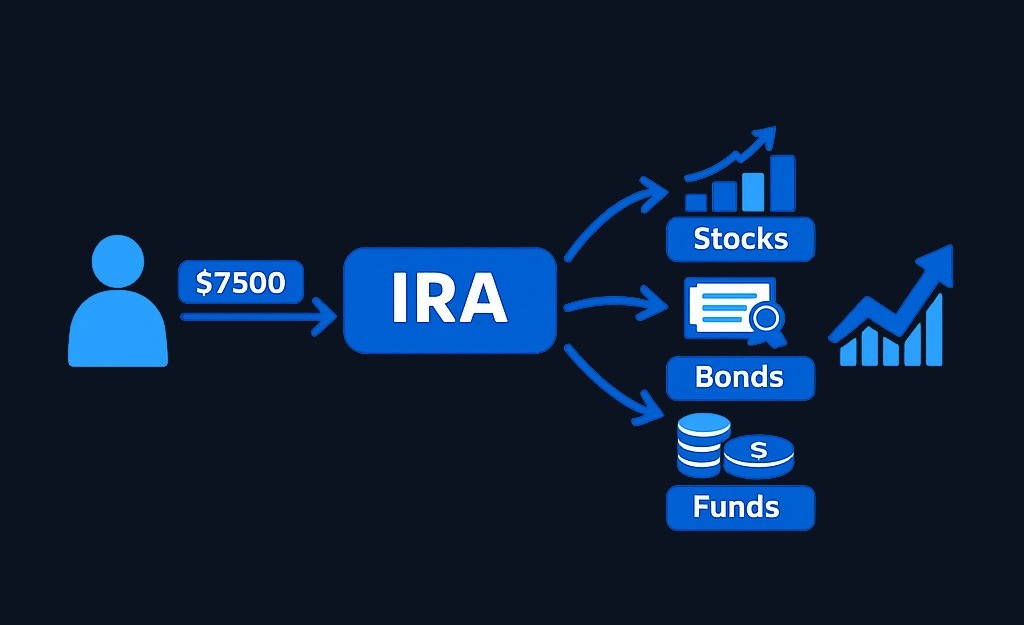
Quick facts about IRAs:
- Traditional IRA contributions are pre-tax, and withdrawals are taxed at your current rate.
- Roth IRA contributions are after-tax, and qualified withdrawals are tax-free.
- Both types share the same 10% early-withdrawal penalty before age 59½.
- Roth IRAs allow more flexible access to your own contributions than Traditional IRAs do.
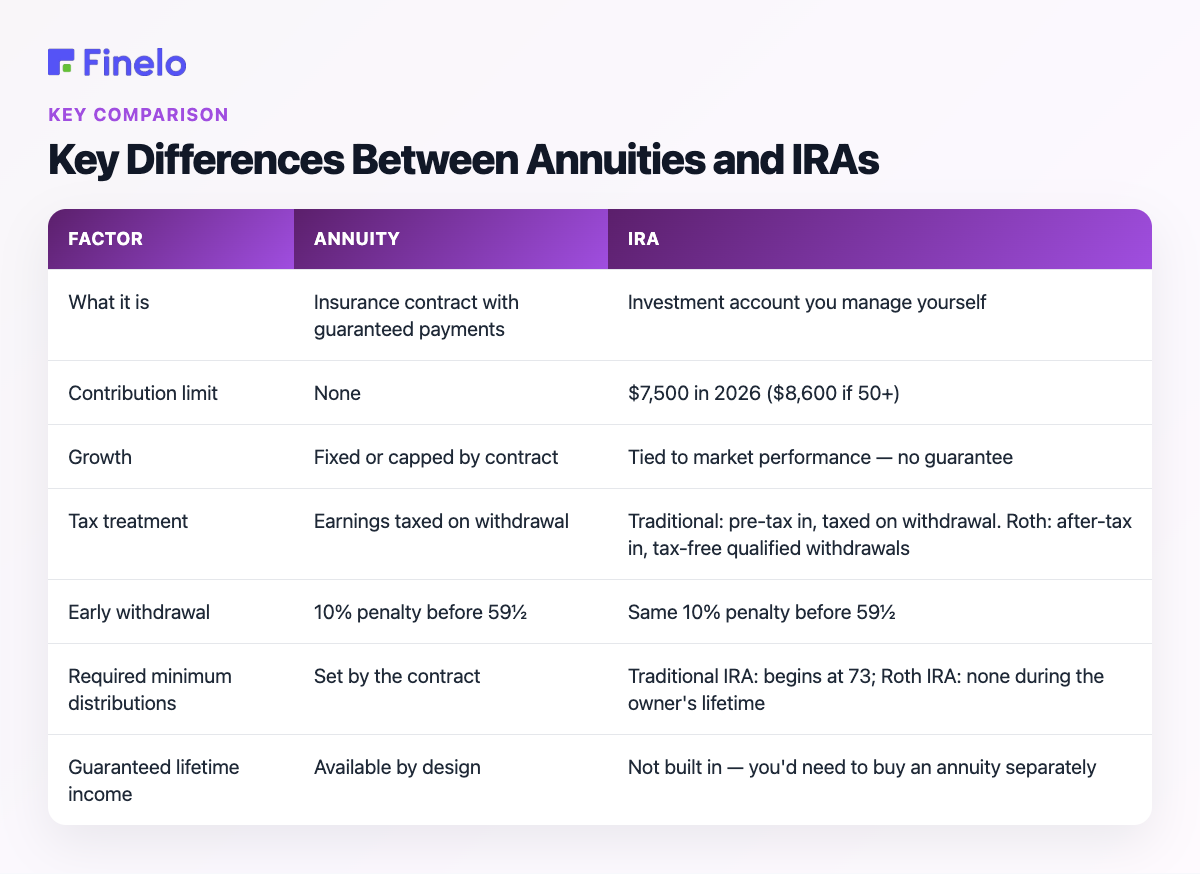
Key Differences Between Annuities and IRAs
| Factor | Annuity | IRA |
|---|---|---|
| What it is | Insurance contract with guaranteed payments | Investment account you manage yourself |
| Contribution limit | None | $7,500 in 2026 ($8,600 if 50+) |
| Growth | Fixed or capped by contract | Tied to market performance — no guarantee |
| Tax treatment | Earnings taxed on withdrawal | Traditional: pre-tax in, taxed on withdrawal. Roth: after-tax in, tax-free qualified withdrawals |
| Early withdrawal | 10% penalty before 59½ | Same 10% penalty before 59½ |
| Required minimum distributions | Set by the contract | Traditional IRA: begins at 73; Roth IRA: none during the owner's lifetime |
| Guaranteed lifetime income | Available by design | Not built in — you'd need to buy an annuity separately |
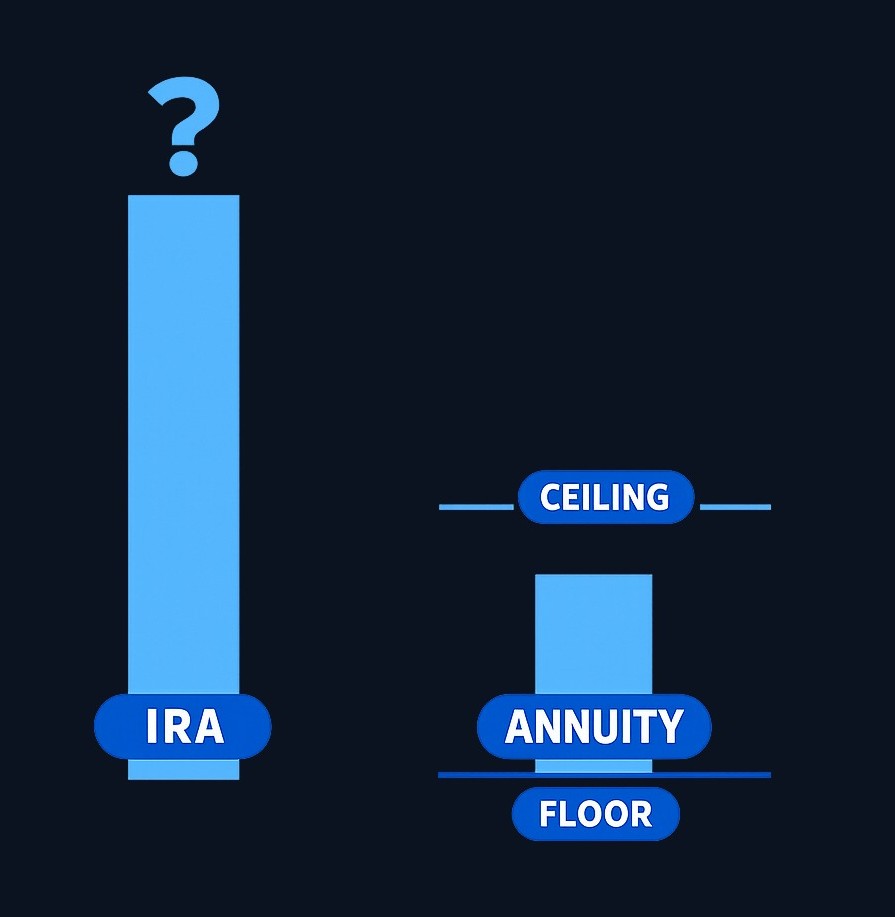
The core tradeoff is simple. An IRA has no ceiling on growth, but no floor either. An annuity gives up growth potential for a guarantee. It also has no contribution cap, which matters once you've maxed out an IRA.
When to Choose an Annuity
Choose an annuity if any of these describe you:
- You're close to retirement and want a payment you can't outlive.
- You've already maxed out your IRA contributions and want another tax-advantaged place for savings, since annuities carry no contribution limit.
- You want income starting right away rather than years from now. An immediate annuity can be funded with a lump sum from an existing 401(k) or IRA, with payments starting immediately.
- Guaranteed income matters more to you than maximizing growth.
It's a weaker fit if you're decades from retirement and can tolerate market swings. Locking into a guarantee this early trades away most of your growth potential.
Practice trading with Finelo
Practice in a simulator, learn with bite-sized lessons, and build confidence before risking real money.
When to Choose an IRA
Choose an IRA if any of these describe you:
- You have a long time horizon and want your money working in the market.
- You want control over specific investments, not a fixed insurer contract.
- You want the flexibility to change your strategy as your goals shift.
Choosing between Traditional and Roth comes down to taxes. Pick Traditional if you want the deduction now and expect a lower tax rate later. Pick Roth if you'd rather pay tax now and withdraw tax-free later.
It's a weaker fit if guaranteed income is your priority. An IRA's balance depends entirely on market performance, with no built-in floor the way an annuity has.
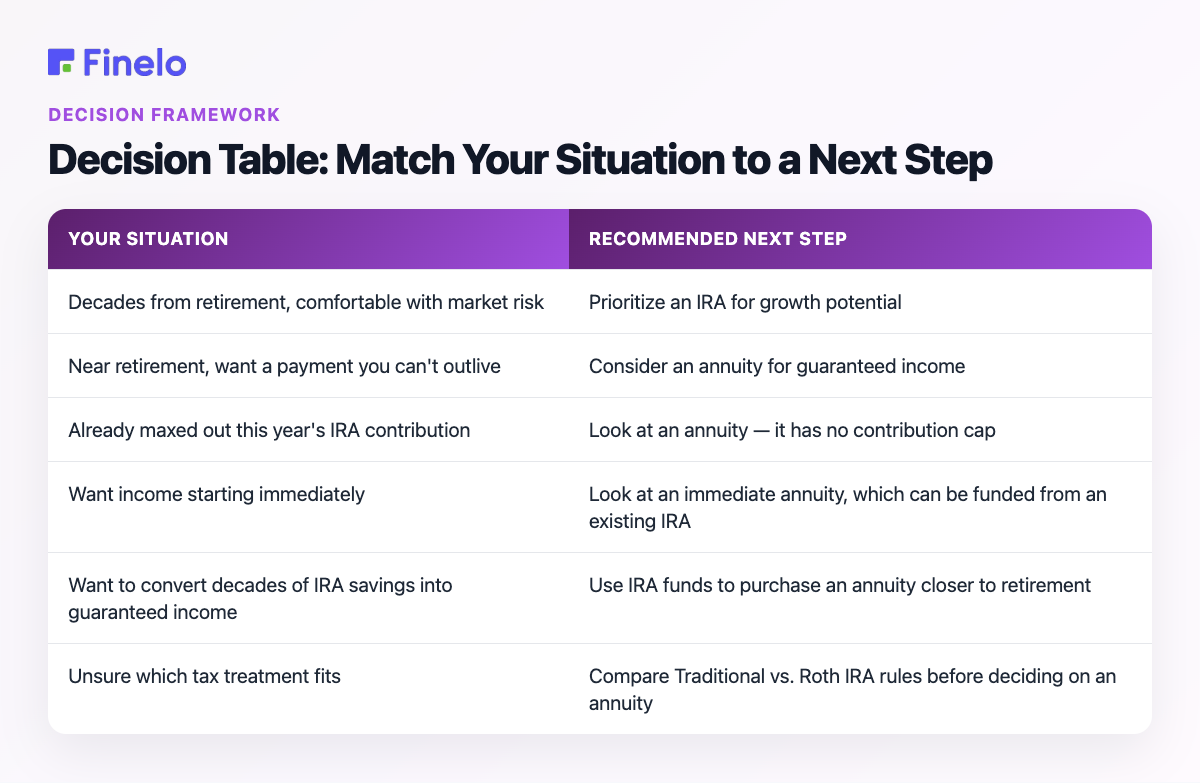
Decision Table: Match Your Situation to a Next Step
| Your situation | Recommended next step |
|---|---|
| Decades from retirement, comfortable with market risk | Prioritize an IRA for growth potential |
| Near retirement, want a payment you can't outlive | Consider an annuity for guaranteed income |
| Already maxed out this year's IRA contribution | Look at an annuity — it has no contribution cap |
| Want income starting immediately | Look at an immediate annuity, which can be funded from an existing IRA |
| Want to convert decades of IRA savings into guaranteed income | Use IRA funds to purchase an annuity closer to retirement |
| Unsure which tax treatment fits | Compare Traditional vs. Roth IRA rules before deciding on an annuity |
Can You Have Both an Annuity and an IRA?
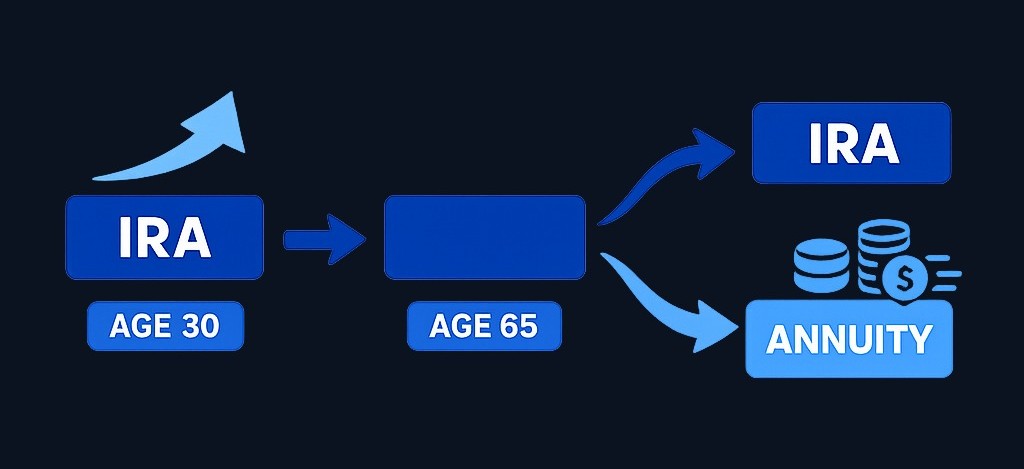
Yes, and it's a common combination. Using IRA funds to purchase an annuity is a fairly common practice among retirees. A typical pattern: grow savings in an IRA for decades. Then use some or all of that balance to fund an annuity closer to retirement. That trades future growth potential for predictable, guaranteed payments.
Conclusion
Neither account wins outright. An IRA offers growth potential and flexibility, with market risk and no guaranteed income built in. An annuity offers guaranteed payments and no contribution cap, at the cost of lower growth potential. Many retirees use both: an IRA for decades of growth, then an annuity to convert some of that balance into guaranteed income later.
This article is educational, not personalized financial advice. Contribution limits, tax rules, and contract terms change and vary by provider. Verify current details with a qualified professional before deciding. If you want to build a broader understanding of retirement and investing options first, Finelo's Wealth Growth Quiz matches you with a learning path suited to your level.
Frequently asked questions
What happens to my annuity if I die?
Payout terms after death depend on your specific contract. Some annuities continue payments to a beneficiary or return remaining value. Others stop payments entirely. Review your contract's death benefit terms directly with the issuer — this varies significantly between products.
Can I convert my IRA into an annuity?
Yes. Using tax-qualified IRA funds to purchase an annuity is a fairly common [practice](https://www.newyorklife.com/articles/annuity-vs-ira), typically done to convert savings into guaranteed retirement income.
Are there penalties for early withdrawal from an IRA or annuity?
Yes. Both typically carry a 10% penalty for withdrawals before age [59½](https://www.nerdwallet.com/retirement/learn/annuity-vs-ira-which-is-best), on top of any income tax owed, unless an exception applies.
Financial LiteracyBeginnerRetirementPersonal Finance
Practice trading with Finelo
Practice in a simulator, learn with bite-sized lessons, and build confidence before risking real money.
About the author
Finelo Team
The Finelo Team creates practical investing and trading education designed to help beginners learn faster with structured challenges, simulator practice, and bite-sized lessons.
Keep reading — Related articles

Financial Literacy
Mercury Books Review 2026: Is It Worth It for Startups?
Mercury Books brings double-entry accounting into Mercury. Review its $35 pricing, reports, AI features, integrations, and migration limits.
Finelo Team

Financial Literacy
Why is My FICO Score Lower Than My Credit Score?
Example takeaway: seeing a higher score in a bank app doesn’t guarantee lenders will see the same FICO number at application time; lenders often pull a specific FICO version from a specific bureau.
Finelo Team

Financial Literacy
Why Is My FICO Score Higher Than My Credit Score?
Brief educational note: this article is educational, not financial or investment advice; investing and credit decisions involve risk and possible loss.
Finelo Team


