A balance sheet shows what a business owns, what it owes, and the owners’ remaining interest at a specific date. In accounting terms, those categories are assets, liabilities, and equity. The statement must satisfy one rule: assets = liabilities + equity. This balance sheet example shows how the rule works and how to use the figures without getting lost in accounting jargon. A balance sheet offers a snapshot, not a full history, of financial health (Australian Government business guide).
Balance Sheet Example: Understanding Financial Statements
A balance sheet shows what a business owns, what it owes, and the owners’ remaining interest at a specific date. In accounting terms, those categories are assets, liabilities, and equity. The statement must satisfy one…
6 min read
Practice investing with Finelo
Build practical investing skills with guided lessons, simulator practice, and structured challenges.
Want to learn more?
Build practical investing skills with guided lessons, simulator practice, and structured challenges.
Explore FineloExplore Finelo's 28-day challenges
Turn learning into a daily habit with guided challenge paths.
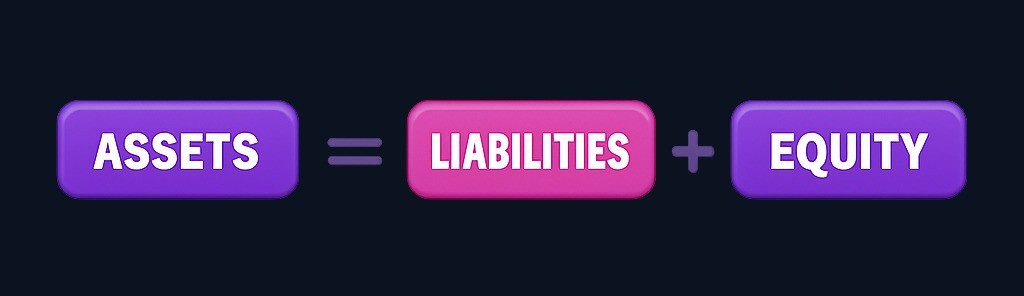
Balance Sheet Example at a Glance
Imagine a small retailer preparing its balance sheet on December 31. These figures are illustrative, not a benchmark for other businesses.
| Assets | Amount | Liabilities and equity | Amount |
|---|---|---|---|
| Cash | $18,000 | Accounts payable | $14,000 |
| Accounts receivable | $12,000 | Short-term loan | $6,000 |
| Inventory | $20,000 | Total current liabilities | $20,000 |
| Prepaid expenses | $2,000 | Long-term loan | $30,000 |
| Total current assets | $52,000 | Total liabilities | $50,000 |
| Equipment, net | $48,000 | Owner’s equity | $50,000 |
| Total assets | $100,000 | Total liabilities and equity | $100,000 |
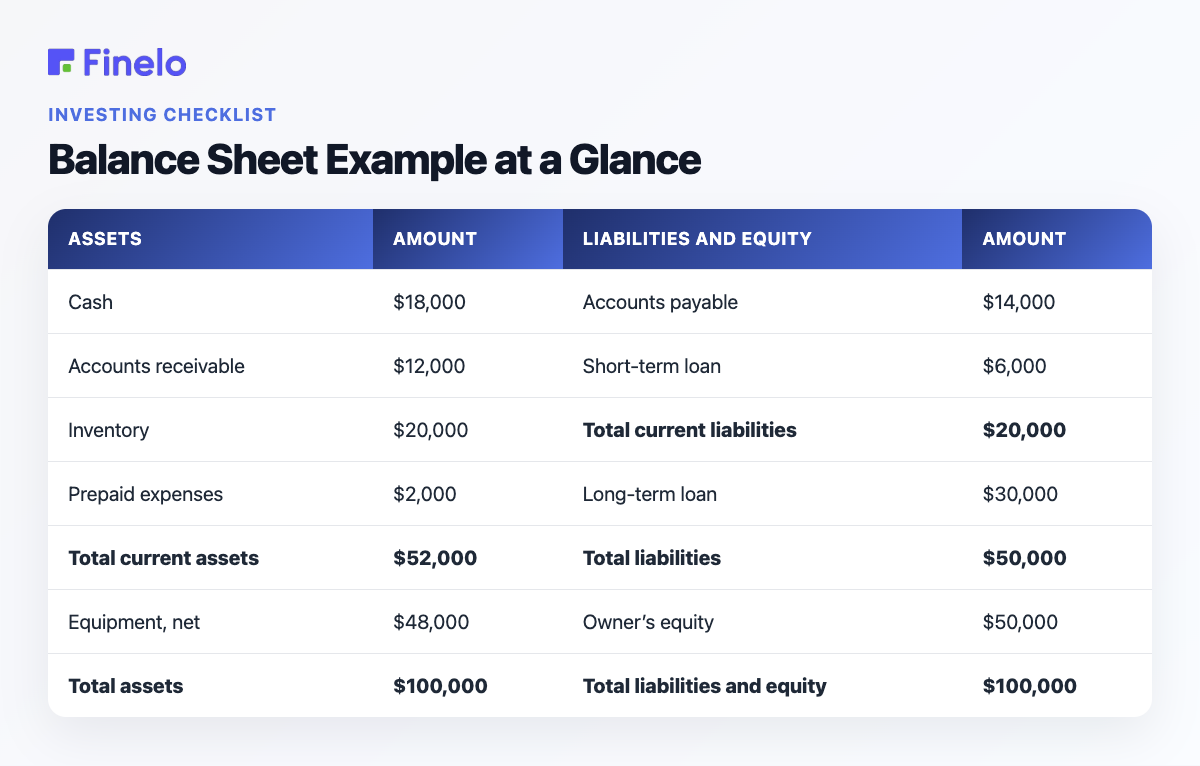
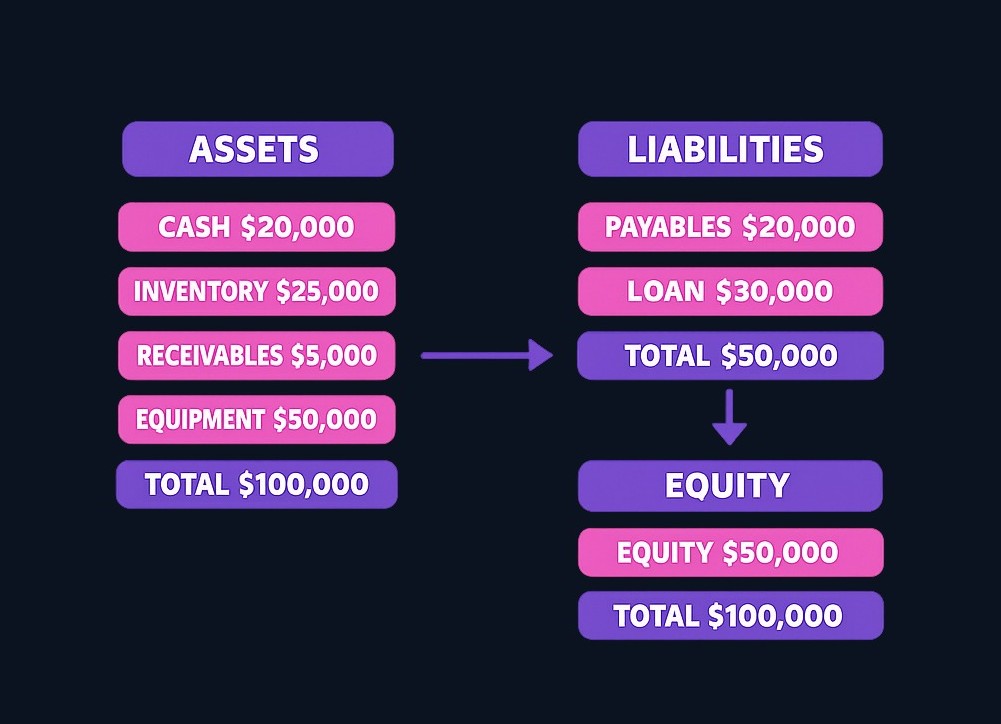
Both sides equal $100,000, so the statement balances. That does not prove every number is correct. It only shows that the accounting equation works. You still need to check account balances, dates, classifications, and supporting records.
The Three Components of a Balance Sheet
Assets
Assets are resources the business owns or controls. Current assets should convert to cash, be sold, or be used within a year. Common examples include cash, inventory, accounts receivable, and prepaid expenses. Fixed or non-current assets support the business for longer, such as property, vehicles, and equipment (Australian Government business guide).
“Accounts receivable” means money customers owe the business. “Prepaid expenses” are costs paid in advance, such as insurance. “Net equipment” means the original cost less accumulated depreciation, which records how an asset’s value is allocated over its useful life.
Liabilities
Liabilities are amounts the business owes. Current liabilities normally fall due within a year. They can include supplier bills, accrued wages, tax obligations, and short-term debt. Long-term liabilities fall due later, such as the portion of a multi-year loan payable after the next 12 months (Australian Government business guide).
Equity
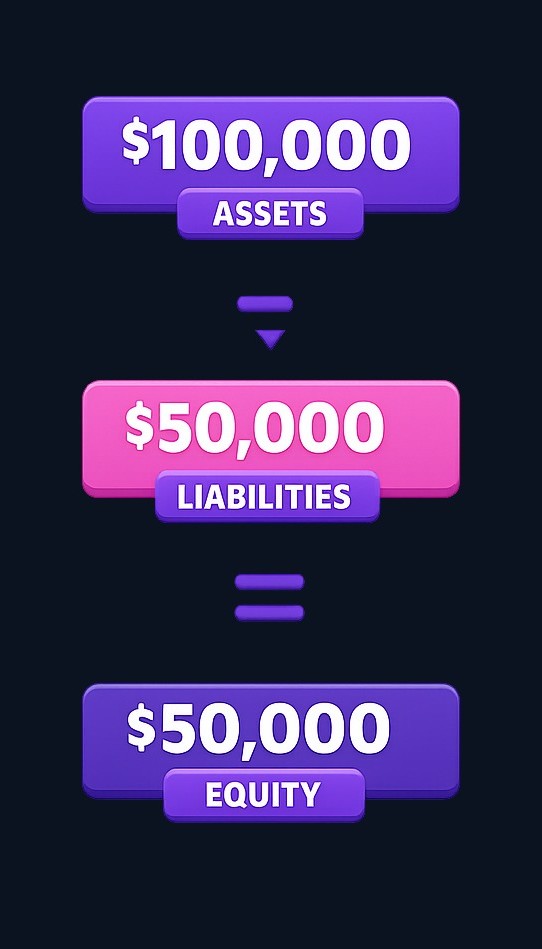
Equity is the amount left after subtracting liabilities from assets. It can include money owners invested and profits kept in the business. In the example:
$100,000 assets − $50,000 liabilities = $50,000 equity
The government guide calls this difference “net assets” (Australian Government business guide). Depending on the organization, you may also see terms such as shareholders’ equity, owner’s capital, retained earnings, or net assets.
How to Create a Balance Sheet
Start with one reporting date. A balance sheet mixes badly with figures from different dates because each number should describe the same financial moment.
- Gather account balances. Use bank statements, customer and supplier ledgers, loan statements, inventory records, and the fixed-asset register.
- List current assets. Include cash and items expected to turn into cash or be used within a year.
- List non-current assets. Record longer-term resources, usually at their accounting carrying amounts.
- List current liabilities. Include obligations due within the next year.
- List long-term liabilities. Include amounts due after one year.
- Calculate equity. Subtract total liabilities from total assets.
- Check the equation. Total assets must equal total liabilities plus equity.
- Review the details. Investigate missing accounts, duplicate entries, old receivables, incorrect loan splits, and unsupported estimates.
Copy this simple balance sheet template:
| Category | Amount |
|---|---|
| Cash | |
| Accounts receivable | |
| Inventory | |
| Other current assets | |
| Total current assets | |
| Property and equipment, net | |
| Other non-current assets | |
| Total assets | |
| Accounts payable | |
| Short-term debt | |
| Other current liabilities | |
| Total current liabilities | |
| Long-term debt | |
| Other non-current liabilities | |
| Total liabilities | |
| Owner’s or shareholders’ equity | |
| Total liabilities and equity |
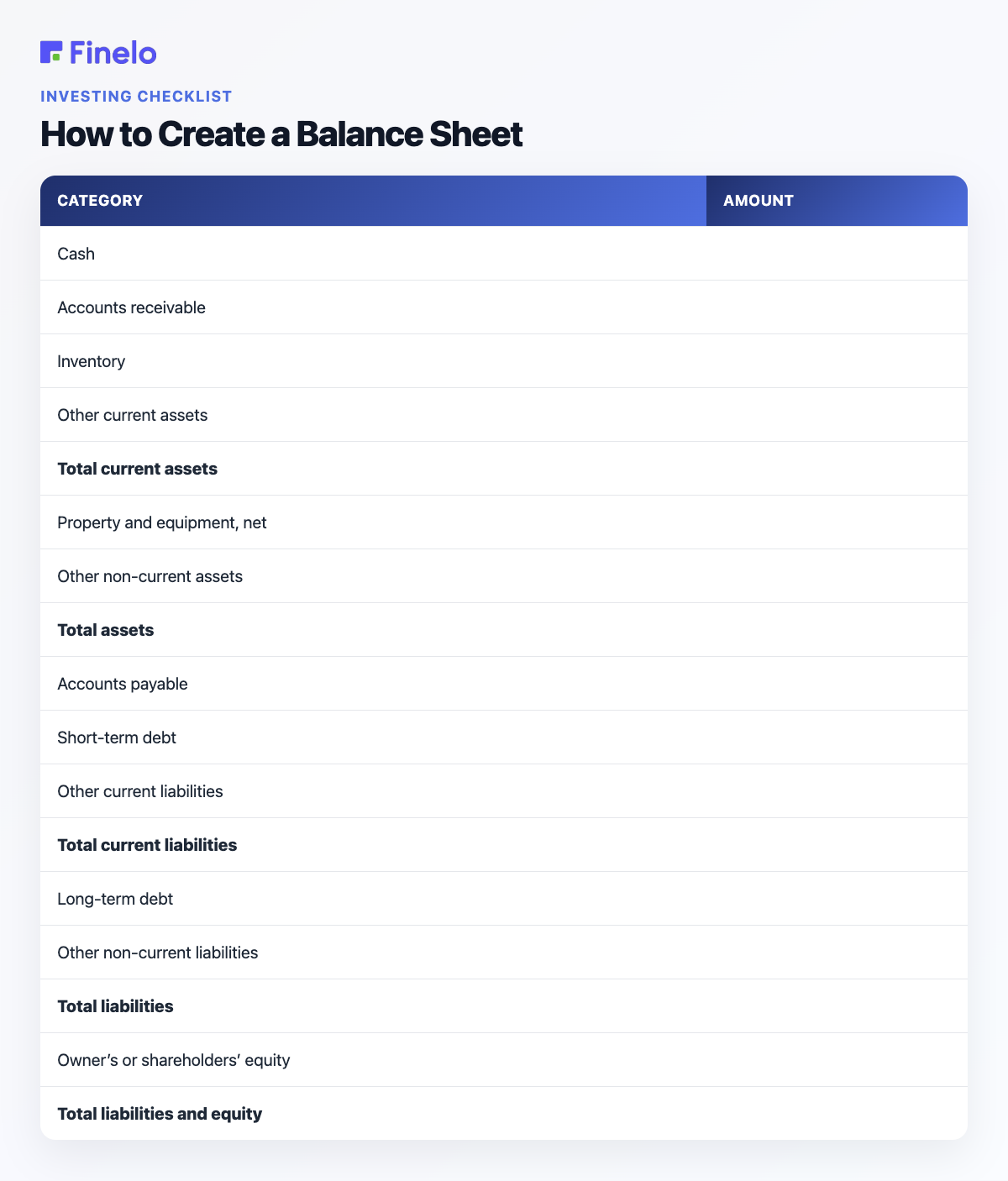
For a spreadsheet version, use the downloadable balance sheet template on the Australian Government’s business site. If you use estimates, label them clearly so readers do not mistake them for confirmed amounts.
Practice investing with Finelo
Build practical investing skills with guided lessons, simulator practice, and structured challenges.
How to Analyze a Balance Sheet
Do not stop when both sides match. Use the statement to ask better questions.
Working capital
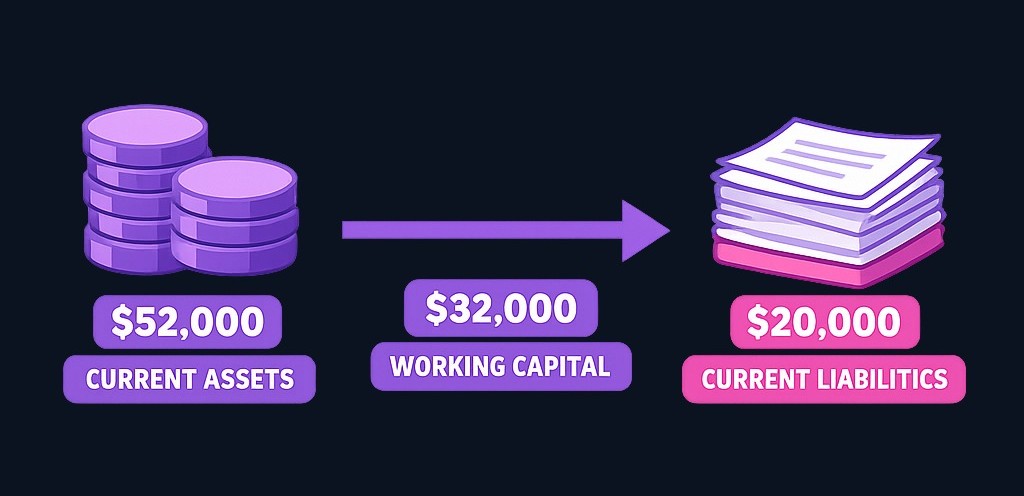
Working capital compares short-term resources with short-term obligations:
Current assets − current liabilities
For the example, working capital is $52,000 − $20,000 = $32,000. The positive result means current assets exceed current liabilities by $32,000 on that date. It does not guarantee that cash will arrive before bills fall due.
Current ratio
The current ratio expresses the same categories as a ratio:
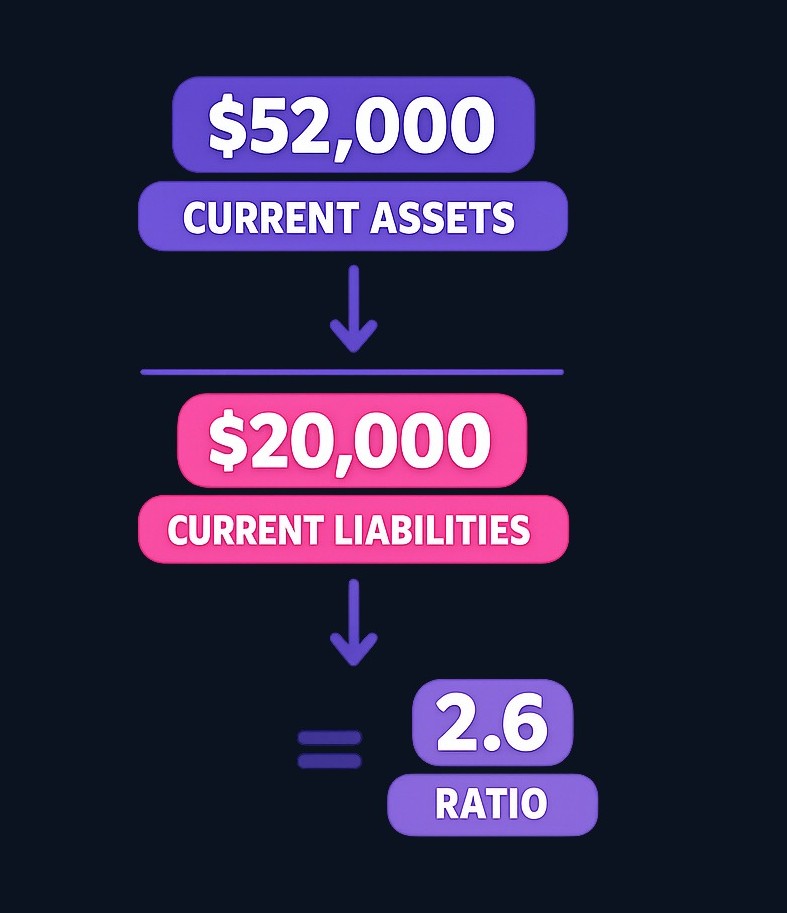
Current assets ÷ current liabilities
The example produces $52,000 ÷ $20,000 = 2.6. In plain English, the retailer reports $2.60 of current assets for every $1 of current liabilities. Inventory quality, slow-paying customers, and payment timing can still affect liquidity—the ability to meet near-term bills.
Debt-to-equity ratio
This calculation compares creditors’ claims with the owners’ interest:
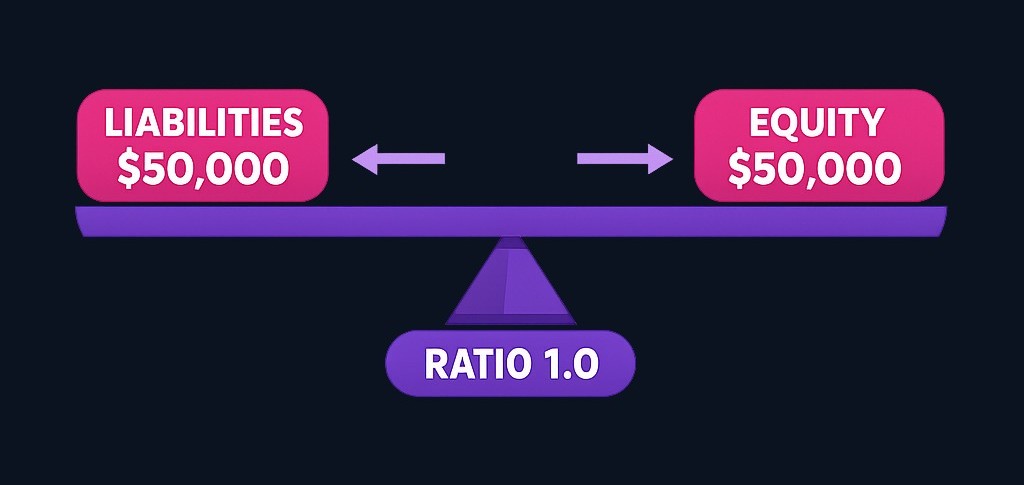
Total liabilities ÷ total equity
The example produces $50,000 ÷ $50,000 = 1.0. That means reported liabilities equal reported equity. Treat this as a comparison tool, not a pass-or-fail score.
Read ratios across several reporting dates. Then compare them with the company’s budget, business model, and seasonal cycle. One isolated number can hide a temporary cash buildup, a large purchase, or a payment due just after the reporting date.
Common Mistakes and When to Update
Watch for these errors:
- Using the wrong date. A December 31 balance sheet should not include a January transaction.
- Omitting liabilities. Unpaid bills, accrued payroll, interest, and taxes can be easy to miss.
- Recording assets at unsupported values. Keep invoices, valuation support, and depreciation records.
- Leaving old receivables or inventory unreviewed. A listed asset may not produce the cash its face value suggests.
- Putting an entire loan in one category. Separate the amount due within a year from the later balance.
- Forcing the statement to balance. A balancing entry can conceal the original error.
- Treating estimates as confirmed figures. Label assumptions and replace them when reliable records arrive.
Update the balance sheet on a consistent schedule and after major events, such as a new loan, asset purchase, owner contribution, or year-end adjustment. If you revise a figure, record what changed, why it changed, who approved it, and which documents support it. This creates a clear review trail.
Inaccurate figures can distort liquidity and leverage ratios. They can also lead owners, lenders, or investors to judge the business from the wrong starting point. Reconcile important balances to independent records before making a high-impact decision.
How Balance Sheets Differ by Business Type
The accounting equation stays the same, but the mix of accounts changes.
| Business type | Accounts likely to deserve attention | Useful question |
|---|---|---|
| Retailer | Inventory, supplier payables, cash | Is inventory selling fast enough to cover upcoming bills? |
| Service company | Receivables, cash, accrued payroll | Are customers paying before payroll and other costs fall due? |
| Asset-heavy company | Equipment, property, long-term debt | Are long-lived assets producing enough value to support their financing? |
| Subscription business | Cash, receivables, deferred revenue | How much collected cash relates to service still owed to customers? |
| Nonprofit | Restricted funds, grants receivable, net assets | Are funds available for general use or tied to a specific purpose? |
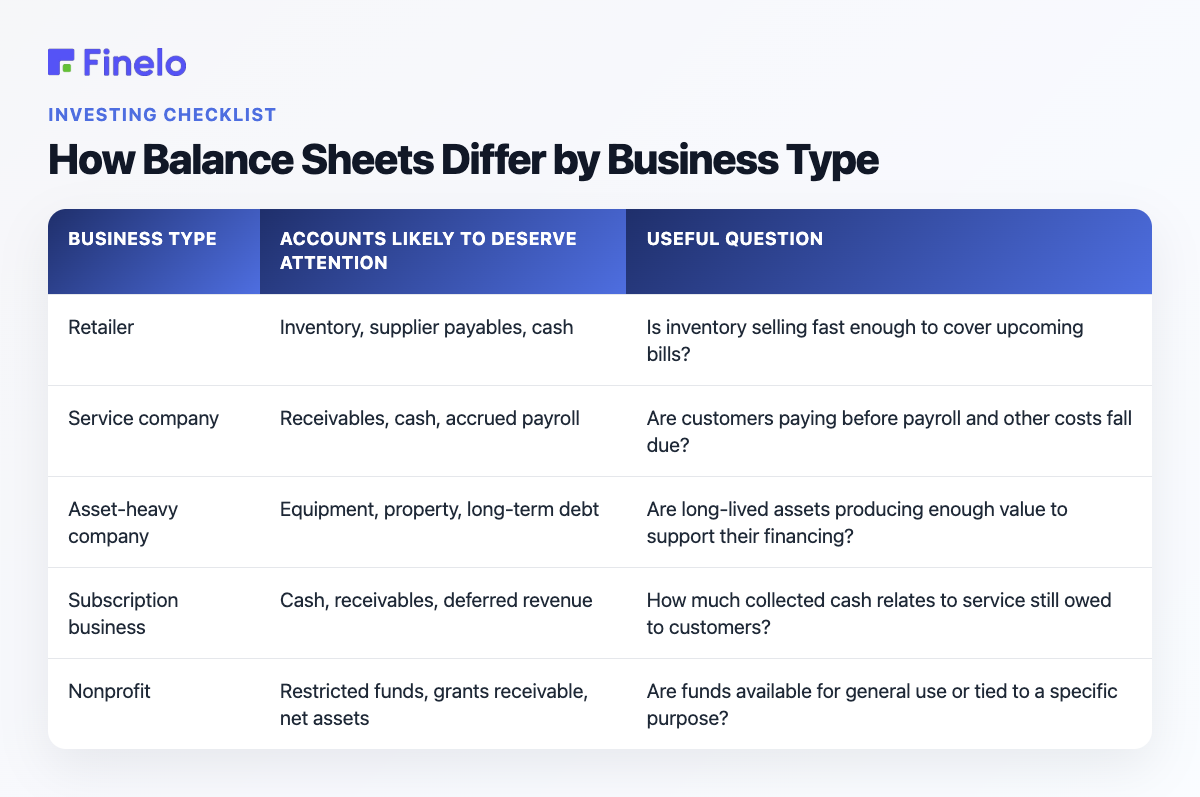
These patterns are prompts, not universal rules. Use the accounts that reflect how the organization earns, spends, borrows, and invests.
Next Steps
Build your first draft from the template, confirm that both sides match, and then test the numbers against bank, customer, supplier, inventory, and loan records. Calculate working capital and the two ratios above. Compare the results with earlier periods and investigate the largest changes.
Finelo’s practical approach is simple: define each term, show the calculation, and connect the result to a decision. Use the balance sheet as one part of the picture. Review it alongside the income statement, cash flow statement, and the underlying records before you invest, borrow, or change how a business operates.
Frequently asked questions
What is a simple balance sheet example?
A simple balance sheet lists assets on one side and liabilities plus equity on the other. If assets are $100,000 and liabilities are $50,000, equity must be $50,000 for the statement to balance.
What is the balance sheet formula?
The formula is **assets = liabilities + equity**. You can rearrange it as **equity = assets − liabilities**.
Is cash on a balance sheet?
Yes. Cash appears under current assets in the supplied government balance sheet guidance (Australian Government business [guide](https://business.gov.au/finance/financial-tools-and-templates/set-up-a-balance-sheet)).
How often should a small business prepare a balance sheet?
Choose a schedule that supports timely decisions and apply it consistently. Monthly statements can help an active business monitor cash, debt, and working capital. A quieter business may review quarterly, while still preparing formal year-end accounts as required.
InvestingBeginnerFinancial StatementsMarkets
Practice investing with Finelo
Build practical investing skills with guided lessons, simulator practice, and structured challenges.
About the author
Finelo Team
The Finelo Team creates practical investing and trading education designed to help beginners learn faster with structured challenges, simulator practice, and bite-sized lessons.
Keep reading — Related articles

Investing
Yield to Call vs Yield to Maturity: Assumptions and Bond Risks
Yield to call (YTC) estimates a bond's yield if the issuer redeems it on an eligible call date; yield to maturity (YTM) estimates yield if it remains outstanding to final maturity.
Finelo Team
Investing
Will My Employer Know If I Take a 401(k) Loan?
Who this page is for: readers new to 401(k) loans who want a practical, privacy‑focused explanation — what your employer can see, how to limit visibility, and the financial tradeoffs to weigh.
Finelo Team

Investing
What Medical Expenses Qualify for a 401(k) Hardship Withdrawal?
Before you decide, confirm three things with your plan administrator:
Finelo Team